Spotty outlook There seems little doubt that we are now in the early months of Sunspot Cycle 22, the transition from Cycle 21 having occurred in the summer of 1986. There are already signs of a significant rise in the maximum usable frequencies on h.f. with a tearing up of the ionospheric predictions that forecast the continuation of Cycle 21 into 1987 or even 1988.
This promise of higher frequencies being usable over longer daily periods will come as a major relief to all users of the extremely crowded h.f. spectrum for communications or broad casting.
For those concerned with h.f. broadcasting, the arrival of Cycle 22 has come at a particularly opportune time, just ahead of the important second session of the World Administrative Radio Conference for the planning of the h.f. bands allocated to the broadcasting service and due to be held in Geneva from January 27 to March 13, 1987.
The very low evening and night-time usable broadcast bands, including the 3.9 and 6 MHz bands, have exacerbated the problems brought about by the ever increasing powers and schedules of external broadcasting, not only those attempting to provide virtually 24-hour world coverage by using ever more relay bases capable of providing strong "one-hop" signals to audiences that tend to be loosely defined (the BBC has recently upped its claimed "regular" audience from 100 to 120 million, but the basis for these figures remains rather obscure and must include a substantial contribution from its domestic and overseas m.f. outlets).
The WARC may or may not come to grips with the pressing problem of jamming, much of it stemming from the network of Soviet jammers intended to blot out foreign Russian-language broadcasts but inevitably affecting h.f. broadcasting in all parts of the globe. If this jamming could be dramatically reduced, the use of multiple frequencies serving the same target area could be minimized, and some sort of order restored to the broadcasting bands.
The difficulty of achieving order out of chaos is underlined by the current BBC use of 87 high-power h.f. transmitters at 10 sites throughout the world, with a further three sites under construction.
The equipment industry is clearly hoping for a phased introduction of compatible single sideband transmissions with partially reduced carrier. Engineers from Marconi and Brown, Boveri presented papers on this subject at IBC86, based on the use of transmitters rated up to about 100kW peak envelope power. The Marconi work is based on the technique of 'envelope elimination and restoration' (e.e.r.) proposed by Leonard Kahn in the 1950s for m.f. and IS. broadcasting, with possible enhancement by the polar-loop feedback technique developed at Bath University by Gosling and Petrovic.
Rejected in the 1960s, it would seem that compatible single sideband is a technique whose time is coming--both for broad casting and for mobile radio communications.
Noise-induced hearing problems
To what extent does listening on the once-again-popular headsets pose a hazard to the user? This question has come up recently in connection with amateur radio, where Morse enthusiasts have always largely remained faithful to listening on 'cans'. But nowadays the pavements, trains and buses are witness to the enormous number of people with walk-about audio who listen at a level of volume that produces audible chatter at distances of many feet. Then, again, many people with hearing problems use headphones to follow television sound.
Nigel Neame, formerly
G2AUB, is one of several correspondents, who have warned of the need for those with normal and partial hearing to take care not to listen on headphones at excessive volume, stressing that some degree of automatic peak limiting is highly advisable to prevent the impairment or even destruction of the remaining hearing ability. Reg Taylor, G3AVQ, has similarly drawn attention to the insidious problem of tinnitus (ringing in the ears) that can result from excessive noise yet may not manifest itself until years after exposure.
As a headphone addict, I have always used a pair of back-to back diodes across my ancient, high-impedance headphones to eliminate loud switching and similar clicks, when operating morse.
In 1984, the BBC Designs Department introduced headphone protectors (type EP5/25A stereo and EP5/25B) that similarly protect the wearer against potentially harmful sound levels when using high-quality, low-impedance headphones (8 to 600-ohms) such as Pioneer SE550, Beyer DT 220 etc. These were, apparently, rather more sophisticated passive limiters including averaging and weighting networks to prevent limiting-type distortion on short-term peaks and low-frequency signals, but including fast-acting voltage clippers to limit all signals well below a level at which instantaneous hearing loss could occur (although possibly, one must assume, not entirely ruling out later development of tinnitus).
Sound limiting level can be set within the range 95 to 110 dBA and the protectors were intended for use in broadcast production.

One gathers, however they are not widely used, either in the corporation or elsewhere.
Brian Davies, G30YU, was born profoundly deaf but by means of a series of operations recovered a good deal of hearing and has had a lifelong interest, including at times a professional interest, in high-fidelity sound reproduction. He is convinced that there is a good deal of emotional feeling against high powered music environments, such as discos, that cannot be substantiated. He believes that, for the most people with good hearing, tinnitus is usually a temporary effect which may disappear overnight. The loud noises that, he agrees, do induce tinnitus or hearing impairment are impulsive sounds with steep wavefronts. These can be induced in the music output from audio amplifiers by using passive back-to-back diode limiters; he advocates instead the use of attenuator-type IC devices which can reduce volume rapidly but without distorting the wave fronts. Even better, he believes, is to use a low-distortion amplifier with plenty of headroom.
He notes that a paper by J.J. Knight, a senior ear, nose and throat consultant, reported an investigation of the hearing of a number of recording studio engineers who had worked for long periods in control rooms with very high sound-pressure levels.
Out of 20 such engineers, only one showed signs of clinical deafness, and this seemed likely to have been age-induced deafness.
This again suggests that while distorted or impulsive loud sounds can and do cause deafness, or tinnitus, undistorted sound is unlikely to do.
Varying the dynamic range
It is well recognized that achieving a universally acceptable balance between music and speech, programs and adverts is virtually impossible, due to the large age and environmental differences of the listeners. Various systems have been proposed during the past decade or two for providing control signals that automatically adjust the dynamic range of the receiver output to suit the environment.
The latest process, this time demonstrated and tested, comes from the German Institutfuer Rundfunktechnik (IRT) and is described in EBU Review- Technical (August 1986, pp. 230 240).
This allows the dynamic range of a program signal, whether speech or music, to be varied to match it to various radio, television or satellite circuits and, more especially, to match it to quiet or noisy surroundings, high or low listening levels, use of headphones or loudspeakers, etc.
An inaudible control signal is inserted in the stereo audio signal. This, according to the listener's choice, either matches the output of the receiver to the dynamic range of the transmission (30dB), or allows the listener to set the range to his choice, over the range 20 to 55dB, or after home taping.
In practice the system serves to enhance the signal-to-noise ratio of the channel by a maximum of 25dB.
+++++++++++++
TELEVISION BROADCAST
Anodyne history
The many events- and programs- that almost swamped the 50th anniversary of the start of television broadcasting from Alexandra Palace tended at times to reduce the development of television to a personal struggle between Baird and Shoenberg and between 'mechanical' and 'electronic' systems.
There was little recognition of the many contributions, some of fundamental importance, that stemmed from Germany and the USA, including the vital requirement to move away from m.f. to v.h.f., or that much of the Baird 240-line system (for which the technical director was not J.L.B. but Captain West) was derived from German work on 180 lines.
At least the IEE's three-day conference (which will be over be fore these comments appear) promises us a number of inter national papers that will help to put the record straight, at least for the delegates, though the public will inevitably, retain the simplistic and rather chauvinistic myths that were sedulously propagated by many commentators.
Of lasting interest and value, however; are the two new television galleries at the National Museum of Photography, Film and Television at Bradford which had their gala opening and preview on 31 October. The upper gallery, The Story of British Television, has been sponsored mainly by the BBC and Thorn-EMI; a lower gallery, Television Behind the Screen, is sponsored by Yorkshire Television, Philips, Lee Cortran, Central ITV, LWT and Microvitec including an initial donation of £ (x1.34 for $)100,000 by Yorkshire Television. This gallery departs from normal museum display by combining broadcast technology with audio-visual exhibits. It shows how programs are made, taking the risk of rapid dating. All program material is stored on Philips Laservision discs, considered the only re cording system rugged enough to withstand constant playing! Very well worth a visit-
though it was unkind to show at the gala opening a stereoscopic film on the enormous (52ft 4in high by 64ft 8in wide) Imax screen. Someone was obviously keen to make the point that even with modern, high-definition tv, there is still a long, long way to go to catch up with this sort of film display! Somehow, the three-day "International Conference on the History of Television- from Early Days to the Present" failed to spark the nostalgic vein to the same degree as the 1985 radar conference. But perhaps this is a jaundiced view of a reporter who had hoped for surprising new revelations, but found most presenters sticking-firmly to the-world-of engineering which, though important, is only part of television, often largely ignored by those who have al ways shaped broadcasting policy. While Alan Blumlein was amply confirmed as the engineering star, little was said of the political background not only to the launch of Alexandra Palace tv in 1936 but also to the German services on 180 lines and then 441 lines under pressure from the Nazi party as a propaganda coup, though with no receivers available to the public.
But then, few of those who spoke were in the original Baird or Marconi-EMI camps, with the notable exception of Tony Bridgewater, Joshua Sieger (Scophony) and H.G. Lubszynski. If all the speakers had been as lively and as forthright as the Berlin-born, one-time employee of Siemens and Telefunken, be fore joining (Sir) Isaac Shoenberg's remarkable team, then indeed it would have been a conference to remember! Lubszynski was one of the few speakers who attempted to correct some of the myths that surround early developments.
He firmly ascribes the invention of the vitally important storage principle in camera tubes not to Campbell Swinton (as often suggested) but to Zworykin. He also confirmed that the 240-line "Baird" system was cobbled together by Captain West, including the purchase of the high-speed scanning disc and intermediate-film system from Germany.
Dr Maurice was brave enough to maintain that the UK should have stuck to 405-lines rather than change to 625. Pat Leggatt told Peter Mothersole that it was "nonsense" to suggest the public were not interested in the better black-and-white pictures that would have been obtained with d.c: restoration rather than a.c. coupling. Otherwise few contentious issues were raised--few myths overturned in an all-too-genial atmosphere of mutual backslapping.
Only H.G. Lubzynski ended on a sad note: "We never thought in 1933 that our efforts would be abused to pump out crime, violence and murder every night to an audience of millions. Instead of increasing the broadcast hours, I believe they should be reduced and the quality of the contents be improved," Whether you agree or not, it was a change from the frequent harping on British television being "the best in the world".
As Professor R.W. Burns pointed out in his closing re marks, few of the firms that pioneered television have remained fully committed to this field. He regretted that nobody spoke on the French work or represented the original Pye company. With 128 registrations, Savoy Place was far from full, with few younger engineers seemingly interested in what Henry Ford is supposed to have regarded as "bunk", but is in fact all our yesterdays, and from which lessons can still be learned.
"Live-Net" grows It is about 20 years since large educational closed-circuit television cable networks were set up in Glasgow and London, only to disappear later when they became enmeshed in local politics. However a significant revival of interest seems to have arisen within the widely-spread colleges of London University. A specialized modern cable net work is now emerging in collaboration with British Telecom.
The original requirement was based on the desire to relay medical lectures and seminars from the new Charing Cross teaching hospital to its seven satellite hospitals south of the Thames, to reduce travel costs and the time wasted in students travelling across London.
The resulting two-way interactive system has encouraged the university to plan optical-fiber links between the Senate House complex and Kings College, Queen Mary College, Imperial College, Bedford College and the university's audio-visual and computer centers. Each link provides four video circuits and data transmission facilities.
Installation of all these links should be completed next summer before the start of the new academic year.
Tv at 2 Mbit/s For several years, British Telecom has been offering video conferencing facilities, with a data rate of 2Mbit/s, based on a GEC-McMichael codec. This bit-reduction system was also offered for satellite links but was more suited to talking-heads than for pictures with fast moving content.
It has recently been announced that Siemens AG in Munich have developed a rather 2Mbit/s similar system, based on the mathematical technique of discrete cosine transformation (d.c.t.) and is studying further bit reduction to 384 Kbit/s and eventually 64 Kbit/s.
For d.c.t., the tv picture is first divided into blocks of, for example, 16 by 16 pixels to which are assigned coefficients that describe the picture content of that block in terms of a real number identifying a signal frequency. Bit reduction of the coefficients is held to be more effective than working on the individual pixel intensities. The signal is processed to eliminate the need to retransmit information on stationary images.
Where there are abrupt movements only the most significant variations are transmitted immediately, with minor variations and details sent in subsequent frames. Viewers see a slight, temporary loss of resolution during abrupt movement.
It is claimed that Siemens has gone beyond existing d.c.t. and differential-p.c.m. systems in the detection of groups of coefficients in the transform do main, adaptive Huffman coding and post-buffer control. A 2Mbit/ s, the Siemens techniques are claimed to provide excellent tv images, even when picture de tails are changing rapidly.
+++++++++++++++
IEEE CONFERENCE ON TELEVISION HISTORY
On 13-15 November the Institution of Electrical Engineers paid its own tribute to the pioneers who gave us television by staging a comprehensive conference on its history, its present state, and- to a limited extent- its future. Around 100 distinguished members of the profession, mostly from the UK but with an American and European presence also, took part in the three-day meeting (which was organized jointly by the IEE, the RTS and other professional bodies). Over 40 papers were presented and discussed, and this brief report cannot cover them all but highlights a few that readers may find of particular interest.
The first two sessions looked in some detail at the early pre-war history, and presented an intriguing picture of the closely parallel course of development in the three main centers- Germany, Britain and the United States, with papers on each national history. As might be expected, there was some gentle jockeying for position and rival claims on who was first with what, where. The picture remained far from clear (out of sync?) even when the session chairman was led to suggest that the arguments be continued elsewhere over a glass of wine--but the conclusion reached by this observer at least, is that here was a genuine case of the almost simultaneous development of a technology- electronic television-whose time had arrived.
In the early stages at least, the exchange of information on a commercially sensitive subject- which television undoubtedly was-- very limited, and confined to the broadcast principles. Zworykin himself published the basic patent on the iconoscope on 31st March 1932 and described it in the IEE's own proceedings in 1933 WEE 73, 437): but the essential development of a working, reliable camera tube from those basic principles seems to have been accomplished largely independently in the three countries.
As to the argument "who first transmitted a public service of high-definition pictures?", well, it all depends on what you mean by high-definition. From Dr J.Kniestedt's paper, it was clear that the German postal authorities, with their trial transmissions in 1932-1934, and their opening of regular public transmissions in March 1935, antedated the BBC's service from the Alexandra Palace by over a year. But the Berlin transmissions used electromechanical scanning on a 180-line standard--arguably medium rather than high definition- and in addition, receivers were not available for purchase: the programs were watched in public viewing rooms. By August 1936 however, for the Berlin Olympic Games, a German-built iconoscope camera was in use. And it was, of course, on August 26th, 1935 that the BBC's electronic services really started, with the special transmissions of the show "Here's Looking At You" to the Radiolympia exhibition.
The story of British television development was succinctly put by Pat Leggatt of the BBC, and readers can follow this in more detail from his excellent article on p.17 of last month's issue. There was also a very revealing paper on the early days at HMV and EMI, presented by J.A. Lodge.
While in Europe the race was neck-and-neck, in the United States development proceeded at a rather slower pace as far as public broadcast services were concerned.
The paper by M.J. Sherlock on the NBC's role in the development of television, and that by Leslie and Robert Flory on the early work at RCA, left no doubt that the efforts put in, and the achievements, were considerable.
Low-definition experiments started around 1930, not long after the NBC was created as a subsidiary of RCA, and test transmissions on a 343-line standard were taking place by 1936; but a full public service did not commence until the opening of the New York World's Fair in 1939.
The final two sessions ranged over the present state of the art, with digital techniques coming to the fore, and prospects for the future- satellite technology, digital standards conversion and the progress towards fully compatible higher-definition systems. To illustrate this theme, a demonstration of h.d.t.v was mounted during the conference by the IBA research department. Dele gates were also able to see a small but fascinating exhibition of historical documents and equipment. Over all, the conference was a stimulating event, and its record will be of undoubted value in the history of this twentieth-century technology.
P.B.
A 200-page volume of papers, Conference Publication 271, is available at £ (x1.34 for $)30 from IEE Publications, PO Box 26, Hitchin, Herts.
++++++++++++++
Mobiles in 5kHz
During the past decade there have been a series of research projects- including the Wolfson project- aimed at achieving practical mobile-radio systems that would permit 5kHz channeling without significant de gradation of the performance achieved by current f.m. or a.m.
systems using 12.5, 15, 25 or 30 kHz channeling. It has long been recognized that, if analog transmission is retained, this re quires some form of single sideband transmission, either with pilot or full carrier, to over come Doppler frequency shifts, and with an effective a.g.c. sys tem in receivers capable of minimizing the deep fading caused by the severe multipath conditions experienced on moving vehicles.
In the UK, Professor J.P. McGeehan at Bristol University continues to advocate feed-forward with pilot-tone s.s.b. for mobile operation. In the USA amplitude companded single sideband (a.c.s.s.b.), in which the signal is heavily compressed during transmission, has been FCC approved for mobile communications, but the systems so far marketed are significantly more costly than n.b.f.m.
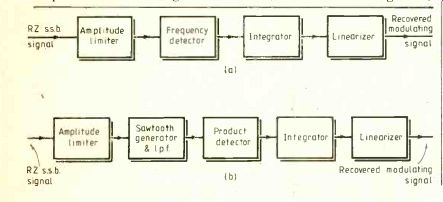
Japanese engineers of NTT have proposed the use of real-zero single sideband (r.z.s.s.b.) with full carrier. This system (IEEE Trans. on Vehicular Technology vol VT-35, No 1, February, 1986) can provide compatibility with f.m. receivers and can use 5kHz channeling, yet incorporates an f.m.-type amplitude limiter in the receiver. This, it is claimed, can largely over come the amplitude degradation caused by fading. This system, like compatible h.f. s.s.b. broad casting, can draw on the techniques proposed in 1952 by Leonard Kahn, enhanced by the use of the high-efficiency polar-loop transmitter configuration developed by Petrovic and Gosling at Bath University.
The r.z.s.s.b. system offers the attraction that there is no requirement to regenerate in the receiver the clean and stable carrier necessary for product detection. In an experimental sys tem the Japanese engineers used phasing-type s.s.b. generation, with full-carrier lower sideband signals developed at 455 kHz and up-converted to 70 MHz.
Reverse Danegeld
Amid all the fervid commemoration of 50 years of television, members of the Special Forces Club in Knightsbridge met to receive from the Danish firm of Bang & Olufsen a modern tv set with v.c.r. in connection with events now more than 40 years ago.
For from 1941-1945, B & O and, in particular, their chief engineer, the late L.A. Duus Hansen (OZ7DU), his surviving widow, and his former secretary Edith Bonnesen, were at the very centre of possibly the most successful of all the wartime clan destine radio networks set up in enemy-occupied countries.
Duus Hansen, born in 1901, while still nominally working for B & 0 pursued single-mindedly his efforts to provide manual and high-speed machine telegraphy and v.h.f. telephony links with the UK and/or Allied representatives in Sweden, working first through British and Danish ("The Princes") Intelligence but later through SOE which, un usually, became responsible for obtaining intelligence from that country, as well as organizing sabotage. The German security police reacted by destroying not only his home but also the B & 0 factory where, with the help of Svend Bagge and Steen Hasselbach, some 60 of his ingenious "telephone-directory" (Telefon bogen) lightweight h.f. transmitter-receivers had been secretly built, using standard domestic-receiver components that came largely from Germany.
Much of Denmark was then using d.c. mains unsuitable for the British-built SIS/SOE "suitcase" sets which also had to be relatively heavily built to withstand being dropped in parachute containers. Duus Hanson rejected such equipments and the hastily-trained operators sent from the UK. He recruited or trained his own `amateur' operators. His seven-valve Telefonbogen unit, the size of the Copenhagen telephone-directory, had an out put of 10 watts from parallel UBL21 valves and a three-valve superhet receiver using three triode-heptode UCH21 valves.
The "transformerless" a.c./d.c. series-heater techniques kept the weight to under 1.5kg. He persuaded SOE to send out crystals and signal plans. His enthusiastic and dedicated group was one of the very few to use a high-speed auto-sender (GNT) on the short-range links with Sweden.
The enormous professional ism shown in Duus Hansen's approach to covert radio had one important outcome not mentioned at the recent presentation: unlike the tragic experience In many other occupied countries where the vulnerable radio-operators had an average operational life of only about six weeks before being overtaken by capture or death or being "played-back" by the enemy, the Danish radio group had an out standing record of survival.
Ole Lippmann, one of the leading members of the Danish SOE group, and (Colonel) J.D. Parker recalled the events in which Duus Hansen and B & O were involved. (Major) John Brown and (Flt Lt) Charles Bovill of SOE Signals were there, as was the remarkable Mrs Yvonne Cormeau, MBE, who, as a young WAAF radio operator, was parachuted into France in August 1943. As "Annette", working for the Section F organizer, George Starr, in the following twelve months she transmitted and received more than 4000 messages before the village where she had set up her station was overrun by Allied forces, so becoming one of the most successful radio-agents to survive in France. And this was despite breaking the convert-radio rule book in operating from the same house for about six months. Usually, in practice, the greatest danger was enemy penetration of the Resistance movements or "amateur" informers rather than the Ger man d/f teams.
Among SOE and SIS veterans one finds a growing irritation with the books being produced by young military historians and journalists whose research may be diligent but often fails to recapture the wartime atmosphere in which Resistance developed and blossomed despite its many tragic shortcomings.
Space logic Dr Karl Meinzer, DJ4LC, one of the leading members of AMSAT DL, interviewed for the New Zealand amateur radio society, NZART, has expressed some forthright views on future satellites for the amateur service.
He shows little support for the use of packet radio transmissions, which he feels may be a craze that will pass like other crazes, becoming just one activity in amateur radio, at a relatively low level. He notes that the general trend in computing, at least in Europe, is starting to wane. This, he feels, is because people have found that doing really useful, complex things with computers is still hard work. He advocates linear transponders on the satellites, since they place few constraints on what you may wish to do.
AMSAT-DL is also not in favor of attempting to have a geostationary satellite, because the project cost would be an order of magnitude greater than present amateur satellites and require much more mechanically complex satellites with de-spun antennas and attitude-control jets.
Dr Meinzer also believes that geo-orbital satellites would diminish the educational value of amateur satellites since they would remove the need for tracking and knowledge of the space environment. A geostationary satellite would be, he suggests, no different in essence from an f.m. repeater or telephone.
------------
Also see: Electrometer amplifiers for sub-pico-amp currents
DISPLAYS FOR INSTRUMENTS: A look at the characteristics of displays used in electronic instrumentation. (Feb. 1987)
==========
(adapted from: Wireless World , Jan. 1987)