LOW-DISTORTION, LOW-FEEDBACK POWER AMPLIFIERS
THE COMPLEMENTARY-DIFFERENTIAL input with complementary push-pull drive and output has been with us for more than a decade.
Most of these designs have depended on large amounts of negative feedback to reduce static distortion, but in 1976, W. Marshall Leach published a low-negative-feedback design of this popular topology (Audio magazine from USA, February 1976). Since then, the constructors and commercial manufacturers have designed and built many variations of this circuit.
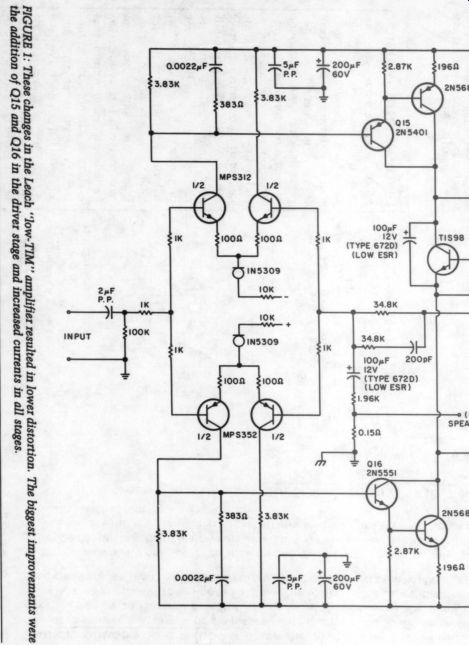
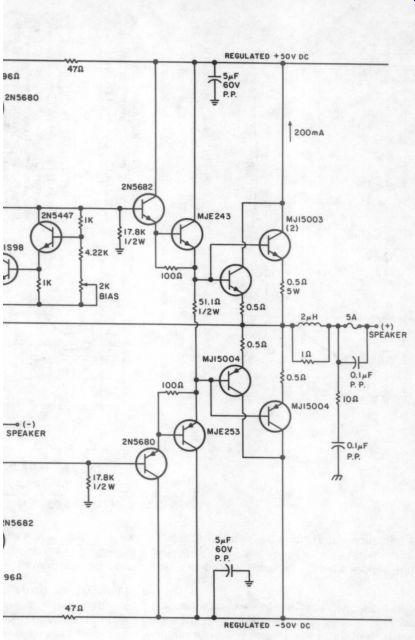
----- Fig. 1
Manufacturers and designers still face one dilemma, however. Low feedback designs generally have higher levels of total harmonic distortion (THD) than high-feedback units. This problem offsets the advantages (such as wide open-loop bandwidth and a flatter open-loop phase response over the entire audio range) of the low-feedback designs.
The unit I chose to modify-the BES model 850, forerunner of the mostly cosmetically improved Streets 950* --originally had the same problem. Initially, I applied my POOGE concepts (TAA 1/81, p. 20; 4/81, p. 7), used regulated sup plies and carefully matched the complementary devices. These changes reduced THD to 0.25 percent at 20kHz, 1dB below clipping.
This distortion level remained fairly high at lower power levels.
I then analyzed the operating currents and design of the original Leach circuit from output to input.
By operating the devices in a more linear manner, I was eventually able to achieve distortion levels 30 times lower (0.008 percent at 20kHz, 1dB below clipping) than my initial changes produced. Distortion decreased as I reduced the power level.
I also cleaned up a ground-loop problem that had prevented the THD from being as low as possible. Once I did this, the 'haze' around the musical instruments disappeared, revealing the finer details of the sound.
My changes in the original design appear in Fig. 1. As you can see, the improved performance did not result from my increasing the amount of overall (loop) feedback.
High-feedback designs do have certain advantages, especially in production. These include the following: no need to reduce THD by using expensive matched devices; reduced unit-to-unit variations; minimized aging effects of components (especially tubes); and the ability to correct high distortion from a nonlinear stage with large amounts of feedback. Still, improving open-loop performance is more beneficial in audio. Is it possible that designing amplifiers to be very linear has become a lost art? This approach was popular around 1977, and Don Prock's “Showcase” feature on Leach's follow-up design (TAA 1/84, p. 43) inspired me to dust off my modification and pass it along to you.
Don't be misled by recent efforts to identify other sources of amplifier colorations (such as grounding, wiring, “passive ” components, low and constant-Z power supplies, topology interactions, slew-induced distortion and passive RIAA) not generally detected by conventional “static” distortion measurements such as THD. However important these factors are, they can be masked by high levels (greater than 0.1 percent) of static THD. There is no good reason why low-feedback designs must have much worse THD levels.
Motional Feedback
Prior to reworking this design, I tried reducing loudspeaker distortion by including the speaker in the amplifier feedback circuit. This was back when the Dyna Stereo 120 was a popular, new amplifier. By passing the speaker current through a small resistance and placing that resistance in series with the Stereo 120's feedback resistor to ground, I could provide a form of motional feedback control. The results of this experiment are shown in Figs. 2-4.
Measurements were taken with an HP 331A distortion analyzer. Even though I experimented with the technique in this low-feedback design (Mr. Streets included this simplified form of motional feed back after I described my results), I think it is best when used only for low frequencies (biamped triamped systems) and with high-feedback amplifiers.
I did not try to find out how low loudspeaker THD would go. It might be fun to revitalize motional feedback, which began in the tube era, for specific applications.
Modern voltage amplifiers driving moving-coil loudspeakers work successfully on the assumption that the impedance is roughly constant over the entire frequency range. This, however, is not the case, and al though damping factors can minimize the effect, varying impedance is one of the causes of coloration.
[ *The January 1985 issue of Audio includes a review of the Streets model 950 amplifier. Apparently, proper ground layout was not maintained, as crosstalk measured only 46.7dB at 20kHz. Distortion was worse, too, but still under 0.1 percent, which is very good for a low-feedback circuit. I suspect the ringing shown is a clue to the regulated power supply, as neither the Leach nor the Streets 850 had this problem. Proper construction techniques such as grounding and wiring are just as important as the design.]
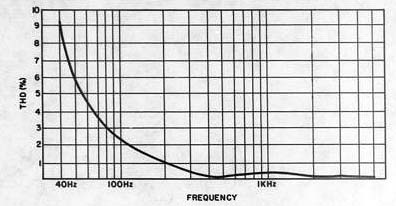
FIGURE 2: Distortion measurements of the JBL D130 15-inch speaker in a C40 short, rear-loaded horn enclosure. Insufficient loading caused distortion to rise rapid ly at low frequencies. THD at 40Hz, 90dB SPL at 3 feet, was 8.5 percent.
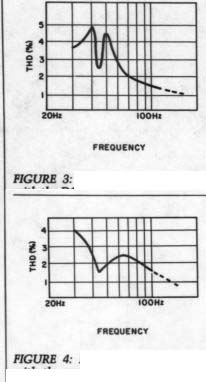
FIGURE 3: Distortion measurements with the D130 installed in a bass-reflex enclosure. Distortion was reduced, and low-frequency response was extended almost one octave. THD at 40Hz, 90dB SPL at 3 feet, was about 5 percent. At a the S- resonance, THD was 2.5 %.
FIGURE 4: Distortion measurements with the same setup as in Fig. 3, but with the motional-feedback modification. THD at 40Hz was 2.6 percent and at 45Hz 1.6 percent. The low-frequency response was also extended slightly.
ABOUT THE AUTHOR: Dick Marsh works at the Lawrence National Laboratory at Livermore, California, as a senior electronics technical coordinator of the Mirror Fusion Test Facility. Music and audio are his primary hobbies.
Muses and Music Since the music moves you, the muse is almost surely able to do so as well-the writer's muse, that is. Put pen to paper or better yet, typewriter ribbon to pa per with a clear, orderly account of your adventure in audio construction, or any related field of endeavor leading to good listening. Send it along with a stamped return envelope. We pay modestly for articles, so write us about it and we'll answer promptly with suggestions and tell you whether or not we are interested. Some of our best articles come from people who have never before written for periodicals. And if your muse is as silent as a tomb, don't let that stop you. Write anyway and let's see what develops. We have a nice sheet of suggestions for authors which we will send to nearly anybody who asks for it.
by R. N. Marsh.
----
Also see:
avahifi's Omega 260 (1996 model): MOS-FET Amplifier 130 watts/channel