
As the trends go, so go we, right down to the tiniest details of our everyday
life. It's automation time! Pretty soon we'll be having electronically controlled
shoelaces with Automated Tie and Untie. Micro-chip built into the shoe heel
plus a couple of mini-bats between your toes. You push an ultra-button on your
ring finger and--presto!
This bizarre thought comes to me as I turn to that august name, Sony, and Sony's new all-out turntable the PS-X75 with "biotracer" electronic tonearm, the arm that, so to speak, ties its own shoelaces. This Sony item represents a whole new generation of disc players such as I have not worked with before.
Since well-made turntables tend to keep on turning year after year, perhaps you haven't either? If you think your old table is about ready to be turned in, then here's what's coming to you next. Something to really marvel at.
I am still in some obscurity (if not in the dark) as to how most of the auto mated functions of this table actually work and I may never figure them out. Things get complicated these days. The Sony has all sorts of sensors, magnetic, photoelectric, tied into electronic mini-brains. To do the work of the arm, it has linear motors--that new kind that doesn't turn but just pushes gently. Three of these useful devices! Where have they been all my life? A brilliant idea--straight back to the horse and other similar means of linear action. A linear motor is very much like a muscle, which is an amazing thought. To heck with the wheel! Why didn't we think of this be fore? To be sure, a few of the automated actions available in this PS-X75 seem to me de trop, too much. But then I tend to be conservative in all this, trusting my 10 thumbs as the finest sensors anywhere around. I will admit that other new record players display an even more mandatory automation than Sony, for this is the game right now. And all, needless to say, for two good reasons, (a) it can now be done (i.e. where there's a way there's a will) and (b) because obviously you want it that way.
Ok, I'll go along. If my sound is OK.
Sony gives me more than satisfaction on that score. Indeed, I've found to my surprise that even with the same old (excellent) cartridge and all else un changed, a table of this generation may noticeably improve the overall quality of your sound. Better engineering at the cartridge/arm interface.
The Sony! We say this as we have said "the Fisher" for so many years, adding a sort of honorary title to a regular name. Curious. Did Sony get there firstest with the mostest? Maybe. But we have too much other excellent Japanese equipment to think that Sony has total superiority. Sheer hype? Not that either--ask the competing agencies. Just a carefully built-up mystique, I guess, along with real quality and performance. My own Sony speculations don't go that far. I keep thinking of pasta ... remember the pasta ad, soni, buoni? In the plural. In a plate of spaghetti (pl.) each single strand is a spaghetto. Just as each item in the vast Sony line manages to be the Sony.
Sony's ample instruction booklet was written in Japan and in spite of the mostly excellent English I am not clear as to what the term "biotracer" may mean. It sounds highly organic, like, say, biosphere, but I detect nothing organic (in that sense) in the arm's operations. Unless via the muscle analogy--could that be what they mean? Any how, in this player t the arm is clearly the center of attention and the most auto mated feature. But I should say at once possible it is still possible to move this arm by hand, though not with impunity. It doesn't rudely say "no"; it says, very gently, "please better not." The system is indeed designed to remove your sticky fingers, if tact fully, but you may override, if need be.
The PS-X75 comes with a large and astonishing diagram printed on trans parent plastic attached to the dust cover. I studied it carefully before removing, then stuck it up on my wall for further study. Phew! If I add right, there are three linear motors, for horizontal arm motion, vertical arm motion, and arm lifting; each with a solid magnet, coil, and coil bobbin (none showing, of course, from the outside). In addition, two more similar arrays, magnet, coil and bobbin, for the horizontal velocity sensor, in the arm itself, and the vertical velocity sensor, down underneath. With two of these magnet-coil arrays actually in side the arm, one wonders how much mass is involved, but the weight, I note, is placed over and behind the pivot, the front "S" of the arm being unencumbered. Surely, I figure, some body had done all the calculating as to resonance and mass relationships between this and the cartridge/stylus up front. I have never had a better tracking arm. Suffice to say it's proof of the bio-pudding.
The direct drive motor is "BSL"--brushless and slotless--and comes up to speed in a half-turn, which is commendable for this type of drive. Some of the earlier direct drivers took an unconscionably long time to get going.
Speed is crystal controlled, of course, and (naturally) there is a readout which says "locked" when we reach fixed speed. Don't try to play your piano with this one. I can't find any optional speed adjustment. In fact, the locked-in speed is accurate within 0.003 percent, which is far less deviation than my rather keen musical ear could ever detect. No audible search-and-correct. And the signal to noise is-78 dB! That's almost digital--quiet.
Shades of earlier tables--remember when the fanciest changers were set to run a half step sharp (speaking musically) in case the pile of discs got too heavy for the motor to manage? And as for noise, you could even feel it, a complex of vibrations from motor shaft, rubber idlers, eccentric dents and bumps, even, perhaps, a thumping belt. (A belt often has a joint somewhere on its length.) I bless my luck in living long enough to outlive that sort of equipment.
Techno-Trailblazing
You can't play a transparent LP automatically on this Sony because the record-size drop point is determined photo-electrically via holes in the table and, of all things, prisms mounted in the rubber mat. Light comes up and runs into a black wall--the disc--or it doesn't. Two light sensors determine the 7-inch and 12-inch drop and also-very important--they signal when there is no record on the table so that the arm will not drop. Nothing more disastrous than trying to play a rubber mat.
The biggest new convenience in re cent all-automatic disc players is the bank of control buttons ranged out side the plastic dust cover, where you can do everything with the cover down. (For too long the manufacturers needlessly put the controls inside that cover, so you had to lift it to get any action.) And the biggest plus by far on the Sony PS-X75 is the extreme right hand control, a small circular dial with a knob in the middle. Imagine it! Both stylus force and skating force, the two automatically locked together, can be set and reset by this knob while the record is playing. No tedious weights, no tiny grooves in which you try to lower the stylus, which never stays put while you clumsily adjust supposed pressure. Here, you just turn the knob.
I couldn't believe it. Dial 0 and the arm gently elevates itself into the air (you have to balance to zero weight first, via the familiar counterweight principle). Turn to a half gram and it lowers and, maybe, if the record is flat, plays music. If the sound skips, turn it up to a gram or more and instantly things settle down. For a warped or eccentric disc, you can momentarily increase the point pressure, to taste--then turn it back, to standard. Really something.
Now that, to my mind, is a really profound improvement. I cannot tell you how many times I have hated that fussy job of setting up the right force ("weight" as we wrongly say) via balances and counterweights and overhang and so on, and I expect our normal readers will enthusiastically agree. It takes a freak, I say, to enjoy that kind of chore. But what can you do? All too often I've resorted to the thin dime or, more recently, a featherweight plastic stylus brush laid on top of the cartridge to bring the "weight" to the correct figure. I have a whole box of cluttery measuring devices, from AR's little plastic weights to Shure's Very Best, but Sony has the right idea. It must be that vertical mo tor. It just pushes, variably down wards. Now that's the kind of automation I like.
Some of the rest I don't. Sony makes a mild claim towards music cueing via that quick half-turn motor start. Yeah, but as an old radio man I know that there is only one simple way to get near-instantaneous music starts on cue and that is via the slip system, a table that turns at speed, a felt mat for smooth friction and a finger that holds the disc motionless. It'll start in a quarter of an inch, full speed. But this is mainly for specialists. More important and quite vital for a lot of us is to be able to start the music without squawks and fumbles at one of the inner LP bands. Through long practice I've got so I can hit the silent grooves by hand almost every time, given a good light. But nowadays you aren't supposed to because of those 10 thumbs. So--automation. Buttons to push.
OK, friends, just try. (And it's not only Sony that offers you this.) Push one button and the hanging arm moves leftward, push another and it goes right, push a third and the arm descends and plays whatever it finds.
That is, after the muting circuit lets go.
Like a cassette. Even more like a one armed bandit, electronic style. Instead of trying to knock out an enemy space ship, you try to hit the beginning of the second movement of the Beethoven Fifth.
Aiwa, to name another maker, has really tied you into this device. If you acquire their home equipment rack, you cannot even open the dust cover and reach in--no room. Instead, the entire table rolls out so you can put the record on, then rolls back in and plays. So you must do your band-searching via the outside remote controls. No fingers at all.
Sony is more moderate. You can reach in (given space in your own cabinetry), and you can move the arm, though it does tend to remove itself from your grasp, gently but firmly. Occasionally, when you have found the exact right spot by hand, it simply turns the motor off on you. There's a button for that, too. Push and the mo tor starts again.
Well, just for kicks I tried to see the difference between what I could really do with automated buttons versus what I myself needed to do to hit the silent grooves between bands accurately. No use! After trying more than a dozen times to hit one quite wide separation band, I ended up each time with a blast of unwanted music and gave up. You try. Do not let minor eccentricities like this bother you too much. Sony has done nobly with the real fundamentals, including much more, such as the ease with which all this complex machinery can be set up to accept widely differing cartridges for size, overhang, weight, height above the disc and so on. And there's that excellent tracking stability, aided by adjustable shock-absorbing feet.
The once famous Canby Loose Floor board, which has sent dozens of arms flying into the air, merely produced a slight hiccup in the Sony sound and no grooves jumped. For such an in credibly complicated table, that's good. If you can cough up the cash, if you are un-intimidated, if you don't mind a big table (it wouldn't fit in the space I had), then maybe the Sony is for you. Linear motors and all.

--Len Feldman and Edgar Villchur Honored
Len Feldman receiving award from Avery Fisher.
On October 4, 1980, Audio Contributing Editor Leonard Feldman and Edgar Villchur, founder of Acoustic Re search, were inducted into the Audio Hall of Fame. Both men were recognized for their career achievements and contributions to the audio field.
Feldman, currently a writer and consultant, began his career as a television engineer, joined Fisher Radio, and later started his own manufacturing company. In 1957 this firm, Madison-Fielding, was one of the first to introduce an all-in-one stereo receiver. Feldman served as the IHF's technical director for a number of years, is now a technical consultant to the audio division of the EIA/CEG, and has written six books relating to FM and audio.
Villchur was an instructor of electronics and a freelance writer when he developed a loudspeaker based on his own invention, the acoustic suspension system, in 1953. He subsequently applied for a patent for the design and formed Acoustic Research to manufacture the speaker. Upon retiring from AR in 1967, Villchur established the Foundation for Hearing Aid Research and has continued to write general and technical articles.
by Edward Tatnall Canby (adapted from Audio magazine, 1981)
======
Vintage ADs:
AT ADCOM QUALITY IS THE PRINCIPLE...
LOW COST THE DIVIDEND.
Adcom GFP 1 PREAMPLIFIER

In a little less than a year, Adcom's critically acclaimed GFA-1 has established itself as the power amplifier of choice for the knowledgeable enthusiast.
Writing in Stereo Review (July 1980), Julian Hirsch declared, "The absence of gimmicks and the pursuit of innovative electrical and mechanical design together make the Adcom GFA-1 a top contender in the heavyweight amplifier class... and its price makes it one of the top values in today's market. One could pay two or three times as much and get no better audible performance" Now, from the same dedicated design team that created the GFA-1 comes a new, meticulously engineered preamplifier, the Adcom GFP-1, that extends performance to the limits of current technology.
Like the GFA-1, the new Adcom GFP-1 preamplifier avoids gimmicks, useless gadgetry and pinball machine illumination to concentrate on the things that really matter, genuine utility, outstanding performance and an affordable price.
To cite just a few of its more noteworthy features, the Adcom GFP-1 employs a super low noise FET phono input stage to minimize cartridge impedance interaction, a problem that many far more costly designs seem to over look. To insure exceptionally high over load capability there's discrete phono and line circuitry. In place of a conventional volume control you'll find a true stepped potentiometer with precision trimmed resistor pads for accurate channel tracking. Another neat touch--genuinely useful tone controls with hinge points that correspond to RIAA phono rollover frequencies permitting improved control of record playback.
Add sophisticated switching, versatile dubbing facilities, vanishingly low distortion and exceptionally quiet operation and you truly have a preamplifier for all reasons.
One last thought. At a time when all too many companies have opted for increasingly exotic designs i.e. very expensive ones, Adcom has conscientiously sought to provide a demonstrably superior preamplifier at a price* that would still be within the reach of most discriminating enthusiasts.
Clearly, you owe it to yourself to audition this remarkable instrument.
And at the same time, listen to its superb companion piece the Adcom GFA-1 amplifier. We think you will agree that they're as good as anything you have ever heard, regardless of price.
For additional information and the name of your nearest Adcom dealer write:
Adcom, 9 Jules Lane, New Brunswick, N.J. 08901. U.S.A.
*Suggested retail price. $350.
---------

Beauty of design ... and performance! NIKKO AUDIO components offer advanced technical design and performance on the same superior level as their extraordinary good looks.
Shown below; The Gamma 20 frequency-synthesized digital tuner with 6-station programmable memory, Beta 20 preamplifier with performance, construction and many features of far more costly units, EQ 1 graphic equalizer, ND-790 metal cassette deck (with optional rack mounts), Alpha 220 DC servo non-switching power amplifier. All except cassette decks backed by a transferable 3-year parts & labor limited warranty.
Visit your authorized NIKKO AUDIO dealer and find out why we say that the beauty of our products more than meets the eye.
NIKKO AUDIO. Beauty... more than meets the eye
1981 NIKKO AUDIO, 320 Oser Ave., Hauppauge, New York 11787.
Available in Canada.
-------------
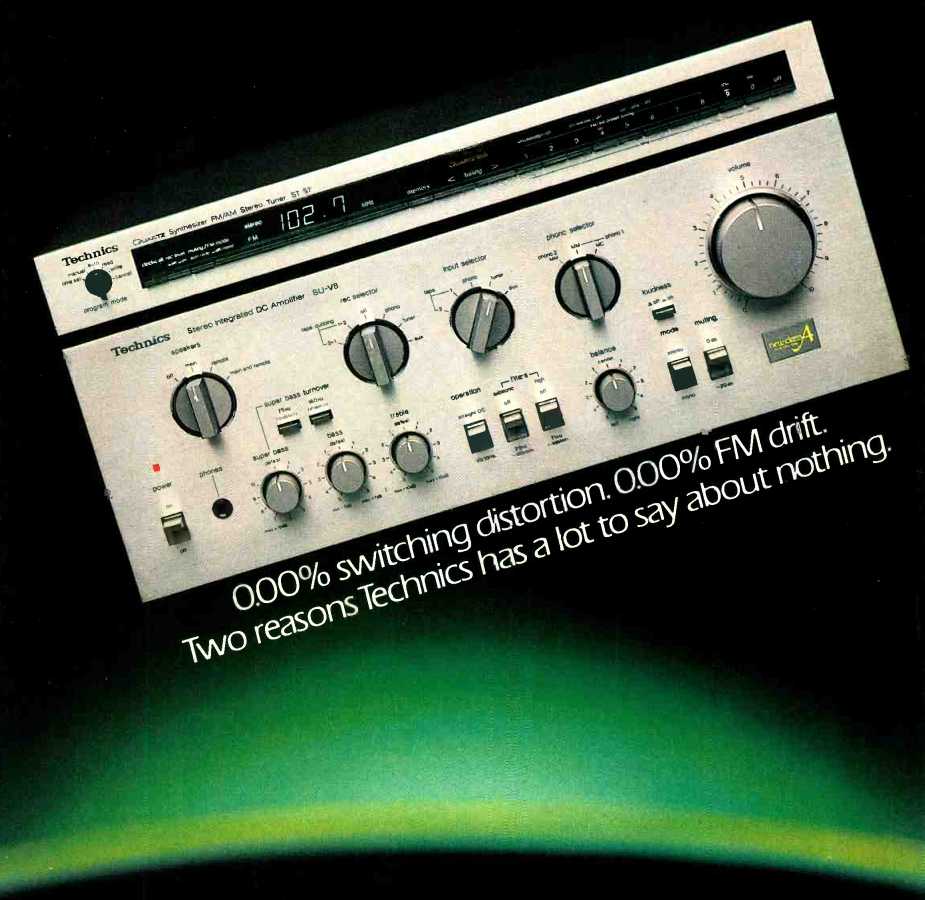
Technics SU-V8 amplifier with New Class A circuitry eliminates switching distortion. The ST-S7 quartz synthesizer tuner eliminates FM drift. And as you'll discover, the more we eliminate, the more we add.
Take the SU-V8. You won't hear any switching distortion because, unlike most of today's amplifiers, its output transistors don't switch on and off as the input waveform goes from positive to negative. The reason: Technics synchro-bias circuitry. What it does is employ high-speed diodes that constantly send minute amounts of current to the transistor not in use. And since the transistors are always on, switching distortion is eliminated.
And there's nothing minute about the SU-V8s power output: 110 watts per channel from 20 Hz to 20 kHz into 8 ohms with no more than 0.005% THD. The results: Music that's rich, crisp and bursting with dynamic range.
In concert with the SU-V8 is the ST-S7. With its quartz crystal oscillator, only the broadcast frequencies you select can be received. And since both frequencies are quartz-synthesized, the tuner can't drift. That means any station you tune is perfectly in tune.
And the ST S7's microprocessor allows you to preset eight AM and eight FM stations and even turn the power on and tune three stations all by itself.
Discover Technics new amps and tuners. When it comes b New Class A and quartz, Technics gets an A plus.
Technics
The science of sound
= = = =