by IVAN BERGER
ROM-ANTICS
A CD for Computers
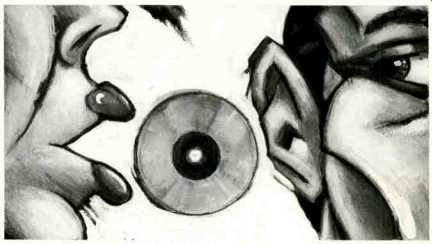
Sony and Philips recently announced agreement on a basic Compact Disc format for computer data and program storage. Details of this CD-ROM (Read-Only Memory) format should be finalized by the time you read this.
The CD-ROM will hold about 550 megabytes of information, equivalent to about 12,000 letter-size documents. Personal-computer memory capacities range from about one-fiftieth to one-half megabyte; floppy disks hold anywhere from one tenth to two megabytes, and hard disk systems (at prices ranging from $1,000 up-and up) hold five to 32 megabytes.
But computer users can store what they choose on these other media. As the ROM designation indicates, CDROM will be, like the audio CD, a playback-only medium. That will limit its utility for computer use to either very large libraries of long programs or very long data files that will rarely, if ever, be updated (encyclopedias or the 13-volume Oxford English Dictionary, perhaps). However, if the format becomes established, it will probably prove very useful once home-recordable optical disc systems arrive-and they're being researched in labs all over the world.
Interestingly, the news of CD-ROM reached me just as I returned from a preview look at IBM's PCjr computer (the fabled "Peanut"). The PCjr has an audio input hidden in its expansion buss-not to process audio signals, but to steer them, under program control, to the computer's direct audio output and the audio channel of its r.f. (TV-channel) output.
These two developments open up some possibilities for interactive audio, much like the interactive video systems now available for videodisc (though perhaps less useful). The Firesign Theater comedy group is reportedly preparing the first interactive CD, presumably adapted from their new videotape (which was originally to have been an interactive videodisc). Whether or not this uses the CD-ROM format, I don't know.
Having occasionally played computer tapes by accident, I know how horrible the resultant garbage sounds. I hope that the directories of CD-ROM discs are encoded so as to tell an audio player not to play them, and that ordinary CDs will be encoded so as not to program computers into nervous breakdowns.
Perhaps there might even be a dual directory structure, which would direct the CD player to read the audio-only tracks of a mixed CD/CD-ROM disc into a stereo system, while directing a computer to skip over them to read the ROM information. That way, one disc could carry both the computer instructions for an interactive program and the appropriate audio material.
Audio Editors Cited
-------Bert Whyte
Associate Editor Bert Whyte holds the plaque given to famed conductor Leopold Stokowski in 1958 when he was made an Honorary Member of the Audio Engineering Society. The Stokowski estate decided that Whyte should have the plaque because of his association with Maestro Stokowski in making early stereo recordings. According to Jack Baumgarten, Curator of the Stokowski Archives, the Maestro said that these recordings were "the best sounding I ever made." Born in Belfast, Northern Ireland, Whyte came to the United States at the age of 4. He began his professional audio career in 1949 as Director of Audio Sales for Concord Radio, was named Sales Coordinator and Musical Director of Magnecord, and later became General Manager of Fine Sound and the Perspectasound Division of Loew's/ MGM in New York. He was cofounder of Everest Records, where he served as Recording Director/Engineer and Director of Classical Artists and Repertoire and where he pioneered the use of 35-mm magnetic film for multi-track stereo recordings. He subsequently became Musical Director of RCA Victor Red Seal classical recordings.
In 1951 Whyte made the first modern classical stereo recordings with Stokowski, and the first big-band stereo recordings with the Benny Goodman, Woody Herman, and Stan Kenton Bands. After collaborating with Major Edwin Armstrong on special stereo recordings for the development of FM multiplex stereo sound, Whyte continued this work with stereo FM pioneer Murray G. Crosby. He is a member of the Audio Engineering Society and was elected a Fellow of that organization in 1977.
Senior Editor Richard C. Heyser has been awarded the Audio Engineering Society's Silver Medal for the development of time delay spectrometry (TDS) and its use in the study of loudspeaker and room acoustics. Since November 1973, Heyser has reviewed loudspeaker systems for this magazine using the TDS technique, on which he holds the patent; it is among nine which he holds in the audio and communications area.
Since 1956, Heyser has been associated with the Jet Propulsion Laboratory of the California Institute of Technology, Pasadena, where he is presently a Senior Research Scientist.
At JPL, his activities have included design of communications instrumentation for all major space programs there, beginning with the conceptual design of Explorer I, America's first satellite. His most recent projects have been with the improvement of underwater sound research and medical ultrasound imaging through the application of coherent-spread spectrum techniques.
Heyser is a member and Fellow of the Audio Engineering Society and of the Acoustical Society of America and a member of the IEEE and the Hollywood Sapphire Club. His biography appears in Who's Who in the West, Who's Who in Technology, and Distinguished Americans of the West and Southwest.
-----Richard C. Heyser
Sony and Philips Honored
The National Academy of Recording Arts and Sciences (the group that gives the Grammy awards) has given its President's Award of Merit to Philips and Sony, for their development of the Compact Disc system. The award ceremony took place October 10th, 1983, during the Audio Engineering Society's Convention.
This was the 10th such award NARAS has given, and the first for a technical development. In a sense, though, the award was only half for the system's technical qualities. The other half was for "The cooperation between Philips and Sony in jointly developing a single standard for this new and vastly superior system." We say "Amen" to the cooperation half; it's all too rare to see firms this large cooperate so well so quickly.
Video on Radio
They're playing Beta Hi-Fi "Video 45s" over WDHA, an FM radio station in Dover, New Jersey. Crazy? Like a fox. The sound is better than from conventional records, the station can also use the Beta VCR as an audio production recorder with good fidelity and five hours of taping time per cassette, and though the audience can't see the video, the D.J. can, and tell the audience about it.
What's on Stereo TV?
Japan has had TV with multiplexed soundtracks for about two years now, but not that many broadcasts are using it. Of approximately 270 broadcast listings in the Japan Times on a recent Saturday, only 28 (10.4%) were in stereo, while another 17 (6.3%) were bilingual. (These numbers all include duplicate listings, where several stations carried the same shows.) Most of the stereo broadcasts were music or variety, but there were interesting exceptions: "Quiz Derby," "All Japan Pro Wrestling," "Laughter Time," "Do Sports," several stations' morning sign-on shows, " Young Plaza" (a soap opera, perhaps?), something called "TV Graffiti," and even one station's weather show. The bilingual programs were mostly American movies and TV series, plus a few news and weather shows.
The Rhodium-Strip Mystery
A year or so ago, I addressed a class at a California university. In the Q & A session following, one student asked me if I'd heard of "the rhodium strip." It was, he said, a new recording medium. I tracked down his sources, and was able to discover that it is laser-etched, comes from a company called Precision Instruments, somewhere in Northern California, and that the strip itself is made by a DuPont subsidiary in Florida. My sources didn't even say if it is used for digital or analog recordings, or what its advantages might be. Anyone out there have further information?
--------------
= = = =