THE PHONO cartridge directory -- Phono Cartridge Survey -- lists some 46 units of which 13 have been selected for capsule reviews which also appear. The modern light-weight cartridge is a far cry from the early models used on the old 78 rpm records. One I designed in the mid-thirties weighed no less than 4 ounces and had an adapter for attachment to a tonearm of an acoustic phonograph: (how many readers remember those xxxx springs?) Like loudspeakers, phono cartridges have improved enormously over the past few years and like loudspeakers, the best ones tend to sound more and more alike. Just six years ago, John Crabbe, Editor of the British "Hi-Fi News" said "... there are really no pick-ups at present available which will properly track high frequencies on the most heavily modulated stereo discs at playing weights significantly less than about 1.5 grams; in fact most require 2 grams or more on the occasional difficult passages.
In some cases it is claimed that cartridges will track at 3/4 gm or less in high quality arms; it can be stated categorically that this is untrue." Well, things have improved since then and now there are several cartridges available which can track below 1.5 gms in a suitable arm. It should be mentioned, however, that too low a tracking weight can cause as much damage to the fine grooves as a heavier weight than necessary, so great care must be taken when setting up.
JVC Wins
From the Land of the Cherry Blossom comes news that the Japanese Record Manufacturers Association have decided to adopt the JVC system (described briefly in our November issue) .as standard. If only U.S. record companies would get together and evolve a standard too. At the moment, CBS have two viable systems but other companies are experimenting with the Feldman-Fixler, Hafler, and Scheiber methods. Perhaps they are wise in being a little cautious.... Meanwhile, my pile of quadraphonic discs gets bigger and bigger-but no decoders. Not even a prototype-infuriating! Greek Hybrids
Several erudite readers have suggested that Tetra phonic or Quadrasonic are more appropriate names for four-channel than quadraphonic, which, they say with some pain, is a Latin-Greek hybrid. And so it is-just like the word television which has been accepted by the pundits for many years! Tetraphonic is a little clumsy and as for quadrasonic, it is not really the logical equivalent of monophonic and stereophonic. Moreover, it conveys the impression of four sounds instead of four sound sources-an important difference. So, for the time being, we will stick with quadraphonic.
PLL PLL PLL
Another acronym to plague us! PLL stands for Phase-Locked- Loop and it refers to a new system. of FM detection involving a voltage controlled oscillator which is kept in phase with the signal by a phase comparator. The control voltage, or difference signal, is the audio output. A simplified explanation--but it will suffice for the moment.
What are the advantages of PLL? In theory, distortion should be low because it is relatively easy to design an extremely linear oscillator. Secondly, capture ratio could be significantly better because of the locking-in effect. So far, tuners using this system have not come up to expectations but you will hear more about PLL... .
Audio Shows
The Institute of High Fidelity announce a new show to be held later this year in Palo Alto, California. The place selected is the Cabana Hyatt House Motel and the dates are March 29 to April 5.
Meanwhile, Teresa, Rogers has been very pleased with the response to the forthcoming Washington Show. Three floors were originally reserved but now a fourth floor has been added. The dates are February 12 to the 15th and it will be held in the Hotel Washington at 15th and Pennsylvania Avenue-within a stone's throw of the White House.
Humor In Advertising
"For Quadrasonic, you really need two heads (or at least four ears) ... Two sounds coming from a proper stereo set-up is frightening enough to comprehend, but four different directions is sure to send you to the nearest analyst"-Skyline Electronics (makers of headphones).
G.W.T.
====
London Letter

Donald Aldous [Donald Aidous is a well-known British authority on hi fi. He is Equipment Reviews Editor of the newly combined British magazine Hi-Fi News/ Record Review. ]
INDICATIVE of what has been called an "audio explosion" in England, as well as on the Continent, has been the number of audio fairs, festivals, exhibitions. demonstrations, and company presentations offered during 1970 to the growing hi fi public. Mind you, the technical standards achieved at some of these shows have been amusingly described by one of my colleagues as varying between "the real hi fi, some commercial hi fi, some lo fi, and quite a lot of no fi!" but sound entertainment in the home-in one form or another-is certainly on the upgrade.
A straw in the wind, however, occurred at the 19th International Tape Recording Contest (CIMES) staged in Geneva last November. The committee and judges were shown some winning video entries in a Dutch contest, and the results were so impressive that video is now a new class in the 1971 CIMES. The time limit will be 5 minutes, and entries are not restricted to clubs so that individuals can submit video tapes.
A pointer to the future, as use of VTR equipment becomes more widespread in schools and in the home, enthusiasts using the medium must know what type of videotape configuration is acceptable. Incidentally, without wishing to wave the British flag too much, our own Peter Bastin's tape "Not a Word" won the Grand Prix and the special prize for the tape most suitable for broadcasting. Yet another British entry, the documentary "Sunderland Hospital Broadcasts" by Ken McKenzie won the first prize in the reportage class. This tape was earlier judged to be the "Tape of the Year" in the British Amateur Tape Recording Contest, of which I am one of the judges.
Thanks to these and other British tapes, the UK scored the highest average marks and so got the cup for "the best national selection." Switzerland came next, followed by Norway, Holland, Denmark. France, Germany, Czechoslovakia, Italy, and Belgium. Why were there no American entrants? I must discover if there are any restrictions on USA tape, as surely some fine examples could be submitted.
Many of you will have an untarnished 1971 diary on hand, and so this would seem to be a good moment to jot down some dates for the English hi fi scene, just in case you can get over to England yourself and sample the 1971 vintage.
If you cannot. I'll report the highlights in one of these letters. "Sonex '71." the audio show sponsored by the Federation of British Audio's special company formed for such promotions, will run from Wednesday. March 31 to Sunday, April 4. with the first two days as trade only. The 17th International Audio Fair and Music Festival will again be mounted in the Olympia exhibition hall, London, during mid October, and the 1970 show features are discussed below. Not strictly hi fi, but worthy of attention by the professional sound engineer is the "Sound '71" exhibition organized by the Association of Public Address Engineers (APAE) from March 16-19, in London. My friend Haydon Warren, APAE Technical Officer, tells me that all stands have been sold and the lecture theme for this year is up-to-the-minute techniques for the sound man!
I don't know whether there is a comparable public address engineering organization in the USA, but the history of the APAE really started with a group of reputable P.A. contractors getting together to form a trade association, led by the late Alex J. Walker, in 1948, when the association was born. Over the years the APAE has expanded its activities and, in addition to its important annual exhibition, publishes a journal, along with other literature, and helps promote the exports of British PA equipment, now amounting to several million pounds.
The quality of sound (or rather the lack of quality in many instances) in public places, from theatres to open-air entertainments) is a pet hobbyhorse of mine, and I make my critical views known whenever the reproduced sounds fall below an acceptable level. There are no technical reasons today why most satisfying sound fidelity cannot be offered in any auditorium, but the usual reason for very inferior results is unwillingness to pay for the best. An example of how good such systems can be, to which I can testify personally, is the Shure Vocal Master sound projection system, which offers selective control of volume and vocal effects over six microphone channels, plus anti-feedback switching, and developing 100 watts rms continuous power. It was used most effectively for all of the 20 lecture/recitals presented in the Hi Fi Theatre by John Borwick at the 1970 Audio Fair at Olympia, and a most pleasing reproduction in the huge Royal Opera House auditorium to reinforce the voices of Pierre Boulez and CBS record producer Paul Myers when introducing the first public playback of the CBS record set of Debussy's Pelléas et Mélisande. This line-source sound system demonstrated what can be done to keep the "golden ears" happy in such a place! In the last year, a most-complex sound system, traveling with a group of American university students presenting a show called "Up the People," greatly impressed me when I heard it in two locations in England. On one occasion some 20 microphones were operative on stage without feedback in a highly reverberant enclosure, controlled by a 24-way mixer, I think, in the body of the hall.
This is not the place for a discussion of the politics of the British hi fi industry, but to reflect the current British scene we must say that with hi fi expanding into a bigger market (perhaps a mass market) the traditional and truly hi fi manufacturers have their problems. The big radio manufacturers are casting eyes at this area, and Mr. John Portlock, Managing Director of the UK end of Bang & Olufsen, has offered his view that rationalization must come, "as the small British hi fi firms are too fragmented to compete with the major firms moving into audio. . . ." He appears to see the future of hi fi in the UK as fewer and larger manufacturers, on Continental lines with probably Great Britain joining the Common Market! Yes, a dilemma certainly, but the outlook is not so dismal for the genuine hi fi firms as Mr. Portlock opines. The best will always have their followers, and the big boys have a long way to go to bridge that mid fi/hi fi gap.
* *
The space remaining will allow me only to mention some of the products that attracted attention at the IAMF show, concentrating on British designs, as most of you will be familiar with the American and Japanese items. John Bowers (of Bowers & Wilkins) provided an impeccable demonstration from a pre-recorded tape, using his latest DM70 combined electrostatic and dynamic loudspeaker, the DM3 model, and the bookshelf design DM 1 performing admirably with its improved crossover network. Celestion introduced their new Ditton 120 speaker, measuring about 17 x 8 X 9 in. incorporating two drive units, the familiar HF 1300 for high-frequencies, and a long-throw LF/MF unit of high-flux, aided by an ABR (acoustic bass radiator) for the extreme bass. Goodmans' latest "Minister" two-unit reflexed enclosure. fitted with an 8-in. long throw bass unit with plastic coated cone and a new type dome radiator mid-range/treble unit, was heard to advantage for the first time here.
One of the most satisfying sonic demonstrations was staged by Rogers Developments, using the latest Monitor models fed from a Ravensbourne amplifier. Full marks here. In the modest-price category, the old electronics firm of Whiteley demonstrated three loudspeaker systems. LC.93, LC.94, and LC.95, and Tannoy's family of loudspeakers put up a very good overall show that attracted big audiences. Another manufacturer who has succeeded in obtaining a family resemblance in their range of speakers is Mordaunt-Short. Sonic similarity is a good sign that the designer knows what he is aiming for, and the new Mordaunt-Short MS077 has a similar character to its brothers. The MS077 is a three-unit model and the essential differences in the models relate to the power handling and bass output only.
Turntables from JP, handled here by Howland-West Ltd., especially the belt-driven models TP.60I and T.500, performed well, and Transcriptors Ltd.. demonstrated a new turntable.
first seen at the Dusseldorf show last August. This has a synchronous motor driving a 6-lb. non-ferrous platter via a belt, resulting in rumble-free performance. The whole baseboard floats at a resonance below 5 Hz and a fluid dashpot can be used to damp this movement. The main bearing is PTFE. This company also offered an exceptional pickup arm (the fluid model) which employs a ball-race to stabilize a uni-pivot. Sinclair Radionics demonstrated an early prototype turntable, with electronic control and the record bearers and pickup arm made from glass tube! Audix Ltd. demonstrated their new Graphic Stereo pre-amp and Stereo Power amplifier, equipment of professional caliber. The pre-amp has a low noise level, magnetic-input circuit, five adjustable equalizers (covering range 80 Hz to 8 kHz), comprehensive mixing facilities, and output PPMs.
The power amplifiers are 160W and 70W types, which include "acoustic environmental correction" (or shelf controls) working over the ranges below and above approximately 800 Hz.
A novelty item was an FM-crystal locked radio-guitar, derived from work on radio-microphones. This device frees the electric guitarist from wire connections! Reslo is the company responsible for this innovation.
Two eminent personalities from America came over specifically to take part in the junketings at and around Olympia-Dr. Robert Moog demonstrated his synthesizer in conjunction with J. B. Lansing loudspeakers in a joint room and later presented a lecture on the instrument and its electronic music to capacity audiences. As an extra-mural event, Dr. Amar Bose, Professor of Electrical Engineering at M.I.T., talked in an easy, lucid style about his Bose 901 loudspeaker system. Dr. Bose's philosophy of loudspeaker design, based on extensive research, is probably well known to AUDIO readers, but the sound was certainly impressive from these comparatively small cabinets housing nine 4-in. units. An equalizer unit is used, of course, and powerful amplifiers are essential to drive the speakers, hence their high price.
With a colleague, I was fortunate enough to be given a special demonstration of the new Nivico JVC four discrete-channel disc system, a system employing a pilot-tone, plus FM and phase-modulation techniques. The bandwidth extends to 45 kHz, and the record is fully compatible. The improved pickup available will play ordinary two-channel stereo discs. The directional information was well presented with good separation, and the system has many features of technical interest. I seem to recall that English Decca engineers had patents on such a system, when the 45-45 stereo system was introduced.
As a collector of test and demonstration records I was intrigued to discover three specimens demonstrated at the Fair: John Borwick's excellent "Enjoyment of Stereo" (HMV .SEDM6), "This is Stereo" by John Wright and Clement Brown (EXP .70) marketed by Howland West Ltd., and a stereo test/demo disc from Audix, Stansted, Essex. Next time you read these notes, we shall have gone over to decimal currency! Thank you to my American friends and readers, who have sent me some encouraging messages about the first of these Letters from London, which appeared in the September 1970 issue.
It will appear more frequently than quarterly, if the reactions continue favorably and the Editor agrees. (I'll think about it! Ed.)
====
ADs:
PICKERING
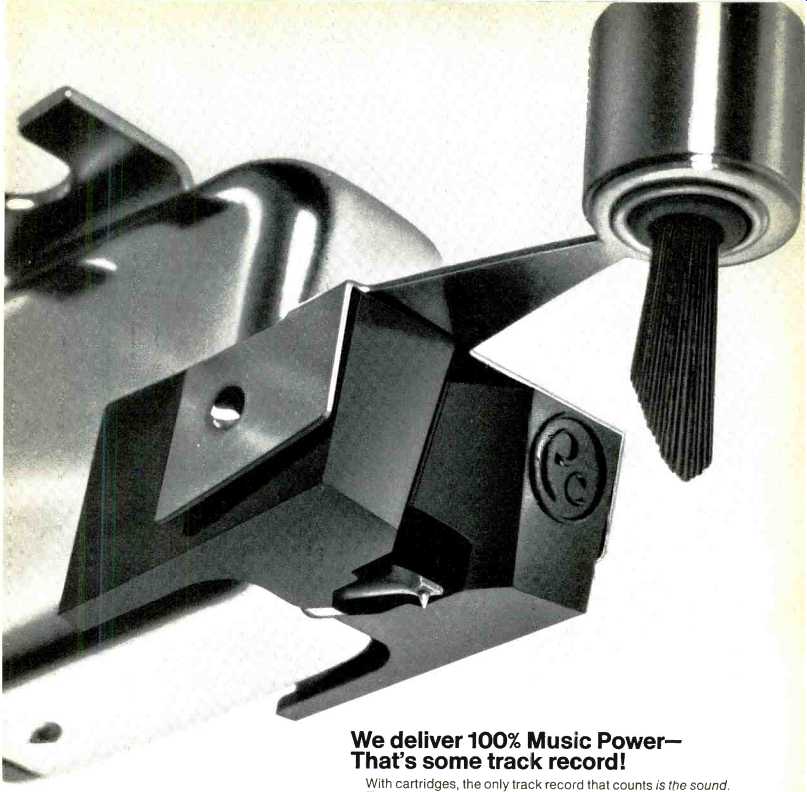
We deliver 100% Music Power--That's some track record!
With cartridges, the only track record that counts is the sound.
To provide great sound, a cartridge should be able to deliver 100% music power, especially at the high frequencies. Just like Pickering XV-15 cartridges do. You will hear the difference! Not an oboe-clarinet-and-flute but an oboe, clarinet and flute. And gone is that disturbing masking effect over the music. The Pickering XV-15 cartridge produces the 100% music power needed to clearly delineate all of the instruments of the orchestra.
And only Pickering gives every XV-15 model a Dynamic Coupling Factor (DCF) rating to help you select the right one for your record player (just like a horsepower rating serves as a guide to the proper engine for a vehicle). Improve your high fidelity music system with a Pickering XV-15 cartridge-priced from $29.95 to $65.00. For free catalog and DCF rating chart, write Pickering & Co., 101 Sunnyside Blvd., Plainview, N.Y. 11803.
The 100% Music Power Cartridge … for those who can hear the difference.
=======
ADC
GREAT STEREO STARTS HERE!
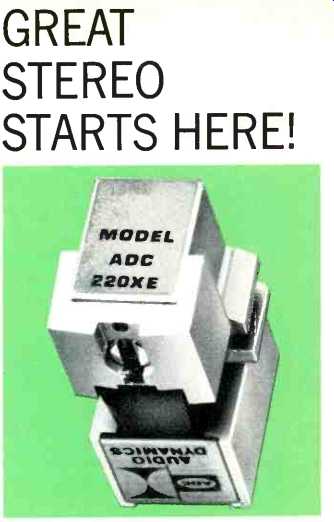
If you're becoming serious about listening to stereo equipment, here's a cartridge to get you started on the right track the ADC 220XE. Like its more expensive brothers, it is carefully crafted by hand with our exclusive induced magnet design. It tracks accurately and yields faithful sound reproduction with virtually any changer or tonearm. As you can see, the 220XE is really a great first cartridge. And even its low price of $22 will be music to your ears.
Of course, when you're ready to move up to more sophisticated stereo equipment, you can choose from ADC's complete line of superior cartridges. Isn't it nice to know we won't desert you on the way up?
ADC 220XE
SPECIFICATIONS
Output: 6 mV at 5.5 cms/sec. recorded velocity.
Tracking Force: 1 to 2 1/2 grams.
Frequency Response: 10 Hz to 18 kHz ± 3 dB.
Channel Separation: 20 dB from 50 Hz to 10 kHz.
Compliance: 20 x 10^-6 cms/dyne.
Vertical Tracking Angle: 15°. Rec. Load Impedance: 47,000 ohms nominal.
Price: $22 Suggested Resale.
Write for detailed specifications on other "X" series cartridges.
AUDIO DYNAMICS CORPORATION
PICKETT DISTRICT ROAD, NEW MILFORD, CONNECTICUT 06776
AUDIO FOR AUDIOPHILES
=========
Fairfax introduces the Unheard Speaker
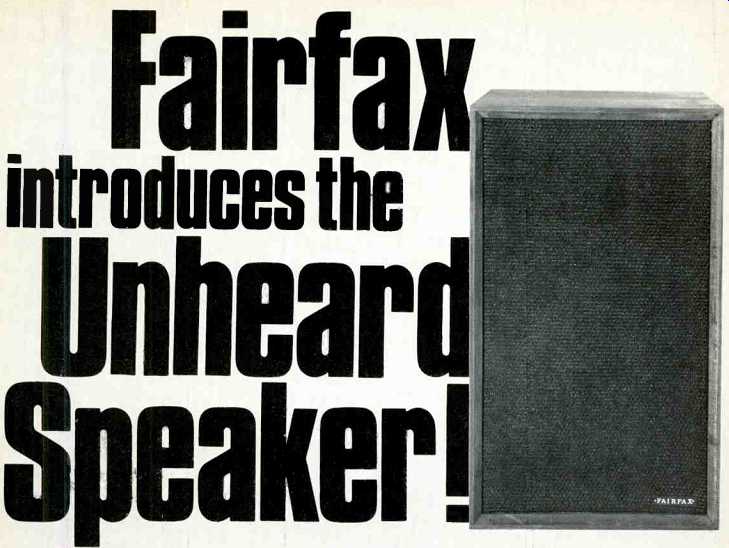

Now hear the speaker with the unheard of performance. The first speaker system to break with traditional stagnation in loudspeaker design and create the last word in audio reproduction. The FAIRFAX FTA is an electronic instrument so perfectly engineered and precisely tuned that it reproduces the original recorded music or human voice in unheard of dimensions and living presence realism.
The FAIRFAX FTA simply cannot be heard. All you can hear is the reproduction of the audio signals fed into it-no discoloration ... no distortion ... pure, pure rich, full-bodied sound.
Originally the FAIRFAX FTA system was built to custom specifications of audio engineers and professionals in the music industry because they demanded a speaker system which would not introduce any audible sound of its own, no undesirable harmonics and imperceptible distortion.-A standard of performance that could not be achieved on most well-known speaker systems.
INCREDIBLE ZERO OVERLAP AND TRUE PITCH The FAIRFAX FTA is the first speaker system to achieve the unheard of state-of-the-art standard of zero overlap-an achievement coveted throughout the audio industry-which now permits the unconscious differentiation between each of the individual musical instruments in a complete orchestra.
You don't have to be an orchestra conductor, recording engineer or audio technician to appreciate the astonishing results in the degree of realism that is so remarkably en chanced by the FAIRFAX FTA. All you have to do is love music and know how it should sound.
The realistic well-rounded, linear-in depth sound that you experience with the FAIRFAX FTA will enhance your stereo recordings and FM reception either mono, stereo or quad-. radial to a degree you've never believed possible.
The next time you're auditioning speakers insist on comparing the FAIRFAX FTA to other speakers of its class or even selling for as much as $100.00 more. You II be amazed at the superiority of the FAIRFAX FTA in all areas including the price! Unheard of at only $139.50 (suggested audiophile net). SPECIFICATIONS of the FAIRFAX FTA: 4 speakers, 3-way system; 1 low bass, 1 mid bass 8" woofers; 1 mid-high 3 1/2" tweeter; 1 ultra-high tweeter; freq. response 28-20,000Hz; 60 watt input; 25" H x 14" W x 12" D.
Other FAIRFAX Speaker Systems are available from $79.50 to $399.50 at quality-minded audio dealers. Ask your dealer for a demonstration or write to us for the name of your nearest FAIRFAX dealer.
900 PASSAIC AVENUE, EAST NEWARK, N.J. 07029
(201) 485-5400
=========
Wharfedale
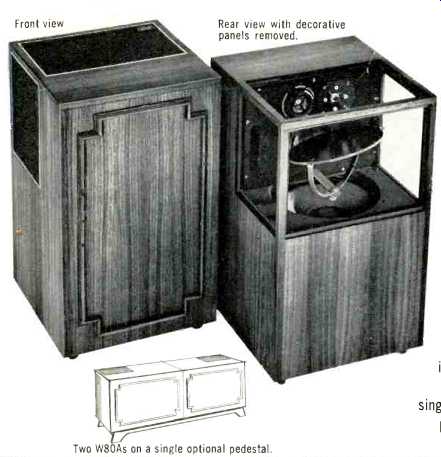
---Front view, ---Rear view with decorative panels removed.
Two W80As on a single optional pedestal.
The W80A Varflex is different!
Unlike any other speaker system available today, two W80As can be placed anywhere in a room, any distance apart or from a wall .. . even together on an optional pedestal as a single-cabinet consolette ... and still preserve stereo perception and original tonal balance no matter where in the room you are listening. Here's why:
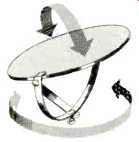
1. The exclusive variplanular disc inside the cabinet provides a discreet amount of direct frontal energy which is projected from the top of the cabinet; omnidirectional energy from the sides and rear of the cabinet; and reflected sound, mostly from the rear and top of the enclosure. The W80A is therefore not just an "omni" or just a "reflecting" a forward projecting speaker ......IS all three.
2. Furthermore, the W80A is a "VARIFLEX", because the variplanular disc is also adjustable. The disc is easily set just once while the system is being installed, without tools or special instruments.
There are numerous possibilities, to meet virtually every decor or physical requirement.
For example, setting the discs outboard widens the stereo sound, if you need to keep the two W80As close together. Setting the discs toe-in prevents the hole-in-center problem, if the room requires placing the two W80As far apart.
3. But, unlike most other multi speaker systems, the bass reproducer does not splatter its sound downward onto the floor, and the mid and treble speakers do not project in other directions. In the W80A, the fundamental tones and related harmonics, which give a musical instrument its identifying timbre and natural, realistic qualities, are reconstituted within a "mixing chamber" which contains the variplanular disc, so that the sounds of musical instruments enter the room as a whole, retaining tonal balance and further abetting stereo perception.
4. So startlingly effective is the combination of the mixing chamber and its adjustable variplanular disc, that you can freely walk about the room, even sit directly in front of one speaker, and you'll always hear both stereo channels. The music, always stereo, will literally follow you!
The W80A VARIFLEX is a decorator's dream, and happily, practical in cost. At $317.60 list each, it is more than a match for old fashioned speakers that are a lot bigger (the W80A is only 28" x 171/4" x 17" deep) and much more expensive.
For a complete catalog, write to Wharfedale Division, British Industries Co., Dept. HA-21 Westbury, N.Y.11590.
=======
JVC
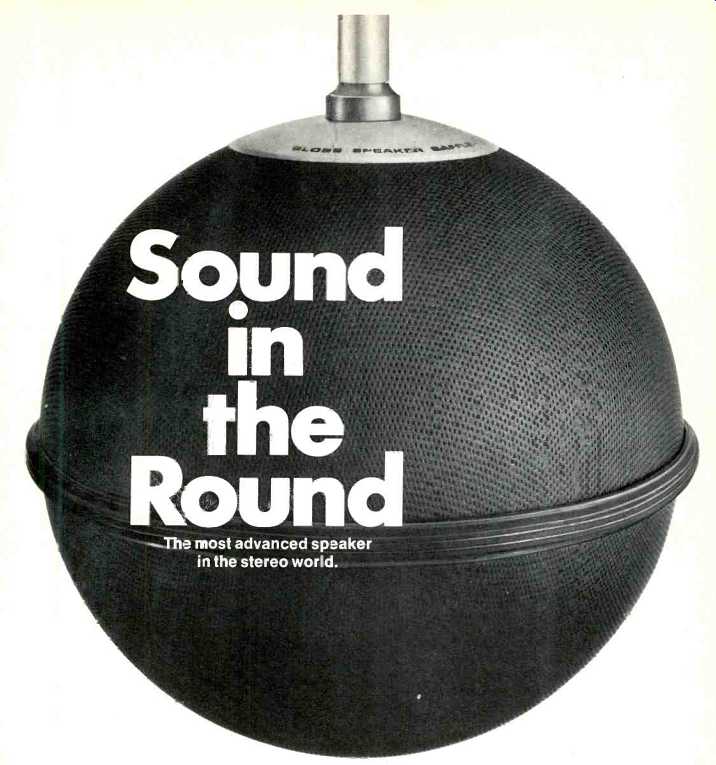
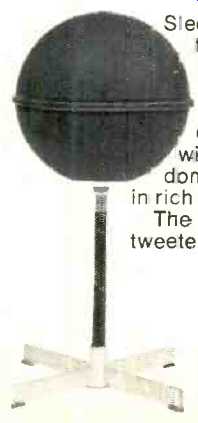
Sleek, black and omni-directional, the 5303 virtually eliminates tight polar patterns on the upper highs. Gives you deep, full timbered bass on the ultra lows. Banishes that bothersome "hole in the middle." Ends nailing your chair down to that one "best" spot common with conventional speakers. Gives you the freedom to roam around your own room, enveloped in rich stereo sound.
The 5303 utilizes tour woofers and four horn tweeters. Flawlessly reproduces the 20 to 20,000 Hz range. Handles up to 80 watts input with ease.
Can be mounted on stand (included), or hung from ceilings to give you more living space. If your tastes are more traditional, then check out JVC's Model 5340. It handles up to 80 watts. Integrates a cellular horn in its powerful 4-way speaker system. There are many other fine speakers in the JVC line. See and hear them at your nearest JVC dealer. He w II be proud to demonstrate them, just as you wall be proud to own them.
JVC-- Catching On Fast
JVC America, Inc.. 5035, 55th Road, Maspeth. New York. N.Y. 11379
= = = =
(Source: Audio magazine.)
Also see: