With the continuing dynamic growth of the professional audio industry, it has become something of a cliché to report that every Audio Engineering Society convention is "bigger than ever." This certainly was the case with the 61st AES convention at the Waldorf in New York, November 3-6.
As usual, the Waldorf's ballroom was filled to capacity with exhibits, and this year the stage area and all the boxes in the upper balconies of the ball room were also pressed into service.
Along with the demonstration rooms on the 12th floor, the conventioneer was confronted with a truly mind-boggling array of audio equipment.
Needless to say, as has been the case for the past few AES conventions, digital technology was the dominant theme. However, even the anticipation of this situation did not prepare us for the onslaught of activity in this field. Any visitor to this 61st AES convention, after having been exposed to all the glittering new digital recording equipment on display and listening to the many papers on digital technology, would have to conclude that the digital revolution isn't coming ... it is here! Thus, I make no apology for this AES convention report being mainly oriented to the "digital domain." It had been widely anticipated that at this 61st AES convention, the standards for digital recording would be established, or at the very least, close to resolution. Unfortunately, some unforeseen complications and procedural problems, not necessarily technical in nature, have put the standards deliberations on "hold" for the present. However, a "Technical Committee for Digital Audio Engineering" has been formed to ensure an ongoing exchange of data on digital technology which, it is hoped, will make a significant contribution to the resolution of the standards problem.
Of course, digital technology has been evolving for some time now, and except for certain proprietary aspects of the technology within various companies, most digital information is on a "shared access" basis among audio engineers. Thus, by happenstance and coincidence, the digital recorders which have appeared share many common features. For example, among the so-called "professional" stationary-head digital recorders, they all use 16-bit systems. The 3M, Soundstream, and the proposed Ampex digital recorder all have opted for a 50K per second sampling rate. They all give very cogent, but remarkably similar reasons for the rationale in their choice of sampling rate. The Japanese, on the other hand, whether their digital recorders are the ubiquitous helical scan variety or the few stationary head models that have appeared, still cling to their 44.056K sampling rate and its tie-in with the NTSC TV signal. Up until quite recently, all the helical-scan PCM recorders based on the various VCR formats have used a 13-bit, with 1 parity bit, nonlinear encoding setup.
Now, in the interests of better signal to-noise ratio and less distortion, the new Japanese "standard" appears to be a 14-bit linear encoding system. It would probably be correct to all these 14 bit/44.056K sampling rate PCM recorders as digital machines for the consumer market.

---3M Digital Editing System
Digital Evolution
Now let us take a detailed look at the digital recording equipment on display at the Waldorf. The 3M digital recording system has been described previously in these pages. It is a 16-bit/ 50K sampling rate system. At the Waldorf they were showing updated versions of the 32 channel on one-inch tape mastering recorder and the 2/4 channel on half-inch mix-down machine. The four systems promised to recording studios by the end of 1978 are said to be on schedule. Most importantly, 3M unveiled its electronic editing facility for the digital recorders.
The 3M programmable electronic digital editing system was engineered jointly with Inter-technology Exchange (ITX), Ltd. of Hollywood. The editing console consists of a video screen, teletypewriter keyboard augmented with special function keys, and remote controls for the 32-channel master and 2/4 channel mixdown recorders. In use, the editor selects the rough edit point by listening, then looks at enlarged visual representations of the sound amplitude on the video screen.
The display first shows 40 samples on either side of the tentative edit point and then the point is refined further by a so-called "zoom" function. With time-code control of edit points and microprocessor control of execution accuracy to within 20 microseconds (!), elaborate inserts and assembly edits are possible. There is also the great ad vantage of being able to "preview" hear the intended edits before their actual execution.
The 3M commitment to a complete digital mastering system was further evidenced by their announcement of a disc lathe preview unit. Using a random access memory, time generator, and digital-to-analog converters with a signal delay adjustable up to 1.3 seconds, the device delays a set of digital signals from the master recorder while analog signals proceed to a conventional computer lathe controller that optimizes groove pitch and depth. The important thing here is that the delayed signals remain in the digital domain, maintaining their integrity until the end of the delay, thus with no degradation of quality.
Dr. Tom Stockham's Soundstream digital recorder was the pioneering unit in the field. It still is a 2/4 channel unit using 1-inch tape and in its latest embodiment is a 16-bit/50K sampling rate system. Editing is done at Soundstream's Salt Lake City headquarters.
The system is in frequent use by a number of record companies, as a specific record session service under direct control of Soundstream. Sound--stream did not have a demonstration room at this convention, no doubt feeling that by now the system is quite well known, and some records made with it are already on the market.
Sony Surprises
One of the big surprises of the convention was the high degree of involvement by Sony in digital recording. Of course, they have pioneered in the consumer-type helical scan VCR recording with their PCM-1 digital encoder/decoder. I have recently used one of these units with considerable success. At the convention they were demonstrating their "big league" PCM unit, the Sony 1600. The 77-pound PCM-1600 is a 16-bit linear quantization system with, however, the familiar Japanese 44.056K sampling rate. The PCM-1600 is used with the Sony BVU 200A helical scan 3/4-inch U-matic VCR.
Electronic editing can be performed using the Sony BVE-500A videotape editing console. By using two of the VCR units with the video editor and the PCM-1600, pitch and depth control are possible with disc cutting laths.
The significant thing about all this is that the PCM-1600 and associated equipment is a system now in production, not a prototype. Price of the system is said to be around $46 thousand. Not content with this, on the stage of the Waldorf ballroom Sony had set up their imposing new 24-channel proto type PCM-3200 stationary head digital recorder. Actually this is one of a series of recorders in which 2/4 channel versions on 1/4-inch tape, 8 channels on 1/2-inch tape, 16 and 24 channels on 1-inch tape, and 32 and 48 (my gawd) channels on 2-inch tape will be avail able. All are 16-bit linear quantization systems, but a real surprise is that there is a switch-selected choice of a 44.056 or 50.35K sampling rate. Sony is covering all bases! The number of tracks on these recorders is greater than the number of channels, as they use two tracks per channel to allow phase modulation and proper redundancy, plus two analog audio tracks and one SMPTE time code track. The SMPTE track will aid in electronic editing on the deck and multi-deck synchronization. A tape speed of 15 ips is said to provide up to 120 minutes of recording.
As if all this activity in digital recorders wasn't impressive enough, Sony capped this by introducing a digital audio mixer. Initially it is an eight-input, two-output small unit, but Sony plans larger units all the way up to 48 channels! It is designed to mix 16-bit linear quantized digital signals with no analog process involved. It has the usual slider fader controls, echo send and receive facilities, and analog plasma bar-graph displays for level. Here again, sampling rate is selectable between 44.056K and 50.35K with, however, a maximum clock rate of 56K.
The reason for the echo send and receive is that Sony has also introduced a digital reverberation system.
The DRX-1000 has a built in micro-computer that allows programming of four different reverberation modes.
The unit accepts digital signals directly and adds reverb directly. It has initial delays up to 100 milliseconds, with reverb times as long as 20 seconds. The mixer will interface with digital equipment with sampling rates up to 55K. It will interface with analog equipment and Sony's new A-to-D and D-to-A ADA-1601 two-channel converter also introduced at the convention. It is obvious that Sony is aiming for the total digital recording facility and, at this convention, they have shown that they are really serious about digital technology.
Sony DAD-1 Digital Disc Player

One further bolstering of this idea was provided by the introduction of their DAD-1X digital audio disc. The system uses a one-sided reflective disc revolving at 450 rpm and is scanned by a low-power, helium-neon laser. The disc system is 16-bit linear-encoded PCM, with 95-dB dynamic range, and less than 0.03 percent distortion. Be cause of a new high density "run length limited code" system, the disc can play for an astounding 21 hours on one side.
Ampex has been keeping a low pro file on digital recording, although good reason told you that they must be working on a system. Ed Engberg, Ampex engineer, gave a paper on a so called "Proposed Digital Recording Format," which, not unexpectedly, opted for 16-bit linear quantization and a 50K sampling rate. Indications are that the ATR-100 might be modified as a digital mastering machine.
Plans for any multi-channel digital recorder are unknown at this time.
JVC was demonstrating its new 14-bit PCM unit with its Vidstar VCR, and it was very clean-sounding with some pop-type music. They are reportedly going to be demonstrating their capacitance-type digital disc system at the Winter CES in Las Vegas.
Digital Discs
Along with a prototype model of their RS-1800 30-ips automatic bias and equalization adjusting tape recorder, Technics was demonstrating their SH-P1 PCM digital encoder/decoder with the Panasonic VHS/VCR deck.
Yours truly recorded the digital tape for them, the Marlboro Festival players in Stravinsky's l'Histoire de Soldat, and I am pleased that it elicited much favorable comment. I am hopeful it will be heard at the Winter CES via their VISC digital disc.
Pioneer and MCA/Universal were demonstrating their digital disc version of the video disc Pioneer manufactures in Japan for industrial users. Not much info on it, other than it's another laser-scan system with 30 minute playing time per side and dynamic range 85-90 dB. Finally on the digital frontier was a paper by Philips on its compact laser-scan disc affording 90-dB dynamic range and a playing time of one hour per side. Oddly enough, it is not supposed to be compatible with their laser-optical video disc.
When I was in London recently re cording the London Philharmonic Orchestra, Arthur Haddy, the Technical Director of Decca Records, was kind enough to invite me and Mrs.
Whyte to a private demonstration of Decca's new digital tape mastering system made in their own laboratories at Finchley. Bill Bayliff, general manger of the Decca recording studios, and Tony Griffiths project manager at Finchly, were in attendance to explain matters and, in fact, were to attend the AES convention as well. I have been asked not to reveal certain details, but I can tell you it is a 16-bit linear quantization system, and the sampling rate is confidential. It uses a professional one-inch helical scan transport, has the ability to monitor off the tape, has, it is claimed, "100 percent dropout correction" (!), and very importantly for a record company ... complete "on session" electronic editing facilities. We heard some Ashkenazy Mozart from Kingsway Hall, plus an operatic recital from Walthamstow, and both were absolutely superb in terms of clarity, cleanness, and wide dynamic range. Furthermore, edits were performed right before our eyes and ears, to perfection I might add.
With it taking sometimes a couple of years to assemble operatic casts, the on-session editing ability is vital to such projects. Obviously, our British cousins are very much into the digital scheme of things.
Yes, Virginia , there is a thing called analog audio, and there were some interesting new items at the AES convention which we will discuss next month.
============
Video Scene
by Bert Whyte
In the last Videoscenes column (December, 1978) I reviewed the Sony SL8600 Betamax, a third-generation VCR in that format. While the Betamax was the pioneering consumer VCR, this was too tempting a market to re main the exclusive province of Sony for any extended period of time. Thus, JVC entered the market with its Video Home System (VHS) video cassette recorder they called the "Vidstar." Naturally, JVC wanted to offer a VCR system that was at least equal (if not better) in quality than the Betamax, with certain special features that would have a strong appeal for VCR customers. In the Vidstar, one of the major attractions was its ability to record for two hours, as compared to one hour for the original Betamax.
Other points in its favor were the ease of unattended recording with its easy to operate built-in digital timer, low energy consumption, and small size.
The VHS system was soon licensed to JVC's parent company, Matsushita.
In remarkably short time, JVC was sup plying OEM units for other electronic firms, while Matsushita was halving the tape speed of the VHS system, thus permitting up to four hours of recording. These extended play VHS recorders are sold by Matsushita under its own Panasonic brand and also sup plied as OEM units to various other companies including RCA in this country, who call their version of this VCR "Selectavision." Currently, the JVC VHS format has been adopted by more companies than those who opted for Betamax.
Recently, JVC introduced its second generation VHS unit, the Vidstar HR3600AU, with substantial refinements and innovations. Physically, it is a 17 7/8 in. wide, by 5-13/16 in. high, by 12 1/8-in. deep package, weighing in at 31 pounds, and attractively finished in a metallic tan color with simulated rosewood end panels.
As in most VCR machines, tape transport functions are activated by "piano key" mechanical controls, and there are separate UHF and VHF rotary channel selectors. These machines have push-in fine tuning knobs and an AFT (automatic fine tuning) button to "lock-in" the program after manual fine-tuning adjustment. The front pan el also has toggle switches for record select and cassette or TV select, digital timer read-out and adjustment controls, microphone input, tracking control, tape counter, and search function button, plus several other special function controls we will get to shortly.
The rear panel has the usual UHF and VHF terminals, video and audio inputs and outputs, and a special remote control facility.
The JVC Vidstar uses the rotary slant-azimuth two-head helical scan recording drum system to record a standard NTSC color signal at a linear tape speed of 1.31 ips. JVC claims the 62-mm wide head drum is the smallest in any VCR and that the record/play head gap is only 0.3 micrometers wide, less than half that of most current VCR units. This narrow gap, coupled with JVC's technique of removing the guard bands which normally separate adjacent tracks in azimuth recording, is claimed to be responsible for the high signal-to-noise ratio of more than 45 dB and achievement of high density recording on half-inch tape without degradation of the color quality. The high signal-to-noise ratio density recording is also due to a number of inter-related technological advances in VCR circuitry. One is what JVC terms "Double Limiter Frequency Modulation," somewhat similar to their Super ANRS (automatic noise reduction system) and the Dolby system in audio, which improves the signal to-noise ratio of the black and white video signal by boosting the picture's brightness over the inherent noise signal. Another part of this is the "Burst Level Up" system, which is similar in function to the DL-FM system, but is used to ensure the proper color hue and saturation for the color video signal.
The final part of this special circuitry is the PSC (Phase Shift Color) system.
When JVC removed the guard bands from the tape to enable high density recording, it created the problem of "crosstalk" at low frequencies (color information). By using the phase-shifter circuitry of a TV receiver and adding a control circuit which attenuates the crosstalk of signals drifting from one video track to another, proper hue is maintained and image degration avoided.
Another feature of the Vidstar is a built-in thermal heating system, which is activated when room temperature falls below 50° F, thus preventing harmful moisture condensation on head drum and tape. Most other VCR units merely have a light to warn of this condition, with no corrective heating circuitry.
New on this HR3600 model of the Vidstar and, for that matter, any other VCR is the ability to operate in other playback speed modes beyond the normal real-time viewing at the 1.31 ips tape speed. On the front panel is that special control I mentioned earlier, Speed Play. When this button is depressed, the tape speed is doubled.
Of course, the action is speeded up in a sort of "Keystone Cops" fashion, but although the audio track is also doubled in speed, through the use of clever digital voice compression techniques, there is no pitch change or "monkey chatter" effects, and speech remains perfectly intelligible. Obviously this can be useful for rapid location of a segment of the program, far more precisely than the usual "fast forward" mode. One can also envision that having recorded several episodes of a serial or multi-part program, it is viewed at double speed to reduce running time and "catch up" with current episodes. There is a jack on the front panel and a remote control, which is supplied as standard equipment with every HR3600 Vidstar, plugs into it to enable switching between normal and double speed viewing.
The HR3600 Vidstar has a Pause control, which it is also labeled Still.
This is a stop-action feature, which permits "still picture" viewing of any scene in the playback mode. Bands of noise may be visible on the screen in this mode, which are correctable via the tracking control. A quasi "slow motion" effect is also possible through use of the tracking control. A rear pan el "Pause/Remote/Still" jack accepts a supplied remote control switch. This allows remote control of starting and stopping of the tape during recording. . . in other words a "commercial killer," as well as controlling the "freeze frame" function. The JVC GC3300AU color video camera can also be plugged into this jack, in which case the camera's "stop/start" button controls the starting and stop ping of the video tape transport during recording.

----------JVC HR3600 Vidstar
The new HR3600 Vidstar is obviously a versatile unit, with the interesting special features adding to its appeal.
More to the point is that it is an excellent unit in terms of its normal VCR functions. I found all the controls easy to use, and they worked with commendable smoothness. A definite plus for people with small living rooms is that noise from the scanning drum and tape transport was exceptionally low, making this Vidstar the quietest VCR I have used thus far. The Vidstar accepts 30-, 60-, and 120-minute video cassettes, with a three-hour cassette to become available early this year. I used video cassettes supplied with the Vidstar, as well as VHS cassettes from TDK, who are just getting into the VCR market with both the VHS and Betamax formats. I didn't find any quality differences in the cassettes, probably because the Vidstar OEM cassettes are made by TDK. In any case, the pictures produced by the cassettes were first class. Dropout glitches were rarely encountered, and jitter was quite low.
Picture distortions and anomalies usually attributed to poor tape packing within the cassette were nonexistent.
Repeated use of a single cassette did not produce noticeable frilling of the tape edges, and there was no image deformity.
With the high 45-dB signal-to-noise ratio of the Vidstar, the resolution of the image quality was very good indeed. Horizontal resolution in the color mode is specified at 240 lines, which is quite high for half-inch tape, but believable in view of the perceived picture quality. Images were quite stable, and brightness and contrast ratios were well averaged, with no "hot spot" extremes. Color hue and intensity were exceptionally stable. As in the Betamax, longer playing times are the result of using progressively thinner tapes, at the one tape speed.
As far as I could see, there was no perceptible degradation of image quality, when using a 120-minute cassette, as compared to a 30-minute cassette. Audio quality of the Vidstar, although specified as 50 Hz to 10 kHz, is no better than the Betamax, and this remains the weak spot for all the VCR units I have used thus far.
All in all, the new HR3600 Vidstar must be judged a "star" performer. As a straightforward VCR recorder, it functions both well and dependably.
Add to this the special "frills" and features of this Vidstar, and VCR recording becomes even more interesting. . . and more fun, too!
============
ADs:
MA -- A best seller. Versus the best.
--The New Large Advent Loudspeaker, $139.00 per speaker
--Micro-Acoustics FRM-2ax, $180.00 per speaker
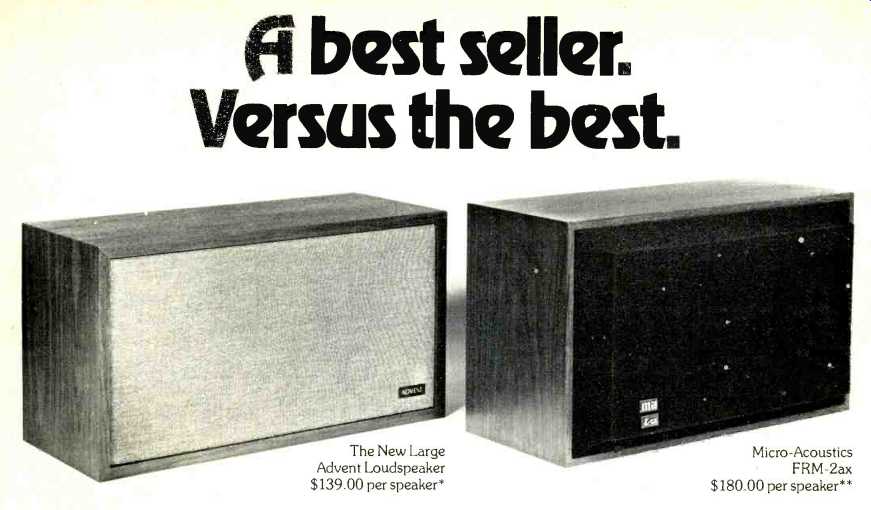
Compare these two speakers, and you'd probably expect the one on the left--with the lower price-to be the better seller. You'd be right .. . but is it the better value? Before you decide, it pays to consider how much more a little more money will buy.
Compare highs. The FRM-2ax uses two dispersion tweeters for room-filling, lifelike highs.
Then adds a super-tweeter for true reproduction of overtones to 20 KHz. All high-frequency transducers are precision-mounted in a diffraction-free Tri-Axis array.
Compare bass. The new FRM-2ax employs a 10" acoustic-suspension woofer with treated multiple-sinusoidal annulus surround, for long excursions. The woofer is tightly secured in a ruggedly-constructed enclosure, providing rich, full bass.
Compare warranties. The FRM-2ax is warranted twice as long.
The Micro-Acoustics FRM-2ax. When you compare, there's really no comparison.
Micro-Acoustics Corporation, 8 Westchester Plaza, Elmsford, NY 10523, (914) 592-7627. In Canada, H. Roy Gray Ltd., Markham, Ont.
Micro-acoustics Quality worth a 10-year warranty.
*Price for utility version shown. Also available in walnut veneer at increased cost. All prices slightly higher in Western region.
**Slightly higher west of Mississippi.
All side-by-side comparison photos are un-retouched.
1978, Micro-Acoustics Corporation.

Complete FRM-2ax specifications are available in Micro-Acoustics literature No. L-2113.
-----------------
Nikko
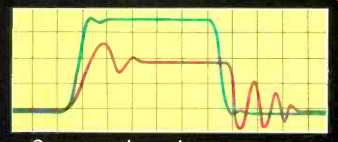
The Nikko Alpha III delivers exactly what you want to hear--no distortion, no noise, no crosstalk just music.
Professional Approach
The Alpha III is a DC, power MOS-FET stereo amplifier. As with any amplifier designed for heavy duty use, each channel has its own independent power supply and transformer for more power with less distortion.
The Alpha III delivers more than enough power for clean reproduction and full dynamic range with any loudspeakers you are likely to use. Total harmonic distortion is the lowest found anywhere.
Power bandwidth is an impressive 80 watts minimum per channel, both channels driven into 8 ohms, 20 to 20,000 Hz, with no more than 0.008% THD.
Compare the pulse wave reproduced by the Alpha Ill (above) with that of a typical amplifier. Note that the Alpha III produces a nearly perfect reproduction of a laboratory square wave.
DC Means Less Distortion, Wider Bandwidth A direct coupled (DC) amplifier eliminates the phase distortion and bass limitation imposed by the input and output capacitors of conventional amplifiers.
Direct coupling enables bass performance right down to the theoretical limit: 0 Hz, or dc (direct current).
Power MOS-FET's, Now

Power MOS-FETs are the most advanced transistors. Until now, none were rigorous enough to be used as power output devices.
No amplifier had them. Now, the Alpha III incorporates two pair for greater reliability, improved linearity, and smoother frequency response.
Power MOS-FETs and DC operation from input through output are responsible for stability and performance not obtainable from any other circuit design.
Loudspeaker Control
The damping factor of 80 indicates how well the Alpha III restrains speaker cone movement after the music signal has stopped.
Some consider high damping factor a frivolous refinement--we believe it's crucial to undistorted loudspeaker performance.
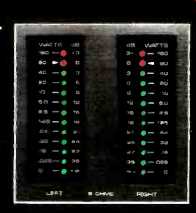
LED Power Display Nikko peak-holding LEDs display power output directly, in watts and in decibels.
Easy to read, LEDs are more accurate and operate at greater speed than any meter mechanism.
It's Your Move
High output. Low distortion.
Maximum reliability. We've told you some of the facts. Now it's time to get the complete story and hear Alpha III for yourself.
Call our toll-free number (800) 423-2994 for the name of your nearest Nikko dealer. Find out why the Alpha III is known by the sound of its technology.
Finished in satin black, the Alpha Ill can be mounted in the new Nikko 19-inch professional rack mount cabinet.
For those who take their stereo seriously.
Nikko Electric Corp. of America
16270 Raymer St., Van Nuys, Calif. 91406 (213) 988-0105; 320 Oser Ave., Hauppauge, N.Y. 11787 1516) 231-8181
Nikko Alpha III: Known By The Sound of its Technology.
---------------
Kenwood
HIGH SPEED AMPLIFIERS: FASTER TRANSIENT RESPONSE THAN ANYBODY.
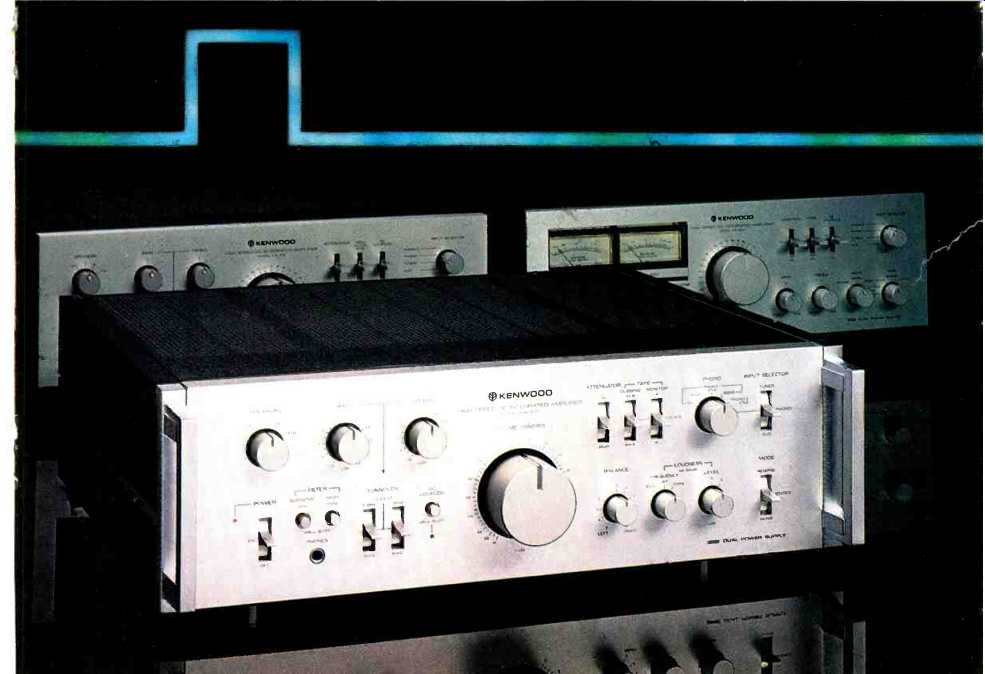
Today, it's not enough to select an amplifier simply by power specs and THD.
That's why Kenwood first introduced DC amplification and dual power supplies in integrated amplifiers to improve low frequencies and eliminate crosstalk distortion.
Now comes the next significant breakthrough:
Hi-Speed. It allows the amplifier to react more quickly to a change in the input signal than ever before. So what comes out of the amplifier matches precisely what went in.
The mid-to-upper frequencies are particularly vulnerable to degradation caused by a slow transient response. But Hi-Speed creates a rapid voltage change (slew rate) which makes the amplifier as fast as the music.
On test equipment, an accurate output signal will show a square wave. And the more rapid both the rise and decay time, the more square the wave. It's an easy way to see the difference Hi-Speed makes.
Compare it with any of the competition.
To hear the difference, listen to a familiar record through a Hi-Speed amp. You'll notice depth and definition that will amaze you. Like each violin individually heard in a string section. Even separate handclaps in recorded applause. Until recently, Hi-Speed was available only in our limited production Audio Purist Group. But now, the next chapter of high fidelity is available to anybody with the ear to appreciate it.
It's at your Kenwood dealer, now.
HI-SPEED -- Hear the future of high fidelity.
KENWOOD -- For the dealer nearest you, see your Yellow pages, or write Kenwood, P.O. Box 6213, Carson, CA 90749.
In Canada: Magnasonic Canada, Ltd.
Model KA-907: $1000. Model KA-601: $600. Model KA-701: $450.
Nationally advertised value.
Actual prices are established by Kenwood dealers.
-----------------
When you test-drive the best speakers from Britain you'll drive home with real sound.
You're a confirmed audiophile and nobody can fool you with a lot of promises.

You're ready for the ultimate test and only your ear will be convinced.
When you test-drive the best from Britain we know well have your ear and maybe a lot more.
When you're ready, take a variety of recorded music into your dealers. (Use direct disc recordings so you can put our speakers to the real test. ) We know you'll be amazed at the accuracy.
And we'll have turned another confirmed audiophile into a dedicated Anglophile.
We've been convincing lovers of sound in Britain for over half a century.
And we've earned our reputation as the leader by not compromising.
We don't rely on gimmicks. Every speaker in our completely new line of systems is based on sound engineering principles and tested thoroughly.
As you know, with everything in audio, it's the end result that counts, not the means to get there.
But we don't neglect the means either. To get your ear, we use our English craftsman's pride in carefully putting together the right components for delivering a broad range of sound smoothly and uniformly so you get the flattest response possible.
When you take a look at the specs you’ll see what we mean.
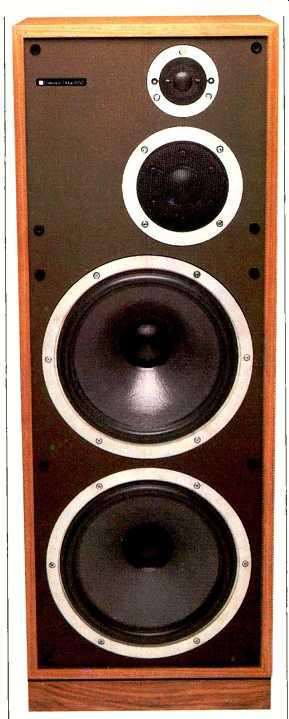
We've shown the Ditton 662, but all three new Ditton speakers, besides being technologically superb and precision engineered, are beautifully styled and assembled in the fine English cabinet making tradition, to fit into any decor.
And we've used a completely different design concept for each of them to satisfy your individual taste and budget.
So now that you've grown up to real sound, you can test-drive your choice of the best sound from Britain.
But you won't be able to find them at just any dealer. For our select list of shopkeepers who carry Celestion, simply drop us the coupon and we'll send you the list by return post.
But don't delay, the traffic may be heavy.
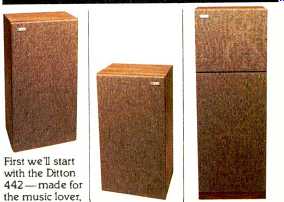
First we’ll start with the Ditton 442-made for the music lover, who wants full bass sound.
Large presentation for hi power system.
Sealed box design -- inside, a second sealed infinite transmission line enclosure for the mid-range unit.
Drive units:
FC 121, 330 mm bass unit with 46 mm voice coil.
FC 61, 130 mm mid -range with 25 mm voice coil.
HF 2001 treble unit with 19 mm voice coil.
Controlled by 14 element di viding network with fuse protection for the treble unit.
What you get is less restriction, overall balance openness with no coloration.
---------
Then move up to the Ditton 551
For outstanding dispersion - tight sound.
A vented box design with improved bass response from a smaller bass unit.
Drive units:
PC 101, 290 mm bass unit with 50 mm voice coil.
MD 701 midrange with 46 mm voice coil.
HF 2001 treble unit with 19 mm voice coil.
Controlled by 15 element network with fuse protection and failure light for the treble unit.
Also level controls for treble and mid-range up to 2 dB boost and 6 dB cut.
---------
And finally, the top of the line, the Ditton 662.
Our passive radiator (ABR) system gives solid bass, smooth response and dispersion, and stereo imaging.
Use with all power amplifiers.
Has 3 active drive units and passive radiator.
Drive units:
FC 122 bass unit, 330 mm passive with double suspension for pure axial movement.
MD 501 mid range with 52 mm voice coil.
HF 2001 treble unit with 19 mm voice coil.
Controlled by 14 element network with fuse protection for treble unit.
Celestion.
Nobody sounds better than the British.
----------------
Dual
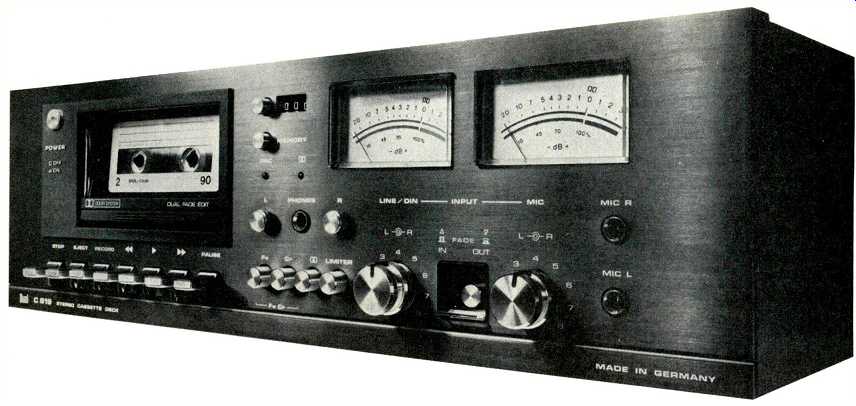
"In its price class, the Dual 819 has some formidable competitors, and one has the right to expect first-class performance from any cassette deck selling for more than $400. Nevertheless, even in such distinguished company, the 819 stands out."
Hirsch-Houck Labs in Stereo Review, December 1978.
We shall be pleased to send you the complete Hirsch-Houck report if you write to us directly. If you'd rather not wait, here are some additional key excerpts: "...the extremely low flutter, flat frequency response and low noise level of the 819, combined with its superbly accurate and useful meters, make this one of the more attractive values in a high-quality cassette deck. Such features as the fade/edit system and the bidirectional memory can be considered simply as bonuses.
"The Maxwell UD-XL-I tape provided a very flat record-playback response (at-20dB) within ±0.75 dB from 30 to 15,000 Hz ...the response with Sony Ferrichrome was flat within ±1 dB from 33 to 15,000 Hz... the Dolby tracking was among the best we have measured ... with a weighted rms reading the flutter was an amazing 0.035 percent. It is clear that in all aspects of its design and performance, the Dual 819 is a first-class unit." One final comment of our own.
As you know, Dual's reputation for quality, precision and reliability has been based upon the performance of our turntables. When we introduced our first cassette decks, we knew they must establish a reputation of their own. And it is evident that they are doing just that.
Dual -- United Audio 120 So. Columbus Ave., Mt. Vernon, NY 10053
------------------
SENNHEISER -- OVER $80. AND UNDERPRICED.
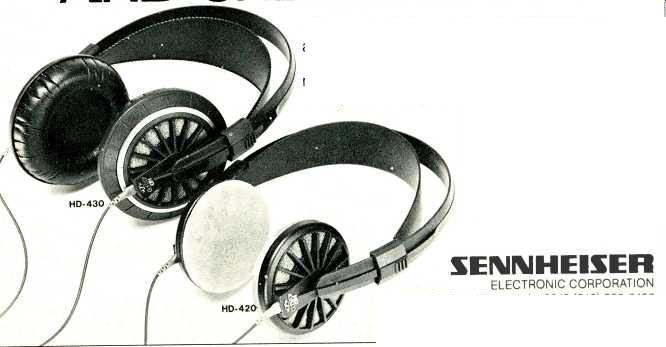
You probably know that our headphones are among the world's most highly-praised.
You may know that our company doesn't introduce new models frequently.
Yet, here we are, introducing two new headphone models. And telling you that as good as our other head phones are, these are better.
It's no exaggeration. Hear what we mean at your Sennheiser dealer.
SENNHEISER ELECTRONIC CORPORATION 10 West 37th Street, New York 10018 (212) 239-0190. Manufacturing Plant: Bissendorf/Hannover. West Germany.
1978 Sennheiser Electronic Corporation (N.Y.)
============
(Source: Audio magazine, Feb. 1979; Bert Whyte)
= = = =