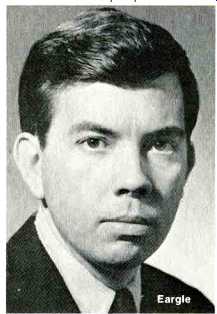
---Eargle
EVEN THE most casual observer of the audio scene is aware of the intense activity in the field. The various aspects of four-channel stereo, developments in the cassette format, Dolby noise reduction ... all these are healthy indices of the dynamic growth and rapidly expanding technology of audio. Having delivered this nice fat platitude, one is bound to say that there are people who view some of these developments with something less than enthusiasm. For example, there are some hard-nosed audio retailers who feel that all the hoopla about four channel stereo is premature and unwarranted and can only have an adverse effect on their two-channel stereo business. Okay . . . that's understandable
... no one wants to get stuck with obsolete inventory. I personally don't think this is going to be a major problem. With cool-headed buying and the application of imaginative merchandising, these dealers can cope with the advent of four-channel stereo, just as we dealt with the transition from monophonic sound to stereo. I can tell you this fellas, you had better review your situation and adjust your attitude, for there is every indication that four-channel stereo could be a viable market entity as early as the fall of this year.
The massive RCA advertising campaign for Quad Eight stereo will have terrific impact and it would be unwise not to be prepared for the overall boost this will give to four-channel stereo. You would be surprised at how many record companies, besides RCA, are busily preparing Quad Eight cartridges! Which brings up another point... . I have seen the release lists for the Quad Eight cartridges from a number of record companies, and I have talked to their engineers. There is little doubt that the type of four-channel stereo sound that will predominate will be of the total surround ping-ping/pongpong variety, with equal amplitude on all four channels. While this should apply mainly to pop music, unfortunately there seems to be some talk that classical music will be similarly processed. It would appear that there will be relatively few of the classical works recorded with ambient information on the rear channels. Of course, it must be admitted that there are very few classical recordings which have been recorded in the four-channel stereo mode. And as I have pointed out a number of times, there are some fairly divergent views on how to record classical four-channel stereo. So I am afraid we will be subjected to some pretty "hoky," phony four-channel stereo classical recordings, in much the way the same thing happened in the early days of two-channel stereo. It is a relatively easy thing to "mix down" an 8- or 16-channel pop recording to the equal amplitude four channel stereo format. As I have noted in these pages previously, in the strictest sense, neither two- nor four-channel stereo pop recordings are stereo in the classic definition. They are really a number of monophonic tracks with reverberation added for "liveness" and oriented left/right, or as is the case with four channel, pan-potted as well.
It is quite another matter to take a two or three-channel stereo classical recording and convert it to four-channel stereo, especially if what is wanted is equal-amplitude, "total surround" sound. Some ghastly things have been proposed, such as taking the middle channel and splitting it to left and right rear! Since with the usual recording setup in a concert hall the center channel of a three-channel stereo recording is mainly woodwinds, with perhaps some strings ... that is what you would be hearing behind you! Bizarre is hardly the word. The big problem for anyone trying this kind of manipulation with a classical stereo recording is that he is dealing with a true stereo recording.
Thus the orchestra totally interacts with the acoustic environment of the hall, producing both direct sound and multiple reflections, which are picked up by the microphones as functions of "time of arrival" and differences in intensity and phase. In a properly made three channel recording for example, while we get directional information which tells us that the first violins are on the left and cellos on the right, there is a certain amount of overlap in the polar patterns of the microphones (they are deliberately positioned to take advantage of the overlap) so there is no gross isolation between the channels. The ideal of course, is to obtain a panoramic "wall of sound," with sufficient directional cues for localization of a discrete instrument or groups of instruments. This lack of pronounced isolation would make very difficult the pop-oriented mixdown of a classical stereo recording.
As most everyone knows, the human eye can be fooled with a variety of optical trickery. So too can the ear be fooled, with psychoacoustic factors prominent in this respect. Now in any four-channel stereo recording, the principal information is on the front left and right channels, and it is a very large proportion ... probably on the order of 90 percent or even more. Now suppose we could take a two-channel preferably a three-channel classical stereo recording and somehow process it so that we could get a four-channel recording with ambient information on the rear channels, which would sound to our ears as if the recording was made in the four-channel stereo mode originally! Well friends, such a process exists! John Eargle, Chief Engineer of Mercury Records presented a paper and gave a demonstration at the last AES Convention in New York of his system of processing two- and three-channel classical stereo recordings into four channel stereo recordings. As you might expect, it is a fairly complicated process, and next month I will report on it in detail. It is important to remember that in his process Mr. Eargle is concerned only with the creation of reverberant information to simulate the ambiance of the concert hall. The resultant processed tape is in the four channels in line format, and is played through four amplifiers and loudspeakers. In other words, it is treated like a true four channel stereo classical recording. As is pretty well known, I'm an audio purist.
I can assure you that Mr. Eargle is equally uncompromising in his audio endeavors. So when I heard about this process and who had worked it out I was a bit shocked ... and reluctantly ... skeptical. As far as I was concerned, any deviation from honest-to-God four channel stereo recording was anathema.
Mr. Eargle kindly supplied me with one of his processed tapes ... and the results were astonishing. The system not only works, but works so well that the ear immediately accepts what it hears as indistinguishable from a true four channel recording. The hard part is that you know you're being tricked, but the ears refuse to acknowledge this and insist you are hearing four-channel stereo. A truly remarkable technique that opens up all sorts of possibilities with the thousands of recordings in the classical catalogs. More next month.
Dolbyized Cassettes You will recall that last month I reported on the first Dolbyized cassettes from Ampex and from Decca of London and that I had two cassettes from Vox, which I would talk about this month.
Vox cassette 678030 has a group of songs with orchestral accompaniment, by Satie, Milhaud, Stravinsky, and Ravel. Vox cassette 678029 has two rare piano concertos, one by Moscheles and the other the 4th piano concerto of Anton Rubinstein. Musically they are both excellent, with Darius Milhaud himself conducting on his work. From the technical standpoint, these cassettes are somewhat different from the Ampex and Decca, in that they were recorded on C-90 tape. C-90 has a thinner base and a somewhat thinner oxide than the C60 type, and this turns out to have certain advantages over C-60. A recent communique from Dolby points out that C-60 provides good output at medium frequencies, but marginal high-level output at high frequencies. By using the thinner oxide C-90 a 1 dB reduction in medium frequency output results, but this is little sacrifice for the great improvement (typically 7 dB at 10kHz) obtained in the maximum output at high frequencies. This enables full frequency response to be maintained even in the loudest of passages. Another advantage of the C-90 is that the tape has greater mechanical compliance, affording better head wrap and tape head contact, resulting in decreased dropouts, d.c. noise, and modulation noise. Listening to the cassette, it was apparent that there was a significant improvement in high frequency response, evident in a smoothness not noted in the C-60 cassettes.
There was also noticeably better transient response and the pianos benefitted there--from, sounding bright, crisp and clean. At a level of 100 dB on peaks, the cassettes were almost completely free of hiss ... one had to consciously listen to hear any. It seemed to me the tiny residual amount was apparent compared to the Decca/London cassettes because of the better high end.
Both cassettes sounded incredibly clean, with just a trace of overload distortion in the vocal works, and it is claimed that this distortion is on the master.
Mechanically they were very good, free winding, and smooth. A slight cyclic ticking noise in the last few minutes of the Rubinstein concerto turned out to be static discharge, which was not evident in another copy of this cassette.
One thing is certain and that is once you start listening to Dolbyized cassettes, you can't stand the "escaping steam" hiss of standard cassettes!
(Audio magazine, 1971)
= = = =