Dear Editor
Missing Issue
Dear Sir:
Just thought I'd drop a line to see if you were still in business, or if you had merely given it to me. I had just finished reading the November issue, and I was beginning to worry. I already had the January issues of my other magazines (that's January, 1971, of course), but still there was no December issue of Audio. I know what kidders you fellows are, and I was seriously considering waiting until Christmas to see if you were having Santa come down my chimney to deliver it in person. But my chimney leads to the furnace, so that would not have done me much good, a charred Audio and a roasted Santa. Perhaps, if you haven't gone out of business, you could mail it to me. I have enclosed a mailing label.
As you can see, it did not come off the cover in perfect condition, so I have reproduced it for you. Come to think of it, that may have had something to do with your magazine's demise; you may have been spending too much money for glue.
-Mrs. Edward Keppner, Quincy, Ill.
Dear Mrs. Keppner:
Many thanks for your letter about the missing issue, which was passed to me-casting a grey shadow over the entire day. The December issue was sent to you but either the pack mules got sick and did not reach Quincy, Ill. or the magazine was put down the wrong chimney. Or it might have been destroyed by agents of those other magazines as part of a well-thought-out and highly calculated plot to keep Quincy, Ill. uninformed and knowing nothing of what is going on Behind the Scenes... . However, another copy was sent to you on January 9th and you should have received the January issue too. If not, perhaps you would let me know? Before you write, please make certain you are still living on Eleventh St.
Finally, I am glad to say we are very much alive and that the chances of our survival for the rest of your subscription period appear excellent.
-Ed.
P.S. Have you ever thought about moving to Philadelphia?
Farnon Society
Dear Sir:
"Two Cigarettes in the Dark," an LP by Robert Farnon's orchestra, has been re-released in England as Eclipse ECS 2053, along with many other fine older London records which have, been deleted since the 1950s. In the course of my three-year search for the original release (London LL 1052), which I finally did find a copy of, I discovered the Robert Farnon Appreciation Society in England, which is an active group of about 100 members all over the world.
We trade information on recordings of all artists in the light orchestral, easy listening, and mood music fields.
I mention "Two Cigarettes in the Dark" because it would be a shame if other collectors are as desperate to find a copy as I was and aren't aware of the English re-release. Any readers who are interested in the Robert Farnon Appreciation Society may write to me.
Steve Keller ; 1045 Oakland Road N.E. Cedar Rapids, Iowa 52402
Three-Channel System
Dear Sir:
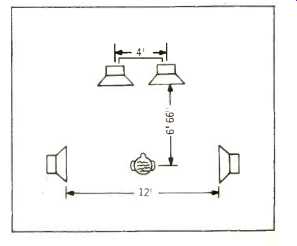
I am presently using a system, which may be too obvious since I haven't seen it suggested. Going Dynaco one better, I drive two speakers from the hot outputs of my amplifiers. So far, it doesn't appear to affect performance. This gives what I call three-channel, four speaker stereo when used with two normally wired front speakers, I believe that four-channel stereo is probably very little better. Naturally, as with the Dynaco system, it would help if the records were made with the use of this output in mind. As a starting point for those wishing to experiment, I am enclosing my present speaker arrangement.
-E. Strawn Kokomo, Inc.
---------
===============Editor's Review
THE FIRST dynamic speaker was probably in vented by Siemans in 1881 but electronic power amplifiers did not appear on the scene for many years-but believe it or not, loudspeakers were used in the early nineteen-hundreds at a number of sports stadiums and exhibitions. And with very high power outputs, too. How? By using compressed air. Originally proposed by Edison, the first "air speaker" patent was taken out by one Horace Short who demonstrated his "loudhailer" from the top of Eiffel Tower, in Paris. Later, in 1904, Parsons (the inventor of the steam turbine) evolved a more sophisticated device called the Auxetophone which used a 30-ft. horn. The British HMV company used both the Parsons and Short patents in smaller, more domesticated models that enjoyed limited sales until about 1914. These instruments employed an air valve developed by Dennison of the Victor Talking Machine Company and volume was sufficient for quite large halls and theatres. Parsons joined forces with Short and they evolved a compressed air amplifier for cellos and. double-basses which was so successful that Sir Henry Wood used them with the Queens Hall orchestra in 1906. (The Musicians Union was not impressed!) A few years later, another air-system was being extensively used in sports stadiums and other places needing high power. This was Gaydon's Stentor phone which had a rotary compressor similar to the present-day Wankel engine. It generated 10 lbs. per square inch with peak outputs up to 50. Owners of a Bexhill, London, skating rink were so enamoured with their Stentorphone that they allowed non skaters to come in and listen at a small charge. Naturally, with the advent of electronic amplifiers all these exotic devices disappeared, but, who knows? Perhaps there is an optimist somewhere who is busily working on a new air-speaker that will Bring True Hi-Fi to the home, etc., etc.
Quadraphonics
Two record companies, Ovation and Enoch Light Project III, have announced that they will market four-channel records, and there is more news from Electro-Voice about the Feldman-Fixler systems. This company reports that encoders are now available for broadcast stations. Orders have been received from WNEW New York, WKNR Detroit, WJIB Boston, KSAN San Francisco, and last but not least WMMR in Philadelphia.
------------
Philadelphia was also in the news recently when the Girard Bank announced that they have commissioned Samuel Barber to write a Choral Symphony which will be premiered by Eugene Ormandy and the Philadelphia Symphony Orchestra in September. As far as I know, this is the first time a bank has sponsored a musical work of this nature but many people will echo the sentiments of Girard's Chairman Stephen Gardner who said "Good citizenship calls for such involvement." Humor in Advertising This is really an example of humor-in-translation and the tortured English describes one of the small electrostatic speakers mentioned on page 30 ".. . the static high-tone speakers known so far features the flat diaphragm, therefore the reflection takes place in copious bundles. This new speaker has no baffle plates, by-pass lines, metal tubes or similar auxiliary means which would after all bring fading symptoms, knots, and irregular reflections in their wake due to their different running times." Sounds more like the L.I. Railroad... .
-------------
Two of the writers in this issue are somewhat critical of the Doppler distortion theory. The other side of the argument is in our August issue (The Mud Factor by Paul Klipsch). This is a subject of some importance and other opinions will be published in future issues. One of the contributors is a well-known Dutch expert, Henry Van Hessen whose article is very amusing. The Dutch have no sense of humor? Don't believe it. Another writer is David Griesinger who has been busy taking measurements for the past few months.
-------------
As many readers have noted, many RCA records issued during the past year have been exceptionally thin and some cynics have accused RCA of "cheeseparing" in an effort to make more profits.
This is not the case at all and the whys and wherefores of the thin disc--called Dynaflex--was the subject of a paper presented by Warren Isom at the last AES convention. Briefly, the change was made to reduce warping and the incidence of blisters (the thinner disc cools more quickly and the use of less compound facilitates the escape of process gasses) as well as the reduction in surface noise due to the more uniform molding. So, we have now set the record straight....
-G.W.T.
========
ADs:
ADC
THIS ONE HAS A GREAT TRACK RECORD.
With so many cartridges on the market, it's easy to get confused. Unless you choose one with an outstanding track record. Like the ADC 10/ E Mark II. Widely acclaimed as the "Critic's Choice", it is crafted by hand using our exclusive induced magnet design.
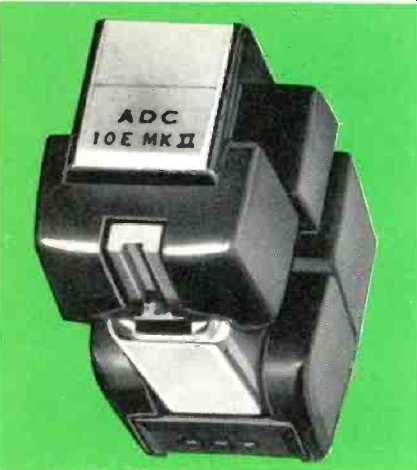
The 10/ E Mark II recreates sound faithfully. And tracks perfectly at the lowest possible pressures for optimum fidelity and long record life. It is as durable as any cartridge made regardless of price, and can be used with virtually any model changer or tonearm.
So end "cartridge confusion" forever by insisting on the ADC 10/ E Mark II. For $59.50, you won't find a sounder value.
ADC 10E-MK II SPECIFICATIONS
Output: 4 mV at 5.5 cms/sec. recorded velocity.
Tracking Force: 1/2 to 1 1/2 grams.
Frequency Response: 10 Hz to 20 kHz ± 2 dB.
Channel Separation: 30 dB from 50 Hz to 12 kHz.
Compliance: 35 x 10^-6 cms/dyne.
Vertical Tracking Angle: 15°. Rec. Load Impedance: 47,000 ohms nominal.
Price: $59.50 Suggested Resale. AUDIO DYNAMICS CORPORATION. PICKETT DISTRICT ROAD, NEW MILFORD, CONNECTICUT 06776 AUDIO FOR AUDIOPHILES
========
TEAC
BACK TALK When it comes to building sound equipment from the inside out, you could call us the component company, You see, we're one of the few tape deck manufacturers who make all our own critical components from heads to motors and most of the electronics.

After all, who knows better than we do what it takes to make a TEAC? For instance, our heads are hyperbolic, not conventionally rounded. This means more intimate tape contact, less tape tension, better sound reproduction. Hyperbolic heads are the shape of things to come and the only kind we'd think of using.
Meanwhile, we still buy outside parts for certain purposes. The ones we buy, we buy because they're the best. The ones we make, we make because they're the best.
And most of the time, we've got it made.
TEAC--TEAC Corporation of America
2000 Colorado Avenue, Santa Monica, California 90404
========
(Source: Audio magazine.)
= = = =