by Bert Whyte
LAST MONTH, at the conclusion of my report on the Audio Engineering Society Convention in New York, I reported that banquet guest speaker Avery Fisher had revealed some of the plans for the reconstruction of Avery Fisher Hall (formerly Philharmonic Hall). Mr. Fisher noted that Dr. Cyril Harris, of Columbia Univ., would be the acoustician for the redesign of the hall, and I mentioned that Dr. Harris had been the acoustician for the new Orchestra Hall of the Minnesota Symphony Orchestra in Minneapolis, and I had a story to tell you in regard to all this.
Actually, there are two tales to tell, and I would be most remiss if I didn't give equal weight to these stories. It all began with an invitation from Dick Ziff, ace public relations man for the 3M Company in New York, to join an audio press junket to the 3M Magnetic Products Division laboratories in St. Paul. Dick assured me that this would not be the usual "how-de-doo," hand-shaking, "quick run through" type of PR visit, but would include an in-depth, "nitty gritty" evaluation and survey of current magnetic tape technology and test procedures. 3M always does things with great style, and thus it was that yours truly, and such audio journalists as Julian Hirsch, Len Feldman, Larry Zide, John Woram, Martin Clifford, and Craig Stark, along with Frank Barr and Bob Finger of CBS Technology Center (they do the testing for High Fidelity) and Ed Foster (formerly with CBS TC and now tech. ed. of Stereo), boarded a 3M executive jet-prop at La Guardia. We were soon winging our way to St. Paul, and needless to say, sustained by heaping platters of Dungeness crab and shrimp, with liberal dollops of "spirituous beverages," there was much camaraderie and lively bull sessions on board. In St. Paul, Clark Duffey, PR supervisor for the tape division, shepherded us to a cocktail party and reception, where we met the executives of the division and the technical personnel with whom we would be associating in the laboratories.
The next morning, we were duly impressed with the scale and scope of the Magnetic Products Division laboratories. Housed in a very functional modern building, there are superbly equipped laboratories dealing with every aspect of magnetic tape technology. There are environmental testing chambers to subject tape to every climatic condition from tropical to arctic. In some rooms are banks of dozens of 8-track players, constantly recycling for "life testing" of cartridges. Labs are filled with oscilloscopes, third-octave analyzers, and frequency spectrum analyzers.
There is one totally fascinating lab with an electron microscope, which can magnify magnetic oxide particles some 5 million times! It goes on and on, lab after lab.
We were then taken to our training classroom, which was heavily instrumented with 'scopes, meters, a new General Radio frequency spectrum analyzer with chart recorder graphic read-out, plus representative hi-fi equipment including cassette, cartridge, and open-reel recorders from 3M's own Wollensak units, to units from Teac, Nakamichi, etc. Our training instructor was Mr. Del Eilers, Technical Service Specialist, a most erudite man in matters magnetic, who must be commended for the thoroughness of his presentation and for his patience and indulgence in fielding the often far-out questions from our press group.
Technical Seminar
Like some of those "crash" language-study courses, Mr. Eilers completely "immersed" us in the subject of magnetic tape and took us right back to the basics, starting with the electro-magnetic characteristics of magnetic tape and covering parameters like sensitivity, maximum undistorted output, peak bias, and tape noise. Then on to recording system properties such as frequency response and signal-to-noise ratio. Next came recorder properties ... wow, flutter, speed accuracy, crosstalk, etc.
We evaluated tape for coating uniformity, surface uniformity, physical distortions, slitting quality, wind quality with and without the special 3M Posi-trak back coating. Then we delved deeper into the intrinsic magnetic properties of tape-coercivity, remanence, retentivity. Much attention was paid to the effects of differing bias settings and its influence on short and long wave length, maximum undistorted output, third harmonic distortion at various levels, and weighted and unweighted tape noise levels. All of these subjects were covered with actual demonstrations and comparisons of different tape oxides, with chart recorder read-outs permitting curve overlays and making evaluations relatively simple.
Near the end of our day, we enjoyed a lecture by Dr. John Holm, who is head of research on magnetic oxides and pigments. Dr. Holm discussed the differences between various forms of gamma ferric oxides, including modified oxides using cobalt.
Chromium dioxide was discussed at some length, and finally Dr. Holm told us about 3M research in metal particle coating for tapes. These are of the same type as the tape Philips demonstrated to me in the summer of 1974.
Dr. Holm verified that it would be indeed possible to gain 6-8 dB better S/N ratio with this kind of tape, noting however that there were difficulties to be overcome in its use, such as proper erasure and that such finely divided iron powder is pyrophoric i.e. can burst into flames in spontaneous combustion! When pressed for more details, Dr. Holm stated that these problems can probably be solved, but that commercial introduction of a metal particle tape was at least several years in the future.
Thus, our day-long seminar at the 3M magnetic tape labs ended. We all learned a great deal about tape and tape testing, and I am sure I voice the opinion of all of the members of the audio press corps present, that we much appreciated the candor and openness of the presentation and the rare opportunity for a behind the scenes experience with this important subject.
Minnesota Orchestra Hall The technical part of our visit to 3M concluded, our hosts took us to Minneapolis for an excellent dinner.
Then, with typical 3M hospitality, we were taken to the fabled new Orchestra Hall for a concert by the Minnesota Orchestra conducted by Stanislaw Skrowaczewski. With all due apologies to the 3M technical people, I must confess that for me at least this was the highpoint of the 3M visit. I had been eagerly anticipating a visit to the new Orchestra Hall ever since it opened in October of 1974, with rave reviews for its acoustic excellence.
The hall has been widely heralded as one of the finest concert halls in the world. Harold Schonberg, music critic of the New York Times, waxed rhapsodic about "acoustics that are almost too good to be true," and praised the "power and projection," the "articulation and detail," and the "phenomenal bass response." Bill Anderson, Editor of Stereo Review, was equally fulsome in his praise for the acoustics of Orchestra Hall, as were many others. Now, almost exactly a year since the hall opened, I would have a chance to judge this acoustic marvel.
As noted, Dr. Cyril Harris was the acoustician for this new hall. Dr. Harris is a man with formidable talents and an impressive list of accomplishments. He is Professor of Architecture and Electrical Engineering at Columbia University, a Fellow and Honorary Member of the Audio Engineering Society, Fellow and Past President of the Acoustical Society of America, and in 1975 was elected to the National Academy of Engineers, the highest tribute that can be paid to an American engineer. Dr. Harris was the acoustical consultant on the Metropolitan Opera House, Powell Hall in St. Louis, and the complex of auditoriums in the Kennedy Center in Washington, all of which are considered to be acoustically successful. Dr. Harris is a traditionalist in his approach to the design of concert halls.
He opts for the rectangular shapes of the old halls in Europe, like the Musikvereinsaal in Vienna or the Gewandhaus in Liepzig, with two or three balconies arrayed along the sides and the rear of the hall, and with many irregular shapes on the ceiling, walls, and balconies for proper diffusion of sound throughout the hall.
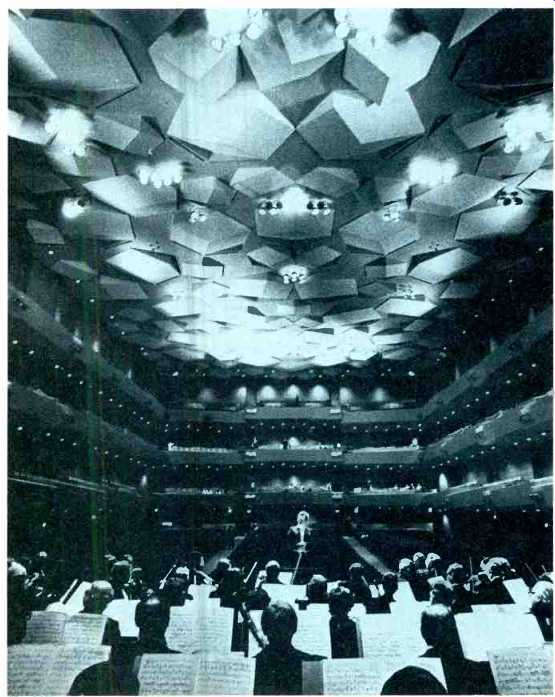
Orchestra Hall in Minneapolis is essentially a modern expression of those old halls, with all the help available from the measurement data and scientific disciplines of acoustical engineering. The hall is a rectangle with three balconies, giving a seating capacity of 2,573. The hall itself is made of concrete and red brick, with a unique noise-attenuating feature in that the entire hall is actually separated by a one-inch gap from the supporting structure of steel, aluminum, and glass. There are splayed panels of inch-thick, cross-braced, solid white oak along the sides and rear wall of the hall, disposed so there are a minimum of parallel plane surfaces.
Wood is also used for the stage and hall flooring and for the backs of the hall seats. There are irregularly tilted surfaces on the undersides of the balconies. In the old European halls, the walls and the ceilings and the balconies were heavily plastered with ornate baroque ornamentations scrolls, bas relief, cherubs... the gingerbread that broke up the sound and gave reasonably uniform diffusion in the hall. Such florid sculpturing isn't used anymore, but nonetheless the use of heavy plaster is retained in what is probably the most striking (and controversial) feature of Orchestra Hall. The entire ceiling is composed of a random pattern of huge plaster cubes, and it gradually slopes down over the audience and continues unbroken to the back of the stage. Thus, there is no shell or proscenium as such, similar to the situation in the original unmodified Orchestra Hall in Chicago. These huge cubes give hundreds of reflecting angles, so there is no reflective reinforcement of sound and diffusion is quite uniform. The great rigidity of the walls of the hall, with solid oak paneling over concrete, gives negligible flexure of the walls and thus avoids sound absorption and aids in the clarity and brilliance of the sound.
Since the stage is not the "room within a room" typical of most concert halls and since there is no shell, the continuation of the ceiling to the back of stage acts like a giant horn and all the sound on the stage is projected into the hall. I would note however, that the stage is on the small side for such a hall; with the chorus for the Beethoven 9th Symphony added to the orchestra, things might be a bit crowded.
The foregoing is an abbreviated description of Orchestra Hall in Minneapolis and cannot do full justice to the many clever aspects of the design.
What Dr. Harris had accomplished was a concert hall designed to simulate the traditional qualities of the fine old European halls, bolstered by all the resources of modern acoustical engineering, and using traditional materials, such as wood and plaster, in new ways. Now, on with the concert! Reaction to the Acoustics John Woram and I sat together in the middle section about the 12th row, while the rest of the audio press corps and the 3M people were seated in the balconies. Orchestra Hall was just about filled to capacity, a good test for the acoustics.
The program began with Handel's Royal Fireworks Music. Most immediately notable were the good internal balances and the superb string quality, which combined a lovely luminous tone with good clarity and articulation. Woodwinds were very smooth, yet well focused. The overall hall sound was quite live, but oddly enough, at the end of phrases, the reverberation seemed to decay fairly rapidly. The music moved along nicely, with good ensemble playing, and when Mr. Handel gave us some big tutti with the fortissimo brass and percussion, all hell broke loose! Gawd-almighty, what projection! This huge sound just completely swamped the strings. There were the musicians sawing vigorously on their instruments, and all we could hear was the all-pervasive brass and percussion. When the orchestra returned to moderate levels, the balances were restored.
Along came another fortissimo passage for brass and percussion, and the strings were completely covered. And so it went to the conclusion of the piece. John and I were shocked! Could this be happening in the vaunted acoustics of this hall? Next on the program was pianist John Ogden performing a work he had composed for piano and orchestra. Here was a pianist pounding out great chords from a Steinway concert grand piano, and what we heard was a rather thin tone, not very well projected. Here too, when the big fortissimo passages came along, the strings and, to some extent, the woodwinds were covered.
At intermission, John and I went up to the first balcony. The last work on the program was Schumann's 2nd Symphony. While the same problems prevailed in the more athletic passages, the overall sound was marginally better. We did notice poor projection and lack of bass from the contrabassi, which were strung along the back wall of the stage, rather than in the usual right side of the orchestra in front-to-rear configuration.
At the end of the concert we all assembled at the front left of the stage, as we were to visit the broadcast booth upstairs, where station KSJN had been doing an SQ quadracast of the concert. The audio press corps turned to me and in virtually one voice said to me, "Well, what do you think?" I told them I was stunned and disappointed and that I couldn't quite believe what I had heard after the acoustics of the hall had been so highly touted. Everyone of my colleagues agreed quite vociferously, that something was amiss. No matter what their seat location, all had heard the imbalances and the swamping of the strings. As we were standing there, the hall had just about emptied and we immediately noted, and a few handclaps and whistles verified, the considerable increase in the reverberation period. That explained how my friend Marc Aubort got such an excellent spacious sound on the Ravel recordings he made in Orchestra Hall for Vox Records, which have been much acclaimed by the critics. In the empty hall with fairly close mike placement, he got the advantage of the fine reverberation, while maintaining orchestral definition, and that close to the stage avoided the brass and percussion imbalances. Our handclapping also verified the bit of low frequency slap-back you can hear in the hall. Up in the broadcasting booth, Mike Shields, the very knowledgeable chief engineer of KSJN, was explaining their transmission practices, mike pickups, and SQ set-up.
He acknowledged that there had been some experimenting with instrumental positioning to clear up the imbalances, but didn't shed much light on the subject. I went to the Green Room to see Maestro Skrowaczewski. In 1960, when I was recording William Steinberg and the Pittsburgh Symphony, Dr. Steinberg was on the selection committee which was to choose a new conductor for the Minneapolis Symphony. I met Maestro Skrowaczewski at that time, and he won the audition and the position with a splendid performance of the Shostakovich 5th Symphony. I had a most pleasant conversation with the Maestro, and asked him about the placement of the contrabassi at the back of the orchestra. He said he was trying to get more projection and a fuller tone from the instruments and had tried other experiments to improve balances.
Either/Or
From the foregoing, it is obvious we have an odd situation on our hands.
On one side we have the distinguished critic of the New York Times, as well as other well-known critics, who have given lavish praise to the acoustics of the new Orchestra Hall in Minneapolis. We know the hall is the work of Dr. Cyril Harris, an acoustician with impeccable credentials. On the other hand, all of us who are members of the audio press are trained listeners. We know what we heard, and we concur absolutely and unanimously that there were gross imbalances in the sound we heard in Orchestra Hall. Who is right? Who is wrong? If we are right, are there remedial steps that can solve this problem? Some critics have suggested that after such a long tenure in the acoustically unsatisfactory Northrup Auditorium, where the Minnesota Orchestra players had to play mightily to achieve a fortissimo, that they are not yet used to Orchestra Hall and are still forcing their tone. Well, perhaps, but after a year in the new hall this doesn't seem likely.
Of course, we heard just one concert. Maybe it was some sort of fluke or temporary aberration, though I doubt it. In the best of all possible worlds, I would like our group and all the critics and Dr. Harris to have the opportunity to hear together a dozen widely varied concerts in Orchestra Hall and then have a little symposium on what we all heard. Anyone like to pick up the tab for this? 3M? Pioneer? Howard Hughes? The reason behind these stories is simple. Avery Fisher Hall, as of May 1976, will have all of its interior removed leaving only the steel and concrete shell of the building intact. It will then be rebuilt as a new concert hall. Considering the original hall and the two "band-aid" modifications, this will be the fourth time around, and I think this time we must come up with a really good concert hall. I think Dr. Harris is a brilliant man, for whom I have the highest respect. Although it may be presumptuous of me, I happen to agree wholeheartedly with the "traditionalist" ideas of Dr. Harris do respectfully suggest that whatever acoustic anomaly our audio press group encountered in Orchestra Hall be investigated and the problem resolved.
(Source: Audio magazine; Bert Whyte)
=====
AD:
Sony---Ten years after the revolution. 1966 / 1975
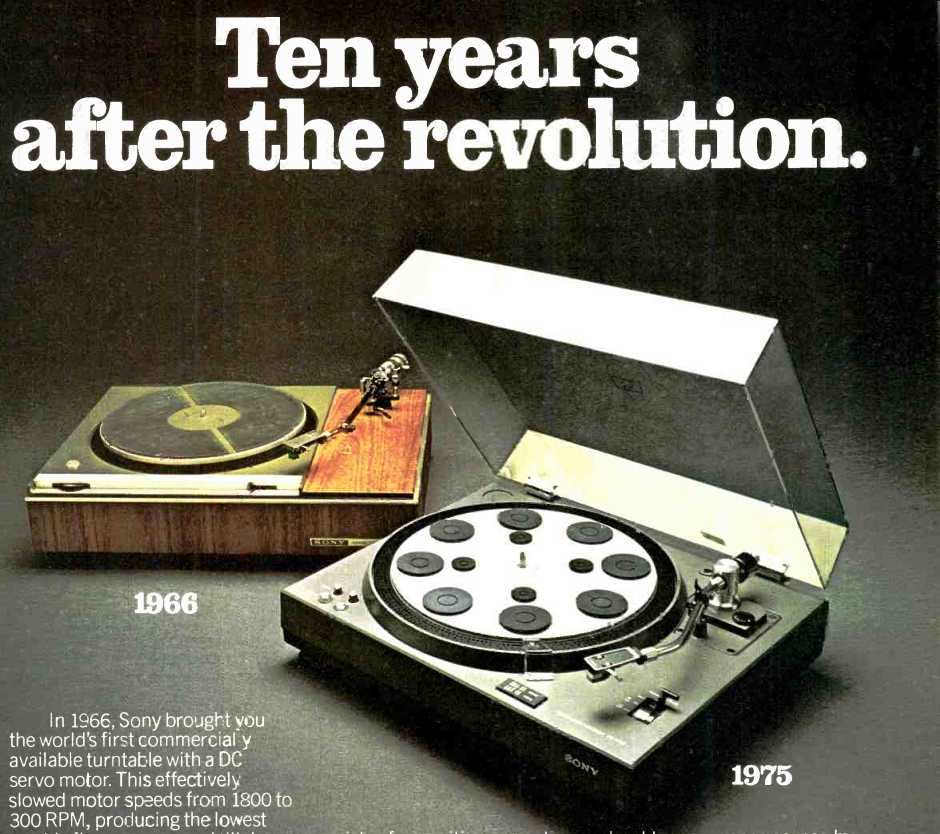
In 1966, Sony brought you the world's first commercial y available turntable with a DC servo motor. This effectively slowed motor speeds from 1800 to 300 RPM, producing the lowest rumble figures measured till then.
The servo system also drastically reduced wow and flutter, thus giving you a chance to bear what 33-1/3 records sound like at 33-1/3. Quite a revolution. But we haven't been sitting on our laurels since then.
Introducing the PS-4750. Overlooking the fact that the PS-4750 is so pretty we could sell it through interior decorators, here are its technical innovations.
It has a direct drive servo motor that gives you incredibly low rumble, wow and flutter levels.
Plus total immunity from line voltage and frequency variations.
That's because the PS-4750 has a unique system that, in essence, consists of a sensitive magnet head (with eight gaps instead of the normal one) which monitors platter speed by picking up a magnetic coaling on the outer side of the platter. This speed data goes through a small computer connected to the motor, instantly compensating for variations.
The PS-4750 is also ultra insensitive to outside Vibrations (which causes intermodulation distortion and acoustic feedback). Sensitivity to outside vibration shows as "Q" And the PS-4750 has a platter and case made of SBMC, a Sony developed compound which has one third the "Q" of aluminum or zinc.
We've even done something about the resonance caused by warp in the record itself. Those round doohickeys on the platter are rubber suction cups that actually provide greeter contact surface, reducing the longitudinal vibration caused by warp. The end result is a cleaner sound.
So, all in all, our engineers think the PS-4750 is pretty nits.
But don't take our word for it. Just stop into your Sony dealer and show your independence by listening for yourself.
SONY-- 1975 Sony Corp. of America. Sony, 9 W. 57 St., N.Y.. N Y 10019, SONY is a trademark of Sony Corp.
= = = =