.Motional Feedback
Dear Sir:
A number of letters have been received from readers who want to know where they can get copies of the NASA circuit I referred to in my August article on motional feedback.
Here is the address: Technology Uitilization Office, NASA, Code KT, Washington, D.C. 20546. The number of the Tech Brief is: B72-10059.
G.W. Tillett Contributing Editor International Record Exchange Dear Sir: am a high fidelity and record enthusiast. Country & Western and American Pop music are my favorites, especially Johnny Cash, Marty Robbins, Buck Owens and Hank Snow. In Czechoslovakia, I cannot buy these records anywhere. I would like to correspond and exchange records with someone in the United States. I can offer pop and classical records from Czechoslovakia and other socialist countries.
Pavel Ruml 170 00 Praha 7 Argentinska c. 8 Czechoslovakia AM Sound Revisited
Dear Sir:
I would like to comment on Mr. Paul Shwartzendruber's letter on AM radio fidelity in the January 1976 issue of Audio, and I refer your readers to my letter on this subject in the February 1975 issue of High Fidelity, a brief synopsis of which follows.
Virtually all AM transmitters in use today are capable of transmitting full fidelity sound. Assuming the transmitter is fed a clean, high-fidelity audio signal and looks into a reasonable flat antenna or common-point impedance over a carrier bandwidth of ±10 to 15 kHz or so, there is no reason why a properly maintained AM transmitter cannot broadcast a high-quality, low distortion signal, flat from 30 to 15,000 Hz.
FCC rules define an AM channel as being 10 kHz wide. A few engineers misinterpret this rule and think that they are not allowed to broadcast any audio frequency over 5 kHz. To this end, they install low-pass filters in their audio consoles with cutoff frequencies of 5 kHz. Fortunately, only a few engineers continue to do this.
There is no FCC rule that requires broadcasters to limit their high end to 5 kHz except in the case of adjacent channel interference, which is a rather rare occurrence in most installations. The rule simply states that an AM channel is 10 kHz wide, nothing else.
The problem of AM fidelity has almost always been at the receiving end. AM tuners, even with high-priced, luxury AM-MF tuners and receivers, range in quality from barely adequate to miserable, not only having limited high-end response, but generating distressing amounts of THD and IM distortion. This leads many listeners to wrongly blame the station for the bad sound. Since they paid a high price for the receiver, they naturally expect (and rightly so) to get a high-quality AM section also, but most manufacturers couldn't care less about the AM section, if they even put one in the receiver at all.
If you look at it from the manufacturer's stand point, you really can't blame them. AM radio has been wrongly accused over the years of being a low-fidelity medium to the point where people actually believe it. Interest in serious AM listening subsided with the appearance of FM, and it became an unnecessary expense for manufacturers to design and build a good AM section into their receivers. Thus, the poor quality of available receivers seems to support the myth of AM's inherent low fidelity.
Interest in AM is reviving, however, with the appearance of the McKay Dymek AM-3 and, more recently, the AM-5 tuners. These units are true high-fidelity instruments. The AM-5 has a multi-pushbutton selection of i.f. bandwidth to ±10 kHz, excellent sensitivity, and extremely low distortion and noise. To my knowledge, it is the only true high-fidelity AM tuner on the market. However, I am told that the AM section of the Dynaco AF-6 tuner is no slouch on performance, but I have never heard one perform.
It is interesting to note that the revived interest in AM seems in part to have been sparked by the default on the part of FM stations to maintain their engineering standards to the state of the art. There are FM stations all across the country whose sound is less than exciting and many whose sound is inexcusably bad. I worked for one of those once. It was an AM-FM outlet that had to be, without a doubt, the worst sounding radio station I had ever heard. I am proud to say, though, that when I left, its sound, technically, was the standard for all the other stations in the area to shoot for. I have noted, happily, upon visiting that they have maintained the engineering standards I established and even improved a few.
Only when demand by listeners increases for good quality AM receivers will manufacturers respond with better receiving equipment. With AM stereo right around the corner, maybe this will help to create the demand.
Robert I. MacDonald Engineering Div. WRDU Television Durham, N.C.
Editor's Note:
The Dynaco AF-6 has a variable bandwidth selector switch, which trades off some selectivity for increased response for use with stations having extended bandwidth and relatively little interference.
AM Air Checks Dear Sir: I have run many AM proofs and know any good AM station is capable of flat audio out to 10 kHz and beyond. However, if receivers were made available with wide bandwidth, many stations would sound excessively bright because many records and spots are processed at the recording studios to have a mid-range and high-end boost so they can cut through and stand out on a typically junky AM radio.
Anyone who doubts the quality of AM radio should visit a good station in their area and listen to the air monitor. If the monitor is derived from the station modulation monitor, they will be very surprised with what they hear.
Noel M. Moss Chief Engineer KEZK-FM St. Louis, Mo.
Why Do It? Dear Sir: Does it make sense for a station to spend much time, effort, and money in producing and maintaining a high level of quality in their broadcast signal, when it is largely unappreciated by virtue of the fact that AM receiving equipment is on the whole only mediocre? Sure, there are minimum performance parameters set up by the FCC but they are just that-minimum.
Our own proof of performance reveals that we, like WTON, have far more than bare minimum; in fact, we run from 50 Hz to 9 kHz ±2 dB and to 15 kHz at 31/2 dB! But is anybody listening? I doubt it. With our Easy Listening MOR format, I doubt that my show is heard over anything more sophisticated than your average car or kitchen table radios, with maybe an occasional compact in the group.
So why not cut corners in engineering and tailor the signal down in quality? Because that same reasoning can be used in other departments too.
Why not skimp on the quality and variety of music on your playlist because most people don't know the difference anyway? And why not hire cheaper, less experienced air people or let the overall quality of your programming go-just to make a bigger buck? The answer, of course, must come from the listening public. The listening public must want to be able to hear the quality that many AM broadcasters pride themselves on putting out. However, the years of aural conditioning to which the listening public has been subjected leads me to believe that any change in listener demand for the better may be nothing more than wishful thinking on my part.
I'm sure that there will always be a market for certain high-quality ancillary equipment we see marketed by a few manufacturers, but they will always be in the minority. To these pioneers, I say "Bravo!" and encourage others to make even their bottom-of the-line kitchen table radio deliver laudable sound.
-Jay Mullins; WGSM Long Island, N.Y.
What Comes First?
Dear Sir:
Most AM receivers that I have seen compromise between a narrow bandwidth, where selectivity is desired, and a wider bandwidth for greater selectivity. This situation is satisfactory for the average listener who always listens to the local station and doesn't know whether he's hearing 20 Hz to 20 kHz or 200 Hz to 3 kHz. Unfortunately, most AM broadcast engineers know this and think that all the critics are listening to FM anyway, so their audio is not given much consideration. They're satisfied if they know that their audio is as good as necessary for the average receiver. But I feel very strongly that any AM engineer who thinks of r.f. first and audio second is not a credit to this profession.
Achieving a good, bright, dense, high-fidelity sound with an AM transmitter is quite a trick because of the obvious limitations that we face but it can be done.
H. Edgar Cole II Chief Engineer, WSIR Winter Haven, Fla.
Equip. Review:
Information Terminals M-300 Cassette Gauge
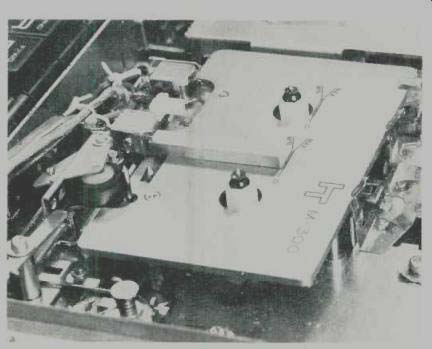
MANUFACTURER'S SPECIFICATIONS
Plate Thickness: 0.096 in. ±0.001 in.; 0.163 in. ±0.001 in.
Flatness: ±0.002 in. overall.
Parallelism: Within 0.001 in. Etch Markings: ±0.002 in. to mean Philips standard.
Bar Thickness: 0.150 in. ±0.000 in.,-0.001 in. Length: 1.500 in. ±0.001 in. Width: 0.25 in. ±0.005 in. Square end perpendicular within 0.0002 in.
Price: $85.00.
Information Terminals are makers of precision cassettes for data systems, and they originally made the M-300 gauge for their own use but decided to make it available for other potential users, not by any means confined to the computer field. The gauge is made of high-quality tool steel in the shape of a cassette and is placed in the deck with the heads in the operating position. An angled bar is employed to check the tape guide positions, head tilt, and depth of head engagement, using etched reference marks on the gauge plate. Thus, transport systems set to the gauge will have optimum head-to-tape contact and penetration. Not only that, but the correctly aligned guides will not cause wow and flutter and possible tape damage. The gauge comes in a well made padded instrument box complete with instructions.
At the price of $85.00, it is not likely to appeal to many audio enthusiasts but it is certainly an invaluable tool for service engineers and manufacturers-I know of several QC departments that should definitely have one! No doubt enterprising dealers could run "cassette clinics" on the lines of the Marantz or McIntosh affairs, and I am sure some customers would be a little shaken. I used it to check a Nakamichi 500, Technics RS-676US, and a Superscope CD-302 and found them all within the Philips specifications, but a "Brand X" portable, which occasionally chewed up tape, had incorrectly aligned guides.
-George W. Tillett
(adapted from Audio magazine)
= = = =