EDWARD TATNALL CANBY
TALKIES, STEREO STYLE
I think maybe I'll stay with pure audio, two-channel, for awhile longer.
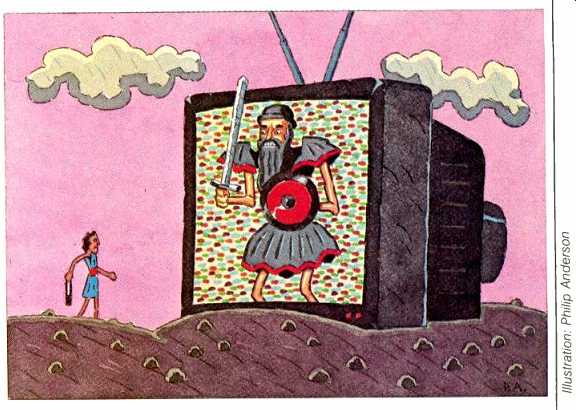
My first experience with homemade hi-fi stereo sound wedded directly to the TV image was, shall I say, soul shaking. It was David (me) and Goliath, but David didn't win. I'm not discouraged! There's a gleam in my eye, and I'll be back. Meanwhile, I've played around with some of the fanciest equipment, a brand-new VCR equipped with-yes-two discrete channels of audio. And a video camera to match.
My thought was simple and, I think, a valid one. Hi-fi stereo and color video pictures are at last getting together for the consumer. Terrific idea but why limit it? As noted last month, there is more to come, much, much more. All in due time, but do you think I'm going to wait? I wanted to try for myself, insofar as I could, ahead of time. All you really need, my argument went, would be one of the new VCRs that will take down any two-channel audio you want, instead of the obstinate mono of all previous equipment. And, if you want to make your own, not merely copy things off the professional tube, you'll need a set of mikes and that camera.
Well, it's one thing to limit yourself to ready-made professional offerings and quite another to get out there and do your own, as anybody ought to know, including me. You very quickly learn respect for the pros, the people who provide us with most of our vaunted hi fi sound, ready to play, and those who produce the home TV image. You don't just transfer all that technique to the home consumer area with a couple of snaps of the finger. Hobbyist stuff is a lot trickier than we sometimes think.
Yet the old human spirit won't be kept down and "hobbyism" usually gets there, eventually, if with modifications. Thus it becomes "commercial" again and again. In every area of this sort there is a steady outflow from the professional into home hobby, a sort of leakage. The line between the two is never really sharp. The better the pro stuff gets, the more are the amateurs inspired. And so, as it specializes and adapts, do-it-yourself becomes an enormous market with its own ever-so-definite demands on the designers and manufacturers. From the very first Kodak Brownie right up to instant Polaroid, from Edison's Philips' cassettes, we on the outside have horned right in on technology to demand equipment that we can use.
I do see it coming. First, "home" video pictures with home sound attached, versatile, with those dual audio channels, apt for all sorts of marvelous new things, once that revolutionary Phase III gets started: Micro miniaturization of video components, the elimination of the Tube, a whole new age of video technology. Hitachi already has its video camera without a tube and talks busily in its ads of cameras thee.
size of cigarette packs. Just go on from there-that's what I mean.
So I borrowed an Akai VS-7U video cassette recorder, VHS and stereo capable. Also a video camera, the VC-X2, a little five-pounder (tiny as com pared with studio pro cameras). With enthusiasm, I set about making for my self a few futuristic examples of AN, home pictures combined with home hi fi. Phew! Did I soon begin to sweat.
Yes, in the end I got a few shaky home-type "movies" of self and friends-like so many home films the very first time you try. I was embarrassed at myself-I thought I knew how to take movies, but this was something else again. No, video is not merely an electronic version of old-fashioned film! Wish I could go into details-later, later. But what matters is this: Yes, talked, visibly and audibly, right there on my giant 19-inch monitor. With instant playback, faster than Polaroid.
Shaky or no, my friends were astonished and delighted to see and hear themselves too. The potential was obvious! This could be far ahead of any thing that ever previously moved and talked via recording, consumer-style.
But it's still today, and by the time I got all this to working, more or less, I had accumulated maybe 200 pounds of decidedly non-portable gear and a roomful of cables. Reminded me of my first experiments with "home" stereo recording, long before the audio cassette. The nearest I got to the great outdoors, where most consumer pictures are made, was the steps of my front porch via extension cables. No matter. I got the feel of what is in the future. Yes, I know there are portable VCRs, including JVC's little five pounder. Steps along the way. But it'll take more than that to open up this new entertainment in commercial form. I got the essentials out of the strictly indoor VS-7U, and so can you, even if it won't fit into a hip pocket.
Note that these experiments were to wards "movies," pictures with sound added. How about the opposite-our familiar hi-fi recording in stereo, but with pictures? A different emphasis but just as promising. Music. Take down your local orchestra or pop group or opera in hi-fi stereo sound, and also in pictures. An all-new idea, never feasible before (at .least in the home-based consumer world). With stereo, the sky's the theoretical limit. Keep in mind our present top-grade stereo cassette recorders. Do you think a rough equivalent with video would be any less popular? Big potential, I say. Just a few li'l problems to be solved before we get down to Walkman size.
When you do add video to your hi-fi recording, you will have some new things to learn, of course. The two elements have to match and that isn't so easy. As I've already found, you run right into the inevitable "simulcast" problems, namely, a wide spread of sound in the stereo playback and a narrow spread in the picture. Not necessarily contradictory, if you are careful how you do your recording. You must stress ambience in your stereo music, rather than too-discrete directionality. Don't get too close! A close up singer, heard way over to one side, will be seen just away from the center of the tube. When the sound source moves yards, the picture moves inches. This can be crazy and you'll have to give it a thought. Avoid, avoid. But with less obvious directionality and more ambience--this can be a splendid sound-you will have no trouble with the sound-sight combination.
On the other hand, if you are into people and people talking-the "home movie" approach, again, I found that an exaggerated sonic separation offers some surprising new effects in an oddly literal way, as you record (and photograph) people. What you do is to extend your working "stage" far off to the left and right beyond the tube itself.
The sides are audio only. The center brings the people into view. It's amazing! You can have conversations be tween people off to one side, invisible, and people in the picture. Audio ghosts, you might say. Your folks can walk casually on and off the tube, or stand just outside it, even stick a hand into sight or peer around the edge of the TV display. Tell me where that has ever been done before! The tube in this case is like a window in a wall. But the wall is transparent to sound.
Note that the video makers today, as might be expected in Phase II of audio/ video equipment consolidation, are emphasizing stereo pairs of loud speakers that sit right next to the tube itself on each side. Good for TV mono sound, natch. Not very good for stereo. Not at all good, indeed, unless you move up so close that the picture hurts. You will be wise to keep your options-use your speakers freely in wide and narrow spacing, according to need, leaving plenty of room. For those new "offstage" effects, the wide spacing is far more dramatic. Also, of course, for ambient music, though again you must watch out for the directional disparities.
As to mike settings, my camera was a mono model. Evidently the two-channel idea is going to be slower to reach this area. The VCR operates in mono too with all standard TV, and with this mono camera. Necessary at this point.
There's a built-in mike on the camera, electret, extendable forward on one side. You can plug in another, of your own (watch out for loud raster buzzing if it gets too near the camera tube), but the signal's still mono, feeding the VCR's left channel. For stereo, you must plug the right-channel mike into the VCR's right mike input; for the left, you can use the camera mike, or plug a second mike into the camera or the VCR's left-channel mike input.
Rather to my surprise, the "binaural'' setup, two mikes close together with some solid object between-the cam era, a head, even a block of wood or plastic-gave surprisingly useful loud speaker directionality to my pictures. It might be the best way for many home purposes. Especially speech. But don't get too far away, and keep the room sound dead-or go outdoors. In this sort of speech recording, ambience merely means off-mike, an amateurish voice quality. Maybe Bob Carver and Sound Concepts and JVC could help here with their respective binaural-for-loudspeaker circuits? As we all know, the techniques for good voice sound do not match those for camera placement-especially with a prodigious zoom such as the one Akai has on its VC-X2 video camera. You've seen the TV reporters stick their mikes into people's faces. That's the pro way, or via lapel mikes, mikes overhead but unseen, and so on. So get close for people, more distant for music.
All of this, of course, is really for the future, or assuming that you can experiment with present two-channel equipment as I did. And assuming muscles and patience in the hooking up. We do have a way to go before we have home-recorded video "movies" with equipment expressly designed for the purpose. That is for Phase III when video goes truly miniature-or maybe gigantic, wall to wall. But you can fuss with it now, as soon as you can get hold of two channels. And camera.
(adapted from Audio magazine, EDWARD TATNALL CANBY)
= = = =