by Edward Tatnall Canby
THROUGH MOST of a recent two-hour drive out of Connecticut into New York found myself being quizzed by a young passenger, a musician, anthropologist, record collector, and into hi fi, about various types of speakers-and why. (I.e., What speakers should he buy for his system?) This guy reads a lot of the poop, as we tend to call it, and he knew the names of as many brands as I do. He has brains and curiosity; he wanted to know. Yet I was astonished at his basic ignorance concerning such fundamentals, say, as a speaker system which suppresses the back wave and makes use only of the front, the acoustic suspension type (he knew that term, all right), versus the newly resurgent front and back wave types which are now so very much in the hi-fi news. Maybe all the poop isn't doing its job, for all the glamour? Most readers of this mag (I am supposing) are moderately up on technical matters and so know a lot about this, including all the excitement about Messrs. Thiele and Small (see "Dear Editor", Feb. 1976). On the other hand, for those younger readers who may be a bit new to our game, I figure a brief non-technical outline of speaker history (such as I had to produce, perforce, while driving) might be a useful background for the thorough technical coverage we offer in so many articles and equipment profiles in Audio.
What has concerned us the most, over the years, is bass. Highs-yes, but there, the problem involves the whole speaker cabinet only marginally, whereas the enclosure design and especially its size and shape is crucial for bass and always has been. True even for electrostatics, where bass and size are directly related. In the beginning (the beginning of electrical reproduction, that is), there was no bass. Skinny horns in the shape of a question mark, minus the point, and skinny sounds there from, even though horn loaded to an extent. Then-from the public's viewpoint-came the cone speaker in an open-back cabinet, and suddenly, for the first time, we who bought radio-phonographs and played 78 records on them, or listened to broadcasts of music, and heard genuine bass of a loud, emphatic sort.
No, no, not flat bass! Obviously there were specialists who even then built vast horns and what-not to achieve hi-fi bass down to the subsonic, but we, the listening public, knew nothing of such matters. Instead, we positively gloried in what later came to be known as "boom bass." Technically, this was peaky, highly distorted mid-bass reproduction, ruinous of transients, mushy and thumpy; but if you had heard no other, it was marvelous. A new sonic experience and a musical bonanza, after so many long years of the old acoustic records and a million tinny machines that produced no bass whatsoever, leaving the ear to reconstruct the musical sense in the bottom range from the meager sonic clues available. It could be done. Otherwise--no music.
But real bass, audible bass unreconstructed, was something else again, and it kept us happy for a good many years through the 1930s and on into the postwar period's beginning.
Yes, most of us became aware that if you removed a loudspeaker from its (open back) cabinet, the bass disappeared. You needed the cabinet as a baffle, to keep the back-propagated bass from cancelling the front wave as the two curled around the edge and met head-on. The lower the tones, the worse the cancellation; hence a neat roll-off to zero. In a cabinet, and with the separation between back and front nicely compounded by the sides of the box, you could get that good old thump bass (not really very low-just heavy and positive) to everybody's idea of perfection.
Then, among those of us of an experimental turn of mind, came the "separate baffle," a big plywood or celotex board, as big as possible, with a hole in the middle for your speaker, removed from its cabinet. Terrific improvement-and just try putting said board up against a fireplace. Suddenly, a gargantuan bass! And much cleaner than before. I produced this miracle in my New York apartment in the late 40s and that fireplace served me for, I hate to tell you, how many years. The fireplace itself wouldn't work, anyhow (the room just filled with smoke), and so there was no reason not to use it. Maybe a tenth of one percent of informed record listeners got so far as to try the Separate Baffle back in those days. The rest of them went along with the standard open-back cabinet, assuming they did anything as fancy as that; as now, there were countless table-top machines with speakers in their lids or in the front panel, for a slight but very limited improvement over the old acoustic phonograph.
Remember..., Remember I should toss in a word about the Orthophonic Victrola, from around the time Victor became RCA Victor.
The Orthophonic disc was electrically made, via microphones and electrical cutters, but the Orthophonic phonograph was still acoustic powered.
What it had, though, was an ingenious and carefully designed horn loading, a folded-horn system, which took hold of a lot more bass than any earlier standard acoustic machines, particularly via the new electrical recordings. Today, the Orthophonic Victrola sounds pretty tinny and thin, but I can vouch for its amazing effect upon us at the time. There was not only an extension of the low end into what could really pass for bass sound, more or less, but the volume was-still acoustic-remarkably loud. This was one of the earlier examples of horn loaded efficiency in sound reproduction, powered entirely from the energy of the moving "needle." There were other famous models, acoustic and electric-as I remember the Brunswick Panatrope was electrical; but the Orthophonic Vic. was the one that really impressed musical people who bought recordings.
By comparison, the succeeding electric phonograph in its stand-up cabinet made a monstrously big bass noise, and I remember intensely disliking it. Instinctive dislike of the boom bass? Maybe. It was a violently resonant effect, going off with a rattle and a blast on certain pitches, the speaker simply breaking up into meaninglessness. But I think the real trouble was the concomitant lack of a high end. "Nothing over 4000 cycles," we used to say but actually the roll off (approaching a cut off) left very little useful sound above 3 kHz. Hard to believe today. Not a trace of an "S." The sibilants were identical with the fricatives (S and F). Nor any more than the barest hint of instrumental color in music, so that flutes and violins were the same; triangles simply did not exist. You could hear a piccolo faintly, if it didn't play too high.
No highs and a heavy, boomy bass; it was a bad combination. But in the end we got used to it and enjoyed it for the music it brought us, there being, as far as we knew, no other kind of reproduced sound. This boom/muffle effect was in fact wholly "normal" for reproduced music and voice, right up until the advent of popular hi fi in the late '40s.
Tuned Boxes and Horns
We had moved precipitately from the shrill acoustic sound, tinny and minus bass, straight to a sound which was just the opposite, muffled and bass-heavy. And here, opportunely, entered the juke box, on the most solid of practical grounds. In that astonishingly prolific public instrument, the boomy resonance was magnified unbelievably and, in the jukey sort of location, was absolutely ideal. First, a strong, thumpy rhythm, dominating all else. Second, a super-muffled high end where highs were quite useless-drowned out or swallowed up by assembled humanity and vast amounts of talking and other extraneous noises. The boom bass moved easily around every corner and into every nook, non-directional and largely immune to absorption. So the juke box was king for a generation and inevitably influenced the home receiver, the radio-phonograph in the living room. If people wanted anything more, it was more of this boom bass (though this purist continued to hate it!). So the stage was set-for the bass reflex. And there it was-a new all-around cabinet with a back which could produce lower, stronger bass than any open cabinet and, with careful tuning, might even produce a crisp, relatively flat bass too. And it wasn't any bigger than the usual box either-maybe smaller.
The tuned bass reflex box came in slowly. It gradually proliferated, making its way into what eventually became the early world of hi-fi componentry. My memory is hazy-was it first used in the 1930s? Was it a Jensen patent? (And is the term still protected? If so, all credit where credit is due.) But for many years, I personally remember this type of tuned cabinet with its solid, well-insulated insides and its tuned port to let out the back wave, as pretty much the elegant standard in good-quality, enterprising home systems amid the beginnings of do-it-yourself. That would take us right up to the late '40s, after the War, when hi fi (and this magazine) first began—literally--to boom.
Horns? Paul Klipsich didn't produce the first horn-loaded loudspeaker, if you count the old acoustic Orthophonic and the fireplace baffle but his, no doubt, were (and are) among the very best and most ingeniously folded. Exponential expansion of the space behind the speaker (or in front), to load up, pull down, and smooth out the bass range--and to maximize efficiency. I don't remember who built the first concrete house-size horn monster, but this excellent principle for getting good, and flat, bass has always been bulky (not to say complex) even in its folded format, and that is probably why the bass reflex in its numerous variants was the type we listeners got to know as a standard.
It blossomed everywhere, and there was only one major hitch to its operation-assuming that you had tired of juke boom and wanted a lower, crisper bass out of your box. In those days you bought your loudspeaker as a component and installed it in a separately bought cabinet. Chaos! For the essence of this system is the careful tuning of the cabinet space and port to the characteristics of the speaker.
This delicate matter was left to the home user or the non-knowledgeable dealer and 99 percent of the time it was botched. Just put the speaker into the cabinet and turn on the juice! Either it boomed unmercifully, or it didn't, and very few of us knew enough to understand that we could do something about it. Most of us assumed that the sound we heard, so to speak, came straight from the loudspeaker-and if there was an unlovely thump and boom, then that driver couldn't be a very good one. Mushy kettledrums, growly string basses, were speaker unit faults. Not so! More likely, a mistuning of cabinet and speaker, to produce a big resonant peak due to the resonances of speaker and cabinet coinciding, instead of being smoothly offset to carry the speaker's range lower than its free air resonance.... All this, of course, is primer stuff for anybody who knows his present hi fi.
Nevertheless, I suspect that a good many sharp readers of Thiele and the others are unaware of the earlier background, so well known to us, who are older. In another installment, I'll continue the capsule history of speaker bass and speaker fashions through the hi-fi ages and will hope you oldsters will go nostalgically along with me.
=======
Ball Corp. Sound Guard Record Preservative

Record cleaning and static removal is a part of record preservation. Recently, the Ball Corporation introduced a unique record preservative, Sound Guard, a commercial application of their VacKote a lubricant designed for moving parts on space craft. Sound Guard is a dry lubricant in a liquid (Freon 113) spray form. The solution, which is sprayed on the record surface, evaporates very quickly, leaving an invisible lubricant film on the record. The record is then buffed with the velvet pad supplied, resulting in a film coating five-millionths of an inch thick on the modulated record grooves. The solution also contains cleaning and anti-static materials.
A well-known independent electronic testing laboratory studied the effects of Sound Guard on such important record parameters as frequency response over repeated playing of both stereo and CD-4 records, harmonic distortion, and surface noise. Their tests indicate that there is no noticeable deterioration in frequency response for either the stereo or CD-4 records, it decreases the normally occurring harmonic distortion after repeated plays, it retards the appearance of surface noise that also occurs after repeat plays, and reduces the amount of dust that is normally attracted to the record surface. Sound Guard apparently preserves the full amplitude of frequency modulations and groove modulations up through 45 kHz. In general, Sound Guard protects the modulated record groove against wear or further wear.
The maker says that a Sound Guard coating might show wear after about 25 plays, though the lab mentioned above found this to be an extremely conservative figure. Repeated use will fill in the bare spots without additional build-up. Although Sound Guard adheres to the record, it does not adhere to itself, thus assuring the user that the film coating will not exceed five-millionths of an inch at any time.
Sound Guard is packaged in a plastic container that holds a two-ounce bottle of fluid, a pump sprayer, and a velvet pad buffer, which is also the cover for the container. The package sells for $5.99.
Tests
Although Sound Guard is also a record cleaner, we found it to be effective in removing surface dust only.
It does not remove fingerprints. Its anti-static property becomes effective about fifteen minutes after the record is buffed. However, buffing does build-up a static charge which may be eliminated with the Zerostat for immediate play.
Our experience indicates that records should be cleaned with either the Monks Record Cleaning Machine, the Discwasher, our two reference cleaners, or with the Fidelicare Spin and Clean Record Washer, using the DII solution, before applying Sound Guard.
In our tests, we applied the spray to the outer half of a record just starting to show wear. The inner half of the record was used as a control. Sound Guard definitely reduced the amount of surface noise present on the record when compared to the untreated portion. We were unable to detect any reduction of frequency response between the treated and untreated portions. CD-4 records treated as above also showed no audible change except that there appeared to be less noise in the rear channels. Sound Guard is normally applied to new records, but we found it to be quite effective when applied to used records.
Because Sound Guard reduces friction between the stylus and the groove, it is advisable to slightly reduce the anti-skating force.
Collectors of old acoustic 78s will find Sound Guard to be an effective way to reduce the normally present background hiss, particularly when transferring them to tape. We tested it on some well-played shellac 78s, circa 1904, as well as some from the early 1920s. Its effectiveness was beyond our greatest expectations. The playback cartridge used was the Shure V15, Type III, fitted with the Shure VN-78E elliptical stylus for playing 78s.
Based upon our tests, we have always advised against the use of treated record cleaning cloths or sprays.
With the introduction of Sound Guard, we are making an exception, particularly since there is no silicone present. To prevent record wear and to preserve the high frequencies present on a record, we found Sound Guard to be without a peer, the best thing for records since vinyl.
--B. V. Pisha
========
ADs:
Empire
Blueprint for Flat Frequency Response In the graph below, frequency response was measured using the CBS 100 Test Record, which sweeps from 20-20.000 Hz. The vertical tracking force was set at one gram. Nominal system capacitance was calibrated to he 300 picofarads and the standard 47K ohm resistance was maintained throughout testing. The upper curves represent the frequency response of the right (red) and left (green) channels. The distance between the upper and lower curves represents separation between the charnels in decibels. The inset oscilloscope photo exhibits the cartridge's response to o recorded 1000 Hz square wave indicating its resonant and transient response.
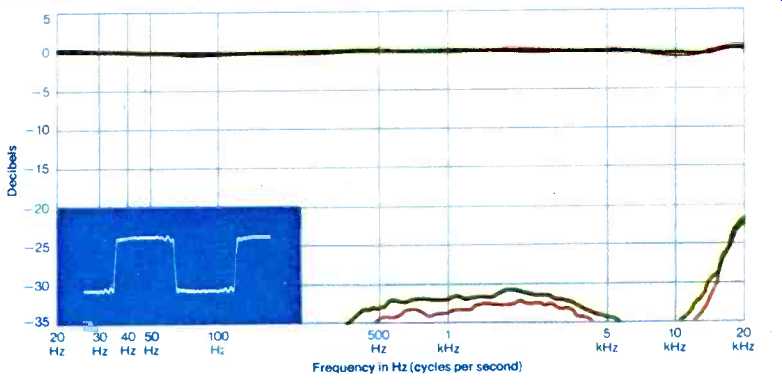
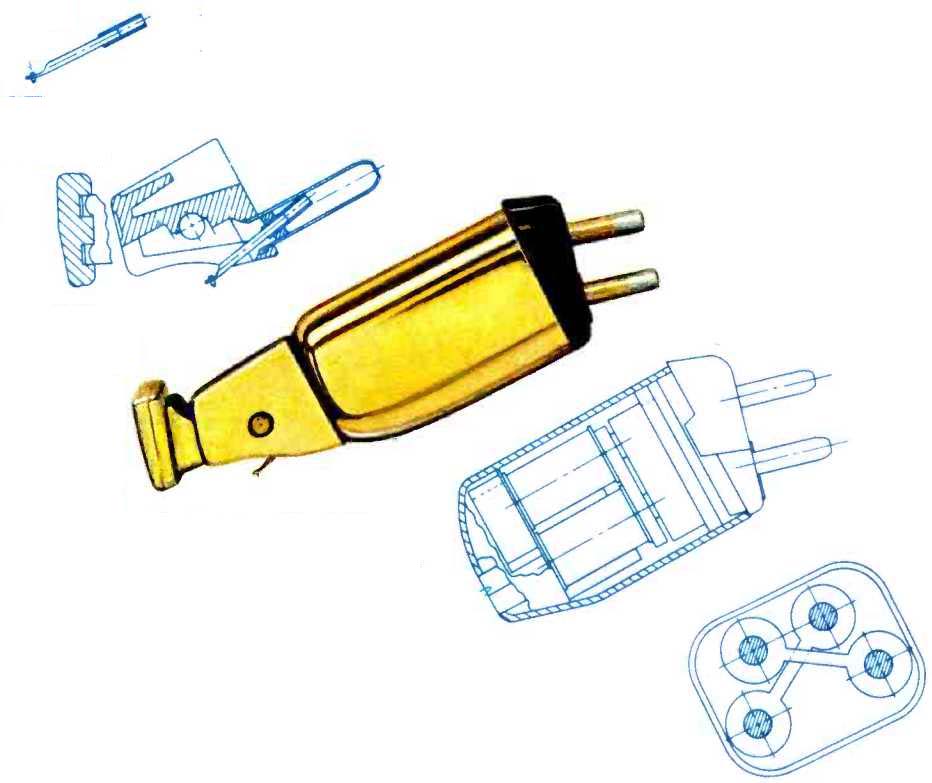
Smooth, flat response from 20-20,000 Hz is the most distinct advantage of Empire new stereo cartridge, the 2000Z. The extreme accuracy of its reproduction allows you the luxury of fine-tuning your audio system exactly the way you want it. With the 2000Z, you can exaggerate highs, accentuate lows or leave it flat. You can make your own adjustments without being tied to the dips and peaks characteristic of most other cartridges.
For a great many people, this alone is reason for owning the Z. However, we engineered this cartridge to give you more.
And it does. Tight channel balance, wide separation, low tracking force and excellent tracking ability combine to give you total performance.
See for yourself in the specifications below, then go to your audio dealer far a demonstration you won't soon forget.
The Empire 2000Z.
Already your system sounds better.
Frequency Response: 20 to 20K Hz ± 1 db using CBS 100 test record.
Recommended Tracking Force - 3/4 to 1 1/4 grams
(specification given using 1 gram VTF)
Separation -- 20 db 20 Hz to 500 Hz 30db 500 Hz to 15KHz, 25 db 15K Hz to 20K Hz
I.M. Distortion (RCA 12-5-105) less than 08%. 2K Hz to 20KHz, 3.54 cm/sec
Stylus--0 2 x 0 7 mil diamond
Effective Tip Mass--0.2 mg.
Compliance--lateral 30x10^-6 cm/dyne vertical 30X10^-6 cm/dyne
Tracking Ability--0.9 grams for 38 cm per sec @ 1000 Hz 0.8 grams for 30 cm per sec @ 400 Hz
Channel Balance -- within 3/4 db is 1 kHz
Tracking Angle--20°
Recommended Load--47 K Ohms
Nominal Total System Capacitance required 300 pF
Output 3mv 0 3 5 cm per sec using CBS 100 test record D.C.
Resistance1100 Ohms Inductance-675 mH
Number and Type of Poles--16 Laminations in a 4 pole configuration
Number of Coils -- 4 (1 pair/channel--hum cancelling)
Number of Magnets -- 3 positioned to eliminate microphonics
Type of Cartridge -- Fully shielded, moving iron
-------------------
TEAC
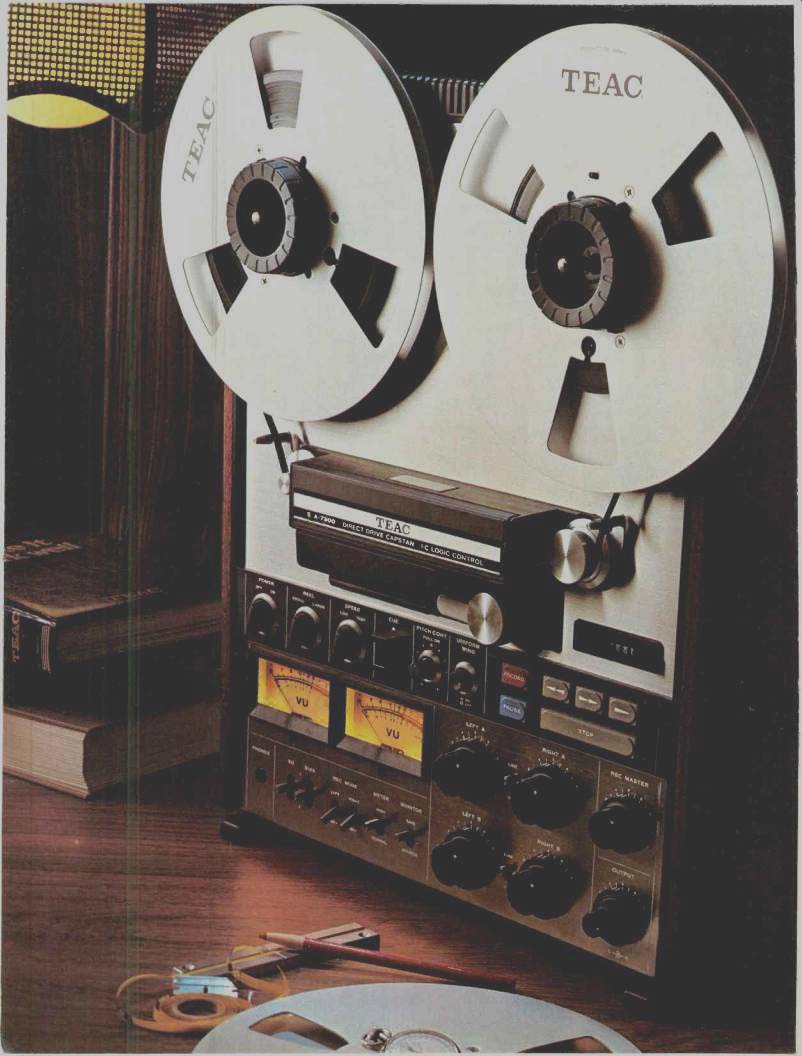
A-7300.

Just because we don't call it professional doesn't mean it couldn't be.
We make professional recorders and we're in a position to know precisely what is meant by the word "professional: So we don't use it casually or carelessly in describing our tape recorders.
On the other hand, the A-7300 is far better than the typical high fidelity component. In fact there are certainly some professional features on the A-7300, like a servo controlled direct drive capstan system, full IC logic transport controls, four balanced mic inputs with XL-type connectors, and a flip-up hinged head cover for easy maintenance and editing.
Then, keeping in mind the serious home recordist, we added a constant speed wind control for even tape packs ... a pitch control for fine-tune speed adjustments ... a 3-position pinch roller setting for cueing and eliminating tape bounce ... and a zero VU click stop on the output level control.
Yet we don't label the A-7300 professional.
Then what about those tape recorders that cost much less and are called "professional"? They're only kidding.
In the final analysis, though, it isn't what it's called, but what it does that counts. You'll have to determine for yourself whether or not the A-7300 meets your specific needs, and you can do that only by examining and operating it for yourself.
You'll find that our retailers are well informed and helpful in general. Rare qualities, so there can't be many of them. You can find the one nearest you by calling (800) 447-4700* We'll pay for the call.
In Illinois, call (800) 322-4400. TEAC
The leader. Always has been.
TEAC Corporation of America. 7733 Telegraph Road, Montebello, California 904340.
------------------
Yamaha
THE END OF THE DOUBLE STANDARD. OUR LEAST EXPENSIVE RECEIVER HAS THE SAME LOW DISTORTION AS OUR MOST EXPENSIVE RECEIVER.
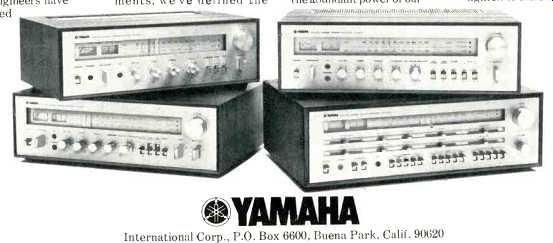
----------IM Distortion Comparison With most manufacturers, price determines quality. However,
in the above chart, you can see how Yamaha alone offers the same quality (low distortion) throughout our entire line, regardless of price.
At Yamaha, we make all our stereo receivers to a single standard of excellence.
A consistently low inter modulation distortion of just 0.1%! A figure you might expect only from separate components. Maybe even from our $850 receiver, the CR-1000. But a figure you'll surely he surprised to find in our $330 receiver, the CR-400. So what's the catch? There is no catch. Simply a different philosophy. Where high quality is spelled low distortion.
You'll find Yamaha's single-mindedness particularly gratifying when compared to the amount of distortion other manufacturers will tolerate throughout their product lines.
(See chart.) Particularly gratifying and easily explained.
Less of what irritates you most.
While other manufacturers are mostly concerned with more and more power, Yamaha's engineers have concentrated on less and less distortion.
Particularly intermodulation (IM) distortion, the most irritating to your ears. By virtually eliminating IM's brittle dissonance, we've given back to music what it's been missing.
A clear natural richness and brilliant tonality that numbers alone cannot describe. A new purity in sound reproduction.
A musical heritage.
Our seeming preoccupation with low distortion, in general, and the resulting low IM distortion, in particular, stems from Yamaha's own unique musical heritage.
Since 1887, Yamaha has been making some of the finest musical instruments in the world.
Pianos, organs, guitars, woodwinds, and brass.
You might say we're music people first.
With our musical instruments, we've defined the standard in the production of fine sound. And now, with our entire line of receivers and other stereo components, we've defined the standard of its reproduction.
Four different receivers, built to one standard.
Between our $330 CR-400 and our $850 CR-1000, we have two other models.
The $460 CR-600 and the $580 CR-800. Since all are built with the same high quality and the same low distortion, you're probably asking what's the difference.
The difference is, with Yamaha, you only pay for the power and features that you need.
Unless you have the largest, most inefficient speakers, plus a second pair of the same playing simultaneously in the next room, you probably won't need the abundant power of our top-of-the-line receivers.
Unless you're a true audiophile, some of the features on our top-of-the-line receivers might seem a bit like gilding the lily. Selectable turnover tone controls, variable FM muting, two-position filters, even a special five-position tape monitor selector.
However, you don't have to pick one of Yamaha's most expensive receivers to get a full complement of functional features as well as our own exclusive Auto Touch tuning and ten-position variable loudness control.
The End of the Double Standard.
Just keep in mind that all Yamaha stereo receivers, from the most expensive to the least expensive, have the same high quality, the same low distortion, the same superlative tonality.
It's a demonstration of product integrity that no other manufacturer can make. And, an audio experience your local Yamaha dealer will be delighted to introduce you to.
YAMAHA International Corp., P.O. Box 6600, Buena Park, Calif. 90620
------------------
Lux
If you're surprised to learn that tubes solve some amplifier problems best, you have something to learn about amplifiers.
And about LLB.
It may seem courageously retrogressive for a company to introduce a tube amplifier--even a highly advanced type--to the semiconductor audio world of 1976. Especially for a company only recently established in the--U.S. market with a comprehensive line of solid-state amplifiers and tuners.
But for LUX, it is simply consistent with our philosophy: whatever path may lead to improvement in the accuracy of music reproduction will be explored by our audiophile/ engineers. Whether it leads to transistors or tubes.
Certainly, transistors are not about to be obsoleted by tubes. However, there are some amplifier problems that tubes still handle better than transistors. Overloading is one such problem.
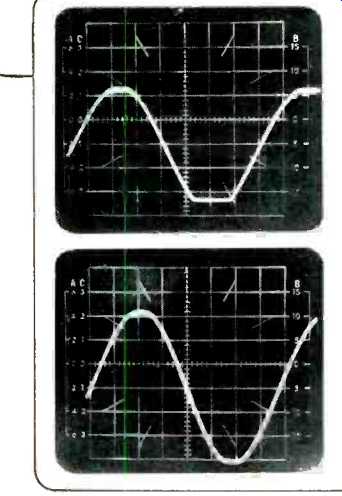
When a solid-state amplifier is driven beyond its rated power, it clips abruptly. Engineers call it "hard" clipping. The term is apt, as the sound from the spurious high-order odd harmonics is raspy and irritating. Further, if the overall circuitry is not stable, and the protective circuits not very well-designed, the distortion is extended in time beyond the moment of overload. Drive a tube amplifier beyond its rated power and it too clips the waveform, but gently and smoothly. This "soft" clipping introduces much smaller amounts of odd harmonics. The distortion is far less irritating, hence less noticeable.
Notch (or crossover) distortion, present in many transistor amplifiers, is another source of spurious high-order odd harmonics. It occurs when the transistor output circuits are not able to follow the musical waveform accurately at the points where it changes from positive to negative and back again. Since notch distortion, unlike clipping, is at a constant level regardless of the power the amplifier is delivering, the ratio of this distortion to signal is worse at lower power. The gritty quality heard from many transistor amplifiers, particularly when they are playing at low levels, is usually due to crossover distortion.
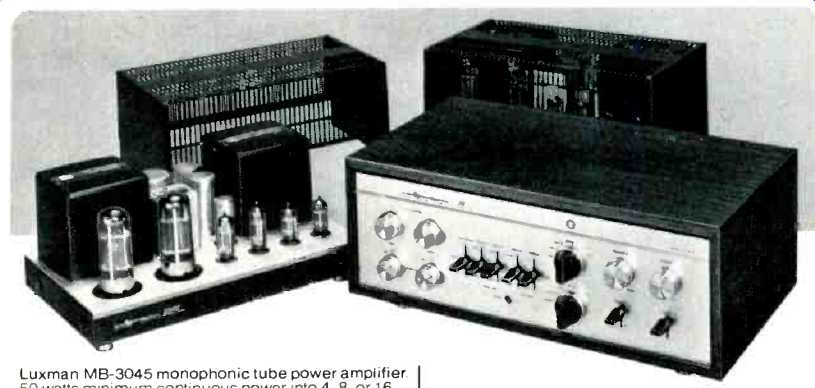
Of course, tubes also have their limitations. Especially conventional tubes. The only tube previously capable of high-power amplification-the pentode-has inherently higher levels of distortion than the triode. Existing lower-distortion triode tubes cannot deliver sufficiently high power as a simple push-pull pair. But LUX, together with NEC engineers, has developed the first of a new breed of triode tube, the 8045G, which with other related technological advances, makes possible a high-power, low-distortion triode amplifier-the Luxman MB-3045. Among the differences in this new triode: the plate-electrode uses a special bonded metal with high heat-radiation characteristics. Also, the fin structure further aids heat dissipation.
LUX also developed a low-distortion high-voltage driver tube, the 6240G, capable of delivering over 200 volts of audio signal to the output triodes. Also, a new output transformer (LUX's, long-time special area of expertise) has been designed to take optimal advantage of the triode configuration feeding it. The quadrafilar winding and core technology of this transformer represents another breakthrough. Overall, from input to output, the use of advanced design direct-coupled and self-balancing differential amplifier stages ensures stability and minimum phase shift.
The MB-3045 produces a minimum of 50 watts continuous power into 4, 8, or 16 ohms, at any frequency from 20 to 20,000 Hz, with total harmonic distortion no more than 0.3%. As the MB-3045 is monophonic, a pair of them connected to a stereophonic preamplifier will not be subject to stereo power-supply interaction.
Now, we don't expect the MB-3045 to become the world's best-selling amplifier, any more than our highest power solid state power amplifier, the M-6000 priced at nearly $3000. You'll find both at our carefully selected LUX dealers who will be pleased to demonstrate them for you. And any of the other dozen or so LUX models. It's why they're LUX dealers in the first place.
------When a typical transistorized amplifier tries to deliver more power than it can.
the top and bottom edges of the waveform "clip" sharply and abruptly ..and not always symmetrically. Result.
high-order harmonic distortion... raspy and irritating When a tube amplifier. such as the Luxman MB-3045. is driven into over load. the 'Clipping' is softer.
with more rounded edges to the waveform The resulting distortion is much less audibly bothersome.
------ Luxman MB-3045 monophonic tube power amplifier.
50 watts minimum continuous power into 4, 8, or 16 ohms, 20-20 kHz; total harmonic distortion no more than 0.3%. Frequency response: 10 to 40 kHz, ± 1 dB Signal to noise ratio. 95 dB. Variable sensitivity, control for matching gain to any preamplifier. $445.00 each.
Luxman CL-35 Ill stereo tube preamplifier. Total harmonic distortion: 0.06% at 2.0 V. 20-20 kHz, all output signals. Frequency response: 2-80 kHz, +0 -0.5 dB. RIAA equalization: ±0.3 dB. Features include: tape monitoring and dubbing, 6 selectable turnover frequencies, twin high and low noise filters, switchable phono-input impedance (30, 50, 100 kohms), variable input sensitivities. $745.00. LUX Audio of America, Ltd. 200 Aerial Way, Syosset, New York 11791 Canada: AMX Sound Corp. Ltd., British Columbia; Gentronic Ltd., Quebec
----------------
700 Series
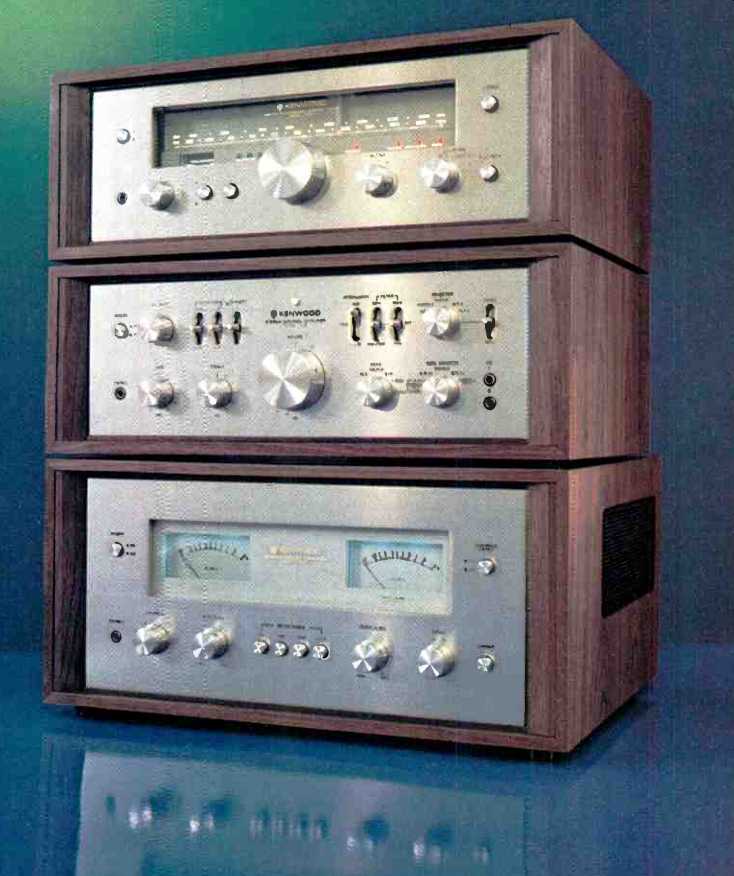
KENWOOD introduces three components of unsurpassed sophistication, created In the KENWOOD tradition of engineering excellence. The incomparable 700 Series carries state-of-the-art to a new plateau of performance in man's continuing endeavor to recreate the living sound of music. The 700 Series ... a classic in its own time.
700T Frequency Synthesizing Tuner
700C Preamplifier—Control
700M-Power Amplifier
15777 S. Broadway, Gardena, CA 90248
7202 Fifty-first Street, Woodside, N.Y.
------------------
harman/kardon
The attitude is consistent.
The expression is new.
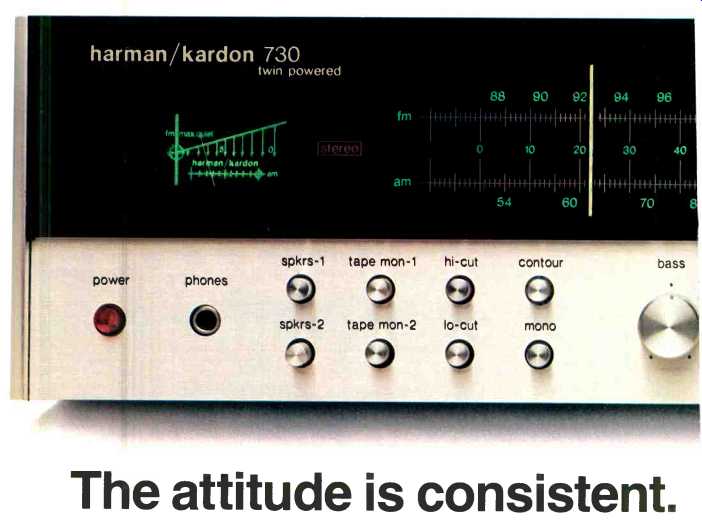
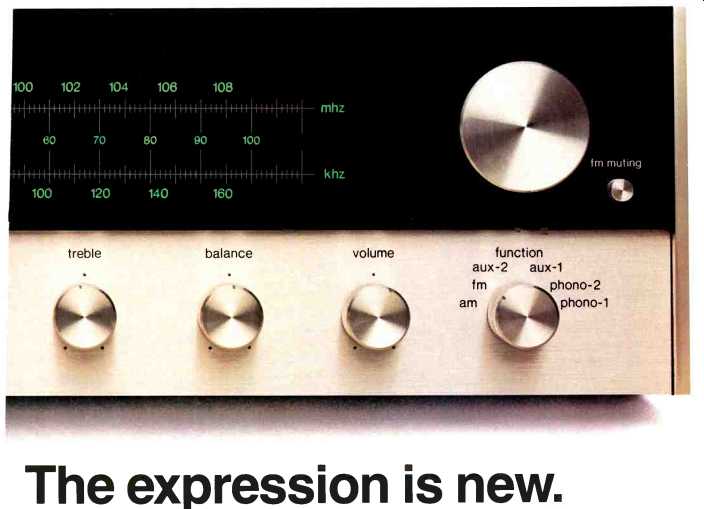
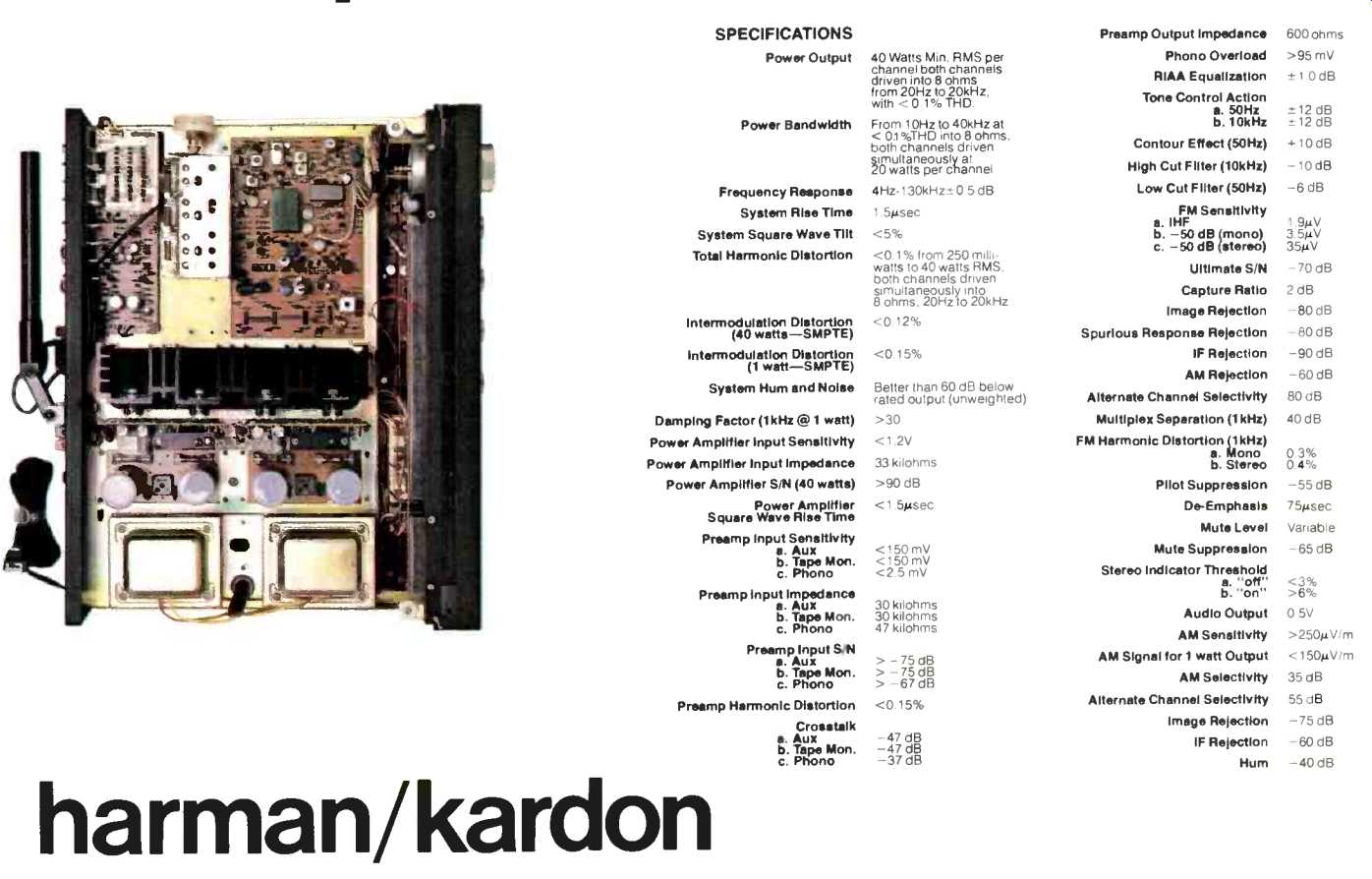
High fidelity engineering, to justify its name, has one goal: to reproduce music in the listening room with unqualified accuracy.
Undistorted. Undiminished.
At Harman Kardon, we explore new technical directions not solely for their inherent challenge, but as methods of predicting and improving music quality.
Specifications are supposed to serve the function of predicting performance. Yet two competitive instruments with exactly the same set of conventional specifications often sound vastly different. Obviously, the reasons for this difference lie elsewhere. Conventional specifications are necessary.
Necessary, but not sufficient.
Our 730 receiver meets specifications equaling or surpassing those of the finest individual component units. Yet it achieves a quality of transcendent realism which these specifications alone cannot explain.
To predict musical accuracy, we have found it necessary to go beyond conventional specifications. We test, rigidly, for square wave response. We monitor, strictly, slew rate and rise time.
These tests account for the sound quality of the 730-not in place of conventional specifications, but beyond them.
The 730 goes beyond the conventional in other ways. It is driven by two complete, discretely separate power supplies, one for each channel. Even when music is extraordinarily dynamic, the energy drawn by one channel will in no way affect the other. The music surges full. Unconstrained.
Any fine tuner measures signal strength. The 730 incorporates a patented system which measures not strength, but signal-to-noise ratio. As a result, it can be tuned to the precise point where the signal is purest for listening or recording.
Equally important, the twin powered 730 has all the basic design elements that identify it as a Harman Kardon instrument: wide bandwidth, phase linearity, ease of operation and a wide range of input and output elections.
All of this suggests further discussion. If you are interested in such an exploration, please write us (directly, since we imagine you are impatient with coupons and "reader service" cards, and so are we). We'll certainly write back, enclosing a brochure also unconventional in its detail.
Just address: The 730 People, Harman Kardon, 55 Ames Court, Plainview, New York 11803.
---------------------
TANDBERG 10XD bridges the gap between consumer and professional tape recorders.
Meet the world's first and only 10 ½” reel tape recorder that operates at 15 ips and combines Tandberg’s unique Cross-Field recording technique with the world-famous Dolby B system.
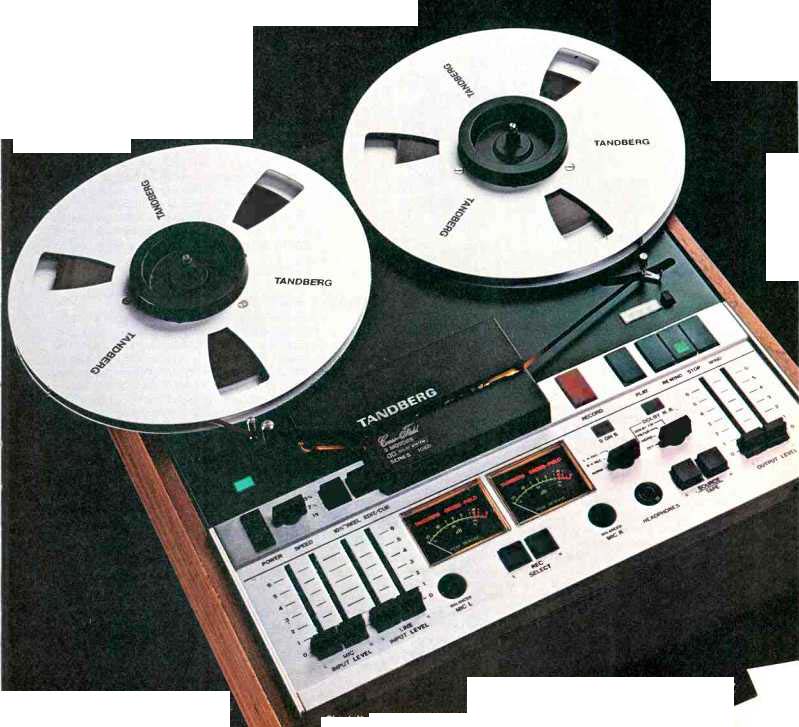
Result: A guaranteed minimum signal-to-noise ratio of 72 dB, measured on a 4-track machine using A-weighting. Simply put, the 10XD completely eliminates audible tape hiss!
Hare are some of the many sophisticated features that make the 10XD the finest tape recorder Tandberg has ever built:
3 speeds: 15, 7, 3 3/4 ips. Electronically selected
3 motors; Hall-effect capstan motor
3 heads; plus separate bias head
Electronic servo speed control
Electronic logic mode controls, including photo optics
Electronic balanced microphone inputs
Peak reading meters
Direct transfer from playback to record (flying star)
Ferrite playback head with symmetrical balanced output for hum cancelling purposes and differential playback amplifier.
Remote control and rack mount optional. Pitch control by special order.
For a complete demonstration of this remarkable new advance in stereo tape recording, see your Tandberg dealer
Tandberg of America, Inc., Labriola Court, Armonk, N.Y
A. Allen Pringle Ltd., Ontario, Canada
-------------------
JBL
How (and how not) to loudspeaker.

Every year thousands of high fidelity customers are put through a variety of "demonstration" rituals on their way to choosing loudspeakers. It's enough to make a tire-kicker blush.
We're going to tell you how to buy a loudspeaker.
We're not going to tell you which one, because loudspeakers are very personal. One man's nice is another man's noise. Still, there are some common sense (and not-so-common-sense) things you should know. For instance:
Enjoy yourself.
You're not getting tetanus shots.
You're searching for love. Enjoy.
Bring your own music.
Bring a favorite record or tape; something you know by heart.
There's no quicker, simpler way to tell the difference between speakers. If you've been listening in black and white you'll know it when you hear Technicolor.
Also, don't evaluate any speaker by listening to radio--AM or FM. By the time a radio signal comes out of a speaker, it's been strained through generations of electronics and the signal has been clipped on both ends. Its just not a test of high fidelity sound.
Listen to the speakers through the kind of electronic system you plan to have at home.
No point listening through $5,000 worth of pre-amp, amp and turntable at the store unless that's what your speakers are going to live with. right? Right.
Turn it up!
Way up. Loud loud. Kid-next-door loud.
You don't have to live with loud music, but you ought to visit there. Loudness magnifies the imperfections that will scar your subconscious at regular listening levels.
Do you like the sound? Is it clean? Is it clear? Does it hum? Does it splatter? Loudness tells you what time will do to your ears, your head, your disposition. So, turn it up!
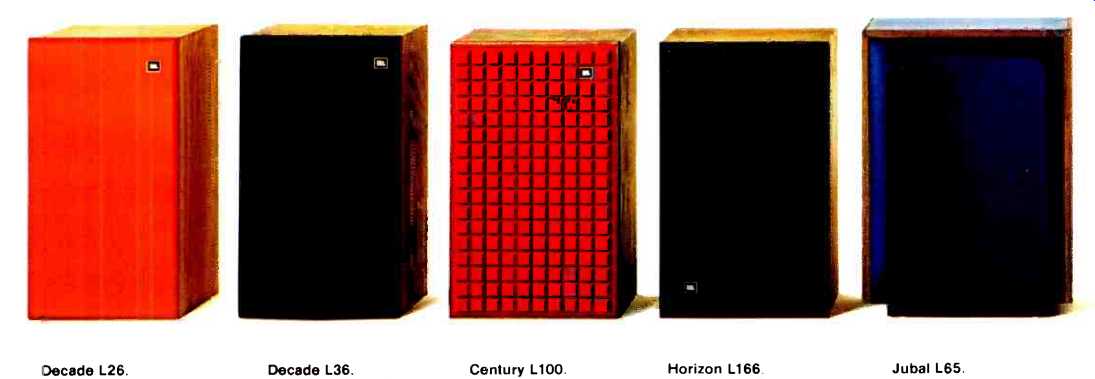
Decade L26.
JBLs best selling two-way system. Natural oak cabinet.
$156 each.
Decade L36.
JBLs least expensive three-way system.
Natural oak cabinet.
8198 each.
Century 1100. JBL dressed up their compact studio monitor and turned it into the most successful loudspeaker they've ever made.
$318 each.
Horizon L166.
JBLs newest It has more power handling capability, definition, and range than any bookshelf loudspeaker JBL has ever made.
$375 each.
Jubal L65.
The smallest floor system we make. Oiled walnut finish with smoked glass top. $426 each.
Turn it down!
Right to the edge of silence.
Are all the textures and details and harmonics of the music still there or does only the melody linger on? No one wants to live with a loudspeaker that can't make its point unless it yells. So, turn it down.
Don't stand right in front of it. You're not taking batting practice.
One way to spot a not-so-good loudspeaker is to listen to the way it handles high frequency sound.
If the sound narrows as the tones go higher, if there's a peashooter effect that requires you stand right in front of the speaker to hear the highs, that's not so good.
A good loudspeaker will disperse the sound throughout the room.
So, stand to one side, then the other. If you don't get all the music, move on.
One demonstration isn't a demonstration.
Expect to listen to three, four, five different pairs of speakers. Be critical. Be opinionated. A little honesty never hurt a courtship.
Last point: Most of how is who.
One of the more expensive bits of nonsense Is that all great products sell themselves. That's just not true with loudspeakers.
You're going to be better off if you can find someone to help you take a speaker through its paces.
And you just can't do any better than an authorized JBL dealer.
He's one of the nicest know-it-alls you'll ever meet.
High fidelity loudspeakers from $156 to $3210.
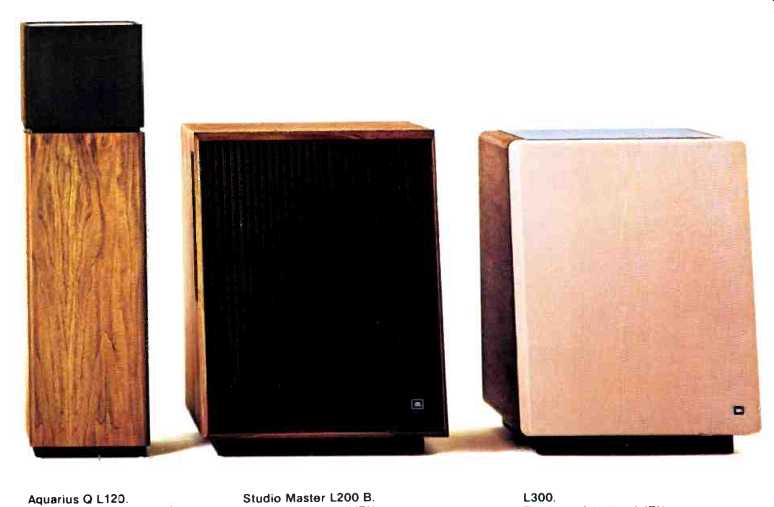
Aquarius Q L120. Sound in the round. 360° sound to match its 360° good looks. Oiled walnut or satin white finish. $633 each.
Studio Master 1200 B. A home version of JBLs two-way professional studio monitor $696 each.
1300. The beautiful twin of JBLs newest three-way professional studio monitor. $897 each.
Now that you've gotten the word, try the number.
Call (800) 243-6100 for the JBL dealer nearest you.
In Connecticut, call (800) 882-6500
JBL
James B. Lansing Sound, Inc./ 3249 Casitas Avenue/ Los Angeles 90039
-------------------
--------------------
Introducing the changer that outperforms all others.
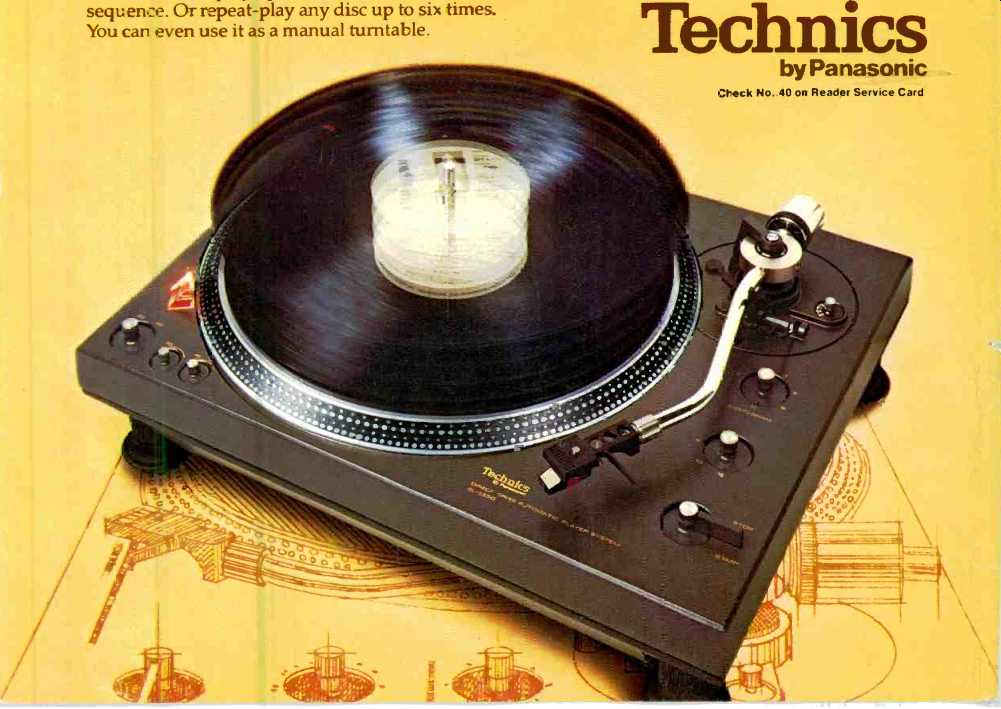
The direct drive SL-1350.
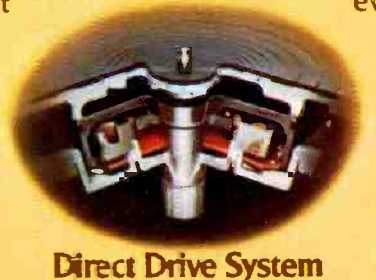
Introducing the world's first and only direct drive changer. The SL-1350. The first changer with the Technics direct drive system. A system so superior many radio stations now use it.
No other changer, and only a handful of manuals, can equal its 0.04% wow and flutter. And because the motor spins at the exact speed of the record, any rumble is an inaudible-70dB (DIN B).
Two pairs of pivot bearings ensure the rotational sensitivity of the SL-1350's gimbal suspended tone arm. And for precise tracking, its effective pivot to stylus length is 9'. With the Technics Memo Gram dial control, the SL "350 can play up to six records in sequence. Or repeat-play any disc up to six times.
You can even use it as a manual turntable.
--------Direct Drive System
But any way you use it, the SL-1350 gives you everything you need. Like viscous damped cueing and variable pitch controls. A 13" platter. An easy view prism strobe. CD-4 phono cables.
Even a hinged detachable dust cover and base are included.
So if you've been sacrificing the convenience of a changer for the performance of a manual, take a look at the Technics SL-1350. It'll change your mind about changers.
The concept is simple. The execution is precise. The performance is outstanding.
The name is Technics.
FOR YOUR TECHNICS DEALER, CALL FREE 800 447-4700. IN ILLINOIS, 800 322-4400.
Technics by Panasonic
(Source: Audio magazine )
= = = =