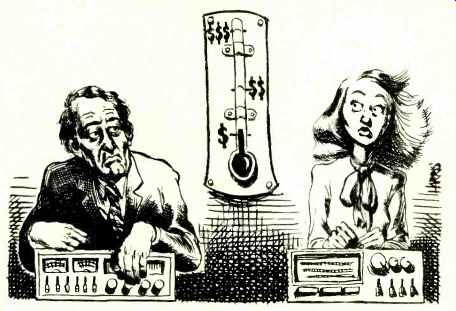
The 1980 Winter CES in Las Vegas was widely anticipated as a barometer of the
audio industry. After what could charitably be called a lean year in 1979,
manufacturers and dealers alike were anxious to get a reading on the prospects
for 1980. The first day of the show seemed encouraging--good attendance, a
definite undercurrent of optimism, and apparent enthusiasm for some of the
new product offerings.
Alas, by the next morning the barometer was falling, and there was a pervasive gloom as it became apparent that many key dealers, especially those from the East, were "no-shows." Quite a few of the manufacturers I spoke to were openly disappointed with the show and weren't sanguine about the financial state of the industry. One speaker manufacturer bitterly commented to me that after all his trouble and the expense of exhibiting, he had opened up exactly one new account.
I am not trying to be Pollyanna, and though the audio industry is most certainly depressed, I don't think it is really quite as bad as many would have you believe. For one thing, I think many industry people are still in a state of shock after finally realizing that the audio industry is indeed undergoing a traumatic recession for the first time in its existence. I'm not trying to give a phony, hyped-up pep talk or any of that "buckle down Winsocki" jazz, but in spite of the industry's very real problems, this is still a very viable business. The great preponderance of American households do not yet have a single piece of audio equipment--surely an untapped market that needs a concentrated effort and a different approach. Certainly in all the burgeoning new technologies, there are opportunities for the creative mind. I think too that we have come dangerously close to saturation in many of the traditional areas of audio commerce. It is time for new directions and also time we took a long hard look at ourselves, friends.
Perhaps one of the reasons for the down-in-the-mouth attitude at the show was the oft-repeated observation that there wasn't much really new or exciting. While generally true, there were some interesting items worth more than a casual look. This time around, with no apologies, I am not even going to attempt a semi-catalog survey of what is new in the various component categories. One is simply overwhelmed by the sheer numbers of what is available. Thus, I shall limit my observations to what I thought was important, useful, and contributory to the enjoyment of music.
PZM Mikes
Crown International, heretofore known for their high-quality amplifiers, preamps, etc. has begun producing a very unusual microphone, the PZM, or "pressure zone micro phone." Originally developed by Ed Long (of "time align" fame), one of this magazine's Contributing Editors, and his associate, Ron Wickersham, the PZM operation is based on the principle that, within a few millimeters of a rigid surface, the incident and reflected sound waves from a pair of equal level signals add coherently.
Very close to a boundary, such as a floor, the signals are still in phase after being stopped and reflected by the boundary. This creates a pressure zone right at the surface of the boundary, where the instantaneous pressure is uniform, and response is not a function of the angle of incidence. In his original experiments, Long used a half-inch Bruel and Kjaer microphone, placed so that its diaphragm was with in a few hundredths of an inch and parallel to a stage floor (rigid boundary) and not facing the sound source; ordinarily the mike diaphragm would be vertical or nearly so. He found that a PZM maintains a flat response and does so for all the angles of incidence in the hemisphere surrounding it. The sound is cleaner and truer because the signal is free of anomalies caused by the phase cancellation of direct-with reflected sound.
Crown has an exclusive license to build the PZM microphone based on Long's research. The firm's general purpose model is a 5 x 6 inch, 1/8-inch thick aluminum plate, with the XLR mike connector mounted on it. The finely machined microphone cantilever features an approximately ¼-inch electret mike capsule mounted on it so that its diaphragm is parallel to and about 1/12,000 inch above the plate. Standard power supply is a combination transformer, battery, and phantom power supply contained in an approximately three-inch metal cube. With the elimination of phase-cancelling and comb-filtering effects, the PZM is very accurate with a smooth, wide frequency response. The design lends itself to simple miking techniques, and the PZM can handle sound levels of more than 150 dB. It can even be placed inside a kick drum! Best of all, the Crown PZM will be priced around $375.00, including power supply. It gives a whole new dimension to miking techniques, and much work has been done with concert recordings.
Dennesen Electrostatics exhibited some unique designs in several product categories. The most intriguing was their DEI linear tracking, air bearing tonearm. On a superbly machined brass support base is a slide track drilled with a series of tiny inlet holes.
This is connected via flexible tubing to a special low-noise air pump. Riding on the slide is an extremely light weight plastic "saddle," and mounted on the saddle is an ultra-thin carbon fiber arm. The air pump maintains a positive pressure through the outlet holes of the slide bar, and the plastic saddle and arm carrier thus ride on a frictionless air bearing. The pump is capable of handling most cartridge weights, and there are several inter changeable arms of different mass. It is uncanny to gently touch the support saddle and "feel" the action of the air bearing. Tracking abilities are phenomenal with this kind of setup. For cartridges of very high compliance, this is an arm that will finally do them justice. The $1,000.00 price includes the air pump. Also shown by Dennesen was their DEI turntable isolation base. This features special pneumatic dampers with a fundamental resonance of 3.2 Hz, and it is claimed to virtually eliminate acoustic feedback.
Most turntable bases can be fitted to the unit, which costs $325.00.
Preamps and Discs
Charlie Woods, the genial head of Audionics of Oregon, was proudly showing the production versions of his Space and Image Composer, with its Tate system SQ decoder and synthesizer. As you might expect, most people are using the unit for its synthesizer functions, finding out what interesting out of phase information is lurking in the grooves of their favorite records. With four matched ADS speakers the sound was great with interesting interchannel dynamics and, with some recordings, an impressive panorama and proscenium effect. Also demonstrated was the RS-One, Audionics' new Class A preamplifier. Essentially a purist design, with a computer-designed RIAA section claimed to be flat within 0.2 dB, the unit also features the same unique axial tilt circuit as on the image composer. This enables ±7 degrees of electronic correction of the mechanical misalignment of the stylus in the groove.
By now, most of you are aware of the dbx-encoded discs and their companion Model 21 disc decoder. The reasons for their design were the extension of usable dynamic range and the virtual elimination of surface noises. I have tried the system at home, and in general it works quite well. However, it is a system that is source limited: It is only as quiet and displays only as much dynamic range as the master tape from which it was encoded. Jerry Ruzicka, the dbx vice president who is the guiding light be hind this project, got the bright idea that if he could find a source of digital masters, encoding them onto dbx discs would really give an honest-to-God 85 to 90 dB of dynamic range. And all this without recourse to an actual digital record playback system--a sort of sonic "have your cake and eat it, too." Well, Jerry found M&K RealTime Records ready to cooperate. Previously, they have been known for their excellent direct-to-disc recordings. They recently hied themselves to Vienna, where they used a Sony 1600 digital recorder to make a series of recordings with the refugee orchestra, The Philharmonica Hungarica. Understandably they concentrated on old warhorses like Tchaikovsky's Romeo and Juliet and Nutcracker suites, The Sorcerer's Apprentice, Espana, and The William Tell Overture, with six albums in all. At the CES demonstration, I wasn't too happy with the sound of the playback system, but there was no question that the vaunted 90 dB of dynamic range had indeed been captured on the discs. (As I related in my recent column on dynamic range, there are going to be some merry old speaker blow-ups with these recordings!) Holding forth at the Showboat Hotel was John Dunlavy of Audio Standards Corp. As I have said before, he is one of the few people in this industry who truly deserve the "genius" label.
John has done it again. His new Model FP-3A preamplifier is one of the most advanced designs extant, with specs which are sure to be challenged by many who won't believe them. The preamp is an entirely FET design, using no inverse feedback loops. All stages have slew rates exceeding 500 volts per microsecond. Square wave distortion is not measurable at 10 volts, peak to peak, nor is TIM at the same levels.
THD and IM distortion are less than 0.01 percent at 10 volts, p-p. Noise is within 3 dB of thermal agitation--in other words, near the theoretical limit of the laws of nature! All these are claims, but John was equipped as usual with his imposing array of test equipment, including HP spectrum analyzers, and proved many specifications on the spot. How did the preamp sound? Sensational, but then it was being played through John's new speaker system, so I'll have to wait to hear this preamp with a variety of systems I'm familiar with before I can make an assessment of the unit itself.
As to John's DDRL-3, Dual Directivity Reference Loudspeakers, this impressive system will likely find a home only where the "man wears the pants." There are rectangular cabinets housing 15-inch woofers, one on the bottom, one on the top. In between them is a cylindrical unit containing six midranges and three tweeters. That's for each side! The speakers stand al most seven feet high, so you see what I mean about their probable owner ship. They feature a switchable pattern of either directional or omni-direction al; I liked the omni better. The speakers are time and phase coherent, and John states they will handle one kilowatt on short duration musical peaks. He also claims distortion is less than 0.3 percent THD at 90 dB SPL at one meter for any frequency from 30 Hz to 20 kHz. I didn't have a chance to listen as much as I would have liked, but on some really high-quality recordings, the sound was truly impressive for smoothness, imaging, really solid bass, and "non-sizzly" top end.
Further judgment must come with extended listening, which I hope will occur within a few months. All in all, two very impressive products, appealing to the advanced audiophile who can afford $1,800.00 for the preamp and $3,000.00 a pair for the speakers.
Next month I'll cover some of the other notable components from the Winter CES and report on a visit with Gene Czerwinski, the "high priest of dynamic range" at Cerwin-Vega.
====
Borgia Column
by Nadine Amadio

The high fashion world of hi-fi or a closer look at the "Sin" pickup arm.
The average hi-fi enthusiast is relatively sane, indeed he displays an above average insight into audio technicalities. Nevertheless, there is a streak of wild romanticism in his make-up that paves the way for high-fashion in hi-fi.
A classic example is the remarkable elevation to superstar status of the Italian-made pickup arm, the Prendi su-Braccio Peccato or, as it has come to be known in good plain English, "The Sin" pickup.
Does the name have a poetic ring? Does it have vaguely erotic connotations? Would Rossini have included it among his "Sins?" Has there been some heavy underground publicity or is it just some quirk of chance that has transformed a pleasantly average piece of equipment into an audio prize? Surely there must have been some organized promotion of one sort or another in the centers of "sound" in fluence to achieve a result as totally irrelevant, but as tyrannically "in," as this year's trend in long or short hair.
I remember once, during a particular period when I was dabbling in philosophical and mythological encapsulation, I christened a well-known New York hi-fi salesman as "The Cortlandt Street Oracle." This, of course, was in no way in tended to be derogatory to that gentleman's commendable habit of selling stock in the most persuasive fashion, nor of his ability to expound on the virtues or virtuosity of his more spectacular equipment. It was rather the large and ardent clientele waiting, palpitating for every crumb of information falling oracularly from his lips that inspired his rechristening.
These same eager clients carried his prophetic words to the farthermost corners of this far-flung continent.
Were these, like Henry V, the makers of fashion? However, back to the canonized "Sin" pickup. Let us look at this four-star fashion fetish in the cold light of a Borgia morning.
Our aim is not to reduce a nice clean-cut, Italian boy next-door pick up to a social outcast, but rather to look beneath the bright stainless steel smile and trendy wrappings and see if there is any real muscle there. Any tonal biceps on the arm, as it were.
Maybe it's not the product that's at fault but the image making. Inflation is a problem in any form and inflation calls for a little iconoclasm, as our Lat in friend will surely agree. Of course, in the old days, we had more subtle and, one might say, more tasteful methods of dealing with little Italian upstarts. Forgive the outburst, but my country's honor is at stake! Many aspects of the "Sin" arm are undeniably attractive--high mass is (ironically perhaps) ideal for the "Sin" moving-coil cartridge. If one intends to "sin," one usually does not wish to be lightweight about it.
Nevertheless, the resonances that become apparent when the “Sin” is excited cannot be excused. If you peer closely at your bass speaker, you will find it pumping in and out distractedly in phase with the low-frequency oscillations introduced by the Peccato pickup. All I can say is "Quel Dom mage!" or better still, "Che Peccato!" And I must warn that under the sunny, virile Italian charms of your "Sin" arm, there lurks an ill-tempered and moody despot. Does high-fashion hi-fi cater to masochists, or does the enthusiast delight in inconsistent and willful behavior from his equipment? You'll find the "Sin" difficult to set up correctly, and if you so much as alter the tracking weight by an eyelash, you will have to completely readjust the bias and anything else you can think of.
So don't expect your "Sin" to warble along as sweetly as any Caruso or any well-paid Venetian gondolier. Expect problems, even if they are fashionable problems.
Of course, if you don't have "ears" or if you don't like being the odd man out or if you are ashamed to admit you don't have any vices--not even one "Sin"--then go ahead and buy one.
====
Vintage magazine ADs:
Revox

Why we created our own total system.
We simply had to.
Because no chain is stronger than its weakest link. And no music system is better than the distortion or noise coming from any of its components.
We wanted to make sure that when you choose one Revox you get all that it has to offer.
The total Revox system delivers virtually distortion-free music from every source and in any mode-music reproduction so true that it is un matched by any other system available today.
---Revox Audio-Rack
All the components in the Revox system are de signed to meet the professional quality standards that have been set by the Revox B77 open reel recorder with its ingenious logic control system.
The B750 integrated amplifier, for example, is renowned for its fast transient response to all musical signals and for its low TIM. It is paired with the incredible B760 digital synthesizer FM tuner with the unusual capability of programming 15 stations which you can recall at the push of a button. The B790 direct drive, quartz controlled turntable reduces tracking distortion to an absolute minimum using a revolutionary new system called Linatrack.
For an unmatched musical experience, listen to our matched components at your franchised Revox dealer. Or write to us for details. Studer Revox America, Inc. 1819 Broadway, Nashville, TN. 37203 (615) 329-9576. Offices: Los Angeles (213) 780-4234 / New York (212) 255-4462
-------------
Harman Kardon introduces low negative feedback design.
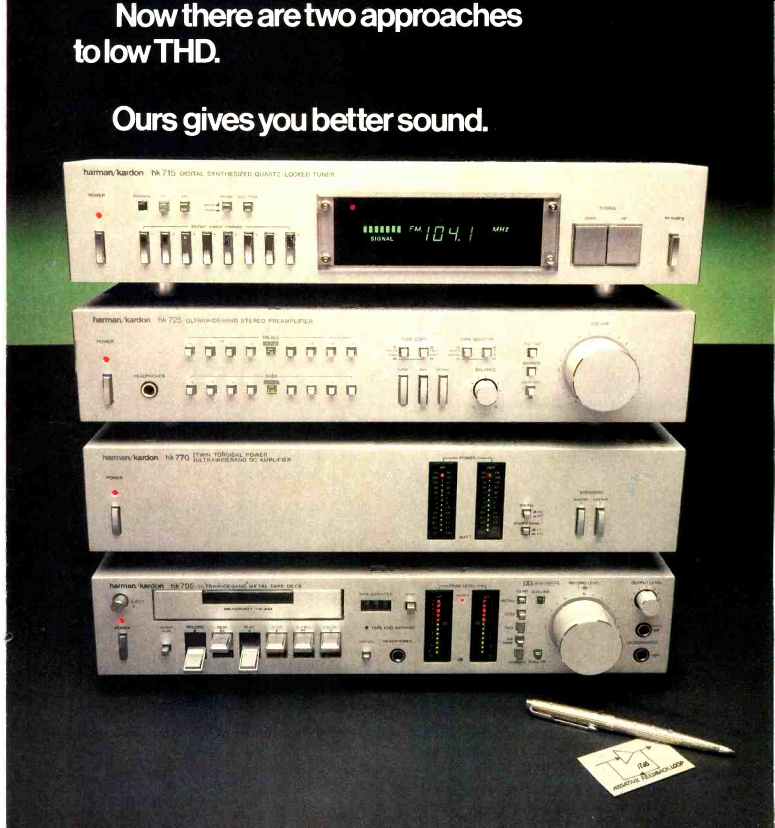
High Technology Separates with low THD and inaudible TIM for incredibly clean, open sound.
For the last few years, audio manufacturers have been rushing to bring you newer, lower THD (Total Harmonic Distortion) levels in their amplifier sections.
And every year, they've accomplished this objective the simplest way they could. By adding more and more negative feedback, a form of electronic compensation that feeds the amplified music signal back through the circuit.
Unfortunately, this universal "cure" for THD-high negative feedback, typically 60-80 dB-creates a new form of distortion. It's called Transient Intermodulation Distortion, or TIM. And it's much more audible than THD. TIM causes music to become harsh, metallic and grating. And the spatial relationship of the instruments to become vague, smearing the image.
At Harman Kardon, our new 700 series amp and preamp give you low THD figures, too.
But we did it the right way-by properly designing the amplification circuitry to deliver low THD even before we apply negative feedback. That keeps our negative feedback at just 17 dB. And our TIM level at just .007%.
Well below the audible threshold.
The result is pure, clear, transparent sound and stereo imaging that places instruments and vocals precisely.
Beyond TIM.
Of course all the Harman Kardon components incorporate our traditional ultrawideband design, which provides fast transient response and phase linearity. We also use discrete components instead of integrated circuits, because ICs create their own IC distortion.
But beyond these major design considerations, we've also paid attention to all the small details.
In the hk725 preamplifier, for instance, we used fixed resistor pushbuttons for tone controls.
They introduce less distortion than rotary knobs. We also incorporated DC coupled FET front ends in both our 8-stage phono section and our high level stage.
Again, less distortion, and improved signal-to-noise ratio.
On the hk770 power amplifier, we used two separate toroidal power supplies, which eliminate cross-talk and hum.
And DC coupling which provides tighter, more articulate bass.
Performance matched separates.
Once we designed the heart of our new 700 series High Technology Separates, we addressed the remaining components just as carefully.
The hk715 digital quartz-locked tuner gives you a full complement of features. It locks in to the channel center every time. And stays there, drift-free.
It also has a memory subsystem that lets you store up to 8 stations and recall them instantly at the touch of a button.
We designed a linear phase analog tuner as well. The hk710.
With an improved version of the phase-locked circuitry we introduced to the industry nearly 10 years ago. It remains the industry standard today for quality tuners.
The first cassette deck with Dolby HX.
In 1970 Harman Kardon introduced the first cassette deck with Dolby NR. In 1980, we're bringing you the first cassette deck with the new Dolby HX headroom extension circuitry.
The hk705. With the Dolby HX headroom extension circuitry, you get an added 10 dB of high frequency headroom, as well as a 68 dB signal-to-noise ratio.
That's comparable to open reel decks that cost twice as much.
And thanks to Dolby HX and metal tape capabilities, the 705 provides an impressive frequency response of 20-19,000 Hz (±3dB).
Once we finished the inside of our components, we went to work on the outside. To bring you a striking system of modular separates. Each measuring a compact 15" wide x 3" high.
These performance matched separates stack beautifully. They give you a noticeably cleaner, clearer, less distorted sound than any system anywhere near the price.
We suggest you audition them. But only if you're serious. Once you hear the difference, you'll never be satisfied with anything less.
(For the location of the Harman Kardon dealer nearest you, call toll-free 800-528-6050, ext. 870.)
--"Dolby" and the double-D symbol are trademarks of Dolby Laboratories.
harman / kardon. 55 Ames Court, Plainview, NY 11803.
HK ... Now there are two approaches to low THD.
-------------
Tandberg

Two of the most important new words in tape recording
Problem:
Traditionally, tape recorder electronics have had insufficient headroom to fully exploit the greater performance capability of the new high coercivity tapes, such as metal tape. The goal of Tandberg engineers was to improve the headroom of tape recorder electronics by 18-20 dB so it can be used with metal tape.
Cause:
In conventional recording systems the summation of record & bias current in the record head is done through passive components, leading to compromise solutions which have their distinct and pronounced weaknesses-primarily a limited headroom for the signal.
Solution:
Tandberg engineers developed & patented a new recording technology without these compromise solutions (See curves above). In the new ACTILINEAR system, featured in our TD 20A open reel and TCD 340A & TCD 440A cassette recorders, the passive components have been replaced with an active Transconductance amplifier. Among the benefits of this new recording system are:
Up to 20 dB more headroom.
Less Intermodulation due to Slew Rate limitation.
Improved electrical separation and less interference between bias oscillator and record amplifier.
No obsolescence factor-usable with any type of tape available now or in the years to come.
Problem:
High frequency limitations inherent in the cassette (i.e., low speed) medium. Tandberg engineers have developed an exclusive, Patent-pending circuit that is not just a technical refinement, but a fundamentally new approach to the matter.
Whereas ACTILINEAR overcomes the limitations of electronics at any speed, DYNEQ overcomes tape limitations at low speeds.
High frequency saturation (overload) is of particular importance with today's new direct-to-disc and digitally-mastered recordings as they deliver more energy in the high frequency range than ever before.
Cause:
The high frequency overload--i.e., "the cassette sound"--of which tape recording purists complain is not simply a question of reaching a point where the tape can hold no more signal. At high frequencies, excessive input levels not only produce enormous amounts of distortion, but actually lower the signal level played back from the tape. In other words, once you have reached the saturation point on the tape, the more signal you try to put in, the less you actually get out.
Solution:
If, just at the point where high frequency saturation (overload) begins to occur, you could automatically lower the amount of record treble boost supplied by the equalization circuit, you could increase the high frequency output of which the tape is capable, and drastically lower high frequency distortion (See curves above). In brief, this is precisely what Tandberg's exclusive new dynamic equalization circuit does.
Yet another benefit is that the DYNEQ circuit, featured exclusively in Tandberg's TCD 440A cassette deck, not only gives improved performance with the new metal particle cassettes, but also delivers a significant improvement in performance with today's better premium tapes.
Perhaps the most important word in tape recording.
Tandberg of America, Inc., Labriola Court, Armonk, NY 10504.
----------
Shure fact: five new Shure Cartridges feature the technological breakthroughs of the V15 Type IV
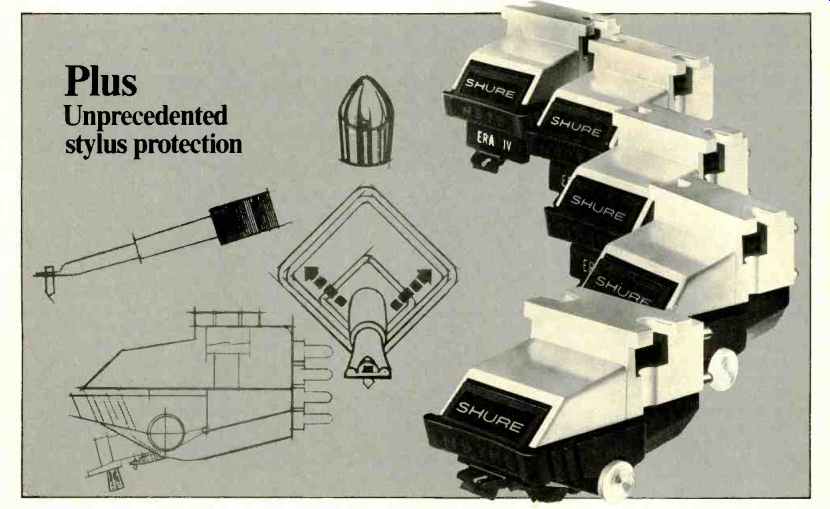
Plus Unprecedented stylus protection…
…the M97 Era IV Series phono cartridges
Shure has written a new chapter in the history of affordable hi-fi by making the space-age technological breakthroughs of the incomparable V15 Type IV available in a complete line of high-performance, moderately-priced cartridges: the M97 Era IV Series Phono Cartridges, available with five different interchangeable stylus configurations to fit every system and every budget.
The critically acclaimed V15 Type IV is the cartridge that astonished audiophiles with such vanguard features as the Dynamic Stabilizer-which simultaneously overcomes record-warp caused problems, provides electrostatic neutralization of the record surface, and effectively removes dust and lint from the record-and, the unique telescoped stylus assembly which results in lower effective stylus mass and dramatically improved trackability.
Each of these features ...and more ... has been incorporated in the five cartridges in the M97 Series-there is even an M97 cartridge that offers the low distortion Hyperelliptical stylus! What's more, every M97 cartridge features a unique lateral deflection assembly, called the SIDE-GUARD, which responds to side thrusts on the stylus by withdrawing the entire stylus shank and tip safely into the stylus housing before it can bend.

NEW! M97 Series Era IV Phono Cartridges...
Five new invitations to the new era in hi-fi.
------------------------
JVC
The clarity of Class A sound and the high efficiency of Class A/B power.
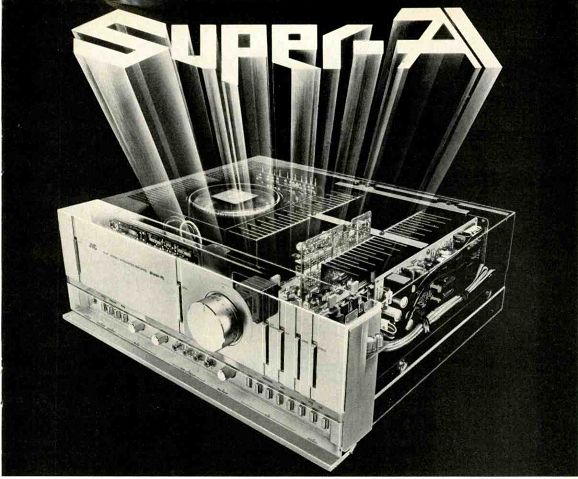
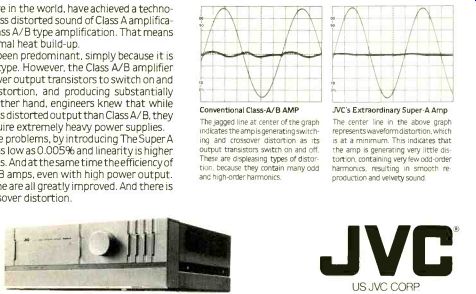
JVC engineers, among the most innovative in the world, have achieved a techno logical breakthrough. Now the clean, clear, less distorted sound of Class A amplification is available with the high efficiency of Class A/B type amplification. That means no excessive heavy power supplies, and minimal heat build-up.
Traditionally, the Class A/B amplifier has been predominant, simply because it is three times more efficient than the Class A type. However, the Class A/B amplifier achieves that efficiency by permitting its power output transistors to switch on and off, leading to switching and crossover distortion, and producing substantially reduced high fidelity performance. On the other hand, engineers knew that while Class A amps had the advantage of cleaner, less distorted output than Class A/ B, they produce enormous amounts of heat and require extremely heavy power supplies.
Innovative engineering by JVC solved those problems, by introducing The Super A Amp. A classic, no compromise amp. THD is as low as 0.005% and linearity is higher than with conventional Class A/B power amps. And at the same time the efficiency of the Super A amp is equal to that of Class A/B amps, even with high power output.
The transient response, slew rate and rise time are all greatly improved. And there is no TIM (Transient Intermodulation), or crossover distortion.
A-X9 Integrated Amplifier. 100 W RMS/ Chan. thru 8 ohms 20-20 kHz less than 0.005% THD: MC & MM phono sections dual tape & phono inputs.
Speaker outputs. Not shown: A-X5 Integrated amplifier 70 RMS/than. thru 8 ohms 20-20 kHz less than 0.005% THD: MC & MM phono sections dual tape & phono inputs.
Speaker outputs.
Conventional Class-A/B AMP The jagged line at center of the graph indicates the amp is generating switching and crossover distortion as its output transistors switch on and off.
These are displeasing types of distortion, because they contain many odd and high-order harmonics.
NC's Extraordinary Super-A Amp The center line in the above graph represents waveform distortion. which is at a minimum. This indicates that the amp is generating very little distortion, containing very few odd-order harmonics, resulting in smooth re production and velvety sound.
JVC US, JVC CORP
For more information, write: US JVC Corp., 58-75 Queens Midtown Expressway, Maspeth, NY 11378.
-----------
-----------
(Source: Audio magazine, 1980; Bert Whyte)
= = = =