
Walter Carlos and the Well Tempered Synthesizer. (Bach, Monteverdi, Scarlatti, Handel). Columbia MS 7286 stereo ($5.98).
This is a mild and proper classical sequel to the famed "Switched-On Bach" efforts by the same Walter Carlos. It won't make the big splash the other one did, but it has more of the same appeal, some really lovely performances-I use the word advisedly-and also some rather untutored renditions, oddly displaying Mr. Carlos' own musical tastes and understanding, just as though he were a live conductor or performer. Once again, we must keep in mind that synthesizers are merely instruments in the hands of human musicians.
The Scarlatti sonatas, four of them, are by far the nicest synthetics on this record. Lovely, delicate textures, yet with the wiry robustness that we associated with Scarlatti in the harpsichord originals. Fine rhythm, excellent phrasing-what else can you ask? Two Monteverdi items are a bit less knowing, just as Monteverdi is a far more difficult composer to interpret today.
Quite a little Suite of pieces comes out of the opera "Orfeo" and a movement from the famed-and wildly variously interpreted-Vespers of 1610. Carlos does as well as most conductors in getting sense out of "these works, which is to say not very well.
Handel is a surprise. Carlos' "Water Music" is a weird mixture of Sir Thomas Beecham and, maybe, the super-authentic Collegium Aureum orchestra of Germany. I found these items stylistically pretty mixed up--but the "Water Music" is not famous for authenticity in its many current and elderly recordings. As for J. S. Bach, here we have the Brandenburg No. 4, the one featuring two recorders (two flutes in another version). Carlos imitates the recorders most astonishingly, which makes the electronic backing material a bit problematical.
This isn't quite up to the super Brandenburg No. 3 on "Switched-On"--but the difference is minor, and the record as a whole maintains the high level of taste and musicianship (considering the medium!) which was so remarkable in the first and more famous Carlos recording.
The Big Steam ... Union Pacific. Power of the Past! Steam railroad sounds.
Howard Fogg, narration and recording.
Owl ORLP-12, ORLP-17 mono ($4.98 each.)
I'll always fall for a steam RR recording and I ordered these as soon as I caught sight of the listings. Oh-oh, I thought-narration! Who wants an announcer. But to my surprise, the man who "narrates" these two discs, who is also the man who made the recordings, has a most attractive voice and presentation with an almost musical quality of delivery; I kept thinking of the talking blues and, perhaps, Woodie Guthrie. For a born New Yorker he has the damdest non Eastern accent you ever heard; might come from anywhere between O-hio and Denver and maybe even Califomee-ay.
Only his occasional bits of attempted drama ("Come on, 754, show the people!") touch on the corn. Inoffensive.
His recordings are not on a par with those highly hi-fi steam offerings from Monitor, on the West Coast, and the fabulous time sequences in stereo made by O. Winston Link. Most date from around 1956 or so, but the later ones seem no different from the earliest and I suspect the same old not-so-hi-fi home-type tape recorder was used straight through. The top end is non-existent and the low bass isn't much; there are overloads and what seem to be tape dropouts, as well as pulses which sound like some species of oscillation. But the old magic is captured nevertheless and many of the sequences are excellent, all of them greatly aided by the matter of fact detailed account of the action, with engine numbers, location, and even the weather included.
The tapes were edited by Mr. Fogg himself in a very casual fashion, without tricks, and my only complaint is that he has a bad habit of fading out too quickly as the train roars off into the distance.
Spoils the illusion! ( Like the audio engineers who fade out musical reverb before it has a proper chance to die away of its own accord.) When he joins segments, it is via a quick fade-down and back up again, a straightforward and serviceable procedure. One good feature
-probably Owl's idea-is that the speaking voice is recorded at a low level, so that when it is brought up to listening volume the trains come in with overpowering force. Good.
My impression is that the Union Pacific recordings are slightly inferior to those on the "Power of the Past" disc, but the difference is not important. None is hi fi but all are interesting, as well as irreplaceable, being entirely of regular mainline steam operations on major railroads.
Performance: A, Sound: C+
Rimsky-Korsakov: Antar. Ippolitov-Ivanov: Caucasian Sketches. Gliere: Russian Sailors' Dance (The Red Poppy). Utah Symphony Orch., Abravanel. Vangaard Cardinal VCS 10060 stereo ($3.98).
The Utah orchestra under its Swiss (I think) conductor Maurice Abravanel has done some splendid music making of Mahler, Stravinsky, arid other difficult composers-considering that it does not inhabit Chicago, Boston, or Philadelphia. In this relatively popular material, alas, it doesn't do well.
The spirit is OK throughout. That's Abravanel's excellent sense of styling and musical projection. But there is more sloppy, confused playing here than is warranted on any recording,. notably in the Antar symphonic suite of good old Rimsky, which sounds as though maybe the men hadn't played it very often before. Probably not too busy with heavier works! Much is OK, of course. But every so often one gets the feeling that things are maybe going to fall apart, or maybe have never yet quite been put together.
After all, a symphonic score, even a semi-pops one like these, is a highly complex sonic machine whose segments must run together like oiled bearings.
For my ear the nicest music is the Ippolitov-Ivanov (one of those stutter and-stammer names, like Castelnuovo Tedesco), which pours out as easily as a mountain stream. The Rimsky is, as always, brilliant, superbly orchestrated and hideously contrived out of cliche and cliche-his own. If you've heard one Rimsky movement you've heard them all.
Performance: C+ Sound: B
Weber: Der Freischutz. Nilsson, Gedda, Berry et al. Bavarian State Opera and Chorus ( Munich), Robert Heger. Angel SCL 3748 stereo (four discs) ($24.92)
Here's a potent opera performance but it has its problems. Too international in the styling.
There are two styles of production for big operas these days. One, much the older, is nationalistic: if the opera is German-"Der Freischutz," for instance--then one chooses a German cast, orchestra, and conductor within the local tradition. If it were to be "Carmen," the ensemble would be scrupulously trained in the French manner. Most older operas were written to be produced this way as a matter of course. Singers and conductors stayed home.
Angel's "Freischutz," significantly unlike at least five earlier recordings, is of the star vehicle type so popular today, the mod style in which, thanks to the jet, nations are mixed up as though they did not exist and top-name singers are expected to sing anything in any old language at the drop of a contract.
Angel's leading lady, in this very Germanic opera, is Swedish. Her tenor hero, with an Italianate name, is if I am right also Swedish. No matter-they're equipped for German, Italian, French.
That's what it takes.
On the positive side there's plenty.
This "Freischutz" is the most consistently dramatic and polished presentation on records so far, with never a flagging moment. Things move smartly, the stars sing with enormous gusto, the big scenes positively exude energy and organization, the recording is excellent. Perhaps the biggest triumph, oddly, is the smooth inclusion of a good deal of that spoken German dialog which Weber in the style of his day blended inextricably into the music. Imagine a Swedish soprano and tenor gushing passionate love-German at high speed! They manage it surprisingly well, and the speech-music flow was never as easy as it is here. (In some early recordings there were separate actors for the spoken parts.) Also positively, the secondary roles are taken by German trained musicians, thereby ensuring a kind of Teutonic foundation for the internationalism. German orchestra, conductor, director, and an excellent and vigorous German chorus from Munich, adding much to the big-scene dramatics.
Yet the performance still is disturbing.
The stylistic sincerity of the music, so typical of German early Romanticism, is replaced by what might be called decibel sincerity-the performers surely do put their hearts and souls into the job. But we hear too much of that high-power neutral "opera" style that serves for any old music today, regardless of country of origin. Without even looking at the credits, for instance, I decided that one soprano in the opening scene between the two women on side 3 had a real sense for the German music. She was the Annschen, Erika Koth from Munich.
The other sounded to me 'way off-beam, with a non-Germanic voice production, a neutral speech and an unsuitable sliding-up to her notes. She turned out to be Birgit Nilsson, the lead, singing Agathe, the top star in the whole production! Similarly, Nicolai Gedda's Max, the very German hero, while impassioned and sincere, sounds Caruso-esque, much too much of an unsuitable Italian opera style. Puccini-yes. But not Weber.
Though this is the most complete recorded version and the most polished and modern, you should sample one or two of the five earlier recordings (on fewer discs) which offer genuine all German productions with such superb local sopranos as Seefried and Trotschel for their Agathes and others to match. I particularly remember the Saxon State Opera version under Kempe on three elderly Urania discs, still listed as available.
Performance: B, Sound: B+
POPS CLASSICS
Tchaikovsky: Romeo and Juliet. Mussorgsky-Stokowski: "Boris Godounov" Symphonic Synethesis. L'Orch. de la Suisse Romande, Stokowski. London Phase 4 SPC 21032 stereo ($5.98)
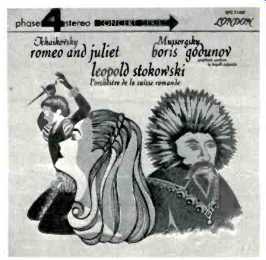
Pop's classics and classicized pops remain important items in the affluent hi-fi life these days (see prices above) though normally they are not much a classical reviewer's concern. But there is a lot to learn from such disks, on an important border line as to our listening habits.
----
London's Phase 4 has always hit my ear as a kind of exaggerated American style stereo, outdoing our classical technique in terms of super-separation and close-up sharpness. (Wide dynamic range, low noise, clarity, etc, etc. are to be taken for granted.) In this Stokowski recording, done with the late Ernest Ansermet's Swiss orchestra, the basic Phase 4 parameters are elegantly set forth, as predictable and to be expected.
I found the sound rather dry, perhaps as a result of the opera house acoustics in Geneva, perhaps also a sacrifice of reverb in favor of clinical separation. (It can happen.) The technique, in any case, is excellent for Mussorgsky and "Boris Godunov" ( London's spelling) but not good for Tchaikovsky’s famed tone poem.
How come? Mussorgsky was a brilliant and advanced eccentric in orchestral sonics, who went in for solo color effects in a time that preferred thick, fat sonic mixes, many instruments blended together in chords and melodic lines. As rewritten and slightly exaggerated by good old Stokowski, Mussorgsky is extremely effective under the Phase 4 treatment, which brings out the exotic colors gorgeously, almost as close as your nose. Moreover, the Stokowski orchestral "synthesis," an imaginative musical patch job that makes a continuous orchestral piece out of many excerpts from the whole opera, asks for even more dramatic highlighting
-that being a well-known feature of Stokowski music these 60 years and more. So Phase 4 gets high marks for the Mussorgsky-Stokowski.
But Tchaikowsky's sound, in the original format, is basically that of the big blend in spite of its well known brilliance.
His chords and most of his melodies depend on a blending-together of groups of instruments to form new colors. Phase 4 just doesn't blend them.
I don't enjoy a big cello melody, for instance, to which is added a bassoon, playing the same tune, yet standing out separately. Ugly and unmusical. It should blend. I dislike a loud harp when I should hear only a distant silvery tingle. The famed pp drum pulse at the very end of "Romeo" can be superb when you hear it as a sort of pounding heart beat, about to cease forever. Here, it sounds like somebody scratching the drum head with his fingernails about five feet away. Total loss, in terms of the original! A poor sonic translation, so to speak.
Granted-quickly-that close-up micro phoning can do a musical job, as proved by thousands of examples already recorded. But the edge of good musical taste is a very finicky one and the more so the fancier is your mike technique. I enjoyed this Phase 4 offering for its outspoken sonic presentation, whether plus or minus, and so will you.
Arthur Fiedler/Boston Pops. Motion Picture Classics. RCA VCS 7056 (2 disks) stereo. ($14.96)
Price or no price, motion picture "classics" rate down at the total bottom of a classical reviewer's list. But when Arthur Fiedler chooses to play them, my ears are wide open. That man has a genius for transmuting lightweight orchestral material into dignified and worthwhile musical sound. And, conversely, heavyweight classical into listenable, uncompromised pleasure. He's been doing both for as long as I've been around. There is no music like the Boston Pops! Not anywhere.
What do you hear on this double offering? An ennobled sound, is the best way I can put it. So odd, first, to hear these familiar and corny film fanfares, title music, love-backgrounds, etc., done with crisp, brilliant highs and middles, a solid, well structured bass. No theatre speaker ( with apologies to Altec) ever had it so good. Superb sound. Then there is the Boston Pops sound in particular, as taken down by RCA-still that huge, warm, golden expanse of realism, all shiny and happy. How do they do it, come thick and thin, mono, stereo, four-channel, what-have-you? Nobody can match it.
Not even the Boston Symphony, oddly enough.
Most important is the music. For here, in the corniest of material, is once more that almost chaste perfection of playing which under Fiedler can always be taken for granted. Somehow, other conductors look down on pop music; they degrade whatever they touch, good or bad, in the interests of box office schmalz. Never Fiedler! His players are not only perfect in performance but they sound interested--they play with fervor, concentration, pride. You can hear it. In funny music they are far funnier, thanks to this. In serious music they radiate musical charm.
In corn, they elevate.
Nope. I didn't play four straight sides here. But I heard plenty to convince me that if the hard working composers of film music really want to hear their efforts at a lofty best, they had better forget their films and listen right here. They never had it so good.
----------------
Performance: A Sound: A
COLLECTIONS COMPLETE
(An honest note: By the time the following were conscientiously played through and evaluated, the entire lot would long since be ancient and out of print. Better, at least, to mention them-in time! Some will also be reviewed, as digested. E.T.C.) Beethoven: The Five Piano Concertos; the Choral Fantasia. Barenboim; John Aldis Choir, New Philharmonia Orch., Klemperer. Angel SD 3752 (4 disks) stereo.
Beethoven: The 32 Piano Sonatas.
Barenboim. Angel SNLV 3755 (14 disks) stereo.
Ravel: The Complete Music for Piano Solo. Samson Francois. Seraphim SIC 6046 (3 disks) stereo.
Mozart: The Complete Music for Piano Solo. Walter Gieseking. Vols. 1, 2, 3.
Seraphim ID 6047, 6048, (4 disks each IC 6049 (3 disks) mono.
To be Continued
------------
BEETHOVEN
by EDWARD TATNALL CANBY
Beethoven: Piano Concerto No. 3 in C Minor; Piano Sonata No. 26 in E Flat ("Les Adieux"). Piano Concerto No. 5 ("Emperor"). Bruno Leonardo Gelber; New Philharmonia Orch., Leitner. Seraphim S-60130, 60131 stereo $2.49 each.
If your ears and eyes are tired of stupendously "acclaimed" Beethoven performances, every one supposedly the Ultimate then take yourself quietly to the nearest record shop and acquire these two modest, modestly priced Beethoven discs (as of this writing they are still listed at $2.49)
which to my ear are the finest, most utterly musical versions of the two piano concerti in many years. I would say that this young man is the world's top under-30 Beethoven pianist, and one of the top Beethoven players of recorded history.
Not that the recordings are sensational-just the opposite. What hits you is their astonishing naturalness, an unassuming rightness in every aspect ( even the audio), an unaffected transparency of meaning that in this day of studied show biz competition is really a miracle. This is Beethoven himself-the sense of his music, absolutely unselfconscious ("Look, Ma, I'm playing Big Beethoven!"), completely communicative, as fresh as though it were all new and wonderful.
Like all really great performances, there is almost a daintiness about it, a sense of economy. But the power is there too, and no two ways about it.
And the top-rate orchestra is led unfailingly by a man who knows the Beethoven tradition as his own native way of thinking. Superb cooperation.
The weirdest aspect of this is that the pianist is wholly foreign to Beethoven's Germany. Bruno Leonardo Gelber comes from, of all places, Buenos Aires. Moreover, much of his training took place there and when he finally did move to Europe for study it was to Paris. Yet, listening here, one might think that Gelber had grown up in Bonn or Vienna, so natural is the Beethoven idiom for him.
Both concerti are immensely appealing but perhaps it is the "Emperor," the famed No. 5, which is the real Gelber miracle. That enormous work is the nemesis for dozens of "great pianists," not to mention great orchestras and their conductors, who bravely or brassily scale its heights and fall flat on their faces. It asks for a truly heroic scale of drama, at an unconscionable length; but at the same time it demands an excruciating effort to avoid overplaying by so much as a hair-for the big piece quickly falls into bathos. It was not one of the composer's perfect works. For all its power and originality it is full of dangerous flaws, moments of anticlimax, long segments of declamatory piano passagework that are the dread of every sensitive player, they so quickly add up to boredom. Many a pianist who surmounts the big climaxes with ease finds himself churning about in these finger exercises, his fine drama tumbling to ruins! Not Gelber. You may at first think his "Emperor" is too modest. But hear him out. He has the whole piece in hand as few pianists ever have in these times. And his orchestra is right with him all the way.
. . . Well, most of the way. You might not know exactly, because Angel made one of those truly imperial booboos in its first edition of this record.
Side 1: the long first movement complete. Side 2: the long first movement all over again! How could it have happened? The "Emperor" was hastily reissued in a corrected edition-but better look to be sure. Concerto No. 3 is complete as composed, and its disk is filled out with a splendid extra in the solo piano sonata "Les Adieux" which will give you a close-up of the dramatic power that this modest pianist has at his call. Helps explain why the concerti go so well.
Performance: A, Sound: B+
-------------------
MUSIQUE CONCRETE
EDWARD TATNALL CANBY
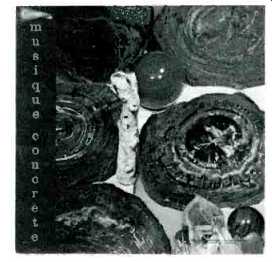
The Very Beginning An unusual historical recording has been released by Vox on its intermediate Candide label. The big, black letters say "Musique Concrete." The title is precisely accurate. This is a study of a kind of "far out" music that is already well into the past and significantly unlike today's much better known synthesizer music. Musique concrete is still being composed today but it is fast losing identity and the term itself has virtually de parted-I hadn't heard it directly in years.
Compared to "Moog" or "synthesizer," "musique concrete" is now positively esoteric. Yet this is where it all started.
Musique concrete is not only basically different in technique from today's synthesizings. Even its musical philosophy is quite different though, to be sure, the two approaches (and others) tend to interpenetrate according to local taste. Musique concrete was the original electronic music and it came out of France as the name suggests. It began even before tape, back in the late forties. Its earliest examples were painstakingly assembled via the old disk system, one record "dubbed" from another. Musique concrete is, very simply, the opposite of abstract music.
Instead of the pure, abstract sounds of voices and instruments, it uses "concrete" sounds-that is, real, specific sounds with non-musical connotations, taken down and then doctored in the now familiar manner. Factory sounds, for example, as in Varese's landmark "Deserts," made in France in the early 1950s. Sounds of autos, pianos, bells, voices, knives and forks, a thousand and one very ordinary noises available everywhere and easily at hand. The weird sound structures made possible by manipulating these actual sounds into complex sonic club sandwiches were a new and fascinating experience in the 1950s and the resulting techniques were enough to keep whole schools of sonic structure-builders busy for years, and only an occasional howl from an oscillator suggested the synthetic future yet to come. Tape recording and editing, of course, provided the enormous boost the technique required. A godsend, after the hopeless bravery of disk manipulation! (I should know: around 1935 I laboriously created on dubbed disk a Bach chorale in which all four of the fuzzy, scratchy voices were my own. If I had only realized it, that was a pioneer experiment.) For awhile musique concrete was a French exclusive but inevitably, in their special ways, others soon took over. Most notably the Germans, whose studious technical brilliance produced a much fancier and heavier school, now crowned by the works of such as Stockhausen. But the French had the imagination to start it all. As to our own early U.S. efforts, perhaps the briefly-used term "tapesichord music" will give an idea of their quality. The name is as gauche as were our first tries, including a 1955 spoof of my own ( for a broadcast) in which I concocted a tape salad out of everything and the kitchen sink and called it the "Canby Concerto for This, That, and the Other." It was musique concrete carried to the absurd, for the time being at least. I fore bore to try again but others carried on, including the well known Tod Dockstader ( Owl Records) whose later works are the much-improved American climax of the school.
Vox's "Musique Concrete" is an apotheosis of the French branch of the art.
Its material dates basically from the early sixties, all the works originating in the period just before 1963. ( Since some are listed as "new versions" the record is later, but its spirit remains that of the earlier period.) Here is the original "concrete" technique in its ultimate French refinement. The first work on the record, indeed, is by that very Pierre Schaeffer, now 60, who in 1948 broadcast a "concert de bruits" ("Concert of noises" ) which must have been one of the earliest public attempts to formulate the new art.
He established his Groupe de Recherches within the French national radio system in 1951-prehistoric in terms of tape--and all the rest of the material on this disk stems from later work in this pioneer studio by younger students of its techniques.
Predictably, the sounds have very much of a family resemblance. This is a "school" in the time honored sense, precisely like the "school" of a Titian or a Botticelli, out of a common workshop and technique, led by an inspired leader.
But, as is often the way in France, there is also a curious crystalization. A style and a manner have been developed; new machinery and new methods merely serve to reinforce the old, adding subtlety and versatility rather than changing the basic idiom. Thus we have here a basic conservatism. Any listening ear can hear it.
The new synthetics are utterly different in impact.
In an important way, then, musique concrete was a transition stage in the developing new sound arts of our time, probably necessary before the pure sound of the synthesizer could take over. Not merely because synthesizers had to be developed-a major electronic-mechanical proposition. But, equally important, because the very idea of assembling sounds via tape manipulation had to grow and spread. And the very best place for that to start was not in the sheer abstraction of synthetic sonics but in the more familiar experience of concrete sounds, recorded and then put together into sonic structures.
We have, thus, made a vital progression in these last few years back towards traditional aesthetics in music-believe it or not. Once again, you see, we are working in the older and more pure form of sonic art, the strictly abstract, the art of a Mozart. Whereas, like the program music of the nineteenth century, musique concrete was a phase where the sonic art tried to forge double meanings, building non-musical, outside ideas and materials into its sound structure. You may find it a bit bewildering to equate, say, Berlioz' Symphonie Fantastique or Dukas' "Sorcerer's Apprentice" with Pierre Schaeffer's Objets lies which opens the Vox Candide record. But the philosophical similarity is very real and will be ever more so as the Moogs and the Arps and the other music synthesizers proliferate their pure abstractions. In these last twenty years, electronic sound has come a full circle-right back to music itself.
Musique Concrete. (Schaeffer, Mache, Philippot, Bayle, Ferrari, Malec, Parmegiani). Groupe de Recherches Musicales, O.R.T.F., Paris. Candide CE 3105 stereo, $3.95.
--------------------
(Audio magazine, May 1970; Edward Tatnall Canby)
======
ADs:
When you spend $395.00 each on a speaker system for your home, you expect to get the same fine quality components that are used in "The Voice of the Theatre" systems and now performing in most theatres, recording studios and concert halls in the nation plus a wider angle of distribution through mids and highs for dearer sounds plus a smoother and flatter response plus an unbounded dynamic range plus a hand-rubbed-pecan-finished cabinet plus a high-relief-decorator design plus a lot of other things.
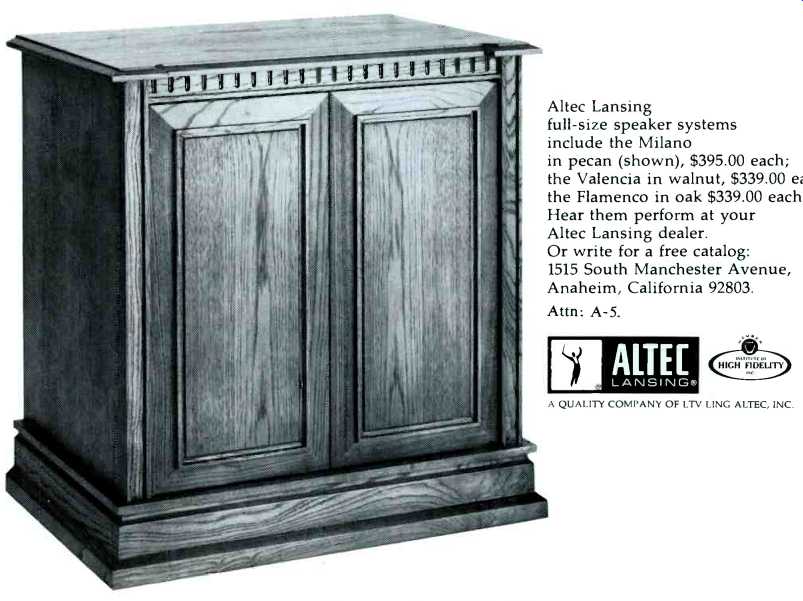
We don't think that's expecting too much.
Altec Lansing full-size speaker systems include the Milano in pecan (shown), $395.00 each; the Valencia in walnut, $339.00 each; the Flamenco in oak $339.00 each.
Hear them perform at your Altec Lansing dealer.
Or write for a free catalog: 1515 South Manchester Avenue, Anaheim, California 92803.
Attn: A-5.
ALTEC LANSING HIGH FIDELITY A QUALITY COMPANY OF LTV LING ALTEC, INC.
---------------
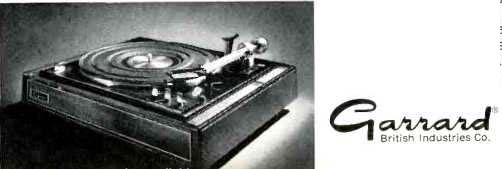
To maintain the uncompromising standard of Garrard automatic turntables, we mass produce them.
By hand.
Garrard of England is the world's largest producer of component automatic turntables.
A mass producer, numerically speaking.
Especially curious, since Garrard remains a staunch foe of mass production methods.
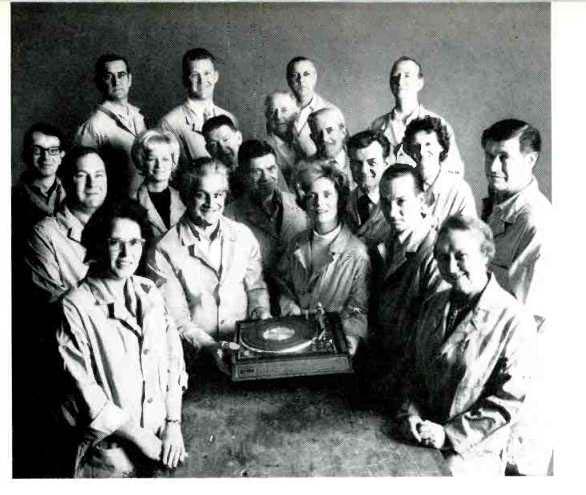
At our Swindon works, final assembly of the Garrard SL95B is in the hands of nineteen men and women.
Hands, not machines.
A modest record As Brian Mortimer, Director of Quality Assurance, sees it, "In top form they turn out twenty units an hour. A rather modest record in these days of mechanized production lines.
"But if we were to speed it up, we'd pay for it in quality. And, in my book, that's a bad bargain." At Garrard, we insist that each person who assembles a part test that finished assembly. If it isn't up to standard, it's corrected on the spot-or set aside to be made right.
And then we test our tests.
Four of our nineteen final "assemblers" do nothing but testing.
Before each unit is packed in its carton, it must pass 26 final checks that cover every phase of its operation.
Is all this fuss-budgetry really necessary?
Brian Mortimer answers it this way. "It would be sheer folly to give up the precision we'd achieved in manufacture through imprecise assembly." The case for fuss-budgetry Of the 202 parts in a Garrard automatic turntable, we make all but a handful ourselves.
And we do it for just one reason.
We can be more finicky that way.
For instance, in the manufacture of our Synchro-Lab motor we adhere to incredibly fine tolerances.
Bearings must meet a standard of plus or minus one ten-thousandth of an inch. Motor pulleys, the same.
To limit friction (and rumble) to the irreducible minimum we super finish each rotor shaft to one micro-inch.
And the finished rotor assembly is automatically balanced to within .0008 in.-oz. of the absolute.
So, in the words of Brian Mortimer, "We indulge our fussiness with a certain amount of conviction." From Swindon, with love For fifty years now Garrard has been important to the people of Swindon, and they to us.
Many of our employees are second and third generation. (Mortimer's father hand-built the first Garrard.) And 256 of them have been with Garrard for more than 25 years.
We've been in good hands.
Today's SL95B is the most highly perfected automatic turntable you can buy, regardless of price.
Its revolutionary two-stage synchronous motor produces unvarying speed, and does it with an ultra-light turntable.
Its new counterweight adjustment screw lets you balance the tone arm to within a hundredth of a gram.
And its patented sliding weight anti-skating control is permanently accurate.
$44.50 to $129.50 There are six Garrard component models from the 40B at $44.50 to the SL95B (shown) at $129.50. Garrard standards, nonetheless, do not vary with price. Only the degree of refinement possible.
The choice is yours. However, your dealer is prepared to help. British Industries Co.
------------------
YOUR FRIEND AT THE FACTORY
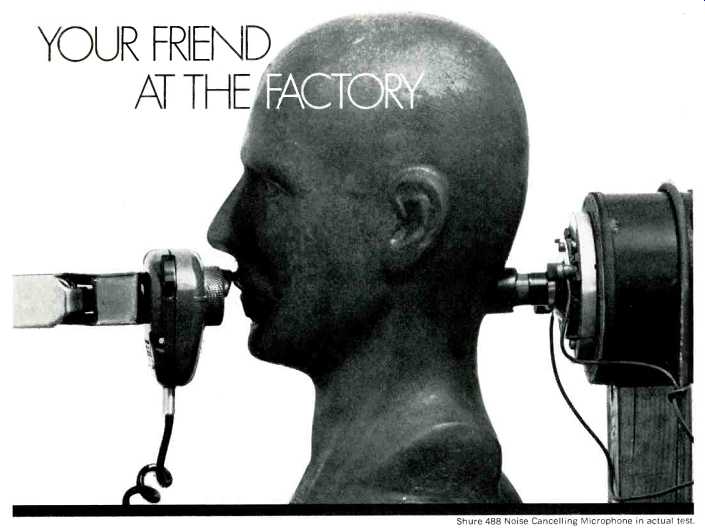
Shure 488 Noise Cancelling Microphone in actual test.
Meet "Oscar," the hard-working plastic "android" of our environmental engineering department.
Oscar helps our development engineers and quality control specialists check the acoustic interaction between a microphone and the person who operates it. He enables Shure to re-create precisely controlled and repeatable acoustical environments free of subjective guesswork. He's shaped like a human head, with special resilient plastic skin that has the same acoustic properties as flesh. He does his thing in a king-size telephone booth with 5-inch thick walls and doors because his full spectrum mechanical voice can be as loud as a rock 'n roll group (or barely perceptible) and his chamber can be flooded with ambient sound that would drive a teenager up the walls. "Oscar" is typical of the care which Shure takes in designing a microphone that is tailored to a given environment and situation. (And, after the original design has been put into production, Oscar is the basis of repeated checking of production units against the original performance parameters.) It's just one of dozens of ways that Shure strives to excel in environmental engineering. At Shure, we anticipate and solve field problems before they become problems: for total reliability in total communications Shure Brothers Inc. 222 Hartrey Ave., Evanston, Illinois 60204
------------------
When you're #1 in tape recorders, you don't make the #2 tape.
If you've got a few hundred bucks tied up in a first-quality tape recorder, you're not going to want to gum up the works with second-rate tape. Especially when just a few extra pennies buy the finest Sony professional-quality recording tape.
Not only will Sony tape make any recorder sound its best, but it'll keep it sounding that way. Because our tape won't shed or cover tape heads with a performance-deteriorating oxide coating. Head-wear, too, is minimized, thanks to Sony's exclusive Lubri-Cushion process, which impregnates the tape with long-lasting lubricants.
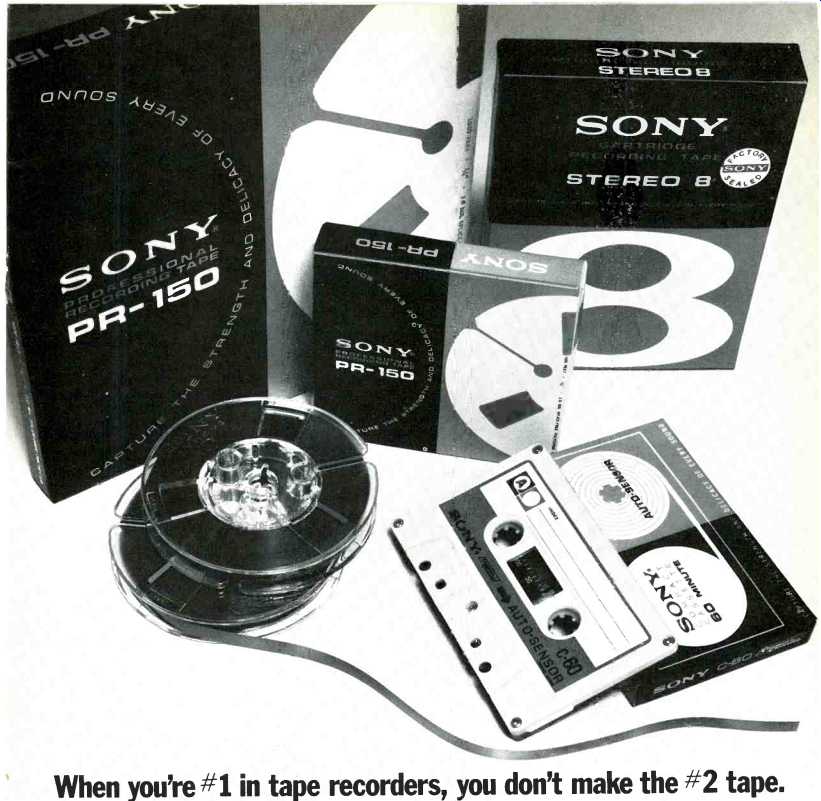
Sony tape comes in all configurations: Open reel. Eight-track. Cassettes.
Open-reel tape is available in 3 1/4", 5", and 7" sizes. The new Sony SLH-180 low-noise, high-output tape is available on 7 1/2 reels only. And "Easy-Threader" tabs make every Sony open reel self-threading, Our professional-quality tape is also available in eight track stereo cartridges plus new Easy-Matic cassettes for both functional and stereo units, with 60, 90, or 120 minutes' recording time.
To hear the best, play the best. Sony Professional Quality Recording Tape. From the people who offer the number-one line of tape recorders--Sony/Superscope.
SONY SUPERSCOPE
You never heard it so good.
1970 Superscope, Inc., 8144 Vineland Ave., Sun Valley, Calif. 91352.
Send for free catalog.
-----------------
BOZAK from top to bottom, the line of quality
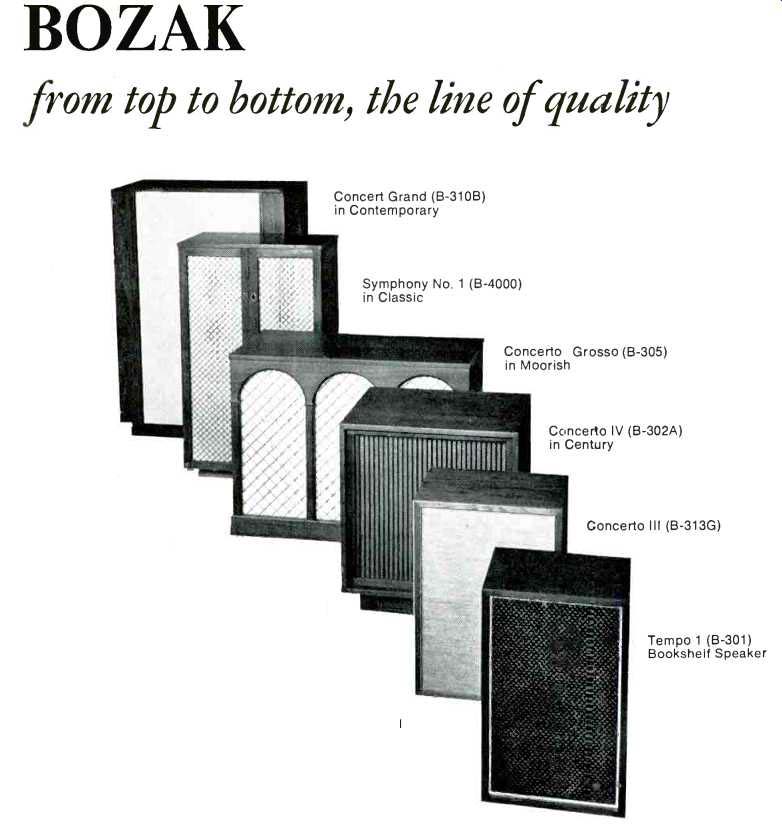
Concert Grand (B-310B) in Contemporary Symphony No. 1 (B-4000) in Classic Concerto Grosso (B-305) in Moorish Concerto IV (B-302A) in Century Concerto III (B-313G)
Tempo 1 (B-301)
Bookshelf Speaker
When you're looking for a high quality loudspeaker, look to Bozak. Here's why:
1. Unsurpassed faithfulness in the re-creation of sound. We never come between you and the music you want to hear. You get all the music exactly as recorded.
2. The broadest variety of finely crafted, high-styled high fidelity furniture. Bozak furniture in your home is a reflection of your good taste and refinement.
3. Priced to meet every need. Either buy the complete r ready-to-play system that fits your budget and space, or use our unique Plan for Systematic Growth. You start modestly and add matched components as you go, enjoying Bozak quality every day as you build up to your ultimate speaker system. Either way, you have a permanent investment in the very best in sound.
Write today for a complete catalog and the name of the Bozak franchised dealer nearest you.
P.O. Box 1166 Darien, Connecticut 06820 Overseas Export: Elpa Marketing Industries, Inc.
New Hyde Park, New York 11040 U.S.A.
---------------------
EV
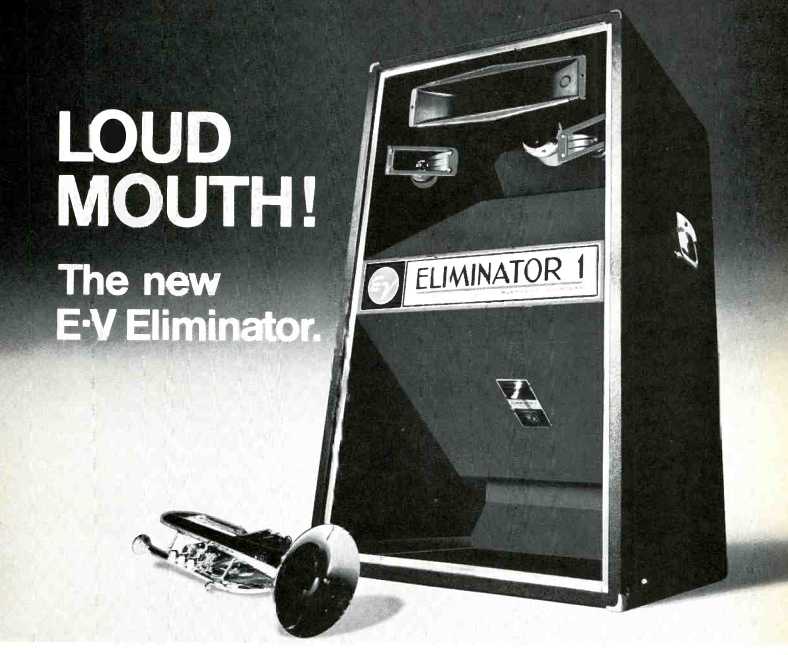
EV Eliminator speaker
The first Eliminator was built to prove a point. Because young musicians, in a search for more volume, were literally driving the guts out of some very good speakers mounted in some very poor enclosures.
It started an intensive investigation into the failure of speakers (ours and the competition) used by guitars and organs. The testing was very rugged. For instance, we took miles of high-speed motion pictures while test speakers destroyed themselves with sound.
We found out a lot about how to improve our speakers. But we also learned that by simply putting our SRO/l5 speaker in a folded horn enclosure we created a combination that was unbeatable for efficiency, high power handling capacity, low distortion, and extended bass. It was an important first step.
Of course, this now meant we needed a solid high end. So we added the time tested 1829 treble driver and 8HD horn, or (optionally) a T25A treble driver plus a pair of T35 super tweeters. These combinations were a revelation to musicians.
They got more sound power per watt than they thought possible. And they could use the Eliminator for both vocals or instruments.

But we weren't quite satisfied. If the Eliminator was good for popular music, what would it do with other kinds of program material? So we tested it in good rooms and bad rooms. With test instruments and with live audiences. And we decided that the Eliminator was too good to sell only to the young.
For example, in one test installation in a difficult domed building, four E-V Eliminator I speakers far out performed an elaborate multi-cell installation in naturalness of sound for voice and music, in uniform sound pressure level throughout the listening area, and in the ability to reproduce the extremes of loudness of a big, driving jazz band with ease.
Granted, the E-V Eliminators have a flash of chrome. But don't be misled.
They perform to beat the band. And they solve problems. Get turned on to the great sound of the E-V Eliminators today. It can open up an important new market ...and shock your old ones!
ELIMINATOR I, 3-way system: Response 55-15.000 Hz; Power Handling Capacity 100 watts RMS (white noise shaped to stringent lead guitar frequency spectrum); Dispersion 1000; Sound Pressure Level 122 db at 4' with full power input; Suggested Resale $465.00.
ELIMINATOR II, 2-way system: Response 55 to 10,000 Hz; Power Handling Capacity 100 watts RMS (shaped to stringent lead guitar frequency spectrum); Dispersion 100'; Sound Pressure Level 123 db at 4' with full power input; Suggested Resale $370.00.
ELECTRO-VOICE, INC., Dept. 506A 602 Cecil Street, Buchanan, Michigan 49107
A SUBSIDIARY OF GULTON INDUSTRIES, INC.
-------------------
It's kind of a dumb-looking thing, but the ear is still the best listening device around.
Which should tell you something about the shape of a Yamaha speaker.
True, the ear receives sound and a speaker reproduces it. But the basic principles of physics and design are essentially the same.
There is a place in the middle through which the sound travels. Surrounding it are planes of varying dimensions. There is no symmetry.
This is because sound is not symmetrical. It bends. So symmetrical shapes-ears or speakers-will confine sound to an area that won't let it bend naturally. (Cup your ear and see how directional and different things sound.) The irregular shape of a Yamaha speaker gives sound waves of different length a place to go. Long waves go to the long parts, medium waves to the medium parts and so on.
The result is a sound as close to natural as you've heard. Freer, fuller, more omnidirectional.
Listen to what natural sound is all about. If you're not convinced then, well, maybe you are wearing the wrong kind of ears.
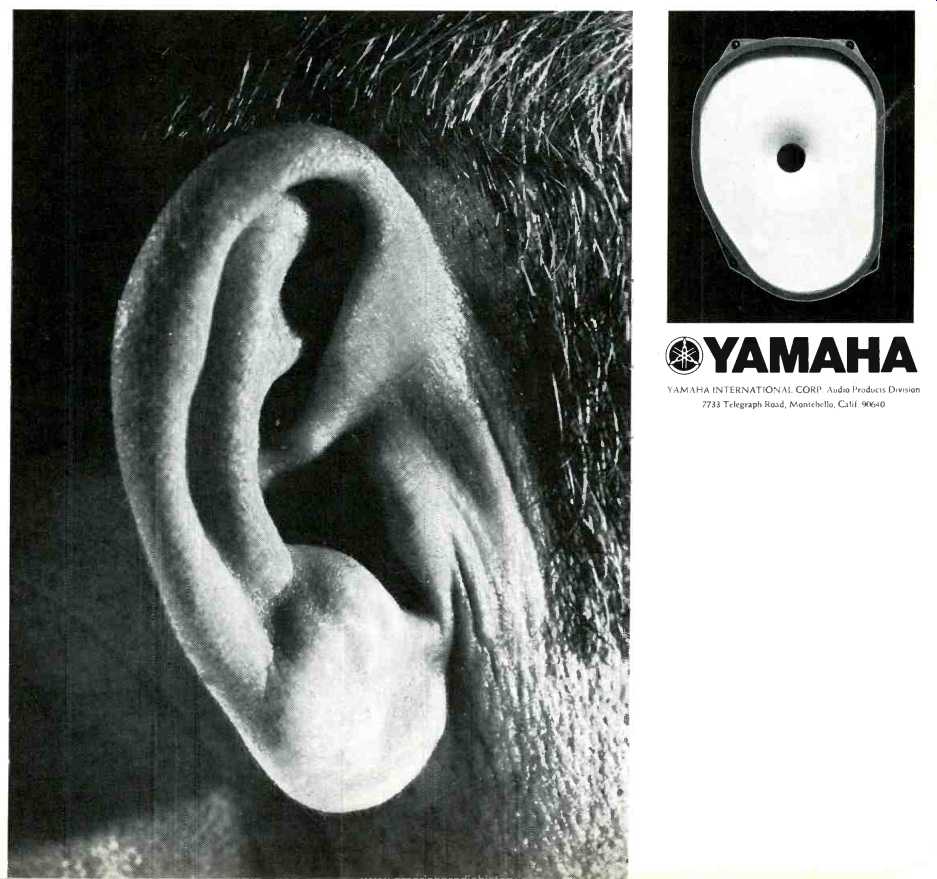
Either we're right about the shape of our speakers, or you're wearing the wrong kind of ears.
YAMAHA
YAMAHA INTERNATIONAL CORP. Audio Products Division
7733 Telegraph Road, Montebello, Calif. 90640
--------------------
TANDBERG NEW 6000X STEREO DECK SETS A BRILLIANT NEW STANDARD IN RECORDING CAPABILITY with UNIQUE CROSSFIELD DESIGN
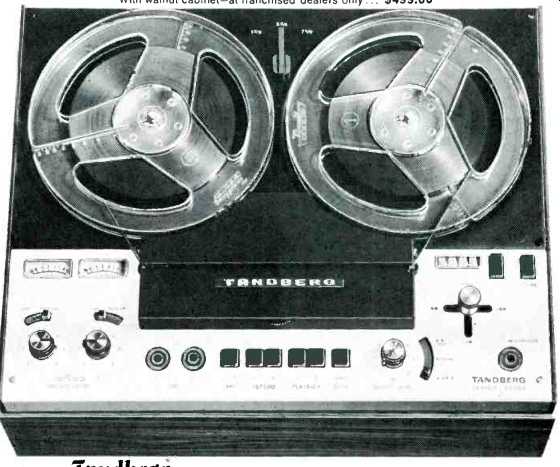
Now you can produce the world's finest tape recordings with this remarkable new instrument. Even at 3 3/4, this solid state, 3 speed deck surpasses the 7 1/2 performance of our top-rated Model 64 (i.e.--freq. resp. 40-18,000Hz ±2 1/2 db @ 3 3/4). And, the design corresponds with demands for the 70's--fresh, interesting. Here are other features:
- Signal-to-noise ratio at 62db 70db dynamic range, plus
- An additional 24db overload protection
- Peak reading V.U. instruments
- 4 hyperbolic, mu-metal screened, precision-gapped heads
- Stereo mixing, cueing, source vs. tape monitor, sound-on-sound, add-a-track, remote control
- Independent mike/line recording controls
- Use with low noise tape; vertical or horizontal operation, highest reliability.
With walnut cabinet-at franchised dealers only... $499.00
Tandberg of AMERICA. P.O. Box 171, 8 Third Ave., Pelham, N.Y. 10803, Inc.
Tel.: (914) 738-0772 N.Y.C. (212) 892-7010
------------------
The Marantz Component.
Now everybody can afford one.
Until last year the least-expensive Marantz FM stereo tuner you could buy cost as much as $750.00 !
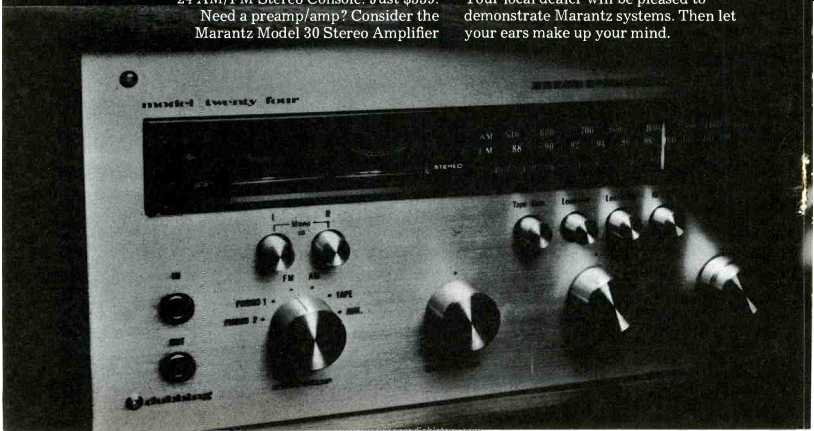
Today, Marantz tuners are available in other than very-high price ranges. And so are other Marantz components. True, you can still invest well over $2000.00 in a Marantz system, but now we have components starting as low as $259.
Though these lower-priced models do not have every unique Marantz feature, the quality of all models is exactly the same.
Marantz quality. And quality is what Marantz is all about.
Take our tuners for example. You will find the Marantz Model 23 AM/FM stereo tuner attractively priced at only $259. Looking for a great Tuner/ Preamplifier? Look at the Marantz Model 24 AM/FM Stereo Console. Just $339.
Need a preamp/amp? Consider the Marantz Model 30 Stereo Amplifier Console.120 watts RMS (180 watts IHF). Yours for only $395. In the market for a superior power amplifier? Shop for the Marantz Model 32 with 120 watts RMS (180 watts IHF) . Only $295.
And for those who want the ultimate Marantz system, we offer: the Model 33 Stereo Console, the Model 16 Stereo Power Amplifier with 200 watts RMS continuous (300 watts IHF), and the Marantz custom-calibrated Model 20 FM Stereo Tuner. Total price-$1340 plus speakers.
Every Marantz component, regardless of price, is built with the same painstaking craftsmanship and quality materials.
That's why Marantz guarantees every instrument for three full years, parts and labor. Except speakers. They're guaranteed for five years.
Your local dealer will be pleased to demonstrate Marantz systems. Then let your ears make up your mind.
Components Speaker Systems Receivers. Marantz Co., Inc., 1970. A subsidiary of Superscope, Inc., P. O. Box 99A, Sun Valley, Calif. 91352. Send for free catalog.
------------
MIRACORD 50H turntable
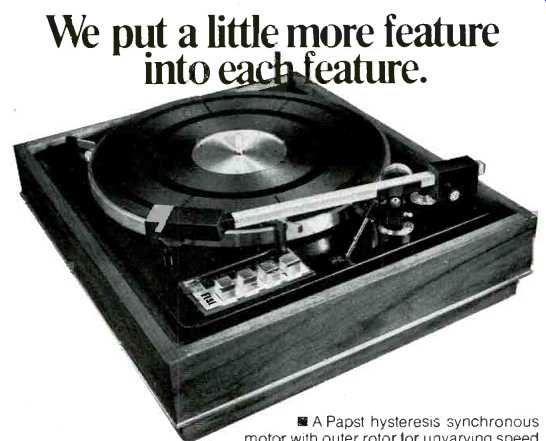
We put a little more feature into feature.
A Papst hysteresis synchronous motor with outer rotor for unvarying speed accuracy.
Precise stylus overhang adjustment with built-in gauge-no shifting, no guesswork, no templates.
Silicone-damped cueing in both automatic and manual play.
And, those exclusive light touch pushbuttons to make it easy to enjoy all those other wonderful 50H features $169.50 at your hi-fi dealer.
Benjamin Electronic Sound Corp., Farmingdale, N.Y. 11735, a division of Instrument Systems Corp.
======
Also see:
More music articles and reviews from AUDIO magazine.
= = = =