by EDWARD TATNALL CANBY
CARNEGIE & CACTUS
Installment IV of my on-again, off-again hi-fi autobiography appeared, I see, well over a year ago in the February 1982 issue. I keep for getting, the time lag keeps widening.
Pretty soon it'll be a half-century if I don't get going. So herewith Installment V; you'll find the first three segments back in 1980, in the January, May and December issues of that year.
There are two incongruous appeals, I hope, in this reminiscent material. The first, I trust, is for the younger readers who, hard to believe, actually do not know much about our Early Days. Well, I was there and I enjoyed every bit, so why not tell about it? Second, of course, is for you elderly souls, of my own ilk; there will be nostalgia and humorous memories. The things we took for granted seem so quaint now. And yet-yes, that's the way they were, all right. So here goes.
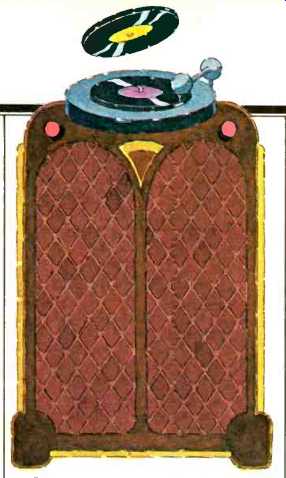
You'll recall (IV) my experience as a young college music instructor with that remarkable proto-hi-fi monster ma chine, the Carnegie Phonograph by Federal Telegraph, size of a small elephant-the working part of a gift that included some thousand or so 78-rpm records presented back in the mid-'30s to worthy colleges and schools with music programs. If you will think how soon this came after the very start of modern electrical recording, you will understand the impact it had and its importance in music teaching.
Music education for the "amateur" we called it Music Appreciation (a term I have always detested)-was then barely beginning to use recorded mu sic. A few years before, there hadn't been any, except those famous bits of opera a la Caruso and, of course, mil lions of corny two-minute ballads, joke recitations, tear-jerkers, and jazz discs, all of which were awful from the point of view of a Professor of Music.
But the buildup, especially in Europe an recording, was very rapid. By the middle 1930s, most of the standard classic repertory had been recorded there was one recording of almost everything you could name, and even a few duplications here and there. It was on this remarkable new foundation that the Carnegie people built their happy idea of an all-out musical gift to the world of Education.
Classroom music was still a thing that was talked about, lectured upon, and then played on a piano--whether it was a symphony, an opera, a chorus or a string quartet. Every classroom had the required piano, and all teachers of music were supposed to be able to play the Beethoven Fifth or a Palestrina Mass or "Tristan and Isolde" in some vaguely convincing manner so that, just maybe, the students might actually recognize it in the flesh, the live performance. The very latest innovation in teaching method was the new small phonograph which began to appear in every music classroom, right next to the usual piano, and, in the Music Library, off in an obscure corner near the reference books, a reluctant shelf of very breakable 78s. All this, I assure you, was considered unpleasantly radical by most of the music personnel, including the librarian. It was roughly as jolting as the appearance of woman Professor in an all male college. A good many years had to go by before the school and college teachers came around to thinking that maybe records could be moderately useful, since the students really seemed to appreciate them. But the transition was not easy. For most older teachers, it was canned music even before James Petrillo invented that term-was it for this that they had spent much of a lifetime training in piano technique for the propagation of the musical faith? For those of us who were of student age, there were no qualms at all. The generous (relatively) collections of re cords that now came to our ears in our classes, no matter how badly displayed, were the very wave of the fu ture, the latest thing in technology. It was precisely like the computer terminals and electronic music labs of to day--we could afford a few records and a modest player in our rooms or homes, but the Music Department had all this munificence, this profusion of recorded sound, real music! And we could even borrow it, sometimes. Just as today you can go to school, music or otherwise, and play with the big computer stuff. But it was really hell for the old professors, trained in the traditions of the 19th century, when artists were purely artists, not mechanics and electricians.
Machinery, any machinery, was still anathema to the artistic soul. You must understand that artists, any sort, were the 19th century's only holdouts (or so they felt) against the crassness and crudity of the Industrial Age. They were aesthetes, they had Finer Sensibilities, they could not bear to think of such things as locomotives and steam engines. Or automobiles. Oh yes, one could learn to cope, to a practical degree. Life required it. But please, do not expect us to approve! And so in this early period of the electric record player, these scrupulously trained teacher--artists ran their phonographs about the way they ran their cars in those final days of the horse. They got where they were going, but teeth-gnashing may hem was committed en route. More or less deliberately, one sensed.
The artists, and almost all "intellectuals," avoided any sort of feeling for the merely mechanical, as somehow unworthy of those Finer Sensibilities they felt they possessed. Or, of course, that one's parents and teachers said we should possess. It was right and proper to hate the machine, or to master it and make fun of it.
Even my amiable mother (no musician, but a music lover and an artistic soul) fell for this line of thought. She and her closest woman friend jointly bought a Model T Ford when my father went off to WWI, and they happily went bouncing around the Connecticut countryside, dirt roads and all, learning to drive backwards up a hill when the low-gear band gave out, putting aside the old gray mare (named Martha) for good. They hadn't the faintest idea, though, what they were doing with that large and potentially dangerous ma chine-it was all a lark. Two artistic souls on a plebeian holiday.
Almost immediately upon at last entering the Big City, they drove that Model T straight into a trolley car, somehow wedging it irretrievably be tween that and another trolley coming the other direction, just like the famous Keystone Kop movie. Nobody was hurt; they didn't drive very fast in Mod el T Fords. So we got an early Chevrolet and, a bit later, my mother commit ted the ultimate artistic boo-boo; one morning she gaily backed the Chevrolet out of our new garage and forgot to open the door first. Such a splintering crash you never heard. Artistic license, shall we say? You may now, with this bit of back ground, go back to February of last year and read my account of the Professor and the Carnegie Phonograph, the elephant machine, or rather the home-made local substitute the Physics people built for him. Same story! There were only two ways the artist could react-either he took on the mechanical monsters in fear and trembling, hating and despising, or just had a good time, like my mother-in neither case knowing, nor wanting to know, anything at all about the machinery's real operation.
Yeah, I was an artistic soul, too. I still am. But oddly enough I was also a mechanical/electrical soul. I loved trolley cars, I was devoted to trains and fascinated by subways, to my literary father's infinite disgust. That's why I am here.
The Carnegie Set, as we sometimes called it, was a lifetime influence on me as you may easily understand. Such an unbelievable abundance! And as al ready mentioned, by the sheerest coincidence I encountered it twice, in my first and only two jobs teaching Music Appreciation. When I arrived for my very first working day ever, I walked into an office piled to the ceiling with huge packing boxes, every one of them filled with RECORDS. And it was my first duty to get those things out of the boxes and into some order on the waiting shelves. So within days I found myself automatic "curator" of the new record collection, and its librarian and indexer as well. Quite simply, nobody else was interested, and wasn't it nice to have an enthusiastic youth who would do all the heavy work? While the profs and the instructors stayed away in droves, I struggled; after a week or so the Boss came in cautiously, but only to ask for a couple of records he might get to use, "Would I find them please?" No card indexes for him. So now I was the stock boy. I pawed through a dozen half-unloaded boxes before I found what he wanted, by a sort of intuition, I guess. I was inundated with discs, flooded, snowed under; they were everywhere, in total confusion. Maybe Carnegie had packed them in some sort of order (singles only, in thin paper jackets, no albums at all) but I didn't discover it or more likely, I just unpacked so enthusiastically that I never even noticed.
But this was getting to be too much.
Somehow, I had to make order. Do you think I knew anything about cataloging? My own little collection was still in the loose-pile stage and no problem. I had not the slightest idea how to go about shelving a thousand records.
Leave that be, since I've told of my eventual catalog system in a series written here a few years ago. Anyhow, with a bit of prompting and a lot of help from our undergraduate hired office boy (now a big wheel in the AMA), I did work out a way to do it which was unique, in that you could use the file cards we typed up or, alt6rnatively, go directly to the shelves in that small cubbyhole office and read a coded label on every disc-if you could remember the code. B15 v1C. Bach Violin Concerto. I still remember a lot of the composers' "ID" numbers. Years later I discovered that this was merely a Canby variation on the universal Dewey Decimal System, still used in many libraries. Somebody must have set me on the right track.
Then we opened for the general university public, who could borrow our magnificent Carnegie records for themselves if they had the right credentials. This was heaven! There I sat, presiding over the goodies and meeting everybody I could ever want to know who loved music and enjoyed records in that university. The most significant consequence, as I've said, was my growing acquaintance with the Physics and Math people in the graduate school, prolific record borrowers, and thus my introduction by them to the very earliest beginnings of component hi-fi.
If you think lending out LPs is a hazardous business, consider the lordly 12-inch shellac 78, incredibly break able, crackable, hideously gougeable and scratchable by steel needles topped with five or six ounces of pick up. They did very well, those records, as long as you left them in the stacks.
Or avoided stepping on them or accidentally sitting on one--or dropping it.
But to lend was to destroy, as we quickly found. I have a vague feeling that we could order replacements through the Carnegie people, who dealt in large volume and even had their own special pressings. I do know that we cracked and broke discs right and left, and the damage was probably done as often by our own faculty members as by the very conscientious outside borrowers.
So-we set up rules. Just like today! But how different. Some of those rules were bizarre, as I think of them now.
But they helped, they really made the difference. At the expense of fi, to put it mildly. We required, for instance, that all borrowers use wooden stylus points ....
You think I'm joking? Not at all. The rule actually said "cactus or fiber" but these were merely hard wood in two formats. Those things were widely used in the 1930 period, especially by the real highbrow connoisseurs. They did indeed preserve our precious re cords, though not from breakage or cracking. With a wooden needle screwed in place, you could not gouge a hole, nor make a scratch.
So long as the disc stayed in one piece, there was nothing those gorgeous styli could do to harm it, except to leave a thick sludge of powdered sawdust in the grooves. So--what if the highs extended upwards to, may be, 1,000 cycles, 1 kHz? What if the point disintegrated after half a side? The record was preserved! That was the real point.
(adapted from Audio magazine)
= = = =