
BERT WHYTE
DISC & DATA
At the WCES in January, video disc activities were minimal.
Pioneer was not exhibiting their LaserVision players, having held a special press conference in New York before the WCES, heavily concentrating on their vastly improved software situation. JVC's "suspension" of their VHD program caused a lot of comment, pro and con, and though a spring introduction date has been set for Japan, there are no new U.S. plans.
Perhaps part of their decision was prompted by the resurgence of the laserdisc system, and surely by the improving market for the RCA CED SelectaVision disc system. After a very shaky start in 1981, the CED system has gathered considerable momentum, and sales in 1982 were double those of the introductory year. The ad vent of the stereo players has helped sales considerably, according to RCA.
They expect even better sales when they introduce an advanced CED player in the fall of 1983. Not only will the new player feature stereo, but it will have interactive random access capabilities as well. That is quite an achievement, for initially there was much criticism that the CED system, which employs a groove/stylus format, was rather archaic and could not be expected to perform all the manipulative functions of the laserdisc, let alone provide stereo and random access.
RCA isn't saying how the random ac cess function will work, other than that it will search out specific segments of video information from the CED video discs. The new player is as yet unpriced.
According to EIA figures, projection TV sales substantially increased in 1982. There wasn't much in the way of new projection TV systems at the WCES, except for the new Novabeam models from the ever-venturesome Henry Kloss. The new Model One-A is available with a 6 1/2- or 10-foot screen.
It features updated electronics and a cable-ready, 105-channel tuning sys tem with wireless infrared remote control. There is also a component version of the Model One-A without the off-the-air tuner. Instead it has, as standard equipment, a separate video control center containing all operator controls, including power on/off, convergence and audio/video input for two program sources. Kloss also introduced their Model T-1, a 105-channel TV tuner with infrared remote control and multiplex output as well as normal audio/video outputs. This $219 unit is intended for use with the monitor versions of the Model One-A and the new, compact Novabeam Model Two, but it can also be used with any component video monitor. The Model Two portable sys tem, which can project a 64-inch diagonal picture on any white wall or flat screen, is now in production and is priced at $2,200.
Another EIA statistic claims a very significant increase in the sales of color video cameras. Apparently, more and more people are becoming videophiles and are demanding more sophisticated equipment in every aspect of video. It is no surprise that color video cameras are currently a hot item.
One standout model at the WCES was Sony's HVC-2800.
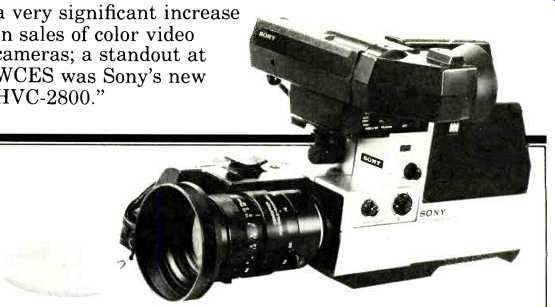
Derived from Sony's professional ENG (electronic news gathering) cam eras, the HVC-2800 is the first consumer camera to use the Sony SMF Trinicon pickup tube. Previously incorporated only in professional cameras, Sony claims this tube affords exceptional resolution, high color accuracy and consistent color purity. Another plus is that the Trinicon design uses a Saticon photoconductive layer, which affords higher sensitivity and lower image lag. In tact, image lag is reduced about 80% and light levels of only 20 lux can be accepted, meaning less need for supplementary lighting.
The HVC-2800 is fitted with an f/1.4 variable speed 8:1 power-zoom lens.
Macro-focusing facilities are provided for extreme close-ups. For audio recording situations where the built-in omnidirectional microphone is inappropriate, a super-directional cardioid mike is furnished.
The HVC-2800 has a 1 1/2-inch, black-and-white detachable electronic viewfinder, in which all critical operating parameters are displayed. A new one-touch automatic white-balance system adjusts the camera's built-in filters to changing light conditions. The camera also features electronic fade in/fade-out and, though it weighs only 6 pounds, has a professional shoulder-mount harness. Essentially, this HVC 2800 is for the serious videophile.
There are no frills such as automatic diaphragm or auto focusing, for the emphasis is on maximum quality in the basic parameters of resolution, color purity, and color consistency. The price of the HVC-2800 is $1,350.
The Fosgate Research Model 101A has a foot in both the audio and video camps. Jim Fosgate calls it, quite properly, the "Tate Two Surround Ste reo System." The result of 10 years of cumulative research by CBS Labs, Tate Audio, Jim Fosgate and others, it is covered by five patents, with others pending. The 101A will play video source material, stereo material in surround or ambience mode, and SO quadraphonic source material. I won't go into all this unit can do, but will point out its application in video playback.
As I am sure most of you are aware, since the advent of VCRs capable of stereo playback with Dolby B noise reduction, several hundred videocassettes of movies with Dolby B stereo encoding have been released. Many of these videocassettes contain the surround-sound encoding originally intended for the motion picture theater presentation. The Model 101A has a "Cinema" position on its selector switch, which activates the Tate surround circuits in quite the same manner as those used in the original theater decoders. If you hook the 101A to your front stereo system (usually via tape loop) and feed its output through another stereo amplifier to a pair of speakers behind your listening position, you will perceive the Dolby surround-sound information. All the spectacular audio effects in Star Wars and other sci-fi movies are vividly re-created. The amplifiers and speakers used for movie surround sound can be modest in power and size and still provide these exciting sonic augmentations.
The Fosgate Research Model 101A has a remote control for easy and ac curate control of the entire sound field, including Dolby surround sound. An extremely versatile unit, the 101A should find many uses in some of the new video technology, such as Beta Hi-Fi, and others now under development. Price of this 101A is $579 with remote control.
Jensen also demonstrated Dolby surround-sound effects, using their component video system and a Tate unit from Wesley Ruggles (who owns the Tate patents and licenses them to Jim Fosgate). And speaking of Jensen's component video system, it has one of the most modern and strikingly beautiful enclosures. Conceived by Design Presentations of Skokie, Ill., the unit is 8 feet long, 38 inches high and 26 inches deep. It features a black polyester mirror finish, with metallic silver trim and a chrome pedestal base.
The doors enclosing the Jensen 25-inch video monitor, tuner, control center, VCR and stereo speakers can be slid into pockets when the components are in use. No price given, but it certainly won't be cheap! Finally, General Electric gave a fore taste of some far-out future video developments. How about digital TV? Essentially, the GE digital system samples the horizontal lines 14 million times per second for color and brightness information. This information is converted to binary code, the familiar 1s and Os of computer language. This constantly monitored information is processed by a computer which instantly regulates any variance in color and brightness. Other advantages of digital TV are two channels on screen at once (picture within a picture), freeze frame and frame storage, teletext and videotext displays, picture resolution enhancement, video noise elimination, automatic ghost cancellation, and direct processing of digital audio. The chassis of GE's digital TV uses just seven VLSI (Very Large Scale Integrated) silicon chips! The digital TV ties right in with GE's new high-resolution picture tube, which has twice as many lines of resolution as the best CRTs currently in use. A fine-grain dot screen is used, rather than the normal slot design in today's TV sets.
Combine all this advanced video technology with direct satellite broad casting, and one wonders how we ever put up with the horse-and-buggy picture quality of our current TV sets!
-----------
(Adapted from: Audio magazine)
= = = =