
EDWARD TATNALL CANBY
The Big Ones Bach: St. John Passion. Grummer, Otto, Ludwig, Traxel, Wunderlich, Kohn, Fischer-Dieskau; Choir St. Hedwig's Cathedral, Berlin Symph., Karl Forster. Seraphim SIC 6036 (3 discs) stereo ($8.94)
Bach: St. Matthew Passion. Harper, Jahn, Equiluz, Rintzler, Stampfli; Vienna Academy Ch. Choir, Vienna Choir Boys, Vienna State Symph., Swarowsky. Nonesuch HD 73021 (4 discs) stereo ($11.92)
To review in any detailed sense such immense and all-embracing works as these great musical studies of the Passion of Christ is nearly impossible. Better, then, the highlights, to steer the inquiring listener in a useful direction.
Both Passions are here done in thoroughly modern fashion, which means a proper orchestra (if not 100 per cent "Baroque," then at least without the once traditional symphonic-style extras and with some of the correct older instruments-oboe da caccia, violas d'amore and da gamba, lute, recorders, harpsichord, older-type organ) a less-than mammoth chorus, reasonably alert and flexible solo voices, and in general the currently preferred fast tempi-minus the draggingly slow impressiveness that used to be inevitable. Both these versions move along smartly, even in the vast opening movements in both, the chorale (hymn) settings are sung at normal tempo without the big (misguided)
pauses and poignantly Romantic expression that used to be standard. Things have changed! These Passions can be listened to with ease. You won't have to immerse yourself in some kind of trancelike immobility for minutes and hours, as of old.
The absolute first condition of any Bach Passion performance is a good tenor narrator, the man who sings the dramatic connecting parts of the story in recitative, often in the highest tenor register, and through violent and difficult changes in harmony. Both recordings pass this test with full honors. In the St. John, Fritz Wunderlich is absolutely indefatigable, and never a trace out of tune or stained.
On the St. Matthew, Kurt Equiluz is a gentler but impassioned narrator, whose slightly lesser strength often serves good dramatic ends in the tense music.
In both recordings there are excellent soloists for the arias, a more profuse selection in the St. Matthew. Marius P.intzler's Jesus in the St. Matthew is no less dignified than the better known Fischer-Dieskau's in the St. John. Heather Harper is her usual superbly musical self in one version's high soprano part; Elizabeth Grummer, with a more variably colored voice, does an excellent job in St. John. Somehow, the subsidiary voices, notably Pontius Pilate, have the fusty, somewhat pompous sound that these roles demand. Part of the drama. There is the marvelous contralto Christa Ludwig ( St. John) ... and so it goes.
The famed St. Hedwig's Cathedral Choir shows all of its classic purity of tone, in the Northern German manner, in the St. John recording. Though normally we expect more wobbly, less blended voices from Viennese choirs, the Academy Chamber Choir seems to have cleaned up its wobbles for this St. Matthew, and performs with almost as much leanness of tone as St. Hedwig's. Both are generally dramatic and (mostly) on the button in the sudden choral entrances that have been the bane of generations of absent-minded choral singers, lulled into daydreaming by the long intervening waits. Both orchestras are in excellent form-need one say more? Seraphim's St. John puts choir and orchestra in a vast, somewhat distant church space, with solo voices somewhat closer but never too much so. The Nonesuch recording is somewhat dryer, with ( to my mind) a slightly less satisfactory balance among the large forces. Only slightly, and a matter of opinion. As to conductorial interpretation, Karl Foster's St. John is unusually crisp, rapid and economical, notably in the big choral movements and the chorales, which fairly whiz along-never, however, in an un-phrased or hurried fashion. I found the speedy music a welcome and legitimate presentation.
Hans Swarowsky, a bigger, more dramatic conductor, moves fast too, but with more variables. His big chorus, movements I find somewhat choppy and hammered-out-too much pounding staccato for my taste. (This is a familiar trait among older instrumental conductors who turn to Bach.) On the other hand, many dramatic moments in the solo arias are superbly handled and the orchestral accompaniments, in contrast, move with beautifully phrased and balanced intensity. Odd.
Performances: A, Sound: B+
Berlioz: Requiem. Charles Bressler; Utah Civic Chorale and A Capella Choir, Utah Symph., Abravanel. Vanguard Cardinal VCS 10070/1 (2 discs) stereo ($7.96)
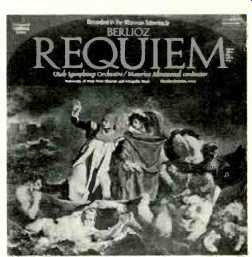
Speaking technically, this release is state-of-the-art, at least in commercial terms, for the recording of enormous massed musical forces in large, resonant spaces. Berlioz' "musical army" (as the record notes put it) is hundreds strong, comprising not only two choruses and five separate instrumental ensembles but in the brass and percussion department--if the specs are followed-no less than 16 kettledrums and an immense battery of trombones, horns, trumpets. For the one famous movement, the Dies Irae, four brass bands are stationed North, East, South, and West in addition to the main forces up front; the kettledrums, each tuned to a different tone of the chromatic scale, give forth a thunderous rumble such as has never been heard in any other music, before or since.
Four-channel? Of course! What else? Not, however, on this disc, which man ages to convey an astonishing amount of the immense musical power, within the vast area of the Mormon Tabernacle, via a mere single pair of channels. If you are planning to rush into four-channel tape, hang on, and buy the Vanguard tape release-if and when-so that the brass bands can really surround you as good old Berlioz intended back almost 150 years ago. But the musical and acoustic gist of it all is most assuredly captured on this disc, and more successfully than I have heard in a number of earlier recordings. This one has Dolby as well as Vanguard's very best efforts in distortion free taping and cutting and pressing. The much-widened dynamic range thereby makes possible the clean high-power attacks, the incredibly complex fortissimi, and at the same time the bug-eyed dramatic pauses, the total pianissimi, the musical whispers of horror. Quite something! Do play it all. Don't confine yourself, as the demos always do, to the one segment of the Dies Irae with the four brass bands!
Technical audio comes first but music is not far behind. It is a good performance, as dramatic as it ought to be, imaginative in that respect for a Western American approximation of the France of the 1830s. Not easy! Musicians sometimes snort about Abravanel's less-than perfect orchestra. Many of us think, oppositely, that this transplanted European conductor has done wonders, bringing to unlikely Utah an unerring sense of the far-distant traditions of European music, such as many technically superior forces cannot muster up. Better good style than perfect note playing, if you ask me.
I almost forgot the lone tenor soloist, Charles Bressler, who is not at all lost in the hugeness thanks to Vanguard's mikes. He is good, and properly distant, yet never overwhelmed. (In four-channel stereo he should sound still further away and smaller, but probably doesn't.) (He does.-En.) As for the Utah singers, they are powerful of voice, which is the biggest requisite. A good many trained vocal organs are audible and the blend within parts is so-so-but no matter. Gusto is what matters, and long breaths. Only in the a capella (as Vanguard spells it)
Quaerens Me, minus instruments, is the pitch nondescript though, to be sure, they do end up more or less where they started, without over-all flatting.
For cleanliness of impact under extreme stress, this recording can't easily be beat. State-of-the-art, I say.
Performance: A, Sound: A
Herold: Le Pre aux Clercs. Soloists, Orchestre Symphonique, Etcheverry. Music Guild MS 873 stereo ($2.98).
Here's a charming bit of early opera, from 1832 and Paris, sung (in excerpts ) by a decidedly all-French cast and orchestra. Based on a historical novel of the time of Charles IX (Merimee), it is, even so, a light or comic affair as is immediately evident in the listening. A joyous combination-intimations of Offenbach (who came later), bits of Mozart, and a great deal of Rossini, all done up in a typically French fashion in spite of the barely post-Beethoven idiom-the music is, as they say, gay and infectious, the necessary contrasts only moderately sad, the whole filled with solid tunes and decorated with a most extraordinary quantity of vocal ornament in the operatic style of that time.
Sometimes this last gets hilarious-for it really is beyond present capabilities in the vocal art! The tenor, a good man and powerful, practically splits a gut on a couple of the fancy cadenzas; if it were more serious music, he would be tragic.
One of the girls, however, is excellent at the coloratura stuff and the others always make it musical, no matter how difficult. What with the typically nasal French voices, the very French ( and nasal) woodwind playing, the catchy tunes, and the liberal quantities of pleasant orchestral music, this record flows along in a most enjoyable fashion in spite of rather lackadaisical ( typically French?) recording, unclean and with the voices proportionately too loud and too close.
Performance: B+, Sound: C+
Elizabethan Lute Songs. Peter Pears, tenor, Julien Bream, lute. RCA LSC 3131 stereo, $5.98
Love's labour lost, that's what this is.
Too bad. A labor of love without question, as the heartfelt and well informed annotations by Peter Pears evidence. The finest lutenist in the business, too, Julian Bream, and songs by Dowland, Ford, Thomas Morely, Philip Rosseter. But Peter Pears' voice is dismally unsuited to the lute and to such music, now in his later middle age. A big, dark, blowsy, wobbly voice, and an exaggerated operatic-style projection and direction-fine for the contemporary music of Benjamin Britten and many another music of larger proportions but wholly out of place in the hauntingly simple songs the Elizabethans sang to the lute's quiet plucking.
Don't be put off if you are accustomed to vocal music. The intention can very well pass for the deed and Pears is an intelligent, careful singer. You can "read" the meaning of the music very well, if your ear is rightly tuned. But for the rest of us, and those who might just like to hear songs of the "Greensleeves" variety, only better, this record is no way to begin. You won't make head or tail of it, Bream or no Bream.
Performance: C+, Sound: B
The Velvet Gentleman (Music of Erik Satie). Camarata Contemporary Chamber Group. Deram ( London) DEX 18036 stereo ($4.98)
This one had me baffled for awhile.
Very serious looking, and that name "Camarata" sounded musicological, like Collegium Musicum. Did Satie write a piece for chamber group called "The Velvet Gentleman"? I soon found out. This is Camerata himself, not "a" camerata! Cashing on Satie's sudden revival of late, Camerata has gone in for a serious-minded set of arrangements of Satie piano pieces, the little ones with the funny names. The "chamber group" turns out to be a vastly mood-music-type orchestra, a symphony and-a-half by the sound of it, though solo instruments are, to be sure, featured heavily. Some Satiel I do not doubt that this was an enterprise in good faith and seriously undertaken. But, first, the little Satie morsels, however cleverly orchestrated, just do not stand up to big treatment. They topple into futility or bombast. And second, good Mr. Camarata hasn't quite been able to suppress his Mantovani-like (well . . . Camerata-like) tendencies towards schmalzy musical slush. It keeps hinting itself in the background. Though Mr. C. probably wasn't even aware of it.
Performance: ??, Sound: Lush
Prokofieff: Symphony No. 5. Moscow Radio Symphony Orch., Itoshdestvensky Melodiya Angel SR 40126 stereo ($5.98)
Curiously, I found this performance of the best known of Prokofieff's symphonies-well known in Russia, too, since it was composed there in 1934-of a rather bland and indifferent expressiveness. Could it be that, though the Russians are now all excited by the earlier Prokofieff music, composed in the West and not favored in Russia until recently, this piece out of standard Russian repertory has palled and turned into a chestnut in the Russian concert halls? Could be. Over here, we don't hear it quite that often. And our dynamic conductors can make it really sing out. No, I don't recommend this version very highly.
Performance: C, Sound: B-
Pfitzner: Concerto for Violin and Orchestra in B Minor, Op. 34. Susanne Lautenbacher; Philharmonia Hungarica, Gunther Wich. Candide CE 31026 stereo ($3.98)
Well, one does live and learn! For years I have shied away from Pfitzner, the super-German late-Romantic composer of a hefty opera called "Palestrina" (of all composers!) much worshipped by the gentry in his home land. More of the Reger kind of stuff, I thought, or Busoni.
Big, fusty, heavyweight, and deadly serious. Ugh. So I looked at this one, and looked the other way fast.
But in the end conscience got hold of me and I thought, well, I'll try. Can always turn it off. I almost did, too; the solo violinist, Suzanne Lautenbacher, tends to play out of tune and in the opening measures she must have had a fit of nerves-just awful! I gritted my teeth and held on. Soon, with Miss Lautenbacher under better control, I began to realize that this music was good.
And, most interestingly, very clearly of its own time, 1925, in spite of a harmonic idiom back in the Brahms era. He was an arch-conservative in any outward sense, but the feelings and tensions of 1925 got through to him though not the snazzy, jazzy brittleness of that day's more advanced music. One hears, curiously, bits of Hindemith or Bartok. Sinewy lines, strong sequences of angular fourths. And one hears "twelve tone" great leaps all over in the melodic line, out of Schoenberg. Yep, it's there. He was, after all, only 56, hardly out of middle age.
In spite of Lautenbacher--and much too-close recording of her fiddle (exaggerating her faults unfairly)--I liked this music and recommend it highly. One new composer in my repertory.
Performance (orch.): B+ Sound: B-
Telemann: Violin Suite in F (with flutes, oboes, horns, trombones); Concerto for Viola; Suite "La Lyra" for Strings. Jaap Schroder, vl., Paul Doktor, vla., Concerto Amsterdam, Frans Bruggen. Telefunken SAWT 9541-B-Ex stereo ($5.95)
What an excellent series is this Telefunken "Das Alte Werk"! Though this disc was recorded back in 1967 and 1968, it is one of the finest examples of good stereo mike placing for a complex ensemble of instrumentalists that I have ever heard. The Violin Suite, for instance, involves in addition to the solo violin and string orchestra a battery of subsidiary soloists-2 flutes, 2 oboes, 2 high horns, trombones-plus the harpsichord continuo and its bass stringed instrument.

The separation between all of these is superb, but so is the ensemble sound and the surrounding room ambience; and each instrument appears, in terms of recording, exactly as it must sound for the most musical effect.
Not all of the many Telemann movements in these two suites and one concerto are first-line music; the poor man was bound to run down once in awhile, considering the enormous quantities of music he composed. But the opening movements, and often the closing ones, are unfailingly interesting and forceful.
Note that the conductor is the brilliant young recorder player Frans Bruggen, who doesn't play his instrument here. The harpsichordist is the well known Gustav Leonhardt.
Performances: A, Sound: A
Paganini: 12 Sonatas for Violin and Guitar. Harold Cohon, Robert Shaughnessy. Orion ORS 6907 stereo ($5.98)
Hmmm. Strange little disc, this one.
( Little in a figurative sense.) It seems that Paganini, the diabolical violinist, was crazy over the guitar and actually gave up the fiddle for five years, early in his career, to concentrate on guitar playing. Since nobody says much about that, we must assume that it didn't quite match his fiddling-and the evidence in these sonatas goes in that direction. The guitar mostly plays plunk, plunk, simple chords. The violin does all the pyrotechnics.
The sonatas are unpretentious and simple, if with occasional mildly hair-raising technicalities for the fiddler en route. They are short little works, in two movements, not unlike the little sonatas for harpsichord by Scarlatti, though far less brilliant and much less complex.
Paganini as a composer was bland, and pleasant, nothing more. Harold Cohon plays impeccably in tune--which is a lot.
The guitar, as I say, just plunks.
Performance: B, Sound: B
The Legend of Leadbelly. Tradition 2093 sim. stereo ($5.98)
Eight of these ten Leadbelly cuts, on a rather skimpy LP for six bucks, are from the old Musicraft 78-rpm catalogue, recorded in 1939. The sound quality is the old so-so sort, no highs and lots of thumping bass, but Leadbelly's driving force and musicianship come through just the same. I hadn't heard his music for quite some time, and had forgotten what a powerhouse of musical energy that man was, even in a studio. Without any doubt, the man was a first-class musical creator and only the scarred circumstances of his life, cotton picking, killing, rotting in jail, kept him short of a modern black Beethoven or Mozart. A stage man, too. He "projects" sheer electrical voltage! Glory be--Leadbelly would be 85 if he were now living. Hard to believe. Some of his best and most vigorous stuff is on this record, along with (inevitably) Goodnight 'Irene. You can have that one. Josh White and Sonny Terry assist.
Performance: A, Sound: C
FREAK OF THE MONTH IVAN REBROFF (The Richest, Darkest, Lowest, Highest Bass in the World). Accompanied by Balalaika-Ensemble Troika. Columbia MS 7373 stereo $5.98.
Only literally true! At first hearing, this disc seems to be going to turn out as the usual semi-pops Russian offering. A typical East-type "folk" band (made up of pro players of course) in the background, "Volga Boatman," "Dark Eyes," and what-not in the foreground, out of one of those typically cavernous basso voices we hear in such varied Russian frameworks as the Don Cossaks, Russian cathedral music and, of course, "Boris Goudonov," the Moussorgsky opera. He's right in the tradition, a sensational basso of the kind you just don't find anywhere else.
But play on-just play on. Presently our friend converts into a tenor. A fine Russian tenor, of the sort you find only in Russia, in the Don Cossacks, in "Boris Goudonov," etc. etc.
Ahem. This remarkable Ivan then proceeds to become an alto, a splendid Rooshian alto, of the sort ... etc.
And at last-you guessed it--he ends up a soprano, complete with canary-type cadenza. Oh wow! He really does. I broke up all over the place.
Of course, it isn't done quite in that order, I'll admit. But not until you've played several LP cuts do you come to the soprano segment. Nicely planned.
The man keeps going up and down, back and forth, unisex style-and that super basso cavern sound keeps returning to make the other sounds the more preposterous. We are, indeed, familiar by now with the male countertenor, in our milk toast Western music. This Russo stuff is something else again, if not exactly profound in terms of the music projected. I can only think, somewhat helplessly, of that lady freak of awhile back, Gorgeous Korjus. She sang from alto profundo to canary-o super-altissimo, which sounded, alas, more or less like a squeak, or a rusty gate in need of oil. She was a mere woman. This guy, now ... Incidentally, his name is spelled on the record jacket in semi-pseudo-Russian characters. Dunno what our printer will make of them.
======
Also see:
More music articles and reviews from AUDIO magazine.
= = = =