
I have to describe to you a new kind of recording experience I had recently.
No, not the latest in digital, nor a Canby experiment. To my own great interest,
this was on the largest possible scale, as big as anything in all audio.
Television! Big-time network TV. And by a sheer happenstance, there I was,
right in the middle of it.
What really knocked me for a loop, and is the reason for this writing, was the unexpected comparison between our own pure-audio recording session and this, my first experience with the parallel world of TV, sharing so many techniques with our own. It was most instructive and, from an audio viewpoint, heartening. We're doin' OK, we audio people! Just let's not let big TV swallow us.
I do have an alter ego, as some know, conductor of a small choral outfit called the Canby Singers. We sing Renaissance music, unaccompanied, Brahms and Mendelssohn the same; we sing in four parts, five, six, up to eight, and we give concerts. Tough music and no piano to help us. Kind and appreciative audiences of a hundred or so, with luck. No audio. If they can't hear us, we don't sing. Only one professional audio man that I know of goes to all our concerts. He's a top pro in architectural sound reinforcement and lives his life with mikes and loudspeakers. Except when he comes to listen to us. Good for him! Good for any audio man's soul.
Suddenly, early last winter, we found ourselves scheduled to appear "live" (on tape) on a network TV show, one of those daily programs, the biggest. It was for Christmas day hence the singing and we would be heard and seen via hundreds of television outlets at an ungodly hour on the holiday morning hence the taping. Same hour, of course, in each time etc. zone, from New York to Hawaii. I will not name the show since everybody who looks at TV knows it. It is so big that it is incorporated and ends its name with "Inc." The male host, or anchor, or whatever you call him, reputedly achieves some 500 kilobucks per year and his humble female helpmate on the show makes 300. (Scuttlebutt.) Both of these worthies assisted us in person, reading genial scripts in large letters off the backs of the TV cameras big-time, yes.
I am no TV man but I have long been in and around what I now must call pure-audio recording and broadcasting, on my own, inside big studios and little, in concert halls, control rooms and all the rest it's my biz. I don't operate a "board" but I've looked at a hundred thousand of them and am nicely acquainted (though not as well as Bert Whyte) with most of the vast array of procedures we have developed over the years for getting out our audio software, on the air or recorded. I went into this TV show as a conductor of music, but you may be sure that I had eyes and, especially, ears to see and hear how a TV recording session worked, as compared with the same in audio, which is sound for sound's sake. After all, we too have producers and engineers, we have talk backs and red lights going on (ON THE AIR, or RECORDING), people who rush about moving equipment and saying TESTING, TESTING; we have control rooms with glass panels, we have monitors, we have banks of big tape recorders, the works. Pictures aside, the situation in TV is not that different at least in theory.
There is one real difference. We got there first. We in audio developed all this production business, in radio, in recording, in "public address," in taping, before TV ever got there. So they obviously have borrowed OUR techniques. And one would expect, considering TV's size and opulence, it would improve them too, adapting our experience to fit the newer needs of the video art. So I looked forward to this big show with a lot of eagerness. It should really be something.
No Business Like...
Now understand. This daily program runs for two solid hours, divided into four half-hour segments, with commercials (natch) in between. Each segment is treated as a unit and on normal days is mostly done live, in real time (on tape), with prerecorded segments or remotes dropped in, including the news. There's an assortment of artists or groups for entertainment, each taking only a few minutes but reappearing several times on the different segments. We were to be on three of the four segments, including the first and the last.
As any recording person knows, a session like this must be very skillfully managed if there is to be other than sheer chaos, plus enormous amounts of valuable lost time. It's not so different, say, than recording the Boston Symphony, or an opera, or some pop extravaganza. There are always those armies of people, artists, equipment, engineers, producers, all to be marshaled into some sort of productive order. In my own small way I have had to do the sort of careful planning that this requires it is the same even on a small scale. Disaster is always around the corner, crises abound, and time flies at $$$$ per second. Be prepared! Be efficient! Use time for all it's worth, which is plenty. Amen.
OK I arrive at the big New York TV center at 8:45 in the morning of taping day (some days before Christmas itself) and check in at Reception. Or try to. In three seconds I am jammed into a sort of dentist's waiting room, six or eight chairs and a tiny coat rack, along with about two dozen other artists, mostly standing and holding their coats. The official waiting room! Huge TV monitor and the end of the current day's show, a remote sports commentator from Hawaii whose face is a bilious greenish yellow. Phase problems? Can't understand a word he says. They return to the home studio, right around the corner from us, and the color is OK. Good. --- I didn't really want my singers a bilious yellow, thanks.
Coffee. The place gets more and more crowded. Finally we are siphoned off into a set of dressing rooms, one for each "act," next to the big main studio where it all happens. Another monitor and lots of mirrors. Outside our door the studio is only a few feet away down the corridor and I note with amazement that there is no door. Wide open, and people moving in and out while the action is rehearsed inside. They continued even when the show was being taped. So much clutter and so much soundproofing in that huge studio that nothing audible carried more than a few yards. All the sets were already in place, one for each act, around the edges, with all the cameras in the middle and a million vast lights hanging from a steel latticework above, and vast dark spaces on beyond to an invisible ceiling.
At this point I discovered that this entire show, too, was to be taped in real time, half hour by half hour, without breaks. Everybody had to be in place, in the studio, at the beginning--we would each perform in our turn, each from our own set, the cameras swinging around to find us. No walking on and walking off; we were there. We had all of four or five minutes in each segment and would have to wait around and be "on stage" for the entire two hours. Worse, our first appearance, I discovered, was after 26 minutes of real time we were to stand on our set, motionless, with all the lights on and in our faces, for those entire 26 minutes then we were supposed to start joyfully singing! Enough to kill a chorus of horses. Was this the best way they could figure to do it? I was appalled such a clumsy, impossible means to achieve "real time." And WHY? Just the usual, I guessed.
Worse still. Remember, we sing unaccompanied. We do not have absolute pitch. Most musicians don't. All we use is a tiny pitch pipe, one peep at the beginning. Our audiences are impressed by our ability, from this one little peep, to sing complex pieces of music and go on for 10 minutes or so, ending exactly where we began via sheer pitch memory. So Hey, I said to a roving producer, catching him on the fly, when do I get to blow my pitch pipe (after 26 minutes of standing there, listening to all the other musical acts)? PITCH PIPE?? Consternation. They hadn't thought of that. Couldn't we, er, well, just start? Just begin singing? Oh yeah, only minutes after a wah-wah jazz trombone in some unknown key, over across the studio! No pitch pipe, he said. BUT--**it, I fumed.
At that point I was screaming, internally, For sake, do a simple edit! Let me blow pitch, a quarter of a second, then edit it out afterwards. So simple! (So simple in audio, anyhow.) No need to stop the show. But suddenly my producer was swept away in the crowd and I got no further. There was time. No rush. I'd figure something later.
Plenty later. By now the place was swarming with hundreds of people. The artists and all their friends and relatives, vast numbers of producer-like characters, scratch pads in hand, dozens of technicians, prop men, ladder carriers, the coffee lady, the make-up head, millions more coming in every minute. Never saw such a mob, like Macy's. All over the studio, in and around the separate sets, jumbled props and equipment lying all over, lights being lowered, huge elephant cameras tooling around on dollies, eight feet high and almost as wide. The two hosts trailed fat cables for their lavalier mikes (they walk from set to set on the show) and kept backtracking to unsnarl themselves.
Nine o'clock, the starting hour, and soon the monitor shows us one act being pushed around into place, then the host, mumbling script, trips over a cable and runs head-on into a crouching technician, nobody paying him the least attention. Everybody frowning, no smiles until the act starts. We waited, and watched. Then we were made up, one by one, just a dash of powder, mostly, to take off the shine. Glasses! Sudden crisis would they ask us to remove them? We all needed glasses to read our music, including me. No sweat. These people have their video techniques beautifully in hand. We kept our glasses, and on the show not a glint of reflection ever appeared in spite of dozens of huge lights all over the place.
Across the corridor from us was the immense video control room, a dozen or so intent operators each with a console and picture in front of him, a vast main board or something up front (we couldn't see it). Huge operation. Over to one side was a small cubicle with glass front, in it a man and a half-size audio mixing board, sort of rebuilt looking. They probably try to keep it up to date. The audio control room! One channel of sound, out of all that confusion. Mono. One technician. Why more? (Maybe if they had stereo they would use two.) That's TV audio. It knows its place, all right.
Waiting for the Go
We sat and we sat, amid the increasing confusion. More and more people kept arriving, more and more hectic conferences were going on, here and there, the various acts were all rehearsing, mostly simultaneously, people dashed from control room to studio and to dressing room with messages; the tempo was getting faster. We were ushered out, 'mid all the din, for an audio test thank the Lord, the single omni mike was placed right over my head, a good distance from the singers; we would at least have a proper mono blend and no close-up mikes. But the sound would be totally dead. Too bad, since the music was meant for liveness, even a cathedral sound. But a good blend, anyhow.
We were tried for video lovely--Gorgeous color, nice pink faces against a big fake blue-sky background and green and red Christmas wreaths. Nothing wrong there. Back to the dressing room. More and more excitement. Nothing new.
At around 10:00 they said the first real-time segment might be taped at 11:00. At 11 o'clock nothing. Somebody said we might start at noon. More milling about, more rehearsals, more conferences. Around noon, our producer took me into a corner and we revised the order in which our music would come. Now at this late moment! I had been in touch for weeks, of course, and had sent timings, and so on. A better musical sequence, now that I saw what was involved. But could this enormous show be improvised in this casual fashion? Indeed it could, and I wasn't complaining.
We took to watching the monitor again, which was hooked into the studio line and showed us whatever was heading towards the still-inoperative.
tape machines. Really beautiful handling of colors and shapes and designs. A bevy of long-gowned maidens, a string quartet in delicate pastels, their instruments a rich deep brown, their hair beautifully auburn, blonde, black. On the 19-inch tube it was really fascinating this was TV at its best, so sure and right, out of all th [...] a few feet from us. But the and ensemble with piano, cymbals, I saw the cymbals playing but not hear them. No highs. I saw [... ] drums and heard a faint crunch. I, lows. It all came out of a monster three-inch speaker, somewhere in that big TV monitor.
By one o'clock we were steeped in despair. Nothing had changed. We had seen everything; all the acts had rehearsed and got themselves ready. Still, the vast coming and going went on and on. Four hours of it already and we had not so much as started. And, we would have to stand butes before we could even 'a note and this only the [...] I began to think it would ght then, I decided I would kst blow my pitch pipe be-[...] ? could stop me, in the si)efore we began to sing. [...] perfectly well edit it out al ole shebang ground to a hair more fool them. I had to do se. g! Time was crawling.
Did I say improvise? After four hours, the session's entire game plan was suddenly junked. Brilliant thought: Instead of the customary real-time operation, which didn't seem to be working very well for this session (!), we would now do the, entire recording via tape editing. That is, they would record everything on the program in bits and pieces, each act doing its complete offerings all at once, and the program would be spliced together later on. Thus we would not have to wait a dozen or so hours more to tape our real-time segments one at a time.
Brilliant innovation, huh?
If you ask me, any reputable audio producer would have thought of that one in approximately nine seconds from the word go. What have we been learning, all these years? In no time at all (that is, only an hour or so more), we were through our work and out of that place. We went and did our stunt, all the music for all three segments, one piece right after the other, in ONE take, no more, and that was that. It took less than 15 minutes and we got applause from the other acts, around the room on their various sets, when we finished.
I still am dumbfounded. (Or is it dumfounded?) Did they really think they could pull off four separate real-time recordings, no breaks, in this extraordinary fashion? Well, after four hours, they certainly were not going to. Couldn't they have guessed? Where ARE these TV people? Somewhere back in prehistory? I don't think they even KNOW what we audio workers have been doing for so long and with such a wealth of invention.
Maybe in another installment I'll tell you how it all came out when we finally got going the right and proper way, via tape edit. Especially the audio. I saw the show on Christmas morning, and heard it. Not bad sound for a so-so one-channel signal, forced through some sort of drastic compression, sent out to a pipsqueak FM tuner in a home TV and spewed forth through a micro-power amp into a mini-woofer. That's TV audio. But the color the color was gorgeous. Just gorgeous.
Not the sound color, the picture.
(adapted from Audio magazine, Jun. 1980)
========
ADs
ADOOM INTRODUCES BALANCED POWER … AT A PRICE THAT WON'T UNBALANCE YOUR BUDGET.

At Adcom, we firmly believe that the primary justification for introducing a new piece of equipment is superior performance.
And, if we can do it at a modest cost, so much the better.
Happily, the new Adcom GFA-1 meets both of these requirements.
No amplifier we know of offers such exceptional performance at such an affordable price, only $400.* Indeed, despite the wealth of sophisticated equipment available today, we know of no amplifier at any price that is significantly better.
Consider power output for example. The Adcom GFA-1 is capable of delivering 200 watts per channel RMS into 8 ohms with less than 0.05% harmonic distortion from 20 Hz to 20,000 Hz. Moreover, it still has enough reserve power or "headroom" to prevent clipping on high amplitude transients.
But high power was not the only or even the most important design consideration. Special attention was paid to reducing transient intermodulation distortion (TIM) and slew induced distortion (SID). Since it has been demonstrated that these two forms of distortion are largely responsible for the coarse or grainy quality known as "transistor sound," a characteristic common to many amplifiers that otherwise measure out well.
In large part, the outstanding performance of the GFA-1 is directly attributable to a singular design innovation, Adcom's "Balanced Bridger" output configuration.
Unlike conventional amplifier circuits which drive only one terminal of the loudspeaker and fix the other terminal at ground, the Balanced Bridge drives both sides of the loudspeaker 180 degrees out of phase. Consequently, power supply voltages are reduced and the output devices are operated very conservatively. More important, this configuration results in a perfectly balanced design that is fully complementary and symmetrical from input to output.
The same meticulous attention to detail lavished on the design of the output section of the GFA-1 is equally evident in the design of the power supply.
Instead of the massive and comparatively inefficient power transformers found in conventional amplifiers, the Adcom GFA-1 employs a specially wound toroidal transformer for better power regulation and greater efficiency. Moreover, the toroidal transformer which is smaller and weighs less affords greater magnetic field concentration and minimizes stray field effects for lower hum and noise.
To insure continuous safe operation at high power levels, the Adcom GFA-1 has a built-in fan that silently directs a continuous stream of cool air over the output transistors. And in the unlikely event the output devices should overheat, a thermal sensor automatically cuts off power to prevent damage.
In sum, the Adcom GFA-1 represents a unique achievement in amplifier design. A near perfect balance of power and inaudible distortion. A serendipitous balance of performance and price.
ADC0M-GFA-1 POWER AMPLIFIER
For additional information on the benefits of Balanced Power, both audible and financial, as well as the name of your nearest dealer write to Adcom, 9 Jules Lane, New Brunswick, N.J. 08901.
* Suggested retail price. Adcom 1980
-----------------

Now get moving coil perfection for the price of a common cartridge.
SATIN by OSAWA
The Measure of Quality
Most music lovers dream of owning a fine moving coil cartridge. But it's been an impossible dream for many because of the high cost. Until now.
Satin, world leader in moving coil technology, has brought the suggested retail price of a high-quality moving coil cartridge below $100, well within the budget of most buyers.
Our new Satin 117Z has the extended frequency range, superb stereo imaging, gloriously open, spacious and--above all--realistic sound quality that Satin MC's are famous for.
User-replaceable stylus.
And like all the Satin cartridges, it features a unique user-replaceable stylus that you can change in seconds, like a common cartridge. The stylus is a perfectly formed diamond, with Satin's exclusive single-point pivot and special magnet/lubricant damping system for high compliance and separation.
No transformer or pre-preamp.
And, of course, the high-output 117Z uses Satin's ultra-thin 10-micron aluminum ribbon coil and high energy magnet so you don't need an expensive noise-prone pre-preamplifier or transformer like most other moving coil cartridges. The 117Z connects directly to any quality amp, preamp or receiver.
Visit your authorized Satin dealer as soon as possible. For under $100, why postpone perfection?
Osawa & Co. ( USA) Inc.
521 Fifth Avenue New York, New York 10017
--------------
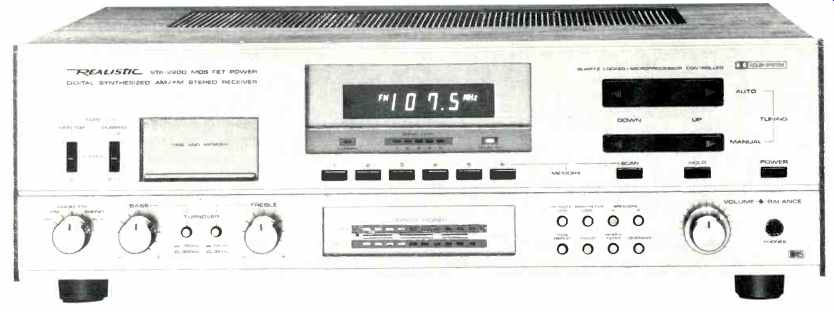
"The Realistic STA-2200 is a highly advanced stereo receiver which sounds every bit as good as its specifications and our measurements suggest... an impressive value for the money."*
Computerized All-Digital Tuner
Breakthrough is a word Realistic seldom uses, but nothing else describes the STA-2200. And the critics agree. The heart of the tuner is the quartz-locked, microprocessor circuitry that ends mechanical tuning problems.
Radio Electronics magazine puts it this way: "On the whole, the receiver embodies a great many design features, most of them concerned with the ease of use and convenience of accurate tuning.' t Bright fluorescent digits display each station's frequency with absolute accuracy, and computer-type tuning automatically scans up or down the FM and AM bands. You can store any six FM and any six AM stations in the microprocessor for instant touch-button recall.

Radio Electronics also says: "The STA-2200 is a joy to use." For example, you can command the receiver to sample each station in the memory, then touch-select the one you want. There's also Dolby FM Noise Reduction, LED signal level indicators, and the display doubles as a quartz clock.
Stereo Review summed up the STA-2200's tuner by saying it "worked to perfection:'* And Radio Electronics said "... because of its clever design and pleasing layout, we have assigned a VERY GOOD R.E.A.L. rating to the STA-2200"
Advanced MOSFET Amplifier
The STA-2200 uses a new breed of power transistors called MOSFETs. Their ultrahigh-speed operation brings you stunningly accurate sound reproduction through superior linearity, superior slew rate and inaudible TIM.
Radio Electronics says "The unit seems quite conservatively rated in terms of power output, as well as rated distortion, delivering a clean 72 watts per channel at mid frequencies and just under 70 watts per channel at the 20 Hz and 20 kHz frequency extremes for its rated total harmonic distortion of 0.02%"t You can monitor the output with the 10-step, dual range output LED power indicators.
Stereo Review reports "There are no signs of skimping in any area of its design or construction:'* The amplifier features go on and on. We've included 11-step bass and treble controls with turnovers for controlling ranges below 150 Hz and above 6 kHz, tone defeat, monitor and dubbing controls, Hi-MPX filter. And more!
Says Stereo Review: "With the STA-2200, Radio Shack has made it perfectly clear that the technical sophistication responsible for the overwhelming success of the TRS-80@ computer system has been applied very effectively to their high fidelity products."*
We couldn't have said it better. Thanks, guys!
The Nationwide Supermarket of Sound
Quoted by permission from Hirsch-Houck Test Labs Report. Feb.. 1980, Stereo Review. (Copyright Ziff Davis Publishing, all rights reserved)
R.E.A.L. Sound Audio Lab Report by Len Feldman, Jan., 1980, Radio-Electronics. Gernsback Publications Inc., all rights reserved.
The STA-2200 is 599.95, at participating stores and dealers, price may vary. Dolby' is a trademark of Dolby Laboratories.
-----------------
TDK

The continuing story of TDK sound achievement.
Part One.
Music has gone through many transitions. Its rhythms, tones and forms have changed dramatically. As have the means of reproducing it.
From the first wax cylinder to today's music machine: the TDK cassette.
TDK pioneering in ferrite technology began over forty years ago.
This led TDK engineers to develop microscopic particles which, through their long shape and uniform size, could translate magnetic energy into flawless sound. By 1968 TDK had created TDK SD. The world's first high fidelity cassette. In 1975, TDK created a revolution. Super Avilyn. Ultra refined gamma-ferric oxide particles were bombarded with cobalt in a proprietary ion-adsorption process. The resulting TDK SA cassette had higher signal to noise. Higher coercivity. Low noise. A maximum output level superior to anything heard before.
Overnight, TDK SA became the high bias reference.
TDK has a philosophy of sound.
A belief that total performance is the outcome of a perfect interplay between the parts. It all begins with Part One, the TDK tape. Magnetic powder is first converted into TDK magnetic material in the form of a coating paint or binder. On a giant rotary press and in a dust-free atmosphere, jumbo rolls of tensilized polyester are coated evenly with TDK binder. The tape rolls are edited and leader is inserted at precise intervals. Surgically sharp knives then cut the tape into predetermined widths. The edges perfectly straight. All along the way, TDK tape undergoes thousands of checks. It's polished to mirror smoothness to give better head contact, increase sensitivity and maintain stable output TDK binder, recently improved, packs more particles on the tape surface. And the whole process is done automatically. Controlled by a central computer brain. From the very first, TDK tape runs true. And so does the sound.
The TDK story will unfold in future chapters. You'll learn about other key parts and their sound synergy in a TDK cassette. And you'll draw only one conclusion. Music is the sum of its parts.
TDK.
1980 TDK Electronics Corp., Garden City, N.Y. 11530
The machine for your machine
---------------
Wharfedale. First and everlasting.


The Wharfedale E's are the newest speakers in an unequalled tradition of excellence that goes back to the early days of music reproduction.
In those days, our speakers-like the unique sand-filed designs of Gilbert Briggs-were received with wide acclaim despite the limited technical resources of that era. Today's Wharfedale E's benefit from our space-age technology, and hold a special position of leadership h acoustic engineering.
The design goal for America's Wharfedale E's was to achieve that elusive combination of crystal-like clarity, strong bass and extremely high efficiency. We met this objective using computer optimization and holographic research, developing speakers with extremely wide dynamic range and no coloration.
They've won the praise of lovers of every kind of music. And seem destined to keep that praise for years to come.
A Wharfedale E can fill a room with just a couple of watts. Or handle hundreds for unusually large areas.
At any level, with any music, you won't detect any of the harshness or roughness inherent in lesser speakers.
Each Wharfedale E goes through a stringent Quality Control procedure that rejects all but the most perfect speakers. Those that pass represent the highest attainable audio technology, enhanced by the skills of old-world craftsmen who make each pair of perfectly matched hand-rubbed, fine wood veneer cabinets.
Many speaker makers have come and gone in the nearly 50 years since the first Wharfedale was made. And when you listen to the E's you'll know why Wharfedale lasts.
The new E90 measures 45- 3/8"H x 15-3/16"W x 14-3/4" D and has a typical frequency response of 30-18,000Hz-±3dB. The E70 is 32" x 13-1/2" x 14" with frequency response from 3518,000Hz ±3dB. The E50 measures 25" x 13-1/2" x 13-1/2" with a frequency response of 40-18,000Hz ±3dB. The new E30 is 22-3/ 4" x 13-3/16" x 10-5/16" with a 45-18,000Hz ±3dB frequency response. Efficiency is 94dB at 1 watt and 1 meter for the and 95dB for the other models.
WHARFEDALE---RANK HI FI Inc., 260 North Route 303, West Nyack, New York 10994, (914) 353-1914
---------
Sansui is breaking up a very successful relationship.
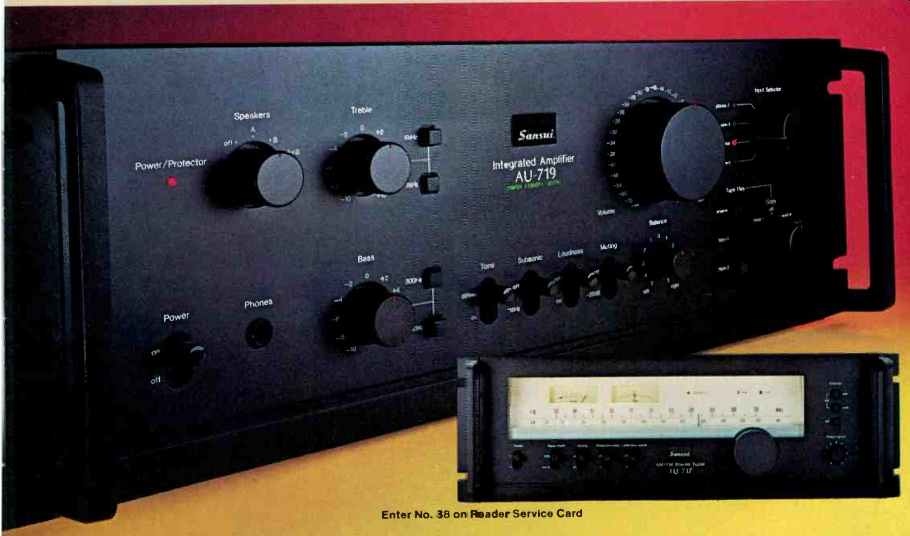
The TU-717 has a new mate: The AU-719.
Sansui has just introduced an exciting new integrated amplifier, the AU-719. It represents the very latest developments in audio and electronics technology. It is so good, in fact, that it has replaced its rave-reviewed, best-selling predecessor as the partner of the TU-717 tuner.
The TU-717's performance has been extravagantly praised by professional critics and knowledgeable consumers alike. With advanced features like switchable IF bandwidth and specs like 81dB signal-to-noise ratio and 0.06% THD, it's only natural.
We expect the tuner's new mate to receive a tremendous reception and set industry amplifier standards for a long time to come. Here's why.
INTRODUCING DD/DC
What particularly distinguishes the new AU-719 amp is Sansui's patent-pending DD/ DC (Diamond Differential/DC) circuitry that provides the extremely high drive current needed to reduce THD by adding large amounts of negative feedback without compromising slew rate or adding TIM.
Slew rate refers to an amplifier's ability to respond to rapidly changing musical signals. The slew rate of the AU-719 is an astounding 170V/µ Sec.
MAGNIFICENT MUSIC
Many modern amplifiers have extremely low total harmonic distortion specs. And that's important.
But THD is measured with steady test signals and is not really representative of an amp's ability to dean with music. Sansui alone, with it's DD/ DC technology, is able to provide both low THD and lowest TIM simultaneously. Instead of the harsh metallic sound you sometimes get on a conventional amp when the musical signals are complex, with the AU-719 you hear only magnificent music.

THD is less than 0.015% at full rated power of 90w/channel, min. RMS, both channels into 8 ohms from 10 20,000 Hz. Overall frequency response is awesome: DC 400,000 Hz, +0,-3dB. Hum and noise are a super-silent-100dB on aux and-88dB on phono. The phono equalizer, which adheres to the standard RIAA curve within ±0.2dB from 20 20,000 Hz, also uses our unique DD/ DC circuit for record reproduction that's second-to-none.
CONTROL YOURSELF
The unit is equipped with a full complement of versatile controls and connections to create the system and sound that's right for you, including two phono and two tape inputs, defeatable tone controls with switchable center frequencies, deck-to-deck tape dubbing and a very convenient 20 dB muting switch, Audition the new AU-719 and matching TU-717 at your authorized Sansui dealer. We think it will be the start of a very successful relationship.
SANSUI ELECTRONICS CORP.
USA: Lyndhurst, New Jersey 07071; Gardena, Ca. 90247
Sansui Electric Co., Ltd., Tokyo, Japan
Sansui Audio Europe S.A., Antwerp, Belgium
Sansui.
---------------
Harman Kardon
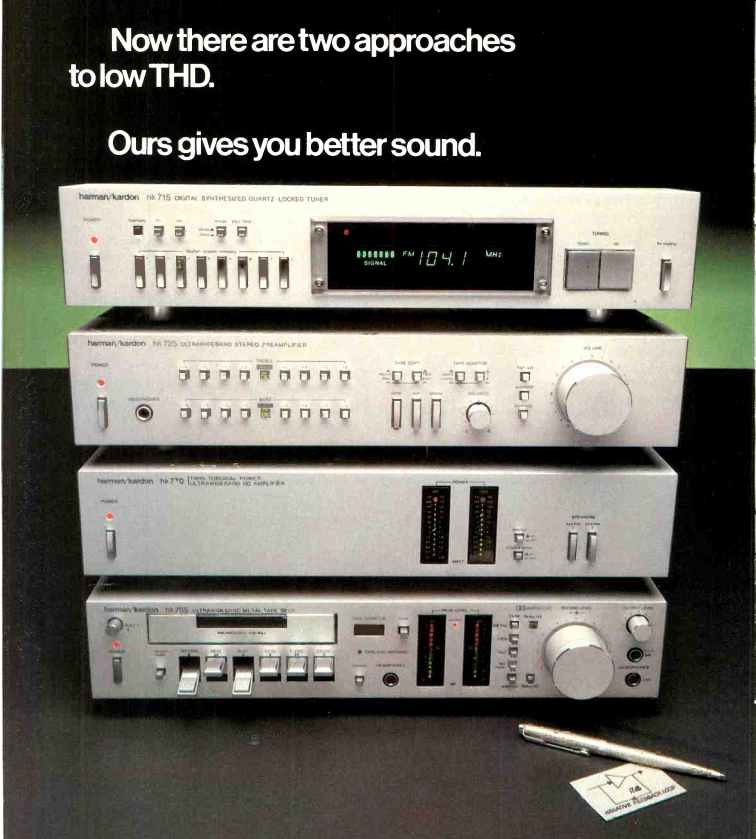
Now there are two approaches to low THD. Harman Kardon introduces low negative feedback design. High Technology Separates with low THD and inaudible TIM for incredibly clean, open sound.
For the last few years, audio manufacturers have been rushing to bring you newer, lower THD (Total Harmonic Distortion) levels in their amplifier sections.
And every year, they've accomplished this objective the simplest way they could. By adding more and more negative feedback, a form of electronic compensation that feeds the amplified music signal back through the circuit.
Unfortunately, this universal "cure" for THD-high negative feedback, typically 60-80 dB-creates a new form of distortion. It's called Transient Intermodulation Distortion, or TIM. And it's much more audible than THD. TIM causes music to become harsh, metallic and grating. And the spatial relationship of the instruments to become vague, smearing the image.
At Harman Kardon, our new 700 series amp and preamp give you low THD figures, too.
But we did it the right way-by properly designing the amplification circuitry to deliver low THD even before we apply negative feedback. That keeps our negative feedback at just 17 dB. And our TIM level at just .007%. Well below the audible threshold.
The result is pure, clear, transparent sound and stereo imaging that places instruments and vocals precisely.
Beyond TIM.
Of course all the Harman Kardon components incorporate our traditional ultrawideband design, which provides fast transient response and phase linearity. We also use discrete components instead of integrated circuits, because ICs create their own IC distortion.
But beyond these major design considerations, we've also paid attention to all the small details.
In the hk725 preamplifier, for instance, we used fixed resistor pushbuttons for tone controls.
They introduce less distortion than rotary knobs. We also incorporated DC coupled FET front ends in both our 8-stage phono section and our high level stage.
Again, less distortion, and improved signal-to-noise ratio.
On the hk770 power amplifier, we used two separate toroidal power supplies, which eliminate cross-talk and hum.
And DC coupling which provides tighter, more articulate bass.
Performance matched separates.
Once we designed the heart of our new 700 series High Technology Separates, we addressed the remaining components just as carefully.
The hk715 digital quartz locked tuner gives you a full complement of features. It locks in to the channel center every time. And stays there, drift-free.
It also has a memory subsystem that lets you store up to 8 stations and recall them instantly at the touch of a button.
We designed a linear phase analog tuner as well. The hk710.
With an improved version of the phase-locked circuitry we introduced to the industry nearly 10 years ago. It remains the industry standard today for quality tuners.
The first cassette deck with Dolby HX.
In 1970 Harman Kardon introduced the first cassette deck with Dolby NR. In 1980, we're bringing you the first cassette deck with the new Dolby HX headroom extension circuitry.
The hk705. With the Dolby HX headroom extension circuitry, you get an added 10 dB of high frequency headroom, as well as a 68 dB signal-to-noise ratio.
That's comparable to open reel decks that cost twice as much.
And thanks to Dolby HX and metal tape capabilities, the 705 provides an impressive frequency response of 20-19,000 Hz (±3dB). Once we finished the inside of our components, we went to work on the outside. To bring you a striking system of modular separates. Each measuring a compact 15" wide x 3" high.
These performance matched separates stack beautifully. They give you a noticeably cleaner, clearer, less distorted sound than any system anywhere near the price.
We suggest you audition them. But only if you're serious.
Once you hear the difference, you'll never be satisfied with anything less.
(For the location of the Harman Kardon dealer nearest you, call toll-free 800-528-6050, ext. 870.)
"Dolby" and the double-D symbol are trademarks of Dolby Laboratories.
harman / kardon 55 Ames Court, Plainview, NY 11803.
----------------
IF YOUR DISKS MATTER, PUT A DISK MAT ON YOUR PLATTER
Disk Mat by OSAWA
Your records are probably very important to you. You spend a lot of time and money building your collection, and you want to hear all that they have to offer. Unfortunately, when you play your records, you often hear a lot more than music, because all kinds of noises slip through your sound system.
Disk Mat can clean things up for you.
An Osawa Disk Mat goes on your turntable platter, replacing the regular mat. Disk Mats are made of a special blend of natural rubber and a high density filler. The extra mass blocks resonant vibrations coming from your turntable motor and mechanism.
Since the stylus moves free of interference, you get better high frequency response, wider dynamic range, improved stereo separation and imaging, and much more detail and realism. You can even play your records louder with a Disk Mat because it blocks feedback vibrations from your speakers.
As a bonus, the extra weight of the Disk Mats add to the platter's flywheel effect, lessening wow and flutter. Disk Mats are available in two models. The Model SE-22 weighs 730 grams and is 5mm thick. The model 0M-10 weighs 500 grams and is 3.5mm thick.
For better sound, flatter your platter. Get a Disk Mat at your Osawa dealer.
OSAWA & CO. ( USA) Inc. 521 Fifth Avenue New York, New York 10017
Distributed in Canada by Intersound Electronics, Montreal, Quebec
---------------
For those who take recording seriously The 580 Series From the economical 580M to the universally acclaimed 582, a 580-Series recorder is not an average cassette deck. It rises above mediocrity.
It is designed for the serious recordist-for the person who insists upon the perfection that comes from individual calibration of each tape and the self-contained oscillator and metering that make this possible. With exclusive Asymmetrical, Diffused-Resonance, Dual-Capstan Transport, flutter and modulation noise cease to be problems. And, Nakamichi s Double Slot Guides and Tape-Pad Lifter assure perfect tracking and absolute signal stability-so stable as to cause STEREO REVIEW to exclaim of the 582: "What we found astonishing...was that this was the first deck... in which the response was identical (within ±0.1 dB) whether the test tapes were played in the normal forward direction or turned over and played on side two:' Unique Direct-Flux erase head, metal-tape compatibility, and IC logic with remote and unattended operation are common to all 580-Series recorders.
Nakamichi
580M 2 Head Cassette Deck Special narrow-gap Sendust record/play head-the pinnacle of combination-head performance. 20 to 20,000 z--3 dB with less than 1% THD sets this recorder apart from the crowd! Dolby* calibration for each channel and each tape.

Now there are two approaches to low THD. Harman Kardon introduces low
581 Discrete 3Head 1 Cassette Deck Discrete 3-Head technology highlights the 581. S/N more than 66 dB-20 to 20,000 Hz with under 0.8% THD! Dolby* and bias adjustments with built-in 2-frequency oscillator assures Nakamichi performance with any quality tape.
582 Discrete 3-Head Cassette Deck
Acclaimed by every leading reviewer, the 582 is the ultimate recorder for the serious audiophile. With three discrete heads and full off-tape monitoring, the 582 has become the recorder on which experts evaluate tape!
*Dolby is the trademark of Dolby laboratories.
For more information, write to Nakamichi U. S.A. Corporation, 1101 Colorado Avenue, Santa Monica, CA 90401
-------------------
ANTIQUATES SO CALLED HIGH SPEED TECHNOLOGY.
Since its inception in the 1960's, there's been a lot of debate as to whether "high speed" is just a lot of fast talk or whether quick rise times and high slew rates are effective in lowering distortion.
Now Pioneer's latest technology brings an end to the heated "high speed" debate. Because Pioneer's new Non-Switching Amplifier design has been recognized as a most significant technological advance. It produces distortion levels so vanishingly low (.005%), its sound purity and specifications are comparable to the very best most expensive power amplifiers.
In fact, further study of Pioneer's new Non Switching technology will show why "high speed" has become obsolete.
NO MATTER HOW FAST YOUR AMP, IT'S STILL BEHIND THE TIMES.
The truth is, "high speed" is just a fancy name recently given to an electronic technology that dates back nearly two decades. The terms slew rate and rise time were around when most amps had vacuum tubes and transistors were rarities. In fact, the only thing new about the terms slew rate and rise time is their recent abuse.
THE HIGHER THE SPEED, THE BIGGER THE CON.
Kenwood, Sansui, and other manufacturers of high fidelity components boast that their units offer higher fidelity because they offer higher slew rates than the competition.
A slew rate of 200 volts per microsecond (v/µs) and a rise time of 0.85 ps. do indeed sound impressive. They are at least three, four and sometimes even up to 10 times faster than those found on most of today's equipment.
But the truth is you no more need rates like this to get superior high fidelity reproduction of music than you need to be an Olympic weightlifter to turn the page of this magazine.
HIGH SPEED GOES NOWHERE FAST.
To understand why "high speed" is really "all talk and no action:' you must first understand what's meant by slew rate and rise time.
Slew rate is the maximum rate of change or slope of a signal measured in volts per microsecond. Like miles per hour, it's a rate of how fast something is traveling. And in this case that something is the musical signal.
All it takes is a simple calculation to show what slew rate would be necessary to handle the most extremely demanding musical signal.
Let's assume 20,000 hertz to be our musical analog with a peak value of 40 volts which will deliver 100 watts of power into 8 ohms.
The steepest part of the wave, where the slew rate is greatest, is at the zero crossing point. The slope at this point is the derivative of the sine wave with respect to time (dt): The waveform is 40sin 2nft; and taking its
So this extreme case signal only has a slew rate of 5. And if the power was increased to 400 watts, the slew rate would only double.
A slew rate of 200 volts per microsecond like Kenwood boasts, only adds one thing to your amp. A high price tag.
Rise time is the time it takes for a signal to go from 10% to 90% of its peak-to-peak value.

Now there are two approaches to low THD. Harman Kardon introduces low
Another simple calculation will show the rise time necessary to handle a 20,000 Hz. sine wave.
The arcsin of-0.8 is the angle at which a sine wave is at 10% of its peak-to-peak value and
+ 0.8 when it's at 90% of its peak-to-peak value.
---p3c
So the time it takes to go from-53.13° (10%) to
+ 53.13° (90%) is:
---p4a
And the rise time needed to handle a 40,000 hertz signal is half of that; 7.38µs.
So what's the necessity of arise time 0.85 ps or faster? Well, some audio companies believe they need it to justify an inflated price tag. And some use it to keep your focus away from audible distortion they can't rid themselves of.
IF KENWOOD AMPS HAVE A LOT HIGHER SLEW RATE THAN PIONEERS', HOW COME THEY ALSO HAVE A LOT MORE DISTORTION?
Unless you own an eleven-year-old "tube job" it's almost certain the distortion you're hearing is not caused by insufficient slew rate and rise time.
In fact, this most significant form of audible distortion can, at the most, be reduced with "high speed" technology. But it takes Pioneer's new Non-Switching technology to totally eliminate it.
This form of distortion is known as "switching distortion." And, most likely, the reason you haven't heard of it before is because most high fidelity companies are still grappling with it. Trying to rid themselves of the audible noise that occurs every time a musical signal is handed over from one transistor to another.
In more detail. Most power amps today use high-speed bipolar transistors in their output stage. Operating in pairs, one handles the positive part of the output waveform and the other the negative. The audio signal alternates between these transistors thousands of times a second. With each cycle, one transistor switches on and the other switches off. When the switch occurs so does distortion.
But unlike other forms of distortion that are more noticeable at very high power levels, switching distortion is also a problem at lower listening levels. And the lower the listening level the greater the amount of switching distortion you hear.
OTHERS REDUCE SWITCHING DISTORTION. PIONEER'S NON-SWITCHING TECHNOLOGY ELIMINATES IT.
For years, people have clashed over which amplifiers to buy.
The output transistors in a Class A amplifier are passing high currents at all times, regardless of the signal driving them. True, since the transistors never switch on and off, there's never any switching distortion. But, due to the high idle currents, over 50% of the available power is dissipated as heat.
Because of this, Class A amplifiers need larger heat sinks, greater power supplies, greater size, weight, and most important, a greater price tag.
A pure Class B amplifier or an AB amplifier, like the "high speed" models touted by Kenwood, are more energy efficient than those in Class A. But instead of paying through the nose for a heat producing Class A, what you're really doing is paying through the ear for an amp that produces distortion. Because transistors on Class B amplifiers constantly switch on and off.
And no matter how high the speed of the amp, they can't lose the distortion that's created when these transistors begin to switch.
NOT CLASS A. NOT CLASS B. BUT IN A CLASS BY ITSELF.
Unlike Kenwood and other manufacturers of high fidelity who remained with the technology of the sixties to reduce the problem of switching distortion, Pioneer forged into the eighties with a new design that totally eliminates it.
So impressive is this technology that it was accepted for presentation at an Audio Engineering Society convention in New York City.
Pioneer's new Non-Switching Design performs like pure Class A without any of its drawbacks.
This new technology instantly monitors the amplitude of the signal, and like a servo, automatically controls the amount of bias current fed to the output transistors.
Unlike transistors in other amplifiers, these transistors receive a trickle of current during "no-signal" periods. Just enough to keep them from switching off. But not enough for them to waste energy creating added heat and expense.
The result of this technology is absolutely clean sound at all levels.
"The technological advantages of the NSA circuit are evidenced by the low distortion of the SA-9800. At 0 dBW (1 watt), no harmonics can be found in a spectral analysis of the output, and, at rated power, (20 dBW, or 100 watts), only the smallest vestiges of (mainly) third harmonic emerge above the noise. Up through 10 kHz, this amp also is essentially free of intermodulation at higher frequencies, especially at high output levels.
"Indeed, our listeners did detect a subtle difference in the SA-9800, mainly in the ultra treble region. Brushed cymbals sound cleaner than we're accustomed to hearing them, and the highs a mite crisper than usual. You can, so to speak, reach down through the general cacophony of a loud passage and pick up the tinkly details that often remain submerged. Several words come to mind to describe the quality; scintillating, brilliant, transparent”
High Fidelity Magazine, September, 1979.
CLASS-A OPERATION. Paired transistors are always turned on, amplifying its assigned waveform within the range above and below its quiescent operating point. Therefore, no switching distortion can occur.
But that bias current is always at the center point and thermal loss is considerable.
CLASS-B OPERATION. Paired transistors alternately turn on and off, amplifying the positive half-cycles and negative half-cycles. This lets amplifiers run cooler with high efficiency. But, as the power transistors are driven below its idle current into cutoff, switching distortion (also called "notching distortion") occurs.
"NON-SWITCHING" AMP OPERATION. Paired transistors are always turned on: they do not switch on and of . Since the bias is controlled by our new Pioneer Non Switching circuit to prevent either output transistor from being driven below its idle current into cutoff, no switching distortion is generated and the thermal loss is low.
THE LESS DISTORTION, THE LESS NEED FOR FEEDBACK. An important result of having such a clean, practically distortion-free amplifier, is a significant reduction in the need for negative feedback.
In most amplifiers, as feedback increases distortion decreases. And frequency response increases in proportion.
But when the basic amplifier suffers from the problem of switching distortion, even a feedback network that feeds back most of the signal can't significantly reduce it.
Pioneer, because of its Non-Switching design and Ring Emitter Transistors (RET's) has extended frequency response and totally eliminated switching distortion. Because of these characteristics, feedback is not needed to obtain impressive specifications. And neither are exotic slew rates and rise times. An unheard of .005% distortion is proof of that.
is certainly a technical achievement of no mean proportions. From our measurements alone, we would have guessed that this was a pure Class A amplifier of exceptional quality, except for the fact that it runs cooler than most AB amplifiers of similar power."-Stereo Review, October, 1979.
THE TECHNOLOGY OF OUR FINEST AMPS IS ALSO FOUND IN OUR FINEST RECEIVERS.
Most audio buffs would think technology as advanced as Pioneer's Non-Switching circuitry, would only be found in Pioneer's latest amplifiers, but the truth is the same engineering can also be found in Pioneer's finest receivers.
Pioneer's SX-3800 and SX-3900 do not sacrifice true high fidelity for the sake of compactness in size or savings in price. In fact, the total harmonic distortion in the 60 watt/channel output of the SX-3800 is a mere 0.005% or less. The lowest of any receiver on today's market. And the price is a lot less than those receivers whose slew rates and rise times are almost ten times Pioneer's.
So, if you're looking for the best components you can buy, don't look for one that gives you "high speed." Look for one that gives you high performance. Pioneer.
PIONEER-- We bring it back alive.
---------------------
KEF

KEF Reference Model 105 Series II: Unique Protection, Extraordinary Performance
4 The KEF Model 105 is now acclaimed as of one of the most respected and reliable speaker systems. Since its introduction in 1977, the Model 105 has been adopted by audio testing laboratories and speaker manufacturers as a reference for evaluating other loudspeakers and audio products.
KEF now introduces the Model 105 Series II, embodying several significant technical features and improvements never before available.
Acknowledged Technical Capability KEF was the first company to develop computer-aided digital analysis for loudspeaker research and evaluation.
The impulse measuring method which the company pioneered in the early 1970's is far more accurate and comprehensive than conventional analog techniques, and has been widely adopted throughout the audio industry.
The benefits of digital techniques are not confined just to research & design alone. KEF's leadership position in this field has enabled the company to employ similar methods to production processes, revolutionizing the standards of quality and consistency that can be achieved in production quantities.
Every vital characteristic is monitored by computer during the entire manufacturing and assembly process. Drive units and filter networks are measured individually. Performance data is recorded digitally and used to group carefully matched sets of components prior to assembly.
Completed speakers also undergo rigorous measurement. Paired Model 105's differ in frequency response by less than 0.5dB, and vary from the original prototype by only 1dB over the entire frequency range.
Thus, for the very first time, it can be claimed that the standard of performance achieved in the original prototype is assured for each and every purchaser.
Electronic Protection Circuit
The Model 105 Series II is fully protected against accidental overload by a self-powered electronic device called S-STOP (Steady State and Transient Overload Protection). This KEF development provides comprehensive protection against excessive voltage, thermal overload, and low frequency excursion: PEAK: The peak protection mode causes the S-STOP circuit to operate whenever peak voltages to the system are so high as to be damaging to the dividing network, or likely to cause unacceptable distortion levels on program peaks.
THERMAL: The input level to each drive unit voice coil is continuously monitored, and whenever a safe operating temperature is exceeded, S-STOP is activated.
LOW FREQUENCY EXCURSION: The excursion of the low frequency unit is also monitored, and S-STOP is again activated whenever the input level on program peaks is sufficient to cause the maximum linear excursion of the bass unit to be exceeded.
The original Model 105 has become an industry reference point. KEF's continuous research & development has now produced the Model 105 Series II-a home speaker system that promises to be even more remarkable.
We would recommend that you visit your authorized KEF dealer for a thorough demonstration of the Model 105 Series II. The speaker system is available with an optional full grille (not shown) and in various wood finishes. For the name of the dealer nearest you, write:
KEF Electronics, Ltd., c/o Intratec, P.O. Box 17414, Dulles International Airport, Washington, D.C. 20041. Available in Canada.
----------------
Empire

It was inevitable ... With all the rapid developments being made in today's high fidelity technology, the tremendous advance in audible performance in Empire's new EDR.9 phono cartridge was bound to happen.
And bound to come from Empire, as we have been designing and manufacturing the finest phono cartridges for over 18 years.
Until now, all phono cartridges were designed in the lab to achieve certain engineering characteristics and requirements. These lab characteristics and requirements took priority over actual listening tests because it was considered more important that the cartridges "measure right" or "test right"-so almost everyone was satisfied.
Empire's EDR.9 (for Extended Dynamic Response) has broken with this tradition, and is the first phono cartridge that not only meets the highest technological and design specifications-but also our demanding listening tests-on an equal basis. In effect, it bridges the gap between the ideal blueprint and the actual sound.
The EDR.9 utilizes an L. A. C. (Large Area Contact) 0.9 stylus based upon-and named after-E. I. A. Standard RS-238B. This new design, resulting in a smaller radius and larger contact area, has a pressure index of 0.9, an improvement of almost six times the typical elliptical stylus and four times over the newest designs recently introduced by several other cartridge manufacturers. The result is that less pressure is applied to the vulnerable record groove, at the same time extending the bandwidth-including the important overtones and harmonic details.
In addition, Empire's exclusive, patented 3-Element Double Damped stylus assembly acts as an equalizer. This eliminates the high "Q" mechanical resonances typical of other stylus assemblies, producing a flatter response, and lessening wear and tear on the record groove.
We could go into mo-e technical detail, describing pole rods that are laminated, rather than just one piece, so as to reduce losses in the magnetic structure, resulting in flatter high frequency response with less distortion. Or how the EDR.9 weighs ore gram less than previous Empire phono cartridges, making it a perfect match for today's advance, low mass tonearms.
But more important, as the EDR.9 cartridge represents a new approach to cartridge design, we ask that you consider it in a slightly different way as well. Send for cur free technical brochure on the EDR.9, and then visit your audio dealer and listen.
Don't go by specs alone.
That's because the new Empire EDR.9 is the first phono cartridge that not only meets the highest technological and design specifications-but also our demanding listening tests.
Empire Scientific Corp.
Garden City, N.Y.11530 USA
----------------
INTRODUCING THE B&W 801.
THE END OF THE BEGINNING.

Speaker design, as any engineer will tell you, traditionally involves compromises and trade-offs. Visions of perfection sacrificed to practical considerations.
But does it have to be this way? B&W doesn't think so and they've designed the loudspeaker to prove it, the B&W 801.
No more compromises.
With the 801, B&W engineers have broken with conventional design practices, not to mention conventional technology, to create a loudspeaker that surpasses, in every audible respect, the finest currently available.
The outstanding performance of the B&W 801 is directly traceable to a massive investment in research and development. From the computer models employed in its design to the laser interferometry used to measure the behavior of its individual components, this landmark in loudspeaker technology represents an uncompromising commitment to excellence.
Critically matched drive units using new materials and fabrication techniques are employed throughout.
A computer optimized, 4th-order crossover network maintains uniform sound pressure/frequency response and correct phase characteristics. In addition, a unique electronic overload protection device continually senses the voltage applied to each driver and if safe values are exceeded, cuts off the signal. A convenient reset button restores operation.
The striking two-part enclosure has been precisely matched to the individual drive units with a staggered, in-line driver configuration insuring wide horizontal dispersion and the time arrival correction needed to yield a coherent wavefront. Finally, the enclosure has been contoured to minimize secondary diffraction effects.
For the discerning few.
To be sure, the 801 isn't for everyone. Both price and limited production effectively preclude widespread use.
However, if you are unwilling to settle for anything less than a supremely accurate loudspeaker fully capable of recreating every nuance of the original performance, the B&W 801 is for you.
A visit to your B&W audio specialist will prove conclusively that the B&W 801 represents a quantum leap in loudspeaker technology -- a singular end to the beginning.
For additional information write: Anglo American Audio Co., Inc., PO. Box 653, Buffalo, N.Y. 14240.
B &W Loudspeakers.
The next step up.
----------------
Celestion
INTRODUCING THE BEST-KEPT SECRET IN LOUDSPEAKERS.
There are more than a thousand loudspeaker brands in the world today. But only a handful of actual manufacturers-the rest are actually speaker assemblers. They buy the component parts-drivers, crossovers and cabinetry-then wed them together with varying degrees of expertise.
Rarely are these matches made in heaven. There are too many compromises. Before, during and after.
And, after all is selected and done, what you audition in the dealer's showroom and will listen to at home, is what comes out of a pair of loudspeakers. Whoever assembled them.
So much for that secret. Now here's another. Us.
Celestion--quite possibly, the most experienced loudspeaker manufacturer in the world. Yes, manufacturer.
For more than fifty years.
We produce every component part of our loudspeaker systems: Voice coils. Cones. Magnetic assemblies. And high-precision speaker frames (which, not so incidentally, are die cast-not stamped like most-for superior alignment and freedom from resonance). Equally important, our drivers are designed to function together in complete systems with our specially designed crossovers. Which is why many "manufacturers" put our drivers in their systems, without approaching Celestion performance.
Another difference is our cabinets. Besides the heavier materials we employ, they boast V-grooved panels and special internal bracing for extra rigidity. The interiors are actually finished themselves...and the exteriors glow with matched elm or walnut veneers.
But construction-even ours-is one thing. And listening, quite another. To appreciate exactly what is accomplished by Celestion design, engineering and manufacturing, visit one of our carefully selected dealers to audition a pair.
You'll experience music reproduced with authenticity that recording engineers and audio reviewers have consistently applauded. They've noted-as you will-the total absence of gimmickry. In its place, accurately produced music throughout the audible spectrum, whose pleasures continue to increase the longer you listen.
And Chars one secret we hope to share with you.
celestion international
CELESTION INTERNATIONAL. Holliston, MA 01746
------------------
Now you can hear how good a Revox system really is.
Studer Revox is known for recorders. The best in the business. But since even the finest recorder is limited by what it is connected to, we recently developed a line of tuners, turntables and amplifiers to optimize the signals going to and coming from our tape machines.
Now the system is complete. We have a new speaker factory. We make our own drivers. And we're introducing three innovative, high performance speaker systems so you can finally have a system that is all Revox. With unmatched sonic quality and a special pride of ownership.
The Revox Triton has the uncommon ability to reproduce undistorted bass frequencies as low as 30 Hz, yet it fits almost unnoticed in rooms of any size or decor.
Triton is a three-piece system. Frequencies from 200 to 25,000 Hz are reproduced by two 3-way compact bookshelf speakers that can be easily placed for maximum stereo effect. And the lowest frequencies, which are essentially non-directional, are reproduced by a pair of subwoofers mounted in a single cabinet that may be placed anywhere in the room. The sub woofers are spring-mounted within the cabinet and their resonance is so low that no vibration is transferred to the cabinet. It can be used as a shelf for other components, even a sensitive turntable.
We are also proud of the new Revox BR530 speaker system. It's a 3-way bass reflex system with the accuracy and musicality customarily expected from much less efficient units. The mid- and high frequency drivers are placed to eliminate interference beats, and ringing is eliminated by a specially damped phase modulator tube. The cabinet on this and all Revox speakers is as beautiful as the sound, with magnificent hand rubbed and oiled walnut veneers.
Our new Revox BX350 makes use of the latest research in phase-coherent wave propagation. The cabinet is precisely stepped, to ensure that all frequencies reach the listener at the same time--even if they are coming from drivers with different depths. The five drivers are specially made with cast aluminum chassis and a new kind of cone treatment, and are arrayed for optimum dispersion and overall transparent sound.
Three superb, but different, new speakers. Hear how good they are at your Revox dealer.
REVOX
Studer Revox America, Inc. 1425 Elm Hill Pike, Nashville, TN 37210, (615) 254-5651 Offices: LA (213) 780-4234; NY (212) 255-4462
= = = =