
by EDWARD TATNALL CANBY
HOMING IN ON A BARGAIN
So you thought you couldn't edit digital audio tapes-that is, short of some enormous expenditure on state-of-the-art digital editing equipment? The sort that only a Very Big Company, or big-time video, film, or pop music star, could afford? Costing, say, a mere 100 grand, or 50 grand, as a starter? If so, then almost all of you small--and medium--timers into recording for LPs, cassettes, maybe even a CD or two; one-man operations; mini-major classical labels; makers of special products (for medicine, law, languages, what have you); producers of high-school shows, from Bach to Boogie and back-all of you seem to have decided that maybe you'll stick with analog a while longer. Analog is cheap to edit. We can all do it. Editing--precise, exact editing--is the payoff for everything but consumer-style cassette recording. If you can't edit, you can't record.
I am surprised at how widespread is the idea that you can't go into digital-audio editing on account of the cost.
Because, to my astonishment, I've discovered that (as Gershwin said) it ain't necessarily so. Not any more! This last winter, with help, I was able to do a trial editing of a short tape of my own Can by Singers. By professional standards the cost was peanuts or less. And the results are good-plenty good enough to please me. Better than I can do myself, if that means anything.
This is such good news that I must tell you all about it, even though, oddly enough, the actual digital equipment has been around quite a while; it should be familiar to most audio professionals and to readers who have perused equipment reports here and elsewhere.
It's a matter of communication. In an area as big as audio, communication crosswise, side to side instead of the usual top to bottom, is often very chancey. You'll remember my January ac count of the San Francisco AES people and the Stanford electronic music re searchers, getting together but virtually unknown to each other. A great many recording entrepreneurs, though they are highly knowledgeable in practical recording terms, have come out of fringe backgrounds, anything from big-time pop and movies to a purely professional music training. It is not easy for them to keep up, not only with the latest equipment but the potential of that equipment. A large part of the audio world revolves around such people in all their diversity, and depends to a large extent on their "softgear," their products in sound.
Now, you take me. I have no X-ray eyes for audio. Perhaps I have judgment as to what is important, but as a writer I get help, much more than mere tips and hints. Audio people rush for ward to tell me all about it in person, to explain new things, verbally or on pa per, until I am dizzy trying to keep up.
More than that, they are ready to work on any practical project I may have in mind, including recording.
Yes, I know-they do it for the publicity. Why not? That's often the catalyst. But I am constantly astonished at how dedicated audio people are to their work, how sincerely they propagate their faith, whatever it may be, far beyond the call of publicity. It's one of the good things in the audio profession and the reason we usually are able to move forward without too many cattle prods at the rear.
So now--digital editing. Here's the story this time. Several years back, I worked on a recording session of my singers with a New Jersey audio pro, Craig Dory, out of Fair Haven, N.J.
He's also in music-that's my kind of man. This was a sequel to another session in which he had participated a year earlier. Digital recording was al ready getting around, but both sessions, of course, were done in analog. I had no choice. A digital recorder was one thing, but I knew I could not edit any sort of digital job for a finished usefulness. That was the clincher. Fifty thousand bucks for an editing ma chine? I couldn't even rent that kind of stuff for five minutes.
On this second session, with Craig Dory, there was a mild surprise. Another man came along from the big re search lab where Craig worked. They needed some bulk audio for their re search; ours would do just fine. So this man set up a Sony digital recorder off to one side. While we started and stopped and started again in analog, with all the usual confusion of multiple takes of Brahms' music for voices, he just sat there idly and let his machine run. Took down everything, got lots of audio time on a Sony videocassette. I paid no attention; I was busy, and this was just a lab reference tape. Digital yes! But it wasn't ours and, anyway, what could we do with it? Especially inside a Beta cassette. I shoved it out of mind and the man went away with the bulk sound he had wanted.
But I underestimated my engineer, Craig. Next thing I knew, I was put to the challenge: Craig said that we now had permission to use that digital tape (or rather a copy of same) any time we wanted. I gulped, said "Wow!" and added, thanks anyway. How could we get any good out of it? Can't edit! So again (just like most of you) I put digital out of mind and got on with my analog.
And this with digital, so to speak, staring me in the face.
Craig is one of those dedicated people, if a very quiet one, and he kept after me. That digital tape was so good-he even made an audiocassette of it for me, though this didn't prove much. Sorry, I thought, I'm not the Denver mint. I can't touch it. Too bad. It would have been a wonderful opportunity. Et cetera.
Then this last winter he came up with something new. He now had a colleague, he said, who could actually do quite precise digital editing on my tape at a price that I could probably man age. I snorted. Down another few grand, to only 20 thou? Great stuff! Craig, as I say, is not the shouting type, but what he told me next was like a bomb. Per hour, this job would may be cost mg roughly a thousandth of 50 grand. WOW! This wow was much louder. But there was a minor hitch.
The guy, Al Swanson, lived in Seattle, working from his home as "Location Recordings." Would I mind hopping out there for a day or so? I had to give another snort. Fat chance, as we used to say. No way, as we say now.
That was in December. In January lo, I was there. Only a hop from Spokane and its Bach Festival, which I wrote about last month.
In Spokane I got a phone call from Seattle. It was Al Swanson's wife. Mrs. Al said Al would work with me, but they simply could not allow me to stay in some old hotel; I must stay with them.
Then I'd be right there, on location. I gratefully accepted and she even went to the airport to meet me.
Like Craig, Al Swanson is also a musician, and his wife is a musician too, active in the business, playing string instruments and teaching both piano and violin in their home. (She also reads Audio.) Craig and Al have never met but they do business, mainly by phone. Craig had made a VHS copy of our digital music, the better to suit Al's digital editing equipment; it was on hand when I arrived. Craig, it seemed, could do all the rough editing on digital in New Jersey, removing the junk, assembling whole takes, but Al at the moment had more digital equipment and could do the precise editing.
Hence the referral, like one M.D. to another. So I found myself on location-- Seattle. And we were ready to go to work on the tape.
I'm going to save a more specific account of this digital operation for next month-I have pages of computer printout from Al with all the professional data and his own first-hand description. For now it's enough to say that the instant I walked into that small studio I knew this was no $100,000 deal, nor even $50,000. I saw just a typical batch of semi-portable, black components, professional grade, spread around on table and desk, plus a computer, and including two JVC VCR units, one of them a standard type to play the source videocassette and the other more specialized, to make the final edited cassette. In between were the crucial digital operators, a computer-type keyboard, a couple of other units (next month) and a CRT monitor crammed with visible information which, incredibly, told us exactly where we were and what we were doing at every moment of the job.
Astonishing! What a difference! It's all done by time code. You cannot get lost. You can locate everything in seconds, without fail. You can do trial edits or "rehearsals," out loud, without risk or damage, until you have exactly what you want--then you let the machinery do the actual copy-edit. Remember: In digital the copy is the original.
No loss, no additives. All this, thanks to the computer-style approach and the video-type technique. Without going further, I can say that this alone is the biggest improvement in editing I could ever imagine. At any price.
With the time coding (long since familiar, of course, in film and video), every point in the music has its specific "address." Nice terminology; that's where it lives, where it is. Same for all digitalized equipment, computers included. Just punch in the right coded address and you are there, in seconds.
The actual musical editing? Let me say quickly that from my viewpoint it was hearteningly familiar, automation and computer notwithstanding. True, in this technique you can't "rock the tape" or play slow. (I didn't miss it.) But you can hear everything, again and again. The actual choice of places to edit was exactly the same for me as in my familiar, longtime analog editing of music and speech. I knew what might work and what might not. My old skills, thank God, were as useful as ever. No real change! This should be heartening to a lot of recording hands, maybe afraid that their years of analog editing are come to naught. Not so.
This time could not touch the machinery myself. It wasn't mine. But I found that Al's practiced musical ear heard very closely what mine did, and so we moved forward from edit to edit in perfect harmony, if you will. If you want to get your own fingers on the controls, you can buy Al's range of equipment for approximately $18,000, list (you'd pay less). You have the knowledge of your own recording and what you want to do with it. But you might need a couple of years to match Al's dexterity, if you ever could. He's a whiz. Thanks, I'll stick with the likes of him, and save.
How precise is this shoestring digital editing? That's the ultimate question! No professional wants to do a sloppy, inaccurate job, at any price. Well, you can edit to within a video half-frame, or closer, via (you might say) musical deduction. Here are examples from my Canby Singers tape.
After two loud chords, one of my Brahms songs was interrupted in a pause by a hysterical little dog, barking. The singers dissolved in laughter and we started again-but, alas, not as well. / needed to excise that dog. Al and I removed three of the five fast, little barks, leaving two that were too close to the reverb and not noticeable to those who weren't specifically looking for pooch noise.
Another piece ended quietly on the German word fahrwohl (farewell). The second take was excellent, but on the very last syllable an auto horn blasted.
Tough! On that final word we edited over from the syllable fahr--in take two, to--wohl in take one, right in the middle of the word. The match is perfect: you would never know. And there's no auto horn.
In still another Brahms song, one tenor came in a fraction of a second too soon, on an "s." The others followed with a second "s." Via careful automated rehearsal trials we edged up closer and closer to the first man, until suddenly he was gone-and there was one "s," exactly in the right place.
That "s," I figure, equals less than a half-inch of analog tape at 15 ips. Slice off a trace too much in analog and you're lost. You can't restore it. In digital, there is no danger. Your original remains intact. Try as often as you like, in tiny increments-then push a button and it's done. What you've gotten is not a splice but a copy.
Are you convinced?
=================
Vintage magazine ADs:
NAD
Since 1978 NAD has led the world in the production of affordable amplifiers that produce unexpectedly large amounts of real speaker-driving power for the reproduction of music.
With the arrival of digital (and other) recordings that capture the full dynamic and frequency range of live music, the advantages of NAD's approach to amplifier design have been widely applauded.
The Model 2200 PowerTracker-amplifier is the first of a new generation of NAD amplifiers destined to set new standards for musically useful dynamic headroom. It is the most powerful amplifier NAD has ever built-and, in real terms, one of the most powerful amplifiers on the market today.
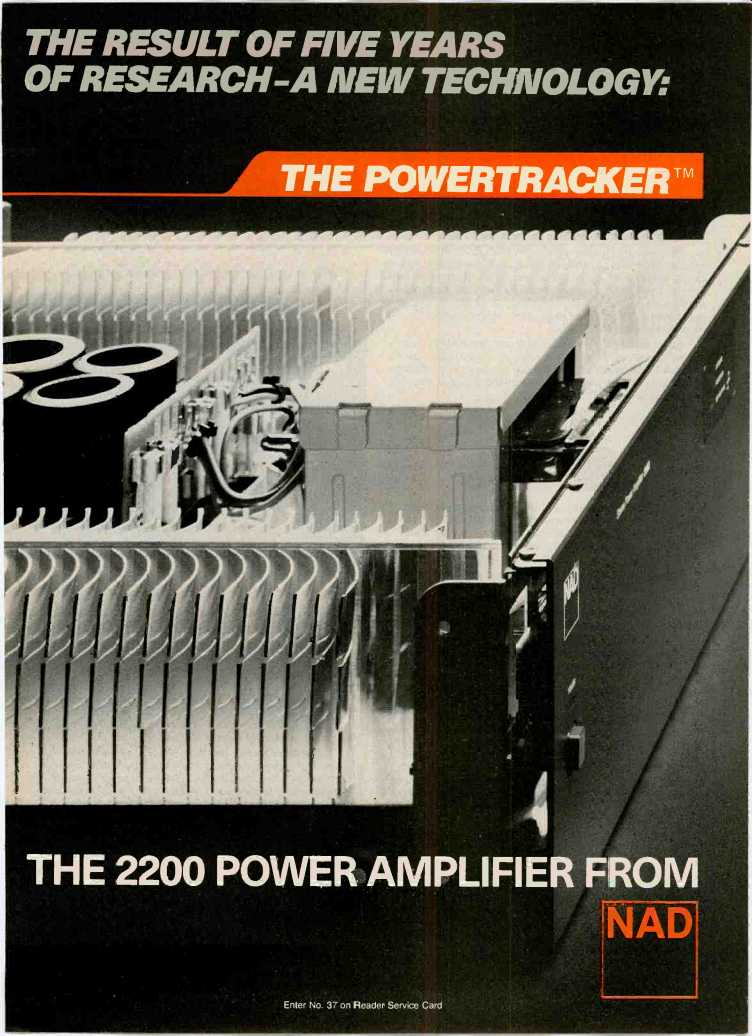
Reproducing musical signals, the NAD 2200 routinely delivers over 500 watts per channel into typical loudspeaker impedances. In actual measurement with speakers of complex impedance and lower-than-average sensitivity, the 2200 produces peak sound pressure levels exceeding 115 dB SPL (Sound pressure Level) in a medium to large room, with no audible or measurable distortion.
But in size, heat dissipation, and cost, the NAD 2200 is similar to many other amplifiers rated at only 100 watts per channel. For audiophiles who can use and appreciate its capability, the 2200 is unquestionably the best-buy power amplifier ever manufactured.
THE KEY: REAL-WORLD DESIGN
Examined from one perspective, the 2200 is a very conservatively rated 100 watts/channel power amplifier that has an extraordinary +6 dB of dynamic headroom, meaning that it can produce more than four times its rated power during musical transients.
Looked at another way, the 2200 is a super-amplifier that produces between 400 and 800 watts per channel for music (depending on speaker impedance), but contains an "intelligent" power supply that gives it the modest size, heat dissipation, and cost of a conventional 100 W/ch amplifier.
The key to the design of the 2200, as with all NAD amplifiers, is that its design goes beyond conventional specifications and laboratory tests to provide optimum performance under the conditions of everyday use. NAD amplifiers are designed, first and foremost, to reproduce the dynamically varying waveforms of music-not just sine-wave test tones. They are designed to deliver undistorted power to loudspeakers of any impedance-not just to an 8-ohm test resistor. NAD's engineers have always recognized the importance of supplying high levels of output current to drive the low and complex impedances of real loudspeakers. NAD premiered the use of Soft Clipping'" in solid-state amplifiers to prevent harsh distortion when the demands of the musical signal exceed the amplifier's limit. All NAD amplifiers feature high dynamic headroom for the transient sounds in music.
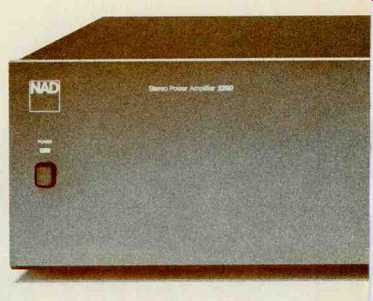
The NAD 2200 is a truly "dynamic" power amplifier. Its heart is the unique PowerTracker- control circuit (patent pending), which automatically adjusts the amplifier's maximum power output according to the dynamic character of the signal that is being amplified. As befits a product designed for the reproduction of music, the NAD 2200 achieves its maximum power output of 400 to 800 watts per channel when amplifying wide-range musical signals that contain peaks 10 to 20 dB above the average level. But when the amplifier is fed a high and constant signal (i.e. a sine-wave test tone instead of a musical waveform), its maximum output automatically declines to avoid overheating, and eventually levels out between 100 and 200 watts per channel.

The 2200 virtually re-defines the concept of dynamic head room. Its high power reserves are available, not only for the short 20-millisecond bursts used in the standard IHF dynamic headroom test, but also for musical surges and climaxes lasting ten times longer. Even with compressed recordings of rock music in which the peaks may be only 8 dB higher than the average power, that may be enough variation to allow the 2200 to operate at high efficiency and maintain a clipping level above 500 watts per channel into the 4-ohm impedance that is typical of real speakers.
SPECIAL FEATURES:
The appeal of the NAD 2200 may be based mainly on its combination of high dynamic power and low cost, but there are other noteworthy aspects of its design, too.
Transparent sound. The audio circuitry of the 2200 is based on the same principles that gained worldwide praise for other NAD amplifiers. In the 2200 the circuitry is scaled up substantially in speed and power, using the finest selected parts available today-individually tested filter capacitors and ultra high-speed transistors for wide bandwidth and extremely low distortion. The output stage is a fully complementary parallel circuit using high-gain 25MHz transistors with over 10 times the "safe operating area" of transistors used in typical 100 watts/channel designs.
High-voltage, high-current design. Current flowing through the voice-coil is what causes a speaker to produce sound, and NAD was the first manufacturer to emphasize the importance of high output current capacity-unrestricted by so-called protection circuits-to cope with the complex, reactive impedance that many speakers present. The NAD 2200 can produce peak output currents exceeding ±50 Amperes on demand, together with peak output voltages of ±95 volts to handle the most dynamic signals.
--Continuous sine-wave output conservatively rated at 100 watts per channel.
--Produces 400 to 800 watts per channel of dynamic power for music (depending on Impedance).
Generates peak sound pressure levels above 115 dB with most speakers.
--Bridging circuit yields 400 watts continuous sine-wave output, over 1200 watts dynamic power for music.
--High-current output stage delivers peak currents up to 50 Amperes for precise control of voice-coil motion.
--Similar in size, weight, and cost to conventional 100-watt amplifiers.
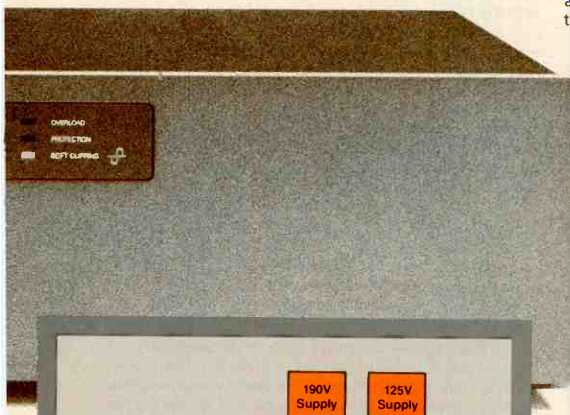
--------The dashed line in this simplified PowerTracker diagram shows the flow of current from the power supplies to the loudspeaker. At normal signal levels the 125-volt supply provides all current. When the audio signal rises above the 140-watt level a controller turns the "gate" transistor on, lowering its resistance nearly to zero so that maximum current can flow from the 190V supply. If the demand for current remains high, a second controller gradually shuts off the flow from the 190V supply to prevent overheating.
Inverted channels for powerful bass. The greatest power demands commonly occur at low frequencies. Bass signals are in-phase (and virtually monophonic) in most recordings; thus when the bass waveform is strongly positive in the left channel, it usually is strongly positive in the right channel at the same time. As a result both channels draw current simultaneously from the positive half of the power supply, while the negative half sits idle. During the negative half of the waveform, both channels draw from the negative supply while the positive supply sits idle.
In the NAD 2200 the right channel is internally inverted in polarity. When a bass waveform causes the left channel to draw current from the positive supply, the right channel draws its bass power from the negative supply, and vice-versa. This efficient usage halves the instantaneous drain on either supply, allowing much stronger bass to be reproduced without draining the supply.
Bridging. The NAD 2200 is so powerful in the normal stereo mode that few listeners will ever need more. For special situations the two channels of the 2200 can be bridged to form a mono amp of truly immense power. Its rated continuous sine-wave output is 400 watts, while its dynamic power output exceeds 1200 watts into 8 ohms and 1600 watts into 4 ohms.
Two 2200s in bridged mode (delivering over 3 kilowatts into a pair of 4-ohm speakers) would cost about the same as an ordinary 400-watt amplifier.
Quiet circuitry. The delicacy and purity of low-level musical information is as important for realism as the power to handle climaxes. The signal-to-noise ratio of the 2200 (relative to its rated 100 W/ch output level) is greater than 111 dB.
No fan noise. In most power amps that are capable of the same 500 W/ch output on musical signals as the 2200, a noisy fan must be used to dissipate excess heat from the circuitry.
The efficient 2200 is totally, blissfully silent in operation.
Close-tracking Soft Clipping: The newly improved Soft Clipping-circuit in the 2200 accurately tracks the available peak power, regardless of speaker impedance. Older Soft Clipping circuits tended to reduce the available dynamic power by 1.5 to 2 dB in order to ensure that continuous output would always be free from harsh distortion (even when the amplifier was over driven). With the new PowerTracker-circuit, this limitation no longer applies. Now the amplifier's sound remains subjectively clean and transparent right up to the maximum output level. It continues to sound good even at levels 2 to 3 dB above the amplifier's rated maximum output, since the Soft Clipping circuit gently rounds off the waveform corners and prevents any distortion due to power-supply modulation as well as reducing high order harmonics which may damage tweeters.
"Audible Clipping" Indicator. To enable the user to make the fullest use of the dynamic power of the 2200, a front-panel "Overload" LED indicator illuminates whenever the amplifier is driven into clipping (or exhibits any other distortion) for a long enough time to be audible. Its calibration is based on psycho acoustic studies showing that the audibility of clipping depends not only on the severity of the resulting distortion but also on its duration. (If an intense but brief transient overloads the amplifier for less than a thousandth of a second, you can't hear it.) The indicator works by comparing the output signal with the input, instant by instant. Ideally the amplifier's output signal should be an exact replica of its input, scaled up by a factor of 40 in voltage. The comparator circuit di vides the output signal by 40, subtracts it from the input signal, and flashes the LED if there is any potentially audible deviation from perfect linearity.
NAD
---MAXIMUM POWER OUTPUT OF THE 2200 INTO A 4-OHM LOAD---Dynamic power is available for musical transients lasting much longer than the 0.02 second IHF dynamic headroom test.
-----Bass signals are inverted within the right channel, for more efficient use of power-supply capacity, but are in-phase at the speakers.
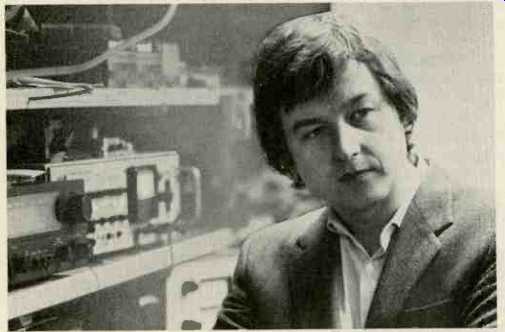
Bjorn-Erik Edvardsen, Director of Research, and principal designer of the Model 2200. Mr. Edvardsen holds 3 patents in the field of amplifier design and has worked for several years on perfecting the concept behind the 2200's unique circuitry.
HOW THE POWERTRACKER WORKS:
The NAD 2200 is a "commutating" power amplifier. i.e., it has two power supplies, switching to the high-voltage supply when maximum power is needed, and switching to the lower-voltage supply for cooler operation at average power levels. (The switch is called a commutator; hence the name for this type of amplifier.) By itself, the basic idea is not new. What makes the NAD 2200 unique is how dramatically it overcomes the two problems that other commutating amplifiers suffer from: (1) poor efficiency, resulting in high heat dissipation in the power supply and consequently high cost; and (2) switching transients, which can become a form of audible distortion.
Basically, any power amplifier consists of two parts: a power supply and an audio circuit. The audio circuit functions as a valve, opening and closing to feed current from the power supply to the loudspeaker in accordance with the demands of the audio signal.
In the case of the 2200, the audio circuit is a fully complementary DC-coupled class A/B circuit designed for 500-watt output, operating in class A for distortion-less sound at low levels and moving into class B for clean, efficient operation at higher levels. It has a fast, high-capacity output stage equipped for the high peak currents (> ± 50 Amperes) and the large peak-to-peak voltage swing (190 volts) that are appropriate to a well designed 500-watt amplifier.
The high-voltage power supply in the 2200 provides the 190-volt swing needed for full-power operation, but it is deliberately designed to be self-limiting, able to supply high current for only a brief period. The lower-voltage supply provides a 125-volt swing and has ample capacity to run the amplifier comfortably at 150-watt levels all day long.
If the amplifier were built for a continuous 500-watt output, it would require an enormous power transformer, special-order high-current filter capacitors, plus an elaborate system of heat sink fins and ventilating fan to dissipate the resulting waste heat. The manufacturing cost of the amplifier would be doubled or tripled, for no purpose. Music rarely requires an average power much greater than about 50 watts (even for very high volume levels), and very few loudspeakers can absorb a continuous output of 500 watts for more than a few seconds. Music is dynamic, requiring high power only in bursts.
The NAD 2200 PowerTracker circuit is designed to reproduce music. Its high-voltage power supply contains a solid-state memory device that stores information on the recent history of the amplifier's output current and consequent heat dissipation. If the output has been fluctuating up and down (i.e. playing music), then the average current is modest, and the high-voltage supply continues to operate at full capacity, ready to supply high power when needed. But if the average goes up, reflecting a constant output of several hundred watts for more than a few seconds, then the high-voltage supply gradually shuts itself down, forcing the amplifier to derive its power mainly from the lower-voltage supply.
Thus while the NAD 2200 functions as a 500-watt amplifier with musical signals, it cannot be made to overheat. And when fed continuous sine-wave test tones it becomes, in effect, a 150-watt amp. Its operation is so efficient that the size, heat dissipation, and manufacturing cost of the 2200 are nearly the same as an ordinary 100 to 150 watt amplifier.
If commutator switching occurs at low power levels, the switching transients can become a form of audible distortion. This doesn't happen in the NAD 2200, for two reasons.
(1) The changeover to the high-voltage supply occurs only at rather high power levels (around 140 watts). Relative to this level, even an ordinary switching transient would represent an inaudibly small percentage of distortion. In most music there is no switching at all; the high-voltage supply is used only during those brief transients and climaxes that demand the top 6 dB of the amplifier's dynamic range, when peak sound levels typically exceed 110 dB (6 ohm speaker, 88 dB sensitivity).
(2) The 2200 does not abruptly switch from one supply to the other. The output stage is permanently connected to the lower-voltage supply. The commutator is simply an electronic gate that opens when needed to allow current to flow from the high-voltage supply-quickly enough to supply the power needed for sudden full-power transients, but smoothly enough to guarantee that no switching transients are ever detectable in the output signal.
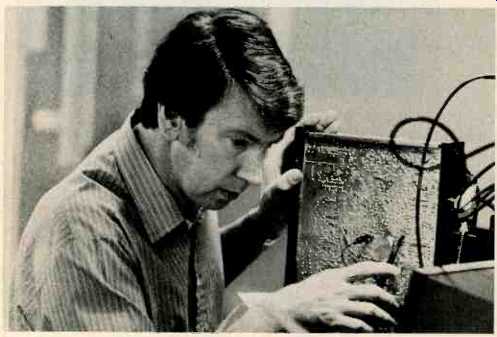
-----Chief Engineer Peter Bath analyzing signal path at NAD Electronics' research lab in London.
NAD is the world's leading manufacturer of affordable high-quality stereo equipment. Since 1978, NAD stereo components have won universal praise for their sophisticated engineering, excellent sound, ease of use and superior price performance value. NAD products are sold by a carefully selected network of dealers in twenty-nine countries around the world. If you haven't seen the name be fore, it is because NAD invests most of its money in engineering rather than advertising-relying on enthusiastic word-of-mouth publicity and an unbroken string of rave reviews in magazines to spread the news of the superiority of NAD's designs. In keeping with its dedication to high value engineering and innovative product design, NAD is proud to introduce the Model 2200 Power Amplifier.
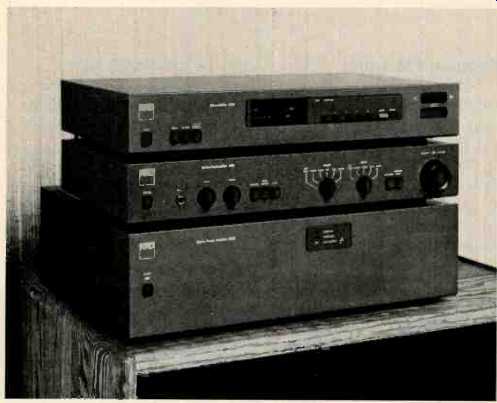
NAD manufactures an entire line of home electronics, including stereo and video components, loudspeakers and accessories. Above, the 2200 is featured with the 1155 Preamplifier and 4155 Tuner.
----------------
BEYOND CONVENTIONAL AMPLIFICATION ONKYO'S NEW REAL PHASE TECHNOLOGY
Today's speakers, with their multiple driver construction and complex crossovers, differ electrically from the simple resistive load used by arrplifi3r designers to simulate the loudspeaker load. The actual load that is "seen" by the amplifier causes severe phase shift between the voltage and current sent to the speakers. This causes an audible loss of sonic clarity and dynamics.
Onkyo's Real Phase Technology uses not one, but two power transformers to correct this problem. A large high capacity primary transformer together with a special In-Phase secondary transformer prevents this phase shift, providing increased power output into the loudspeaker load as the-music demands it. The result is clean, dramatic dynamics; musical peaks are reproduced with stunning clarity.
Now, the dynamic range of the music can be fully realized.
On the 'allowing pages, you'll find a complete explanation of the Real-Phase story.
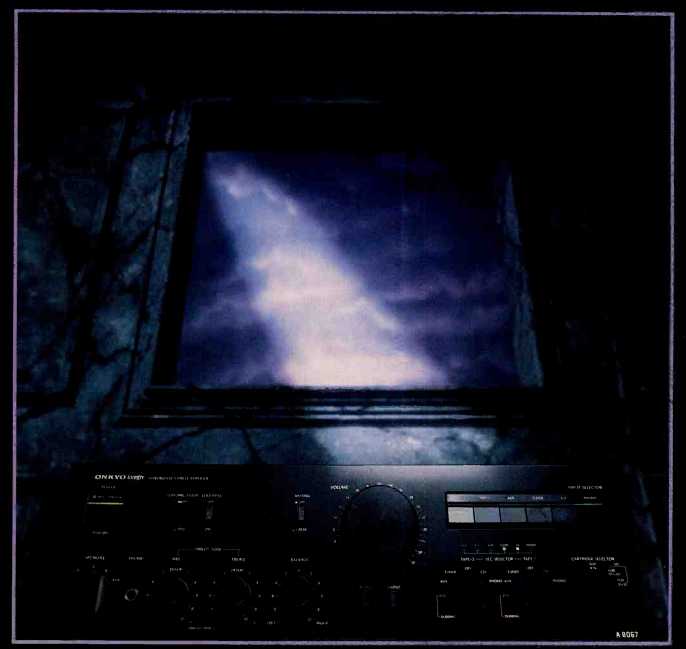
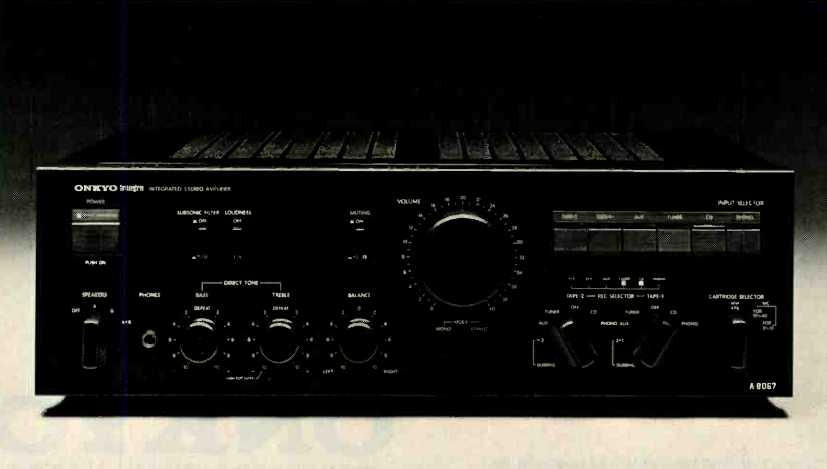
Shown in our new A-8067 Integra amplifier, with Real Phase Technology and our exclusive Dual Recording Selector.
Artistry in Sound
200 Williams Drive, Ramsey, N 1.07446
The ONKYO "Real Phase" Amplifier Story Overview
------------ Impedance Characteristics for IHF Reactive Speaker
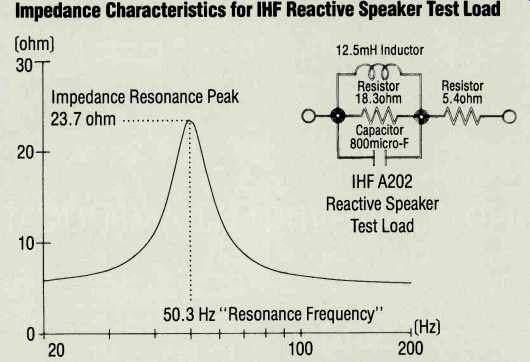
In conventional amplifiers, the power supply and amplifier stage have been designed with a simple resistive load of fixed impedance, quite unlike the reactive load actually provided by high fidelity loudspeakers.
Recently, some amplifiers have been designed to operate into a wider range of load impedances, as the actual impedance of a loudspeaker varies with frequency. However, the power supply design of these amplifiers still treats the loudspeaker load in a simple resistive fashion.
The IHF A-202 reactive loudspeaker load model, shown in Fig. 1, consists of a circuit configuration designed to simulate the reactive load normally found in today's loudspeakers. The graph in Fig. 1 shows the impedance variation with frequency caused the IHF A-202 reactive loudspeaker load, with an impedance peak of 23.7 ohms at 50.3 Hz.
-------Figure 2 "Conventional Power Supply Design"
-------Fig. 3 Degree of Current Phase Shift to Voltage vs. Frequency (Degree)
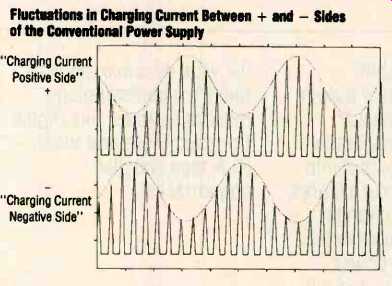
-------Fig. 4 Fluctuations in Charging Current Between of the Conventional Power Supply and Sides
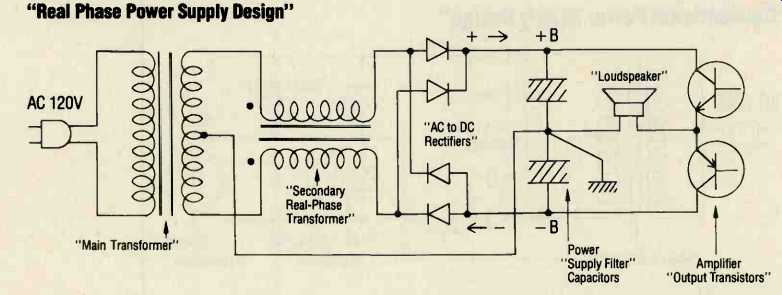
------Fig. 5-------"Real Phase Power Supply Design"
Conventional Power Supply Design
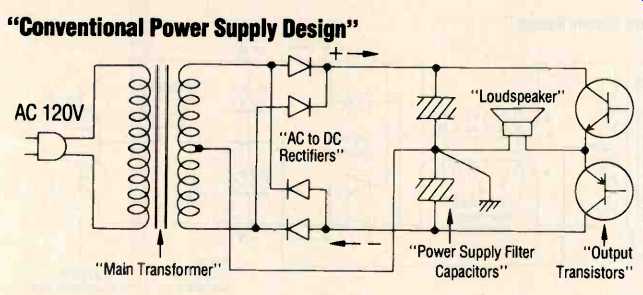
Fig. 2 shows a conventional power supply design. The 120 Volt AC home supply is reduced by the main transformer to a lower level. The AC to DC rectifiers convert the AC pulses to DC pulses, and the filter supply storage capacitors smooth the ripples into a steady DC supply. This DC source feeds the amplifier's output stage with the energy required to drive the speaker load.
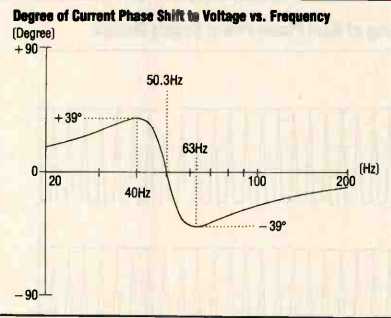
Unfortunately, if the speaker load connected to the amplifier output stage is reactive in nature, and not a simple resistive impedance, a phase shift between the amplifier output voltage and the loudspeaker drive current will occur. Fig. 3 shows the amount of phase shift between the amplifier output voltage and the loudspeaker drive current caused by tie reactive loudspeaker load model.
Fig. 4 shows the fluctuations between the charging current values at the positive and negative sides of the conventional power supply. The peaks and troughs of the + " and "- " sides are 180 degrees out of phase with each other. This charging current fluctuation prevents the power supply from delivering a steady DC source to the amplifier output stage and loudspeaker load.
Onkyo Real Phase Power Supply Design
Fig. 5 shows the Onkyo Real Phase solution. A second power transformer, called the "In-Phase Transformer" is connected between the "+" and "-" sides of the main transformer's outputs. Any potential between the "+" and "-" charging current is cancelled out by the In-Phase transformer, and a rock-steady DC supply current is supplied to the amplifier output stage, regardless of the actual loudspeaker load. Fig. 6 shows the constant, non-fluctuating charging current of the Onkyo Real Phase power supply.
The Real Phase power supply design ensures that the amplifier's output stage has a continuous DC supply, free of the fluctuations caused by phase shift between the amplifier output voltage and loudspeaker drive current. Considerably increased power output into any loudspeaker load assures maximum dynamic range and impact. Transient details are not blurred by power supply fluctuations, and full power reserve is provided for the wide dynamic range of today's high technology musical sources, like Digital Compact Discs and Video Hi-Fi tape and disc soundtracks.
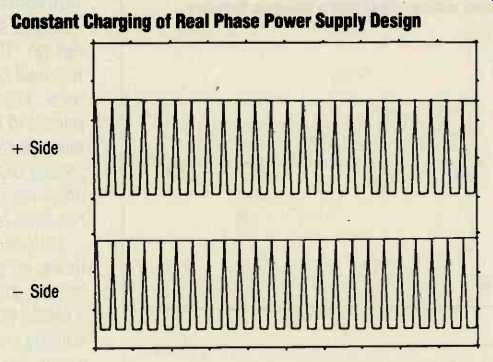
-----Figure 6--Constant Charging of Real Phase Power Supply Design
The Onkyo Real Phase M-510 Power Amplifier is the first amplifier to incorporate this unique technology, with other Real Phase Onkyo components soon to follow.
The Onkyo M-510 represents the state of the art for solid-state amplification, conservatively rated at 300 Watts per channel, minimum RMS at 8 ohms, both channels driven from 20 Hz to 20 kHz, with no more than 0.005% THD. However, this specification is derived with a simple resistive load, using sine wave signals of fixed intensity.
The IHF Dynamic power test, using low and high level signals, more closely simulates the actual performance obtainable with actual loudspeaker loads and music signals, and the Onkyo Real Phase design contributes to the exemplary performance:
The Onkyo Real Phase Amplifier Technology will soon be available in two new integrated amplifiers, the A-8057 and A-8067. Rated at 65 and 80 watts per channel respectively, these models feature the ability to drive difficult loudspeaker loads with ease; both models feature substantially increased power output into loads as low as 2 ohms.
Onkyo Industry Innovations 1975 Affordable Quartz Digitally Synthesized Tuning 1976 Quartz & Servo Locked Tuning 1977 Straight Low Mass Tonearms 1978 Auto Accubias 1979 Super Servo & Linear Switching 1980 First Cassette/Receivers 1981 High Speed Dubbing Cassette Decks, Real Time Counters 1982 Receivers with CX Decoders 1983 Delta Power Supply, Digital Ready Amplifiers, Automatic Precision Reception, Triple Stage Isolation Systems 1984 First Compact Disc Player with FOUR Power Supplies, First Cassette Deck with all Noise Reduction Systems; Dolby B-C NR HX Pro, dbx, First Receiver with dbx and Dynamic Bass Expander, First Dual Auto Reverse Dubbing Cassette Deck 1985
Real Phase Technology
Dual Recording Selector
Polysorb Acoustic Vibration Absorbing Compound for Turntables & CD Players
First Affordable Audio/Video Remote Control Receiver
Artistry in Sound ONKYO. 200 Williams Drive, Ramsey, N.J. 07446
(adapted from Audio magazine, 1985; EDWARD TATNALL CANBY)
= = = =