
With all these anniversaries sailing past, the 200th, the 100th, our own 30th
and 60th, I'm feeling retrospective--which means, with me, looking forward
in the light of the past. Perspective! I have a sense that this is a good time
for all of us to do just that. We are in a sort of interim in spite of all
the excitement generated by new developments, early-digital and otherwise.
We need some new names, I think.
I am not referring to sales efforts. Nor to new models. The biggest sales tend to be rung up, like on Wall Street, when there is an era of profit taking. It is the fully matured and developed product that sells, not the Latest Revolution though we're always talking about revolution. A few revolutions catch on quick but most don't.
More often, the latest sensation, if it has any solid worth, soon finds itself falling flat on its face, snarled into every imaginable kind of unforeseen trouble and hassle, and doesn't pull itself out and into the clear for an agonizingly long time.
You know what I mean! Like with stereo. Not stereo now. Back when stereo was the revolution Or the LP disc, which had its problems and before it was a year old ran smack into the 45 and the all-too-familiar wars of the rival systems.
But now conventional stereo is the fully matured product, as well as the LP disc. A matchless pair! Next year, the stereo disc has its 20th anniversary and the LP its 30th. Wow! Old geezers like us can scarcely believe it.
Silly Revolutions Succeed
Only the silly revolutions succeed right away. Instant miracles. Frisbies, hula hoops, bubble gum, the Great T-Shirt Explosion. And, of course, George.
Now don't run down George. In terms of purpose and utility, George has to be the most frivolous (and expensive) gadget in recent memory, but George is indeed a miracle, the very embodiment in a van -like shape of current technological know-how.
And George works by audio. Totally minus complications like, say, decoders, demodulators, Shibata styli and four speakers in the living room.
George just is, and does. What more do you want for sales? What we need in the hi fi biz is James, which I'm inventing. James is the pint-sized electronic robot who turns on your hi fi when you smile.
And turns it off the instant you frown.
So your system becomes subliminal and is subconsciously automated. You need merely think, positively, and it goes on. Howzat? James isn't quite yet perfected but I'm working on the digital circuitry and the smile/frown chip. Any day now and I expect to make millions.
Meanwhile, that slightly larger Sensation with the name that begins with a Q has done it. Predictably fallen flat on its face. What else? As I say, it never fails. As usual, this once-Latest Revolution turned out to be a bit more complex and profound than previously thought, and took a wee bit longer to fall on its fizz than most. That's where it is now, and the ardent people who once promoted it are pretending it isn't there any more, nor ever was. OK par for the course! So now in all the stores there are stereo records and stereo records, the former two-channel, old tried-and-true, the latter, shall I say, discreetly four. Look for the fine print on the back side.
All in all, this isn't a bad idea. I am not about to deplore the present situation, as you may have thought. Indeed, I think that in a way this is a healthy reaction after eight -odd years of over promotion, ill-digested technology and the sort of war between systems that merely bores most of us, to the tune of million $ wasted. I am-as one of the proponents of the new idea right from the beginning--not backing down, just revaluating as we all must. Because from here on out we must take a new tack altogether and maybe our very first move should be to get rid of that word itself, which begins with a Q and goes on to an i, an a or an o, depending. (Look--we couldn't even agree how to well it, let alone sell it!) That word was just as misleading, think, as the word we once used for stereo, back at its beginning-binaural. In case you are too young, you should know that two-channel recording, tried before WWII, first broke into our audio news around 1950 but not as stereo. We called it binaural, even though intended for loudspeakers, and the term stuck for a number of years until the more accurate "stereo" took over, just in time for commercialization. In those days I used to refer to "loudspeaker binaural," to make it clear that I wasn't talking about headphones. But it was such a clumsy term that, as I now note, I often left the matter in doubt and can't even tell at this late date whether I meant loudspeakers or phones, just referring to binaural. Stereo was much better.
So, I say, we might as well call Q what it really is, which is indeed a form of loudspeaker stereo.
Stereo--old Greek, meaning solid, or with shape. An excellent description of the sound we hear out of multiple speakers and more than one channel of information. And the useful minimal number of channels, plural, is of course two. Q is stereo out of four sources, set variably around the listener rather than up-front, and from four channels of info. The basic idea remains not only a valuable modification of the original stereo but--in spite of present problems--an increasingly practical concept as multiple circuits become progressively easier and tinier. The important modification, then, is that the number four, as indicated by that obsolete letter Q, is arbitrary. We will have even more varieties of stereo, before we are finished, and in numerous channels too, as Dyna (3), Audio Pulse (6), AR (16) and Entity I (40) continue to remind us.
The Limiting Letter
Indeed, the letter Q is much too limited itself. The most we can squeeze out of it is Quintaphonic, which doesn't even satisfy existing commercializations. So please, down with Q, as well as Q , and let's start talking. We need new names, more accurate names, to clear the air before we go much further. Until we find them, the name of the present game is emphatically STEREO. In two, four, or more channels.
Speaking of that, I must remind again that the basic idea of our standard stereo is not the limitation to two channels but a much more important aspect, stereo up front. It could be out of twenty channels and still be up front. This was the original concept and you have heard of the U.S. debut of this type of sound with the aid of Leopold Stokowski back in the Thirties, when music by a "live" orchestra was transmitted directly from one hall to another via microphones and loudspeakers. Two channels? If I remember, not having the data before me, there are many more than two.
But all of them were reproduced up front.
And yes, you have anticipated me: next (in the U.S.) came the movie "Fantasia," again with Leopold S., and this time we had-what? No, not Q but the more important concept behind Q , which is multiple sound sources (x in number) distributed around the listening space. Will I ever forget, in the original production, the big choral number, Schubert's Ave Maria blown up to enormous size, spread out in enormous stereo, which then proceeded to flop back and forth, oscillating between the front and the back of the theatre! In those days it was an impressive sonic fantasy. I suspect that in recent re-playings, even with speakers in the rear, it has been modified. Nowadays that sort of thing sounds a bit corny.
Anyhow--you see that we had both of the fundamental types of stereo, the up-front kind and the surround or semi-surround kind, way back in the pre-war years. And you also see that the limitation to two channels or four channels did not exist; it was the placement of the available channels that counted.
It is still the same today, and will be as we expand into our destined future in living-room sound.
I must add one minor story, as of a week or so ago. That wealthy lady in my neighborhood who owns an estate in Antigua and another in France, plus a considerable hunk of my Connecticut home town, came up to my place one recent afternoon in her old clothes to give me a book she had found, my mother's writing as of 1932, and stayed on to talk once more about the vast stereo system her husband had installed in Antigua back around 1959-he's dead (leaving his millions) and she wants out. The trouble is, she says, every time she leaves Antigua those big speakers, all three of them, have to be hauled by truck into a special dry room, to avoid rot and mildew. She wanted my recommendation for three little speakers, to replace them.
Get my point? Three speakers, for stereo in 1959. Of course! In that year, with stereo discs just beginning, the whole idea of stereo was untrustworthy, not yet settled down, and people generally didn't like what they called "the hole in the middle," which was clearly-as we now see it-due to faulty procedures in recording, in phasing, even in listening to a new and unfamiliar medium.
So you bought yourself a third and essentially mono speaker as a kind of insurance, to blend the sides into the middle and so fill up the hole. This lady, now in 1977, still wants three speakers, to replace the original trio.
She hadn't heard about four.
I never fell for the center channel idea myself, though for a time it was even built into many amplifiers (and maybe still is), with a third set of output terminals to accommodate the extra speaker. I tried it, and quickly found that all I was doing was in fact diluting the very stereo I was trying to create with all that equipment. If there was an absence of sound in the middle, the answer was elsewhere and, most of all, it was in phasing-which at that time could be reversed in the darndest places. Not only your own pair of speakers (or between woofer and tweeter) but anywhere in dozens of points within the electronic equipment (they hadn't yet gotten used to the idea of phase continuity as between channels, now taken for granted) and even, occasionally in some records. I still have a few marked in grease pencil OUT OF PHASE! Also, to be sure, in terms of ping pong, which exaggerated channel separation in various crude ways, for greater sales impact. I can tell you, no center speaker ever cured a case of ping pong. All it could do was to make the ping-pong table a bit narrower.
Which you could do just as well by sliding your two speakers closer together.
Hard Experience
I will allow the abundant analogies between all this and our recent experiences with Q to fall where they may. So clear! The same has happened all over again but worse, since the surround type of sound was a very much unexplored concept in terms of the living room and few recording people or audio engineers really had much of a positive idea as to what would work out for useful listening.
We blundered, and argued, and we still blunder. It's a long road into pioneer territory, and in no way comfortable for such as record and hi fi dealers, we might add. But we have learned. As we did for up-front stereo. The new stereos to come, whatever their names, will be the better for it. And even the old stereo records, two-way or four-way, will sound better and better as we improve our knowledge of multiple-channel reproduction.
As I've said before, and even if Q as such remains on its flat face for some time to come, we have not dropped the idea of more-than-upfront, nor the idea of more-than-two.
Whether the shape of the sound is triangular, quadraphonicular or multi-polygonous, there will be a lot more of it coming up for the next batch of anniversaries.
(Source: Audio magazine, July 1977; Edward Tatnall Canby)
========
ADs:
Stanton
Write today for further information to Stanton Magnetics Inc., Terminal Drive, Plainview, New York 11803.
Disco goes portable...and portable disco pros make Stanton their first choice!
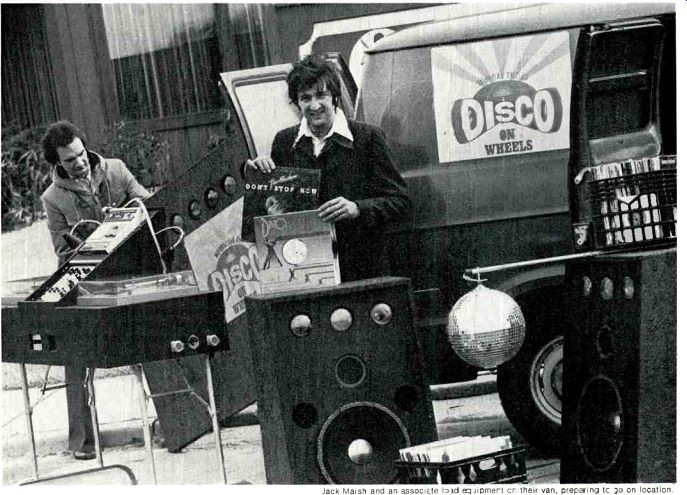
Jack Marsh and an associate load equipment on their van, preparing to go on location.
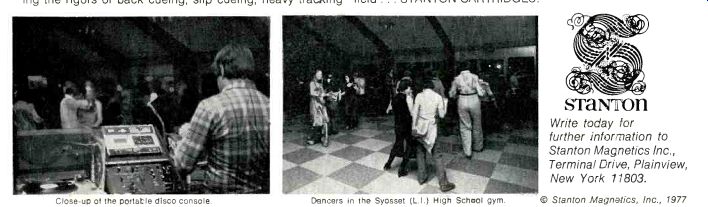
Close-up of the portable disco console.
Dancers in the Syosset (L.I.) High School gym.
If people can't get to Discos, then why not bring Disco to the people? Bring it to their Church Halls ... to their School auditoriums... to a banquet hall in a nearby Motel ... that's just what Murray the K's DISCO ON WHEELS is doing.
At last count, there were numerous franchised Murray the K DISCO ON WHEELS rolling across America, bringing Disco to the people. And, every last one of them has a STANTON CARTRIDGE as part of the system; in this case, the Stanton 500AL, a truly tough performer that is also known as the "work horse" of the broadcast industry. The Stanton 500AL does a fine job of playback while withstanding the rigors of back cueing, slip cueing, heavy tracking forces, vibration and potential mishandling
This cartridge can take it under circumstances where a damaged stylus means even more than lost music... it means lost business.
For those Disco Operators who prefer a more sophisticated sound quality, Stanton has created the 680EL, the top quality performer for both Disco or Radio broadcasting.
So, Stanton, world famous for its top-of-the-line cartridge, the Calibrated 681 Triple-E, also serves the professionals in an interesting new branch of the Disco industry.
Whether your usage involves Recording, Broadcasting, Archives, Disco, or home entertainment, your choice should be the overwhelming choice of the professionals in every field ... STANTON CARTRIDGES!
=========
TDK
Our new AD cassette takes the normal bias extremes.
We made a name for ourselves by creating the world's first non-chrome, "high" (CRO2) bias/EQ cassette tape, TDK Super Avilyn (SA). The state-of-the-art tape that has quickly become the standard of reference for cassette tape performance.
Our latest innovation is called AD (ay- dee), and we predict it will soon become the standard of performance and economy in the "normal" bias/EQ position.
We produced the first high fidelity ferric oxide cassette tape some ten years ago, and we've been perfecting the formulation ever since. Our new AD delivers superior performance, especially at the critical high-frequency range (7kHz to 20kHz), where many mid-priced cassette decks and even premium priced cassettes tend to fall off too quickly.
AD is our ultimate ferric oxide tape designed for the "normal" bias/EQ position. Overall, it provides the lowest noise, highest frequency response and widest dynamic range of any pure ferric oxide cassette tape. In 45, 60, 90 and 120 minute lengths, AD has the same super-precision cassette mechanism found in TDK SA, in a new blue-gray shell.
And AD brings its audible benefits to all cassette decks, with and without switch able bias/EQ, including those found in cars, portables and home stereo systems.
So the music you love can travel with you, with all of the clear, crisp, brilliant sounds that make music so enjoyable.
AD is the finest pure ferric oxide cassette tape you can buy at any price.
And it has TDK's full life time warranty.
Give our new high-fidelity, moderately priced AD a try-it's anything but normal.
TDK Electronics Corp., 755 Eastgate Boulevard, Garden City, New York 11530. In Canada: Superior Electronics Industries, Ltd.
TDK--The machine for your machine.
============
SME
3009+FD200

The FD200 is a new accessory from SME : a fluid damping device which can be fitted, easily and quickly, to any Series II or Series II Improved arm. The benefits of fluid damping have long been known : resistance to external shock, audibly improved bass, and reduction of spurious low frequencies; but these are not fully realised when the damping is applied at the bearings. For this reason the FD200 is designed to be fitted at a point along the length of the arm.
The FD200 design overcomes the usual problems of leakage and low efficiency. It offers a choice of two damping rates, to suit a wide range of cartridge compliances.
The attractively presented kit includes viscous fluid and full instructions.
The illustration shows the extreme low frequency response characteristics of a typical high-quality cartridge in the Series If Improved arm.
Note the substantial reduction in the Q of the low frequency resonance. Although these frequencies are themselves outside the range of human hearing they give rise to undesirable side-effects which are audible.
Write to Dept 1443A, SM E Limited Steyning, Sussex, BN43GY, England Exclusive distributors for the U.S: Shure Brothers Incorporated 222 Hartrey Avenue Evanston, Illinois 60204 and in Canada: A. C. Simmonds and Sons Ltd 975 Dillingham Road Pickering, Ontario, L1 W 3B2 271
==========
Advent Corporation, 195 Albany Street, Cambridge, Massachusetts 02139.
There Are Bigger, Chromier, Knobbier, More Expensive Cassette Machines Than The Advent 201A. But...
If you are going to buy a high-performance cassette deck, you ought to know that no cassette machine will make more satisfying recordings (and keep on making them for year after year) than the Advent 201A. The Advent 201A is a new version of the machine that made cassettes the high-fidelity medium they are today.
It is a uniquely simple, precise, and durable piece of recording machinery that will make cassette tapes that sound essentially identical to the best material you will find to put on them with an ease (and repeatability) that is approached by very few cassette decks at any price and surpassed by none.
The 201A is designed to be used, not worshipped. Its unique single VU meter (which continuously scans both stereo channels and reads out the louder at any given moment) and its precise recording controls make it the same kind of day-after-day joy to operate as a fine camera.
If you will send us the coupon, we will be happy to send full information on the Advent 201A (including a description of the new features, such as the Sendust tape head, that distinguish it from the original 201) . In the meantime, we suggest that before you buy any tape machine, cassette or open reel, you give the 201A the performance test it deserves.
And check with anyone who owns an Advent on the kind of satisfaction it gives year after year.
Thank you.
============
Tannoy
INTEGRATED SPEAKER SYSTEMS
At first glance, the Tannoy appears to be a loudspeaker.
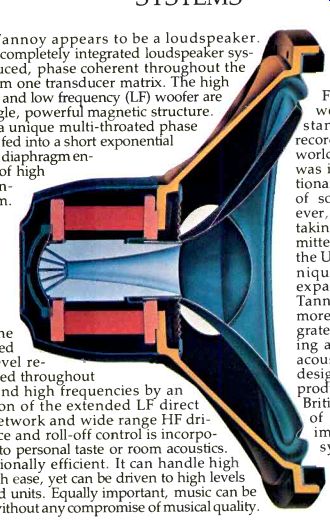
It is more. It is in fact a completely integrated loudspeaker system. Sound is reproduced, phase coherent throughout the entire audio range, from one transducer matrix. The high frequency (HF) tweeter and low frequency (LF) woofer are combined within a single, powerful magnetic structure.
Sound is collected by a unique multi-throated phase compensating unit and fed into a short exponential horn. The curvilinear LF diaphragm ensures wide dispersion of high frequencies and an unbroken audio spectrum.
The LF diaphragm acts as a true piston from the lowest bass up to 1kHz. The tweeter handles frequencies from 1kHz to beyond 20kHz. The crossover network ensures smooth transition between the woofer and horn-loaded tweeter. A superb, level response curve is achieved throughout the low, mid-range and high frequencies by an ingenious combination of the extended LF direct radiator, crossover network and wide range HF driver. A dynamic balance and roll-off control is incorporated for adjustments to personal taste or room acoustics.
The Tannoy is exceptionally efficient. It can handle high powered amplifiers with ease, yet can be driven to high levels by moderately powered units. Equally important, music can be played at low volume without any compromise of musical quality.
A Rolled surround for stability in low bass response
B Unique ribbing virtually eliminates cone break-up ensuring smooth response and extraordinary high power capacity
C High temperature voice coil D Dustproof, acoustically transparent sealing dome
E Concentric HF horn (completed by curved LF cone)
F Phase-compensating multiple throat for extended and smooth HF response
G Acoustic balance cavity for reduced distortion
H Aluminum voice coil conductor for high power capacity and superb HF response
I Exclusive magnetic shunt for increased LF flux
Tannoy has been engaged in continuous research and production of high quality transducers for half a century.
From the outset, its products were adopted as a listening standard by broadcasting and recording companies all over the world. By 1968, the term, "Tannoy" was in the Chambers English Dictionary as synonymous with the art of sound reproduction. However, modest facilities and painstaking standards of production permitted only limited distribution in the United States. Now... new techniques and materials, as well as expanded facilities have made Tannoy systems available to many more listeners. The Tannoy integrated speaker system is the crowning achievement of generations of acoustic consultants, researchers, designers, sound engineers, and produced in the best traditions of British craftsmanship. The hand of the master cabinetmaker is immediately apparent in the system's exquisitely finished enclosure . The Tannoy will provide the maximum quality your electronic equipment is capable of delivering.
122 Dupont Street, Plainview, N.Y. 11803
============
Celestion Loudspeakers
::.a pair of 66's may sound unspectacular, even disappointing.::
This is not the sort of quote that manufacturers usually select from equipment reviews. However, we did it for one reason: to get your attention. That's not an easy task, considering the hundreds of other speaker manufacturers clamoring for your ear and your dollar.
The complete excerpt (from Canadian Stereo Guide)
reads: "To the untrained ear, a pair of 66's may sound unspectacular, even disappointing. There's no thump and sizzle which many equate with good frequency response. No spectacular effects, just the neutral sound of musical instruments playing with nothing added by the speakers. Purity of tone and cleanness of reproduction is particularly noticeable."
The Ditton 66 was in fact developed by Celestion to serve as an authentic monitor speaker, which means that it was designed to neither add nor subtract anything from the original program material. Recording engineers aren't interested in "hi-fi effects"-they want to hear exactly what's on the master disc or tape with minimum sonic contribution by the speaker.
When the British publication, Hi-Fi Answers needed a concert monitor they found the Ditton 66's "...sufficient to cope with the loudest orchestral climaxes available (or even required)... when we wanted to provide concert levels in a large hall, 110 feet x 55 feet with a 25-foot ceiling. A most impressive performance..." Since most listening rooms are somewhat smaller, the shape of the Ditton 66 should be of special interest.
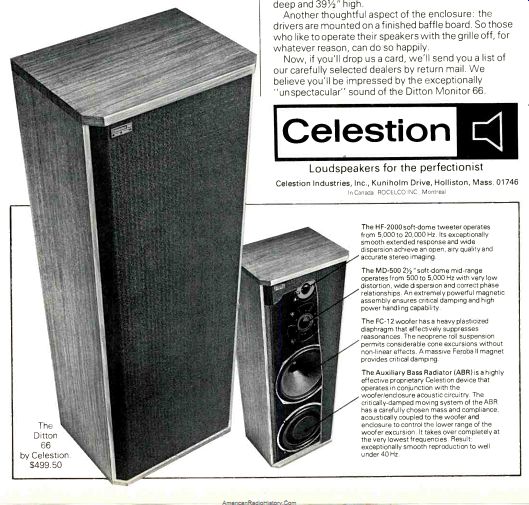
Though its internal volume is three cubic feet, it needs only 1.2 square feet of floor space. It is 15" wide, 11" deep and 39 1/2" high.
Another thoughtful aspect of the enclosure: the drivers are mounted on a finished baffle board. So those who like to operate their speakers with the grille off, for whatever reason, can do so happily.
Now, if you'll drop us a card, we'll send you a list of our carefully selected dealers by return mail. We believe you'll be impressed by the exceptionally "unspectacular" sound of the Ditton Monitor 66.
The HF-2000 soft-dome tweeter operates from 5,000 to 20,000 Hz. Its exceptionally smooth extended response and wide dispersion achieve an open, airy quality and accurate stereo imaging.
The MD-500 2%, "soft-dome mid-range operates from 500 to 5,000 Hz with very low distortion, wide dispersion and correct phase relationships. An extremely powerful magnetic assembly ensures critical damping and high power handling capability.
The FC-12 woofer has a heavy plasticized diaphragm that effectively suppresses resonances. The neoprene roll suspension permits considerable cone excursions without non-linear effects. A massive Feroba II magnet provides critical damping.
The Auxiliary Bass Radiator (ABR) is a highly effective proprietary Celestion device that operates in conjunction with the woofer/enclosure acoustic circuitry. The critically-damped moving system of the ABR has a carefully chosen mass and compliance, acoustically coupled to the woofer and enclosure to control the lower range of the woofer excursion. It takes over completely at the very lowest frequencies. Result: exceptionally smooth reproduction to well under 40 Hz.
The Ditton 66 by Celestion. $499.50
Celestion Loudspeakers for the perfectionist
Celestion Industries, Inc., Kuniholm Drive, Holliston, Mass. 01746
===========
Sansui
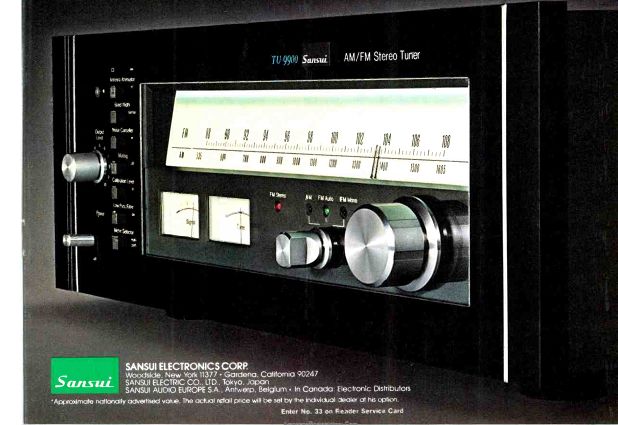
Approximate nationally advertised value, The actual retail price will be set by the individual dealer at his option.
" `Super' FM tuners are usually priced from $1000 up.
Sansui's new model TU-9900 tuner, at (under) $450; matches (their) performance..., at least in the most important respects':
Julian Hirsch, Hirsch/Houck Laboratories These are excerpts from the Julian Hirsch test report on Sansui's new Model TU-9900 as it appeared in Popular Electronics, January 1977.
"The Model TU-9900 ,.. is a-1 ideal mate for the highest quality amplifiers and speaker systems lIt isI esthetically impressive The S/N at 65 dBf (1000µV) was 74 dB in mono and 71.5 dB in stereo while distortion measured an incredible 0.021% and 0.052% respectively. (These figures ... leave no doubt that the tuner has stretched the capabilities of our test equipment to its limits) Image rejection was unmeasurable, exceeding the 100 dB range of our test equipment Stereo channel separation was almost as unbelievable as the distortion figures, exceeding 60 dB from 60 600 Hz ,
... The alternate channel selectivity I narrow model was unmeasurable (greater than 100 dB) and the adjacent-channel selectivity of 17 dB was one of the best we have ever measured on a tuner ... "Clearly, the Sansui Model TU-9900 tuner is a very superior performer .., land I any untoward sounds heard via this tuner originate from the FM station In sum, this separate tuner excels in virtually every area of FM performance It's a top value unit." Visit your nearest Sansui franchised dealer today for a demonstration of the TU-9900 or any of the other models in Sansui's impressive line of amplifiers and matched tuners, the AU/TU series, A whole new world of beautiful music.
SANSUI ELECTRONICS CORP. Woodside. New York 11377 Gardena, California 90247 SANSUI ELECTRIC CO., LTD.. Tokyo, Japan SANSUI AUDIO EUROPE S.A.. Antwerp, Belgium In Canada. Electronic Distributors
===============
Reintroducing A World Standard...
CBS Laboratories' STR Professional Test Records

For over ten years, the original series of these high-precision test records set a standard for the audio industry. Now the new series sets an even higher standard. It's been revised, recut and expanded.
The new series consists of eight records for professionals and one for non-professional audiophiles.
Each record contains a complete series of easy-to-use tests to help you rapidly and accurately evaluate components and systems. Even one of these records can eliminate the need for costly, additional equipment.
Each will find productive use and save you hours in the laboratory, on the production line and in field testing.
Take a look at what this essential testing series contains:
SEVEN STEPS TO BETTER LISTENING-For only $6.98, you can improve your system with CBS Laboratories' "Seven Steps to Better Listening." This high-precision test record enables you to make sure that your equipment functions properly ... to tune your system to your ears and your room acoustics. Included is a detailed 16-page booklet by Audio's Edward Tatnall Canby explaining how to use the record to improve the performance of your system. With the record you can perform the following "ears alone" tests: left-right identification, phasing, loudspeaker balance, tone control setting, alternate phasing, buzz and rattle elimination, lateral tracking, and vertical tracking.
*STEREOPHONIC FREQUENCY TEST RECORD STR 100
Designed for the evaluation of pickups and systems. Provides a constant amplitude characteristic below 500 Hz and a constant velocity characteristic above 500 Hz. Tests include: Sweep Frequency-with the sweep rate synchronized for use with a graphic level recorder; Spot Frequency-with voice announcements; Channel Separation; Wavelength Loss and Stylus Wear-to pinpoint oversize or worn-out styli, and excessive pickup tracking force; Compliance; Phasing; Vertical and Lateral Tracking: Tone Arm Resonance-to check system performance at low and sub-audible frequencies and thus reveal undamped resonance which may cause equipment overloading.
*SQUARE WAVE, TRACKING AND INTERMODULATION TEST RECORD STR 112 Enables detailed study of tracking capabilities of stereophonic phonograph pickups. The square wave modulation allows a rapid appraisal of stylus-tip mass, damping, and tracking. Low frequency compliance and tracking are determined by means of 300-Hz bands of progressively increasing amplitude. Intermodulation distortion measurements are made possible by graduated 200-Hz intermodulation test bands. The Str 112 has been cut with vertical angle approximating 15°, which is representative of current recording practice.
BROADCAST TEST RECORD STR 151
Developed especially to meet the needs of broadcast engineers, audiophiles, and other professionals seeking a convenient signal source for the testing and adjustment of all audio equipment. Tests Include: phonograph pickup response and separation, speed accurccy at 33 1/3 and 45 rpm, wow and flutter, rumble and hum detection, ballistic test of V.U. meters and many others."
RIAA FREQUENCY RESPONSE TEST RECORD STR 130
Provides RIAA frequency characteristics for the calibration of professional recording equipment and for testing the response of professional and consumer record reproduction equipment. This record is suitable for use with a graphic level recorder to provide permanent, visible records for precise evaluation. Spot frequency bands for use without automatic equipment are included.
318 MICROSECOND FREQUENCY RESPONSE TEST RECORD STR 170
Provides pickup designers and recording studios with a high-level, easily-equalized signal for frequency response and channel separation measurements. The STR 170 employs a 318 microsecond characteristic corresponding to the "test" or "flat" mode common to most disc recording equipment. Constant amplitude recording Is employed in the region below 500 Hz with constant velocity recording in the region above. The transition is smooth, in contrast with the STR 100 which employs a sharp breakpoint at 500 Hz. The record is suitable for use with a graphic level recorder to provide permanent, visible records for precise evaluation.
WIDE RANGE PICKUP RESPONSE TEST RECORD STR 120
Makes possible the measurement of pickup response at frequencies far beyond the audible range, where elusive distortion elements can cause audible distortion. The low-frequency range includes glide-tones at twice normal level for the detection and elimination of arm resonance, loudspeaker cone and cabinet rattles. Other tests include: silent grooves for measuring rumble and surface noise characteristics; and standard level bands at O dB for overall system S/N measurements. This record is suitable for use with a graphic level recorder to provide permanent, visible records for precise evaluation.
QUADRAPHONIC TEST RECORD SOT 1100
Designed for calibration verification, and adjustment of SO decoding equipment. The record provides test bands for pickup measurements, for adjustment of decoder electronics and for channel identification and balance. Each band is described in terms of recorded characteristics and its intended use.
*RIAA PINK NOISE ACOUSTICAL TEST RECORD STR 140 Designed for acoustical testing of systems and loudspeakers and for psychoacoustic tests on reproduction equipment. With the STR 140 it becomes possible to test loudspeakers in the room in which they will be used. Spot frequency tones with voice announcements facilitate the testing procedure.
Continuous glide-tones in 1/3-octave bands cover the frequency range from 30 to 15,000 Hz and are synchronized with a graphic level recorder.
The original series has been unavailable for many years. Quantities of the new and improved series are also limited. So make sure you have perfect copies on hand for years to come by ordering duplicates. Fill out and mail the coupon now for immediate action. so is a Trademark of CBS Inc.
================
Shure
Revolutionary!
Sound-shaping taping mike.
Never before-a single microphone that gives you the versatility of 6 microphones! Four tiny frequency filter switches built into the new Shure 516EQ E-Qualidyne Microphone let you tailor sound for studio effects in virtually array recording situation: flick a switch to add sizzle to vocals ... flick another switch to highlight the sound of a bass drum. You can even compensate for the acoustic response of a room right from the microphone! In all, the 516EQ creates 16 different response variations that can add a new, professional sound to every tape you make. Available singly or in pairs for stereo recording. Ask to hear a recorded demonstration at your participating Shure dealer.
Shure Brothers Inc. 222 Hartrey Ave., Evanston, IL 60204
Manufacturers of high fidelity components, microphones, sound systems and related circuitry.
========
= = = =