
I am hopeful this will make our July issue. I am late. July! Often I used to miss that month, and almost missed this. In times past, it saw our very thin nest product, what with manufacturers on vacation and the public in no mood to listen to hi fi. Nor, it would seem, to buy fi. Result: Our July mag had an uncanny tendency to blow away with the slightest breeze. I was seldom blown away because I often wasn't there. Not heavy enough.
No longer. And it is not our un doubted success in a busy field that has wrought the change, laudable as the thought may be. I suspect the transistor and, equally, the printed circuit and its successor the IC. They enormously widened hi-fi applications and usefulness, especially in summer.
Then came the big industry trade events such as the "summer" (i.e. spring) C.E.S., which sets an urgent early stage for the fi of the coming autumn season. Those big shows are not accessible to the public, so do you think all that stuff can wait? You begin to hear about it in July and continue right on through August and September and October . . . and then it's "winter" C.E.S. time.
So I hereby put aside my July lethargy in a hurry, if only to tell you that I have now discovered an important offshoot to a law that vitally affects every facet of our industry, Murphy's Law. This one is called Murphy's Sub set and states that if you correct an error in print you will make two more.
Murphy's Subset neatly tripped me in our May issue, where--of course-- I was correcting in print an earlier misstatement concerning the infinitely low S/N in the new digital recording systems. It exists, the residual or added noise, and I quoted my informant, reader Brian Berkeley, to point out that it is specifically determined by a digital formula having to do with significant bits.
Eheu, dolor! Murphy got hold of perhaps the most important single word in the Berkeley quotation, aided by myself, and the result was strictly according to the Subset. "Least" be came "last." In print it sounded plausible and to me the same, though quite meaningless as it turned out. The "last" significant bit.
Now I know better and thanks again to B.B. Go away, Murphy, while I explain. The admittedly very low S/N in digital recording is determined by the LSB of the particular coding system in use. Look out, now, let's not go wrong again. That's LSB, which is to say, the LEAST Significant Bit. LEAST, Mr. Murphy--get it? There is also an MSB, a Most Significant Bit, or sign.
But at least we may safely ignore that one. For the most part, anyhow. It's all a matter of getting used to the digital lingo.
I will be curious (see May) to find out how many of you will have caught this one and reported same to us. Too early at this writing.
While I am at it, I should report that in respect to June's "Audio ETC" and after a number of months of digital de lay combined with decode/enhance in my living room, the six-way system I described is a continuing success and on the way to permanence. Regularly now, for my own listening pleasure, I continue to check out each recording first of all with the delay unit (Advent SoundSpace) in the "direct" position, i.e. with no delay in the extra set of speakers, so that I may hear what the recording people had in mind as actually recorded in the grooves. (Decode/ enhance makes use of this information specifically.) Only then do I pick a suitable room size and a suitable degree of reverberation, both synthetic, to complement the sound of the re cording itself. It is easy and quick, and the more you do it the more unerring it becomes. No fumbling, no uncertainty. Just a brief listen, then a flick of the readout numbers to the right place, the right delay for that music.
The modest but very definite further enhancement of already-enhanced four-way sound is a pleasure for any musical ear. Only an occasional faint T-T-T-ttt as a scratch or tick goes by or I drop my pickup a mite too fast be trays the presence of all that sophisticated synthesizing circuitry--see Len Feldman in May.
Was It Murphy? A further curious and useful habit of this unit has cropped up since my last writing. I thought someone was using my equipment--the numbers on the readout changed. It seems, I now discover, that when you turn your system off the readout cancels as in any calculator or larger computer--but not to zero. Instead, when you switch back on again you find an invariable reading of 50, which is the halfway point.
In delay terms this corresponds to a room or hall of middle size, some where between a "chamber music hall" or studio and a large symphony hall, or the median equivalent in the synthesized spaces found in pop music. Excellent idea, and a good set ting to start with, making the going easy either upwards or downward, to smaller or larger synthesized space.
Somebody used his musical brain de signing this, for sure.
Speaking of concert halls and other halls for music, I have just been examining a piece I wrote some time ago in a brave attempt to get ahead of the game, even before my copy was actually due, and to store up some reserve, incidentally, in case of disaster or forgetfulness. Well, it never works. This one, it seems, just never got published at all. It went into the perpetual re serve file- So to heck with getting ahead, but I will mine a bit of it-
which means, of course, I will come out with something entirely different; I always do. No matter.
The Space of Sound
Music and architecture are one, or should be. Just as the product fits the market and vice versa, these two arts have developed side by side, and it is never easy to tell which came first, if either did. They have progressed coincidentally, though occasionally one or the other has taken the lead for the moment. Before we in audio came along, music was designed to be heard in a particular and suitable space, an architecture, and it wasn't ever the home living room as we now know it--most certainly not for a hundred sorts of large-scale music. Do you think operas were designed for Texaco? Or for "stereo" headphones or the TV? But all that is another story.
In the 17th century, they built sumptuous new-style buildings to house a new-(angled musical idea, the King's 24 Violins (Louis XIV) or equivalent in other up-and-coming royal pre serves all over Europe. Needless to say, these buildings were designed to suit the occasion, not only visually but with acoustics ideal for the music itself. If you have seen the kind of ornate elegance in which this music was heard, you know what I mean.
In Venice of the 16th century the peculiar architecture of St. Mark's Cathedral, many domed and Byzantine, prompted a whole school of multi-choir music that was imitated all over the continent. It was devised simply to take advantage of major performing difficulties, a number of widely spaced but extremely cramped locations where musicians could be squeezed into place, not one of them big enough for the forces at hand. So why not use more than one, or all, and write different music for smaller groups of performers at each location, to be performed separately for a dramatic directional contrast or simultaneously for a marvelously wide "stereo" spread? Thus out of severe architectural problems was achieved what is now called poly-choral music, voices and instruments, the glory of works by the Gabrielis, A. and G., and others from Schutz to Brahms. Architecture determining the very nature of music.
In the 19th century this pairing of music and architecture, far from fading away, reached its most spectacularly successful level. This was the age of bigness, in all respects from wars to nations and empires, from roads and railroads to the Eiffel tower, from Beethoven to Mahler, and from small, intimate concert rooms to the vast spaces, holding thousands, that we collectively know as the concert hall. Right through the 19th century, until Tchaikovsky himself came over to dedicate Carnegie Hall in New York, that close relationship between existing music--the sound of music--and existing architecture remained the ever larger.
Soundless Spaces
Then came the modern age. For the first time in Western history, we now depend very largely on past music, of other times, for our concert fare. Not to mention our recordings--again an other story. And every year this past is farther diversified and extended. What about the architectural spaces? Should not each type of music be performed, at least in the live format, within the enclosure that corresponds or is close facsimile thereof? The big concert hall, the concert hall, as it happens is just fine for the prevailing (still prevailing) mostly-19th-century music that is played by our monster symphony orchestras, to the tune of giant deficits and enormous fund-raising campaigns plus government and foundation support.
Fine, that is, in the case of the older halls. Carnegie in New York, the Academy of Music in Philadelphia, Symphony Hall in Boston, even the quite-late Severance Hall in Cleveland, art deco rather than modern; also some others of the oldie type in our more recently settled West.
The big old symphonies that we of ten hear, the even bigger concertos, were designed for this type of extravagantly large hall out of the last century. The two grew up together, as al ways in the past, music and performing space united harmoniously. And it is not possible to say which was in the lead. Aiding and abetting. The original concert halls, of course, many more of them, are in Europe; the music, after all, is European, and until quite recently our own homegrown concert music followed the same tradition and be longed in the same space. Not until the 1920s did the hegemony of Europe begin to crack, at least for contemporary music. It began to try to move elsewhere. It is still trying. Where can it go? Does it have any close and enduring relationship with our present flourishing architecture? Not that I can see. Mostly, it just drifts back to the same old places or the same new ones.
Right along with the Tchaikovsky and the Brahms. Should it? Box office people think so. If you don't surround it with the familiar stuff, who'll listen? True, true. But in past ages contemporary music did extremely well, wherever, whenever. Or quit. Or tried a new tack. Survival of the fittest, an old-fashioned idea if Darwinian.
What, then, should a contemporary concert hall, brand-new, sound like? Obvious! Like Carnegie Hall or symphony Hall in Boston, to match the music inside it. Old fashioned. But al ways provided that it look modern, contemporary. That sort of two-way-ism accounts for the sonic disasters of recent memory--nobody really knew how to make the ears contradict the eyes in such an unheard-of way. We wanted the sound of yore, but heavens, we couldn't build a visible fake Carnegie or another Academy of music in molded plastic. Unthinkable! A modern building, first of all. And let the sound fall where it may.
I do go along with the idea that we should build modern. Today is for today. It's OK to restore or convert our existing older buildings but if we build anew, let's build US. We have one of the great periods of architecture at hand. We should indeed build modern. The sound is another matter.
Yeah, I know the properformula for avoiding the sound/sight conundrum.
Build a concert hall in which "all" music sounds good. Double--yeah. Just like those new pipe organs that play everything from early Baroque to late Music-Hall. Or the all purpose coffee grind I just bought. True, it works in any coffee brewer. And does a mediocre job in every one of them.
Mediocrity is the inevitable by-product of any all-purpose operation, no matter how high minded. Good music has very rarely been all-purpose--quite the contrary.
Nor, for that matter, architecture.
Imagine an ancient pyramid complete with Pharaoh plus built in tourist hotel and maybe a hockey rink.
So now we have the successor to the all-purpose concert hall, which has so often been no-purpose, though we have tried and still do. The successor is more honest, if thoroughly two-way.
Back to Square One! Here, indeed, is a hall that does look modern and sound old fashioned. This took some doing.
A miracle of sorts, all right. But (sorry, Avery) I still think the idea is truly a cop-out.
What we really need is a whole new kind of music to go along with our new spaces minus any sort of compromise, just as in past ages. Why not? How about Music for Office Building? Symphony for Small Exxon Station? Rhapsody for Underpass in E Minor? These should do it. Might even get a Concerto for Very Modern Concert Hall.
Next time you listen to the Best Seat in the Concert Hall via your new home fi, think on these things. What an impact they have had on our kind of music listening!
OBITUARY
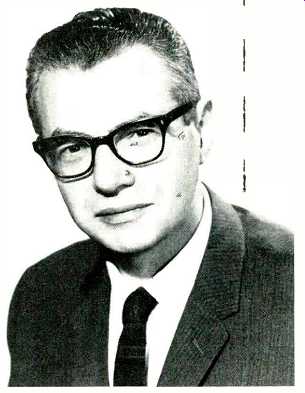
Benjamin B. Bauer, former Vice President and General Manager of the CBS Technology Center, Stamford, Conn., died of a heart attack in Stamford Hospital on Mar. 31 at the age of 65. Per haps best known for his work on the SQ four-channel sound system, Bauer had been awarded some 75 U.S. patents, with foreign patents bringing the total to more than 100. His first invention, the single-transducer cardioid dynamic microphone, was awarded a patent in 1938, shortly after his graduation from college. The mike's acoustical phase-shift principle is still used al most universally in commercial broad cast and P.A. microphones.
Born in Odessa, Russia, Bauer grew up in Cuba and came to the U.S. in 1930 to study. A graduate of the Pratt Institute and the Univ. of Cincinnati, where he received a degree in electrical engineering, he then joined Shure Bros., where he developed the directional microphone. He joined CBS in 1957, taking charge of the audio technology development at CBS Laboratories, as the center was then called.
Bauer's long list of achievements included microphones for acoustical measurements, piston-phones, heartbeat measurements, hearing aids, P.A. systems, broadcast, and civilian and military communications; head phones and artificial voice and ear devices; loudspeakers and speaker enclosures; vibration measuring instruments; the famous STR series of test records; phonograph pickups; magnetic recording heads and transports; directional hydrophones and hydrophone calibrators, and psychoacoustic research into the measurement of loudness and directionality of hearing in air and underwater.
----------Benjamin B. Bauer
A Fellow of the Audio Engineering Society, Bauer was also an Honorary Member of the A.E.S. and a past president and had received the A.E.S. Gold Medal Award. He was also a Fellow of the IEEE and of the Acoustical Society of America from which he had received its Silver Medal Award, only the third scientist so honored. In March of this year, he had been made a member of the l'Ordre de Chevalerie de L'Etoile de la Paix, a Vatican-based nondenominational organization founded in 1229 and dedicated to peace.
(Audio magazine, Jul 1979; Edward Tatnall Canby )
ADs:
MA
How to improve your tonearm.
One of the most frequently-asked questions in high fidelity these days is how well a particular tonearm and cartridge work together. Because tonearm/cartridge compatibility is increasingly recognized as vital to accurate record reproduction.
At Micro-Acoustics, we have a unique solution: the first phono cartridge specifically designed to help any tonearm work at its best-whether that tonearm is straight or S-shaped, low- or high-mass, with low to high cable capacity. We call it the 2002-e ... and it offers significant advantages over conventional cartridge designs.
Tonearm/cartridge resonance: a critical problem
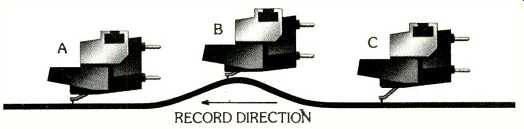
Figure 1. Record warp activates tonearm/cartridge resonance, undesirably reducing and increasing stylus force. (A) Normal position--normal tracking force. (B) Compressed position--increased tracking force. (C) Extended position--decreased tracking force. Record direction is right to left.
Record warp, present to some degree on nearly every disc you play, causes the cartridge to move up and down about the stylus (see Figure 1). This low-frequency up-and-down oscillation--called tonearm/cartridge resonance- can be considerable, since the amplitude of record warp can actually be twelve to fifty times that of the loudest musical program material.
When the tonearm/cartridge combination, moves upward relative to the stylus, the stylus tends to be pulled out of the groove, reducing tracking force to a fraction of the tonearm set ting. When this lower tracking force coincides with a loud musical passage, the cartridge mistracks, causing audible distortion and sometimes, groove jumping.
There is a common misconception that tonearm/cartridge resonance can be "matched" out of existence. The fact is, it cannot: it must be controlled to allow the cartridge to function properly.
Compromised vs. optimized damping
The most important factor in controlling this tonearm/ cartridge oscillation is damping-a mechanical counterforce precisely applied to suppress resonance. Because the tonearm must be absolutely free to move, virtually all tonearms are totally undamped devices. So damping must be supplied by the cartridge.
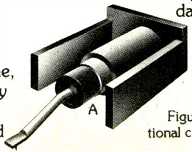
In conventional cartridges, damping of tonearm/cartridge resonance must be a compromise. Because it is provided by a single, multi-purpose elastic bearing (see Figure 2) which must trade off maximum compliance for tracking ability (less damping) with maximum suppression of high-frequency stylus resonance and tonearm/cartridge low-frequency resonance (more damping).
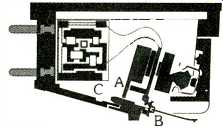
In contrast to this, Micro-Acoustics' 2002-e (Figure 3) has a sophisticated multiple damping system utilizing eight specialized dampers. One pair are low-frequency warp stabilizers, specifically designed to control tonearm/cartridge resonance. This is the first effective warp-control system because it suppresses oscillation at the cantilever pivot, rather than ahead of the stylus. The remaining six dampers are optimized for stylus high-frequency damping and other factors, while our exclusive dual-bearing system independently optimizes tracking ability.
By designing separate systems for damping and compliance within the 2002-e, we can precisely control tonearm/cartridge resonance without compromising any other aspect of cartridge performance.
Figure 2. Single multi-purpose elastic bearing (A) on conventional cartridges compromises damping and compliance.
Figure 3. In Micro-Acoustics 2002-e, one pair of dampers--low-frequency warp stabilizers (A)--control tonearm/cartridge resonance. Other dampers optimize other characteristics. Dual bearings (B) provide maximum tracking ability. Microcircuit (C) optimizes cartridge output to any cable capacitance (Only one channel shown.)
High vs. low cartridge body weight
Regardless of the tonearm and damping system utilized, low cartridge body weight increases the tonearm's ability to track warped records. This is be cause the lower tonearm/ cartridge weight allows damping to more effectively counteract tonearm/cartridge resonance. At four grams, (3.3 gm with stylus guard removed-the lightest weight possible without headshell or counter- weight modification), the 2002-e yields two or more times the effective damping of many other high-quality cartridges.
Cable capacitance capability
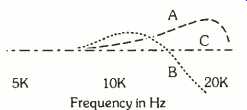
Another important limitation of conventional cartridges is their interaction with cable capacity, which causes a deterioration in high-frequency response and transient ability (see Figure 4). In contrast to this, the 2002-e has a passive microcircuit which automatically matches the cartridge output to any tonearm's cable capacity, providing linear high-frequency response and transient accuracy.
Figure 4. With conventional cartridges (Al, low cable capacity causes response to peak; medium-to-high capacity (B) caused high-frequency response to roll off. Response of 2002-e (C) is un affected.
Tonearm optimization made easy
If there were no such thing as tonearm/cartridge resonance or cable capacity, any cartridge would match any tonearm. But in the real world, where these problems exist, the only way to get optimum performance from your tonearm is the Micro-Acoustics 2002-e. Or our other direct-coupled cartridges: the moderately-priced 282-e and top-of-the-line 530-mp. All of them offer advantages you can hear today. Starting with less than 1% FIM distortion (DIN 45 542)-the best! Micro-Acoustics Corporation, 8 Westchester Plaza, Elmsford, NY 10523.914-592-7627. In Canada, H. Roy Gray, Ltd., Markham, Ontario.
1979 Micro-Acoustics Micro-Acoustics Corporation. Because good tracking isn't enough.
Lux
A FUNCTION OF CONSTANT ATTENTION TO INFINITE DETAIL
For those who consider adequacy enough, there are many manufacturers able to meet that audio standard.
Superiority, however, is another story.
Superiority demands imagination translated into production. It requires thorough dedication to quality without compromise. And most of all, it takes constant attention to infinite detail.
These are the factors t-tat have made Lux audio systems recognizably superior to the select group appreciating such detail and willing to pay the price.
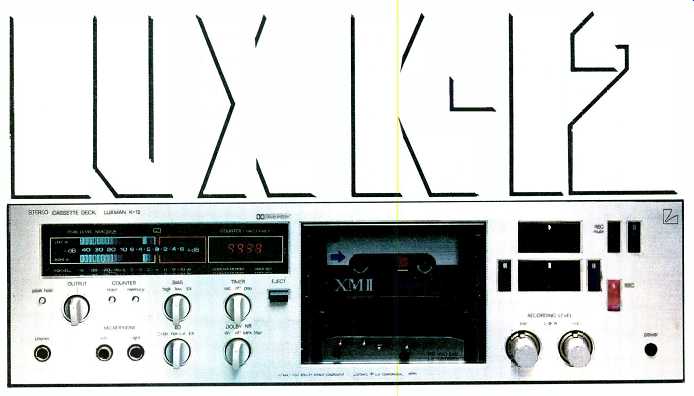
The Lux K-12 Stereo Cassette Deck reflects Lux's focus on perfection with a number of new and exclusive features devoted to producing the ultimate in audio fidelity and user convenience.
The first of these is "real-time processing;' a standard set by computer manufacturers to eliminate the most minimal time lag in dealing with electronic signals during record or playback.
Because any meter is too slow to match real-time processing, Lux provides their Plasma Peak Indicator with peak hold function for instantaneous response to signals by means of a fluorescent tube display scaled in dB for each channel. You can see real-time processing in action.
Dual DC Amplification
As a pioneer in the development of DC amplifiers, Lux refuses to compromise and introduces the K-12, the first cassette deck with two DC amplifiers, one for recording and the other for playback.
Manufacturers--even of expensive equipment-are satisfied-with mixed amplification systems, one AC amplifier and one DC amplifier. Most decks available are AC amplifiers only.
Minutes and Seconds
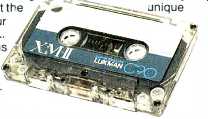
Still another exclusive when used with Lux's unique cassette tape, featuring SKEW adjustment for optimum tape to head and wide pad and holding mechanism for stable frequency response, is the ultimate precision found in the Electronic Digital Tape Counter. Lux engineers designed and built an electronic counter working off a specially designed tape motion sensor. As you record or playback, this elapsed time is shown ona4-digit LED display in terms of minutes and seconds.
Dedicated to Superiority
Lux's K-12 pure Sendust alloy heads are capable of handling any tape, including the new metal particle tapes.
Dual drive motors are part of the tape transport system, with one motor driving the capstan and another the reel.
Thus, torque vibration is virtually eliminated and back tension is always maintained at the optimum.
In addition, with IC logic circuitry, the slightest touch on human engineered controls fulfills your commands...instantaneously.
Additional features include Dolby* NR system, recording mute device, mike mixing circuit, separate 3-way bias and equalization and just about everything you would want or expect-on audio equipment bearing the Lux name.
Specifications are among the best available...
Frequency Response of 30-20,000Hz ± 3dB (metal tape), S/N ratio better than 69dB (Dolby on, metal tape) and Wow & Flutter no more than 0.04% (WRMS). But, in the final analysis, your own hearing, has to be the judge.
See the K-12 and test the unique cassette tape at your Lux dealer. Try it...hear it... and focus on perfection as only Lux can provide.
----------*Dolby is a trademark of Dolby Laboratories. Inc.
LUX AUDIO OF AMERICA, LTD.
160 Dupont Street Plainview, NY 11803
Today's studio technology is putting sounds on record that most home stereos simply can't cope with.
So instead of hearing everything the way it went down at the recording session, you miss the subtle nuances that make the music come to life.
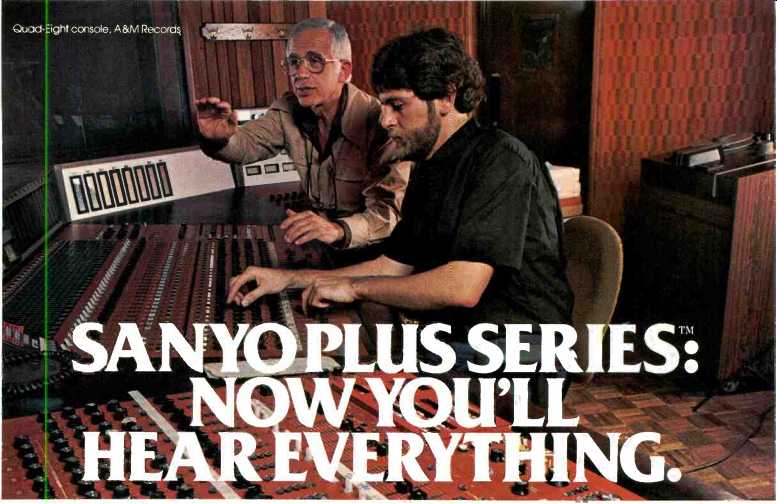
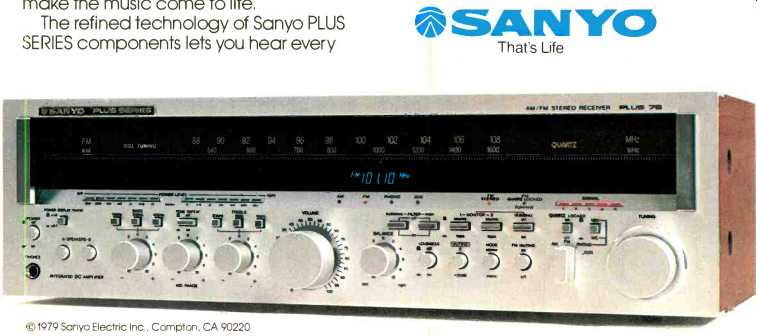
The refined technology of Sanyo PLUS SERIES components lets you hear every detail captured in your recordings--without perceptible noise, distortion, or coloration to spoil the sensation of living, breathing music.
Hear the gloriously true-to-life sound of Sanyo soon at better audio dealers.
That's Life.
1979 Sanyo Electric Inc., Compton, CA 90220
= = = =