Lirpa MADness
I went to school (impressed?) and studied under Prof. I. Lirpa (even more impressed?). I'm glad to see he's get ting the recognition he deserves. (Actually if he got the recognition he de served, he'd be in jail.) Anyway, I subscribe to and read Audio--and at times you guys are bananas. Maybe you'd like to review a record that lasts a half hour (some think it lasts for three days) and sells for only two bucks, with a free magazine attached I'm talking about the MAD disco record for which I served as lyricist and creator.
It's a floppy disc, "floppy" referring to the disc, not the sales of the disc.
Believe it or not we made it from a 24-track master, which meant using 24 paper cups and strings--quite an accomplishment not to get them all tangled up, which would put a knot in the fidelity! Look for the MAD disco special issue on the newsstand.
-Dick DeBartolo, MAD Magazine, New York, N.Y.
Lirpa Tape Deck
Dear Editor:
In response to your review in the April, 1980 Equipment Profiles section, I suggest you check with Lirpa Labs and get more information on the Lirpa NUT-5 tape deck.
This unit utilizes a spring-mounted flywheel motor with special balsa wood heads and accepts Lirpa Labs' new SADEX CrO2 paper tape with micro sand particles. I believe Lirpa Labs has also developed a splicing medium of 100 percent pure pulp resin--Sap-Splice.
- Jeffrey LeBrun Somers Point, N.J.
Resolving the TIM/SID Controversy
Dear Editor:
In recent years one of the more controversial audio topics has been the subject of Transient Intermodulation Distortion (TIM) or Slewing Induced Distortion (SID) and their bearing on audio. While controversy surrounding an issue has a positive result in openly airing differing views held, it has a more negative one in that it can potentially impede progress towards other equally serious problems. The undersigned authors, all having been principals to this issue, would like at this time to extend the following joint resolution towards ending controversy in this subject area.
The recent two-part article by Robert R. Cordell in Audio [12] can be interpreted to imply that there exists disagreement among these authors on this issue. We feel it is fitting that the public understand that there is in fact no controversy among us. We agree upon the distortion mechanism which gives rise to TIM and/or SID, as may be evidenced by our papers, with appropriate allowances for semantic differences, and different boundary conditions.
While we do not necessarily agree completely with the "view of TIM as presented by Mr. Cordell, or some manners of his presentation, we have no strong desire to prolong arguments on this issue which might result only in further public confusion and controversy. We would refer those interested in technical details to some papers on amplifier designs [2, 9, 13, 19, 21, 22, 23], program rate-of-change characteristics [14, 15, 16, 20, 26, 27], measurements [10, 18, 19], and listening tests [24, 25, 26, 27].
We sincerely hope that debates upon these issues may be finally laid to rest, and look forward to working further in unison, as we examine in de tail the many other technical problems facing high-quality audio reproduction.
-John Curl, Audio Consultant, Berkeley, Calif.
-Walter G. Jung Consulting Author W. Marshall Leach, Jr. Associate Prof. Georgia Inst. of Technology Atlanta, Ga.
-Matti Otala. Professor Tech. Research Centre of Finland; Oulu, Finland
References
1 through 11, contained in [12].
12. Cordell, R.R., "Another View of TIM," Audio, Part I, Feb., 1980, pp. 38-49; Part II, March, 1980, pp. 39-42.
13. Leach, W.M., "Suppression of SR and Transient IM Distortion in Audio Power Amplifiers," Jour. of the Audio Engineering Soc., Vol. 25, No. 7/8, July/August, 1977.
14. Lammasniemi, I. and K. Nieminen, "Distribution of the Phonograph. Signal Rate of Change," presented at the 62nd AES Convention, Brussels, March, 1979 (to be published in IAES).
15. Pass, N., "The Pass/A40 Power Amplifier," Audio Amateur, Issue 4, 1978, p. 12.
16. Groh, A.R., "Address to Nov. 1976 Boston Audio Society," BAS Speaker, Dec., 1976, pp. 17-21.
17. Cordell, R.R., "Comments on 'A Method for Measuring Transient Intermodulation Distortion (TIM),' " Jour. of the Audio Engineering Soc., April, 1979, pp. 295-296.
18. Otala, M., E. Leinonen, and I. Curl, "Reply to Comments on A Method for Measuring TIM," Jour. of the Audio Engineering Soc., April, 1979, pp. 296-297.
19, Jung, W.G., M.L. and C.C. Todd, "An Overview of SID and TIM," Audio, Part I, June, 1979, pp. 59-70; Part II, July, 1979, pp. 38-47; Part III, August, 1979, pp. 42-59.
20. Curl, I., "Omitted Factors in Audio Design," 1978 IEEE Conference on Acoustics, Speech and Signal Processing, April, 1978; published in Audio, September, 1979, pp. 20-24.
21. Leach, W.M., Ir., "Build a Double-Barreled Amplifier," Audio, Part I, April, 1980, pp. 36-51; Part II, May, 1980, pp. 44-60.
22. Otala, M., "Circuit Design Modifications for Minimizing TIM in Audio Amplifiers," Jour. of the Audio Engineering Soc., Vol. 20, No. 5, June, 1972, pp. 396-399.
23. Lohstroh, I. and M. Otala, "An Audio Power Amplifier for Ultimate Quality Requirements," IEEE Transactions on Audio and Electroacoustics, Vol. AU-21, No. 6, Dec., 1973, pp. 545-551.
24. Jung, W.G., "Slewing Induced Distortion in Audio Amplifiers, Part IV, Listening Tests," The Audio Amateur, Issue 4, 1977, pp. 22-28.
25. Lewitt, H., C.A. McGonegal, and L.I. Cherry, "Perception of Slope-Overload Distortion in Delta Modulated Speech Signals," IEEE Transactions on Audio and Electroacoustics, Vol. AU-18, Sept., 1970, pp. 240-247.
26. Petri-Larmi, M., M. Otala, E. Leinonen, and I. Lammasniemi, "Audibility of TIM," IEEE Transactions on Acoustics, Speech and Signal Processing, Vol. 28, No. 1, Feb., 1980, p.p. 91-96.
27. Petri-Larmi, M., M. Otala, and I. Lammasniemi, "Psycho-Acoustic Detection Threshold of TIM," Jour. of the Audio Engineering Soc., Vol. 28, No. 3, March, 1980, pp. 98-105.
==========
ADs:
Why we created our own total system.
We simply had to.
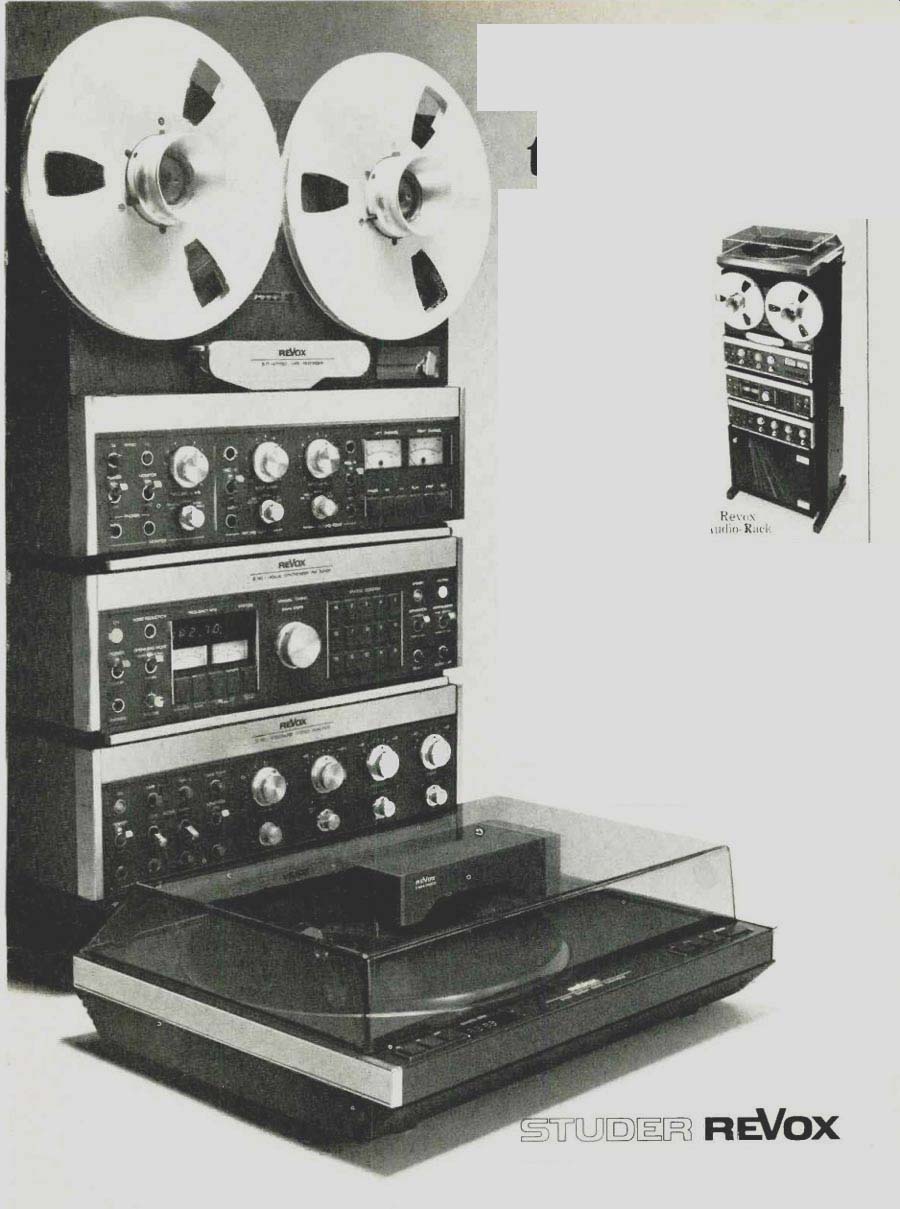
Because no chain is stronger than its weakest link. And no music system is better than the distortion or noise coming from any of its components.
We wanted to make sure that when you choose one Revox you get all that it has to offer.
The total Revox system delivers virtually distortion-free music from every source and in any mode-music reproduction so true that it is unmatched by any other system available today.
------ Revox Audio-Rack.
All the components in the Revox system are de signed to meet the professional quality standards that have been set by the Revox B77 open reel recorder with its ingenious logic control system.
The B750 integrated amplifier, for example, is renowned for its fast transient response to all musical signals and for its low TIM. It is paired with the incredible B760 digital synthesizer FM tuner with the unusual capability of programming 15 stations when you can recall at the push of a button. The BUM direct drive, quartz controlled turntable reduces tracking distortion to an absolute minimum using a revolutionary new system called Linatrack.
For an unmatched musical experience, listen to our matched components at your franchised Revox dealer.
Or write to us for details.
ReVox
Studer Revox America. Inc.
1425 Elm Hill Pike, Nashville, TN 37210, (615) 254-5651
Offices: Los Angeles (213) 780-4234 / New York (212) 255-4462
In Canada: Studer Revox Canada, Ltd.
----------------
JBL's new L112.
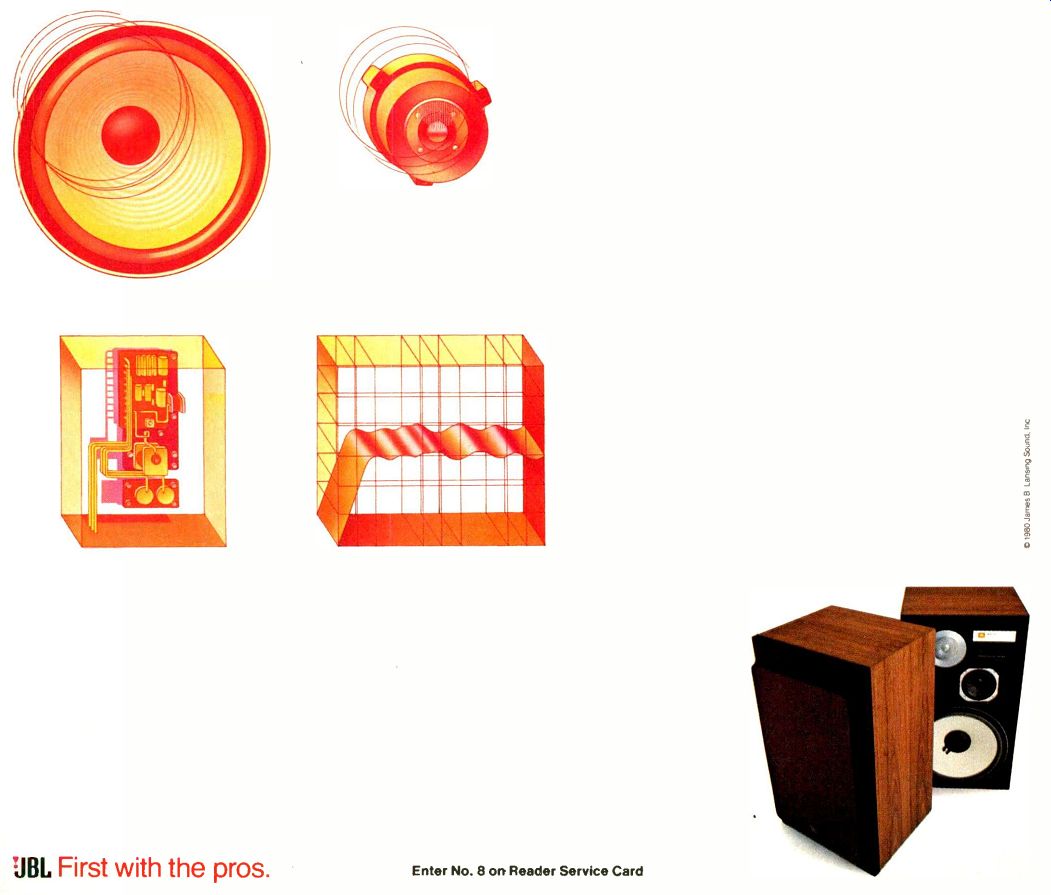
Lower, higher, faster, flatter. UBL Listen to years of research at the leading edge of transducer engineering.
Lasers, holography, computers and the human ear interfacing toward one end: a new state-of the-art in bookshelf loud speakers ... JBL's new L112.
Lower. The L112's Symmetrical Field Geometry 12" woofer, with its larger 3" voice coil and specially-coated cone, delivers the low notes of music with extremely low distortion. Lower than any other bookshelf speaker we've ever tested.
You'll hear crisp, clean, powerful bass all the way down to the lowest notes.
Higher. A new vapor aluminum-coated lightweight phenolic Dome Radiator was developed through the use of laser holography This laser research helps our engineers examine tweeter cone movement like an X-ray al lows physicians to examine the human body. Diaphragm excursions have been refined for exceptionally smooth response, maximum stereo imaging and high-power handling. You'll hear harmonics you've never heard before.
Faster. JBL's new High Resolution Dividing Network enables the L112 to deliver transients with startling immediacy It controls each of the L112's drivers throughout their full operating range. You'll hear sound so coherent, it will seem that only one extremely wide-range transducer is responsible-not three! Flatter. The flat frequency response measurements of the L112 qualify this speaker as the most accurate bookshelf performer we've tested in JBL history.
The L112 represents more than engineering excellence. It's also excellence in quality assurance and manufacturing. In JBL's ma chine shop, we hold tolerances on the L112 components such as pole pieces to 2/10,000ths of an inch! These are tolerances normally found only in aerospace technology.
Each speaker is crafted in the USA at our Northridge, California facility, inspected and tested at over 50 test stations and beautifully hand-finished with oiled and rubbed American walnut veneer.

Listen to musical reproduction at technology's leading edge. At your JBL dealer.
James B. Lansing Sound, Inc.
8500 Balboa Blvd., Northridge, CA 91329.
---------------------
Sony
DON'T LET YOUR EGO STAND BETWEEN YOUAND BETTER SOUND.
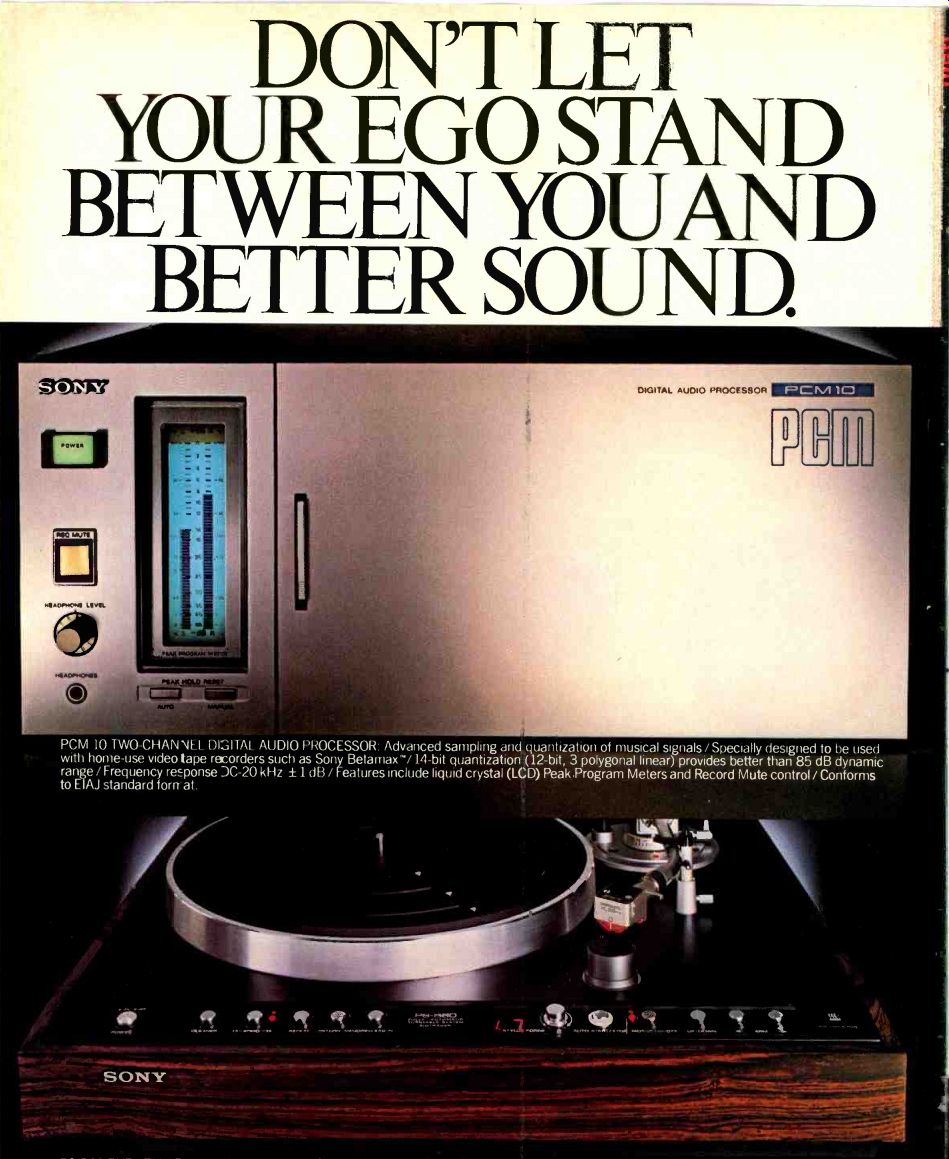
-----PCM 10 TWO-CHANNEL DIZITAL AUDIO PROCESSOR: Advanced sampling and quantization of musical signals / Specially designed to be used with home-use video tape recorders such as Sony Betamax"/ 14-bit quantization (12-bit, 3 polygonal linear) provides better than 85 dB dynamic range /Frequency response DC-20 kHz ± 1 dB / Features include liquid crystal (LCD) Peak Program Meters and Record Mute control / Conforms to EIAJ standard format.
-------PS-B80 TURNTABLE
Velocity Feedback (VFB) electronically controlled tonearm system allows automatic tracking, antiskating, and tone arm damping operation / Microprocessor-programmable functions and replay flexibility/ Quartz X-tal locked, fully automatic DD turntable, with high-torque BSL motor and Magnedisc servo control / SBMC chassis material, with height-adjustable viscous feet.
XL-55 PRO CARTRIDGE: Sony developed figure 8 moving-coil voltage generating system /'Air core' armature design, with multiple cantilever construction / Integrated magnesium die-cast low-resonance head shell.
There are those who insist that the most sophisticated audio equipment can only be produced by relatively unknown companies.
At Sony, we take exception to this unwarranted position.
First, because there's probably no audio company in the world that can match the technological resources and research facilities of Sony.
Second, because it is our contention that the Sony Audio Lab components pictured here represent the absolute state of the audio art.
And finally, because no other audio company can match Sony's record for innovation and quality.
So the point of all this is simple.
If you're looking for the ultimate in audio equipment and you find yourself unduly prejudiced at the sight of our name, do us both a big favor.
Close your eyes. And just listen.
SONY--High Fidelity
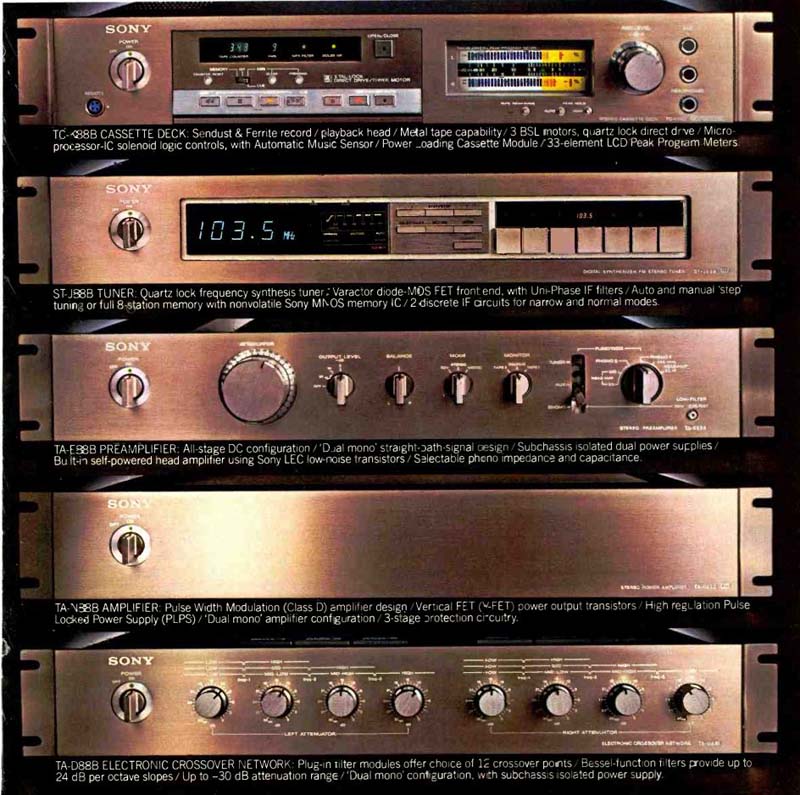
TC-CB8B CASSETTE DECK:
Sendust & Ferrite record / playback head / Metal tape capability/ 3 BSL motors, quartz lock direct drive / Microprocessor-IC solenoid logic controls, with Automatic Music Sensor/ Power Loading Cassette Module 133-element LCD Peak Program Meters.
ST-J988 TUNER:
Quartz lock frequency synthesis tuner: Varactor diode-MOS FET frontend, with Um-Phase IF filters / Auto and manual 'step tuning or full 8-station memory with nonvolatile Sony MHOS memory IC / 2discrete IF circuits for narrow and normal modes.
TA-E3813 PREAMPLIFIER:
All-stage DC configuration /'Dual mono’ straight-path-signal assign / Subchassis isolated dual power supplies/ Built-in self-powered head amplifier using Sony LEC low-noise transistors / Selectable phono impedance and capacitance.
TA-N3BB AMPLIFIER:
Pulse Width Modulation (Class D) amplifier design /Vertical FET (W-FET) power output transistors / High regulation Pulse Locked Power Supply (PLPS) /'Dual mono' amplifier configuration / 3-stage protection circuitry.
TA-D88B ELECTRONIC CROSSOVER NETWORK:
Plug-in filter modules offer choice of 12 crossover points/ Bessel-function filters provide up to 24 dB per octave slopes/ Up to-30 dB attenuation range/'Dual mono' configuration, with subchassis isolated power supply.
-----------------
Allison
Original.
original n: that from which a copy, reproduction or translation is made.
(Webster's Collegiate Dictionary)
The ALLISON: ONE Room Matched loudspeaker system was introduced in 1974. It was the first direct-radiator system ever designed to use room-boundary reflections constructively, so that flat acoustic power could be radiated into a listening room throughout the full frequency range.
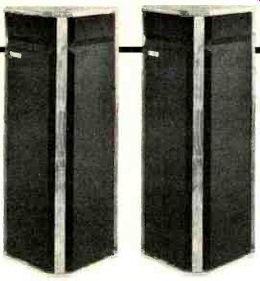
Now, more than five years after, we are pleased to see systems based on this concept being marketed by AR, Design Acoustics, and Snell (if we've anyone, our apologies), all such we say, "Welcome aboard." The more of us there are, the better.
But imitation does not mean replication. Only Allison loudspeaker systems are manufactured under U.S. Patent No. 3,983,333, which teaches the most effective and least costly ways to make Room Matched loud speakers. Only Allison systems have convex-diaphragm tweeters and mid range drivers, which combine high output capability and unmatched dispersion. And only Allison systems are available in models designed for use with one, two, or three intersecting room boundaries.
Information on the complete line, including specifications, a list of authorized dealers, and details of our Full Warranty for Five Years, is available on request.
ALLISON: ONE $460/$483 (each) (Price varies with shipping distance)
---------------------
The Secrets of Onkyo

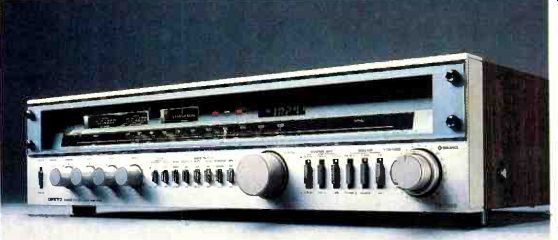

Let Onkyo transport you to a world beyond electronics...to a world of more perfect sound.
Where you'll hear music of such stunning purity and sensual richness, that you'll forget you're listening to an audio system.
That's the secret of Onkyo... and Onkyo's dramatic success. The unique ability to take you several steps beyond pure technology...to experience more exciting sound. And you'll find it in all our components... including all four of our new receivers.
The Onkyo TX-7000 Quartz-Locked AM-FM Stereo Receiver is an outstanding example. Both its power amplifier and FM sections are rich with important new design concepts.
The TX-7000's power amplifier provides two major innovations never before present in a stereo receiver. The first is called Super-Servo and it totally eliminates the sonic "ghost signals" common to DC power amplifiers. As a result, each instrument and voice sounds purer and more individually real...regardless of volume level. Perhaps for the first time, you'll experience stereo with true depth, spaciousness, and a remarkably discernable third-dimension.
The second innovation is Linear-Switching which lets us provide Class A amplifier sound quality with Class B power efficiency. Crossover distortion is significantly reduced. And output power is very highly efficient...90 watts per channel with no more than 0.02% THD.* The TX-7000's FM section is also clearly superior... picking up weak stations noiselessly and strong stations without distortion.
A unique Human Touch Sensor automatically controls the Quartz-Locked system for more reliable and convenient operation ... releasing the system instantly when it senses your touch on the tuning knob...engaging it again as your fingers leave the knob.
Special circuits also monitor both channels...detecting and cancelling out sound distorting FM signal noise. Other circuits cancel out appliance noise.
Digital FM readout...separate bass, mid and treble controls... 2-way tape dubbing facilities...and dozens of other important features are all found in the TX-7000. And the TX-7000 is just one of four new receivers from Onkyo.
Hear "the secret of Onkyo".
Hear receivers so advanced, they transcend mere technology.
Onkyo USA Corporation 42-07 20th Avenue Long Island City, N.Y. 11105, (212) 728-4639
The Onkyo TX-7000---A remarkably advanced new stereo receiver that provides dramatically superior sound quality. Minimum RMS at 8 ohms both channels driven from 20 to 20,000 Hz.
-------------------
Stanton--The Professional in The Recording Industry
Application--The Metal Mother-Stanton plays it back
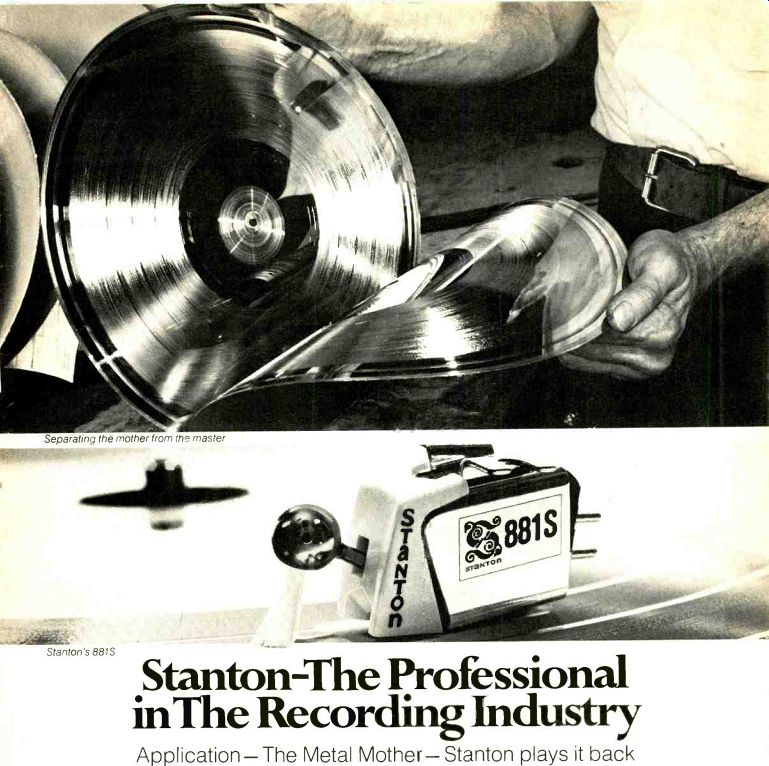
Once the recording studio has delivered the lacquer disc to the plating plant it is sprayed with liquid silver making it electro-conductive, and then electroplated with nickel, which is separated from the lacquer. The nickel is now a negative image called a master, and has, instead of a groove, a ridge that comes to a point.
The master is treated and nickel plated again and upon separation forms a mother, a positive metal record.
Engineers rely on the Stanton 881S cartridge in playback evaluation of the mother.
Stanton's 881S Professional Calibration Standard Cartridge is a sophisticated, low mass phono pickup truest fidelity and gentlest possible treatment of the record groove. Lightweight, high energy magnets allow reduced mass and higher output than conventional magnets. And each Stanton 881S that comes off the production line has been tested and individually calibrated with the test results packed in each unit to as sure the very finest professional quality product regard less of application. From disc cutting to disco to home entertainment your choice should be the choice of the Professionals... Stanton cartridges.
1979 STANTON MAGNETICS
For further information contact:
Stanton Magnetics Inc., Terminal Drive, Plainview, New York 11803

---------
Technics
Everyone knows what Technics direct drive does for performance and accuracy in of r turntables. That's why 73 of the top 100 radio stations that use turn tables use Technics direct-drive turntables. Now, for only $330; you can record your cassettes with the accuracy of Technics direct drive. And that says a lot about the Technics RS-M45.
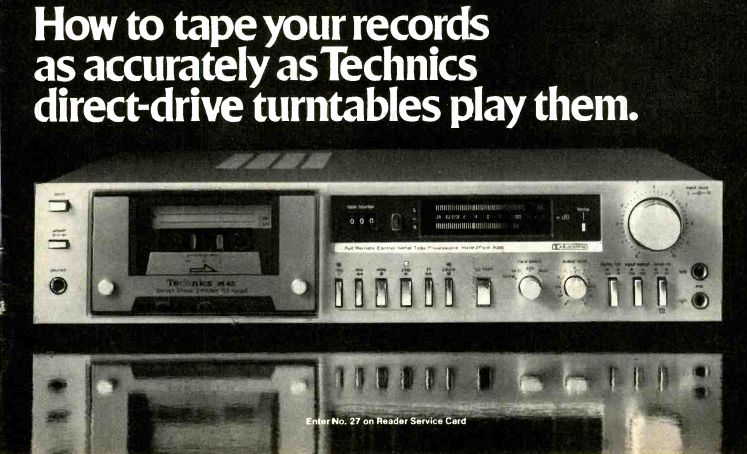
So does is tape transport system. Especially when you consider what the RS-M45 has going for it: An FG servo DC direct-drive capstan motor. And while 0.035% wow and flutter can tell you a lot about our direct-drive performance, the world's only limited 3-year motor warranty tells you a lot more.
Equally impressive are the RS-M45's solenoid controls. They not only make switching from one node to another simple and accurate, they also put minimal strain on the tape transport system.
And to put minimal strain on you, there's the optional RP-94545 remote control unit. With it, all transport functions, as well as record mute, can be operated from your easy chair.
Just as special are the RS-M45's fluorescent VU meters with auto-reset peak-hold. They're fast, electronic and highly accurate. You'll also like Dolby NR and a S/N ratio of 68 dB.
And if our SX record and playback heads make CrO2 tape sound great (20 Hz-18 kHz.) wait until you hear the increased frequency response (20 Hz-20 kHz) and extended dynamic range of metal.
Technics 2S-M45. Direct drive and solenoid controls say it isn't your typical $330 cassette deck. In fact, compared to the leading brands, it's one of a kind.
And that's very typical of Technics.
Technics
How to tape your records as accurately as Technics direct-drive turntables play them.
========
(Audio magazine, July 1980 )
= = = =