Lirpa I Retest
Dear Doktor:
After Mr. Dennoc was arrested and sent to the "house on the hill" with the psychiatrists, a group of us here in Texas tested your "thing." We found the 100 watt pilot light too bright and threw it away. The Lirpa I looks much better in total darkness anyway. We are still looking for the "destruct" button. The muting switch still allows noise to come through. Local FM stations, even the rock things, disclaim any knowledge of either you or your Lirpa I. When asked, the hi-fi stores just moaned and hung up the phone.
The report by Dr. I.M. Toidi is obviously edited by you just to make it sound good. Nonsense, it is worse than that. And you know about anybody from California. U.R. Dennoc needs new hearing aids, for both ears! However, we found it sounds better with either the speakers or headphones not connected.
The surprise was that you made the Lirpa with a single burstanic, denotramertecum, or zoptanuporumbactiocoryuist in the ptuidic assembly, yet still got nothing.
We offer to purchase it...the price? Fifteen cents is way out of line. Our bid is one genuine U.S. nickel. Take it or leave it.
With pity and hope... R.R. Cunningham Cunningham Assoc., Houston, Tex.
Editor's Note: Unfortunately we already have a much better offer...two brand new 1914 Chinese pennies which were recently found along the banks of the Olt River in the Transylvanian Alps of Dr. Lirpa's homeland, Ru mania.
Audio Accolades
Dear Sir:
I am a new subscriber to Audio Magazine and I just read the April 1977 issue. I am very delighted and impressed with your article on "The Compleat Microphone Evaluation." I should add that I have been a subscriber to Stereo Review Magazine for the last five or six years, and while I have learned a lot from that magazine, it is refreshing to be part of fresh and different audio topics and points of view.
Your microphone article was particularly timely for me since I now own a Dokorder 7140 tape deck and I am about to purchase a pair of mikes for general use in serious recording of both solo and small group vocals, as well as occasional orchestras and larger choral groups. I have read all the mike selection articles in old Stereo Reviews, and I have searched all the newsstands for all the information on mikes I can find. By doing this I have learned a lot about some aspects of choosing and using mikes, but I still face a bewildering choice of mikes.
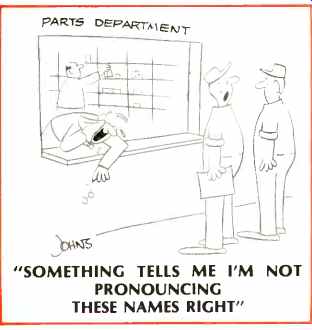
"SOMETHING TELLS ME I'M NOT PRONOUNCING THESE NAMES RIGHT"
The refreshing thing about your mike reports project is, that at last, we buyers will have some access to Real Live Test Reports on mikes, and unbiased at that! That in itself is almost unbelievable and long overdue. Nobody else seems to be interested in testing mikes, and if they are, the bottom line of the report always reads something like..."This mike is a fine value and would be a worthy addition to any system, etc., etc."
-Dr. Scott C. Suly DVM N. Hampton, N.H.
Lirpa Ardor
Dear Sir:
Radio station WKIK, along with most AM broadcast stations, spends a lot of money to provide a clean, wide range signal which far exceeds the frequency response limitations of most AM receivers. Many broadcast engineers have written letters pointing this out, and the review in the January issue of Audio on the vintage E.H. Scott receivers also bears this fact out.
There are many fine FM tuners available, but only one AM that I know of which can reproduce the full range of a contemporary AM signal.
Perhaps, the folks who produce the Lirpa I receiver reviewed in the April issue will soon deliver an AM receiver for testing, a receiver that can match their FM set in quality.
The management has authorized me to order a Lirpa I FM receiver, and I am sure that as soon as a Lirpa 2 AM receiver comes on the market, many engineers at FM stations will order them. Just imagine the value of a receiver that can show your competition at its worst! Of course, I understand that certain control functions will have to be revised. For example it would be helpful to have adjustments for hiss, co-channel beat, noise, adjacent channel (10 kc) whistle, a device to accentuate skip interference, and, of course, a "mud control" like the one on the Lirpa I FM receiver would be essential..."See how muddy they sound!" people buy advertising on that.
Thanks for the best and most straightforward test report I've seen today.
Frank S. Miner III Director of Engineering WKIK Radio Leonardtown, Md.
Alternatives to Bad Records
Dear Sir:
I would like to urge Mr. Robert H. Lacher (letter to "Dear Editor," May 1977 issue) not to sell his $5000 system because the inferior quality of most records makes listening less than pleasurable. With Stereotape of California (and soon Barclay-Crocker of New York) issuing absolutely stunning Dolbyized reel-to-reel tapes, there is no reason to settle for sloppily made records. Stereotape is now issuing RCA and London, and I understand that DGG will soon be added. Barclay-Crocker will soon offer the Musical Heritage Society line, among others. There IS hope for those of us who demand quality.
William T. Wingo, Jr., Sulphur Springs, Tex.
Lirpa Lover
Dear Kindly Editor:
Thanks for the copy of the April issue of Audio. My good friend R.M.S. Watts has bought one of the Lirpa I receivers. I have enclosed his comments, as perhaps you would want to share them with your gentle readers.
Robin W.J.J. Hoge
Boy Wonder
After reading Professor Lirpa's review of his receiver, I went out and bought one. It is a significant advance in the audio art, perhaps, even a major breakthrough. I have found the performance to be superior to my previous reference unit, a homemade 500 W amplifier which uses 50 2A3 thermionic vacuum valves in a parallel/push-pull, Class A circuit which is direct coupled to the loudspeaker.
I did not experience the Doppler effect problems reported by Mr. Toidi. I suggest that a higher caliber cartridge, such as the Remington High-Velocity .357 Magnum, would match his pace. Also, I did not have Mr. Dennoc's loudness problem. This is because I am using the Hurtz & Associates Ultimate LSH (1) system (in mono, of course) with the Lirpa I. This system requires 1200 W input power to produce 88 dB SPL at one meter.
(Editor's Note: We believe that there is a misplaced decimal point here. The system produces 0.88 dB SPL at one meter, or 88 x-10-2.) I have found a way of reducing the TIM distortion in the amplifier to a level which should be inaudible to Professor Lirpa. A non-alignment tool (available from Third-World Elektronik, Gmbh.) is used to adjust the nonuser-adjustable control for an output of 16.67 furlongs/fortnight with a 4 kg load. Great care must be taken to avoid overtweaking, or the resulting grounded-base operation will cause excess acidity which will consume 47 times its weight in dome tweeters.
I have only one complaint with the Lirpa I...the sound type selector does not have a TN button. How can I play my country music records from that city named after my hometown?
R.M.S. Watts B.S. Nashville Audible Group, Ltd. Nashville, IN
(1) O. Gadfly Hurtz, "The Ultimate LSH Loudspeaker" Journal Audio Engineering Society, March 1974.
Lirpa Kudos
Dear Sir: I have long awaited such a major audio breakthrough as the Lirpa I and to say that I am ecstatic is the understatement of the year. May I congratulate your editorial staff for this recognition and for being the first to review it.
There is, however, one facet of this receiver that really bothers me. A quite pedestrian lock is shown with a very ordinary-looking key, and sure as hell someone is going to turn that thing on. So, may I respectfully suggest that you notify the manufacturer that there are 12-button combination locks available that not even my very talented cousin, who is presently in San Quentin, can pick.
R.W. Armstrong; Gold Beach, Ore.
(Audio magazine, 1977)
=======
Vintage magazine ADs:
Three heads above other cassette decks.
Hitachi's MP Head.
Two-head decks are compromise performers, because they use a single head for both record and playback.
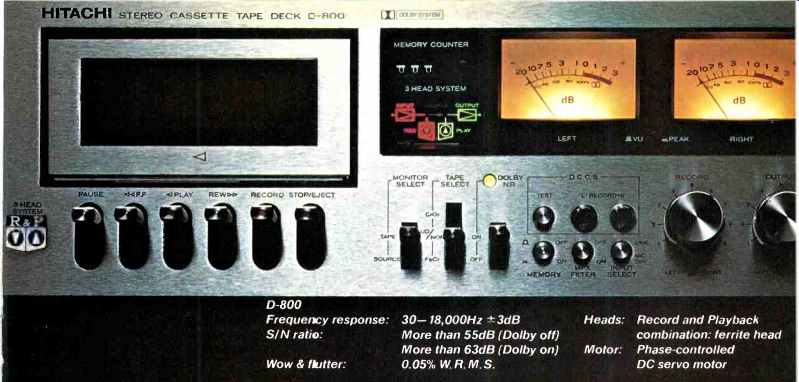
To insure no-compromise performance, Hitachi developed the R&P 3-Head system. It uses 3 heads, like professional reel-to-reel decks. And these unique record/playback heads have separate and optimum gap widths extending both dynamic range and frequency range significantly.
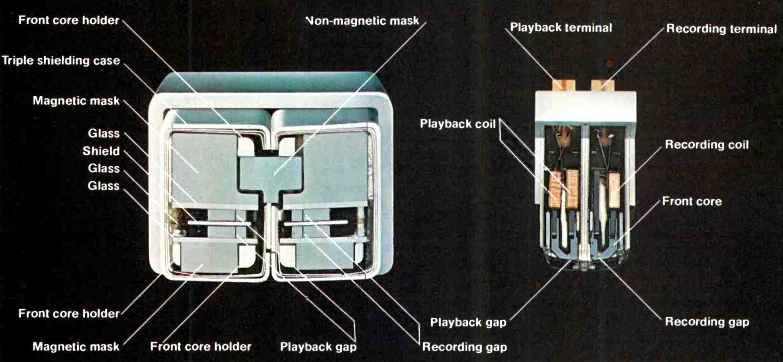

The Hitachi R&P head is capable of playback monitoring, so you can compare the original source with your tape, a moment after it's recorded. And as an added benefit its single housing eliminates height and azimuth adjustment problems.
Add up the benefits. You'll agree that Hitachi's decks are three heads above other cassette decks.
HITACHI When a company cares, it shows.
Audio Component Division, Hitachi Sales Corp. of America, 401 West Artesia Boulevard, Compton, CA 90220, (213) 537-8383, Extension 228
-----------
Do-it-yourself JBL.
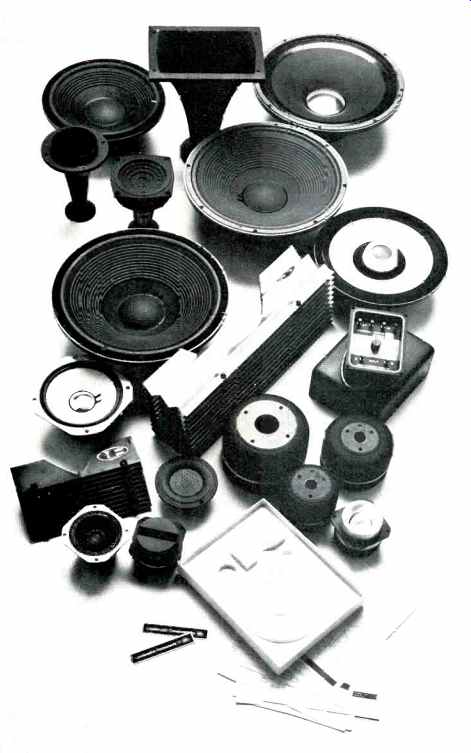
Take the guts of what makes JBLJBL and adapt it to your own ideas of what a loudspeaker system should be.
Mix and match with forty-seven individual JBL components--horns, lenses, dividing networks, transducers, everything.
And when you've found your perfect sound, we'll help you find somewhere to put it: The JBL Enclosure Construction Kit, with complete plans for building your own loudspeaker enclosure from scratch.
See your authorized JBL Loudspeaker Components dealer for the start of a great new team in sound: You and JBL. JBL
James B Lansing Sound, Inc. 8500 Balboa Blvd., Northridge. Ca. 91329, USA.
-----------------
Shure
V-15 Type III ... critics called the Type III the finest cartridge ever, when it was introduced. The ultimate test, however, has been time. The V-15's engineering innovations, the uniform quality, and superb performance remain unsurpassed by any other cartridge on the marker today. 3/4 to 1-1/4 gram tracking force.
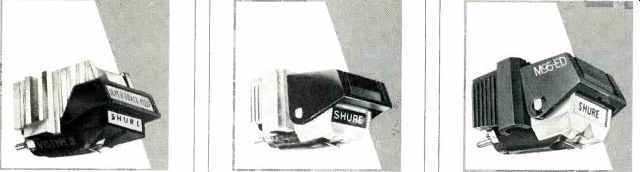
M75ED Type 2 ... excellent track ability at a lesser price. The M75ED Type 2 features a built-in snap down stylus guard and a smooth 20 to 20,000 Hz frequency response. 3/4 to 1-1/2 gram tracking force.
M24H ... the cartridge that does not compromise stereo reproduction to add four-channel capability.
Superb stereo trackability and quadraphonic carrier signal retrieval. New hyperbolic stylus tip, high energy magnet, and low-loss laminated electromagnetic structure. 1 to 1-1/2 gram tracking force.
M70EJ ... the easiest way to upgrade your hi-fi stereo system without straining your budget. Basically flat response is comparable to other brand cartridges costing twice as much. 1-1/2 to 3 gram tracking force.
M95ED ... second only to the V-15 Type Ill in stereo reproduction. A thinner, uninterrupted pole piece minimizes magnetic losses. Its 20 to 20,000 Hz response remains essentially flat across the entire frequency range for excellent sound quality 3/4 to 1-1/2 gram tracking force.
M3D ... the original famous Shure Stereo Dynetic Cartridge. The M3D provides extremely musical and transparent sound at o rock bottom price. 3 to 6 gram tracking force.
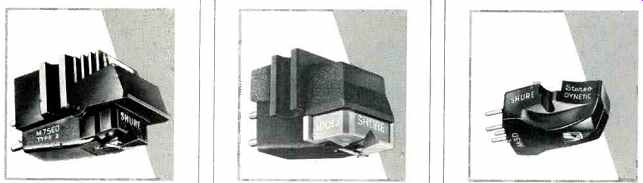
The People's Choice-World-wide.
From Singapore to London to New York, Shure hi-fi pickup cartridges outsell every other brand according to independent surveys. And for good reason: Shure cartridges, no matter where they're purchased, are guaranteed to meet the exacting published specifications that have mode them the Critics Choice in every price category.

Shure Brothers Inc., 222 Homey Ave., Evanston, IL 60204. USA
---------------------
= = = =