A great many Audio Engineering Society members last March were aware of the
presence in Brussels, at the AES winter convention, of a man whose familiar
initials were BBB. It was only the usual. As always, he was everywhere, indefatigable,
seeing everybody, highly visible. And as usual he presented a paper what AES
convention has he ever missed, and did he ever not present a paper or two?
This one, though, was perhaps more than the usual. Somewhat as in Einstein's
unified field theory, BBB here aimed to set forth an overall theoretical system
for multichannel sound in both recording and broadcasting, in the taking down
and the playing back, incorporating all the presently variable approaches towards
an "en route" broadcast signal as presently designated 4-4-4, 4-3-4,
4-2-4 plus conventional mono and stereo and SCR and, of course, every aspect
of the disc process. A huge theoretical package and, as the ultimate synthesis
of this man's work over many years, it must have impressed even those who might
not go along with the system itself by its sheer elegance and comprehensiveness.
BBB also received a new honor at Brussels this year, on top of many others. He became an honorary horseman. A chevalier of the ancient Order of the Knights of the Star of Peace, an organization founded in 1229 when knighthood was in flower and quadraphony quite unknown. This must have tickled him pink. Some horseman! Fortunately, there was no need to mount an actual horse.
As always, BBB came back home full of verve and immediately got to work preparing his Brussels paper for wider distribution, to the American audio press and to all other possibly interested parties including, of course, the most important party of all, the FCC in Washington, which has a few outstanding little matters to decide in this very same area. The FCC has been hearing regularly from BBB for perhaps a bit longer than some of its members might wish. Few engineering minds in the U.S. could match BBB's steely ability for careful, quiet, and logical argument of the sort that one challenges at considerable risk. I do not think I would ever have wanted to be in the line of BBB's technical fire. Not even as an FCC member. Behind that courteous European politeness was a will of incredible intensity and the mind power to match. Was it diamond drill or bulldozer? A judicious bit of both.
The final BBB paper was ready for mailing only a week or so after the Brussels AES, more than 30 pages of closely reasoned text, diagrams, formulae with derivations, and reference listings. My own copy was sent out from BBB's "retirement" office, Audio Metrics, Inc. (which consisted of his front living room plus facilities in his old nearby laboratory haunts in Stamford, Connecticut), on Wednesday, March 28, 1979. Enclosed was a signed, personal note from BBB. Page 5 of the paper was missing the only indication of any haste, and surely not his haste. I got it later on. On that very day, Benjamin B. Bauer suffered his second and fatal heart attack. After a typically optimistic and even cheerful several days in the hospital, where he happily found himself in the charge of a personable physician, Ben Bauer died on Saturday, March 31. It was barely two weeks after the Brussels convention. So he made it by a hair.
He must have known the risk.
Patents by the Score As most of us know, BBB was for many years out in the Midwest with Shure Brothers, doing major work on microphones, in our field, and later in phono pickups, predecessors of the present-day Shure line. There was that sensational "dart" arm and cartridge, a long, thin, tapering arm with an incredibly tiny cartridge in its drooping nose, independently sprung; the arm moved sidewise only, the tiny head moved up and down. (Well, if an arm can have a head, it can have a nose . . . .) There was a cybernetic problem with this arrangement. To raise the stylus, you pushed downwards on a button, a motion so unnatural for the human mind and fingers that most people just grabbed the arm itself and dragged the point sidewise over the grooves. No damage but an awful squawk. I doubt if this aspect was a BBB idea.
The most important of BBB's earlier inventions (he pulled down some 75 U.S. patents) was the original single transducer, cardioid dynamic microphone, 'way back in 1937, making use of the phase-shift principle, or what I like to call re-entry, to cancel out signals coming from the sides. It is, of course, fundamental to the cardioid style of miking today and therefore fundamental to the art of recording and broadcasting. How directly prophetic of later Bauer developments along phase-shift lines! Culminating in the ultimate BBB consolidation, the 1979 Brussels paper.
In 1957 BBB came east to join CBS Laboratories and from thence onwards his activities spread and multiplied into the infrared and the ultraviolet. One never knew quite what he was up to. I remember one notable occasion (for me) when I became a temporary Bauer guinea pig. Under Ben's benevolent direction I was taken to a local Stamford indoor swimming pool and immersed in about 12 feet of water, with headphones on. There was an athletic CBS guard, too, in case I conked out, which I didn't. I can still swim my 50 feet under water minus snorkel or aqualung. Down at the bottom of the pool I was fed headphone signals and asked to point to their apparent source. The signals had been processed in such a way as to simulate ordinary airborne acoustic signals. Inside the phones, there were air pockets for ordinary dry-land-type binaural hearing. This was merely a bit of fundamental research, the sort that must cover all bases, however obvious. Of course I heard the signals exactly as I would have on shore, but this had to be proved. So I vigorously pointed to the left and to the right, but not towards the front (!) and then came up for a hot shower. My normal binaural experience, if in an odd location.
Note in passing that this, too, was based on timing differences as between two listening ears and upon directional selectivity in sound reproduction. One way or another, that was the focus of Bauer's engineering life over a span of 40 years and more. SQ was merely the late-late product of phase preoccupation, though it was what most of us will remember first.
Movers and Doers
With long-time friends, I have a curious habit of forgetfulness of the past. I have not the slightest recollection of my first meeting with BBB. Nor, for that matter, with that other and closely related (corporately) CBS leader, Dr. Peter Goldmark.
Curious, too, in a larger scale of reference, that CBS, grand and omnipotent combine of communications corporality, should have taken on two such far-seeing and original engineering leaders of similar backgrounds. Both came out of Europe, Goldmark from Hungary, Bauer out of Russia via Cuba; both inherited an unmistakable degree of Old World culture and manners and
to the day of their respective deaths so near in time spoke with the faint remains of a European accent. Eventually, of course, they became more American than most Americans, joining a whole group of similar powerhouse types from the ancient lands who made their mark at the very top in American communications biz. (To give good credit to the CBS Opposition, we might mention Gen. Sarnoff of RCA.) These men, as we always put it, were movers and doers. But in a higher sense they were also out of a background of culture, however distantly, that was totally unlike that of our native Edisons and Henry Fords. These were better, more meticulous engineers, if not greater geniuses, more rigorous in their science but also far wider in their range of view. It was no accident that so much of the audio related work of both Goldmark and Bauer was based to a really surprising extent on the demands of European classical music in all the aspects of its reproduction and this held true from the innovation of the Goldmark LP record and "360 degree" Columbia phonograph (anybody still remember that one?) right through to the final Bauer matrix configurations of SQ-with-logic, and that ultimate consolidation of this year at Brussels which he called USQ. If I may say so, I have often suspected that with these men CBS must have sometimes thought that it had bitten off a bit more than it could chew. No doubt of their leadership and we do not need to hold the CBS hand in sympathy for a few little monetary losses here and there. The overall balance was emphatically favorable. But, however corporate minded they became, in their work both remained the purest engineers and scientists and, if you will, artists. Goldmark was from a distinguished musical family. Ben Bauer studied classical violin, as I discovered one day when I heard some remarkable fi coming from his living room and went in to find the man tossing off advanced fiddle exercises "live" on his own instrument. This peculiar combination of far-seeing aesthetic, artistic, and scientific background with the doer-mover psychology meant that CBS as a whole was really rocked pro and con by these two, again and again; for both were, needless to say, consummate persuaders within the company, as well as outside it, and very much in that order. First, persuade the corporation execs to plank down X R & D millions; then persuade the public to buy the D via the press.
Most of the press in our area can remember that relentless, if genteel, blizzard that came down upon us in favor of this or that CBS project from the Goldmark and Bauer offices, and of course from every subsidiary branch of CBS Public Relations right down to the bottom. I would suggest that Bauer's persuasiveness was even more potent than his engineering logic. And equally so with Goldmark.
Not that these men were remotely alike in personality. During the very early LP days I used to go visit CBS Labs, which then squeezed itself into a floor of the old New York CBS building, and Dr. G. would take me out to some plush, private dining room nearby, where I would be treated to unimaginably wonderful food, plus a soft, deft, endlessly interesting lecture on the latest Goldmarkian developments.
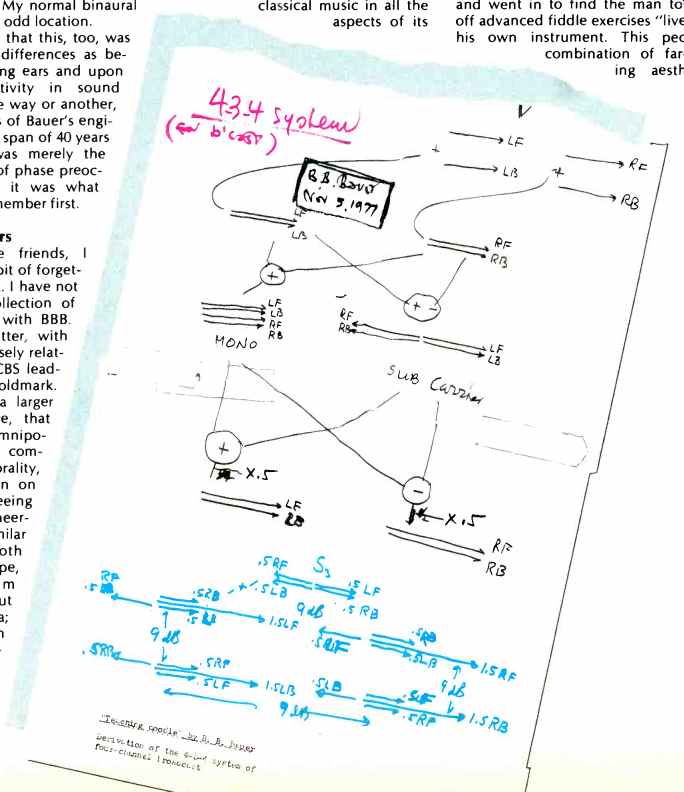
In later years, BBB would do the same but here it was some happily expensive suburban steak house in Connecticut where Bauer knew all the waitresses by their first names; and with his wife, we three would consume whole lobsters while I would again be subject to tablecloth and torn-notebook diagrams on every aspect of SQ and plenty more see illustration.
To Teach, Perchance to Learn
It was sheer education at its best, right from the top, a thing that could not ever be duplicated by an academic course, though that kind of organized study is equally important, obviously. I floundered (again see illustration). But I learned.
I tried, I really tried, to ascribe ulterior motives. Yes indeed, both men were single minded about promoting their own wares. After all, I would very possibly "write them up." But to spend all those hours with a non-engineer tyro like myself who had no more to offer personally than a brain and a desperate interest to learn the impossible this was beyond the call of duty. And public relations. They were natural teachers, these two, and as a matter of fact in his "off moments" (say a mere 8 hours a day) Bauer often taught courses in engineering. I learned with dismay, last year after his first and warning heart attack, of his pleasure in a strenuous 1978 summer course at Pennsylvania and the welcome request that he expand the project for the next summer this one. Too much! He never stopped. And his satisfaction was clearly in seeing the advancement of others' knowledge and understanding. The very learning process itself. As is my own satisfaction, too, in a smaller way and in different areas. This, I may say, is the utter opposite of what I must call the "didn't you know?" attitude, which radiates disdain towards those who do not happen to know the same things as the radiator himself. What distinguishes the real teacher in every area is a respect for the un-knowledge of his students, of whatever sort, even including us reasonably intelligent souls in the hi-fi press. I have always cherished that sort of respect. And with it goes another, an equal respect for the things that one does happen to know which was given to me unstintingly by Ben Bauer. We should realize by this time that leadership, greatness in this world, basically means humbleness of spirit.
Different personalities yes. I never saw Bauer less than humble in the deepest meaning of that word. Gold mark, at the glorious height of his fame, I thought rather enjoyed the perquisites and fringe benefits that come to the Big Boss. I will never forget the day when, happening to be at CBS for some other biz, I casually asked if I could stop by for a moment and see Dr. G., just for old times. It was at the apex of that glorious CBS development, EVR (TV recorded on film), and Dr. G. was IT. Braces of lowly minions took me in charge and I was granted the privilege of an INTERVIEW, maybe for five minutes. I walked in and gaped there he was, the Great God himself in his CBS heaven, behind a monstrous white desk so covered with phones and pushbutton consoles I could hardly see him, Rajah of Rajahs, the Panjandrum! Believe it or not, I began to laugh. Never saw such a preposterous sight.
"I didn't even ASK for an interview," I sputtered, "I just wanted to say hello and look at you!" For a moment a black thundercloud arose. Dr. Goldmark could be pretty formidable when he wanted to. But a twinkle quickly appeared and he suddenly laughed, too, almost apologetically. Those fancy trimmings really did look sort of silly.
How could I be expected to take them seriously? Before his last and somewhat pensive speech at an AES banquet, long after EVR, he came up to me of his own accord in the preliminary cocktail hour, this time with no conceivable public relations in mind simply as a human being. I was moved. Not so long after, he was killed in a hideous car accident.
I am, of course, aware that from his position as an executive in a very large corporation Ben Bauer was able to wield great power in the long, frustrating war of the quadraphonic systems. I do not think he ever abused the engineering aspects of that power, and I know that he was always ready to meet arguments with the most detailed reasoning. I must say now that in private I did not myself necessarily go along with all aspects of the SQ system that I could judge and understand that is, the audible, musical aspects.
I did feel that there were other and reasonable premises and different values, if not always presented with the rigorous logic that was Bauer's. But now that he is gone, few of us are likely to challenge the sheer technical elegance of his conclusions. Enough! Even BBB's erstwhile foes are going to miss the excitement of the fight that is now over, for him.
Take a look at that Brussels paper it'll soon be around. USQ by BBB.
(Source: Audio magazine, Aug. 1979; Edward Tatnall Canby )
TANDBERG
Perfection for the Professional
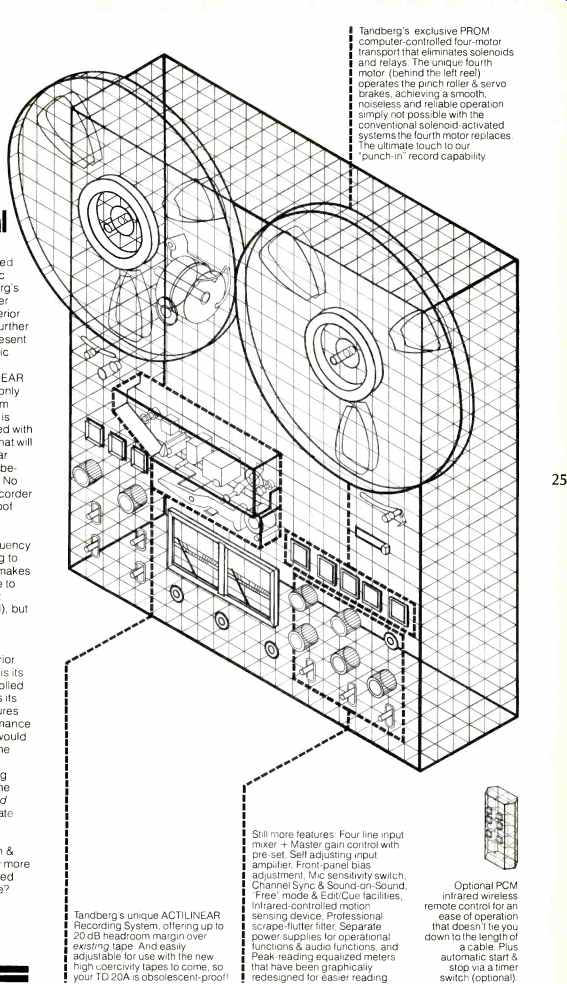
Drawing upon their unequalled 30 year leadership in magnetic recording technology, Tandberg's TD 20A open reel tape recorder extends their traditionally superior level of performance to even further limits-to even beyond the present capabilities of today's magnetic recording tape! This is due to Tandberg's exclusive ACTILINEAR Recording System, which not only provides up to 20 dB headroom margin over existing tape, but is specifically designed to be used with the new high coercivity tapes that will appear in the market in the near future-including the soon-to-be available metal particle tapes. No other quality open reel tape recorder can make this obsolescent-proof claim today.
The ACTILINEAR Recording System's extremely linear frequency response ("ruler flat" according to some test reviewers) not only makes the TD 20A essentially immune to slew-rate limiting and transient intermodulation distortion (TIM), but also means better transient response and lower distortion overall.
Adding to the TD 20A's superior level of quality & performance is its unique PROM computer-controlled four-motor transport, as well as its many standard operating features that permit a degree of performance and control flexibility that you would expect only from Tandberg-the world leader in tape recorders.
Visit your authorized Tandberg dealer for a demonstration of the TD 20A. Check our guaranteed minimum specifications and rate them against any other manufacturer. Combined with the unsurpassed ease of operation & control, the TD 20A is probably more tape deck than you actually need.
Isn't it the way things should be?
Tandberg's unique ACTILINEAR Recording System, offering up to 20 dB headroom margin over existing tape. And easily adjustable for use with the new high coercivity tapes to come, so your TD 20A is obsolescent-proof! Tandberg's exclusive PROM computer-controlled four-motor transport that eliminates solenoids and relays. The unique fourth motor (behind the left reel) operates the pinch roller & servo brakes, achieving a smooth, noiseless and reliable operation simply not possible with the conventional solenoid-activated systems the fourth motor replaces.
The ultimate touch to our "punch-in" record capability.
Still more features: Four line input mixer + Master gain control with pre-set, Self adjusting input amplifier, Front-panel bias adjustment, Mic sensitivity switch, Channel Sync & Sound-on-Sound, "Free" mode & Edit/Cue facilities, Infrared-controlled motion sensing device, Professional scrape-flutter filter, Separate power supplies for operational functions & audio functions, and Peak-reading equalized meters that have been graphically redesigned for easier reading.
Optional PCM infrared wireless remote control for an ease of operation that doesn't tie you down to the length of a cable. Plus automatic start & stop via a timer switch (optional).
For your nearest dealer write:
Tandberg of America, Inc.
Labriola Court
Armonk, N.Y. 10504
TANDBERG
Shure
fact: the phono cartridge is the heart of hi-fi...
The hi-fi phono cartridge functions as the source of sound (the point at which the recording is linked with the balance of the hi-fi system)-therefore, its role in high fidelity is absolutely critical. Just as the camera can be no better than its lens, not even the finest hi-fi system in the world can transcend the limitations of an inferior cartridge. The cartridge represents a relatively modest investment which can audibly upgrade the sound of your entire record playback system.
Consult with your nearby Shure dealer who will help you select the Shure phono cartridge that is correct for your system and your checkbook. We especially recommend that you audition the Shure V15 Type IV. Discriminating critics throughout the world praise this cartridge as the new standard for faithful sound re-creation. It overcomes such ever-present problems as dust, static electricity, "hot" signals, and record warp that cause "clicks" or "pops:' and distorted record reproduction. May we send you our brochure?

Shure Brothers Inc., 222 Hartrey Ave., Dept. H1, Evanston, IL 60204
SHURE: Manufacturers of high fidelity components, microphones, sound systems and related
-----
fact: it's easy to upgrade your M95 cartridge and gain dramatic freedom from distortion
One of the critically acclaimed advances introduced in Shure's incomparable V15 Type IV phono cartridge is its revolutionary and unique distortion-reducing Hyperelliptical diamond stylus.
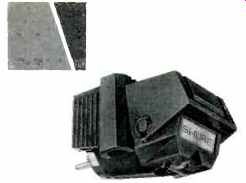
The Hyperelliptical stylus contacts the groove in a "footprint" that is narrower than both the Biradial (Elliptical) and the long contact shapes such as the Hyperbolic. The performance features of this new tip geometry are now available to owners of M95ED or M95G cartridges by simply upgrading either with a Model N95HE Hyperelliptical stylus.
You'll find the cost extraordinarily low-but the difference in sound will be immediately apparent.
The new stylus takes only seconds to install with a simple, no-tools procedure.
The Hyperelliptical stylus is also available in a brand new, ultra-flat frequency response, high trackability cartridge: the M95HE. Write for free brochure (AL600).
N95HE. Improvement Stylus
Shure Brothers Inc.222 Hartrey Ave., Evanston, IL 60204
MANUFACTURERS OF HIGH FIDELITY COMPONENTS, MICROPHONES, SOUND SYSTEMS AND RELATED CIRCUITRY.
JVC
Your deck isn't ready for the ultimate cassette tape ...
Introducing the first line of decks that are.
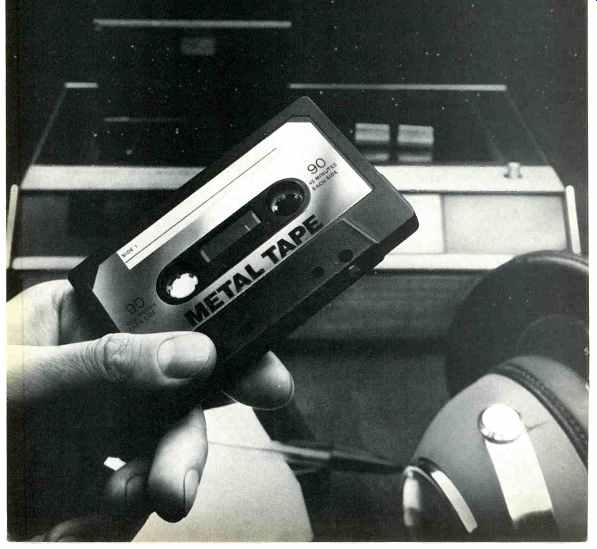
25-18,000 Hz± 3dB at-20VU with metal tape, 70dB signal-to-noise ratio.
6dB hotter output than ferrichrome.
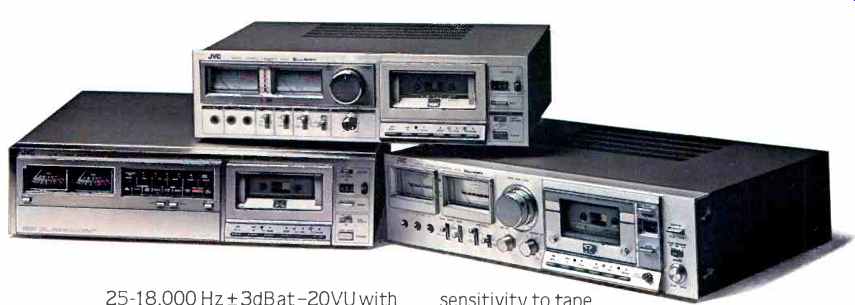

The reason we can offer you SIX metal tape-compatible decks with specs like these, is all in our heads. Sen-Alloy heads. With better high frequency characteristics than the Sen-Dust most of our competitors use, Sen-Alloy just happens to record and erase metal tape perfectly.
So while our competitors have had to struggle with little problems like designing heads that could handle metal tape, we've had a head start towards packing our metal decks with more state-of-the-art features.
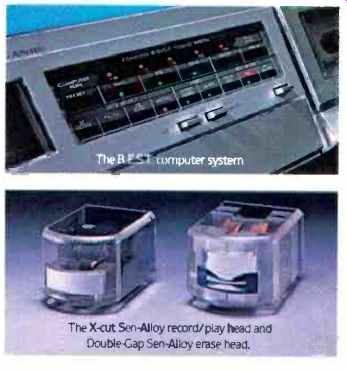
Our new "X-cut" Sen-Alloy record head extends bass response to lower than your woofers may go: 25Hz! Our unique double-gap Sen-Alloy erase head gets 60dB erasure on metal tape at the critical 400 Hz level.
Our B.E.S.T. computer automatically fine-tunes deck bias, equalization and sensitivity to tape in less than 30 seconds.
Spectra-Peak and Multi-Peak L.E.D. indicators react 100 times faster than meters so you can make perfect, undistorted recordings.
How much does it cost to replace the weak link in your system with a JVC metal deck? As little as $299, and no more than $750, suggested retail price.
After all, now that your ears are ready for metal tape, your pocketbook ought to be too.
JVC Corp., 58-75 Queens Midtown Expressway, Maspeth, NY 11378.
Now you're ready for JVC.
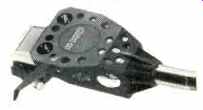
New Shure/SME IIIS tonearm

fact: we took the ultimate... and made it more affordable
Nitrogen-hardened "cartridge carrier" of pure titanium tubing
Precision bearing system for virtually frictionless operation
Extremely low effective mass to keep resonance frequency above the warp frequency region
Precision tracking force adjustment up to 2.5 grams without a separate force gauge
Total control of every important cartridge positioning consideration
Superb camera finish throughout
May be fitted with optional fluid damping system
Incomparable High Fidelity
Combination
The precision design of the Shure/SME Series IIIS tone arm is perfectly complemented by the spectacular performance of Shure's high trackability cartridge, the V1.5 Type IV. For the finest in high fidelity reproduction be sure to ask your dealer about purchasing the V IS Type IV along with the Series I IIS.
In the U.S.. SME tonearms are distributed exclusively by Shure Brothers Inc.
Stanton



A Revolutionary Record Care Breakthrough From Stanton...
Permostat eliminates record static permanently with only one application!
--UNTREATED RECORD -BRAND X -PERMOSTAT
Stanton introduces Permostat, the only record care product that eliminates record static permanently with just a single application. Permostat is a new and uniquely formulated fluid, which with just one application to a record totally eliminates static without any degradation in sound quality... and prolongs the life of your record.
Static electricity draws airborne dust particles onto the record where they can be pushed along the groove creating various degrees of audible distortion. Now, Permostat eliminates this problem permanently.
To demonstrate Permostat's unique anti-static qualities, Stanton engineers constructed a dust chamber to perform accelerated dust pickup tests.
In this test, three records were suspended vertically within the chamber, the first untreated, the second treated with anti -static products currently available (piezo electric guns, fluids, cloths and conducting brushes) and the third treated with Permostat.
Under test conditions, only the Permostat treated record showed no visible evidence of dust pickup and no residual charge.
Each Permostat kit provides protection for 25 records (both sides). Just spray it on, buff it in and eliminate static for the life of your records.
Now available at your local dealer.
Suggested Retail: Complete Kit...$19.95; Refill...$15.95
For further information contact:
Stanton
= = = =