Well, here it is September already, and summer is beginning to fail. So this month's column is going to have a lot of failings including some that are of the double-negative sort that come out positive. If summer fails, can fall be far behind? And without fail, year after year, autumn is the time when hi-fi falls into place again after the hot weather hiatus.
We use that term "fail" too often, if you ask me. It's getting to be silly. Every single political opponent fails to do or say just about everything imaginable. I just got a snippy postcard concerning my musical broadcast in New York I "failed to identify" some of the performers. I didn't fail. I did it deliberately, because my subject was the music and its composer, and the performers were performing very well on their own, thanks. So often, you see, we are doing something positive when we "fail." Yes, this evening I failed to drink my usual martini before dinner, I had a manhattan instead.
A year or so ago in this space you may well remember that I spoke of an honorable old AM-FM tuner, the Fisher Series 80, one of the first "miniaturized" hi-fi components using the then new miniature tubes and taking maximum advantage of their reduced space requirements. (My point, in case you forget, was that the enormously smaller transistor and its relatives plus the IC have led us not to smaller but to larger hi-fi units, a thought that failed to please me.) So shortly thereafter in a letter to Audio magazine (June, 1977) Burdick S. Trask of Sherman Oaks, Cal., wrote a fascinating account of his refurbished 1936 Spartan all-wave receiver, complete with bi-amped output into a 15-inch woofer and two tweeters via an electronic crossover -- for more details see the letter itself. However, before he got into that, Mr. Trask took a good humored sideswipe at me and my Fisher. It seems I "failed to mention" once again the broad and narrow band width i.f. switch on the Fisher front panel, the main use of which was to allow reasonable hi fi when an AM station came in wide, clear and, maybe, clear channel, yet in the narrow-band position reduce the hopeless AM interference, especially at night, when reception was weak and/or distant and the desired station overborne by its neighbors far and near.
Selectivity.
Well, with reluctance, the truth must now out. Yes, I failed to mention this useful Fisher feature, out of tact. On my Fisher the FM worked beautifully as I indicated, but the AM was dead.
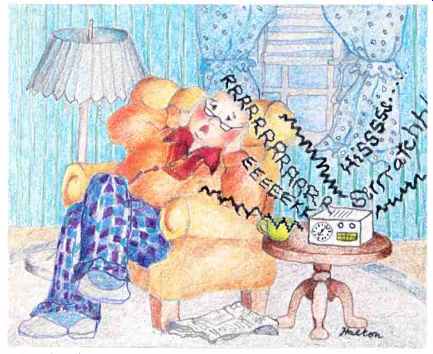
Well, not quite. It did produce several types of interesting hiss and the signal strength needle moved perceptibly now and then as I wheeled along the AM band. But that wasn't enough for my local weather summary, which was what I was after at the moment. On mature reflection, and since the rest of the tuner worked just fine, I decided to fail to mention the dead AM. After all, it was probably my fault. And time had indeed been passing for many a year so why not give Fisher the benefit of the advantage? And after all, too, Mr. Trask's Spartan was rebuilt by himself from the bottom upwards with new and revived parts and even some rather vital modernizations.
My Fisher Series 80 was strictly on its own, never serviced in any way and still (mostly) operating. So there's one positive failure for you.
I'll betcha one of you hounds could fix that Fisher in an hour or two if you got your hands on it. Just call me up and I won't charge you a thing.
Historical Horrors
And speaking of that, our friend Bert Whyte last year in his history of hi-fi shows missed out on (i.e. failed to mention) one of the prime marvels of the first Audio Fairs in the Hotel New Yorker over on 8th Avenue and 34th Street in the Big Apple. That august hotel, vaguely out of the art deco era (1930s?) was indeed furnished with 120 volts of electric potential in each and every room, since it wasn't nearly old enough to boast gas light. But thanks to dear old Thomas A. Edison and his latter day namesake utility, now nicknamed Con Ed, the New Yorker was provided with the very best available electricity in the mid-town area as we used to put it, 120 volts of d.c. current. And we picked that for a HiFi show! Maybe nobody realized it until the last minute.
But the show must go on, and the Audio Fairs did indeed. Somebody with a proper electrical background had apparently foreseen the future and the lucrative possibilities in servicing Conventions at the hotel, electronic included. There was a modest local alternator, somewhere down in the basement, which fed a.c. to extra outlets (right among the d.c. outlets) in well, in some of the rooms.
Our earliest hi-fi exhibitors, therefore, had to choose the right socket, and if they did they were rewarded with that splendid cacophony which we now find so familiar in hi-fi shows the world over. It was a brand-new sound, then, and not nearly as well appreciated as now. If the wrong socket was chosen, in haste or by unfortunate accident, then there was smoke and damage and silence except for that ominous crackling hiss.
That alternator, if I remember correctly, was the handiest closing-time signal you can imagine. Right on the dot, six o'clock or whatever, the a.c. failed, whereupon the constant and excruciating blasts of nonintegrated fi from dozens of superior sources suddenly ceased penetrating every wall into four surrounding rooms and into corridors all over.
And we were left in an instant with the loveliest silent d.c. illumination you can envision. The d.c. kept going it was from Con Ed. Conversations, continued, in low, hushed tones, and I'd guess there were more hi-fi deals made in those late moments of silence than in all the day's noise.
All that goes back to one of T. Edison's greatest failures in the midst of his greatest triumph, the integrated electric light system as pioneered right there in New York at the famed Pearl Street power station and distribution system. That system was built on direct current, two-conductor. Very soon after, Edison worked out the three-conductor system but again via d.c. When this idea was applied to its ultimately right area, the a.c. distribution system, we had modern power but old Thomas would not go along. He stuck to d.c. and there were horrid stories perpetrated about people being fried via high-voltage a.c. in those newfangled arrangements. This was made even more gory by virtue of the new electric chair, which fried but did not quite kill one of its earliest occupants. Result was that the older Eastern cities, notably Boston and New York (and I would suppose Philadelphia) became entrenched in the d.c. system and stayed that way an astonishing number of years, right on through the 1930s. Of all the vicious impediments to fi, that of d.c. in the home was surely at that time the worst. Very nearly insurmountable. I should know; I was there.
Yankee Ingenuity
When I got out of college I moved to New York, right into a d.c. zone. There were plenty left, all over town. Ah, for today's ultra simple transverters, to make up a generic term! I could not exist without a record player, even then. I had a big collection of 78s, which travelled to New York from my college room with hardly more than 5 percent breakage, a near miracle, thanks to enormous care in the packing of it into my family's Ford . Naturally, I had rented my lodgings without a thought as to current and now it was too late. So I went out and bought a perfectly enormous motor-generator thing, which I could just barely lift.
Installed in my modest rooming-house corner, it went on with a wham, as the d.c. lights went momentarily dim, and produced a roar of "live" noise that rivaled the sound of the (a.c.) portable phono that it fed. So, heaven protect me, I put it in the back of a deep, deep, old-fashioned clothes closet and covered the entire thing with layers of old blankets and such. The brashness of youth! Somehow, there was no fire.
However, I failed to anticipate a failure to filter. There was a loud, insistent buzzing that came through my speaker whenever I played Beethoven. Was it square wave or sawtooth? I tend to think the latter. And Beethoven would have rolled over for good, because the pitch of everything, as you might guess if you are a Murphy's Law man, was about a half step too high.
Most radios and phonos in those days where a.c./d.c. and these faults, even in commercial manufactured equipment, were all too common.
Nasty buzzing.
Wrong pitch.
The very idea of fixed and stable playback speed, of course, was then relatively recent. The old acoustic machines had a loosely adjustable friction playback speed control, marked Fast and Slow, or just F and S, and you pitched things to taste, with the spring fully wound. As most of us know, the early acoustic 78s were of many speed variants in the original cutting. Fixed pitch only became really practicable in the electrical area of the 1920s, but it took many long years before the home player could match the large professional cutting table in this extremely vital respect. So-I was brought up on variable pitch, alternating with unstable pitch, as commonly found on virtually all the standard home equipment of the pre WW II period. That was a real failure, though nobody seemed to be bothered much except for a few of us musicians.
With all of that, you can understand why each time hear of a new amplifier that is "flat to d.c." I give a cringe and fail to be properly impressed. In my book, d.c. is an element of hated memory. Is there any U.S. city still providing d.c. for public consumption? If there is, I don't want to hear about it, so please fail to tell me.
Booming Bass
One final item in the positive failure category. A few months back, I went to a fabulous "do" in a late-late New York disco-type place (it was mid-afternoon) to celebrate an ingenious new device for the disco trade (mostly) whereby a low bass portion of the musical signal is electronically transposed downwards an octave (transpose is the proper musical term) and then fed to the giant woofers via giant power amps. When this thing was operating via the house system, the bench on which I had sat down actually jumped up and down under me on every beat. Overpowering. Fantastic!
The outfit behind this powerhouse bass is, of all people, dbx, a very imaginative firm if there ever was one. The only curious thing, as old readers may agree, is the title-Boom Box ! Now, not too many years ago, that term was generally derogatory and unfunny, referring to a mistuned home speaker system that produced a resonant, broken-up, false bass, not so much a thump as a thrrump. The sound had its place in the old commercial jukeboxes, which often had no highs above 2.5 kHz and made up for it by the famous basso, not so profundo, that would go right through walls. In a crowded "joint" that was all you got to hear. But when a haphazardly matched home bass-reflex system (speaker and cabinet bought separately) produced a similar thrrump, we spoke disparagingly and with disdain of the boom-box sound. We disapproved. Ask Paul Klipsch.
Well, I suppose dbx really didn't know -- or failed to remember. Because they are dealing with superpower public nitery and disco-type equipment where the enormously enhanced and improved Big Boom is very much in place and in taste.
I liked it! However-dbx did put on a small publicity for their Boom Box as a home device, usable even with systems of very modest power. I'd take that with some d.c. salt, if I were you. The small system won't really get much whomp out of the transposing down an octave. Not enough power and probably not enough bass range in the speakers. But if you have the prevailing super-watt big system, you may find your floor hopping and ditto for the ceiling below. But have a care with the overall level of the system. For while you may well love the effect of the Boom Box, your downstairs neighbors may fail to appreciate the unit quite so much as you do.
(Source: Audio magazine, Sept. 1978; by Edward Tatnall Canby)
=====
European Records
by John Wright
It is peculiar how when one new recording of a work appears, competitive versions are issued in rapid succession from other major record companies. At the moment this seems to be centered around Liszt's Sonata in B minor. Only a short while ago I had reason to enthuse about the outstanding performance by Berman on the Melodiya label (ASD 3228), which is comparatively unemotional but freely exploits the artist's dexterity. This has been swiftly followed by a performance of Vladimir Horowitz in his Golden Jubilee Recital disc on the RCA label (RL 12548). Considering his age, this is equally flamboyant but with many inexactitudes accompanied by an over-emphasis of contrasts. And now the latest release by Alicia De Larrocha recording on Decca (SXL 6756) provides a more romantic and whimsical interpretation of this rather formless sonata. It is played with a technical expertise, that in contrast to these other performances, makes it sound so easy. The piano tone is convincing, portrayed with an adequate sense of spaciousness, and the nearest comparison from my collection for such positive sentimentality and complimentary acoustics is the 1971 recording by Agustin Anievas (EMI HQS 1246) which still weathers well. However, with due consideration between these renditions, my first choice would now lie with this new Decca as the most tasteful musical/engineering balance.
Albeit, perhaps, less spectacular, the record reincarnates my initial adolescent attraction to the work ... even after repeated playings.
------Alicia De Larrocha
In my last record column I had cause to enthuse over Alfred Brendel's interpretation and Philips' recording of Schubert Impromptus. This month I give equally unreserved praise for Brendel's contribution to the Liszt catalogue this time with a selection of items including the well-known prelude and fugue on the name B-A-C-H. It is surely the sign of a great performer, be he actor or musician, if he can lend himself equally to a multitude of roles. The "organ-like" playing which Brendel brings to this work is in complete contrast to any other works that I have heard him play. From a technical viewpoint this release (9500 826) retains that uncanny naturalness that epitomizes the best of Philips and as such is the best recording of the Liszt discs mentioned in this issue.
Also in the last column I recommended two Haydn Symphonies, The Philosopher and The Schoolmaster, played by Neville Marriner and The Academy of St. Martin-in-the-Fields (9500 198). Continuing the series, we have two more releases which are recorded in an equally luscious way, yet being clean and crisp.
Haydn Symphonies 94 & 96, The Sunrise and The Miracle, are properly and frivolously performed on 9500 348 while Symphonies 44 & 49, The Mourning and La Passione, on 9500 199 are less immediately attractive but perhaps for this are longer lasting in their appeal.
A quick mention of a great event is that in celebration of Vivaldi's birth 300 years ago, I Musici, celebrating their 25th Anniversary, are engaged in the recording of 10 volumes totaling nearly 50 LPs of his chamber works! Obviously at the expense involved nobody is going to purchase all or even part of this marathon on the basis of cursory remarks from me, but judging by a sampler (available at a reasonable price) I can concur that Philips have maintained their high standards of chamber music recording for which they are justifiably renowned. On 6833 247, this sampler at least is really too good to miss.
Moving forward in time, musically speaking, works for two flutes by J.S., W.F., and C.P.E. Bach are played by Stephen Preston and Nicholas McGegan on DSLO 518. It is an "in-the-room" presentation being slightly dry and in need of a large listening area, allowing a good seating distance from the loudspeakers. The high cutting level results in low background noise, revealing breathy action sound of the instruments.
The performance as such I would describe as "straight-laced."
News from Enigma, which was started in June, 1976, by John Boyden and Peter Whiteside (being joined in December of that year by Tony Faulkner as recording manager), is of a recent takeover by WEA Records, a subsidiary of Warner Communications Inc. In less than two years Enigma has issued 45 records in addition to some 25 others already taped but not yet released. Initially it was the company's policy to concentrate on the British market but the future will involve more and more international artists. It is interesting that one of the most dynamic and modern pop record companies should have bought Enigma who are almost alone in making a classical product based upon simple microphone techniques, rejecting with scorn the widespread anti-musical multi microphone, multi-track techniques of the pop studio.
Something magical generally happens when Sir Adrian Boult conducts while Parker & Bishop record for EMI. Their latest recording of Beethoven's Symphony No. 6 Pastoral with the London Philharmonic on ASD 456 is no exception. It is unashamedly warm and lyrical and is accompanied by subjectively unrestricted low frequencies, resulting in a sonic experience that can only rate as "superb." It is therefore slightly a pity that in the same period the same engineers should record the LSO conducted by Eugene Jochum performing Beethoven's Symphony No. 5 (ASD 3484) for which if there had been no direct comparison would have deserved a similar rating sound-wise. However, this just misses that higher echelon, being slightly brasher but perhaps correctly so? In complete contrast by way of balance, Brian Couzens provides a BBC type "seat-in-the-audience" perspective of the complete Sibelius Tone Poems played by the Scottish National Orchestra conducted by Sir Alexander Gibson (RCA RL 25136: 2 records). Apart from some minor pressing flaws, which are becoming more prevalent on this label of late, this whole rendition is likely to appeal mostly to the purists among us and reproduces well at low levels when listening in a quiet environment.
Containing equally good distance effects, HMV's new recording of Bizet's The Pearl Fishers creates a highlight on the operatic scene (SLS 5113, 2 discs). It is rare for me to recommend opera records, and this is, regrettably, because they are usually too contrived for my tastes. While I acknowledge the dilemma presented to the engineers by this art form, I do object to "full frontal" soloists thrown before a receding orchestra. Not so in this box set, where the front-to back perspective is fine in every respect, with the orchestra (enjoyable to listen to on its own) is extended in both range and dynamics, yet with the soloists well positioned, even if synthetically, only just in front. Conceding the insuperable difficulties of opera recordings as a home entertainment medium, this version is difficult to fault and the Chorus and Orchestra of the Paris Opera, conducted by Georges Prêtre, provides an authenticity coupled to some of the loveliest music which has rightfully become very popular.
Returning to music more suited to the home, Elly Ameling, accompanied by Dalton Baldwin (piano), sings Songs for Gretchen, Ellen and Suleika by Schubert on Philips 9500 169. Including the famous Ave Maria, this has similar qualities to their earlier discs of 16 Leider (6500 774), possessing a "single microphone" feeling about the balance.
Equally it is emotional but unsentimental, conveying a depth of feeling yet without embarrassment. The ambience suggests a deceptive cutting level. In fact the record is not too easy to track, and I found it necessary to keep the stylus impeccably clean, but this is a small sacrifice for the satisfaction provided.
It is coincidental that within the same quarter RCA should choose to issue a two-record set of Schumann Romantic Lieder sung by Peter Schreier, accompanied by Norman Shetler on RC 25126, which in its way is outstanding.
It is a forward and onward going interpretation, if perhaps a little over-dedicated, but has similarities to the Schubert in the plushness of balance although comparatively sibilant in places.
The market seems insatiable for records of Stravinsky's The Rite of Spring.
Why this should be defeats me, since for my money if one had to extract the single Stravinsky ballet that stands repeated listening without the visual element, it would be Petrushka. However, I must be in the minority since the number of records in my collection alone disproves this. Maybe it is that, in short doses, parts of The Rite of Spring make ideal demonstration material for hi-fi enthusiasts. Following this line of thinking, and looking back through the most popular releases, there has been a distinctly "contrived" versus "purist" battle between engineers. Each strategy has succeeded within its own right, but only to a certain extent. One of the most successfully "contrived" discs with particularly impressive brass is that conducted by Sir Georges Solti on Decca SXL 6691, while a comparatively "purist" approach was taken by Philips and Haitink on 6500 482. Bridging the two approaches then came Lorin Maazel on Decca SXL 6735. And now we have yet another new disc which really does not fit into any of these categories.
Conducting the Concertgebouw Orchestra, this time Colin Davis records for Philips (9500 323). It has that distinctive "laid-back" sound but with special crispness, detail, glistening transients, and differentiated timpani. So often where there is an extended bass drum, it results in a homogenous wedge. Not so here where every skin struck can be heard as a separate entity. I hesitate to call it natural but certainly it does possess that quality demanded by the pseudo-purist (despite Enigma's recent release). Containing impact, this is the very best "compromise" recording so far. Very little need be said about the playing except that it embodies a deliberately punctuated interpretation. Surprisingly for the extraordinary results achieved, there is no need to play this record loudly to maintain excitement and neither, despite the nature of the work, is it particularly tiring. To sum up I don't know how this record was made, but the results are so fine I don't even care.
==========
Vintage magazine ADs:
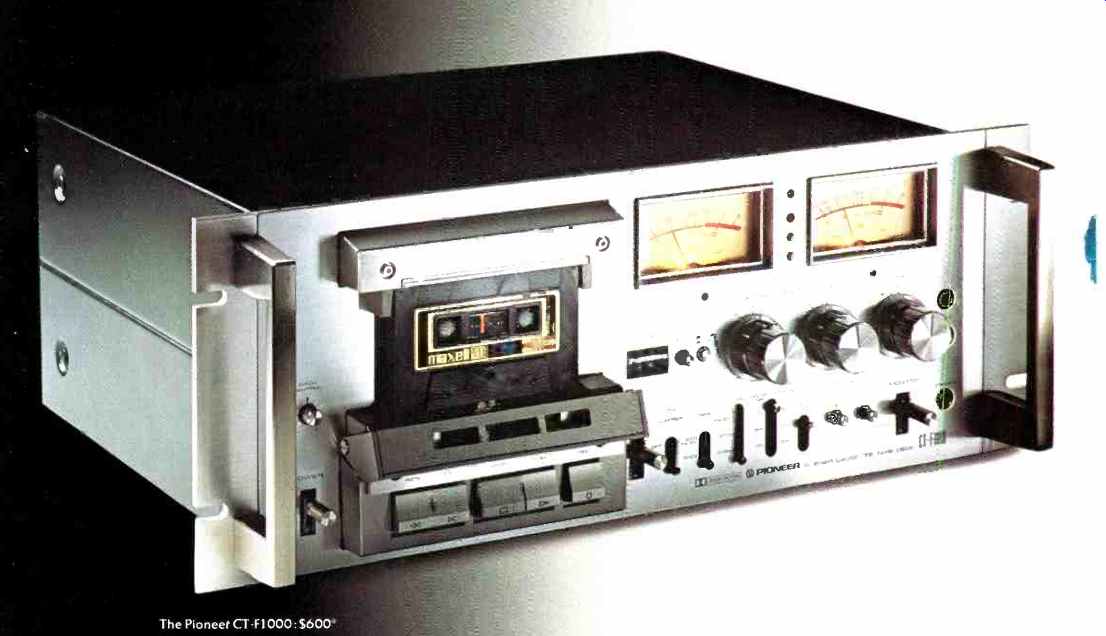
The big difference between this cassette deck and Pioneer's new CTF1000 isn't sound.
It's Value.
For years, Nakamichi has enjoyed a reputation for building the world's finest cassette deck.
Now Pioneer is introducing something Nakamichi won't enjoy at all: the Pioneer CT-F1000. A cassette deck that offers all the features and performance of Nakamichi's best cassette deck, at less than half the price.
PIONEER VS. NAKAMICHI: THE HEAD TO HEAD COMPETITION.
The $1,650 Nakamichi 100011 and the $600 Pioneer CT-F1000 are both honest three headed cassette decks that let you monitor right off the tape as you record.
Both have separate Dolby systems for the playback and recording heads. So when you're making a recording with the Dolby on, you can monitor it exactly the same way.
Both have two motors to insure accurate tape speed.
Both feature solenoid logic controls that let you go from fast forward to reverse, or from play to record without punching the stop button, and without jamming the tape.
And both are filled with convenient items like automatic memories for going back to a selected spot on a tape, multiplex filters for making cleaner FM recordings, separate bias and equalization switches for getting the most out of different kinds of tape, and even a pitch control adjustment that lets you match the pitch of a cassette to the tuning of your guitar or piano.
A $1,000 GAP IN PRICE; NO GAP IN SOUND.
When we built the CT-F1000, however, we did more than match the Nakamichi's renowned features. We also matched its renowned performance.
Both machines boast totally inaudible total harmonic distortion levels of less than 1.5%.
Both have all but conquered the problem of wow and flutter. (An identical 0.05% for each machine.) Both offer similarly impressive signal to noise ratios: 64 decibels Pioneer, 65 decibels Nakamichi. (At these levels we dare you to hear any noise at all, let alone any difference.) And finally, where the CT-F1000 delivers a frequency response of 30 to 17,000 hertz, the Nakamichi deck goes from 35 to 20,000 hertz. (We offer a little more at the bottom; they offer a little more at the top.
Either way, the specifications are close enough to be called virtually identical.)
A FEW PIONEER ADVANTAGES THAT AREN'T MONETARY.
To prevent you from making distorted tapes, the CT-F1000 has a peak limiter that the Nakamichi machine lacks.
Our tape heads are made out of a special single crystal ferrite material that's been proven to last longer than the Nakamichi's permalloy variety.
And our Dolby system can be calibrated by hand while the Nakamichi 10001I requires a screwdriver.
Admittedly, the Nakamichi 100011 does feature a fancy azimuth control for aligning your heads before every recording session. But we've developed a more accurate way to mount the heads in the first place. So you can spend your time recording, instead of aligning.
A FEW CONCESSIONS TO NAKAMICHI.
Obviously, at almost $1,000 more, the Nakamichi 100011 must offer some advantages over the CT-F1000. And we'd be remiss if we didn't point out that their VU meters extend slightly higher than ours.
And that they have extra input for premixed program sources.
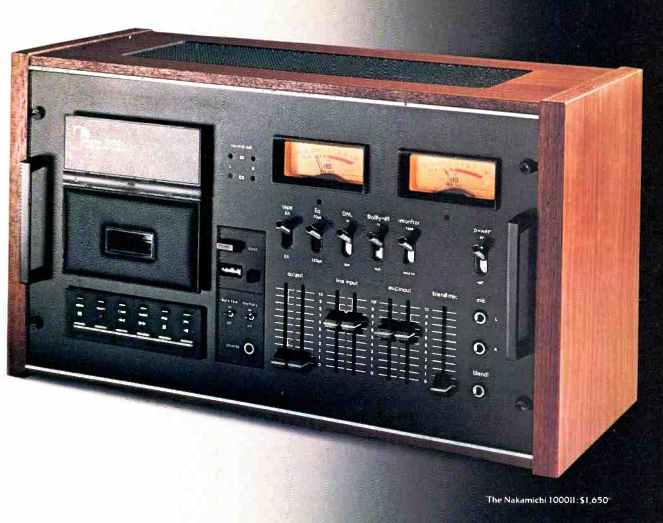
And although their signal to noise ratio is hardly different than ours, the Nakamichi 100011 does feature an extra Nakamichi-invented noise reduction system.
Considering the slimness of these advantages, the choice is clear-cut: You can buy a Nakamichi 1000II and get an incredibly expensive cassette deck.
Or you can buy a CT-F1000. And get one that's simply incredible.
PIONEER We bring it back alive.
*Manufacturer's suggested retail price. Handles optional at extra cost.
U.S. Pioneer Electronics Inc., 85 Oxford Drive, Moonachie, N.J. 07074.
---------------
TDK

To get a superb performance, you need a precision machine.
To command a great performance, a cassette shell and cassette tape must be engineered to the most rigorous standards.
Which explains why we get so finicky about details. Consider:
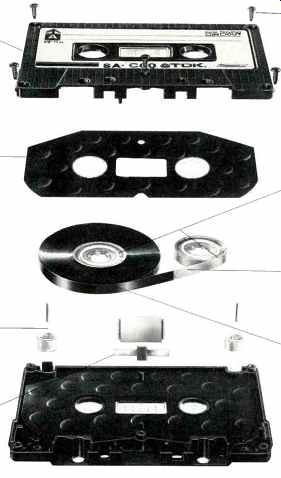
Precision Molded Cassette Shells--are made by continuously monitored injection molding that virtually assures a mirror-image parallel match. That's insurance against signal overlap or channel loss in record or playback from A to B sides. Further insurance: high impact styrene that resists temperature extremes and sudden stress.
An Ingenious Bubble Surface Liner Sheet--commands the tape to follow a consistent running angle with gentle, fingertip-embossed cushions. Costly lubricants forestall drag, shedding, friction, edgewear, and annoying squeal. Checks channel loss and dropouts.
Tapered, Flanged Rollers--direct the tape from the hubs and program it against any up and down movement on its path towards the heads. Stainless steel pins minimize friction and avert wow and flutter, channel loss.
Resilient Pressure Pad and Holding System spring--mounted felt helps maintain tape contact at dead center on the head pap. Elegant interlocking pins moor the spring to the shell, and resist lateral slipping.
Five-Screw Assembly--for practically guaranteed warp-free mating of the cassette halves. Then nothing-no dust or tape snags-can come between the tape and a perfect performance.
Perfectly Circular Hubs and Double Clamp System--insures there is no deviation from circularity that could result in tape tension variation producing wow and flutter and dropouts. The clamp weds the tape to the hub with a curvature impeccably matched to the hub's perimeter.
Head Cleaning Leader Tape--knocks off foreign matter that might interfere with superior tape performance, and prepares the heads for...
Our famous SA and AD Tape Performance--two of the finest tapes money can procure are securely housed inside our cassette shells. SA (Super Avilyn) is the tape most deck manufacturers use as their reference for the High (CrO2) bias position. And the new Normal bias AD, the tape with a hot high end, is perfect for any type of music, in any deck. And that extra lift is perfect for noise reduction tracking.
TDK Cassettes--despite all we put into them, we don't ask you to put out a lot for them. Visit your TD dealer and discover how inexpensive it is to fight dropouts, level variation, channel loss, jamming, and other problems that interfere with musical enjoyment.
Our full lifetime warranty* is your assurance that our machine is the machine for your machine. TDK Electronics Corp., Garden City, N.Y. 11530. Canada: Superior Electronics Ind., Ltd.
The machine for your machine.
----------------
Sansui
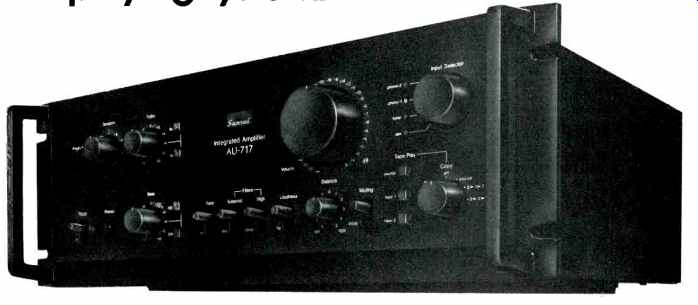
"The Sansui AU-717 is a superb amplifier.
We like it with no ifs, ands, or buts. (Julian Hirsch)
It offers "as much circuitry sophistication and control flexibility as any two-piece amplifying system:'
Everyone says great things about the new Sansui AU-717, but the experts say it best.
The Sansui AU-717 DC integrated amplifier is "Sansui's finest .... It incorporates a fully direct coupled power amplifier section whose frequency response varies less than +0,-3dB from 0Hz (D.C.) to 200 kHz. The amplifier's power rating is 85 watts per channel (min. RMS) from 20 to 20,000Hz into 8-ohm loads, with less than 0.025 percent total harmonic distortion .... If any amplifier is free of Transient Inter modulation Distortion (TIM) or any other slew-rate induced distortion, it is this one .... The slew rate ... was the fastest we have measured on any amplifier, an impressive 60 V/µsec.
"The preamplifier section of the AU-717, has very impressive specifications for frequency response, equalization accuracy, and noise levels ... The AU-717 has dual power supplies, including separate power transformers, for its two channels ... [and] exceptionally comprehensive tape-recording and monitoring facilities .... Good human engineering ... separates this unit from some otherwise fine products.... "The Sansui AU-717 is a superb amplifier. We like it with no ifs, ands, or buts." (Reprinted, by permission, Stereo Review Magazine, Feb. 1978. Julian Hirsch Test Report. Copyright 1978. Ziff-Davis Publishing Company, All rights reserved.) "One clear advantage of DC design is apparent. Even at the low 20Hz extreme, the amplifier delivers a full 92 watts the same value obtained for mid frequency power compared with its 85 watt rating into 8 ohms....
"The equalization characteristic of the preamplifier was one of the most precise we have ever measured, with the deviation from the standard RIAA playback curve never exceeding more than 0.1dB.... "Sansui claims that this unit has reduced transient intermodulation distortion-a direct result of the DC design, and, indeed, the model AU-717 delivered sound as transparent and clean as any we have heard from an integrated amplifier.... worth serious consideration even by those who prefer separate amplifiers and preamplifiers." (Reprinted in part from Len Feldman's test report in Radio-Electronics, January, 1978.) Listen to the superb sound of the Sansui AU-717 at your Sansui dealer today. And be sure to ask him for a demonstration of the matching TU-717 super-tuner.
SANSUI ELECTRONICS CORP. Woodside, New York 11377; Gardena, California 90247; SANSUI ELECTRIC CO., LTD., Tokyo, Japan; SANSUI AUDIO EUROPE S.A., Antwerp. Belgium
---------------------
ADC
Now you can hear the music you’re missing.

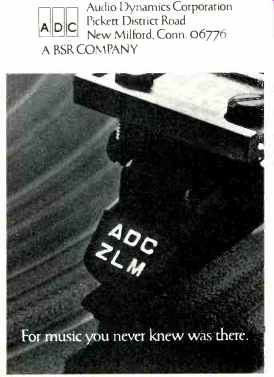
You cant hear everything that's in the grooves unless you have an extremely sensitive cartridge. A cartridge that can pick up all the subtle harmonics you are probably now missing. A cartridge like the ZLM by ADC. The ZLM has the unique ALIPTIC stylus. Which combines better stereo reproduction with less wear to your records.
What's more, the frequency response is always ruler flat ±1dB to 20kHz and ±1 1/2dB to 26kHz.
It tracks at 1/2 to 1 1/4 grams.
So listen to the ZLM cartridge.
It's like listening to a whole new record collection.
Audio Dynamics Corporation Pickett District Road New Milford, Conn. 06776
A BSR COMPANY -- For music you never knew was their.
------------------
THERE'S MORE TO FM THAN BEING ON THE RECEIVING END.
Over the past few years numerous hi-fi companies have introduced an array of sophisticated FM tuners. All claim to make a remarkable advancement in FM reception and the claims are justified. Strong reception is an important factor in the reproduction of an FM signal.
Unfortunately, the reception is only the beginning.
As a matter of necessity, most FM stations compress the dynamic range of the musical material prior to transmission in order to make it easier to broadcast. All other tuners regardless of their sophistication simply decode this compressed signal and pass it along to the amplifier. The reception may be excellent, but the dynamic range of the material is still greatly compressed. That's what your amplifier will reproduce. As a result, FM reproduction is generally regarded as mediocre in comparison to records and tapes.
Until now.
The Phase Linear 5000-Series Two FM Tuner represents a significant sonic improvement in the reproduction of an FM signal.
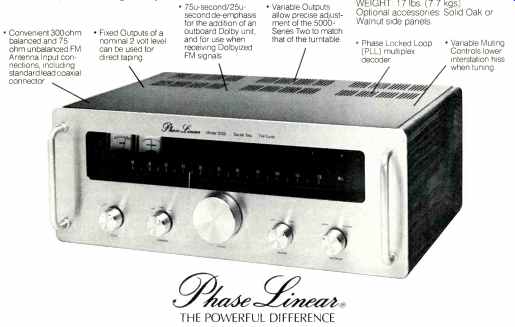
By incorporating a linear signal expansion circuit, the Phase 5000 Series Two successfully compensates for problems associated with signal compression, and is able to restore up to 9 dB of dynamic range.
With the Phase 5000-Series Two, FM reproduction exhibits a dynamic range and sonic quality that is audibly superior to other tuners.
Regardless of price: Interested in adding FM to your collection of recorded material? The Phase Linear 5000-Series Two belongs in your library.
SPECIFICATIONS IHF SENSITIVITY: (mono) 10.8 dBf (1.9 uV) (stereo) 20.8 dBf (6.0 uV) USABLE SENSITIVITY: 50 dB Quieting: (mono) 14.8 dBf (3.0 uV) (stereo) 34.8 dBf (30.0 uV) SIGNAL: NOISE @ 65 dBf: (mono) 74 dB (stereo) 72 dB TOTAL HARMONIC DISTORTION:
@ 65 dBf: (Narrow Band) (mono) 0.1% (stereo) 0.2% FREQUENCY RESPONSE: 20 Hz-15 kHz ±.5 dB CAPTURE RATIO: 1.2 dB (Narrow Band)
ALTERNATE CHANNEL SELECTIVITY: 75 dB (Narrow Band)
STEREO SEPARATION: 1 k 42 dB. 10k32dB SPURIOUS REJECTION: 120 dB AM SUPPRESSION: 60 dB IMAGE RESPONSE: 110 dB DIMENSIONS: 19" X 7" X 10" (48.3cm X 17.8cm x 25.4cm)
WEIGHT: 17 lbs. (7.7 kgs)
Optional accessories: Solid Oak or Walnut side panels.
Convenient 300 ohm balanced and 75 ohm unbalanced FM Antenna Input connections, including standard lead coaxial connector.
Fixed Outputs of a nominal 2 volt level can be used for direct taping.
75u-second/25usecond de-emphasis for the addition of an outboard Dolby unit, and for use when receiving Dolbyized FM signals.
Variable Outputs allow precise adjustment of the 5000 Series Two to match that of the turntable.
Phase Locked Loop ((DLL) multiplex decoder.
Variable Muting Controls lower interstation hiss when tuning.
Phase Linear--THE POWERFUL DIFFERENCE
Phase Linear Corporation/20121-48th Avenue West/ Lynnwood, Washington 98036
Made in U.S.A.
Distributed in Canada by H. Roy Gray Ltd. and in Australia by Megasound Pty. Ltd.
-------------------
audio-technica phono cartridges
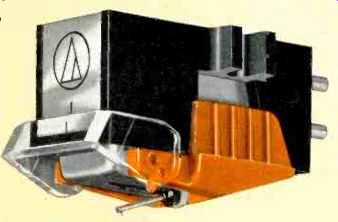

Q Where should you start in your search for better sound? At the beginning. With a new Audio-Technica
Dual Magnet stereo phono cartridge.
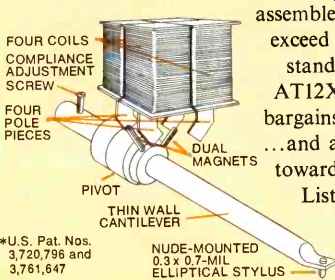
Our AT12XE, for instance. Tracking smoothly at 1 to 1-3/4 grams, depending on your record player. Delivers smooth, peak-free response from 15 Hz to 28,000 Hz (better than most speakers available). With a minimum 24 dB of honest stereo separation at important mid frequencies, and 18 dB minimum separation even at the standard high-frequency 10 kHz test point. At just $65 suggested list price, it's an outstanding value in these days of inflated prices.
Audio-Technica cartridges have been widely-acclaimed for their great sound, and for good reason. Our unique, patented Dual Magnet construction provides a separate magnetic system for each stereo channel. A concept that insures excellent stereo separation, while lowering magnet mass. And the AT12XE features a tiny 0.3 x 0.7-mil nude-mounted elliptical diamond stylus on a thin-wall cantilever to further reduce moving mass where it counts. Each cartridge is individually assembled and tested to meet or exceed our rigid performance standards. As a result, the AT12XE is one of the great bargains of modern technology ...and a significant head start toward more beautiful sound.
Listen carefully at your Audio-Technica dealer's today.
FIG. DUAL MAGNETS
FOUR COILS
COMPLIANCE ADJUSTMENT SCREW FOUR POLE PIECES
PIVOT
THIN WALL CANTILEVER
* U.S. Pat. Nos.
NUDE-MOUNTED 3,720,796 and 0.3x 0.7-MIL 3,761,647 ELLIPTICAL STYLUS-
audio technica.
INNOVATION - PRECISION – INTEGRITY
AUDIO-TECHNICA U.S., INC., Dept. 98A, 33 Shiawassee Avenue, Fairlawn, Ohio 44313 In Canada: Superior Electronics, Inc.
---------------------
Tandberg's New TD 20 A
Tandberg Presents the Next Generation
With The Exclusive ACTILINEAR Recording System
Tape recorders can no longer be looked upon as independent units in today's extremely sophisticated sound systems, but rather as components within a total system with performance capability as technically advanced as all other components of that system.
Drawing upon its unequalled 30 year tradition in magnetic recording technology. Tandberg has met this challenge by developing a completely new concept in tape recording known as ACTILINEAR Recording (Patent pending) for their new, advanced open reel and cassette machines.
In conventional recording systems, the summation of record & bias currents in the recording head is done through passive components, leading to inherent compromise solutions. The new ACTILINEAR Recording System is totally free of these compromises, as the passive components have been replaced with an active Transconductance amplifier developed by Tandberg. Just a couple of its many benefits are: up to 20 dB more headroom over any recording system currently available, and the ability to handle the new high coercivity tapes.
In fact, Tandberg's new ACTILINEAR Recording System, when used in conjunction with the soon-to-be-available metal particle tapes now under intense development in the U.S., Japan and Germany, offers performance parameters approaching those of experimental Pulse Code Modulation (PCM) technology, yet is fully compatible for playback on all existing tape recorders. It is literally a machine for the future, with no obsolescence factor, as it can be used with any type of recording tape, available now or in years to come.
Tandberg engineers have mated this new recording system to a logic-controlled, four-motor, solenoid-less tape transport of advanced design, which, like the ACTILINEAR concept, is totally unique on the market today.
Other superior features of the TD 20 A include: built-in Sel. Sync. front panel bias adjustment front panel 2-position microphone sensitivity switch frequency-corrected, peak reading VU meters, with new graphics designed for improved readability four line inputs + master gain control a "free" mode + Edit/Cue facilities for easier editing LED mode indicators separate power supplies for operational functions and audio functions rack mount capability optional wireless, PCM infrared remote control.
Visit your authorized Tandberg dealer for a demonstration of the new TD 20 A deck, and discover how tape recording will be done in the years to come. For your nearest dealer, write: Tandberg of America, Inc., Labriola Court, Armonk, N.Y. 10504; or toll-free 800-431-1506.
------------------
Nikko. Deadly Accurate for Live Sound.
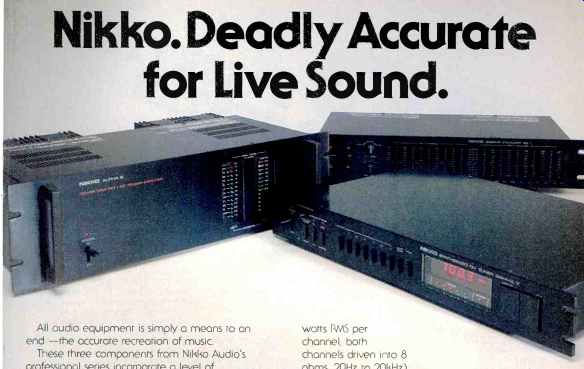

All audio equipment is simply a means to an end-the accurate recreation of music.
These three components from Nikko Audio's professional series incorporate a level of technology that truly puts the "high" into that "end" of accurate music reproduction.
Gamma V Synthesized Digital Tuner
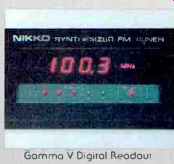
--- Gamma V Digital Readout
Nikko's Gamma V FM stereo tuner has PLL twin stage synthesized tuning circuitry. When the LED readout shows 100.3 MHz, for instance, you've got 100.3 MHz on the button.
You can rune to the station automatically or manually, and then ser it (and five others) into the memory bank for instant recall. Accuracy plus convenience!
Alpha III Power MOS-FETDC Amplifier
The Alpha Ill power MOS-FET DC amplifier oozes accuracy. The power MOS-FET circuitry assures ultra wide frequency response at rated output, while the continuous DC operation from input to output stages assures absolute stability.
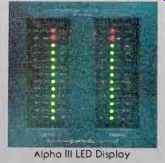
---Alpha III LED Display
An LED power level display provides a direct reading of the power output of each channel. And (here comes the best part) THD is one of the lowest in the industry-0.006% (80 watts RMS per channel, both channels driven into 8 ohms, 20Hz - 20kHz). Unheard-of-accuracy!
EQ 1 Graphic Equalizer
For situations where room acoustics interfere with faithful music reproduction, Nikko's EQ 1 is the solution.
With 10 bands per channel providing ±12d13 boost or cut, you can adjust your system to precisely recreate the live performance. Active accuracy.
Nikko works hard to stay ahead in technological excellence. Bur we never forget what is all about accurate musical sound for ultimate musical enjoyment. If this is what you want too, call this toll-free number for the name of your nearest Nikko dealer: (1) 800 423-2944.
---EQ I Gain Control
Nikko Audio
For Those Who Take Their Stereo Seriously Nikko Electric Corp. of America
16270 Raymer Sr., Van Nuys, Calif. 91406 (213) 988-0105 218 Sherwood Ave., Farmingdale, N.Y. 11735 (516) 293-2906 In Canada Superior Electronics, Inc. ©Nikko Audio 1978
----------------
THE JVC RECEIVER.
Every bit as revolutionary as they look, and then some.
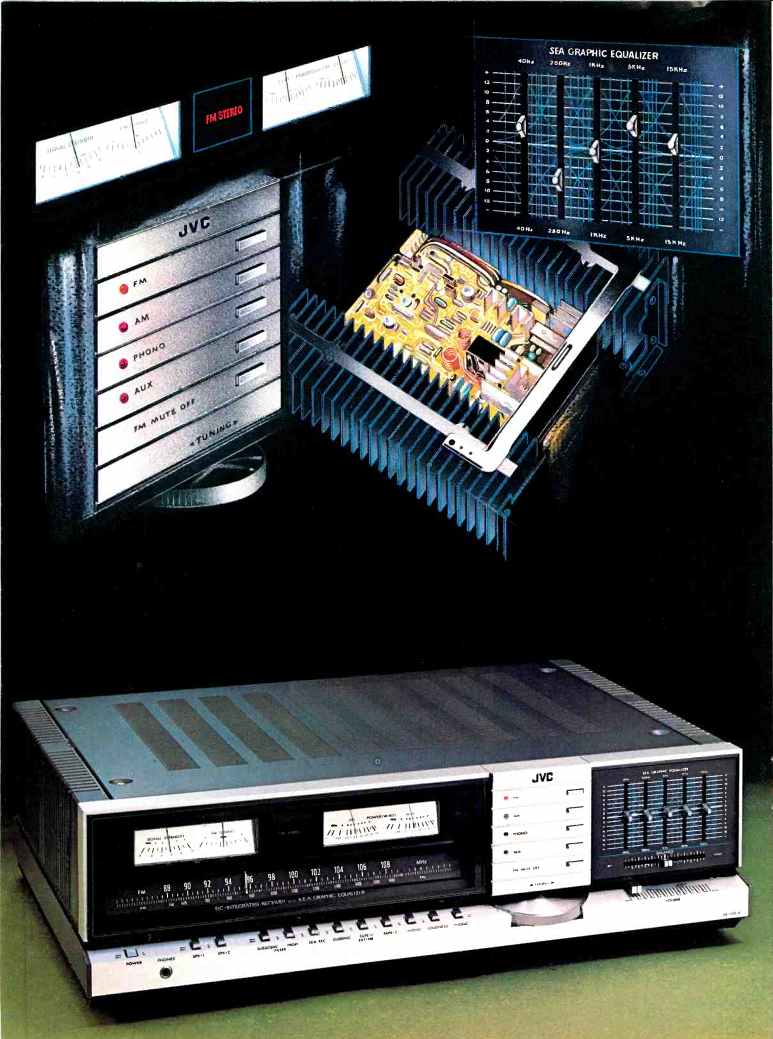
In our case, looks are never deceiving. Because all our new DC integrated stereo receivers combine unprecedentedly revolutionary styling with electronic design features that reflect JVC's more than 50 years' experience in audio development and innovation.
DC POWER AMPLIFIER DESIGN
Usually found only in costlier separates, JVC offers DC amplifier circuitry in all four of our new receivers. By eliminating distortion causing capacitors in our interconnecting circuit sections, JVC designers have created an amplifier that offers virtually distortion-free performance (0.03% THD) not only over the entire audio spectrum, but above and below it. As a result, all the sounds you hear are clearer, cleaner and crisper. Moreover, our DC design improves square wave performance and eliminates phase-shift-both factors being of paramount importance in distortion-free music reproduction. In addition, Triple Power Protection circuits and dual power meters give you safety and full indication of receiver operation.
There are four new JVC DC integrated receivers, offering your choice of 120, 85, 60 and 35 watts/channel* respectively.
S.E.A.-ALL THE WAY
JVC was the first receiver manufacturer to offer a built-in S.E.A. Graphic Equalizer in a quality receiver, and we continue this tradition by incorporating this convenient feature in our entire new receiver line. Far superior to even triple tone controls, this JVC exclusive gives you complete control over the entire musical spectrum. You can attenuate or accentuate any of five separate bands, covering the entire audible range of music. And as an added feature, we've incorporated a special button so that the S.E.A. equalizer circuit can also be switched to your tape deck, so you record exactly what you hear.
PUSHBUTTON SOURCE SELECTORS
Unlike conventional receivers, ours incorporate an advanced pushbutton source selection panel. Color-keyed LEDs indicate the program source, and a full-function horizontal pushbutton panel provides total control over all receiver operations. Professional-type slider controls set volume and balance.
SUPERIOR TUNER SECTION
High sensitivity and tuning precision are featured in all four new JVC receivers. Multi-gang FM tuning capacitors, PLL MPX demodulators and other circuit refinements provide optimum frequency response and stereo separation for FM, with maximum sensitivity for AM reception—a feature often neglected in receiver designs. A thumb-control tuning wheel and accurate metering make station location and fine-tuning easy.
Other features include Mode/Loudness/ Subsonic Filter switches and provision for connecting two sets of speakers.
Features, styling, innovation and performance: the four main things to look for in a DC integrated stereo receiver. And you'll find them all in a JVC. JVC America Company, Division of US JVC Corp., Maspeth, N.Y. 11378. In Canada, JVC Electronics of Canada, Ltd., Ont.
JR-S501 (featured at left): Below: JR-S401 (top); JR-S201 (bottom left) & JR-S301 (bottom right)
JVC We build in what the others leave out.
----------------
Sony Audio



You can hear he difference because the difference is right here.
Take a look at what's taking the industry by storm. The Back Electret, another giant step forward from Sony.
Never before has it been possible for thin polyester film to be used in electret condenser microphones.
That's because polyester film, acknowledged as the best material for microphone diaphragms, just can't hold a static charge for a long duration.
But Sony's engineers have made the impossible, possible.
They've found a way to adhere the electret material directly to the back plate of the microphone. By thus putting the charge on the back plate, we are able to use polyester film in the diaphragm.
The result will be obvious to your ears. Clearly superior sound quality, without particular coloration in the upper frequency range. The low mass diaphragm means better transient characteristics over the entire frequency range.
DIAPHRAGM ELECTRET FILM BACK PLATE ACOUSTIC RESISTER
RESISTER FRAME ACOUSTIC PHASE CIRCUIT
OUTPUT TERMINAL CASE DIAPHRAGM RING SPACER LOCK RING
You can find the Back Electret in four Sony microphones:
ECM-56F $220; ECM-65F, $210; ECM-33F $165; and ECM-23F, $100.
But you don't have to look at Back Electrets to see why Sony is ahead.
NO MATTER WHAT KIND OF MIKE YOU NEED TO GET, WE'VE GOT IT.
Sony's microphone line is thoroughly complete. It ranges from professional condenser to semi-professional to microphones for public address, vocalists, and outdoor use. There's omni and uni-directional. And we think it's big of us to make sophisticated miniatures.
And all microphones are available with Phantom Power, battery operated, or both.
So if you need something to talk into, it makes a lot of sense to talk to Sony. Write to Sony, 714 Fifth Avenue, Dept. TK, New York, N Y 10019.
SONY
© 1978 Sony Corp. of America. Sony, 9 W. 57 St., N.Y., N.Y. 10019. SONY is a trademark of Sony Corp.
--------------
Onkyo TA-630D Cassette Deck with the Exclusive Accu-Bias System.

The reason you waited to buy one.
With cassette hardware and software changing constantly, a lot of you have been waiting.
Holding off for top technology.
You've got it.
Onkyo's TA-630D with our exclusive Accu-Bias is here. And it's the only cassette deck with adjustable bias in a two-head configuration. Which right there offers lower distortion, better low frequency response and little or no crosstalk. That's a lot, but there's more.
You know how important it is to have optimum bias when you record. Too low a bias signal and you have distortion. Too high a bias signal and you lose high frequency response.
Other cassette decks have adjustable bias and equalization, set at the factory for average conditions. Onkyo doesn't believe in playing averages. And gives you Accu-Bias.
Accu-Bias is Onkyo's exclusive system. It works with a pair of reference signal generators built into the TA-630D. Feed these signals to your tape, and read the reproduction signal on the meters. If bias is off for that cassette tape, you compensate with continuous, variable settings until you get an absolutely flat frequency response. It's that simple...and you get the best high frequency response, least distortion and lowest signal to noise ratio.
You get all that because the bias signal primes your tape as the recording is made, and every manufacturer's tape is different.
Even when equalization is correct, if the bias is incorrect, it results in producing peak or losing the high frequency characteristic. Again, this depends on the tape used...al of which respond differently.
Does it work? After all the effort Onkyo's gone to so you can have the only two head continuously variable bias control you might expect fantastic sound.
You've got it.
You've got-frequency response of 20-15,000 Hz on normal tape; 20-18,000 Hz with FeCr and CrO2.
S/N ratio with FeCr is 58dB, going up to 68dB with built-in Dolby* NR System. Wow and Flutter are negligible at 0.055% WRMS by use of a DC servo motor for constant speed.
There's still more, but you'll have to find out from your Onkyo dealer. Be prepared for a stunning cassette listening experience and features found only in higher priced decks. Listen for the difference Accu-Bias makes and find out what keeps Onkyo a step ahead of state-of-the-art.
'Dolby is a trademark of Dolby Laboratories, Inc.
------------------
Shure/SME
new!
fact: the Shure/SME Series III is the state of the art in tone arms.
Breakthroughs & Improvements.
The Series Ill is the culmination of research and development extending over more than seven years. It embodies a number of significant breakthroughs as well as evolutionary improvements over its distinguished Shure/SME predecessor.
Notable among these is an exotic nitrogen-hardened titanium tubing arm (with wall thickness only twice the diameter of the average human hair) providing a previously unattainable strength-to-weight ratio. The arm has a soft core annular cross-section with an internal fibrous lining which results in an efficient, natural damping of the vibration fed into the arm by the cartridge.
Cartridge Carrier.
The Series Ill "cartridge carrier," a combination tone arm and shell in one piece, is removable and interchangeable for multi-cartridge use. Coupling is close to the fulcrum so the carrying arm makes a minimum contribution to the Series Ill total effective mass (only 5.05 grams measured at 9 inch radius!).
Fluid Damper.
A built-in highly efficient F.D. 200 Fluid Damper gently but effectively resists spurious or potentially damaging stylus forces in both planes, yet does not interfere with normal arm motion.
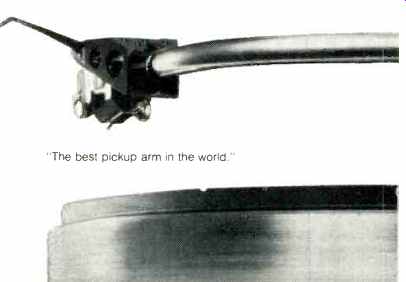
--"The best pickup arm in the world."
THE SME SERIES III PRECISION PICKUP ARM WITH THE NEW SHURE V15 TYPE IV CARTRIDGE
The combination of the Shure V15 Type IV cartridge and the SME Series III tonearm transcends previous tone arm-cartridge system performance, and sets dramatic new standards in connoisseur-class high fidelity reproduction.
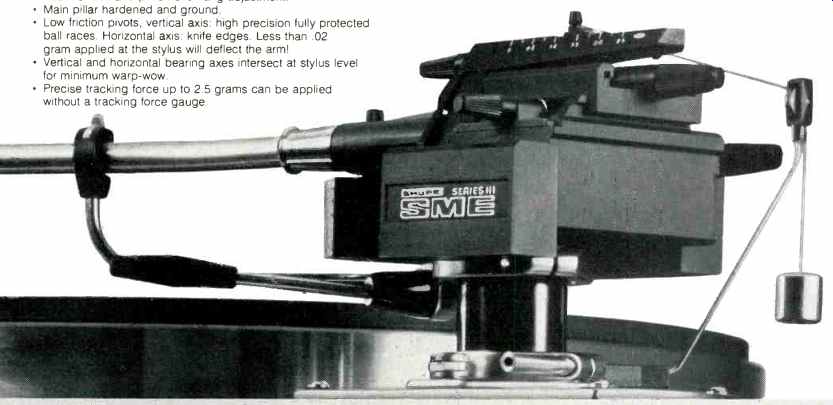
...other features of the unique SHURE/SME Series III precision pickup arm:
Unique balance system enables cartridges weighing 0 to 12 grams to be operated under conditions of minimum inertia.
Interchangeable integral carrying arm replaces conventional tone arm and shell.
Positive rack and pinion overhang adjustment.
Main pillar hardened and ground.
Low friction pivots, vertical axis: high precision fully protected ball races. Horizontal axis: knife edges. Less than .02 gram applied at the stylus will deflect the arm!
Vertical and horizontal bearing axes intersect at stylus level for minimum warp-wow.
Precise tracking force up to 2.5 grams can be applied without a tracking force gauge.
Bias (antiskating) with fine adjustment.
Longitudinal and lateral balance with fine adjustment.
Ultra low-distortion geometry.
Fluid-damped lowering and raising control.
All electrical contacts heavily gold-plated.
Superb camera finish throughout.
1978 Design Award from the British Design Council.
Shure Brothers Inc., 222 Hartrey Ave., Evanston, IL 50204
-----------------
Radio Shack
"I'm very impressed with the way Radio Shack has translated latest technology into good looks and precision record playing in the 400.”
Realistic Direct-Drive Automatic ... Finest Turntable We've Ever Offered
Two motors, damped cue/pause, S-shape tonearm, speed controls, $39.95-value Realistic/Shure cartridge
The LAB-400 makes studio performance both affordable and convenient.
Its massive die-cast platter rests directly atop a 16-pole brushless DC servomotor. The platter and motor rotate at the same speed, either 33 1/3 or 45 RPM no idler wheels, reduction gears or belts to alter the music that's stored in your record's grooves. The result: wow and flutter is less than 0.03% WRMS and rumble is better than -63 dB (DIN B). The fully automatic tonearm has an effective length of 8 11/16”, for flawless tracking down to 1/2 gram. Handsome walnut vinyl veneer base with ultra-modem, slim design.
Elliptical-stylus magnetic cartridge and detachable hinged dust cover significant "extras" that aren't extra. All for $199.95.
Fully Automatic Tonearm Operation
You need never touch the tonearm-just select record size and push start switch.
An independent motor does the rest, cueing the arm, gently lowering it onto the record, and removing it at disc's end. With repeat mode, cue/pause, anti-skate and tracking force controls.
Two speeds with controls for ±4% pitch adjustment.
Neon light with strobe disc for checking speed.
Low-profile styling with precision shock mounts to stop acoustic feedback.
------------------
Osawa
Pair up for perfect reproduction
With Osawa's Dynamic Duos
Advanced electronics are just not enough. For the most realistic music reproduction you need a high performance tonearm/cartridge combination to ensure smooth, wide frequency response and highly accurate tracking. The kind of top-quality performance that the Osawa duos deliver.
Start with the Ultracraft AC-300 MK-II tonearm that features adjustable oil damping. This eliminates resonances by fine tuning the arm to your cartridge. Then select the Osawa cartridge that's priced right for you. You can mount it directly on the tonearm la without a headshell, thus reducing effective mass to the minimum.
Choose from 4 Satin Moving Coil models, the only MCs available that feature user-replaceable stylus and that don't require a step-up transformer or pre-preamp. Or choose one of the newly introduced high-compliance Moving Permalloy (MP) models by Osawa. Top-of-the-line 300 MP offers a unique carbon-fiber cantilever that is extremely lightweight yet extraordinarily strong.
lb select the combination that's ideal for you, visit your Osawa dealer. Ask him for the Osawa "Consumer Guide to Phono Cartridges," and then get a complete demonstration. Whichever combination you select, the name Osawa assures you the ultimate in clean and faithful music reproduction.
OSAWA & CO. ( USA) Inc./521 Fifth Avenue, New York, N.Y. 10017/Tel. (212)687-5535-9/TELEX: 23-6593 OSAWA
-----------------
crown
Power... Precision... Presence...
The crown Distinction Series
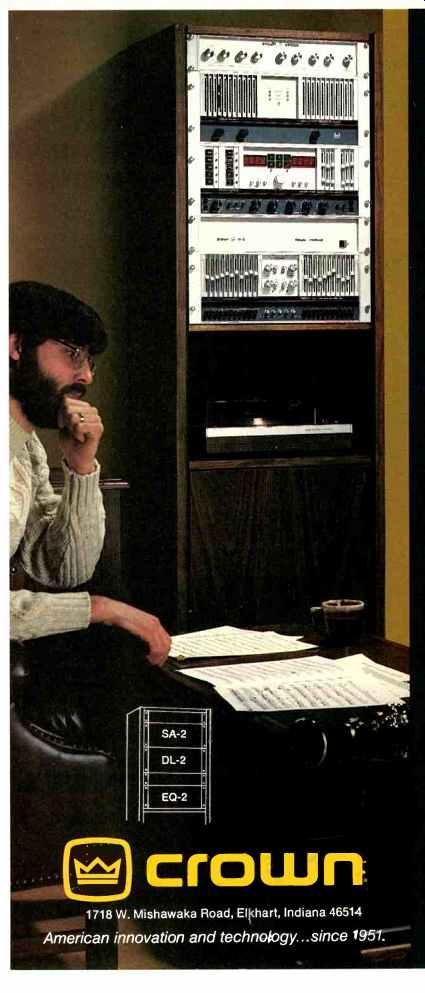
These new components, designed and built solely for sonic excellence, are intended for the discriminating listener who needs equipment meeting the highest standards of audio technology.
They express everything Crown has learned in twenty-five years of building state-of-the-art audio components.
SA-2 Power Amplifier 221 watts per channel into 8 ohms, .01% THD, 3 Hz 20 KHz. New patent pending protection circuitry.
Drives any load. Internal cooling.
DL-2 Controller New precision in preamplification. Separate phono pre-amp and power supply for low RFI and line noise. S/N down 97dB unweighted. Frequency response ±0.2dB, 3 Hz to 100 KHz. Digital balance/level control.
EQ-2 Equalizer for concert-hall presence in your listening room.
Eleven bands per channel (±15dB per band) with center frequency control for each band.
Listen to the complete line at your authorized Crown dealer now, or write for information.
1718 W. Mishawaka Road, Elkhart, Indiana 46514 crown American innovation and technology... since 1951.
-------------------
KENWOOD
ALL THREE-HEAD CASSETTE DECKS LET YOU HEAR AS YOU RECORD. OURS LETS YOU RECORD PRECISELY WHAT YOU HEAR.
Three-Head Design with Double Dolby*
Not all three-head cassette decks are created equal.
Some manufacturers have designed their decks with separate erase, record and playback heads primarily for convenience. So you can tape monitor as you record.
But our new KX-1030 uses separate heads primarily for performance. Each designed with the optimum gap to record or play back sound more accurately.
As a result, the KX-1030 has a frequency response of 35-18,000 Hz (±3 dB using CrO2 tape.) And to let you take full advantage of the separate record and playback heads, the KX-1030 has a Double Dolby system with separate circuits for the record amplifier and the playback preamplifier. That way, as you record with Dolby, you can also tape monitor with Dolby, so you hear the sound precisely as it's being recorded.
The KX-1030 also has a Variable Bias Adjustment Control and a built-in oscillator, so you can adjust the exact bias for the type or brand of tape you use.
We also built in a number of other features like MIC/LINE mixing, memory rewind and a peak indicator.
But as good as all this sounds, wait until you hear the price. Because at $425.00, no other comparably priced cassette deck can match the performance and features of our new KX-1030.
-----Variable Bias Adjust compensates for tape differences.
Of course the only way you're really going appreciate the KX-1033 is to visit your Kenwood dealer. Once you do, you'll be convinced: Performance, convenience, and value set the KX-1030 apart from all the rest.
KENWOOD
For the Kenwood dealer nearest you, see your yellow pages, or write, KENWOOD, P.O. Box 6213, Carson, CA 90749
-------------------
AIWA
Start playing with a full deck.
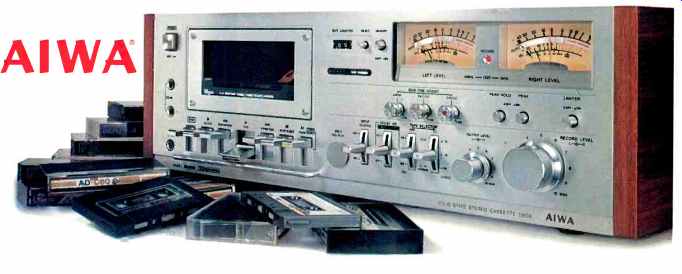
The AIWA AD-6800. It has everything you should expect in a top-flight cassette deck. And that includes our Flat Response Tuning System (FRTS) that adjusts to the optimum bias level for any tape on the market, precisely and effortlessly.
The AIWA AD-6800 uses its own circuitry to measure the precise bias figure of not just one or two, but every brand of cassette tape, whether it's LH, FeCr or CrO2. The result; a flatter-than-ever frequency response with any tape on the market.
And the new AIWA 3-head Flat Response Tuning System is a snap to use.
First, slip in a cassette and the AD-6800 will load it automatically.
Next, set the Input Selector to "test" and push the "record" key to automatically activate the 400Hz and 8kHz built-in oscillators. You're all set for test recording.
Slide the Azimuth Adjust control for optimum head alignment and adjust the Bias Fine Adjust knob that corresponds to the type of tape you're using. The AD-6800 will let you know the exact bias necessary for the flattest possible response when the right (8kHz) and left (400Hz) VU meters are in corresponding positions. Now you're ready to record. It's that simple.
----Bias Fine Adjustment allows precise fine tuning for optimum response.
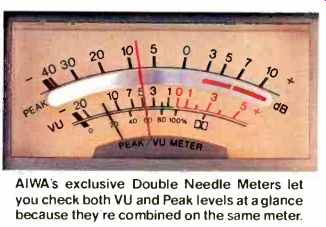
-----------AIWA s exclusive Double Needle Meters let you check both VU and Peak levels at a glance because they re combined on the same meter.
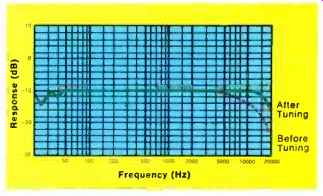
AIWA's new 3-head Flat Response Tuning System (FRTS) lets you monitor a tape simply by observing characteristics of the frequency response. You can actually "see" the sound so you can record at optimum levels.
The AD-6800 provides another exclusive feature--Double Needle Meters. AIWA has combined VU and Peak readout on each meter so you can monitor both functions at a glance. A convenience feature you won't fund on any other cassette deck. The AD-6800 includes a Peak Hold function, too.
-----------The AIWA Flat Response Tuning System achieves flattest response possible for maximum recording results.
And with the AD-6800 you get an incredibly low wow and flutter of 0.05% (WRMS), and with Dolby on and FeCr tape, an S/N ratio of 65dB, and a frequency response of 20 to 19,000 Hz.
With all this in one great cassette deck and AIWA's exclusive new Synchronized Recording Operation (when used with the AIWA AP-2200 Turntable) you'll begin to understand what precision recording is all about.
The AIWA AD-6800. See it at your AIWA dealer now and start playing with a full deck.
Distributed in the U.S. by: AIWA AMERICA INC., 35 Oxford Drive. Moonachie, New Jersey 07074
------------------------
KOSS
The perfect pair.
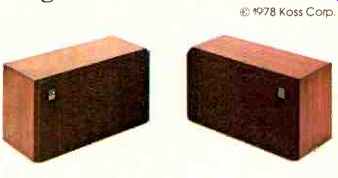
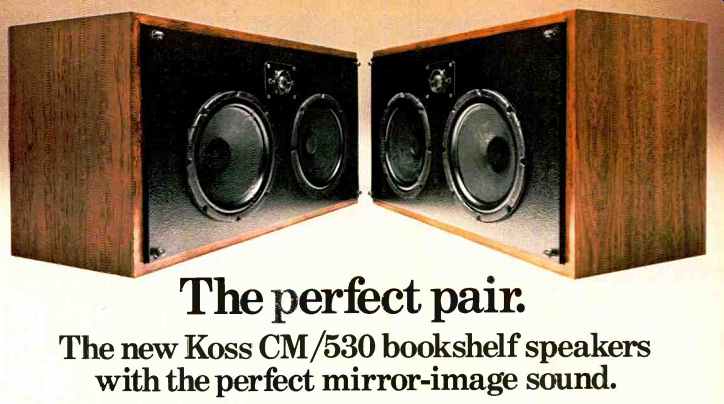
The new Koss CM/530 bookshelf speakers with the perfect mirror-image sound.
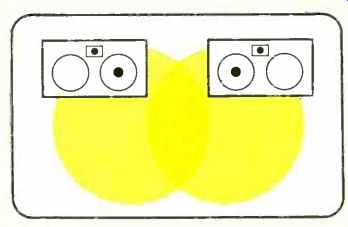
-----No matter how you place them on your shelves you get perfect mirror-image sound.
Here is truly a remarkable achievement in loudspeaker design and performance. The Koss CM/530 bookshelf loudspeaker sets an entirely new standard in extended bandwidth response, high efficiency, low distortion and perfect mirror-image for speakers in its size and price range and within today's technological capabilities.
By designing a left and a right channel configuration for the passive radiator, the woofer and the tweeter, Koss engineers have created a perfectly matched set of bookshelf speakers that can be placed horizontally or vertically without losing the perfect right to left imaging, an incredible degree of dispersion and the beautiful Sound of Koss.
To create the breathtaking depth and clarity in the CM/530, Koss engineers used an 8 inch passive radiator to radiate the sound energy over the lower two octaves. This allowed them to use an 8-inch woofer to reproduce the critical sounds in the midrange up to 3,000 Hz.
In addition, the CM/530's 1-inch dome tweeter reproduces an exceptionally flat energy output and unusually low distortion that provides for a transparency and liveliness not found in other competitive speakers.
Ask your Audio Dealer to give you a live demonstration of a matched pair of bookshelf speakers. You'll be amazed at their perfect mirror-image sound. And while you're at it, try the perfect answer to private listening: Koss stereophones. But by all means, write, c/o Virginia Lamm, for our full color speaker and stereophone catalogs. The Sound of Koss will do great things for your records or tapes ... and your image.
KOSS CM/530 BOOKSHELF SPEAKERS hearing is believing
KOSS CORPORATION, 4129 N Port Washington Ave., Milwaukee, WI 53212, USA. International Headquarters. Milwaukee / facilities: Canada France Germany Ireland Japan
------------------
ESS

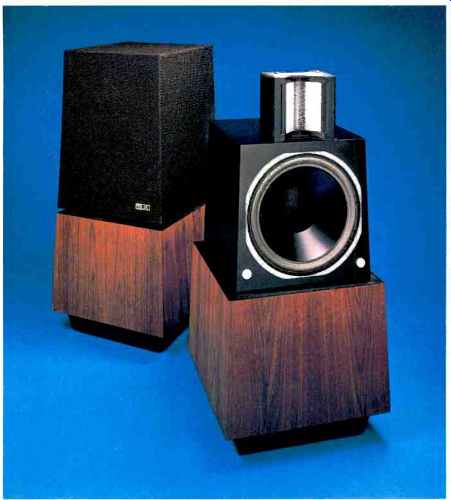
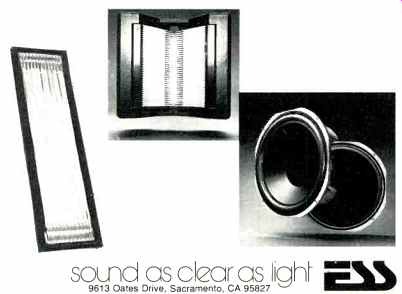
At ESS, technology means more than trying to repackage a 50-year-old conventional loudspeaker design under a glamorous new name. Even the best conventional driver pushes air on a one-to-one ratio; it moves only as fast as the cone's movements. Only ESS's Heil air-motion transformer squeezes air, accelerating it to five times the speed of its own motions.
Free of the distortion and sonic limitations of sluggish conventional designs, Heil-generated sound is unparalleled in dispersion, transient response, dynamic range and musical detail. ESS makes 11 superb Heil-equipped loudspeaker systems, all characterized by a decided feel of excellence. Audition a pair today. See if you're not convinced.
sound as clear as light
ESS, 9613 Oates Drive, Sacramento, CA 95827, USA.
--------------
SONUS SERIES II. THE BEST DEEPS GETTING BETTER.
The original Sonus cartridge established a new standard in high definition phonograph reproduction. Yet we believe there is even further room for improvement in this often-overlooked area of high fidelity. So we have taken the original Sonus cartridges and refined their designs, taking full advantage of the latest in materials and techniques. Sonus Series II cartridges are the result of these new design developments.
The new Sonus Gold consists of three models with identical bodies and stylus assemblies, differing only in the form of their diamond tips. The new Sonus Silver comes in two stylus types, and shares all the qualities of their more costly counterparts, yet still can offer a dramatic improvement in sound reproduction overall. Both series employ a transducer system characterized by reproduction of exceptional accuracy, clarity and definition. For full details and a recommendation of which model is correct for your particular system, we suggest a visit to the Sonus dealer nearest you.
SONIC RESEARCH. INC.. Sugar Hollow Rd.
Danbury. Conn. 06810
High Definition Phono Cartridges
----------------------------
Ohm
"AWESOME" and other comments from audio critics about Ohm F loudspeakers:
Comments from The Complete Buyer's Guide to Stereo/Hi-fi Equipment:
"The Ohm F is an extraordinary loudspeaker. It has only one driver, which acts as a pulsating cylinder... What this means in terms of sound quality is remarkable. It may well be the finest speaker on the market and is certainly without a doubt among the top few."
Comments from Stereo Review:
"The tests we have made all tended to confirm the claims made for the Ohm F.... In our simulated live vs. recorded test it rated A to A+ ... with one of the larger power amplifiers... the sound began to warrant the use of such words as 'awesome'... it is easily one of the best."
(Ziff-Davis Publishing Co., 11/73, all rights reserved. Reprinted by permission.)
For a free reprint of thirteen complete reviews of Ohm speakers priced from $100 to $700, please write us at:
241 Taaffe Pl., Brooklyn, N.Y. 11205
Ohm--We make loudspeakers correctly.
--------------
Beyer Dynamic
--the first 5 minutes don't count--
Or even ten!
Sometimes it may take a little while before you know just how good a headphone really is.
Comfort, weight, cord convenience all are vital factors in headphone wearability.
With every minute of use, any manufacturing deficiencies in these areas grow into discomfort and inconvenience.
At Beyer we know these problems and all our headphones are designed to achieve the highest possible wearability factor (Hi-Fi News, September '76, page 143, Beyer DT440 ranked 1st out of six comparative tests for comfort).
Coupled with physical comfort comes the lack of aural fatigue. That bright overdone sound associated with the 'loudspeaker-on-the-ear' concept oversold by our competitors will often give you a bad headache in minutes. It takes time to appreciate good clean sound. And with time, good sound doesn't tire (Hi-Fi News, September '76, Subjective Headphone listening test, Beyer DT440 ranked 1st). So visit your Beyer headphone dealer now and give yourself time to compare Beyer headphones against the competition.
But remember--the first 5 minutes don't count!
Beyer Dynamic. Distributed by Hammond Industries Inc.
155 Michael Drive, Syosset, New York 11791. Telephone (516) 364-1900 West Coast telephone (213) 846-0500, Canada telephone (416) 677-0545
-------------------------
SAEC WE-308N
Tracks your Records with Surgical Precision
Preciseness epitomizes SAEC's WE-308N tonearm. It utilizes an advanced design, double knife edge bearing system, automatic tracking pressure compensation, inside force canceller, even an ultra low resonance "ultimate" headshell.
What does all this do to your records? Virtually nothing. Nothing, that is, when it comes to record wear. But everything when it comes to allowing your cartridge to translate with unwavering accuracy the musical information locked between the grooves of your records.
Write for literature that reveals in detail all the exquisite features of SAEC's WE-308N tonearm, and SAEC's other fine audiophile products. Distributed by:
AudioSource
1185 Chess Drive, Foster City, CA 94404 Phone: (415) 574-7585
---------------------------
17 MARANTZ COMPONENTS 225 MARANTZ SYSTEMS WHATEVER THE MIX IT'S ALWAYS A MATCH-FROM $650* TO $2100

Now there's a Marantz component system for everyone! From our most affordable to our finest--with 223 systems priced in between Marantz delivers the same top Marantz quality and the same stunning Marantz look. There's never a compromise! And with so many systems to choose from, you'll be able to find the exact match for your listening requirements and budget.
A MARANTZ EXCLUSIVE: MIXED SYSTEMS THAT REALLY MATCH.
From the least expensive to the most expensive, all Marantz Pre-Amps, Power Amps, Console Amps, Tuners and Front-Load Cassette Decks feature the same front panel size, the same striking cosmetics, the same top quality design philosophy. So whatever component combination you choose, you'll have a perfect match. Only with Marantz.
BRINGING IT ALL TOGETHER.
Once you have selected a system, only one question remains: Where do you put it? With a Marantz STACK RACK you can bring it all together with style. The RM-3100 "Professional" STACK RACK (at right) will accommodate up to four Marantz components equipped with optional rack handle adaptors. Or you may prefer the RM-3700 "Decorator" STACK RACK (above) which encloses three Marantz components behind its full-length smoked glass door. A perfect fit in either rack, your entire system will be at your fingertips.
---------The RM-3700 STACK RACK contains three Marantz components on fixed positioned shelves, an accessory shelf and divided record compartment behind its full-length smoked-glass door
The Marantz system shown includes the 6170Q Turntable, 2110 Tuner 1IS0DC Integrated Amplifier 5010B Cassette Deck and Design Series 930 Speakers.
BUILD NOW ADD LATER.
Once you see and hear what Marantz components have to offer by way of more performance per dollar, striking appearance and unheard of flexibility, you'll be sold. You'll have a perfectly matched system tailored to your specific needs from as little as $650* to $2100. And don't hesitate when you want to upgrade any part of your system. Any Marantz component you upgrade to will match what you already have.
MIX AND MATCH BY MARANTZ-IT'S ALL FOR YOU.
17 separate components from Marantz. Designed to mix and match into 225 different systems to give you unprecedented flexibility. Whoever you are, Marantz has the perfect system for you.
The three unit Marantz system shown at right includes the 2100 Tuner 1090 Integrated Amplifier and the 5000 Cassette Deck with 6270Q Turntable. The four unit Marantz system shown at the far right includes the 2130 Tuner, 3650 Preamplifier 5030B Cassette Deck and the 300DC Amplifier with a 6370Q Turntable.
----------------
= = = =