
Sometimes the simplest ideas are the brightest. Often, too, it takes a big
company to produce a really simple, basic idea. I don't necessarily mean in
technology--I mean in concept. To make one say, why didn't I think of that?
Clears away the underbrush, cleans up the confusion, points the direct way,
makes things easy. Like, say, the safety pin.
It looks as though, maybe, Philips has launched a modern safety pin for us in audio.
It's called the Compact Disc and the analogy with Philips' Compact Cassette is deliberate. Very different product but much the same thinking.
Need you guess? This is a digital disc. Need you guess again? It's for everything and everybody, the cheapest and the fanciest alike. And I'll give you three: It is NOT a picture disc. Pure audio, and blind as a bat. The only picture this one will ever show might be a title in little red letters. Do you need a fourth guess? It's SMALL. Compact is hardly the word; this is the Sub compact of the Future. And if I have my wish, it will at last spark that audio miniaturization which, with all our transistors, ICs, and chips, is still barely beginning. I've yelled miniaturization for years. Now, maybe, compact fi to match Disc? About time! Some safety pin! Philips' well-matured cassette, of course, took a long time to get going, and no doubt the Compact Disc will also take a while. Philips expects so.
This is just the beginning. When the cassette first appeared there was nothing very much of interest in it for the hi-fi man; it was put out basically as a "people's tape" and I often wonder whether Philips really had any idea of its future quality potential. No matter! It did have that potential, which is what counts. Things move faster now and the Compact Disc has much more than mere quality potential. Remember--it's digital. The quality is already there. But the thinking goes the same as before. Back then, Philips took a basic tape problem in hand--how could we use tape at its maximum potential for an inexpensive, automated consumer recorder/player with no threading, no-touch, no bulky reels, all push button? The Philips solution was so radical, such a complete break, that it has kept us busy every since, and never more than at present with metal tape ready for another quantum jump in cassette performance. Yet the cassette is still a basic "cheapie" mass-sales system today whenever you want it to be. That was the idea. That is the Philips approach.
True, there was plenty of competition in automated tape. But Philips is big and, shall we say, obstinate. It kept its cassette exactly the way ii wanted.
We should note, after the fact, that unbridled modifications of the format might well have confused and splintered the consumer market beyond repair. Many of us have chafed at these de sign limitations, but I think we now admit that the rigid interchangeability of all cassette tapes and players has been a good thing and per haps the biggest factor in the present cassette success. We know all too well what hap pens when interchangeability goes down the drain. (Compatibility is something else again, primarily between the old and the new in transition of formats.) Ah, for the good old days again. Remember 1948, when Columbia offered the LP disc to all corners for practically nothing? RCA demurred, but came around, and vice versa.
Now here we go again. If Philips is wise, I think it will (a) stick to its technical guns as to specs for its Compact Disc, as with the cassette, and (b) license out its new system liberally, persuasively--low impedance, high power. It's a likely bet and Philips can easily afford it as the best way to discourage rival systems.
Like Father,...
Let me paraphrase, then, the aims of this new Compact Disc as of its predecessor the cassette. How can we use the digital disc potential for an auto mated consumer disc record system that will be truly basic, practical for use all the way from the lowest "cheapie" right up to the top, at lowest possible cost and highest efficiency? Same idea, you see. But now there are differences. To make digital cheap is a mountainous proposition. Curiously, an even bigger problem is digital quality--there's too much. Just the opposite from the cassette. There, you started low and gradually worked upward through improvements. Now, with digital, we start in the stratosphere and try like the dickens to bring things down to earth in a practical way. Crazy.
In engineering terms there is virtually NO limit to the audio potential of the digital disc. If a vinyl platter of standard 12-in. size can already, right now, produce an hour of acceptable home color TV, then the same can give you days and days of super audio in a similar configuration. Who wants it? As I noted facetiously a few months ago, the audio version of JVC's joint audio/video 12-in, disc is probably still playing- they haven't finished timing it yet. Too much! For the same, you could have quadra-quadraphonic in 16 channels plus perfume cues and still have too much. At too much cost.
Now all this has made a good many of us increasingly uneasy. The tie-up between pictures-with-sound and plain audio is technically solid and just a matter of bandwidth, but in terms of use, it seems increasingly to be unnatural and unfortunate. Audio, sound for sound's sake, is always going to be at the short end--not too little quality but too much. Wasteful. Hence--expensive.
It's like having to hire a 747 to take your family for a modest weekend in the country. Or buying a gallon of Coke to take one swallow. Suppose Coke came only in gallon jugs? So we in audio, we who like music, all kinds, music on its own, sound on its own, are beginning to understand that disc digital sound can co-exist commercially, and reach a normal development in its own terms, only on its own disc, minus picture requirements.
There isn't even a software compatibility between TV-style pictures-with-sound and audio by itself. We have known this for years. In spite of groans galore, in spite of noble efforts to improve, and all those worthy simulcasts in FM stereo, the basic television sound, whether broadcast, cabled or recorded, remains largely indifferent (to be polite)--and it is not merely to save on costs. For the big commercial run of TV-type pictures, sound quality is not really important to the message.
Like the telephone. If you understand the words, there's communication.
That is what matters. Good audio is merely an added frill. Go to any bar on a baseball night, or visit your own living room! You should have heard the sound on Philips' own TV tape blurb for its new disc. Phew! Yes, there is televised opera, ballet, concert, and there the sound is important. But this is not the main stream, alas. As the mainstream goes, so must the medium. A picture disc can do a lot better for these specialties and surely will, since digital allows for it. Even so, audio by itself is still going to suffer, from too much quality at too high expense. If it ties itself to this medium. Restrictions. Small market. Specialty. Premium price.
So on this precise basis, Philips has taken the big and logical step. An optimum pure audio--digital disc, unwasteful of space, money and quality. This combined with the typical Philips broad-sales-spectrum "Compact" thinking--it must be inexpensive enough to cover all markets and purposes. I was wrong when I said there would never be another purely audio disc. Not ever again an analog system, to be sure. But I forgot the safety pin.
Now why didn't !think of this one? If you have been following recent digital developments you can give a good guess as to the details of the Compact Disc without reading any further. Its operating principles are al ready familiar in other digital disc prototypes. Laser beam tracking of billions of tiny reflecting pits in close spirals, replacing the contact grooves of the past. There is, of course, the new size-- remember, we are now free of picture requirements, and we can scale down the parameters for optimum audio alone. And--clever idea!--the Philips is variable speed, from 500 to 215 rpm, inside out. That makes the small-diameter inner grooves playable.
Constant velocity as the laser sees it, very much like tape itself. (Now would you have thought of that safety pin?) But what size? And what quality? Follow me a bit further. You could, I suppose, put a ring of digital sound around the outside of a 12-in. platter, a half inch or so, and accommodate, disc for disc, all our existing LP software.
Why bother. Very wasteful. Or could you bond a ring or band of vinyl onto a cheap 12-in. substrate? Clumsy. Better to reduce the size. Ten-inch? Still far too big and wasteful of digital potential. Eight-in.? Maybe 7-in.? For at least some compatibility in the packaging and pressing departments during changeover? Is there any useful compatibility?
Tiny & Very Long
The Philips answer is an unequivocal NO. Except for one vital thing: Philips puts the entire playback system in side its tiny player unit and comes out with a standard stereo signal, ready to feed anything you want. That's an excellent sort of compatibility both for retail and manufacturing: Nothing to buy except the single player unit and its complete miniature electronics and laser system.
What, then, is the size of the disc? Hold onto your bonnets. The Philips choice is a whopping 4.5 inches of feather-weight vinyl. It comes in a handy jacket, very much like an LP (with the same cover art). The whole thing fits into the palm of your hand.
Inside the jacket are all the notes, texts, bios you want, neatly bound like a little book. Great improvement over the information-scanty cassette. Only the spine is unprinted, at least in the prototype; but an LP-like spine could easily be added for better filing, and probably will be.
What does this little dandy do? It's digital, remember. It plays one full hour of stereo on a single side. That's the contents of a standard LP, both sides.
The second side is blank, for a start. Who needs it? But somebody in authority at the initial demonstration last June allowed as how there could be a double-side disc any time it might be useful. That would make two hours of play on a single 4 1/2-in. mini-disc. See what I mean by the technological gap that has been building up between the standard LP and the new digital potential.
Imagine it. A whole five-hour Wagner opera on three tiny discs, five sides, or Mahler symphonies or complete musical shows. And yet all of the present LP flexibility and variety is pre served and all present LP material can be reissued, disc for disc (one sided) or 2 for one (double sided) for playing in the new format. Whole shelves of your present LP items will file away, record for record, in a small cardboard box.
How about sound quality, for this super-miniaturization? You should not be surprised. Yet Philips is cagey. The specs for the Compact Disc are not quite up to top professional standards--that is, digital standards. Philips is thinking consumer. Most professional digital tape now uses a 16-bit coding, for the ultimate in "headroom." Philips has made a mild cut back, from 16-bit to 14-bit coding. This allows for a system useable in the very lowest, cheapest popular equipment on a mass basis. But is it a serious compromise from the audio viewpoint? Well, not exactly. Merely from the astronomical to the semi-astronomical.
As we are aware, the digital system does not "read" noise of the all-too familiar analog sort, on either disc or tape. To be sure, S/N in the Compact Disc system is not quite up to professional digital tape. Instead of an incredible 90 dB down for the noise level, it is reduced to a mere 85 dB.
Please note that the very best an LP can do, in theory, is around 60 dB signal to noise, and we'll say nothing about the average disc. And look at the S/N specs for your hi-fi circuitry, where the noise is purely electronic.
This little disc matches the fanciest. Its available dynamic range, to match is also 85 dB--check that against cassette and LP.
Stereo separation? Because the two stereo channels are read out in separate digital "words" the separation is, well, not quite infinite. The finest stereo cartridges edge up towards a 40-dB channel separation and anything in the mid-30s is very OK for the better models. The Compact Disc figure: 80 dB.
Need I say more about audio quality? It is sensational, and that is that.
And yet still, in the end, this disc is potentially inexpensive enough to go into the cheapest of popular mini-players. It has that potential, like its cassette sibling.
Subtitles? The prototype reproducer unit looks like a miniature LP player, around 8-in. wide and maybe 3-in. high. The entire laser-beam pickup system and all its (chip) electronics are housed in the bottom of this little box; there is nothing else. It can be built into a small "portable" system just as easily as the cassette. Or plugged into the fanciest hi-fi set-up. There is a "fast forward and reverse," so to speak, and you can start anywhere (they say) though the first demo left a lot to be desired in this respect, most of the music fading in after the beginning. (You can't do that to Beethoven!) Temporary, if a problem at all. There's a visual readout, centimeters or something and-- very neat--you can indeed encode a printed message right in the recording which will appear at the right moment. Titles and such. (And let's hope it's not an ad.) How long they didn't say. I suspect that the String Quartet No. 29 in A Major, Opus 371 No. 2, "Springtime" by Karl Ditters von Dittersdorf will appear simply as DIT.
Strictly telegraphese. Visible message or not, the little disc spins merrily and visibly under the top cover, and you can put it on and take it off like any LP via a slightly larger center hole. Or play automatic.
The record is really unflappable.
Those billions of tiny pits are imprinted and sealed below a transparent layer of protective plastic, reflecting the laser beam via a metallic coating. The laser tracks without physical contact via the now familiar lightwave feed back circuitry, correcting itself for both vertical and sidewise irregularities in the record. There is the usual coding redundancy to correct for any errors or drop-outs in the digital signal. Since it is sharply focused by a tiny lens, the laser reads only the pits and "sees" surface scratches and dust only as a blur, completely ignoring same. Short of maybe chocolate sauce or a splatter of paint, nothing is going to bother this system and the record will not ever "wear" until the plastic collapses.
Or the dog chews it up. Whether it will play upside down, I do not know--we weren't allowed to touch.
Oh, yes--WHEN? Keep cool. Philips, ever the radical conservative, says "early 1980s" and expects the good old LP to last another 10 years before the Compact Disc drives it out. No rush. Philips can wait. It has the umph.
Meanwhile there are the vital circuit chips--not yet in being. At the demo they had to use a two-foot pile of ordinary macro-electronics. And there are a few minor (!) competitive problems coming up, like patents, licenses, whole rival systems. Again, Philips is tough and unhurried. Negotiations will proceed. Power will be applied.
It's a good disc though. And I do hope Philips will carry its big stick and talk very softly, until it persuades our market and the world's. Better than bulldozing, any time.
(Adapted from: Audio magazine, Sept. 1979; Edward Tatnall Canby )
ADs:
TDK
The era of metal particle tape has arrived. Metal-ready cassette decks are already in the stores, and more are on their way. There are also a number of metal cassettes on the market, and all of them have a high coercivity and remanence--their magnetic energy is roughly four times that of the best oxide tapes.
But that does not mean that all metal cassettes are alike. Not by a long shot.
TDK's metal cassette, MA-R, looks, feels and performs like no other cassette. That's why we call it "The Music Mirror." We've used advanced manufacturing technology to solve the problems inherent in metal tape. If left untreated, metal particles oxidize upon contact with water vapor and oxygen in the atmosphere-they actually "rust." TDK has developed a unique way to coat each and every particle with a process that protects them from the atmosphere, even at the critical exposed edge of the tape. The result is a tape that is resistant to oxidation. In fact, the overall stability of MA-R is well within the limits that have been set for conventional cassettes. But superior tape is only part of MA-R's story. TDK's new Reference Standard Mechanism is so revolutionary in design and performance, that its influence will be felt for years to come.
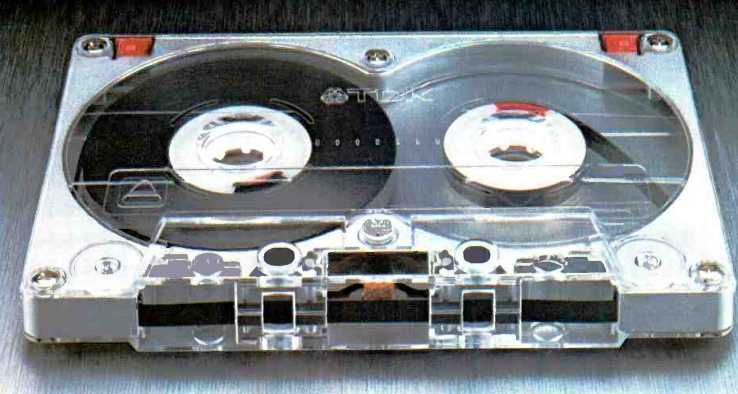
For starters, there's the one piece, die-cast metal main-frame.
Metal is far more resistant to war page than plastic, and unibody construction eliminates performance differences between the A and B sides. The frame and mechanism are sandwiched between two clear covers held in place by six computer-torqued, double-threaded locking screws that will not slip be cause of vibration.
MA-R's amazing mechanism is visible for all to see, thanks to a transparent slip sheet. Our unique double hub-clamp is an integral part of a strong and circular tape storage system. (MA-R's two clamps are color-coded red and black, as a visual reference).
Our newly-designed, seam less, water-wheel-type rollers rotate around stainless steel pins, which are micro-polished for circularity. Our new dual-spring pres sure pad assembly allows for more flexibility, yet provides more horizontal support for uniform tape to head contact. MA-R even includes removable, replaceable erase-prevention lugs, a new standard in protection and flexibility.
Ask your TDK dealer to show you the new MA-R cassette. Hold it in your hands and feel its weight.
Look at the ingenuity and precision of the shell and mechanism. Then listen to it perform in one of the new metal decks. All your senses will tell you that this isn't just another new cassette--it's one of the memorable audio products of our time.
TDK Electronics Corp., Garden City, N.Y. 11530. 1979 TDK Electronics Corp. The machine for your machine.
Electro-Voice
Super-Dome high performance tweeter to match a high performance speaker system.
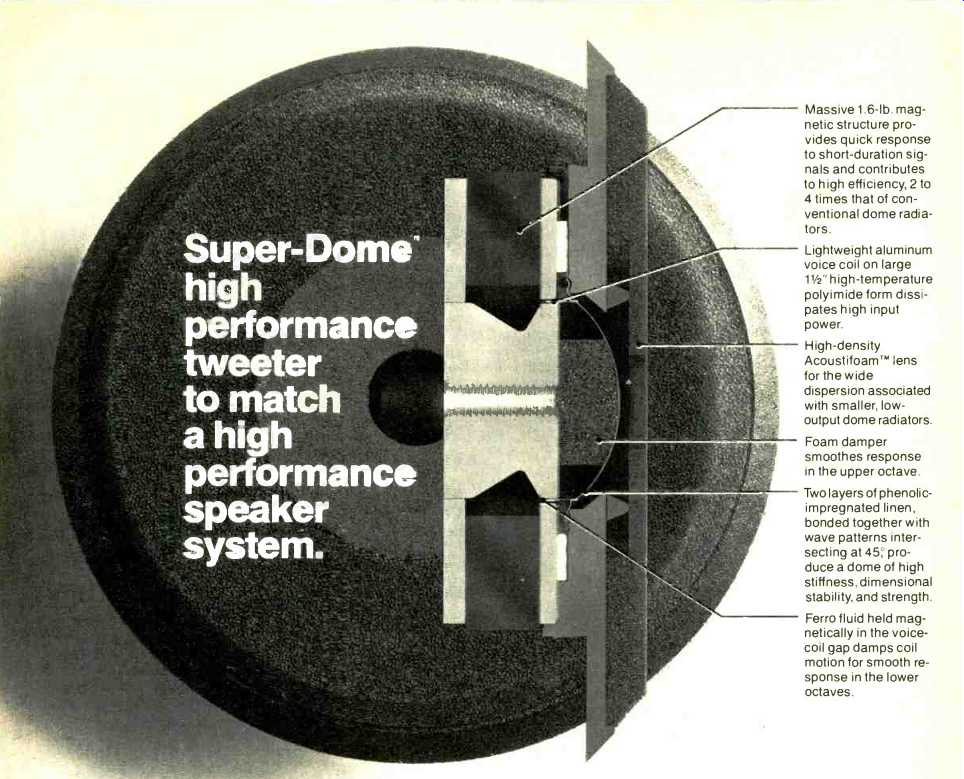
-------Massive 1.6-lb. magnetic structure pro vides quick response to short -duration signals and contributes to high efficiency, 2 to 4 times that of conventional dome radiators.
Lightweight aluminum voice coil on large 1 1/2 high-temperature polyimide form dissipates high input power.
High-density Acoustifoam lens for the wide dispersion associated with smaller, low-output dome radiators.
Foam damper smoothes response in the upper octave.
Two layers of phenolic-impregnated linen, bonded together with wave patterns intersecting at 45 degrees produce a dome of high stiffness, dimensional stability, and strength.
Ferro fluid held magnetically in the voice-coil gap damps coil motion for smooth response in the lower octaves.
The Super-Dome tweeter in the new generation of Interface speakers represents an extraordinary development in speaker design. Electro -Voice engineers have developed the first high-performance tweeter capable of matching the high efficiency and ex tended bass response found in our optimally vented, computer designed Interface: A. Super-Dome has the sonic excellence normally associated with a dome tweeter and the efficiency heretofore found only in cone tweeters--two to four times that found in a standard dome. Plus, its voice coil will withstand a full 25 watts power input long term. That's five times the power handling capacity of other standard dome or cone tweeters.
While the angle of dispersion narrows at high frequencies with conventional tweeters, the high-density Acoustifoam lens in Super-Dome helps keep dispersion constant in the upper octaves. Acoustically trans parent at lower tweeter frequencies, the lens becomes opaque at higher frequencies, reducing the effective diameter of the radiating surface, thus increasing the angle of dispersion.
The result is the wide, uniform high-frequency dispersion necessary for precise localization of sound, both lateral and front-to-back.
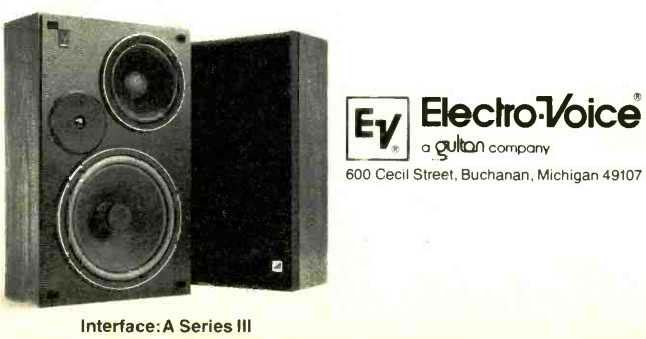
Super -Dome is found in six of seven speakers in the new third-generation Interface line. No matter which model you decide to buy, you are assured of outstanding performance and model-to-model sonic integrity. Our goal re mains the same as it was in 1973 when we introduced the first Interface speaker -- to offer you a speaker that sounds like music.
EV--Electro-Voice--a gultan company 600 Cecil Street, Buchanan, Michigan, 49107
Sound Guard
Have you ever considered what it would cost to replace your record collection at today's prices? With that kind of investment at stake, it's no wonder that many music lovers have become more aware of record care. Regular cleaning of your records is important and necessary, but cleaning alone won't prevent them from wearing out.
To protect your investment you need more than cleaning. You need both Sound Guard Cleaner and Sound Guard Preservative.
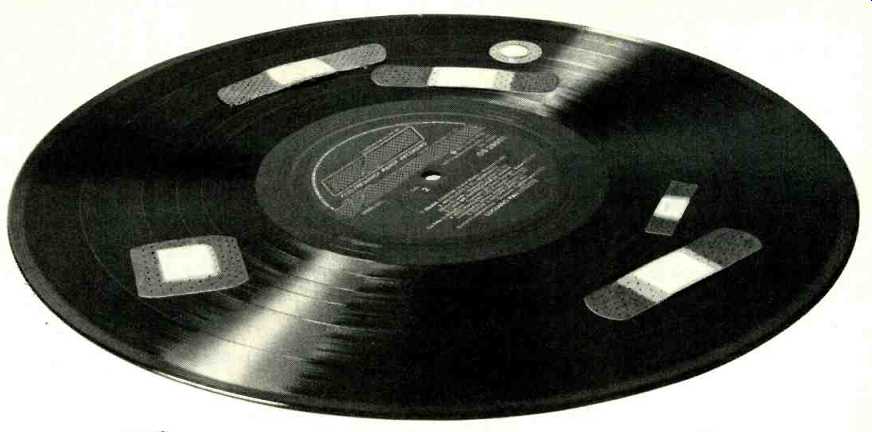
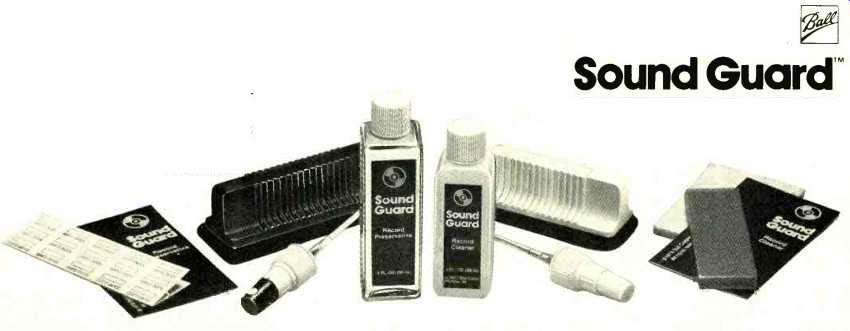
Sound Guard Record Preservative is a revolutionary dry lubricant which virtually eliminates record wear without affecting the fidelity of the record. And when you drag the hardest substance found in nature--diamond--through the soft, intricate vinyl canyons of a phonograph record at phenomenal rates of acceleration, it doesn't matter how light you 're tracking. Something's got to give, and that's the vinyl. But with a Sound Guard-treated record, even after 100 plays, there is no audible degradation of performance.* Before and after you preserve your records, be sure to use our superior cleaner to remove the dust and oily films that can further mar performance. (The cleaner will not remove the preservative's protective coating.) Sound Guard offers the only complete program of record preservation and maintenance. It requires a little more time and effort than just cleaning. But how much did you say it would cost you to replace your record collection?
Sound Guard.
Every thing else is a lot of noise.
Sound Guard Sound Guard preservative-Sound Guard cleaner.
Sound Guard Total Record Care System.
Sound Guard is Ball Corporation's registered trademark.
Copyright , Ball Corporation, 1979, Muncie, IN 47302.
ortofon
LAUNCHING A NEW ERA IN THE REPRODUCTION OF MUSIC FROM RECORDS.
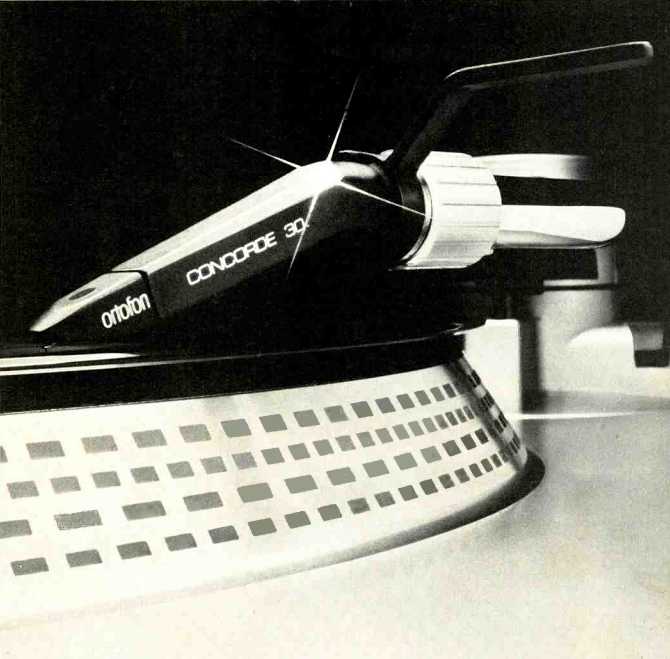

A strong claim, but true. The Concorde combines a cartridge and headshell in a single form, but weighs less than most headshells alone. The reduction in record wear and distortion, and the ability to track accurately despite warpage, pay incalculable dividends to music lovers.
Ortofon dealers are now ready to demonstrate the Concorde. It's worth a visit just to see and hear this remarkable cartridge that stands at the very frontier of music reproduction technology. For complete information write:
Ortofon, 122 Dupont Street, Plainview, New York 11803.
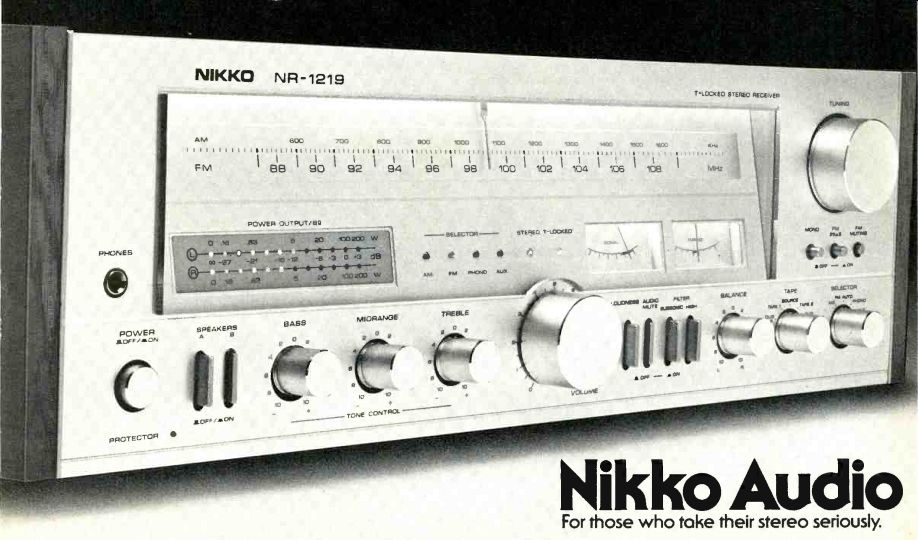
The Nikko NR-1219 state-of-the-art AM/FM Stereo Receiver gives you the features, performance and versatility of separates plus all the convenience of a receiver.
Lots of Sock
100 watts minimum per channel both channels driven into 8 ohms, 20 to 20,000 Hz with no more than 0.03% total harmonic distortion. That's more than enough--even for rock concert levels. And distortion is so low you'll never hear it.
T-Locked Tuning
Once you place the tuning indicator close to an FM station, all you have to do is take your hand off the tuning knob. The Nikko T-Locked circuit automatically locks onto the exact center of the FM frequency. Perfectly. Every time.
DC Power Amplification-Less Distortion, Wider Bandwidth
The latest word in power amplifiers. DC (direct coupling) means that input and output capacitors have been eliminated. The output transistors are, in effect, coupled directly to your loudspeakers. The phase distortion and bass limitations of conventional amplifiers have been eliminated.
The NR-1219 amplifier section gives you bass response right down to the theoretical limit: 0 Hz, or dc (direct current).
LED Power Readouts
Nikko peak-holding LEDs display power directly in watts and in decibels for each channel. LEDs are more accurate, easier to read and faster than any meter mechanism.
There's More Yet
12-dB per octave subsonic filtering eliminates distortion due to turntable rumble or warped records a 20-dB muting switch lets you lower volume temporarily and return to the exact original setting two-position tape dubbing with full monitoring and copying from either deck pre/main terminals for optional external signal processors 25 µS Dolby* FM de-emphasis exclusive Nikko fully electronic protection circuitry wood veneered side panels.
Don't Just Take Our Word For It
Write for complete information and specifications, or call toll-free (800) 423-2994 for the name of your nearest Nikko dealer. Compare features. Compare performance.
Compare price.
Nikko Audio For those who take their stereo seriously.
Nikko Electric Corp. of America, 16270 Raymer St., Van Nuys, Calif. 91406, (213) 988-0105
320 Oser Ave., Hauppauge, N.Y. 11787 (516) 231-8181 © Nikko Audio 1979
+++++++++
ORIGINAL MASTER RECORDING
Available from select audio and record stores coast to coast.
Imported Super Vinyl Pressings Half-Speed Mastered Special Protective Packaging
++++++++++++
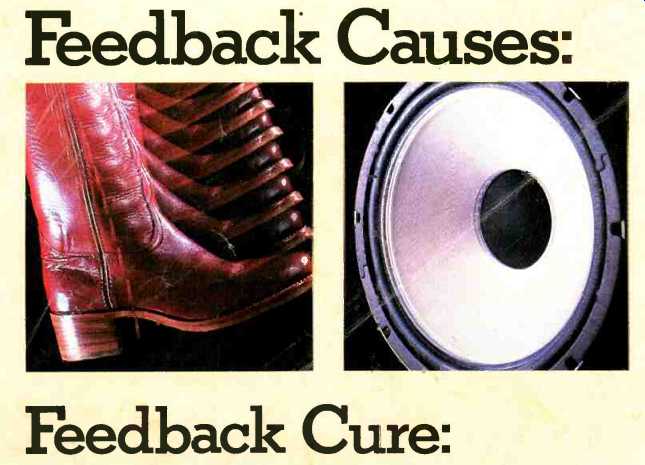
Feedback Causes:
Feedback Cure:
DiSCWASHER DiscFoot.

Hi-Technology Turntable Isolation System
Works in combination with existing feet for dramatic reduction of feedback.
Isolates better than original or "replacement" feet.
Home environments can "upset" a turntable by feeding back both speaker and footfall vibrations.
Acoustic isolation of a turntable involves the complex variables of turntable weight, room/floor conditions and audio system placement. The Discwasher DiscFoot has been specifically designed to success fully isolate most turntables in the home environment.
The "Material" Solution
The major components of the Discwasher DiscFoot System are new, "totally engineered" chemical complexes that behave radically different than other plastic, rubber or spring systems. These proprietary compounds are durable and precise in behavior, although difficult and expensive to synthesize. Laboratory and real-world tests justify the use of these unusual materials in the DiscFoot System.
The Telling Test
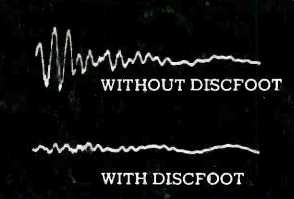
The oscilloscope photo shows the output of two identical audio systems on the same shelf with their styli contacting the platters. The shelf is being struck by a rubber mallet. The top trace shows a turntable with absorptive "replacement" feet. The lower trace shows a DiscFoot System operating in conjunction with the existing turntable feet. Note the dramatic (tenfold) improvement in shock and feedback isolation.
The DiscFoot System contains four isolation feet, four platform caps, four furniture-protecting sheets and four special damping pads (to adapt DiscFoot units to certain turntables.) Additional single DiscFoot units are available for turntables weighing over 22 lbs. The system costs $22.
DiscFoot.
Discwasher DiscFoot can be found at audio dealers interested in preserving your music.
discwasher, inc.
1407 N. Providence Rd.
Columbia, Missouri 65201
++++++++++++++++++++
= = = =