
There's nothing like on-the-spot experience (with a bit of informed guidance) to push you through the learning process in any field, as you will understand if you read my installment on radio last month.
Educators set up workshops to supplement texts and lecturing, audio specialists help you with hands-on sessions to get your sticky fingers where you want them. All this is just the old apprentice system, whereby various trades and skills--also the very highest arts--are carried forward from one generation to the next. But how about an accidental apprenticeship, unintended? So it was for me in radio and plenty else, as noted before. A series of happenstances, or call it luck. As though I'd bumbled somehow into Titian's or Michelangelo's studio (bottega is the word) and found myself trying to paint feet on a half-finished Madonna. An apprentice by mistake, but even so, it might be interesting.
Routine work in a radio station of the 1940s was not that different from the same today, granted no automation and differences in equipment and programming. Most present-day operators could walk right in and get down to business. But for an outsider, then as now, the basics were a considerable surprise. I quickly learned about time, for instance, when I got past that first show of mine. It is measured in seconds, not minutes, and a half-hour program runs 28:30 or else. No dillydallying. As a result, to this day I am the most punctual oldster I know. People find it disconcerting when you are so literal--but not in broadcasting.
I learned, too, about the dread of time lost-the phenomenon of dead air. No signal. Five seconds of that is endurable; 10 is disturbing--the heart begins to pound. Thirty seconds of silence is total disaster, Sweat pours, hysteria mounts.
Some stations have deliberately tried, over the years, to relax this tyranny of the seconds, but it isn't really possible. It's inherent in the medium itself, AM or FM. Yes, we can be relaxed but only in proportion. A 10-second pause seems forever.
You'll note (and I learned) that recording has the same sort of time factor. Spacing between LP bands, for example, now runs naturally in the 5 to 10-second range. But in live concerts that spacing can be 10 times as long and audiences don't mind a bit. A "live on tape" recording today, even with music unedited, must somehow be shortened in those painfully long (and noisy) intervals-as we hear the reproduced sound. You fit the message to the medium.
Curiously, television, combining audio and visuals, has an inherently much slower tempo, probably because it can command more attention through two senses, however soporific on occasion. TV shows are longer by far than the old radio equivalents, and correctly so. Blanks and silences do not seem to matter as much. Again, it's the nature of the medium.
I learned very quickly to use one vital time trick: back-timing. Brilliant idea! So simple. You start at the end and go backwards. If your plane leaves JFK Airport at noon, you back-time from that point, step by step, to find out when you can safely leave home. Elementary, but few people bother. I still back-time practically everything, but now I'm canny. When dealing with people who don't, I insert an extra NLQ, a Normal Lateness Quotient. Some people are always 5 minutes late, or maybe 10, others much, much more. One guy, the other day, said on the phone, "I'll be there in 20 minutes." I knew him. He was punctual, right on the dot (including his NLQ), an hour and a half later. Fit perfectly into my back-timing.
On radio, if your show (always live, in the '40s, except for a very few muddy transcriptions on disc) ran too long it was usually dumped off the air at precisely the preset time. You weren't supposed to run overtime; whole networks were waiting on your final word. So you didn't. I learned to live with this imperious rule after several hideous mishaps.
One of my later taped programs was a "mystery composer" show, a sort of musical guessing game. I did a long, tricky build-up, giving hints, with lots of music, and I had the bright idea of saving the composer's actual name until the very end to heighten suspense. At that point I said, portentously, "And now, the name of our mystery composer! Believe it or not, he is ..." Clunk. I was cut off the air! Right on the last word.
That name would have gone 1 second overtime, due to a late start with the tape, the station's fault. No matter.
The axe fell exactly on schedule. "You have heard Edward Tatnall Canby ..." said the announcer, not even noticing.
And then the phones started to ring.
I made an unconvincing explanation the next week and thereafter resolved to run my tapes a bit short-and never to end with vital information.
Now, so many years later, even if I try to delay I always get to the doctor's office exactly on time, as scheduled and then must wait an hour, or often two. Curious ideas some of us have as to the allowable plus or minus! I'd hate to be an M.D. with a program on the air. Of course, it's not only radio and all broadcasting that adheres to the tyranny of the second. Every music group, in studio or concert hall, must learn exact timing wherever there is audio involved. So must the home hi-fi user when it comes to video or audio cassette recordings. Time waits for no man! It never has.
For our timing we had, in the 1940s, a non-computerized card catalog which at first had me somewhat scandalized. Every bit of music we owned on records was filed by timing, second by second. If you had 4:58 minutes to fill up after a featured work, you looked under 4:58 and took your choice of maybe four or five items. When I later came to making up dozens of recorded programs, all to a typically exact length, I found this system quite delightful. (So you thought we chose the music for its artistic worth, did you?) Now, I suppose, you do exactly the same thing on the house computer monitor. Might save 2 or 3 seconds over the old system on cards.
An even more personal bit of learning came for me when I splurged and had my very first broadcast on FM taken down on ET (electrical transcription). An air check. Very simply, I wanted to hear myself. Delusions of grandeur? Maybe, but more practically, I wanted to know what my show was like to the outside listener.
No tape, no personal recorders then.
You went to a local recording studio and had them take you down off the air. Mine came on two big, 16-inch, 33 rpm lacquer discs, professional type, which I could play in the studio. They ran about 15 minutes a side. The alternative 78 lacquers for home playing ran around 5 minutes (narrower grooves than commercial discs). All these were cut on two tables, overlapping the material at each ending. For a half-hour show on 78 this was painful.
But at least you got all the content.
Yes, I indulged in a bit of megalomania. I remember going out into Central Park and gazing at the top of the Hotel Pierre, where our antenna was clearly visible-little me, emanating from way up there! But when I heard the ETs of the show, I was dismayed. It sounded awful. / sounded awful, I mean. Why? I had tried to do my best. Why did it sound so monotonous and dull? I was deflated, embarrassed.
Well, of course, in those days you did not ever hear the sound of your own voice as others heard it. In the broadcast, before the mike, I thought I was being witty and cheerful and very sophisticated. What a delusion! On the air, as recorded, I sounded like an idiot, and it wasn't the fi either, which on ETs could be quite good.
Well, live and learn, or retire from the field. I took those two big lacquer discs into our studio during off hours and spent many days working on them. I got out my script and read it out loud along with the recording, to see how it sounded from the inside of me. That study was another turning point. I found out several things that largely accounted for the trouble.
First was timing. When you speak via any electronic medium you must punctuate by deliberate pauses. Most people don't. I had blithely run my clauses, my sentences, even my paragraphs into one long, unbroken flow. You could understand if you tried, but I wasn't helping. I once heard a recording of a famous American novelist who read his own works exactly the same way. Excruciatingly dull. If you don't do it naturally, then you learn. You practice and practice, until it becomes second nature. All actors, all radio and TV people (including the President!) either know their timing instinctively or have studied it very, very well. As a matter of fact, when you read anything aloud, anywhere, the timing principle applies.
Even to impromptu speeches. Pause for effect, also for grammar. So I tried and tried. I filled up my script with pauses and thus made it too long. But the next one went better.
Second was pitch-emphasizing speech by ups and downs of the voice-and third was the big punch, the forceful explosion that carries. Teddy Roosevelt-ever hear him? (He left a few recordings.) That punching is a big temptation. It goes over in board meetings and on the basketball court.
It quells any opposition if you do it right. But it kills mikes.
It seems I was a puncher and I didn't use the pitch of my voice nearly enough. (Do you?) To make my impression, notably as a teacher before a lot of apathetic students, I learned to punch like crazy without half noticing. I had punched my way (without enough pitch variation) straight through that first radio script and all I got for my trouble was a batch of momentary overloads and no punch at all.
So I practiced, as I went on to more broadcasts, making all my points at a dead level of volume, using only the pause and the rise of pitch to get impact. It began to work (more ETs). I sounded more interesting and the VU meter stopped banging its pins. I proliferated the pauses, short, medium, and long; the voice soared up and down (however silly it seemed at first), and my programs began to be almost professional. That direct comparison between my inside voice and its outside equivalent paid off.
Today it is simple to do all this with any tape recorder almost anywhere.
Today our equipment, from mikes to speakers, can generally take a wider dynamic range, though the ubiquitous limiter will cut you back if you get too loud. But the rules still basically apply, as they did 40 years back.
I went further in those first years. I began to take on some announcers' tricks I heard (as you do now) every single day. You start a sentence like "And now ... let's hear ..." with an "and" in your very deepest bass, then a "now" at a higher pitch-and you curl that "now" around the diphthong, naw-oo, like the knell of doomsday.
Announcers can make the silliest things sound important: "And naw-oo, a message from Chompy Cheese Bits"-phew! Grabs you. Why shouldn't I do the same, even on classical radio? So I did.
"And naw-oo, just listen to this extraordinary interpretation of (pause) Johann Sebastian Bach ...." It's a strange world, this audio of ours.
(adapted from Audio magazine, Sept. 1985)
========
Vintage magazine ADs:
THE MR 20 STEREO MONITOR/RECEIVER FROM NAD
Television Without Compromise.
High-fidelity video with stereo sound.
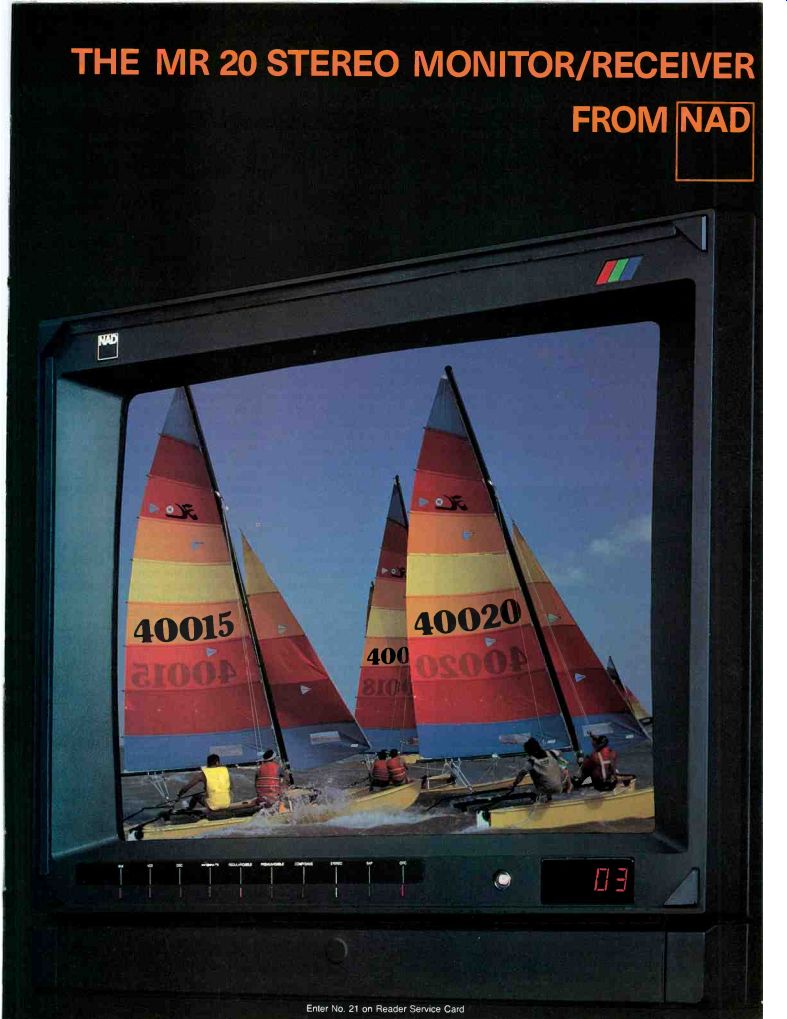
The MR 20 monitor/receiver from NAD sets new standards for the emerging "high fidelity" era in television. It combines brilliantly clear video with wide-range stereophonic sound to provide a television experience with more satisfying realism, and more dramatic impact, than anything previously available for home use.
The NAD MR 20 is a no-compromise monitor/receiver. It is a studio-quality video monitor that accurately reproduces every tonal shading from velvety black to glistening white highlights, and shows every detail in the broadcast picture with unprecedented clarity. It is cable-ready with sensitive 139-channel digital tuning and wireless infra-red remote control; it has inputs for seven program sources including video disc and video tape and it is completely equipped for stereo sound (with built-in decoding for stereo and bilingual TV broadcasts). It costs more than an ordinary TV set; but , like a stereo hi-fi system, the MR 20 is a rewarding long-term investment in viewing and listening pleasure.
Television as it was meant to be.
Engineers in TV studios employ costly high-performance video monitors to check the quality of TV pictures before broadcast. But TV receivers sold for home use have always been compromised in quality, in order to simplify their circuitry and reduce manufacturing cost. As a result, most people have never seen a high-fidelity video image and do not realize how remarkably good how sharp, clear, detailed, and realistically textured-a television picture can be.
If you love good music, you already know that a "high fidelity" stereo system provides more listening pleasure than a table radio. With its clear and undistorted highs, rich bass, and accurate timbre, a fine hi-fi system authentically reproduces the natural sound of music, and that makes it a deeply rewarding investment.
The NAD MR 20 brings the concept of high fidelity to video, faithfully reproducing the entire television picture exactly as it is broadcast, with no compromises or short-cuts. The advanced design of the MR 20 begins with the striking new shape of its square-cornered picture tube. Its flat screen shows the entire TV picture without losing information at the edges or corners, while NAD's high-performance video circuitry delivers brighter whites, blacker blacks, finer details, crisper contours, more realistic textures, a truer gray scale altogether a clearer, sharper, more detailed and lifelike picture than you have ever seen on a television screen.
The New Technology of Television:
Television is no longer just TV.
Until recently, television was a restricted medium with limited viewing choices, fuzzy and ghost-ridden pictures, and low fidelity mono sound (so low-fi that it actually was relayed from networks to local stations via telephone lines). Today television has entered a new age.
Broadcasts have improved in technical quality through better cameras, better electronics, and satellite relays. Cable and pay-TV provide dozens of program choices. Video games and home computers generate colorful video images for entertainment, education, and practical tasks. Video tapes and discs give you more freedom to watch what you want, whenever you want, and LaserVision discs rival the best broadcasts in sharpness and clarity. Spacious, wide-range stereo sound is available from video discs, "hi-fi" video tapes, and a growing variety of TV broadcasts, while the preparations for stereo have improved the quality of all TV sound.
The NAD MR 20 enables you to take full advantage of this dramatic evolution.
Its wide video bandwidth and special sharpness-enhancing circuits resolve every detail in the best broadcasts and LaserVision discs, while also producing an astoundingly vivid display of the brightly colored graphics in computers and video games. The MR 20's designation as a monitor/receiver means that it provides direct audio and video "line" inputs (instead of antenna-type connections) for video cassette recorders and video disc players. The direct inputs provide clearer pictures, much better sound, more operating versatility, and are more convenient than having wires and switches dangling from the antenna input terminals.
To take advantage of all of today's new options, you could invest in a system of separate video components-a cable ready video tuner, a decoder for stereo and bilingual TV sound, an audio/video control center with input-output connections and switching for the video and stereo audio from several program sources, and a high-resolution video monitor to display the picture.
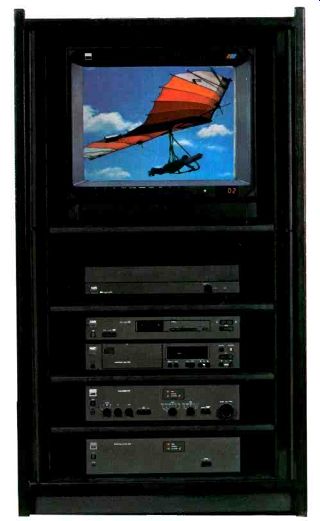
You could but you don't have to, because the MR 20 includes all of these. It offers all the quality and flexibility of separate video components, in a convenient all-in-one unit that is as compact and easy to use as an ordinary TV set.
The Audio-Video Home Theater.
Just as Dolby* Stereo sound in theaters has dramatically heightened the excitement and pleasure of movie-going, the addition of wide-range stereo sound makes television a far more involving and satisfying experience.
There's no need to add an external decoder for stereo broadcasts; it's included. The full-featured amplifier is equipped with standard preamplifier controls (bass, treble, balance) to tailor the sound to your taste. The MR 20 gives you five ways to listen:
1. Use the built-in speaker, as with an ordinary TV.
2. Enjoy stereo sound in private, via headphones.
3. Connect external speakers for stereo. A 2.5 watt/channel stereo amplifier is built-in, with connections and circuitry to handle the stereo audio from video discs, tapes, and stereo TV broadcasts.
4. Connect a patch cord to the Auxiliary input of your stereo hi-fi system, or to a higher-powered external stereo amplifier and speakers.
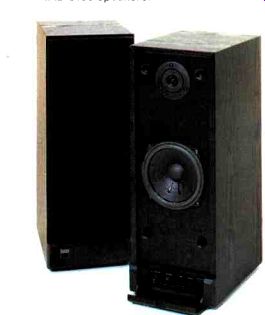
5. Use the matching self-powered NAD 8100 speakers.
Designed to match the MR 20, the economical NAD 8100 is a two-way loudspeaker system with built-in power amplifiers for the woofer and tweeter (40 watts total per channel). Each speaker contains dynamic filtering to remove high-frequency noise, a Dynamic Signal Processor for astonishingly powerful bass output, and magnetic shielding to make it completely safe for use near TV sets.
--Dolby is a registered trademark of Dolby Laboratories Licensing Corporation.
About NAD:
NAD is the world's leading manufacturer of affordable high-quality stereo equipment. Since 1978 NAD stereo components have won universal praise for their sophisticated engineering, excellent sound, ease of use, and superior price/performance value. NAD products are sold by a carefully selected network of dealers in twenty-nine countries around the world. If you haven't seen the name before, it is because NAD invests most of its money in engineering rather than advertising relying on enthusiastic word-of-mouth publicity and an unbroken string of rave reviews in magazines to spread the news of the superiority of NAD's designs. Now NAD has brought its expertise in high-value engineering and innovative design to video.
NAD-We Make State-Of-The-Art Technology Easy To Use.
NAD's audio and video products combine outstanding performance with logical, easy-to-use controls. We build the sophistication into the circuitry, so you don't need advanced training to operate it. (For instance, to select Channel 4 just press 4 on the remote control. You don't have to enter 04, as you do with less advanced tuning systems.) But behind the MR 20's elegantly understated exterior you will find some of the most useful features and most advanced video engineering available today. For example:
Wireless infra-red remote control.
"Signal seek" tuning that scans up or down, automatically stopping (perfectly center-tuned) on any active channel.
-J Separate inputs for regular and "premium" cable. Use the premium input (with an external decoder) for scrambled pay-TV channels, and use the MR 20's convenient remote control tuning for all other channels.
Convenient rear-panel connections and front-panel selection for both a video disc player and a video-cassette recorder (VCR).
Black-level clamping and automatic contrast control for blacks that are pure black, not gray.
Tightly regulated high-voltage supply that maintains crisp, sharp focus even in the brightest white picture areas. From velvety black to brilliant white highlights, NAD video offers a greater range of picture contrast than any other TV on the market.
Comb filter to reduce color interference and preserve full resolution of fine picture details.
Fine-pitch in-line black matrix screen for brilliantly pure colors, crisply-defined details, and lifelike textures.
Switching-mode power supply, filtered to eliminate hum and interference, and tightly regulated so that the picture does not flicker and shrink when an air conditioner clicks on.
Built-in decoding for TV broadcasts with stereo sound. (You won't need to add an external decoder later.) Plus full stereo input/output connections for other program sources, including Hi-Fi VCR's and video discs.
Why NAD Video Is Better: The Inside Story.
Your eyes recognize that the MR 20 delivers a better picture than other TV sets. Here are the reasons why: Regulated Switching-Mode Power Supply
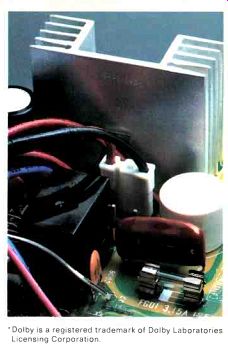
An efficient switching-mode power supply provides the voltages that the circuits need, safely transformer isolated from the AC power line. Filtering eliminates hum and interference, and tight regulation keeps the voltages constant regardless of fluctuations in AC voltage. The picture doesn't flicker when a refrigerator clicks on, and doesn't shrink on hot summer days when air conditioners cause a heavy power drain.
Consistently Sharp Focus
In the MR 20 the high-voltage power supply that focuses the scanning electron beam on the screen is tightly regulated, so that it can produce more brilliant white highlights than other TV sets, without either "blooming" (blurring caused by the electron beam going out of focus at high intensity levels) or fluctuations in picture size.
Low Overscan
In other TV sets as much as 15 percent of the picture is over-scanned beyond the borders of the screen, forever lost to view. This over-scanning is done to ensure that the picture will continue to fill the screen even when it shrinks. Since the MR 20's picture can't shrink, it is factory-set for minimum overscan (no more than 5 percent). Together with the square cornered screen, this ensures that you see virtually all of the picture, all of the time.
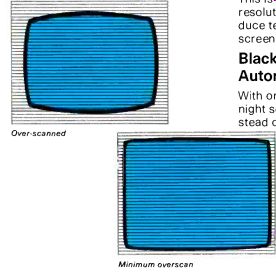
---Minimum overscan
---Over-scanned
Comb Filter For Sharp Horizontal Resolution
The MR 20 uses a high-precision comb-filter circuit that accurately extracts the color subcarrier from the video signal, minimizing false color interference while still preserving its full 4.2 MHz bandwidth. Colors remain pure; black and white stripes remain black and white; textures are reproduced with lifelike detail on the screen.
Video Pre-Shoot and Peaking
A special pre-shoot circuit sharpens contours and edges for an especially crisp look to the picture. And the Detail control on the front panel adjusts a peaking circuit that you can use to boost the highest video frequencies (to sharpen details in the picture, especially with a VCR) or, alternatively, to soften a picture that is grainy or snowy.
Fine-Pitch Black Matrix Screen
The color picture is produced by pure red, green, and blue phosphors that glow brightly when struck by the scanning electron beam. In the MR 20 nearly 500 tricolor phosphor groups fit across the width of the screen (spaced only .74 mm apart), resolving even the finest picture details.
Perfect Interlace for Sharp Vertical Resolution
A standard television picture is not formed by 525 sequential scanning lines but rather by fields of 262.5 lines each, alternating 60 times per second.
If the lines in each field are precisely interleaved between those of the previous field, a smooth 525-line picture is obtained, and the individual scanning lines are spaced so evenly and closely that they are hardly visible.
This is essential for optimum vertical resolution of fine details, and to produce textures that look realistic on the screen. The MR 20 achieves this goal.
Black-Level Clamping with Automatic Contrast Control
With ordinary TV, large dark areas in night scenes tend to become gray instead of black, and bright lights may produce a gray streak across the screen. Sixty times per second a special DC-restoration circuit in the MR 20 measures a black-reference level in the signal to lock in consistently pure, velvety blacks.
Having explained our approach to television design, we now invite you to visit your local NAD dealer and audition the MR 20 Monitor/Receiver. We are confident that you will find the MR 20 to be the best television you have ever seen or heard.
Specifications:
NAD MR 20 Monitor/Receiver
Tuning system Digital synthesizer tuning, 139 channels total.
Random-access keypad channel selection via remote control, plus signal-seek Up/ Down scan.
RF connections, VHF antenna, F connector UHF antenna, screw terminals Cable input, F connector Cable output (to decoder), F connector, Premium cable (from decoder), F connector Game/computer (RCA phono).
Cable tuning, All mid-band, super band, and hyper-band channels (A-1, J-W, A5-A1, and AA-WW up to W-28).
CRT screen, Slot-mask black matrix, 0.74 mm pitch.
Over-scan, Less than 5%
Geometric linearity 5%, horizontal and vertical
Convergence 1.7 mm maximum error except in extreme corners.
Video bandwidth Exceeds the NTSC broadcast limit of 4.2 MHz.
Resolution Equals or exceeds the NTSC broadcast limit, both the horizontal and vertical.
Stereo decoding EIA MTS (BTSC) standard, built-in; no external decoder required. Includes both stereo and S.A.P.
-------------------------
Proton D540
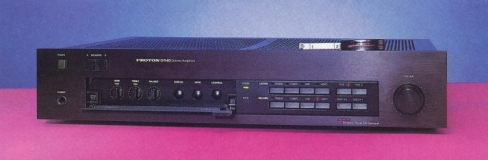
PROTON INTRODUCES DYNAMIC POWER ON DEMAND.
BECAUSE MUSIC DEMANDS IT.
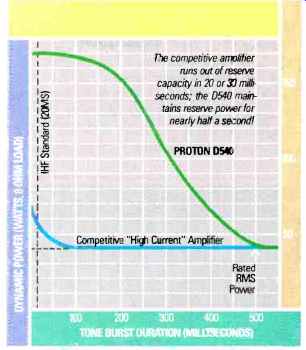
Music is a demanding master. Nowhere does it ask more of amplifiers than in the reproduction of musical peaks. It's in this area of dynamic range that conventional amplifiers fail. They simply run out of energy before the sound does. Now, with the increased dynamics of digital audio discs and hi-fi video sound, there's more than ever to hear... or miss.
DPD lets you hear it all. Dynamic Power on Demand [ Patent Pending ] is a radical new design that uses two different types of circuits to supply power The first is ideal for most of the signals that music produces. The second circuit stores power, and automatically takes over when the loudest musical passages require the big reserves; and, it provides power as long as the musical peak lasts. That's what only DPD can do deliver its reserve capacity up to 20 times longer than other amps! The result is performance that's fanatically faithful to your favorite Benatar or Beethoven.
With more realism and dynamics than you've ever heard before. But even DPD is just the beginning of our remarkable D540 integrated amp. Add to that a unique dual action volume control, phono circuitry for either moving magnet or moving coil cartridges, complete record-playback flexibility, and the ability to bridge to mono. This is the Proton D540 with DPD. The demands of music have never been better fulfilled.
Proton Corporation. 737 West Artesia Blvd. Compton, CA 90220 (213) 638-5151.
-----------
YAMAHA
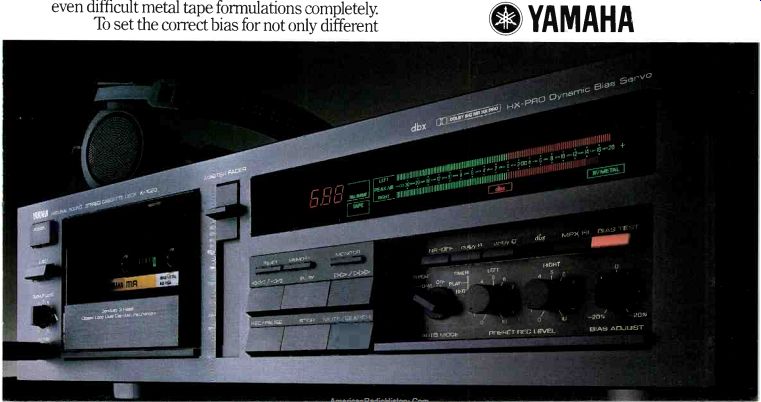
One of the most advanced cassette decks in recorded history.
With its advanced technology and features, Yamaha's new K-1020 cassette deck makes most others seem like ancient history.
To begin with, the K-1020 has a specially designed closed-loop dual-capstan transport system. There's one capstan on either side of the record and playback heads. This insures that the tape is always in optimum contact for exceptional frequency response and low wow and flutter.
And separate reel and capstan motors insure that the tape drive stays isolated from the reel operation for increased reliability and reduced modulation distortion.
Each of the three heads in the K-1020 is specifically designed to maximize its performance. The pure Sendust record head has a 2 micron gap for precise signal recording. The pure Sendust playback head has a 0.7-micron gap for accurate reproduction as high as 23 kHz.
And the double-gap erase head has an ion-plated 0.3-micron glass coating to insure that it erases even difficult metal tape formulations completely.
To set the correct bias for not only different tape formulations, but each individual tape, the K-1020 has an Optimum Record Bias Tuning system. Just press the TEST button and adjust the bias control until the ORBiT tuning indicator shows you the bias is precisely set. Then to prevent saturation, use the variable 0-VU recording level indicators to set the level for each tape formulation/noise reduction combination.
Of course, a deck as advanced as the K-1020 gives you a choice of Dolby* B and C as well as dbx** noise reduction. Plus full-time Dolby HX Pro* to increase headroom by as much as 8db at 20 kHz. Along with a full complement of convenience features including a four-digit real-time counter with auto memory.
And the K-1020 is just one in a complete line of new Yamaha cassette decks. Because history has a way of repeating itself.
K-1020 shown with Yamaha YHD-1 Orthodynamic Headphones
*Dolby and Dolby HX Pro are trademarks of Dolby Laboratories
**dbx is a trademark of dbx, Inc.
Yamaha Electronics Corporation, USA, P.O. Box 6660, Buena Park, CA 90622 YAMAHA
= = = =