By G. W. TILLETT
Highlight of my recent visit to Los Angeles was an evening spent at the home of Superscope's President-Joseph Tushinsky, listening to the Vorsetzer.
Not that the day spent in the Superscope--Marantz plants was uninteresting-when you have seen one production line, you haven't seen them all-and I was very impressed with the high standard of engineering and sense of direction. But the Vorsetzer is something else. As many readers know, it is a kind of player-piano device and it forms the basis of the "Keyboard Immortals play again in Stereo" program carried by more than 200 FM stations. The story goes back to 1904 when Edward Welte invented a player-piano that really captured the original performance-unlike the crude machines of the day. Welte had attached to each key a light carbon prong that made contact with a tray of mercury, thus when the key was depressed an electrical circuit was made which could measure the initial transient and the duration. Similar devices were attached to the pedals. The electrical impulses were recorded on a paper roll by a kind of pen recorder and then the tracings would be laboriously punched out by hand. All very clever, but Welte's player mechanism was even more ingenious. He had a wooden box fitted with eighty felt-tipped fingers and two feet for the pedals, called the Vorsetzer ( sitter-in-front) And this is what it does, it sits in front of the piano-any piano and plays. It is operated by air suction controlled by the perforations in the roll.
Now, Welte had a workable instrument that could reproduce every nuance, every inflection of the actual player. Weite did not stop there-he was a musician and an engineer, but he was also a Showmanthe David Merrick of his time. He realized that something dramatic was necessary to persuade the great pianists of the day to record for his contraption. So what he did was to rent a castle on the Rhine and then he invited the virtuosos, the great masters of the piano for a champagne-gourmet vacation with a chance to record their genius for posterity. This move was very successful and Welte was 'in', he was established. The artists were full of praise; said Debussy "It is impossible to gain a greater perfection of reproduction." And Alexander Glazounoff "I must add that on the first demonstration, I gained an impression that this instrument reproduces my playing with the most complete artistic perfection." So Welte prospered and by 1927, his catalogue listed no less than 264 artists performing over 5000 compositions. This was probably the peak year and the decline in popularity took place so quickly that the last Vorsetzer was made only five years later. The emergence of the radio and phonograph may have had something to do with it but whatever the reason, Vorsetzers fell into disuse and rolls gathered dust in attics and basements. About 40 years later, Joseph Tushinsky was given a Welte catalog and it aroused such an interest that he began a hunt for rolls and Vorsetzers which soon spread to Europe.
By 1968, he had unearthed over 300 rolls and spent a small fortune restoring Vorsetzers. The "Keyboard Immortal" program started in 1966 from station KFAC in Los Angeles and it is now heard throughout the country.
I had listened to the programs from a New York station off and on for the past two years and I was familiar with the history of the Vorsetzer. And so, I jumped at the chance of seeing and hearing one 'in the flesh' so to speak. Joseph Tushinsky's house is high up in the Encino hills and the long picture window of the listening room gives a superb view of Los Angeles in the valley below. The room is a large one but it is dominated by two 9;i foot Bosengorfer grand pianos.
One was on a platform at the end of the room and going closer I saw it was mounted on rails which enabled it to be rolled against the wall. I walked onto the platform and I saw there was a panel in the wall through which I could now see the eighty fingers of the vorsetezer, patiently waiting to summon up ghosts from the past! But why, I thought is the piano so large? Well, one of the reasons is the incorporation of an extra octave that goes way down to 16 Hz. This refinement helps to give a richness to the overall tone although I imagine it is not often used directly. For recording, a Sony ( what else?) stereo professional ES22 recorder is employed and the microphones are three C55 condenser types. Two are suspended a foot above the strings and the third is placed through one of the circular sounding holes in the metal frame. This combination produces the best stereo image without giving the impression that there are two separate pianos! Going into the adjoining room where the Vorsetzer lived, I noticed the big library of rolls-now over 5,000. These have to be stored in a carefully controlled humidity and temperature environment--as might be expected. The mechanism of the Vorsetzer looks very clumsy but it works-and works well! It huffs and puffs like a fun-fair robot, but when the massive wooden cover is in place, all is quiet. Soon, the piano was rolled to its appointed position and then we sat back and listened to the sonorous notes of Chopin played by Josef Hofmann, some Debussy Preludes, Rachmaninoff playing his Prelude in C-Sharp minor, the great Master Joseph Lhevine, md more until the lights of Los Angeles shone through the darkness like a multitude of stars and it was time to go. Truly an evening I will not easily forget . . . As I came down the winding road, I could not help thinking about that Castle on the Rhine, and the carriages coming and going, the music and wine, laughter and gaiety of the famous who had come from all over Europe, not knowing that the lights would go out within a few short years. And in the background, Edward Welte, clutching his paper rolls, pleased and excited. Yes, he was successful, he would record all the great pianists for posterity but even in his wildest dreams he could not possibly imagine that in 70 years time, thousands of people would listen to his Vorsetzers in their own homes-without a piano!
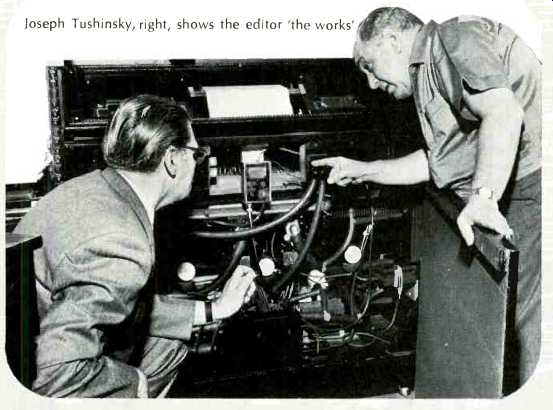
--------Joseph Tushinsky, right, shows the editor 'the works'
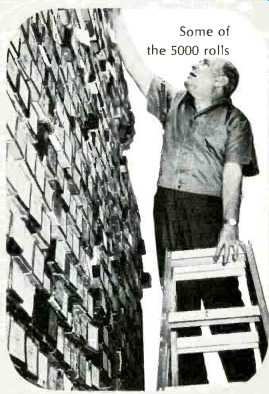
--------Some of the 5000 rolls
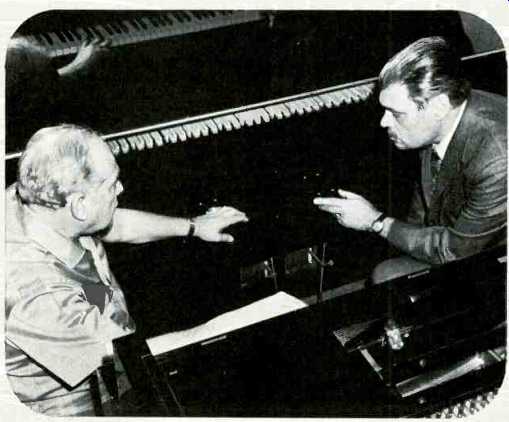
-------- Showing the vorsetzer fingers and pedal controls
(adapted from: Audio magazine, Oct. 1970)
Also see:
Remasters of Living Stereo (Aug. 1993)
============