Cartridge Aging
Q. My cartridge is almost two years old; the stylus is now ready to be replaced. Under these circumstances, I am wondering if it is best to replace the whole cartridge rather than just replacing the stylus.
Do cartridges which are two or more years old lose enough sonic quality to warrant replacement?
-Mark Pearl, Lancaster, Pa.
A.There is no reason to think that a cartridge should lose any sonic quality because of age; it should operate perfectly for years. Styli will wear out, bend from being dropped, and otherwise be detective from a number of causes, but the basic cartridge will keep right on going.
Sometimes a coil in the cartridge will open up, with the result that one channel will become completely inoperative. Barring such a failure, however, cartridge performance should remain substantially unchanged over the years.
Power Line Leakage to Chassis
Q. When touching the metal knobs or metal front panel of my receiver, a "buzz" or slight current can be felt by my fingertips. This can be felt even when the power is turned off. What gives?
-Willis C. Lewis, Sacramento, Ca.
A.There is often a bit of leakage between the power line and the chassis of a receiver, tape machine, etc. There is also something less than an infinite Ohmic resistance between you and earth ground. Thus, when you touch a chassis which possesses some leakage potential, this current passes through you to ground. You feel this slight "buzz" or vibration as the fingertips slide over the metal parts of a piece of equipment.
Sometimes this leakage is deliberately introduced in the form of a line bypass capacitor. (The purpose of this capacitor is to minimize transients or radio frequency energy present on the power line from adversely affecting the performance of the equipment, and also to reduce hum possibilities.)
This "feelable" leakage is generally not a problem. The condition can often be completely eliminated by interchanging the two prongs of the wall plug, i.e. reversing the polarity of the plug.
When a receiver or other piece of electrical equipment is grounded as instructed by its maker, the sensation of current leakage will disappear, regardless of the polarity in which the plug is inserted into the wall outlets.
If the leakage is still apparent after grounding, then the ground being used is not a good one or perhaps the interconnecting cable between chassis and ground is defective.
There can be rare instances where a direct short exists between the power line and the chassis, which can be quite dangerous. The sensation you have described will probably be no greater under these conditions than it would be with just a slight leak present. With a direct short between power line and chassis, a dangerous shock hazard exists if you were to simultaneously come into contact with the metal parts of the equipment and a good ground, such as a kitchen sink, radiator or a host of other items around the home. This is now much less likely with more and more devices equipped with grounded outlet line cords. In the case of the tiny, random leakages often found, coming into contact with a ground and the chassis of the equipment won't cause problems.
While power line leakage is not generally a problem, its presence may indicate a more serious condition.
Test for serious leakage conditions with an ohmmeter. Check between each prong of the wall plug of the suspect equipment and the equipment chassis. Have the power switch turned on. The resistance between chassis and the wall plug terminals should high, probably better than one meg.
These direct shorts between chassis and power line can be the result of a shorted line bypass capacitor or a short between the primary winding of the power transformer and its core.
Of course, it can also result from careless production.
Unity Gain From Sound Modifiers
Q. I plan to modify the sound of my acoustical guitar by running the output of an audio pickup through such devices as synthesizers, octave dividers, echo, attack delay, etc. I want such devices to have unity gain so that the volume will remain constant. Is there a device that will monitor/compare the input and output voltages in this system and make them equal?
-Howard R. Peters, Rockford, III.
A.To achieve "unity gain" all that is required is to adjust each sound modifier in turn, as follows:
1. Feed a test oscillator into the input of the device.
2. Keep the signal level low enough to prevent overload.
3. Measure the output of the audio oscillator.
4. Adjust the volume control on the sound modifier so that its output voltage equals the voltage from the generator.
5. Make certain that such frequency-sensitive items, as wah-wahs, are disabled during this adjustment.
Although the system is now set up to have unity gain, there may be times when the sound produced by the system appears to be louder than when no modifiers are involved. This has to do with the tonal and coloration characteristics of such things as "fuzz" boxes, ring modulators, wah-wahs, etc. These devices may cause frequencies in the so-called "presence" range to be louder, and make it appear that the overall volume is higher than when the devices are not in use.
A master gain control just ahead or after the sound modifiers should be the only volume control used to adjust the amount of sound heard from your loudspeakers.
In order to obtain the most efficiency, do not use high fidelity loudspeakers; use musical instrument speakers.
These are more efficient and produce the highly colored sound favored by many performers. Such speakers will not sound good in high-fidelity applications. When uncolored sound reproduction is required, switch to a conventional, high-fidelity unit.
Lubricating a Turntable
Q. What is the best method for lubricating a turntable?
-Richard Roland, Orchard Lake, Mi.
A.Before lubricating a turntable, check the maker's instructions. It is important to use the correct lubricants. I have run across instances where the use of an improper lubricant did physical damage to the turntable.
In general, the well should be oiled with a few drops of a light oil, no heavier than 10-weight, non-detergent oil.
Many turntables employ an intermediate idler to transfer motion from the motor to the turntable. A drop of light oil should be applied to the bearing. Make sure that no oil is deposited onto the idler's drive surface.
Record changers often require grease on sliding parts. The old grease should be removed with an appropriate solvent before new grease is applied.
It is often difficult to lubricate the motor shaft without completely dismantling the motor and soaking its bearings in the proper lubricant.
Some of the soft, porous bearings are designed to hold a certain amount of lubricant. The manufacturer may say these bearings are "life-time" lubricated but may not be literally true. I do this sort of "soaking business" with a light-weight oil for this purpose.
Sometimes the pivots of the tonearm become oxidized, with an audible crackling as the arm moves across a record. A little "spritz" of WD-40 in each pivot does a good job because it both lubricates and cleans them. The arm then becomes a better ground and shields the system against hum.
Checking Capacitance of Phono Cables
Q. I have several sets of phono cables of unknown capacitance. Because CD-4 reproduction requires cables rated at approximately 100 pF, I need to determine the specific capacitance of these cables. I have access to a Heathkit IT-28 direct-reading capacitor checker, but I am not familiar with the correct procedure by which to test the cables. Please advise me.
-Robert L. Gable, Jr., APO San Francisco, CA.
A. The capacitance of a shielded cable is measured between the center conductor and the shield. Therefore, in order for your capacitance checker to be used properly, one of its terminals is connected to the center terminal of the connector of the phono cable to be checked. The other terminal of the capacitor checker is connected to the outer portion, or skirt, of the same connector. If one of the terminals of the capacitance checker is at ground potential, this terminal is the one to be connected to the outer shell of the connector-the shield of the cable.
This will allow you to determine the amount of capacitance within the various interconnecting cables you have. You must, however, add the capacitance within the tonearm. To do this, remove the cartridge from the headshell and connect the terminals of the capacitor checker to the slide lugs. Try to keep the ground terminal of the checker connected to the ground terminals of the tonearm leads.
To determine the total effective capacitance of your phonograph system with any one of the cables you are about to test, you add the capacitance of that cable to that possessed by the tonearm.
Cartridge Output Versus Cost
Q. I just purchased the Empire 999 TE/X cartridge. When I installed it I found that I had to turn the volume control up higher to obtain the same output from my system that I had with a much cheaper magnetic cartridge.
Why is this?
-McDonald A.Layne, Jr., Bronx, N. Y.
A.The less expensive cartridges are designed for use with less expensive equipment which do not always have the sensitivity necessary for use with low output cartridges.
Manufacturing a cartridge which has a lot of output, however, involves moving quite a bit of mass. This, in turn, means more record wear and a degradation at high frequencies and transient response. The better cartridges, such as yours, are made with as small a mass as possible, thus making them more difficult to construct, and their output falls off. Therefore, a better amplifier is needed, one having a good noise figure in order to use one of these better cartridges.
The output from one of these cartridges would be even less if the tolerances in their manufacture were as loose as those in the less expensive models. This factor also adds to the overall cost of the more expensive cartridges.
The value of the parts used to make a magnetic cartridges is not high. The cost is really a matter of the labor involved in working with the small parts so that they will operate correctly over long periods of time. This means that, in addition to the actual process of manufacturing the cartridge, more inspections and testing must be performed to make certain that the unit you buy will perform as the maker intended.
(Audio magazine, Oct. 1976, JOSEPH GIOVANELLI)
=============
ADs:
Pioneer
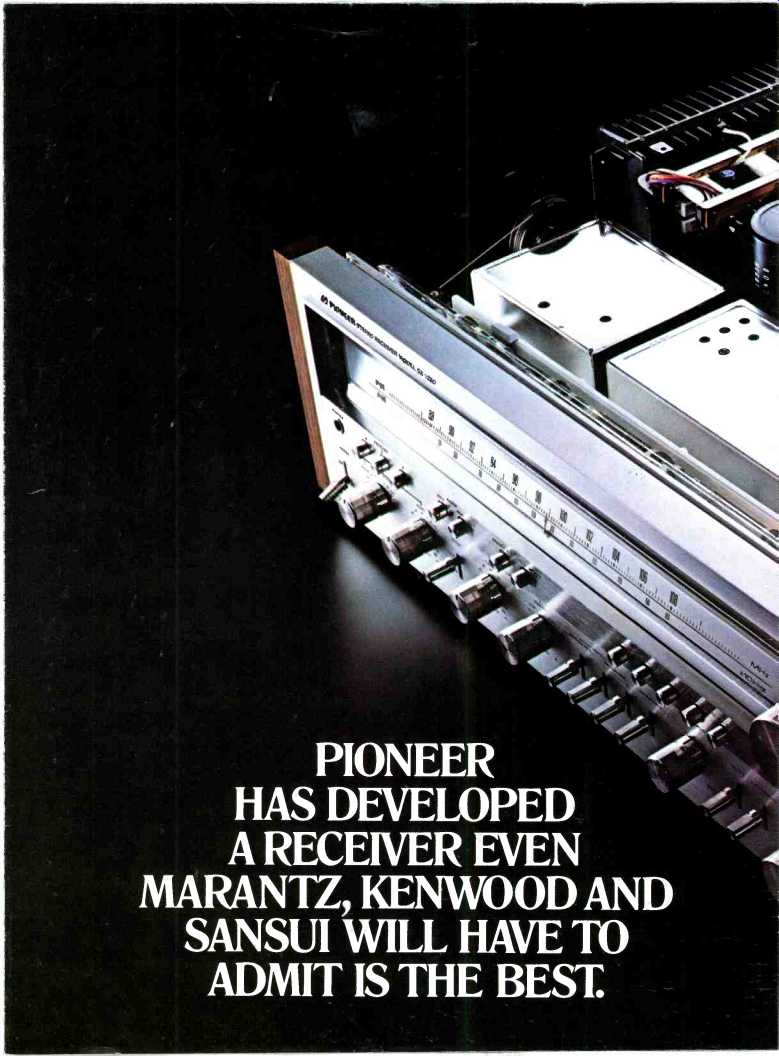
A Comparison that's no A Comparison.
PIONEER HAS DEVELOPED A RECEIVER EVEN MARANTZ, KENWOOD AND SANSUI WILL HAVE TO ADMIT IS THE BEST.
One look at the new Pioneer SX-1250, and even the most partisan engineers at Marantz, Kenwood, Sansui or any other receiver company will have to face the facts.
There isn't another stereo receiver in the world today that comes close to it. And there isn't likely to be one for some time to come.
In effect, these makers of high-performance receivers have already conceded the superiority of the SX-1250. Just by publishing the specifications of their own top models.
As the chart shows, when our best is compared with their best there's no comparison.
160 WATTS PER CHANNEL: AT LEAST 28% MORE POWERFUL THAN THE REST. In accordance with Federal Trade Commission regulations, the power output of the SX-1250 is rated at 160 watts per channel minimum RMS at 8 ohms from 20 to 20,000 Hz, with no more than 0.1% total harmonic distortion.
That's 35 to 50 watts better than the cream of the competition. Which isn't just something to impress your friends with. Unlike the usual 5-watt and 10-watt "improvements”, a difference of 35 watts or more is clearly audible.
And, for critical listening; no amount of power is too much. You need all you can buy.
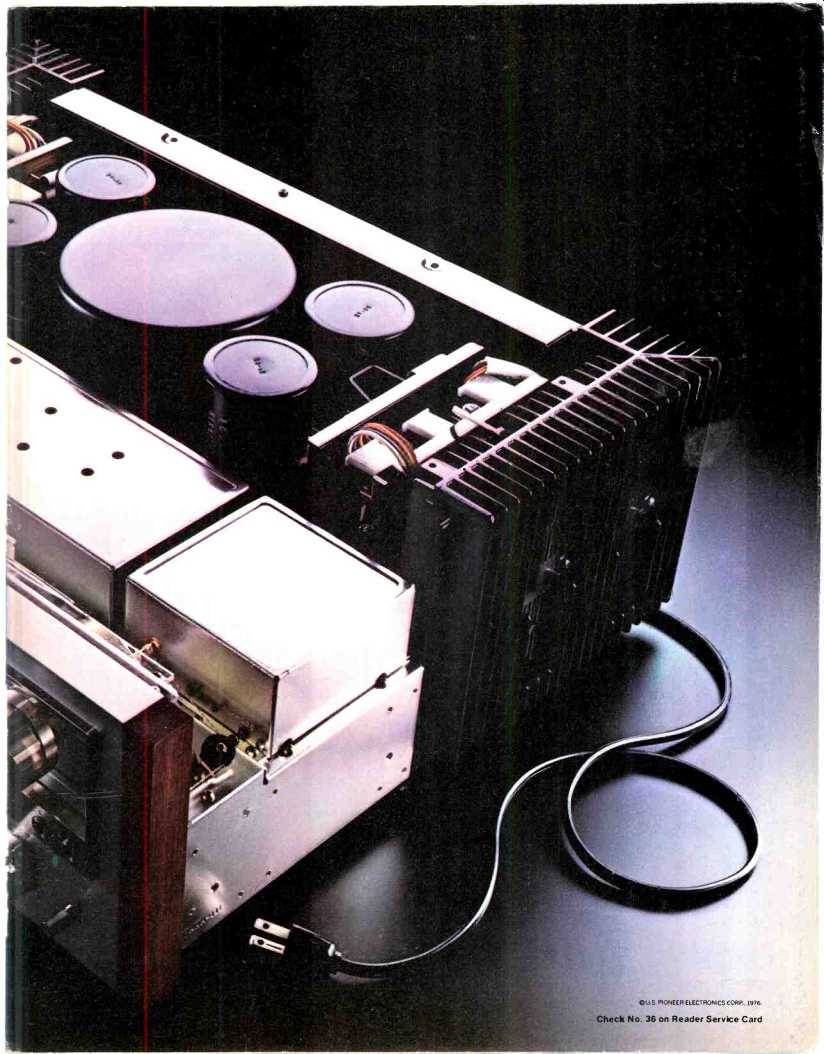
To maintain this huge power output, the SX-1250 has a power supply section unlike any other receiver's.
A large toroidal-core transformer with split windings and four giant 22,000-microfarad electrolytic capacitors supply the left and right channels independently. That means each channel can deliver maximum undistorted power at the bass frequencies. Without robbing the other channel.
When you switch on the SX-1250, this power supply can generate an inrush current of as much as 200 amperes. Unlike other high-power receivers, the SX-1250 is equipped with a power relay controlled by a sophisticated protection circuit, so that its transistors and your speakers are fully guarded from this onslaught.
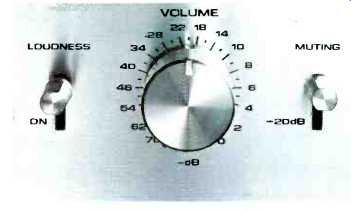
----------Click-stop volume control calibrated in decibels, with left/right tracking within 0.5 dB.
PREAMP SECTION CAN'T BE OVERLOADED.
Perhaps the most remarkable feature of the preamplifier circuit in the SX-1250 is the unheard-of phono overload level of half a volt (500 mV). That means there's no magnetic cartridge in the world that can drive the preamp to the point where it sounds strained or hard. And that's the downfall of more than a few expensive units.
The equalization for the RIAA recording curve is accurate within ±0.2 dB, a figure unsurpassed by the costliest separate preamplifiers.
THE CLEANEST FM RECEPTION THERE IS. Turn the tuning knob of the SX-1250, and you'll know at once that the AM/FM tuner section is special. The tuning mechanism feels astonishingly smooth, precise and solid.
For informational purposes only, the SR-1250 is priced under $900. The actual resale price will be set by the individual Pioneer dealer at his option.
The FM front end has extremely high sensitivity, but that alone would be no great achievement.
Sensitivity means very little unless it's accompanied by highly effective rejection of spurious signals.
The SX-1250 is capable of receiving weak FM stations cleanly because its front end meets both requirements without the slightest compromise. Thanks, among other things, to three dual-gate MOSFET's and a five-gang variable capacitor.
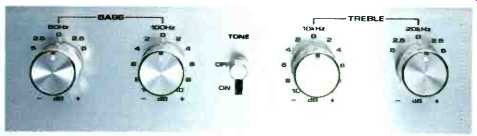
----------Twin tone-control system with step-type settings, permitting 3025 possible combinations.
On FM stereo, the multiplex design usually has the greatest effect on sound quality. The SX-1250 achieves its tremendous channel separation (50 dB at 1000 Hz) and extremely low distortion with the latest phase locked-loop circuitry. Not the standard IC chip.
Overall FM distortion, mono or stereo, doesn't exceed 0.3% at any frequency below 6000 Hz. Other receiver makers don't even like to talk about that.
AND TWO MORE RECEIVERS NOT FAR BEHIND.
Just because the Pioneer SX-1250 is in a class by itself, it would be normal to assume that in the class just below it the pecking order remains the same.
Not so.
Simultaneously with the SX-1250, we're introducing the SX-1050 and the SX-950. They're rated at 120 and 85 watts, respectively, per channel (under the same conditions as the SX-1250) and their design is very similar.
In the case of the SX-1050, you have to take off the cover to distinguish it from its bigger brother.
So you have to come to Pioneer not only for the world's best.
You also have to come to us for the next best.
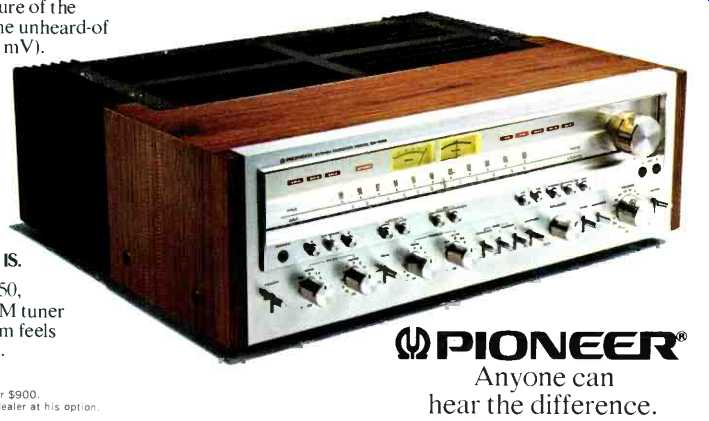
U.S.Pioneer Electronics Corp., 75 Oxford Drive, Moonachie, New Jersey 07074 For informational purposes only, the SR-1250 is priced under $900. The actual resale price will be set by the individual Pioneer dealer at his option.
===============
Pickering
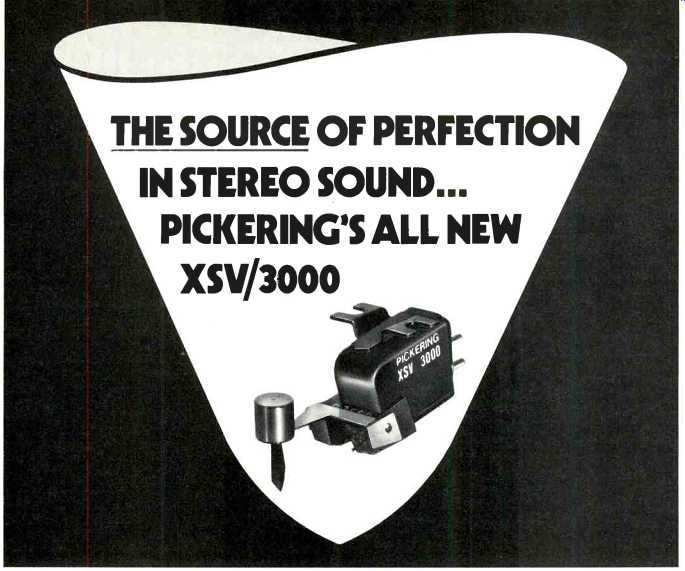
It features a totally unique construction (developed by Pickering through our pioneering efforts in discrete, 4-channel) plus a totally new stylus tip shape, the Stereohedron, which has superior tracing ability and assures longer stylus and record life! This new cartridge makes possible a wider, more open, finer sound because it maximizes stereo tracing capabilities with the slightest, lightest touch a record ever had. It increases record life because force is spread over a greater contact area. And that means the least record wear achievable in these times (with a stereo cartridge).
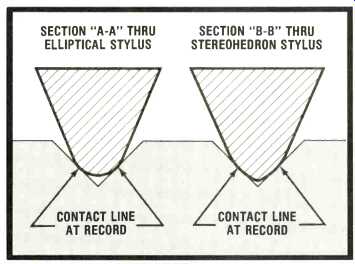
----- Conventional elliptical styli have a relatively limited bearing radius at the contact area with the groove. The Stereohedron combines the elliptical and Quadrahedron concepts to create a stylus having a larger bearing contact radius at the area in order to reduce stylus wear and prolong record life. SECTION "A-A" THRU ELLIPTICAL STYLUS vs. SECTION "B-B" THRU STEREOHEDRON STYLUS

For further information write to: Pickering & Co., Inc. Dept. A 101 Sunnyside Blvd., Plainview, New York 11803
========
Still Number 1
...because unlike some record "care" product, Watts really works!
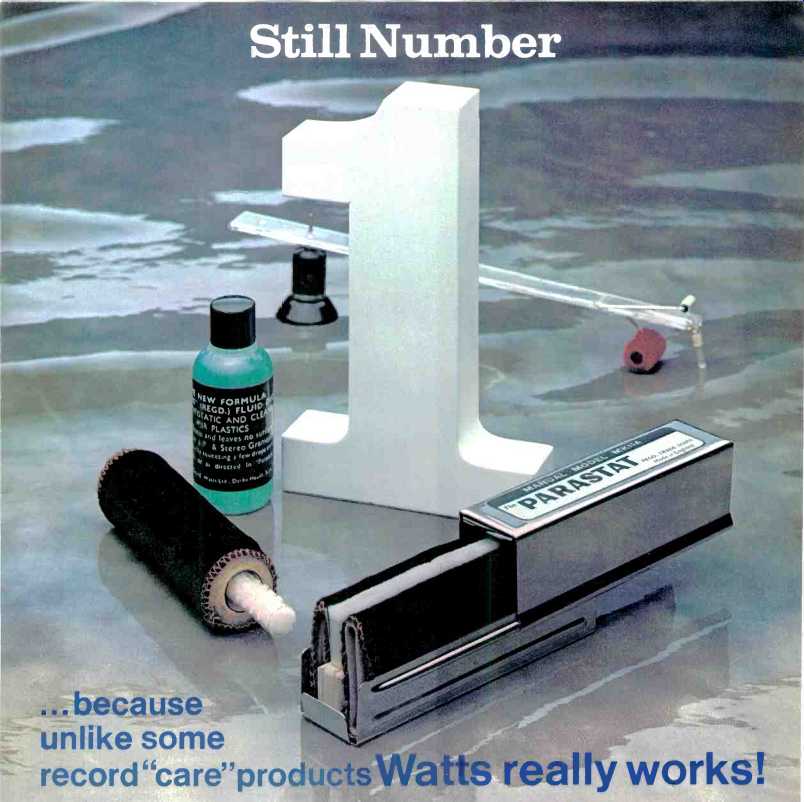
Watts Disc Preener. World's most popular record cleaning tool. Simply add a few drops of Watts "Anti-Static" solution to its moistened core and without transferring any liquids to the record's surface, Preener cleans and preserves the grooves of your new records. Watts Preener leaves no residue to clog the stylus, which can degrade the sound quality of your favorite record.
Watts Parastat: 2 Cleaners in One.
Parastat's special brush penetrates record grooves to loosen and remove dust and dirt. Ideal for records which have been mistreated with anti-static sprays.
Parastat also provides cleaning action for the maintenance of new records. With a drop or two (we're not in the flu d business) of Watts "Anti-Static solution, to the Parastat's lower pad, the proper degree of humidity is applied to relax dust attracting static.

Watts Dust Bug. Elegantly simple in design and function, the famous Dust Bug keeps a new record clean by removing dirt and dust which may settle on the record while in use. When the red plush pad of the Bug is slightly dampened with Watts "Anti-Static" solution, which is supplied, Dust Bug provides just the proper degree of humidity to prevent the generation of static electricity. While imitated, the ultra-lightweight Watts Dust Bug has never been equaled in performance and effectiveness.
Record Care Products are distributed by:
ELPA MARKETING INDUSTRIES, INC.
EAST: New Hyde Park, New York 11040
WEST: 7301 E. Evans Rd., Scottsdale, Arizona 85260
==========
Clearly Nakamichi
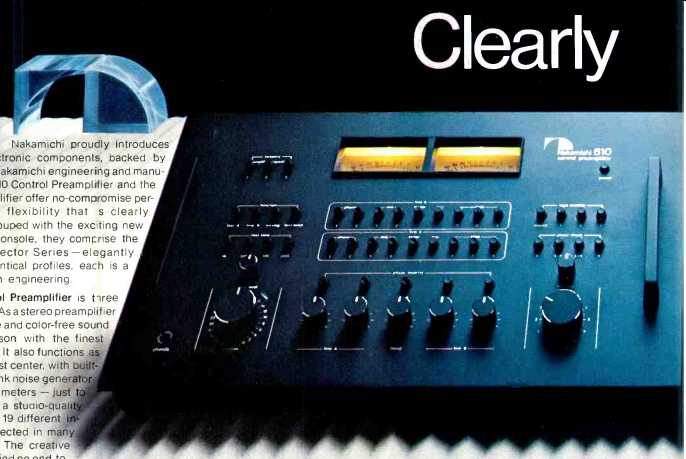
Nakamichi proudly introduces its first all-electronic components, backed by world-famous Nakamichi engineering and manufacture. The 610 Control Preamplifier and the 620 Power Amplifier offer no-compromise performance and flexibility that s clearly Nakamichi. Grouped with the exciting new 600 Cassette Console, they comprise the Recording Director Series--elegantly styled with identical profiles, each is a study in human engineering.
The 610 Control Preamplifier is three devices in one. As a stereo preamplifier its performance and color-free sound invite comparison with the fine units available. It also functions an advanced test center, with in test tones, pink noise gen and precision meters j name a few. As a studio-quality mixer, any 5 of 19 different puts can be selected in m combinations. The creative audiophile will find no end to the 610's capabilities.
------- Phono S/N Ratio (IHF-A): Better than 80 dB (0 dB=1 mV); THD: Less than 0.005% Meters:-40 dB to +10 dB range, peak reading; Frequency Response: 5 Hz- 150 kHz +/- 0.75 dB.
The 620 Power Amplifier boasts harmonic and IM distortions so low they cannot be reliably measured with the best test instruments. It is unconditionally stable under any load, including a direct short circuit. The power supply packs more punch than units several times its size. A unique biasing circuit cuts idling current by 1/20 and keeps the bold heat sink fins cool to the touch.
Peak indicator lamps glow green or red for each channel at pre-settable power output levels.
For complete information, write Nakamichi Research (U.S.A.), 220 Westbury Ave., Carle N.Y. 11514 or see your Nakamichi dealer soon and for a demonstration of 610 and 620 together with the incredible 600 Cassette Console (now also available in matte black finish).
Power Output: 100 watts per channel min. RMS, 8 ohms, 5 Hz-20 kHz, with no more than 0.01% THD IM Distortion: Less than 0.002% at 100W/8 ohms (60 Hz: 7 kHz, 4:1); S/N Ratio: Better than 120 dB (IHF-A)
==============
Accuphase
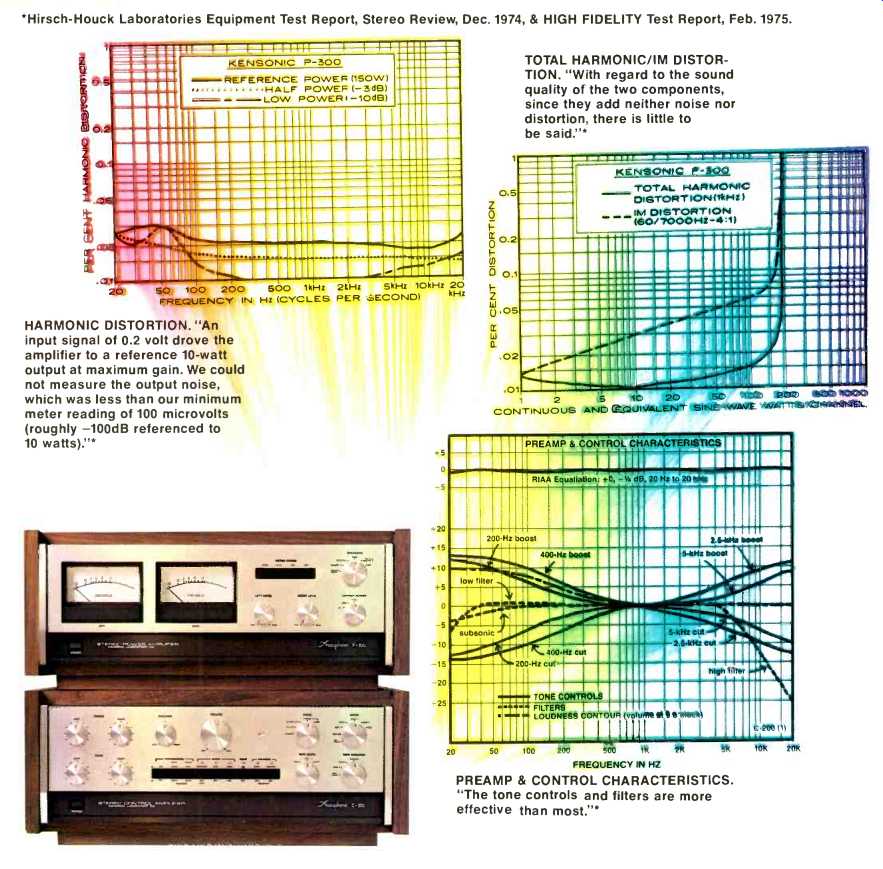
"If you are looking for the proverbial ‘straight wire with gain,' this combination meets all the requirements."
Hirsch-Houck Laboratories wrote that headline over a year ago. Since then, quite a number of independent laboratories have attested to the uncompromising quality of Accuphase.
We've assembled them for you in a free 36-page booklet. It's the second most informative way you can learn about these superb stereo components.
The best way is to audition them yourself.
Then you'll understand why the critical acclaim has been as impressive as the product itself.
Accuphase
HARMONIC DISTORTION. "An input signal of 0.2 volt drove the amplifier to a reference 10-watt output at maximum gain. We could not measure the output noise, which was less than our minimum meter reading of 100 microvolts (roughly-100dB referenced to 10 watts)."
TOTAL HARMONIC/IM DISTORTION. "With regard to the sound quality of the two components, since they add neither noise nor distortion, there is little to said."
PREAMP & CONTROL CHARACTERISTICS. "The tone controls and filters are more effective than most."
===========
LUX
Some thoughts on whether to simply upgrade your receiver or step up to separates.
As receivers become more powerful and versatile--approaching the performance of separate components-the original virtues of the one-chassis format diminish. Space-saving and convenience no longer exist when the chassis is too large for any normal shelf. All-in-one construction can now be considered an inherent disadvantage. No single element-tuner, preamplifier or amplifier-can be individually upgraded. And if any of these elements needs servicing, the entire receiver must be packed, shipped and done without.
These conditions are likely to worsen as the power race among receivers continues. With existing technology, higher power means physically larger (and heavier) power supplies and more massive heat sinks, leading to even more unmanageable proportions.
Control flexibility functions and facilities are other considerations. If you want filters with selectable cut-off points, turnover frequencies for each tone control, and if special refinements, such as a linear equalizer for phono, are preferred over basic controls, you're probably ready to consider separates. Which brings us to LUX. Although our published specifications of LUX amplifiers and tuners are typically state of the art, independent test reports have found them very conservative. For example, Hirsch-Houck labs, after testing the L-100 integrated amplifier, reported the following in Stereo Review: "The harmonic distortion (THD) at 1,000 Hz and 10 watts output was 0.0087%, and it remained at that figure up to the rated 110 watts:' (Note that at 110 watts, the rated distortion from 20 to 20,000 Hz is 0.08%.) Audio magazine had a similar experience with the T-310 tuner: "...most of our results were far superior to those claimed...distortion in mono and stereo was the lowest we have ever read for any tuner at any price ... LUX's conservatism extends to some of the 'lesser' FM specs as well. We measured a capture ratio of 1.2 dB (1.5 claimed) and alternate channel selectivity turned out to be 76 dB (70 dB claimed.)..:' However, we regard measured specifications as no more than a partial indication of a component's ultimate performance. LUX's audiophile/engineers consider accuracy of music reproduction the most important goal in new product development and modify circuit parameters in pursuit of sonic excellence long after measurable goals have been reached Thus, we consider one of our finest tributes to date to be Radio-Electronics' overall evaluation of the L-100: "We heard a clarity and effortless power capability that is hard to describe in words but definitely is audible...LUX seems to have found some of the answers...about what makes one amplifier sound better than another" Whether you simply trade in your present receiver for a better one, or move up to separates, it's likely to be expensive. We suggest therefore that you carefully examine all the relevant factors-size, weight, flexibility, specifications, performance, and expected reliability, in addition to the initial cost.
The more care you take, the more likely it will work out to your ultimate advantage. And, we suspect, to ours also.
LUX Audio of America, Ltd. 200 Aerial Way, Syosset, New York 11791.
In Canada: White Electronics Development Corp., Ontario.
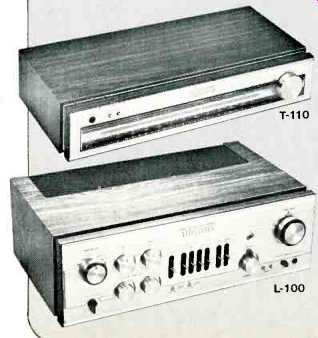
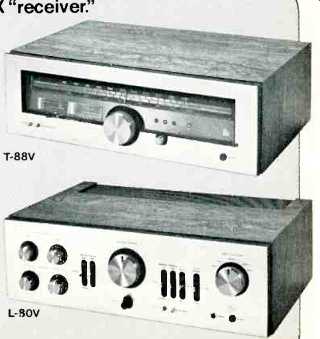
At the moment, this is as close as you can get to a LUX "receiver."
T-110 Stereo FM Tuner -- LUX's finest FM tuner. MOS-FET front-end, five-section tuning capacitor. Phase-locked loop IC for FM multiplex. Special features include: antenna attenuator circuit: time-delay circuit protection; 75/25 microsecond de-emphasis for use with external Dolby' unit. $525.00
L-100 Integrated Stereo Amplifier LUX 's most powerful: 110 watts minimum continuous power per channel into 8 ohms, 20-20,000 Hz, with no more than 0.08% total harmonic distortion throughout. Features include: exclusive linear equalizer for custom-tailored phono response; variable phono input sensitivity and impedance: three turnover frequencies each for bass and treble; 20-dB-range volume attenuator for each step of master volume control. $995.00 T-88V AM/Stereo FM Tuner LUX's least expensive tuner, yet includes FET front-end and linear-phase ceramic filters in IF section. $345.00
L-80V Integrated Stereo Amplifier. 50 watts per channel minimum continuous power into 8 ohms, 20-20,000 Hz, total harmonic distortion no more than 0.08%, Features include: two turnover frequencies each for bass and treble controls; two cutoff frequencies each for high and low filters: two-deck dubbing. $475.00
===============
WE STOLE THE IDEA FROM NASA.
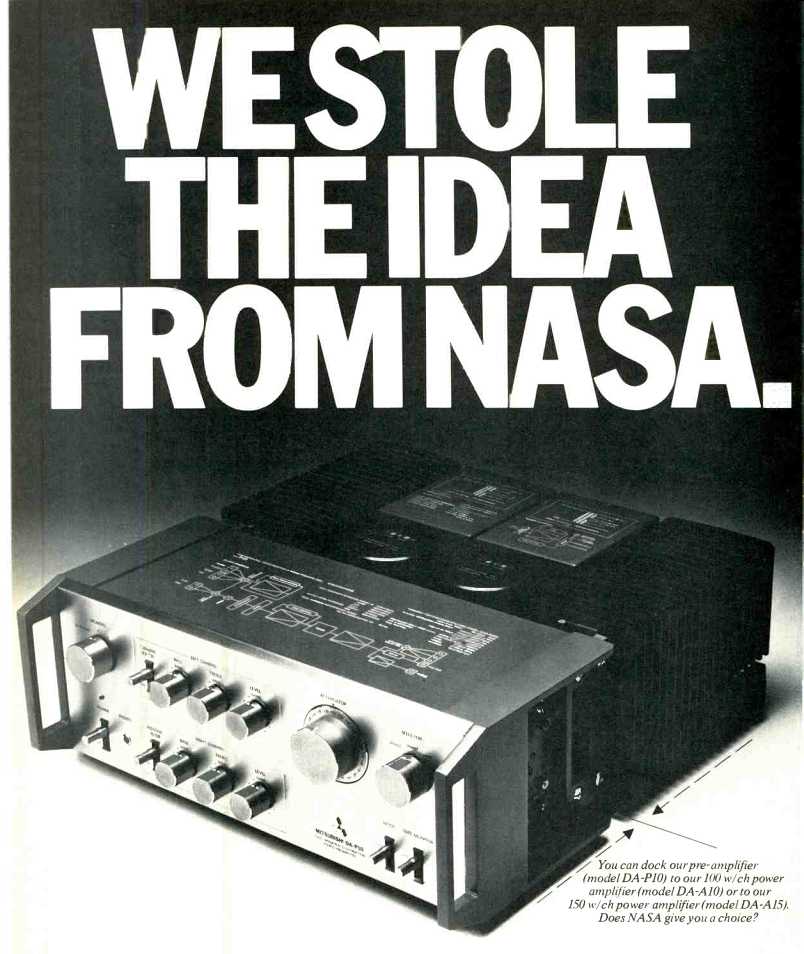
-- You can dock our pre-amplifier (model DA P10) to our 100 w/ch power amplifier (model DA-A10) or to our 150 w/ch power amplifier (model DA A15). Does NASA give you a choice?
As soon as Apollo docked with Soyuz in outer space, our engineers got itchy.
Why not design a pre-amp that docks with an amplifier? Or a power meter that docks with an amp?
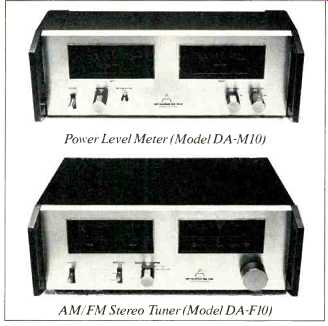
------Power Level Meter (Model DA-M10)
-----AM/FM Stereo Tuner (Model DA-F10)
No sooner dreamed than designed.
Now Mitsubishi introduces a whole new series of components that dock--pre-amp, power amplifier and power level meter.
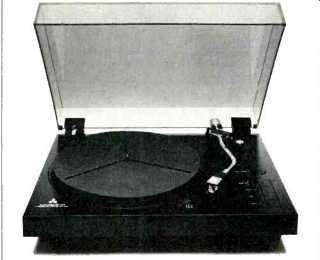
-------Integrated Logic Control Turntable (Model DP-ECI)
Plus an electronically controlled turntable with integrated logic design, universal head shell, and an arm that knows exactly the size of the record you're playing.
As for purity of sound, Mitsubishi handled that with dual-monaural construction.
Our one amp is actually two separate amplifiers built on one chassis. Our docking pre amp is built the same way.
That's how we give you a great signal-to-noise ratio.
And separation that really separates.
And everything's designed with a sturdy military look.
There's only one problem with stealing this neat idea from NASA.Soon everybody else will be trying to steal it from us.
MITSUBISHI AUDIO SYSTEMS
For more information write Melco Sales, Inc., 3030 East Victoria Street, Compton, California 90221.
================
JVC builds in what other receivers leave out.
A graphic equalizer.

The only way you can equal the realistic sound capability of JVC's modestly priced S300 stereo receiver, is by adding an expensive, but highly versatile graphic equalizer, to another receiver.
For the price of a conventional receiver in its price range, the S300 has built-in JVC's exclusive graphic equalizer system. With five zone controls to cover the entire musical range. While most high priced receivers offer bass and treble controls, and some include a third for midrange, none approach the precision and flexibility of the SEA graphic equalizer system developed and patented by JVC. 371,293 ways to hear better sound.
By adjusting the five detent tone controls covering the frequency range at 40Hz, 250 Hz, 1,000Hz, 5,000 Hz and 15,000 Hz, you can create 371,293 different sounds. A feat never before achieved (with a stereo receiver) outside a professional recording studio. But, then, the S300 is a JVC professional.
Get better performance from your components and listening room.
Why do you need such tremendous variations in tone? Quite simply, they help you to overcome the shortcomings of the acoustics in your listening room; they also can help you to compensate for the deficiencies in old or poor recordings.
Finally, they can do wonders for the frequency response(of your speakers, and where you place them.
SEA is really quite easy to use. For example, the 40Hz switch reduces record hum or rumble, and it can add greater clarity to the ultra low bass of an organ.
The problem of booming speakers is simply handled with the 250Hz switch. And in the important midranges, the 1,000Hz control adds new dimension to the vocals of your favorite rock performers, while the 5,000 Hz switch brings out the best in Jascha Heifetz. You can even reduce tape hiss and diminish the harsh sound of a phono cartridge at high frequencies, with the 15,000 Hz control. Then, to double check any adjustment, SEA works with a tone cancellation switch which permits you to instantly compare your setting with a perfectly flat response.
SEA adjusts the sound of your system to the size of your room.
You see, small rooms tend to emphasize high frequencies, while large ones accentuate the lows. But the ingenious SEA allows you to compensate for room size and furnishings-so your system can perform the way it was meant to, wherever you are.
While most manufacturers reserve unique features for their top of the line model, JVC has included SEA in three of its receivers. The S300, the S400, and, of course, the top professional-the S600. When you hear these receivers at your JVC dealer (call toll-free 800-2217502 for his name), think of them as two components in one. In fact, it's like having all the benefits of a graphic equalizer ... without buying one.
JVC America. Inc. 58-75 Queens Midtown Expressway, Maspeth, N.Y. 11378 (212) 476-8300
=================
Power separates the new Powerhouse receivers from the competition.
Lafayette's new Powerhouse receivers have more than just brute power. Check our spec chart. You'll find clean power for clear, distortion-free listening.
That's the kind of power the Powerhouse line delivers.
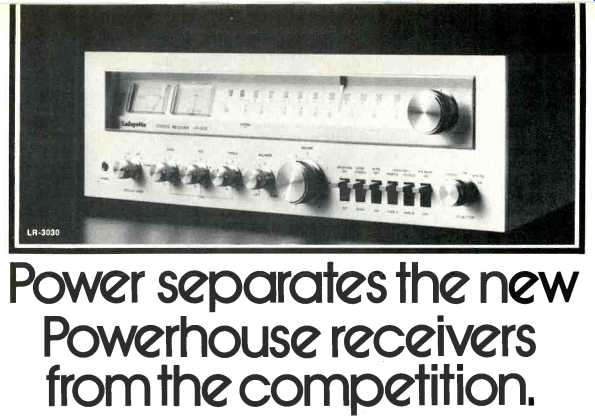
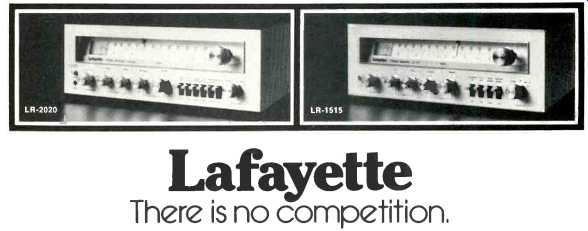
Powerhouse receivers are designed to be the center of your music system. And they've got the performance and features that make them the heart of your music system.
Every Powerhouse receiver, including the LR-1515, the LR-2020 and the LR-3030 shown, has the selective phase-lock-loop circuitry for drift-free FM and positive detent controls for complete control. You'll also find superb features like derived 4-channel sound, dual tuning meters, tape monitor, FM mute and other performance and convenience controls on our other Powerhouse models.
Behind every Powerhouse receiver you'll find Lafayette warranties, and qualified experts to help you.
Stop in at one of the Lafayette stores or dealers coast to coast.
The differences between Powerhouse receivers are in this chart. The difference between Powerhouse and other receivers is simple-Performance makes the difference.
Lafayette
There is no competition.
For more information and a free catalog please write: Lafayette Radio Electronics, Box 121, 111 Jericho Tpke., Syosset, N.Y. 11791 Copyright 1976 Lafayette Radio Electronics
=================
Onkyo
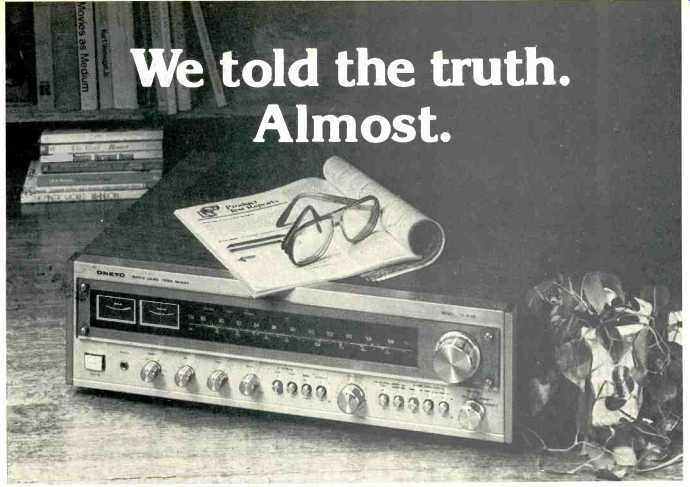
We erred on the side of modesty when we published the specifications and performance data of our Quartz Locked AM/ FM Stereo Receiver.
Then Hirsch-Houck, a famous independent audio testing lab, put our TX-4500 through the mill on their own. You know who they are ... possibly the best known in the business. They said and we quote: "... virtually impossible to incorrectly tune in an FM station." "... sound quality in FM reception with the TX-4500 will be determined only by the quality of the broadcast program." "... when playing records the sound had a definition and clarity that were unmistakable." In fact, they compared the TX-4500 favorably with component tuners and amplifiers, and we didn't lose.
While we claimed the TX-4500 would deliver 55 watts per channel, minimum RMS at 8 ohms, both channels driven, from 20 Hz to 20 kHz with no more than 0.1% Total Harmonic Distortion, they found Total Harmonic Distortion less than 0.02% at middle frequencies; 0.09% at 20 Hz, and 0.04% at 20 kHz.
We said IM distortion was 0.1% at 1 watt. They found it between 0.01% and 0.02% at most power levels from 1 to 40 watts.

You should also know about our FET/4-gang variable capacitor front end. Our circuitry with 70 transistors, 8 IC's and 59 diodes, plus the FET. About provision for three sets of speakers and three tape recorder circuits, each controlled by its own pushbutton.
You might also be interested in detented tone controls and center detent balance control. Phase Locked Loop Multiplex.
But mostly, you have to see what Quartz Locked tuning does, verified by the lab that the system invariably resulted in the lowest possible distortion and noise and best stereo separation the receiver is capable of.
There's no way we can tell you everything about our "Studio on a Shelf". There's too much, and we're too modest. But, you can find out at your Onkyo dealer. He may even have a copy of the lab report. If not, write us for a copy.
While you're at it, look into the TX-2500 also. It costs a little less than the TX-4500 and performs almost as well.
Instead of Quartz Locked tuning, the TX-2500 features Servo Locked tuning. In our own modest way we have to say it's pretty good.
So, if you can't go for the top of our line, you can come pretty close. And the best place to start is with an Onkyo dealer.
*Popular Electronics, August, 1976.
ONKYO U.S.A.CORPORATION
Eastern Office: 42-07 20th Ave., Long Island City, N.Y. 11105, 212-729-2323
Midwest Office: 935 Sivert Drive, Wood Dale, Ill. 60191, 312-595-2970
Canada: Sole Distributor, TriTel Associates Ltd., Willowdale, Ontario, Canada M2H 2S5
=============
Garrard.
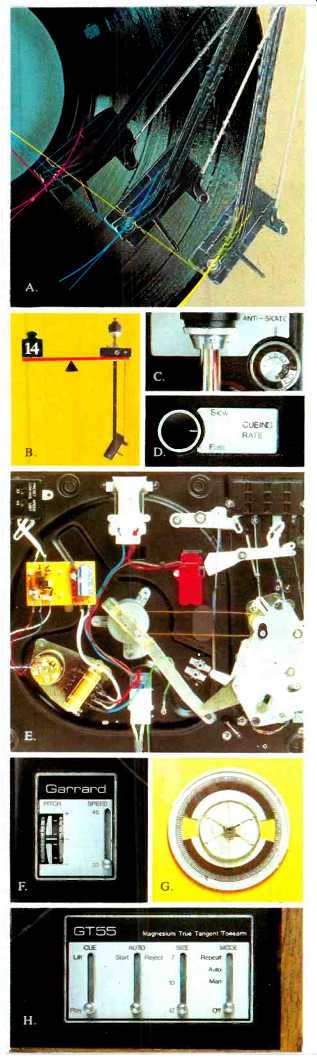
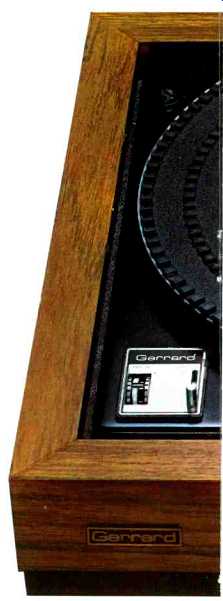
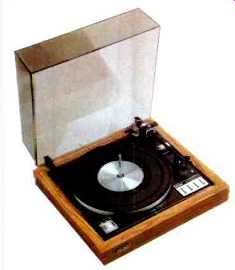
A.The computer-designed True Tangent Tonearm keeps the stylus at a constant 90° tangent to the record groove, by means of an articulated head. The angle between the head (holding cartridge and stylus) and the shaft of the tonearm changes with each groove. Thus, while the tonearm swings in an arc over the record, the stylus is kept at a constant, true tangent. Tracking error is eliminated, with its consequent problems of record wear and harmonic distortion.
B. Made of modern, low-mass magnesium, the GT55's tonearm weighs an astonishing 14 grams. It rides on jewel vertical pivots and horizontal ball bearings.
Inertial drag and friction are reduced to absolute minimum levels.
C. Anti-skating protection on the GT55 is provided by a unique, patented system.
Completely non-mechanical, it operates magnetically, and varies in proportion to the actual skating force across the surface of the disc. It is calibrated for elliptical and CD4 styli.
D. Cueing rate is variable, and the cueing operation is damped in both directions by the main cam of the turntable.
E. The GT55 is the only belt drive multiple play turntable with a DC servo motor. Both the motor and the belt-driven automatic mechanism are completely new. The speed of the motor is continuously governed and regulated by an electronic servo system.
The automatic mechanism is smooth and silent in both single and multiple play. It is also completely disengaged from the tone arm when the record is playing.
F. Speed control is variable ±3%, and is electronically governed by the servo which controls the motor. Read-out is monitored by an illuminated stroboscope.
G. The platter is four pounds, die cast and dynamically balanced for smooth, precise rotation. It is driven by a flexible belt, which insulates it from any possible motor vibration.
H. The precision controls are conveniently grouped, and include selectors for single or multiple play, as well as a repeat-play option for use in either mode.
Garrard.
Turntable specialist for 50 years.
Only three turntables in the world offer True Tangent Tracking.
Bang & Olufsen, Rabco, and the new Garrard GT55.
They play your records precisely the way the original masters were cut, with the stylus held at a 90° tangent to the groove.
They eliminate harmonic distortion caused by tracking error.
One of the three is also fully automatic in both single and multiple play. Its tonearm is low mass magnesium, balanced on jewel pivots.
Yet it sells for the lowest price of all three as much as $400 lower! The new GT55.
By Garrard.
The GT55 Generation Two Turntable with True Tangent Tracking.
Since the first flat disc record was made, just about 90 years ago, audio engineers have been searching for a way to eliminate tracking error.
The master record is cut with a stylus that maintains a constant 90° tangent to the groove it is inscribing. Problem: play it back the same way. Anything else produces tracking error (maybe a little, maybe a fair amount), and that means distortion.
In 90 years of search, turntable manufacturers have proposed an array of solutions. Some have been inventive, even ingenious; others have verged on the ridiculous. None until quite recently have been successful.
Now there are three, all as different from any other turntable as the flat disc is from Edison's cylinder. Two of them solve the problem by a radical departure from traditional design: they move the entire tonearm across the record-pivot, counterweight and all.
Ingenious. Complex. And expensive.
Garrard found another way. Our half-century of turntable engineering culminated in a solution that retains the pivoted tonearm yet keeps the stylus in an absolutely true 90° tangent to the groove at every point from the record's outer rim right to the label.
Further, we did this with a computer-designed tonearm made of the ultimate in lightweight, rigid metals: magnesium. It has the lowest mass (14 grams)--and the lowest inertial drag--of any multiple-play turntable.
And it is automatic. Fully automatic. Silky-smooth, silently automatic, and therefore gentler and safer than the steadiest hand, whether you use it as a single play or a multiple play turntable.
Garrard' s solution--the GT55--delivers other advantages, as well. Some small, some quite large, depending on what's important to you.
And one overriding advantage. The others sell for prices up to $700. The GT55 is under $250. Which makes True Tracking not a costly privilege but an available benefit. To everybody.
For your free copy of the new Garrard Guide, please write:
Garrard. Division of Plessey Consumer Products, Dept. C, 100 Commercial Street, Plainview, N.Y. 11803
=============
AR
Some straight talk about loudspeaker accuracy from the people who invented it.
Of over 100 speaker brands advertised on the market, all claiming supremacy for their product based on the kind of sound they produce, one leading company stands apart. It is Acoustic Research. We design, build and test our products to accurately reproduce all the sound information contained on your records, tapes and radio broadcasts, but no more. What you want from a loudspeaker is a precise recreation of what the recording engineer placed on your disc or tape, be it good, bad or mediocre. Only AR loudspeakers can guarantee you this kind of accuracy.
The most important contributors to AR loudspeaker accuracy are an original design with inherently flat frequency response (the ability to reproduce faithfully the complete range of musical sounds, including harmonics, without emphasizing or subduing any of them) and a rigorous testing program to insure that this ideal-specification is fully realized in every product shipped. The flatness of AR response curves is an accepted fact. Perhaps not so well known is our insistence that every individual AR driver, and every completed system, perform to within ± 1 dB of this response curve before it may be shipped to your dealer.
We'd like you to know much more about accuracy in sound reproduction and have prepared a 36-page brochure on loudspeaker design and selection which will help you to make the most informed choice among the many options offered in the marketplace. For $1.00 we'll send you a copy by first class mail. Or you may obtain your copy free by visiting your AR dealer. While you're there ask for an A-B demonstration of AR speakers using m' ]sir with which you're familiar, against any other speakers in his showroom. We think you'll find our accurate sound the one you want to live with. For a list of AR dealers serving your area, circle reader service
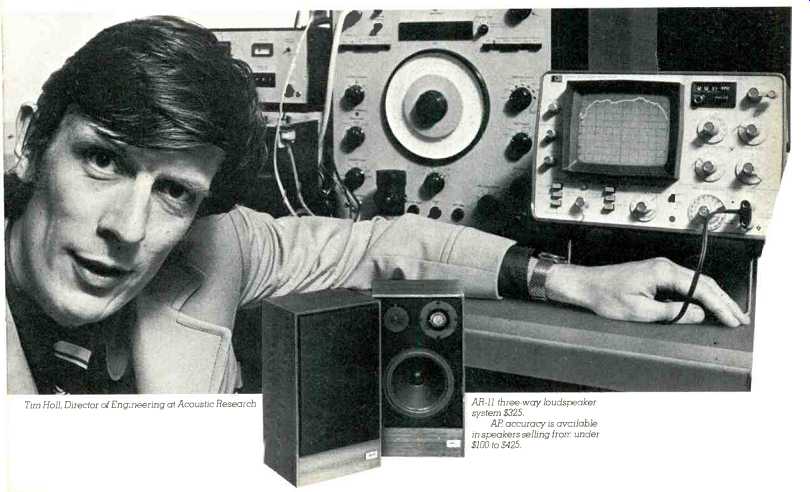
-----------Tim Holl, Director of Engineering at Acoustic Research
-------------AR-11 three-way loudspeaker system $325.
AR accuracy is available in speakers selling from under
$100 to $425.

TELEDYNE ACOUSTIC RESEARCH number or contact: D American Drive, Norwood, Massachusetts 02062
===============
Who's behind the remarkable DQ-10 speaker?
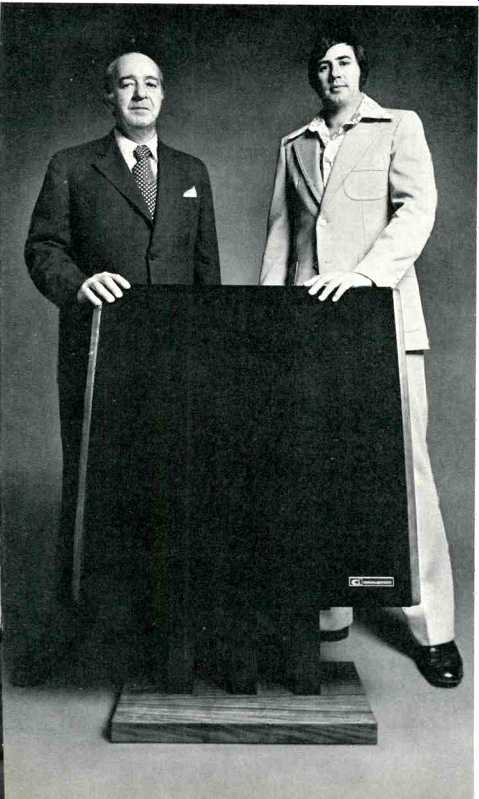
Some of the most remarkable men in audio--Jon G. Dahlquist and Saul B. Marantz, the founders of this company.
There's, hardly an audiophile anywhere who doesn't know about Saul Marantz, one of the pioneers in the growth of this industry and a leading proponent of high quality performance.
Then there's our brilliant engineering head, Jon Dahlquist. His contribution in the Lunar Excursion Module project involved vibration and stress analysis. This eventually led him to more earthly projects such as loudspeaker wave-form behavior. His 93 research was applied to the unique acoustical concepts that are incorporated in the DQ-10, Phased Array speaker system.
For the first time a single speaker system accurately controls time delay, phase shift, and diffraction effects.

This advanced speaker design has caused quite a stir in the audio industry. Critical listeners and knowledgeable reviewers throughout the world have praised the DQ-10 for its superb definition, its 3 dimensional spaciousness, the ultra smooth coherency over the entire range, and its correct stereo imaging.
It doesn't take long to discover these qualities for yourself. Just take your most challenging record down to your nearest Dahlquist dealer and put yourself in front of a speaker that some remarkable men are behind.
The boxless speaker. 27 Hanse Ave. Freeport N.Y. 11520
===============
ReVox

Our Contribution to the Realization of High Quality Music Reproduction in the Home over the Past 25 Years.
Our company was founded at the time of rapid developments in the field of magnetic tape recording.
During this period there were few machines available, but they revolutionized professional sound recording.
This advancing technology soon introduced a new era to the amateur recordist, because it was now possible to record sound on a reusable storage medium, which could even be cut and spliced together again.
It is with considerable pride that we note our participation in these developments right from the very beginning.
As long ago as 1954, our recorders were already equipped with the professional three motor drive system.
What is it that makes REVOX recorders so successful?
The answer to this question must take into account the changes which have occurred in the consumer since the early days of recording.
Today's audiophiles have an increasing awareness of true quality, and only a first-class product has a chance of being accepted by the serious recording enthusiast.
The fact that REVOX tape recorders are in constant demand in such an increasingly quality-minded market is indicative of their high standard of construction and performance, but it also reflects the increasing sophistication of the serious audiophile, whose requirements can only be met by a small number of select products.
Our involvement in the design and production of professional equipment has led us to think in terms only of professional standards, even for our consumer products.
This approach produces far-reaching effects; the performance of REVOX recorders with regard to durability, mechanical and electrical stability, and closely-held specification tolerances, will stand comparison with professional equipment, and this is our main contribution to the realization of true high fidelity sound reproduction in the home.
Does your equipment meet the high standards you require? Visit your nearest REVOX dealer or write to:
1. DYNAVOX (1950)
2. REVOX A36 (1954)
3. REVOX D36 (1960)
4. REVOX A77 MK I (1967)
5. REVOX A700 (1973)
6. REVOX A77 MK IV (1975)
=====================
More things from Uher. great Some facts everyone should know about tape recorders.
Mercedes Benz. Leica. Uher. Familiar names that represent precision and quality in cars, cameras and tape recorders. German products without peer.

Those interested in making fine tape recordings usually look to Uher, a pioneer in magnetic recording for 25 years. Our newest products are no exception to this spirit of excellence. In fact, some of our ideas are extraordinary and truly useful to the tape recordist.
The first home tape deck without a pinch roller is Uher's is with an exclusive Omega looping system, originally developed for video techniques and perfected for open-reel recording.
As a new generation deck, the SG-630 operates quickly and accurately, switching directly from fast forward to rewind to play without tape spill.
Without a pinch roller, the SG-630 has far fewer parts to wear out and there's far less damage to tape edges. Tape tension is kept constant with "motionless sensors," and a four-motor drive system with computer controlled tape transport combine to provide ease of operation and the finest specifications.
Another solution to old tape recording problems is the addition of a stroboscope disc which offers a means of verifying actual tape speed. It's Uher's idea of designing many features of professional 10 1/2 inch reel machines into the consummate deck for the home recordist.
This is what tape recording is coming to.
Uher has another sensible idea, this time for those who need an''. audiophile quality portable stereo cassette machine. The CR-210. It's a deck at home, in the car with a Uher power mounting bracket or a portable machine anywhere else.
For those who have dreamt about owning a Uher recorder, we introduce the Uher CG unlike any other stereo cassette machine, even a Uher.
We built the CG-320 to be exceptionally reliable two machine with the performance and features to match or the world's finest cassette. Obviously, low distortion top specifications are the hallmark of this quality Uher product.
We also include features a clutchless tape drive system and self-contained stereo stage making the CG-320 playable off a 12-volt car or in the home with its built-in speakers. For noise reduction, the Dynamic Noise Limiter excels and on-off automatic level controls, memory rewind and automatic EQ switching chrome tape places the user complete command.
All in all, the CG-320 offers technical precision, versatility and design to suit demanding tastes.
We invite you to visit a Uher tape expert who will guide to the recorder best suited your needs.
The CR-210 is the smallest precision cassette recorder in the world. Even at that, it has automatic reverse, automatic switching for chrome tapes, a built in condenser mike and disconnectable ALC switch. The kind of things seldom found even in bulky decks.
This gem operates on a variable power supply and if you're into filmmaking, the CR-210 can be used for synchronized sound recording.
It has everything, even a built-in speaker and handy carrying case.
For those interested in specs, the Uher CR-210 raises the technological standards for cassette recorders with wow and flutter characteristics found only in some larger machines.
By now you've discovered that not all stereo recorders are created equal.
Uher of America, Inc.
621 S.Hindry Ave.
Inglewood, Calif. 90301 (213) 649-3272
===================
Phase Linear starts where state-of-the-art leaves off.
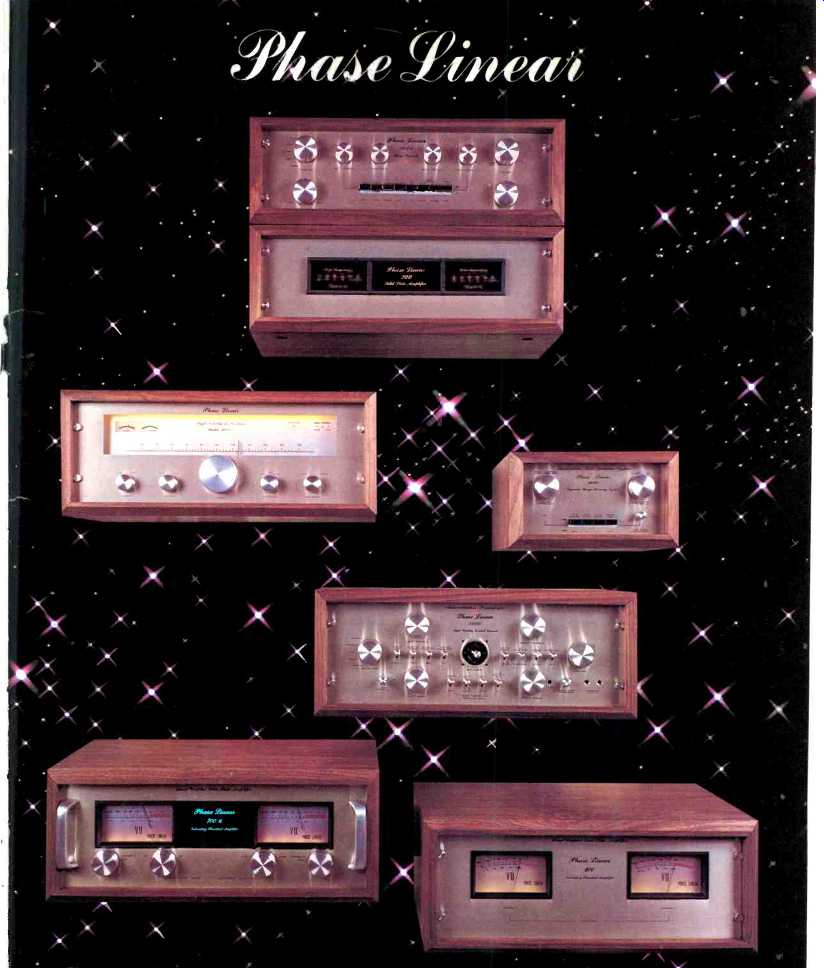
We build products with state-of-the-art specifications. But we don't stop there. Specifications are important to us, but equally vital is the achievement of obviously audible improvements in the reproduction of music with every separate component we make. This is the driving force behind Phase Linear, the single-minded philosophy that has produced so many innovative features, advanced circuitry and ultimately, products with more dynamic range and bigger, more lifelike sound than any comparably priced components available on the market today. Our Research Department, headed by Robert Carver, is staffed by imaginative design engineers deeply concerned with the entire spectrum of musical reproduction. Many more new products are in the wings; in the meantime, we invite you to review the present Phase Linear line and read what the critics have said. Then ask your dealer for a demonstration, and draw your own conclusions.
The Phase Linear 700B Stereo Amplifier Has established performance and power standards unequalled by any other amplifier on the market ... regardless of price.
"the lowest distortion, in spite of it's enormous power capability, was on the Phase Linear 700..." Hirsch-Houck Labs in STEREO REVIEW. "Hum and noise figures were also well below anything we have encountered before" C. G. McProud in AUDIO. "...in terms of sheer power it is the most impressive we have tested." HIGH FIDELITY. The Phase Linear 400 Stereo Amplifier Hailed internationally as the undisputed "best buy" among all the "super amps" available today.
"We were utterly flabbergasted when we discovered in our early A-B comparisons that the amplifier which sounded dramatically cleaner and more revealing turned out to be, when we removed our blindfold status, the Phase 400...In over 100 blindfold A-B comparisons with five other amplifiers at a time, the two Phase 400's kept coming back to the surface... No other amplifier... ever even tied the Phase 400 for naturalness, clarity, and lack of distortion."
SOUND ADVICE, 225 Kearny St., San Francisco.
"Harmonic distortion proved to be almost unmeasurable on this amplifier." STEREO & HI-FI TIMES . The Phase Linear 200 Stereo Amplifier The newest addition to our amplifier line incorporates all we have learned to date about power amplifier design. The 200 has not been reviewed, but with its advanced LED metering system, sophisticated protection circuits and excellent performance specifications, we are optimistic! The Phase Linear 4000 Stereo Preamplifier The model 4000 illustrates our philosophy of delivering far more than state-of-the-art specifications. It offers revolutionary features that make music sound better by providing greater dynamic range and a quiet background.
.. . a combination of noise reduction and dynamic-range-expansion circuits whose sophistication far surpasses anything previously available on the audio consumer level ... even without the assistance of its special noise reducing systems, it would rank as one of the quietest units we have ever encountered
... makes any program played through it sound better than through any other preamplifier we have ever used... a most impressive technical achievement." Hirsch-Houck Labs in STEREO REVIEW. The Phase Linear 2000 stereo preamplifier Beyond efficient handling characteristics and excellent specifications, the 2000 is capable of reproducing more of the music on your recordings. Its ability to reproduce ambient signals is a function found on no other preamplifier.
"Super in the listening as it is smooth in the handling ... The extra flexibility in the tone controls delivers worthwhile options. We find the ambience recovery feature a decided plus." HIGH FIDELITY. The Phase Linear 1000 A noise reduction and dynamic-range expansion system designed to eliminate noise from all sources (records, tapes, FM, etc.) and restore the music we hear at home to its original dynamic range.
"... for any already top-quality music system, we doubt a $350 expenditure in any other component could match the audible improvement made possible by the Phase Linear 1000" Hirsch-Houck Labs in STEREO REVIEW. "In theory, the circuit (AutoCorrelator) can make the distinction and reduce the level of the noise component while reproducing the signal component unaltered.
In practice, its ability to do so is far from absolute, yet audibly greater (to my ears) from that of any other noise-remover on the market" Robert Long, in HIGH FIDELITY. To be released soon. The Phase Linear 5000 FM Tuner Loaded with innovations, the 5000 will feature circuitry capable of increasing the dynamic range of broadcast signals up to 9 dB! It will do more than just reproduce a mediocre broadcast perfectly; it will make FM signals sound virtually as good as recorded signals. This feature alone makes the Phase Linear 5000 FM Tuner worth waiting for! Phase Linear Corporation, 20121 48th Avenue West, Lynnwood, Washington, 98036. Manufactured in the U.S.A., Distributed in Canada by H. Roy Gray, Ltd.
Phase Linear 2000 Preamplifier
Phase Linear 200 Power Amplifier
Phase Linear 5000 Tuner
Phase Linear 1000 Noise reduction System
Phase Linear 4000 Preamplifier
Phase Linear 700B Power Amplifier
Phase Linear 400 Power Amplifier
Phase-Linear Corporation. Lynnwood, Washington,
=============
TEAC
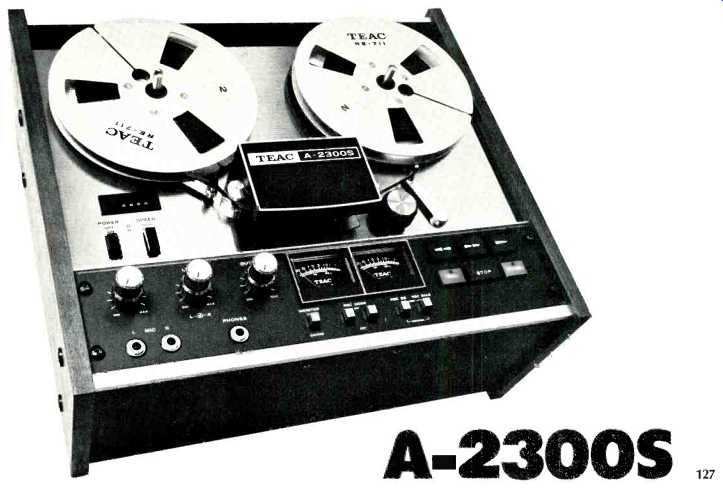
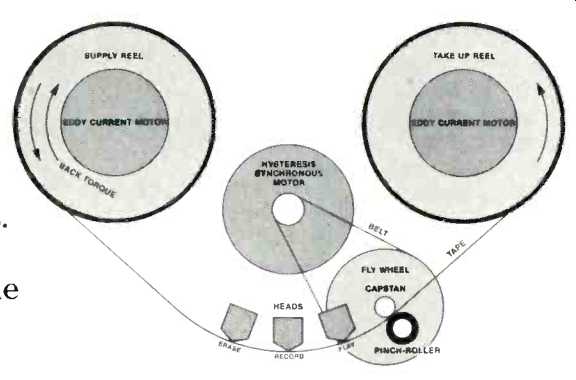

With this musical instrument, the possibilities are indeed endless.
So are the rewards. Because your tape recorder becomes an extension of you. How you control and shape the audio signals, the musical selections you choose, and the sequence you determine.., it's all a function of your own artistic perceptions.
The tapes you make will bear your personal imprint. Because tape recorders, like musical instruments, don't play all by themselves.
And there's something else in common: quality differences between brands will determine how good the music can sound,. Buying a good one is worth it.
We've been making this basic 3-motor, 3-head tape recorder for over 20 years now. It works reliably well. If you'd like a demonstration of how that experience can benefit you, just call (800) 447-4700* toll free for the name of your nearest TEAC retailer.
In Illinois, call (800) 322-4400. As long as quality in tape recording and reproduction continues to enhance the enjoyment of music, we'll continue to make the A-23005.
TEAC-- The leader. Always has been.
TEAC Corporation of America 7733 Telegraph Road, Montebello, Ca. 90640 ©TEAC 1975
===============
Technics by Panasonic--Professional Series
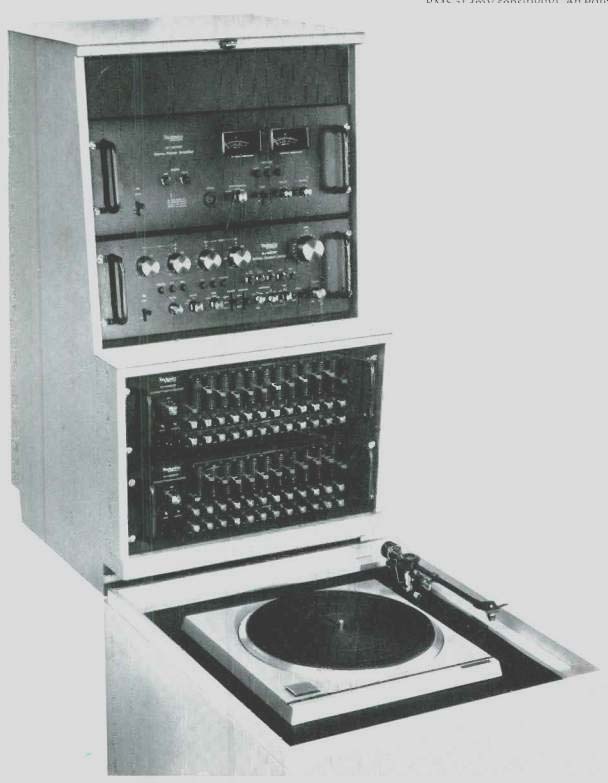
Technics introduces components designed for professional use only.

The SE-9600P. Regulated stereo power amplifier with a lot more than just power. Like 100% constant-current and voltage power-supply regulation. Which means complete freedom from transient IM distortion. It also means high-level transients introduced in one channel won't affect the other. There's also only 0.08% IM distortion. A frequency response of 5 Hz to 150kHz (+0dB-3dB).
A S/N ratio of 110 dB. A 4-step damping factor control.
And 110 watts per channel, minimum RMS, into 8 ohms from 20 Hz to 20 kHz with no more than 0.08% total harmonic distortion.
The SU-9600P. The stereo preamplifier that performs as well as it looks. Starting with an unheard of magnetic phono overload tolerance of more than 1 1/3 volts (1350mV RMS at 3mV sensitivity). An equally impressive phono-2 S/N ratio of 76 dB (referred to 3mV input). Virtually non-existent total harmonic distortion (0.02%). As well as bass and treble negative-feedback tone controls calibrated in 2.5 dB steps. With turnover pushbuttons at 125 Hz and 500 Hz as well as at 2 kHz and 8 kHz.
The SH-9090P. The Universal Frequency Equalizer that has no equal. You get 12 dB of boost or attenuation for 12 bands (10 Hz to 32 kHz). Plus the center frequency of each band can be continuously shifted by as much as ±1 octave. In addition, the bandwidth (Q) for each of the 12 bands is continuously variable from 0.7 to 7. The result: You have more control over response shaping than with any other single instrument. (Configuration: one in, one out.) The SP-10MKII. In every respect, it's everything you want in a professional turntable. So much torque it only takes 0.25 of a second to reach the exact playing speed at 33 1/3 RPM. Our lowest wow and flutter (0.025% WRMS) and rumble (-70 dB DIN B). A quartz-locked frequency generator DC servo motor. And, of course, the reliability of Technics direct drive. The system that radio stations use. And discos abuse. Supplied without tone arm.
Panasonic Company Technics Dept. 110. One Panasonic Way. Secaucus, N.J. 07094
Attention: Sid Silver, Technical Service Specialist.
Technics by Panasonic Professional Series
= = = =