In the first part of my SCES report, I concentrated on the impressive vitality
of our most important sound source, the LP phonograph record, and the ever-more-sophisticated
equipment designed to extract the maximum amount of signal information from
the grooves. That signal information may be raucous rock or sublime symphony,
but no matter. It is all music, and its enjoyment is--or should be--what high
fidelity is all about.
Which brings me to the point that since music is the quintessential element in this audio business, why is it subverted in so many equipment demonstrations at these shows? In room after room at the show hotels, I was subjected either to shrill, shrieking, boomy, atrociously distorted sound played at levels far beyond the capabilities of the amplifiers and loudspeakers the exhibitors were using or--a new phenomenon at this SCES--to playback at such reduced levels that the music was an amorphous blob of sound, devoid of any detail or definition. The whole thing was an affront to anyone's sensibilities, and it was obvious that the inept personnel manning these demonstrations had no concept whatsoever of music balances and dynamic perspectives. Granted, the rooms in these hotels can be troublesome in terms of speaker placement and acoustics, but the real pros in the business manage to cope and present informative and musically enjoyable demonstrations. These poor sound demonstrations at both the Winter and Summer CES have become biannual gripes of mine, and it is most discouraging to find that each year the problem seems worse than the year before. Fortunately, however, among all the sonic dross, there are glitters of golden sound.
One of the cleanest, most musical sounds at the SCES was to be heard in the IMF Electronics suite at the Pick Congress. This is the British firm well-known for their transmission line loudspeakers. IMF Electronics President in the U.S.A., Ronald Bliss, and IMF Chairman, John Hayes, were on hand to demonstrate their full range of speakers, including the Professional Monitor Four-a large floor –standing model featuring new proprietary speaker driver units. Highlight of the demonstration was that they were playing 30-ips master tapes on an Ampex ATR-104 four-channel unit which had been recorded by Ron Bliss using the Calrec Soundfield microphone.
The tapes were thus encoded for the Ambisonic Surround Sound System, which has been under development in Britain for some years now. The music, mostly of the highly dynamic big band variety, was played back through an Ambisonic decoder which will shortly become commercially available. The decoder will also feature what they describe as a SuperStereo enhancement mode. As demonstrated through four of the Professional Monitors, the sound was spectacularly wide in dynamics, pristine clean, and had sharp and precise transient response and solid tight bass, and with the Ambisonic feature giving a convincing sense of liveness and spatial perspective. I would have to say the surround effects were more subtle and less pervasive than usually heard in American surround sound systems, but it certainly lent an extra quotient of realism to the excellent big band sound.
Staying with our British friends, B&W was at the Pick Congress presenting their usual highly civilized, ultra-musical loudspeaker demonstrations. The Model 801, with its superbly stable imaging and depth perspective (now the official monitor speaker for EMI, Pathe in France, Electrola in Germany, and Decca Records in London) was joined by its new smaller companion, Model 802. John Bowers, the genial head of B&W, was giving an impressive demonstration of the capabilities of this new speaker with a broad range of music. I had already heard the prototype Model 802 on a visit to the B&W plant in England some months ago, and I will be reporting on this trip in the near future. The 802 is a columnar type of speaker system. The identical midrange and tweeter units of the 801 are used in the 802, and thus the precise imaging and sense of depth of the 801 are completely preserved in this smaller system. The bass section of the 802 differs from the 801 in employing two 6 1/2-inch drivers with Bextrene cones and PVA compound coating, rather than a single larger diameter woofer. These drivers feature ultra-long-throw suspensions, and are used in a closed-box, acoustic-suspension system with a minus 3 dB point at 49 Hz, the system resonance. Thus, bass response is somewhat less than with the 801, this being more apparent with organ music than with most music programs. For those who have limited space, but who would like to have the superior sound qualities of the 801, the 802 is a kissin' cousin of the 801 and will serve this purpose quite handily.
Since the B&W exhibit was a cooperative effort with their Canadian importers, Anglo American Audio, this company also showery its other import products. One of these, the Meridian M2 Active Loudspeaker is a product of Boothroyd Stuart, another company I visited on my trip to England. The M2 is the brainchild of bright, young engineer, Bob Stuart. In .a cabinet that is very narrow--7.1 inches, with a height of 19.7 inches, and 14.8 inches deep (an unusual shape that is said to be part of the design brief)--are two five-inch, long-throw Bextrene woofers with a 52-mm dome tweeter mounted between the woofers in a vertical configuration. The bass section is powered by a 70-watt amplifier similar to the firm's Model 105, and the treble unit is driven by a 35-watt amplifier. There is a 1.75 kHz double Butterworth crossover with a 76-microsecond electronic time delay to time align the tweeter with the bass speakers. This diminutive system can put out 105 dB SPL at one meter, with a minus 3 dB point at 38 Hz. Quite solid and well-damped bass, plus clean, sharp transients, and a big sound belying the size of this speaker, are the result of the active design. Although the price will be about $1600 per pair in this country, you must remember that this includes the power amplifiers.
KEF was demonstrating a Mark Two version of their now-famous Model 105 loudspeaker. The new unit features various refinements including extended bass response and more power handling capacity due to their new S-STOP overload protection circuit. This translates as Steady State-Transient Overload Protection; it has a mode to protect against peak voltages, thermal mode to protect against overheating of the voice coils, and an excursion mode which monitors the linear excursion of the bass driver. KEF has evidently had requests to produce a speaker with the desirable imaging and depth perspective characteristics of the Model 105, but in a smaller package. Thus, they were introducing the Model 105.4.
This is essentially a junior version of the Model "105 Mark Two, with the same size midrange and treble enclosure. Apparently the midrange driver is identical to the Mark Two unit, but the treble unit is listed as the KEF T33HF. Instead of the single large-diameter woofer of the Mark Two, the new system features two 8-inch Bextrene woofers in a 40-liter bass enclosure, as compared to the 70 liters of the Mark Two. According to KEF, this smaller enclosure gives a half octave less bass response and is minus 10 dB at 30 Hz.
In all other respects, the Model 105.4 has all the niceties and design characteristics of the Mark Two, including the S-STOP protection circuit.

American Speakers
With B&W and KEF making junior versions of their larger established loudspeakers, Bob Fulton is going the other way. His well-received Nuance loudspeaker, is now being made available in a king-sized version he calls the Crescendo. Standing 44 inches high, 18 inches wide and 16 inches deep, the Crescendo is a five-way system, utilizing a 12-inch woofer, 10-inch upper woofer, five-inch midrange, and two high-power one-inch dome tweeters. Crossover points are 95 Hz, 750 Hz, 550 Hz and 22,000 Hz.
This is a high-power system designed to handle the wide dynamic range of direct disc and digitally mastered recordings.
Speaking of high power and wide dynamic range, Gene Czerwinski of Cerwin-Vega has a new system that will really clear your sinuses, How about his new SR-2 loudspeaker he terms "digital ready," which can handle 1,000 watts continuous input and put out peak SPL of 135 dB! The system comprises an 18-inch dual-spider woofer in a sixth-order Butterworth vented enclosure. To increase internal volume Gene uses his unique Thermo-Vapor Suspension which has sealed, acoustically transparent pouches filled with a soft gas. Mid and high frequencies are handled by a 12-inch, mid-axial, composite driver with a time-coincident, compression driver/horn, acoustic filter arrangement. Frequency response is rated at ±2 dB from 28Hz to 18 kHz. This brute is 52 inches high by 25 inches wide and 20 inches deep.
Projected price is $3,400 per pair.
ADS is another company which has seen the digital handwriting on the wall and has introduced three new professional monitor loudspeakers said to be capable of handling the dynamic range of digital recordings when they arrive on the audio scene.
To complement the speakers they have introduced a special high-powered bi-amplifier system. The ADS L2030 is the big daddy of the new line.
This system has two 14-inch woofers in independent acoustic-suspension chambers, four two-inch soft dome, acoustic-suspension midrange drivers, and one special one-inch soft dome tweeter with samarium-cobalt magnet for a very high 22,000-Gauss magnetic flux density. This 190-pound unit measures 58 inches high by 27 wide and 13 deep. Crossovers are 12 dB per octave at 450 Hz and 4000 Hz. Frequency response is ±3 dB from 22 Hz to 20 kHz.
To power this system, ADS uses their new B-2000 stereo bi-amplification system. This consists of two one-kilowatt bi-amp modules and the C2000 control unit. Each module supplies 500 watts to the woofer section and 500 watts to the midrange/tweeter section, for a stereo system total of 2 kilowatts! The C-2000 control module has a digital trigger to turn on the power modules, plus selectable crossover points optimized for the various ADS monitors, or for other speaker systems, and what ADS calls a Dynamic Bass Extender circuit. When I heard the L2030 system, it was putting out prodigious amounts of low frequency energy from my Virgil Fox organ recordings, literally flexing the hotel room walls! Sheffield Labs made a rare appearance at the SCES and in their suite were demonstrating their unique direct-disc recordings, including some new releases. Doug Sax of Sheffield has chosen to use the Itone VMPS Super Tower Two loudspeaker that I described in the May issue of Audio.
Naturally this delighted Itone President and speaker designer Brian Cheney, who rose to the occasion by furnishing Sheffield with a newly modified version of the Super Tower Two. Gone are the piezo-electro tweeters, replaced by a new high-efficiency ribbon tweeter, for much smoother and more extended treble response. A side-mounted 12-inch passive radiator has been added, mainly to damp a residual cabinet resonance and earlier units can be retrofitted. Thus, a good speaker becomes better, and Brian was making some mighty sounds playing back Sheffield's dramatic recordings.
Other Eye-catchers
I would like also to mention some other items that caught my eye at SCES. Nakamichi introduced a new cassette recorder, the 1000ZXL, having a micro-computer they call A.B.L.E. which affords automatic calibration of azimuth, bias, level and equalization.
With this system, Nakamichi claims the unit will permit a frequency response of ±3 dB from 10 Hz to 25 kHz.
Even more astonishing is the 20 Hz to 20 kHz response claimed to be within plus or minus a half dB! The unit has random access memories and many other features. It will do just about everything except tuck you into bed, and for $3800 this is to be expected! The Dolby HX system has made considerable headway; 14 cassette decks now incorporate it in their circuitry . . . there were new open-reel decks from Tandberg and Akai ... Audionics has their RVR and RVP replacement record and playback electronics for the Revox A77 tape recorder, said to give better headroom (six dB), increased output and improved signal-to-noise ratio ... the Carver C-300 is a sonic hologram generator and time delay unit that can be added to existing preamplifiers ... Threshold has introduced new stereo versions of its Stasis amplifier; Stasis Two uses 48 150-watt power transistors and a 1-kW transformer, and will sell for $2450, while Stasis Three uses 32 of the same 150-watt power transistors and the same 1-kW transformer, this amp will sell for $1675 ... dbx ventured into a new field with the introduction of their Model 20/20 ten-band automatic analysis and equalization system. The unit has its own calibrated microphone, generates a pink noise signal, performs real-time analysis, and automatically adjusts equalization for flat response. A 300 LED display can show either the RTA or the equalized frequency response curve. The unit has memory inputs for up to 10 different equalization curves representing, for example, various listening positions in a room. The 20/20 is priced at $1295.
Finally, the new products from Mark Levinson are always noteworthy ... his ML3 stereo power amplifier has been upgraded with even larger electrolytic capacitors to go along with the 1.6-kilowatt toroidal power transformer.
Certain internal wiring is of a new high power type, and other refinements have been made. The result is an amplifier with great reserves and prodigious current output, better than 30 amperes per channel! Mark's pride and joy is his totally new ML-7 preamplifier. The unit looks exactly like the slim line design of the current ML-1 preamplifier, but there the resemblance ends. This is a much more complex design than the ML-1, with completely new circuit topology. Gone are the potted circuit modules, replaced by open-frame interchangeable modules, each with its own heat sink plate.
There are many unusual parts within the modules, such as a new type of very close tolerance capacitor and precision resistors. There are interchangeable modules for specific purposes and, in fact, the type of module determines the overall cost of the ML-7. For example, all units have the two L1 modules for left and right line-level output. If ordered with the L2 module, which is for moving-magnet and high-output moving-coil cartridges, the price is $3000. If ordered with the L3 module for low-output moving-coil cartridges, the price is $3500. The rear of the ML-7 features a four-layer PC board, with input and output connectors mated with the board by very short leads. This affords improved rejection of crosstalk and suppression of r.f., along with superior grounding.
There is an entirely new super-regulated, separate power supply with eight-pin interconnect cables including separate ground returns. There are many other technical innovations on this ML-7 preamplifier, and the unit should be in limited production by the time you read this. As usual, Mark had his HQD speaker system set up in his demo room, with its six Class-A amplifiers in tri-amp configuration. Pete McGrath was on hand with more of his 30-ips master recordings made with just one pair of Bruel and Kjaer mikes and the Levinson LNP-2 recording preamplifier on the ML-5 Studer/Levinson tape recorder. Pete had recorded a rather exotic piece with voices, woodwinds and percussion, including some unusual drums and temple bells.
The sound was stunning, with a smoothness, utter cleanness, and a clarity that was very close indeed to the live experience. Once again, the best sound at the Show.
===========
ADs:
MAXELL
IF THERE'S A MAXELL CASSETTE IN THIS CAR AND IT DOESN'T WORK, WE'LL REPLACE IT.
If you own a car stereo, you've probably already discovered that many cassette tapes don't last as long in your car as they do in your living room.
Conditions like heat, cold, humidity, and even potholes can contribute to a cassette's premature demise.

At Maxell, our cassette shells are built to standards that are as much as 60% higher than the industry calls for. Which is why we can offer you the best guarantee in the industry. An unconditional lifetime warranty.
So if you'd like better mileage out of your cassette tape, try Maxell. Even after 100,000 miles on the road, it'll run like new.
If only they made cars this well. IT'S WORTH IT
======================
Audio Research
In photography, it is the razor-sharp resolution and faithful adherence to hues, tones, and shadings of the subject. In music it is the strict recreation of musical transients and subtle tonal structures which give the listener the sense of "listening through" the music system to the "live" performance.
In an age of many exotic pretenders, all claiming to be state-of-the-art, Audio Research stands alone in its ability to transmit the listener to the "live" event. Audio Research has achieved this goal through a decade of research and development that has considered first and foremost, the complex, constantly changing phenomena of musical waveforms. This "musical approach" requires design parameters which exceed good static specifications in order to perform in demanding dynamic applications, i.e., music reproduction. It is this musical approach that sets Audio Research apart from its competition.
A case in point. Pictured above are the SP-6B stereo preamplifier and the D-120 stereo power amplifier. Conceived with a decade of design experience, both products truly deserve the title, state-of-the-art The SP-6B is a refinement of the legendary SP-6; a product that many critics have acclaimed as a true breakthrough in audio technology. With dynamic range and high definition capabilities unique to Audio Research products, the SP-6B is unsurpassed in preamplifier design.
The D-120 power amplifier incorporates the proprietary circuitry of the Analog Module. Rated at 120 watts per channel into 8 ohms, the D-120 handles complex loudspeaker loads with ease. The D-120 will meet the needs of the most demanding audio perfectionist, both in terms of construction quality and musical transparency.
The SP-6B and D-120, along with other fine Audio Research products can be auditioned exclusively at authorized Audio Research dealerships. Audio Research dealers are selected for their high degree of integrity, expertise and service. An Audio Research dealer is worth knowing. It is insurance that you will receive the most from your Audio Research investment.
audio research corporation---HIGH DEFINITION MUSIC REPRODUCING EQUIPMENT 6801 SHINGLE CREEK PARKWAY MINNEAPOLIS, MN 55430
----------
Kenwood. The Ultimate Turntable. $1,700:
And worth every penny.
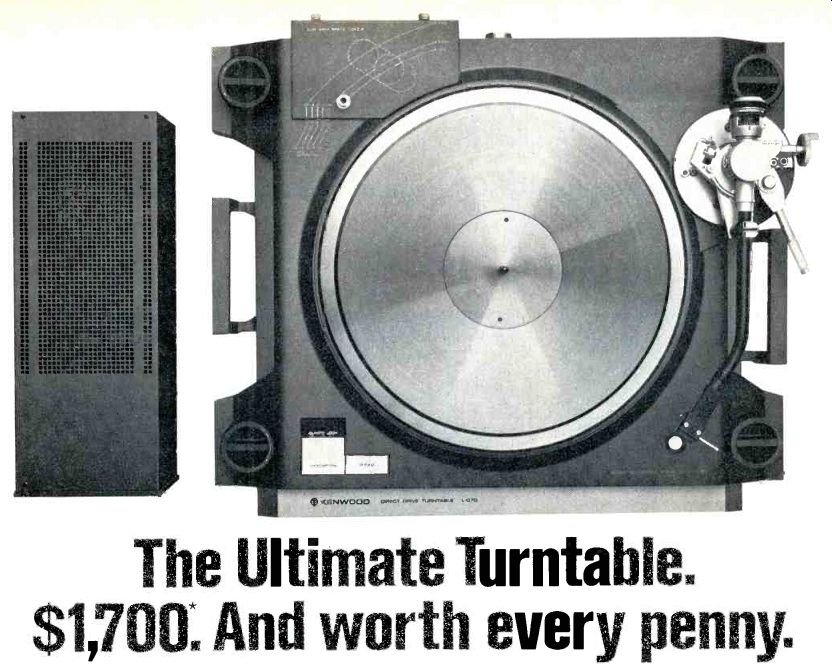
At first glance, its price may seem pretty steep. Until you know what the L-07D delivers: No other turntable can come as close to the theoretical limit of 100°/ß reproduction of recorded musical signals.
To get that performance, we had to invent the turntable all over again.
Our engineers found that one of the biggest obstacles to perfect sound was loss of energy caused by vibrational movement where the stylus meets the record groove. Up to now, these vibrations have resulted in mis-tracking, output distortion and audible resonance inherent in ordinary turntables.
So we designed the L-07D with a closed, ultra-rigid motor-platter-tonearm loop to virtually eliminate unwanted vibration. To further cancel out resonance, we formed its low-mass tonearm from alternating layers of aluminum, carbon and boron.
Then we took our quartz-PLL, speed-phase double servo control motor and added a 12-pound platter to give an extremely high moment of inertia for superior speed accuracy And mounted all the workings in a 68-pound base of resin concrete bonded to mahogany in a cast aluminum frame to virtually eliminate resonance across the entire audible spectrum.
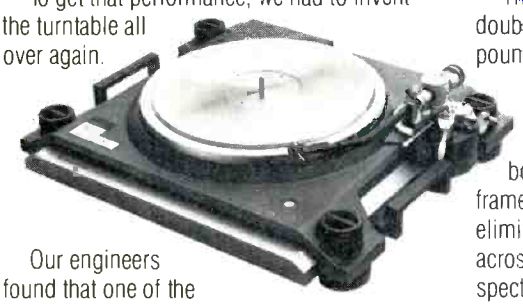
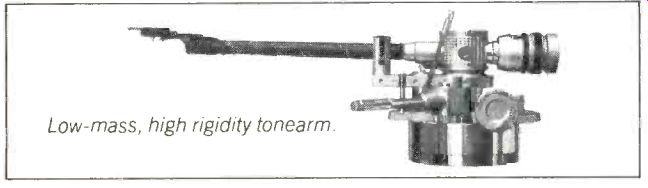
----------Low-mass, high rigidity tonearm.
----------Ultra-rigid closed pickup loop.
----------The L-07D's external Dynamic Phase Compensator
We even designed a separate power supply and logic control for the L-07D. An external Dynamic Phase Compensator that automatically regulates rotational accuracy and isolates the cartridge from electrical interference.
For the full technical story, please write us at the address below. Or better yet, see your nearest Kenwood Audio Purist Group dealer for an audition of the remarkable L-07D turntable. If your ears can appreciate what the L-07D can do for your records, the price won't seem so extravagant.
AUDIO PURIST GROUP KENWOOD Not all Kenwood dealers carry these products. For the Audio Purist Group Dealer nearest you, write Kenwood, PO. Box 6213, Carson, CA 90749.
* Nationally advertised value. Actual prices are established by Kenwood dealers.
-------------------
The tonearm that isn't.
The traditional tone arm has been replaced. By Linatrack. A revolutionary tracking system developed by Revox.
This sophisticated and highly refined electronic servo-system ensures that your records are played just the way they were cut, with perfect tangential tracking.
We've eliminated the causes of distortion inherent in conventional tone arm design. There's no need for an anti-skating device because there is no skating force.
Our unique LED/photo diode array monitors the stylus angle and makes instant corrections to keep the tip absolutely perpendicular.
Pivot friction has also been dramatically reduced by our unique single-point jeweled pivot/magnetic support and suspension system.
With Linatrack, tracking error is reduced to a phenomenal 0.5° or less, virtually eliminating distortion and protecting your records from excessive wear.
The high torque direct drive motor of the Revox B790 uses Hall-Effect magnetic sensors tied to a quartz crystal to constantly read and instantly correct rotational speed. This eliminates the moment-to-moment deviations , found on even the most expensive conventional direct drive motors. You can verify speed accuracy with the fast responding LED digital readouts. The readouts also provide an accurate log of manual speed adjustments.
Even with its advanced features, the Revox B790 is a pleasure to operate with safe and convenient automation. It works with virtually every cartridge and is ruggedly built to stand up to years of daily operation.
For more good reasons to play your records without a tone arm, experience the B790 at your Revox dealer.
Studer Revox America, Inc. 1425 Elm Hill Pike, Nashville. TN 37210, (615) 2M-5651
Offices: Los Angeles (213) 780-4234 / New York (212) 255-4462. In Canada, Studer Revox Canada, Ltd.
---------------------
hk
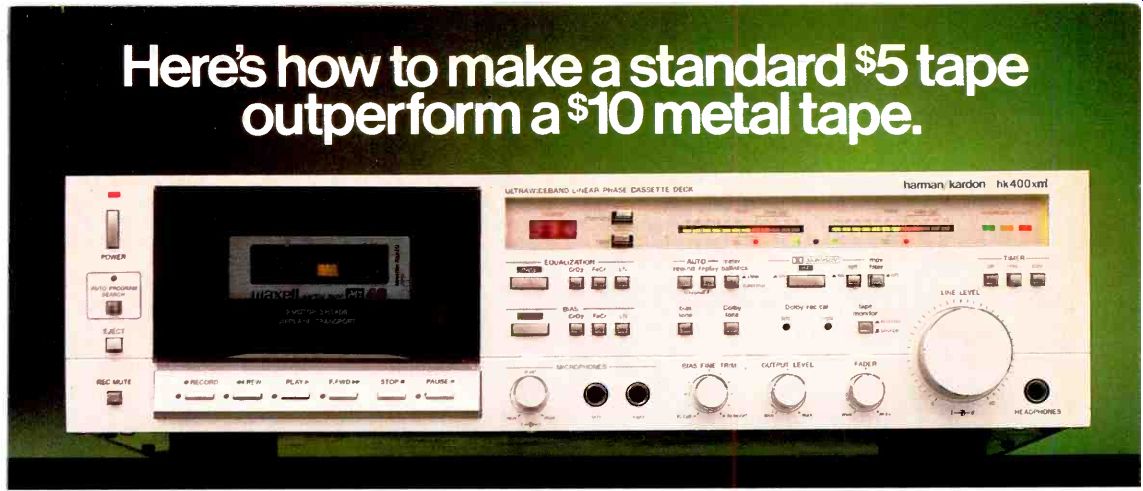
Record a standard $5 tape on one of the new Harman Kardon High Technology cassette decks with Dolby HX*. And a $10 metal tape on a conventional deck. Any conventional deck.
Now compare.
The Harman Kardon deck with Dolby HX will give you substantially better performance from the standard tape. More dynamic headroom. And better signal-to-noise ratio.
Yet the recording made on our Harman Kardon High Technology deck costs about half as much.
Which can save you a small fortune if you plan a tape library of any size.
Of course our new High Technology decks are metal capable, too.
So you can use Dolby HX and metal tape for performance that can't be topped by anything less than a professional quality open reel deck.
But Dolby HX is only part of the performance story.
Our heads cost more. And they deliver more.
The heads used in a cassette deck probably dictate the performance you'll get more than any other single component. That's why at Harman Kardon, we spent a lot more time and money on our head designs and materials. We started with Super Sendust Alloy, the costliest and most advanced material available. In manufacturing, we machine our head gaps to incredibly precise tolerances, and align them with equal care. Obviously, this process takes more time and costs more money. But it results in frequency response unheard of in a single speed cassette deck at any price.
Even our most economical deck, for instance, gives you ruler-flat frequency response from 15 Hz to an incredible 19,000 Hz from a conventional tape. You also get features like Dolby NR, a front panel bias fine trim, MPX filter and memory.
As you move on up the line, the specs just get better. And so do the features. Like the world's first headroom safety indicator to prevent tape saturation far more accurately than any peak level indicators.
You'll also find built-in Dolby and bias test tones. Normal and slow meter ballistics. A fader control.
Plus our exclusive Auto Program Search System that scans a tape automatically, sampling the beginning of each cut until you've located the one you want.
Yet the new Harman Kardon High Technology cassette decks do share one thing in common with the conventional decks.
A conventional price tag.
So before you settle for a deck that will set you back $10 or more every time you want a quality recording, audition the new Harman Kardon Decks with Dolby HX. You'll get performance that beats metal. At about half the price.
'Dolby and the double-D symbol are trademarks of Dolby Laboratories. Dolby HX is a standard feature on all Harman Kardon High Technology decks except the 100M.
The hk100M with frequency response from 15-19kHz ± 3dB.
The hk200XM with frequency response from 15-19kHz ± 3dB.
The hk300XM with frequency response from 15-20kHz ± 3dB.
Harman/kardon 240 Crossways Park West, Woodbury, NY 11797
Toll free: 1-800-528-6050 ext. 870
-----------
JVC
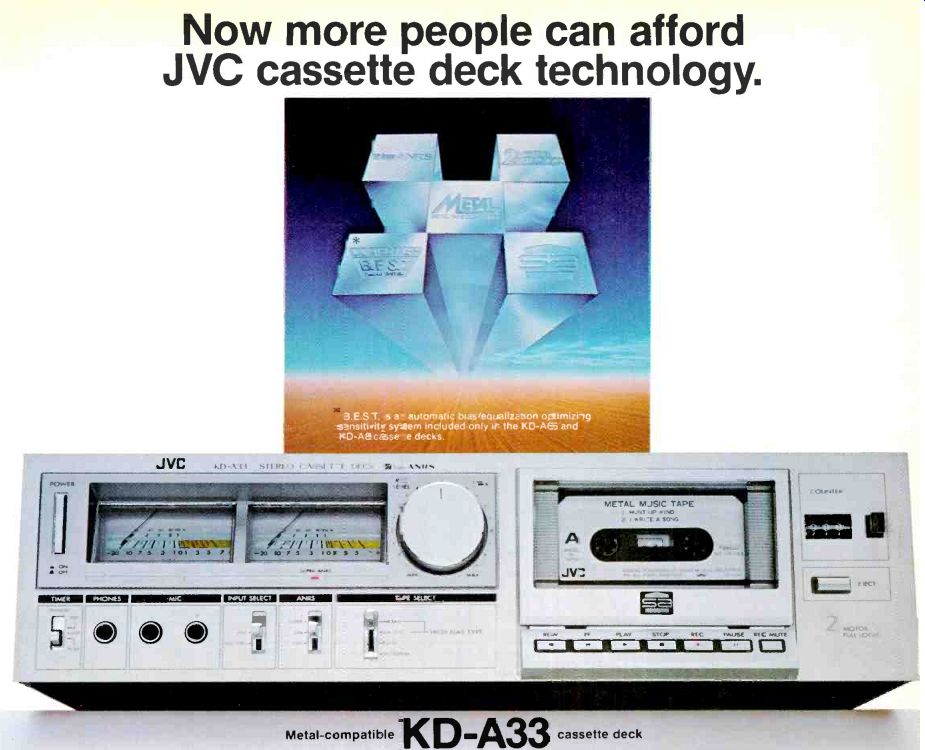
Now more people can afford JVC cassette deck technology.
KD-A33
If you've found that an affordable price usually means a sacrifice of performance, take heart. The JVC KD-A33 metal-compatible cassette deck includes much of the technology found in our most expensive decks. Yet it happens to be one of our least expensive decks.
For example, it uses Sen-Alloy, heads. These JVC-developed heads handle tremendously high currents with ease so they're especially wet' suited for recording and erasing metal tape. And SA's superb electromagnetic and physical properties give you accurate frequency balance, superb extension and low distortion through years of use.
When you use metal tape with the KD-A33, you'll get all the performance you expect from metal. But when your budget dictates using a less expensive ferric-oxide tape, you can still get metal-like sound thanks to another JVC development-Super ANRS.
In recording, Super ANRS`" reduces the level of high-frequency signals so the tape :,an handle them without saturating. In playback, it boosts them back to their original level. As a result, sounds like cymbal crashes, trumpet blasts, and spoken sibilants (normally the downfall of cassette recording) are reproduced with astonishing clarity and fidelity to the original.
And like our most expensive decks, the KD-A33 has logic-governed solenoid transport controls. You can switch directly between modes, even from "rewind" to "fast forward," with just a light touch of a switch. The KD-A33 also has provisions for adding a timer device and optional remote control.
Compare the KD-A33 with decks you want but can't afford. Then dial 800-221-7502 for the location of your nearest JVC dealer (in N.Y. State 212-476-8300). You'll find that high-quality cassette performance is more affordable than you thought it was.
JVC
--------------------
AIWA AD-M800U STEREO CASSETTE DECK
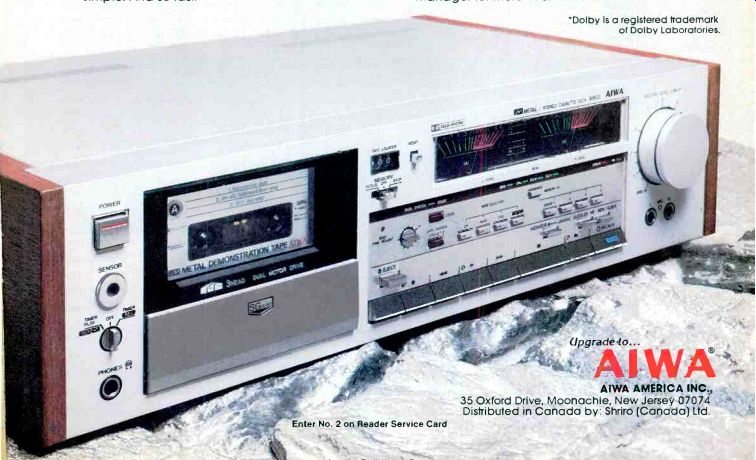

Three heads ... and a brain.
Only the very best decks have three heads. But Aiwa's metal compatible deck adds wireless remote control. And a brain ... DATA. Aiwa's exclusive, microcomputer Digital Automatic Tape Adaptation.
THE DATA SYSTEM
In less time than it takes to read what DATA does
...DATA does it. Set DATA's computer and press START. LEDs begin to flicker. One each for LH, FeCr, CrO2 and METAL. DATA's electronic senses analyze the tape and an LED lights up as the others go out. Now you and DATA-know the kind of tape being used.
Another LED flickers and lights. BIAS is set for best frequency response using a built-in 6 kHz reference signal. The next LED flickers and lights.
Dolby* levels are calibrated and set using a 400 Hz reference signal.
Two LEDs remain. One flickers and lights. EQ-M is set... equalization for the mid-range 5-10 kHz. Then the next, EQ-H ... equalization for the high, 10-18 kHz range is set.
Further down the panel an LED lights. It's green.
OK! You're ready to record. But... if the red LED lights instead, the machine's not wrong. The tape is. Get another tape or switch to manual override.
Once DATA is set, you record with maximum sonic quality, regardless of whose tapes or what type you're using. And DATA stores the tape analyses-at your command-in its memory bank.
Four different tapes of your choice.
Cassette recording was never so precise. So simple. And so fast.
IT ALL ADDS UP
Precise sophistication like DATA deserves features and performance to match. You've got them, starting with built-in wireless remote control for full-function performance from across the room, using dependable, invisible infrared projection.
You have 3-head performance using linear, ultra-hard sendust heads with Aiwa's exclusive V-cut geometry for contour effect elimination doing away with roughness at low frequencies. And each head is designed for best performance at its specific function.
Add Double-Dolby'; IC logic controls; dual motor drive; backlit VU meters with 5-step peak reading LEDs; auto-repeat; memory replay; oil-damped eject and more.
The sum of the parts is frequency response of 30-17,000 Hz using metal tape. S/N ratio of 68dB with FeCr, Dolby on. Wow & Flutter 0.04% WRMS. This is one of the finest decks you can get at any price. If you prefer, it's available in black with rack handles as the AD-M800BU. Aiwa's AD-M8000 is like having your own recording engineer tucked away in a small but powerful chip. The power's there for you. Listen to an Aiwa. Or write Bob Fisher, national sales manager for more information.
Dolby is a registered trademark of Dolby Laboratories.
AIWA AMERICA INC., 35 Oxford Drive, Moonachie, New Jersey 07074
Distributed in Canada by: Shriro ( Canada) Ltd.
-----------
(Source: Audio magazine)
Also see:
Mark Levinson JC-2 Straight-Line Preamplifier (Apr. 1976)
= = = =