
Edward Tatnall Canby
One of the pleasures I've always found in occupying this somewhat ancient spot in our journal is what I might call the automated follow up-not by me, but by our readers.
For every little bit of knowledge, evaluation or opinion I project here I get two large ones back via Uncle Sam's carriers, and this, surely, keeps me alive whether pro or con, last of which there is plenty, now that we've gotten so big. (Never forget that in a little journal, with no circulation, you can say anything you want, no matter how libelous.
If I had much hair to tear, I'd be bald again thanks to the con, but the rest more than bal antes, and nowhere better than in the helpful additions. Astonishing what a breadth of contacts and information we all have, taken collectively.
Take Boyd Neal. Months ago, I wrote a piece concerning a recording of the complete Brandenburg Concertos (Bach) which had reached my turntable unheralded and, shall I say, unexplained--i.e., it looked brand new though I knew very well that it wasn't. Reissue? I speculated upon the possibilities in the evidence before me, the discs themselves and the markings thereon, notably a very clear "PB" and equally clear "DBH" indicating, as I figured out, two friends of mine in the biz, Peter Bartók and David B. Hancock. (I didn't recognize him at first but the wheels finally turned and out it popped.) Also my own very long memories of earlier recordings. For I knew the name Boyd Neel well and it wasn't yesterday.
Now I doubt if Boyd Neel ever conceived of himself as a vital cog in the audio industry. His offerings have been purely as a musician, a conductor of his own excellent playing groups, notably the Boyd Neel Strings in Europe. Nevertheless, through his many years of conducting very good music for our medium, recorded sound, he is definitely an early cog in the mesh of gears that keeps us all turning merrily today in hifi. Early, because his music goes back to the old 78 days of shellac, and forward to those of high quality tape. Forward still further, and with contemporary significance, into this very time of ours, now, when the entire former waxed, lacquered and taped repertory of recorded music is being systematically pored over by a thousand professional ears with one thing in mind--profitable reissue.
Profitable & Otherwise
Profitable first, of course, in terms of cash, whether legitimate or pirate--we run the gamut, there. Columbia does not normally pirate from itself to create its reissue legends, but there are vaster and more confused fields to cultivate, to put it mildly, and sometimes nobody really knows, as you will see. A whole new world of quasi-legal research is a--building, just to untangle the legitimate problems of legal reissue.
As for the pirates, you might think they had few problems, but you would be wrong. After all, you have to know just how pirate-like you are, and what are your risks and where. So a counterpart under world of legal research must necessarily exist on this basis.
And if you ask me, the over and under-worlds are themselves so entangled that even the lawyers aren't sure which side they're on. That is the whole point, and the longer we go on producing recordings, then withdrawing them, the more utter is the total snafu.... Anyhow, so much for intro and synopsis. I concluded on the basis of my own evidence, tactile and memory, that the Olympic recording I had in hand was in fact a reissue of a much earlier job done by an elegant but short lived company, Unicorn, out of Boston. But definitely, Peter Bartók had done recording for that label-I owned some of the results, though not the Brandenburgs above mentioned. And just as surely, it was Hancock who cut the disc masters of part of this series. Who else but DBH? Curiously, I have not heard from either of these gents, and some whimsical fluke in my head decided me not to call either one of them. As I said, I like a mystery. But then came the letters. At this point, I'd say both PB and DBH are not longer de rigeur, though it would be nice to chat with them. The automated follow up has taken care.
So many strands. First, I note a letter from Gregor Benko of the International Piano Archives. Mr. Benko's company is specializing in piano notables Who have recorded in the past and he has a distinguished board of officials with him, from Arthur Loesser and Alicia de Larrocha (that dynamic Spanish pianist lady) to Mrs. David Rockefeller and Alice Tully. (If in NYC, visit Alice Tully Hall.) Two brothers, friends of mine from my days of singing in the Dessoff Choirs, had as their Swiss father a remarkable pianist, Ernst Levy, who did some tremendous recordings which, not surprisingly, I acclaimed (as the phrase goes) 'way back. I did a couple of comparative (tape edited) radio programs that stacked Mr. Levy's Beethoven against Artur Schnabel's and, if I remember, the then young Glenn Gould's. Phonomontage, direct from one to the other with commentary. Now Mr. Benko is on the trail of the Levy recordings and wondered whether I had in my collection the original discs, hopefully mint, that I might be willing to lend to him. (No, not mint--I played them to death. And no, not available--I can't find them.) Why this?
Masters "Misplaced"
Ah, ha (as I always say)--a clue! Mr. Levy recorded for two labels, one was Kapp records--was that the Kapp that made the famed styli? The other was an elegant company named Unicorn.
One sentence tells all. "It seems that the master tapes for the Unicorn and Kapp records of Mr. Levy have disappeared."
Now it just happens, you see, that the Boyd Neel Brandenburg Concertos on Unicorn belong straight in this same series of master tapes. If a first-line pro in the recorded archive business can't find those tapes, what of the Neel tapes? And now a second letter.
Daniel W. Doell of Columbus, Ohio, wrote me a long letter--he says that he owns a Neel recording of the same Brandenburgs, Realistic RM 2200, evidently an album-nobody has yet got all six of the Brandenburg Concertos on one disc. (More about this in a moment.) He says he must have bought this recording at Radio Shack in Boston around 1961 or 62; the discs are hand scratched G9OP 9456/7/8/9 (that would be four sides) and also stamped UNLP 1040 and 1041.
Ah, ha again--those were the Boyd Neel Unicorns I had in my catalogue, though the discs have been "borrowed" and not returned by one of my Bach-loving friends. Also to be noted on these Realistic disc are the initials PB. Take that, Peter Bartók. The sound of the recording (now) is good but muffled, says Doell. He adds a new bit of mystery--" The signal seems to have been passed through a filter circuit that only lets go when the signal gets high and loud." Hmm-shades of the old H.H. Scott Dynamic Noise Suppressor. Neither Dolby nor dbx, of course; neither than existed. And filtering does NOT sound like either Bastok or David Hancock, especially if it is audible gating. Wanna argue? You can write Mr. Doell, and I guess he won't mind, at 1070C Weybridge Rd. S., Columbus, Ohio 43220. He also notes, I note, that the 1961 surfaces are "much quieter than most of the records I have bought recently." Fighting words, those.
Then we have Richard J. Hammond of Palo Alto. He owns the original Neel Unicorns, 1040 and 1041, and solves one point for me. They were definitely mastered by Bartok; it says so on the labels and the initials are on the discs; whereas 1042, next in the series, was Boyd Neel Mozart, mastered (as I wrote, before) by Hancock. Mr. Hammond adds some bio material. He thinks that the playing group that did the Unicorns was a later orchestra, not the original Boyd Neel group that recorded for Decca in England (I guess my early Neels must have been Deccas). He says Neel emigrated to Canada after WW II and the English group was taken over by Thurston Dart. Yep, Check! I have L'Oiseau Lyre recordings (Decca) by the Boyd Neel Orchestra under Dart. Later it became the Philomusica-that name I remember too. Neel, Mr. Hammond says, was originally a medical man and reverted to that profession during the big War. Interesting.
Editors' Additions
And so the evidence trickles in. Hey, how's this! A letter from our exEditor and still-contributor, George W. Tillett, who is, of course, British. (Didn't you know?) George is in Florida, as is ex-Editor/Publisher C.G. McProud. Seems that Mr. Tillett--George, pardon me--was an official at Decca ("C. E.") and in the late fifties the early Neel recordings were still selling well, though the String Orchestra under Neel's name had been disbanded several years before. Now those records must have been at least in part either from 78 originals or the 78s themselves? I persist in my memory of a batch of Boyd Neel shellacs, which is now lost somewhere in my attic. Decca ( London) went over to LP very early, late '49 as I remember or thereabouts; but the famed ffrr wide range recordings first appeared on shellac 78s, as very few people remember. I think maybe George is a bit off on that disbanding, wouldn't you say? Not disbanded but taken over, at first under Neel's name, and conducted by Dart. Not that it makes much diff.; orchestras come and go, not necessarily in line with their names. How many different Columbia Symphony Orchestras were there, including Bruno Walter's and Stravinsky's and-? Matter of convenience. George thinks that Neel set up another group in Canada with a name such as "The Arcadians." Well, that sounds Canadian, all right. But what of the Brandenburgs done for Unicorn of Boston, U.S.A.? Mr. Hammond (above) thinks that this group used some British and some American soloists, though how he knows this he does not say, nor do I deny it--how could I? I wasn't there.
You will remember that I was bemused by the problem of Neel's age.
If he made shellacs that I bought when I was a youth, then he is definitely no chicken right now, and indeed, I suggested that in order to have done a brand new recording, such as his Olympic album seems to be, he would have to be at least a Stokowski. (At last count, Stokowski was approaching the mid 90s and still operating.) No youthful, longhaired conductor, Neel! George Tillett says Neel visited Decca in 1958, went back to Canada "and dropped out of sight."
Dear me, George, not quite that. The very nicest letter I received in all this correspondence is one I am going to take the liberty of quoting.
Dear Mr. Canby. I don't know why you think I am so old and decrepit!! I play tennis 3 times a week and can beat all my students at squash. Yrs, Boyd Neel So the automated follow up has pinned down our conductor--via himself-if not by any means all the interesting details concerning those Unicorn tapes, presumably, maybe, lost?--the discs, or some discs, reappearing first in the early sixties and then again, on Olympic, this last year.
On that score I give you a final mystery, and this one provided by Mr. Neel himself, to my astonishment and almost disbelief. Some readers may have seen an account of this in another journal; I hadn't.
Musical Manipulation
It seems that those Olympic discs, at least according to the conductor who did the music, have had their tempi altered from the original (but not their pitch, which is precisely OK)--by as much as two or three minutes a concerto, that is, a half side more or less. That's a lot. Mr. Neel had asked for an explanation, had received none, and proceeded to disown the first three concertos as "a complete travesty of my original recordings." The other three concertos mystifyingly (he says), were untouched and are OK in tempo.
How strange. Neel had not known, and many of our readers may not know, that one can indeed alter the pitch of a piece of music without changing the tempo, or the opposite-raise or lower the pitch at the same tempo-by one or another of the various ingenious sampling devices that have been around now for a number of years (but not back to the early sixties, I think). The first such machines were mechanical, with whirling tape heads that took graduated samples from the original and magnetically spliced them together in a new chain, either shorter (by excising tiny bits) or longer (by overlapping part-repeated segments). Gotham Audio, in New York, handled one-and alas I forget its trade name and can't phone in at the moment, being definitely elsewhere. They might even know who did the job-but probably wouldn't tell you without consulting lawyers right and left! It's a complicated world.
I played with that German machine at length, and it was absolutely astonishing. It could speed up or slow down anything to a huge degree and in the lesser stages with very little audible distortion or added noise; also change pitch by an outlandish amount. For timing a piece of music to fit a time slot-say a few moments shorter, or longer, invaluable. If the conductor of the music or the performer goes along. Maybe Olympic just didn't think it really made that much difference? If so, they don't know their musicians. Anyhow, clearly the tempo changes were made, if they were made, in order to accommodate the music to the disc parameters in the recutting, which may have been somewhat different from Unicorn's, 'way back. Reasonable thought, as far as engineering is concerned. But music? It all depends.
A few years ago I heard the first all electronic logic/computer type apparatus, to accomplish the same thing. It was awful-that is, for music. Lo-fi, and with a horrible saw-tooth background buzz. Never could have used that thing on any music at all. The current theory goes that for speech work, deaf people, learning problems, the speeding up of too-slow public speeches (is that a good idea!) and a whole complex of language teaching usage, this lo-fi "speech quality" sound will do just fine. I have always deplored this attitude, which has been taken for granted for decades in vast areas of education, children's entertainment, and sound-orientated speech research. Now, with the easy fi we can accomplish, I find it plain outrageous. I visited a children's disc outfit a few years ago and was stunned at the dreadful quality of the speech recording they promoted. There is no reason at all now why speech should not be subject to every bit of "fi" that counts, in every way equal to that which we apply to music. And I say this even if I am a musician.... Anyhow, I hear there is a much improved logic for this pitch/speed alteration now which might allow a reasonable fi if applied to a recording of music; but I know for a first-hand fact that the old, bulky, cumbersomely expensive mechanical pitch/speed converter did a superb job and could well have been used in those Neel Olympic recordings if the pitch was indeed altered, and who are we to doubt it.
So much for automated follow up. More questions than answers? Of course! That's the kick of it. If Neel's tempi were altered, for instance, wasn't it done from the original master tape, or reasonable copy thereof? Therefore-did the Neel Unicorn tapes survive, all those years, have the Levy tapes (above) disappeared and are they hopelessly lost? Does Olympic maybe have Levy somewhere in its store room, maybe without even knowing it? These catalogues are often bought and sold in bulk, to be plowed through at leisure. One often gets a lot for a song, this way. But the process can be legitimate if it is legal, and surely helps keep our huge sonic "legacy" alive for a few more years.
Definitely not better dead than alive.
==============
ADs
Uncompromised stereo/quadriphony--Undeniably Shure.
2+4
MODEL M24H
STEREO + QUADRIPHONIC CARTRIDGE
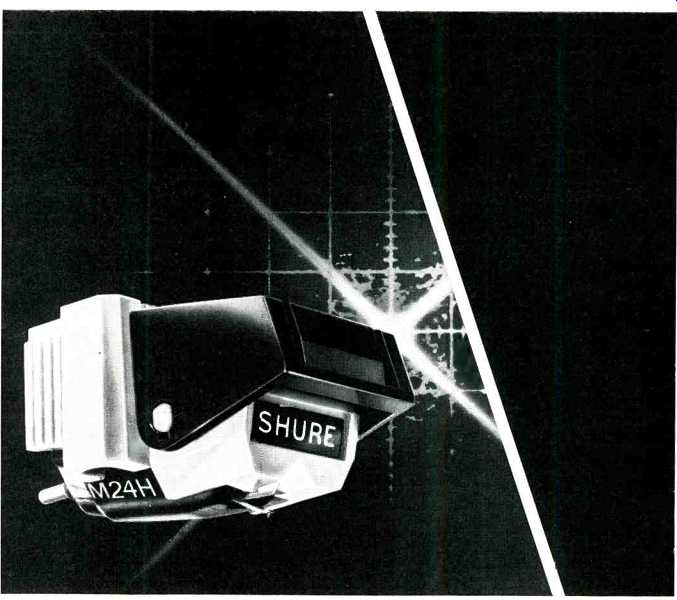
The new Shure M24H Cartridge offers audiophiles the best of both worlds: It is the only cartridge on the market that does not compromise stereo reproduction to add discrete quadriphonic capability. It eliminates the need to change cartridges every time you change record formats! This remarkable performance is achieved at only 1 to 11/2 grams tracking force-comparable to that of some of the most expensive conventional stereo cartridges. Other M24H features include the lowest effective stylus mass (0.39 mg) in quadriphony, a hyperbolic stylus tip design, an exclusive "Dynetic"' X" exotic high-energy magnetic assembly, and a rising frequency response in the supersonic carrier band frequencies that is optimized for both stereo and quadriphonic re-creation. If you are considering adding CD-4 capability, but intend to continue playing your stereo library, this is the ONE cartridge for you.
Shure Brothers Inc. 222 Hartrey Ave., Evanston, IL 60204
Manufacturers of high fidelity components, microphones, sound systems and related circuitry.
----------------------
THE COST/PERFORMANCE EQUATION: HOW MUCH TAPE RECORDER IS ENOUGH?
Essentially, a tape recorder is a machine you can use to capture your talent and faithfully reproduce it. Practically, the more you make demands on a tape recorder, the more demands it can make on you.
Put another way, a tape recorder can be your wings or an anchor. It can work for you or it can work against you.
At $1,299.95 the investment you make in the Dokorder 1140 gets you a partner instead of a handicap. Compare what it does to what it costs and you won't find a better tape recorder anywhere.
The 1140 lets you concentrate on your music as art. Much of the concern you have about your music as signal is handled for you automatically.
The 1140 has logic circuitry that takes care of getting you in and out of Sync and in and out of Source automatically. It makes knowing where you are in multi-track recording a whole lot easier.
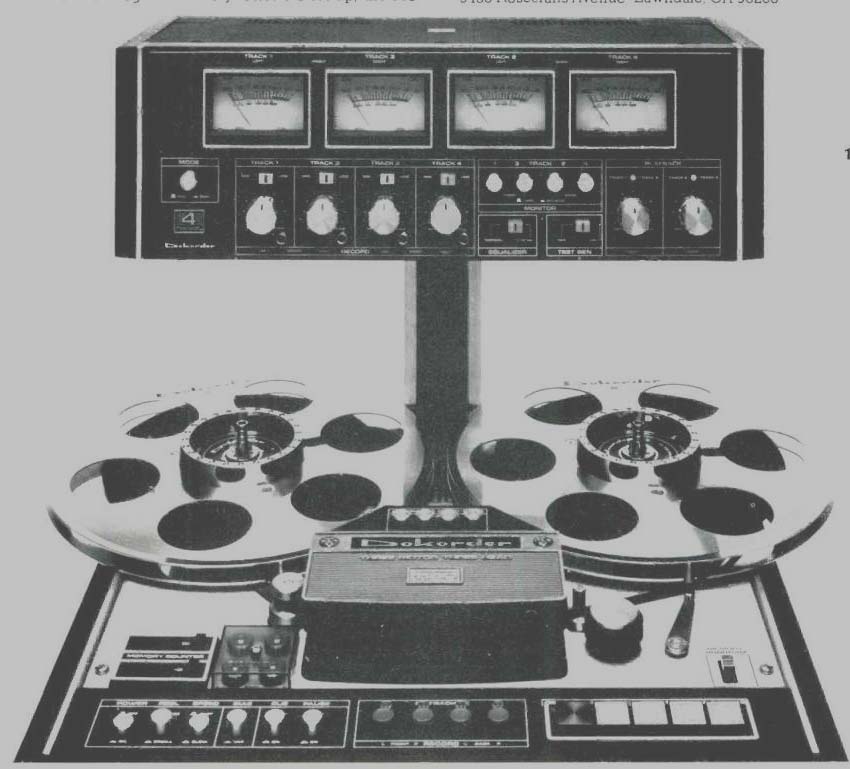
The 1140 also has an automatic cue-up function, called Program Memory. Once it's set up, the Program Memory automatically brings you back to the beginning of material and either stops or plays it again, depending on what you tell it.
The transport controls on the 1140 are digital logic-operated so you can go from one mode to another directly except in Record and there is a motion sensing system which lets you go into play from fast forward or rewind when the reels stop.
Bias controls are up-front on the transport and there is a built-in pink noise generator which supplies a test signal to each channel. This unusual device makes biasing simple but extremely accurate.
There is a lot more hardware to the 1140: peak level indicators, discrete playback and record amplifiers, 62-Volt record drive circuit, wide band sync response, etc.
All to make it easier to put music on tape.
DOKORDER 1140. 5430 Rosecrans Avenue. Lawndale, CA 90260, USA
---------------------
Now you don't have to starve your treble to feed your bass.
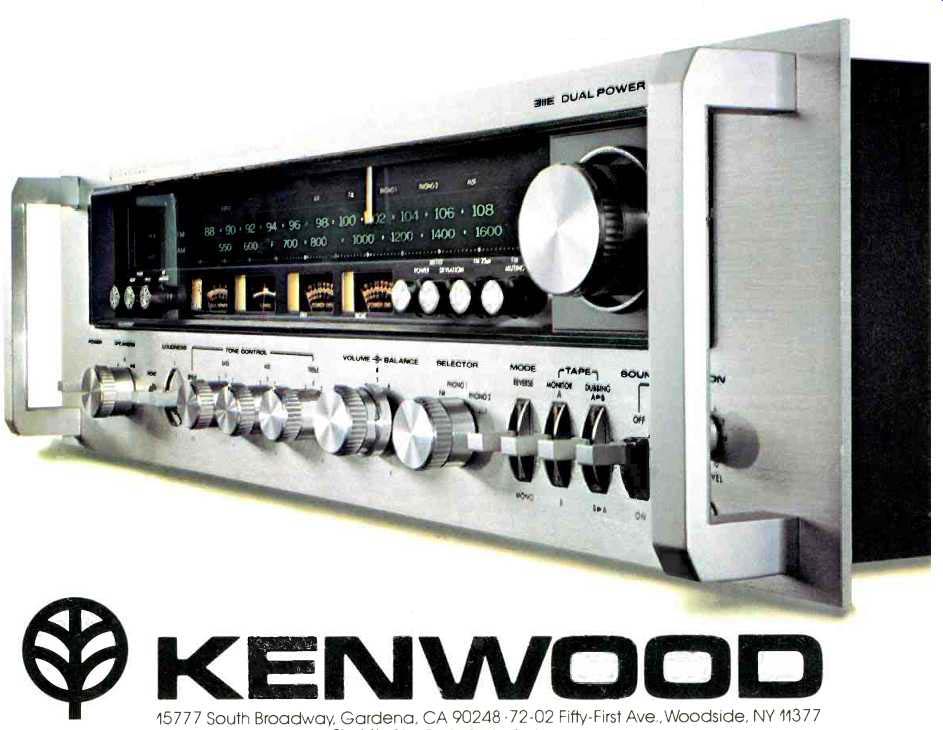
Our KR-9600 Receiver puts independent power supplies behind each channel, so demanding musical passages in one channel won't cause distortion in the other.
At 160 watts per channel minimum RMS power at 8 ohms, from 20 to 20,000 Hz, with no more than 0.08% total harmonic distortion, the KR-9600 is the most powerful receiver we have ever made.
What's more, the KR-9600 is loaded special features. A mid-range presence control, MIC mixing and source fading, a deviation meter for perfect off-air recording and 2 big power meters, to mention a few. Impressed? All this and more, on the KR-9600. At just $750* it's the best watts per-dollar value around.
For informational purposes only.
KENWOOD
----------------------
REVOX
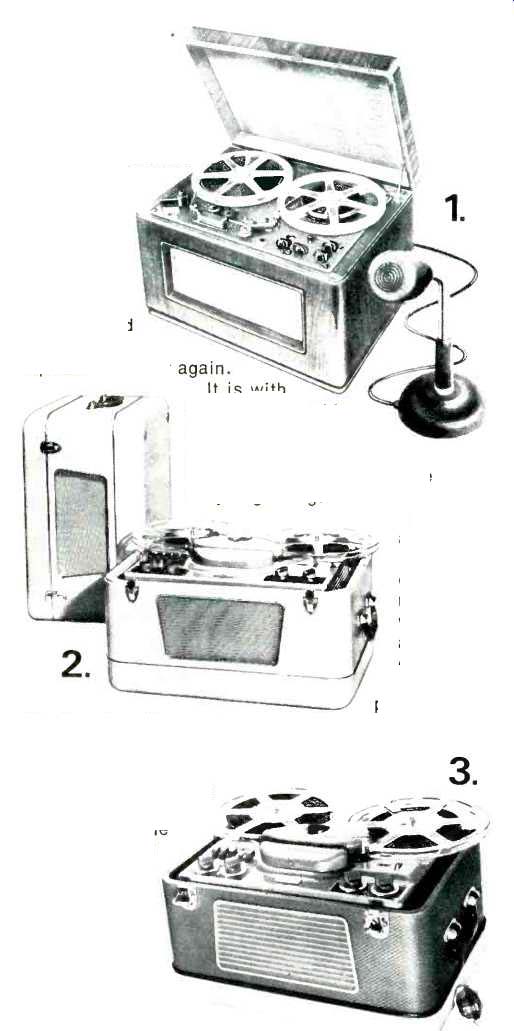
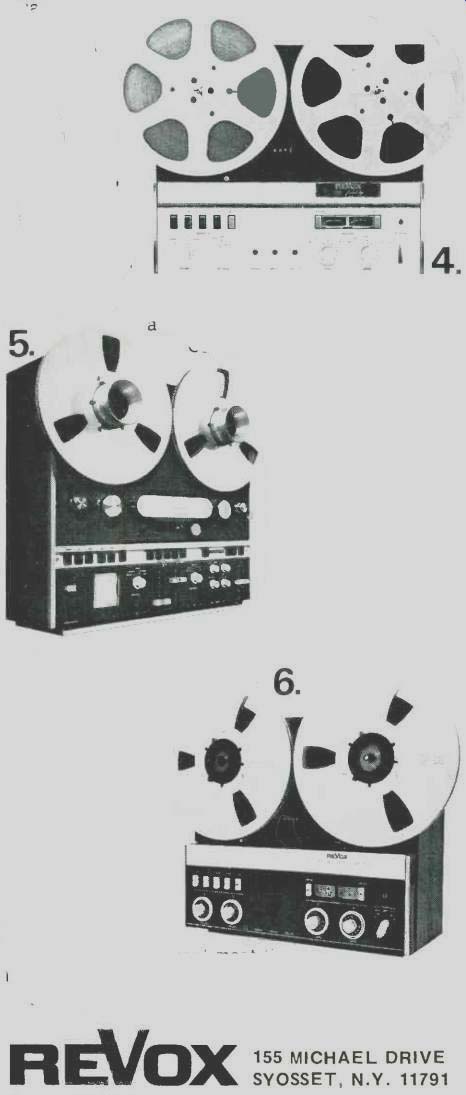
1. DYNAVOX (1950)
2. REVOX A36 (1954)
3. REVOX D36 (1960)
4. REVOX A77 MK I (1967)
5. REVOX A700 (1973)
6. REVOX A77 MK IV (1975)
Our Contribution to the Realization of High Quality Music Reproduction in the Home over the Past 25 Years.
Our company was founded at the time of rapid developments in the field of magnetic tape recording.
During this period there were few machines available, but they revolutionized professional sound recording.
This advancing technology soon introduced a new era to the amateur recordist, because it was now possible to record sound on a reusable storage medium, which could even be cut and spliced together again.
It id with considerable pride that we note our participation in these developments right from the very beginning.
As long ago as 1954, our recorders were already equipped with the professional three motor drive system.
What is it that makes REVOX recorders so successful?
The answer to this question must take into account the taw changes which have occurred in the consumer since the early days of recording.
Today's audiophiles have an increasing awareness of true quality, and only a first-class product has a chance of being accepted by the serious recording enthusiast.
The fact that REVOX tape recorders are in constant demand in such an increasingly quality-minded market is indicative of their high standard of construction and performance, but it also reflects the increasing sophistication of the serious audiophile, whose requirements can only be met by a small number of select products.
Our involvement in the design and production of professional equipment has led us to think in terms only of professional standards, even for our consumer products.
This approach produces far-reaching effects; the performance of REVOX recorders with regard to durability, mechanical and electrical stability, and closely-held specification tolerances, will stand with professional equipment, and this is our main contribution to the realization of true high fidelity sound reproduction in the home.
Does your equipment meet the high standards you require? Visit your nearest REVOX dealer or write to: REVOX, 155 MICHAEL DRIVE SYOSSET, N.Y. 11791
-------------------
Rectilinear
The Powerful Difference.
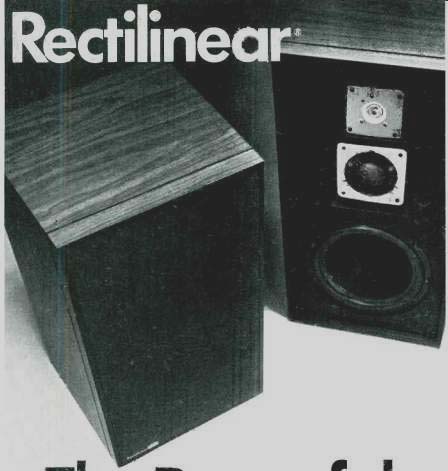
As speaker specialists, we at Rectilinear know, better than most, that to play music at realistic volume levels requires speakers of extraordinary dynamic range and power handling capacity
That's why every Rectilinear speaker is designed to handle enormous amounts of power and do it effortlessly.
Two prime examples are the Rectilinear 2 and 4 1/2. Though moderate in size, they can easily reproduce the ear shattering levels of a rock group in full cry and do it with unmatched clarity and precision.
Both the Rectilinear 2 and 4 1/2 use special high reliability drivers and frequency dividing networks backed up by protective circuitry to prevent mechanical damage and burnt out voice coils.
In addition, a unique cabinet material with a high density fibrous core dramatically reduces cabinet resonances.
Yet in spite of their high power handling capabilities, both speakers are efficient enough to be used with moderately priced and powered amplifiers and receivers.
If your speakers aren't delivering the kind of punch and power you know is in the music, you owe it to yourself to listen to Rectilinear. You'll be impressed with the powerful difference.
Rectilinear speakers from $169 to $ 449.
For complete information write:
Rectilinear Research Corporation, 107 Bruckner Boulevard, Bronx, N.Y. 10454. USA
-------------------
TANDBERG
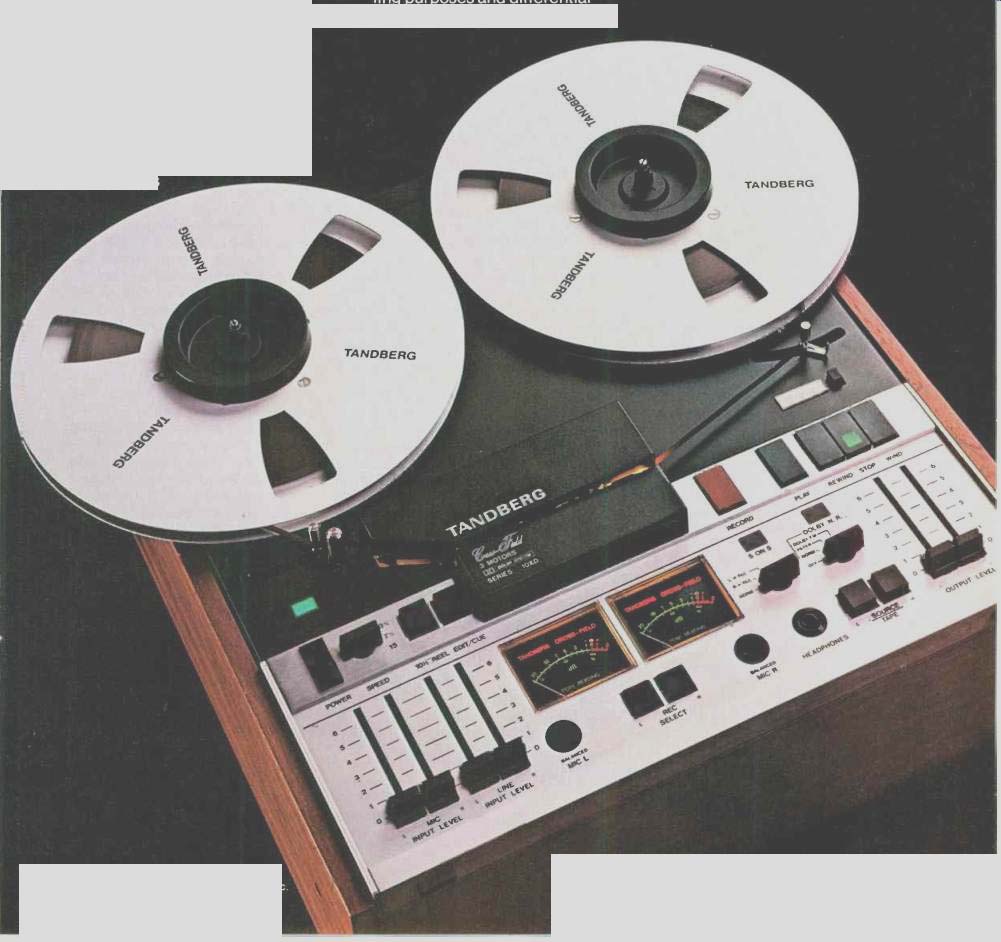
10XD bridges the gap between consumer and professional tape recorders.
Meet the world's first and only 10%2" reel tape recorder that operates at 15 ips and combines Tandberg's unique Cross-Field recording technique with the world-famous Dolby* B system.
Result: A guaranteed minimum signal-to-noise ratio of 72 dB, measured on a 4-track machine using IEC A-weighting. Simply put, the 10XD completely eliminates audible tape hiss! Here are some of the many sophisticated features that make the 10XD the finest tape recorder Tandberg has ever built:
3 speeds: 15, 7 1/2, 3 3/4 ips. Electronically selected 3 motors; Hall-effect capstan motor 3 heads; plus separate bias head Electronic servo speed control Electronic logic mode controls, including photo optics; Electronic balanced microphone inputs; Echo, sound-on-sound, editing, A and B tests;
Peak reading meters; Direct transfer from playback to record (flying start)
Ferrite playback head with symmetrical balanced output for hum cancelling purposes and differential playback amplifier.
Remote control and rack mount optional. Pitch control by special order.
For a complete demonstration of this remarkable new advance in stereo tape recording, see your Tandberg dealer.
-------------------------
(Source: Audio magazine )
Also see:
= = = =