Dictionary of Scientific and Technical Terms, 2nd Edition, McGraw-Hill 1978, 1848 pp., $39.50.
This impressive volume contains 108,000 definitions and 2,862 illustrations covering its 8 3/4 x 11 1/2 in. pages, almost 2,000 of them. There were a good number of contributors and editors to cover about 100 disciplines, which include acoustics, communications, electronics, engineering acoustics, mathematics, physics, and statistics. Because so many fields are covered, it is to be expected that there are some omissions.

Overall, however, there are many examples of careful selection and editing. There is an up-to-date definition for "Fourier analyzer," for example, and various transistor types are well covered. The individual entries evidence excellent editing- definitions identified for field, SI equivalents where units appear and good cross referencing. The excellent illustrations are mostly line drawings, but there are some halftones. There are also useful tables, flow diagrams, and schematics.
The pages are slightly thin with a little leak-through from the back of the page. The terms are in bold face, however, and the type face used for the definitions is very readable. Included in the appendices are SI units conversion tables, abbreviations of terms and organizations, and semiconductor symbols and abbreviations. Yes, there's a lot contained, and it's well presented- for a good price. This dictionary will provide good support in your own field and aid investigations into others.
-Howard A Roberson
The History of Radio. Five cassettes, $9.95 each (also open reel, same price, and 8-track $11.95). By mail: Satellite Broadcasting Co., P.O. Box 644, Matthews, N.C. 28105.
Five hours' running time! For a long time I kept putting off a trial, for lack of stamina. But one night I suddenly decided to give these a whirl. I ended up listening to every minute of those five hours. An excellent job, mainly because it is done so simply--just a huge quantity of radio excerpts, in a number of lumped categories, rather neatly edited at good stopping points, and laced with minimum announcer identification, plus a few concise back ground accounts. It all flows very easily--it could so easily have been a mess! I was impressed.
Two groups of listeners will enjoy.
First, of course, us old timers, who will be ever amazed, and amazed again, at the recall of programs, of styles, of sounds we thought we had forgotten or never heard at all. I was no radio listener in those days, but it seems I absorbed the stuff direct-to-brain or something. It all came through the way a forgotten highway opens up be fore you on a trip, after years of absence. The older you are, the better, of course; we begin here in the pre-
Amos & Andy time and go on until the fade-out caused by television, when virtually all of this sort of programming shifted over to the new medium.
Second group is the nostalgia lovers and don't ask me how it will all sound to them. I found, for instance, that in spite of the minimal sound quality, with never a sibilant in a carload, I could easily understand everything, out of long practice; whereas I don't get a word out of most rock songs to day that younger people understand with ease. Will they be baffled by English-minus-sibilants and plus noise? Maybe! It'll be very quaint, in any case.
-Edward Tatnall Canby
TV Antennas and Signal Distribution Systems by M. J. Salvati. Howard A. Sams, 1979, 256 pp., $9.95.
This volume is directed to the solution of TV reception problems, but there is a great deal that is applicable to FM, as detailed below. The first chapter is on antenna system basics such as wavelength, impedance, bandwidth, and gain. There are some excellent comments on the various antenna gain references, plus material on S/N ratio and reception range. The next chapter covers VHF antennas, with different design approaches discussed along with particular commercial products. The performance comparisons add to the value of the section, which has some material specifically on FM reception.
The chapter on UHF antennas is an other good one, but the following one on all-channel configurations has more for the FM owner. There are good physical and electrical descriptions and performance reports. The chapter on transmission lines is brief, but it is excellent- both concise and lucid. There is discussion of performance, both wet and dry, and the costs and installation ease of various cable constructions. Baluns and other signal-distribution components are treated extensively in the following chapter.
Mast preamps, pads, and connectors are also covered. Antenna hardware and accessories get 18 detailed pages, and guying, lightning protection, and rotators are also in there.
"Signal Optimization Techniques" and "Designing the Antenna System" contain much helpful information that does not appear in most texts covering the same general area. What is included will be of value to the professional as well as to the hobbyist who needs installation guidelines or has a problem to solve. The final chapter covers the actual installation and construction tasks. Two appendices list abbreviations used in the book and a directory of manufacturers. The index is of good length and detail. It would be improved further with added cross referencing.
The entire text is well written, and there are many pertinent illustrations.
Numerous practical comments increase the value of the book, which has a great deal of information for a modest price. The omissions in the area of FM reception were well covered by the same author in the January to April, 1978, issues of Audio.
-Howard A. Roberson
===============
ADs:
HOW TO CHOOSE FROM SOME OF THE CHOICEST MICROPHONES WE'VE EVER MADE.
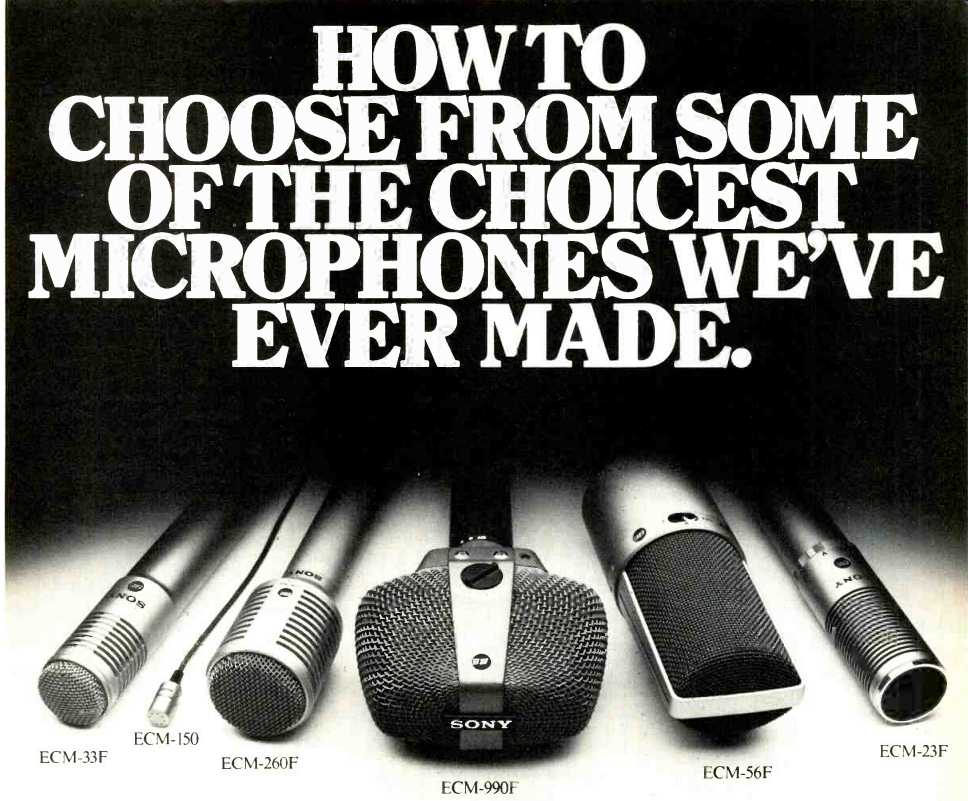

Among recording professionals, Sony is widely recognized as an expert on micro phones. That's because we're continually applying new technology to deliver better sound.
Our latest innovation is the exclusive Back Electret condenser microphone capsule, which delivers response truer than ever thought possible.
You can get this capsule in a variety of Sony mikes. And that's a bit of a problem: it's hard to know which mike is appropriate for your recording needs.
Therefore, let us clear up any confusion:
MICROPHONES THAT ARE AT HOME IN YOUR HOME STUDIO.
If you're involved in the music business and have a home studio, you need a microphone as professional as the rest of your equipment.
For all-purpose recording, we recommend the Sony ECM-56E It's a uni-directional Back Electret condenser mike with excellent transient response, good for close miking of both instruments and voices.
For recording instruments only, the unidirectional Back Electret condenser ECM-33F is ideal. It provides flat frequency response over the entire range, and picks up amplified and non-amplified instruments equally well.
Both of the above plug into mixers for multi-channel recording.
LOCATION MIKES, FOR STUDIO SOUND WITHOUT THE STUDIO.
But suppose you want to record on location. At a rock concert, say, or a performance of your church choir or glee club. Sony has mikes that, combined with your tape recorder, practically make up a portable studio.
Take the ECM-990E an especially versatile and lightweight stereo Back Electret condenser mike. You can vary its directional quality to adapt for everything from solo voice to small groups to full orchestra.
Or choose an ECM-23E. It runs more than 6,500 hours on a single AA battery, and it's uni-directional. Use a pair when you want to create a stereo effect. The ECM-23F also incorporates Sony Back Electret technology.
RECORD FOR RECREATION AND STILL RECREATE NATURAL SOUND.
Maybe you just need a mike to use at home, to record family sing-alongs. Or some one's performance on guitar or piano, for your own enjoyment.
You can still get a Sony Back Electret mike at a very affordable price. It's the ECM-260E which plugs into a tape recorder and makes whatever you record-instrumentals, singing or speech-sound true to life.
For greatest versatility, use our ECM-150 omni-directional condenser mike. It's Sony's tiniest mike, smaller than a dime in circumference, and you can clip it to the fingerboard of a guitar or use it as a lapel or tie tack mike.
(Incidentally, it's great for business conferences or any occasion when you want the mike to be inconspicuous.)
Whatever you need to record, and wherever you need to record it, there's a choice Sony mike to do the job.
And now that you know which mikes to choose, all you need to do is see your Sony dealer.
SONY We've never put our name on anything that wasn't the best.
-------------
ACCURACY. JBL LAYS IT ON THE LINE.
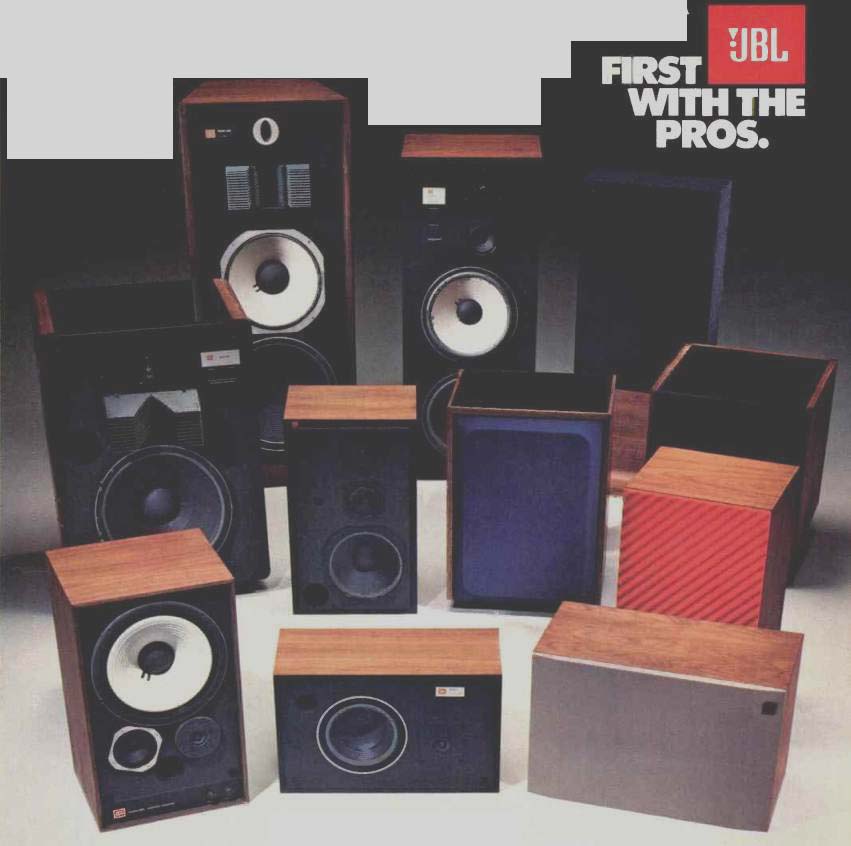
Why do so many stars and studios use JBLs? And more discos than any other speaker? Accuracy is the answer. The music as performed. That's the sound the w pros insist on. No wonder 7 of the 10 top albums in 1978 were recorded, mixed or mastered on JBLs.
And that's the sound we demand in every speaker in our line. JBL speakers are designed to match the music as played. Clear and lifelike.
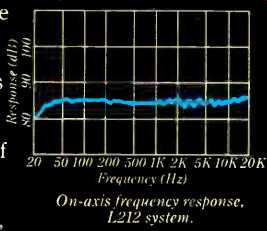
-----------On-axis frequency response, L212 system.
We can state this with some pride since we create our speakers from the ground up.
Concept, design, individual components- all are created at our plant and tested against stringent engineering specifications. Rigorous quality control is applied every step of the way.
We could go into more technical detail but we want to keep our message short and sweet. The reason so many stars, studios and professional installations prefer our speakers is JBL ac curacy. Their living depends on how good they sound. So if you question your own ears, trust theirs.
James B. Lansing Sound, Inc., 8500 Balboa Boulevard, Northridge, CA 91329.
FIRST WITH THE PROS.
*Billboard Disco Survey, 1978.
*Recording Institute of America Survey.
------------------
Dual
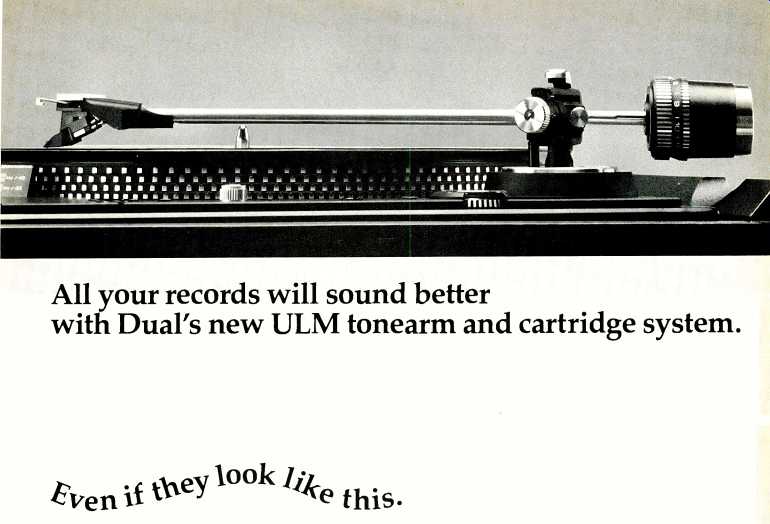
All your records will sound better with Dual's new ULM tonearm and cartridge system.
Although none of your records may be in such bad shape, many are probably warped enough to present serious problems to conventional turntables.
The high inertia of a typical tonearm and cartridge combination, with approximately 18 grams total effective mass, causes the stylus to dig in riding up the warp and to take off on the way down. Tracking angle and tracking force vary widely as much as 30 percent. And a warp as small as 1.5mm (which is barely discernible) can generate harmonic distortion of 2.7 percent.
That's audible! These problems have now been solved by Dual's new Ultra Low Mass tonearm and cartridge system.
The potential for this solution has existed ever since the development of Dual's dynamically-balanced tonearm with its gyroscopic gimbal suspension and straight-line tubular design.
Dual's research into the effects of mass on record playback led to a collaboration with Ortofon.
A cartridge was developed with substantially less mass than any in existence. It weighs just 2.5 grams, including mounting bracket and hardware.
At the same time, the mass of the Dual tonearm was further reduced so that a perfectly matched tonearm and cartridge system emerged. Its total effective mass is just 8 grams. That's less than half the mass of conventional tonearm and cartridge combinations.
Tracking a record with the same 1.5mm warp, the ULM system reduces harmonic distortion to only 0.01 percent. That's 270 times less than that produced by the conventional tonearm and cartridge.
Not only is the overall sound audibly improved, but stylus and record life are significantly extended.
To experience the demonstrable advantages of ULM, bring a badly warped record to your Dual dealer.
Listen to it played with the ULM tonearm and cartridge. (All nine new Dual turntables feature this system.) You will hear the difference that ULM can make on all your records.
For the complete ULM story, please write to United Audio directly.
ULM.
A major breakthrough in record playback technology.
Dual United Audio 120 So. Columbus Avenue Mt. Vernon, New York 10553.
---------------------
EV
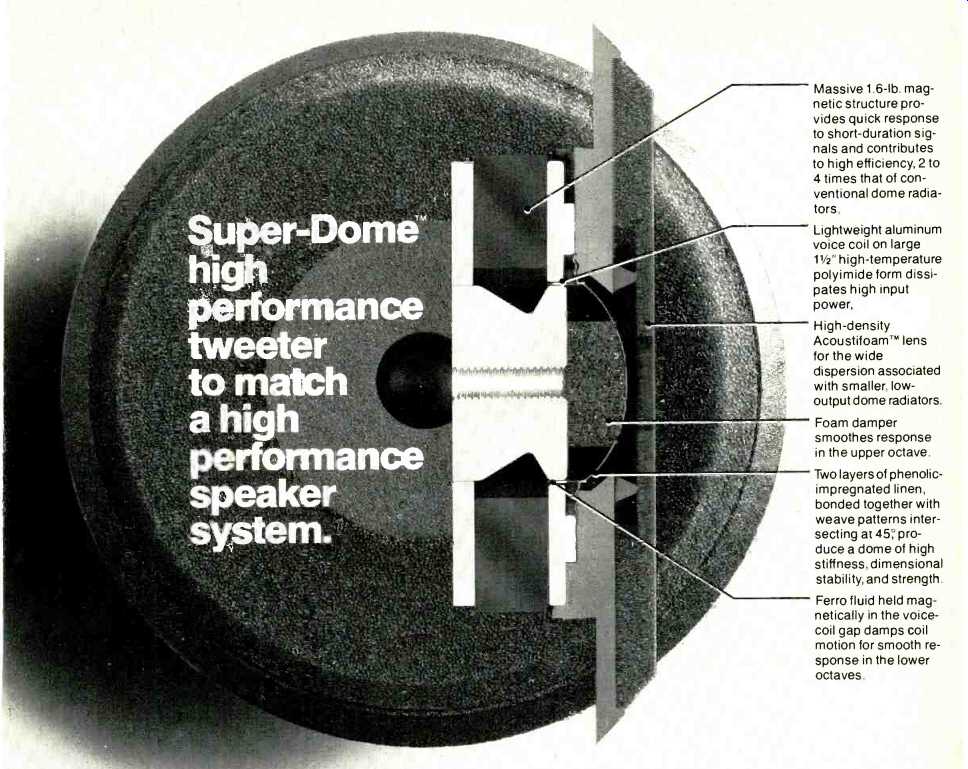
Super-Dome high performance tweeter to match a high performance speaker system.
---Massive 1.6-Ib. magnetic structure provides quick response to short-duration signals and contributes to high efficiency, 2 to 4 times that of conventional dome radiators
---Lightweight aluminum voice coil on large 11" high-temperature polyimide form dissipates high input power
---High-density Acoustifoam lens for the wide dispersion associated with smaller, low-output dome radiators.
---Foam damper smoothes response in the upper octave.
---Two layers of phenolic-impregnated linen, bonded together with weave patterns intersecting at 45; produce a dome of high stiffness, dimensional stability, and strength.
---Ferro fluid held magnetically in the voice-coil gap damps coil motion for smooth response in the lower octaves.
The Super-Dome tweeter in the new generation of Interface speakers represents an extraordinary development in speaker design. Electro-Voice engineers have developed the first high-performance tweeter capable of matching the high efficiency and extended bass response found in our optimally vented, computer designed Interface:A. Super-Dome has the sonic excellence normally associated with a dome tweeter and the efficiency heretofore found only in cone tweeters--two to four times that found in a standard dome. Plus, its voice coil will withstand a full 25 watts power input long term. That's five times the power handling capacity of other standard dome or cone tweeters.
While the angle of dispersion narrows at high frequencies with conventional tweeters, the high-density Acoustifoam lens in Super-Dome helps keep dispersion constant in the upper octaves. Acoustically trans parent at lower tweeter frequencies, the lens becomes opaque at higher frequencies, reducing the effective diameter of the radiating surface, thus increasing the angle of dispersion.
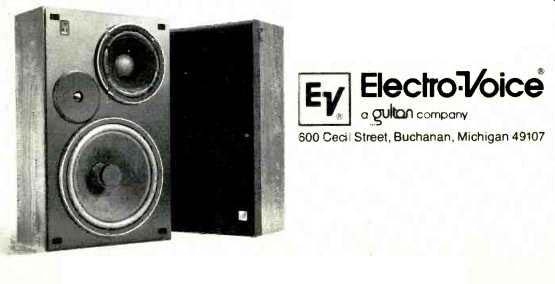
The result is the wide, uniform high-frequency dispersion necessary for precise localization of sound, both lateral and front-to-back.
Super-Dome is found in six of seven speakers in the new third-generation Interface line. No matter which model you decide to buy, you are assured of outstanding performance and model-
to-model sonic integrity. Our goal re mains the same as it was in 1973 when we introduced the first Interface speaker- to offer you a speaker that sounds like music.
EV Electro-Voice company 600 Cecil Street, Buchanan, Michigan 49107 Interface:A Series III
-------------------
Put metal tape where it will do the most good.
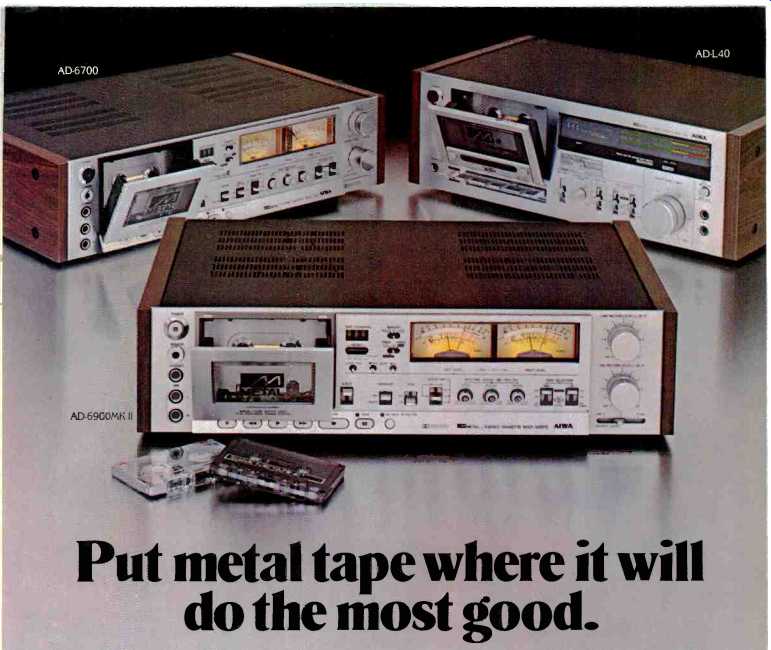
Again AIWA leads the way toward the ultimate in cassette technology--with three of the most sophisticated metal-capacity decks you can buy: the AIWA AD-6900MK II, AD-6700 and AD-L40.
Performance is simply unparalleled.
At -20 dB recording. AIWAs state-of-the-art AD 6900MK II boasts a frequency response of 20-20,000 Hz with metal tape. Even at 0-dB, frequency response is an exceptionally broad 25n-12,500 Hz +/- 3dB.
This superb performance is maximized by AIWAs extremely durable Ferrite Combination V-Cut (CVC) playback/record head. With the best possible gap widths of 5 microns for recording and 1 micron for playback.
The AD-5900MK II's unique 3-head de sign not only lets you compare source with tape during recording-it also permits the most precise bias adjustment available today for FeCr, CrO2 and all other LH/Nc- mal tapes: AIWA's exclusive FLAT RESPONSE TUNING SYSTEM.
And only AIWA's AD-6900MK II and AD-6700 offer advanced feather-touch logic controls including Cue & Review-plus exclusive full-function wireless remote control from across the room. Both decks also feature AIWAs exclusive Double Needle Meters for simultaneous monitoring of Peak and VU.
AIWAs newest AD-6700 and AD-L40 are just as sophisticated.
The AD-6700 offers 2-head design, convenient Auto/ Repeat with Memory Switch, full-function wireless remote control and an amazingly accurate 9-point LED peak power display in three dramatic colors.
AIWAs ultra-modern AD-L40 offers the only 20-point LED horizontal peak power bar graph you can buy--for instant three-color warning of distortion.
All three decks were designed with a special Ferrite double-gap erase head and high-power erase circuitry.
So if you're ready for metal tape. put it where it will do the most good. Inside AIWAs incredibly advanced AD-6900MK II, AD-6700 or AD-L40.
Upgrade to AIWA
Distributed in the U S by. AIWA AMERICA INC.
35 Oxford Drive. Moonachie, New Jersey 07074.
Distributed in Canada by SHRIRO ( CANADA) LTD.
------------------
MADE FOR EACH OTHER.
Earphones are made for ears.

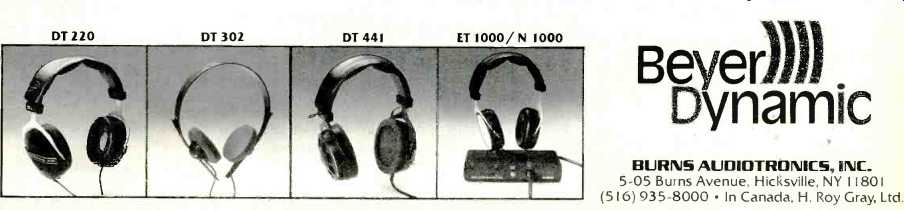
Yours. That's why the Beyer DT 440 has sound so natural and is so light and comfortable you don't even know it's there, even after many hours.
At 9.6 ounces, it is one of the lightest headphones available.
And its weight is evenly distributed among the sponge-padded ear-cups and air-filled headband.
There's no great weight suspended from your head, and your ears never get squeezed.
Some people complain about the isolation of headphones that close them off from the world. So we built the DT 440 with a high velocity open design, to allow a natural mixture of recorded music and environmental sound.
How does it sound? Most people say "spectacular." A great combination of impact and intimacy. The overall sound is wonderfully smooth and transparent.
With clean, rich bass response.
Powerful, lifelike midrange. Crystal clear, undistorted highs. And perfect stereo imaging.
For sound--and for comfort--nothing beats a Beyer. We'd like to make one for you.
Beyer-Dynamic
BURNS AUDIOTRONICS, INC.
5-05 Burns Avenue, Hicksville, NY 11801 (516) 935-8000
In Canada, H. Roy Gray, Ltd.
------------------
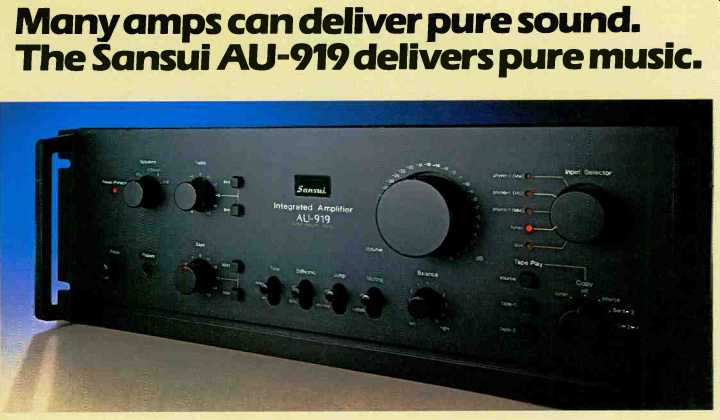
Many amps can deliver pure sound.
The Sansui AU-119 delivers pure music.
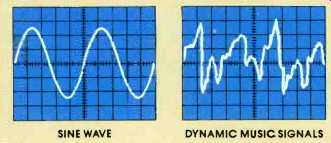
------- SINE WAVE; DYNAMIC MUSIC SIGNALS

Today's audio engineering has reached the point where you can select among a number of affordable high-power amplifiers that have virtually no "total harmonic distortion." That's good. But THD measurements only indicate an amplifier's response to a pure, continuously repeating, steady-state test signal (be low, left). They don't tell you how the amp responds to the never-repeating, rapidly-changing transient waveforms of real music (below, right). And only an amplifier designed to reproduce the demanding dynamics of music signals can satisfy the critical audiophile. An amp like the Sansui AU-919.
Because low THD without low TIM is like sound without music, the Sansui AU-919 is designed to respond well to both simple sine-wave test signals and also to handle the jagged, pulsive edges required for realistic reproduction of music-
without imparting that harsh, metallic quality known as "transient intermodulation distortion" (TIM).
The Sansui AU-919 sounds better than conventional amps because Sansui developed a unique (patent pending) circuit that is capable of achieving both low THD and low TIM simultaneously.
Our DD/DC (Diamond Differential/DC) circuitry provides the extremely high drive current necessary to use proper amounts of negative feedback to re duce conventionally-measured THD (no more than 0.008%, 5Hz-20,000Hz into 8 ohms at 110 watts, min. RMS) without compromising our extraordinary 200V/µSec slew rate, ensuring vanishingly-low TIM, as well. The power amplifier frequency response extends from zero Hz to 500,000Hz.
Since ultimate tonal quality depends on more than the power amplifier alone, Sansui also uses its DD/DC circuitry in the phono equalizer section--where current demands are also particularly high-to prevent TIM. ICL (input capacitorless) FET circuits are used throughout the AU-919, and a "jump switch" is provided that will let you run pure DC from the Aux. input to the output.
Visit your authorized Sansui dealer today, and he'll show you a lot more that the AU-919 has to offer. Like twin-detector protection circuitry and our Penta-Power Supply system. Two-deck monitoring/recording/dubbing facilities. And a high-performance ICL/FET pre-preamp for moving-coil cartridges.
Then listen to the AU-919 with the most demanding music you can find. You'll hear the way the music should sound. Like music. Not just like sound.
The Diamond Differential/DC, Sansui's (patent pending) totally symmetrical double ended circuitry with eight transistors, is named for its Diamond-shaped schematic representation.
SANSUI ELECTRONICS CORP.
Lyndhurst, New Jersey 07071 Gardena, Ca. 90247 Sansui Electric Co., Ltd., Tokyo, Japan Sansui Audio Europe S.A., Antwerp, Belgium
---------------------
Empire's EDR.9
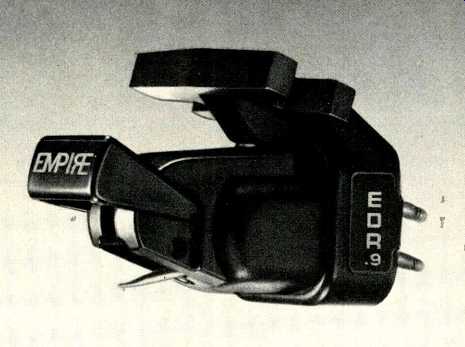
The Phono Cartridge Designed for Today's Audiophile Recordings
Direct-to-Disc and digital recording have added a fantastic new dimension to the listening experience. Greater dynamic range, detail, stereo imaging, lower distortion and increased signal to-noise ratio are just a few of the phrases used to describe the advantages of these new technologies.
In order to capture all the benefits of these recordings, you should have a phono cartridge specifically designed to reproduce every bit of information with utmost precision and clarity and the least amount of record wear.
The Empire EDR.9 is that cartridge.
Although just recently introduced, it is already being hailed as a breakthrough by audiophiles, not only in the U.S., but in such foreign markets as Japan, Ger many, England, France, Switzerland and Sweden.
What makes the EDR.9 different?
1. Within the cantilever tube, we added a mechanical equalizer. It serves two purposes: (1) to cancel the natural resonance of the cantilever tube, and (2) to improve the overall transient response of the cartridge. The end result is a stylus assembly that has a mechanically flat frequency response. The frequency response extends from the 20Hz to 35Hz with a deviation of no more than ± 1.75 dB. No other magnetic cartridge has that kind of performance. We call this stylus assembly an Inertially Damped Tuned Stylus the refinement of which took over 6 years.
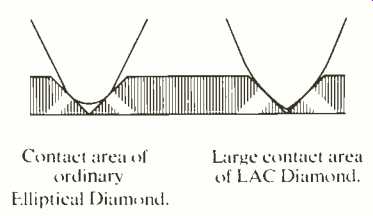
2. Contact area of ordinary Elliptical Diamond. Large contact area of LAC Diamond.
In order to reproduce a groove containing extreme high frequency musical overtones, the stylus tip must have small enough dimensions to fit within the high frequency portion of the groove.
Yet, the smaller the stylus tip, the greater the pressure applied to the record surface and the more severe the record wear. In the EDR.9, we have responded to these conflicting requirements by developing a stylus that has the. proper dimensions from side-to-side, a much smaller dimension from front-to-back, and a very large, low pressure degree of contact between stylus and groove top-to-bottom. The net result of this large contact area, which engineers call a "footprint" is that the stylus of the EDR.9 can track musical signals to the limits of audibility and beyond, yet has the lowest record wear of any cartridge presently available. The stylus shape of the EDR.9 is called L.A.C. for "Large Area of Contact”.
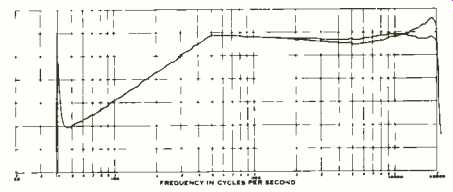
3. Conventional cartridges exhibit radical changes in their frequency response when connected to different preamplifiers. This is because the load conditions- the amounts of capacitance and resistance provided by the preamp vary tremendously from one preamp to another, and from turntable to turn table. Consequently, most phono cartridges, even expensive ones, have their frequency response determined essentially by chance, depending on the system they are connected to.
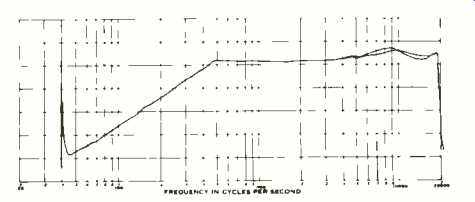
But the electrical elements of the EDR.9 have been designed to remain unaffected by any normal variations in load capacitance or resistance. Thus, the 1,rDR.9 maintains its smooth frequency response and accurate transient-reproduction ability in any music system, irrespective of loading conditions.
A conventional cartridge's frequency response changes when connected to different preamps.
EDR.9 is not affected by changes in loading conditions.
4. Then, as a final test of performance, we listen to every EDR.9 to make certain it sounds as good as it tests. At 5200, the EDR.9 is expensive, but then again, so are your records.
For more detailed information and test reports, write to: Empire Scientific Corp. Garden City. NY 11530
===============
(adapted from Audio magazine, Nov. 1979)
Also see:
= = = =