by Edward Tatnall Canby
"What is the future of classical recording?" With that somewhat grandiose question I recently began a late-summer trilogy on a subject particularly dear to my musico-audio heart, which loves the ancient LP record as a very old friend, a friendly medium that, as we all know, can never, ever, be purely digital, any more than, say, you can motorize the horse. Digital is a horse of another color altogether and, in spite of all the talk, is not yet with us. We still have the LP and will continue to make use of it during what I have called the Great Interim, until a true all-digital disc system appears at last to replace the LP for ever.
A bit of recapitulation. In August I promoted what is surely my most important thought in this series to date:
Why classical music is so important in the audio field and in the consumer hi-fi industry, considering that it makes up such an insignificant proportion of total recorded music sales. I've said my all on that subject and will say no more. See the August issue.
In September I took an oddball look at the immediate future of our present hi-fi sensation, the audiophile LP record, a worthy collective endeavor so full of happy contradictions that I can't see how it can avoid phasing it self out before very long, by virtue of its own success. How can you have a specialized, special-care, limited-production disc that becomes so popular that it proliferates into near-mass production? How can you perpetuate a special kind of disc for hi-fi listeners when in truth all first-line records should provide first-line quality? And so the audiophile LP simply will become the expensive first-line standard LP disc as everybody and their brother applies undoubted competitive skill towards successful production of better quality LP records at much higher prices. Inevitable, what with such as Columbia and RCA now joining the club, not to mention liter ally dozens of smaller outfits. Fun and games, as we always say, and I am all for it, whatever the chosen designation. We have needed a genuine, competitive improvement of quality in the finished LP disc for a long, long time and if it had to come via the term audiophile, I am perfectly happy.
N.B. There just might come a day (disturbing thought) when a block buster of a still newer idea takes hold: Audiophile records at low prices.
That ploy appears periodically in al most every commercial field, and if it is timed right and the product is right, there is success. Top-flight engineering can be applied in this way, too, as we ought to know. Remember Concert Hall's MMS (Musical Masterpiece) re cords? Remember Nonesuch at a dollar an LP, around 1963 or so? Remember Columbia's 78 price cut in the early 1930s to a dollar per shellac? And do not forget that large and quiet organization called MHS (Musical Heritage) which right now is producing first-quality LP records at a price you won't believe if you haven't paid it--mail order.
There is absolutely nothing we can't do in the area of better quality if we really want to apply our skills, engineering and merchandizing, with the proper acumen, and it does not really matter whether the price is extra high or extra low. It can work both ways.
I am, of course, speaking still within the present standard operation according to the LP system.
The entire audiophile movement moves within that system and its very strict analog limitations. The LP is a real bottleneck but, I think, a benign one, like the bottlenecks we find in every flask of good wine.
Surprising what good things can get past those narrow necks, when the product is right.
Frisco Discs? While I'm at it, I must purvey another analogy concerning the audiophile disc.
I am just back from vacationing in chilly San Francisco, the city of dizzy heights and extreme pitches. It occurs to me that the audiophile disc is much like a San Francisco phenomenon, I noted with amusement, since I have only seen the same in European towns of enormously greater age. Paved streets so steeply inclined that there are steps alongside to keep pedestrians from sliding downhill on their behinds. In San Francisco the cars don't use the steps; they climb straight up, then veer crazily sidewise and park at an angle you don't dare believe. To get in or out of either door, up side or down side, takes an athlete's strength and a lot of courage. I really gasped as I watched two elderly tourists trying to turn their Cadillac around at the top of one such hill. The wheels were splayed out and curled under, on the shaky verge of an upset. Phew! Those San Francisco streets and the busy cars that climb up and park precariously at the top represent the fast progress of audio and recording. (See how my mind runs on business even when I'm on vacation?) High powered and high risk, recession or no (see Whyte for August). I tried to walk straight up one such street like a car, but my feet were so bent and tortured I had to take to the steps. Ha! The audiophile disc is like one of those steps, I said to myself, gasping for breath. A sudden, all-out burst of technological progress straight up, then forward on a dynamically flat and workable plane.
That's where we are in audiophile discs right now. But note that the overall rate of audio progress keeps right on climbing at the same steep angle, and pretty soon the step finds itself back at grade, and so we need another sudden step forward. Get me? I rather like the analogy.
For The Present
Of course, for that next big step we'll have to find a new name. By then, almost every LP disc will be called audiophile, just as all beers are superior products (according to the la bel) including the low-priced super market specials. Just had a drink of the latter and it was lousy beer.

Now, folks, let us set our friends and relatives straight on this digital business. It used to be that my non-hi-fi acquaintances were incessantly after me, the "expert," as to what kind of a stereo they should buy at, say, $150 for the whole. Now it's different. What they want to know now is whether these new digital discs will play on their present system. Yes, Virginia, they will play on your present stereo be cause they aren't digital at all. They are merely audiophile.
So please tell your intelligent, if unknowing, friends that while our present audiophile discs are indeed of ten superb, there is no such thing as a purely digital LP and never will be. I will not say that current publicity is mendacious, it merely misleads. All in a good cause. Everybody is hopping out there to buy expensive digital re cords and wondering why, strangely enough, they sound like very good LPs. What else? That's what they are, and often worth the money; you can tell 'em so.
Imagine having to write this out in an audio magazine! You think you know all about it, but go ask your aunt, whose IQ is 147, and you'll find out what I mean. A sea of digital confusion.
I do not need to speak at length-write at length--concerning the one alternative to the audiophile disc that now exists via the LP system, to keep us all going during the Great Interim--pending true digital. I wrote at length about it in our December, 1979 issue and so did the chief purveyor of the system in a more technical article.
This is, of course, the dbx-encoded LP disc, somewhat analogous to the Dolby cassette.
The reason the coded disc is important is it manages to break through the LP bottleneck as no audiophile LP can ever do, and this is in fundamental respects that take us a long way towards the ultimate parameters of the all-digital consumer disc that we do not yet have. The price is a decode circuit, at the moment only available as a separate small component, although it is handy and simple to use, but just may be an extremely minute cost in sound quality, immeasurably small (non-existent for my ears).
For this micro-cost in sonic quality--if there really is any audibly perceptible loss--the advantages of the coded LP disc are enormous and go beyond anything that any audiophile LP can offer in a number of fundamental respects. Since my December, 1979 discussion I have heard most of the currently available coded LPs in my home via my system and the little de coder, and I continue to be enormously impressed by the potentialities of this state-of-the-audio-art system of compression-expansion, mirror image.
What advantages? Simple enough.
The greatest, without the slightest doubt, is the elimination of noise. Uncanny. All audible traces of continuous LP hiss are completely removed, along with print-through and groove echoes of the sort that many of us find musically painful, however faint.
Moreover, those .hideous loud pops and ticks and wide smears of irregular surface noise, if not totally eliminated, are reduced to the most polite little sounds you ever heard, wholly unobjectionable. When you push the "De code" button, you think you are turning your entire system off. Yet when the recorded music begins, it can be startlingly loud.
With an encoded LP disc there is absolutely no "turning" rhythm at all, no sense of a record being played. Just music. On my reviewer's rating scale this rates an accurate A ++, as I have observed before. The coded "surface" is simply off scale. There is no surface, as far as the ear is concerned. Is that a boon! Second (and some put this first), is the suddenly widened dynamic range.
From a maximum in the 60s for even the best standard LP, the coded disc jumps out to 85 dB. That is only slightly short of the dynamic range found on digital tapes and prototype digital discs. Sometimes, musically speaking, this is hair raising. At other times, different music, it is only marginally important. We don't always need that vast, almost-digital dynamic range for a lot of our listening--hence my reason for placing it second. Total silence is more important, not only for its freedom from aural irritation but because it brings out such marvelous tiny de tails in the recording, both in loud pas sages (greater inner clarity) and soft.
I need say no more, except to note a third enormous advantage for the en coded LP in the coming period before we get to true digital home discs. That is the fact that the encoded release can bring to the LP medium a great deal more of the original dynamic range, not to mention silence, than any standard or audiophile LP. That is what is now being done in the first up dating of the encoded disc, via reissues encoded from many different record labels out of past and present top-level master recordings.
Parallel Yet Merging Perhaps even more important is that the new digital recordings can also be and are being issued 'in the coded form, thereby bringing to the LP a great deal more of the digital essence than is possible through the standard audiophile LP. In fact, there is no reason why the audiophile movement and the encoded LP cannot merge, and indeed they are doing just that in a widening area of top-flight recording. You'll find alternative parallel issues, coded and uncoded, as in other times of dynamic change in the record business.
I can easily see how this may develop. Can't you? Decode circuitry built into more and more components, eventually becoming automatic in preamp departments, as Dolby in most cassette players. A slow phase-out of standard releases in favor of encoded discs, to suit the state of current home equipment. We've been here before.
At the moment, the coded disc is not in the audio spotlight. You have scarcely heard of it. Good reason. We are still in the throes and the joys of the audiophile disc, the "digital" LP.
And please, one sensation at a time.
But as I say, time will pass and we will need a new and drastic step upwards in the LP if we are to keep things dynamic in the continued absence of true digital playback for consumers. As I figure it, this can only come via a pro cess as sonically radical as the encoded LP disc, whether from analog or digital masters, or even direct-encoded-to-disc--how about that? I think it's entirely feasible.
So do not let the fact that present encoding is the exclusive property of one company affect you at all. Fortunately, there are many record labels being encoded with more to follow, and there is no reason why the process itself might not be licensed out, even if this company does turn out to have a technological de facto semi-monopoly, in the manner of the Dolby-encoded cassette. These things get around, one way or another, when the need for them is real. We are desperately going to need a next (and per haps final) LP step. This could be it.
---------
OBITUARY
John E. Volkmann died on July 9, 1980, following a short illness. For over 30 years, Mr. Volkmann was in charge of advanced acoustic development and theater engineering activities at RCA, Camden, N.J. He specialized in the development and application of large auditorium loudspeakers and stereo sound systems and he consulted on architectural, electronic and acoustic problems.
Design and development projects on which he contributed his expertise include: Stereo sound systems for the John F. Kennedy Center, Washington, D.C.; Radio City Music Hall, N.Y.; the Hollywood Bowl; Jones Beach Marine Stadium, N.Y.; custom loudspeakers for the New York World's Fairs of 1938 and 1964, and recording acoustics for Walt Disney's "Fantasia."
Mr. Volkmann pioneered the concept of variable acoustics which he applied to the design of RCA Recording Studios, N.Y., and he provided the acoustic design for RCA Italiana's 364,000-cubic-foot Studio A (the first and largest room ever built for recording full-scale operas and symphonic orchestras).
-- John E. Volkmann
=================
ADs:
The continuing story of TDK sound achievement.
Part Four.
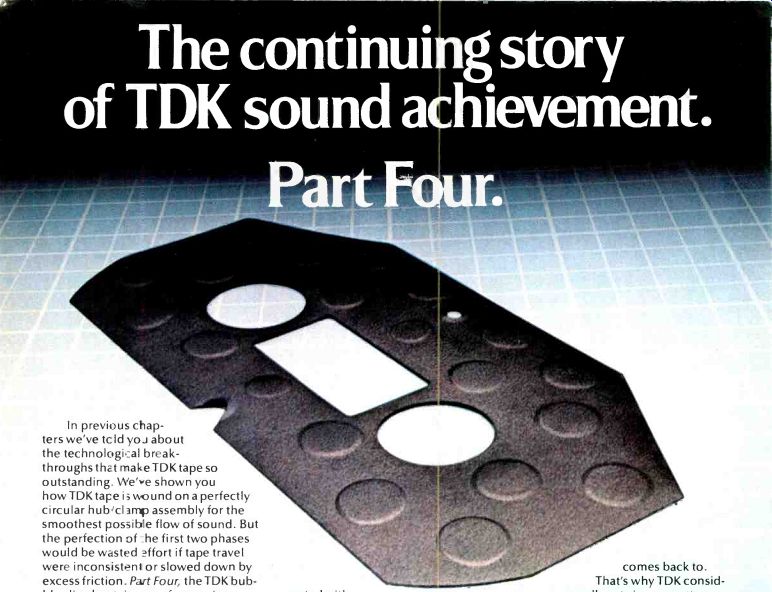
In previous chapters we've told you about the technological break throughs that make TDK tape so outstanding. We've shown you how TDK tape is wound on a perfectly circular hub clamp assembly for the smoothest possible flow of sound. But the perfection of the first two phases would be wasted effort if tape travel were inconsistent or slowed down by excess friction. Part Four, the TDK bubble slip sheet, is one of our unique answers to reducing friction. On it rests TDK's reputation for smooth-running sound.
TDK engineers painstakingly studied tape travel. They found the edge of the tape comes into direct contact with the cassette at several points. At any of those critical spots, the tape can be slowed down, tilted away from the parallel, side-tracked or damaged. The need to reduce friction was evident. And it had to begin where the tape edge makes contact with the shell.
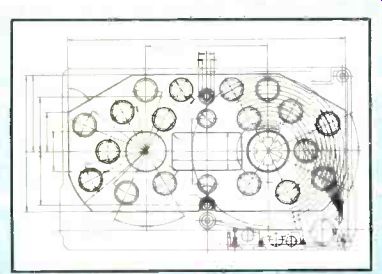
-------------Running analysis of TDK bubble slip sheet
The TDK ship sheet first came into existence as a flat piece of paper. Our engineers knew it had to do more than reduce friction. It also had to maintain constant tape speed and perfect tape winding. Two formulations met the exacting TDK standards. Ultra-thin paper coated with silicone. And Teflon-coated with a fine layer of graphite. To further diminish the area of contact between tape and slip sheet, our engineers created the bubble concept.
Each TDK bubble slip sheet is computer-designed with twenty bubbles of varying diameters.
Each bubble slip sheet is manufactured to micron tolerances to guarantee uniformity in height.
In operation, the TDK bubble slip sheet maintains a constant running angle for the tape, minimizing friction. Tape winding is even and consistent. Your music is recorded and played back in a safe, reliable environment.
Music is what it all comes back to.
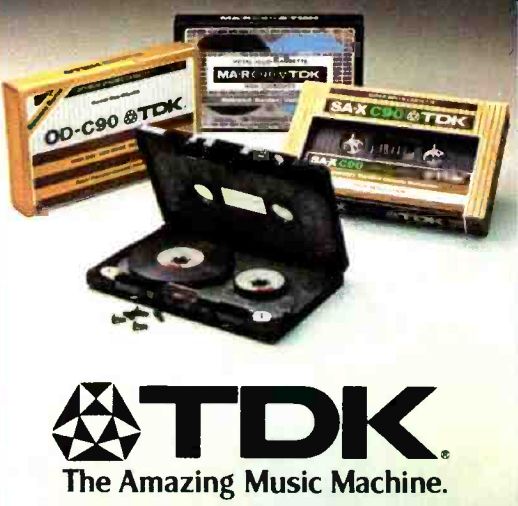
That's why TDK considers all parts in a cassette equally important. And why every effort is made to achieve a perfect interplay between them. It's an achievement you'll hear every time you play your favorite music on TDK.
Music is the sum of its parts.
TDK.
The Amazing Music Machine.
---------------
The secret of Onkyo.

You'll find it in all four of our new stereo tape decks.
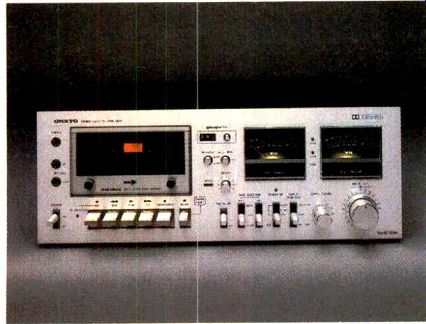
--------- The Onkyo TA-630DM
Let Onkyo transport you to a world beyond electronics ... to a world of more perfect sound. Where you'll hear music of such stunning purity and richness, that you'll forget you're listening to an audio system.
That's the secret of Onkyo ... and Onkyo's dramatic success. The unique ability to take you several steps beyond pure technology .. . to experience more exciting sound.

And you'll find it in all four of our new stereo tape decks.
The Onkyo TA-630DM is an outstanding example. It achieves performance heights only hinted at in the acclaimed Onkyo TA-630D.
In 1979, independent testing confirmed that the TA-630D out performed all 19 cassette tape decks in its price range ... placing first in both sound quality and value.
Now even more innovations have been added in the TA-630DM, to widen Onkyo's lead still further.
Not only have we designed-in metal tape capability ... using a newly developed high-performance hyperbolic S&S Sendust record/playback head ... but we've also fully redesigned the record system electronics to take fullest advantage of metal tape's much improved dynamic range.
The feature-laden TA-630DM also employs Onkyo's exclusive "Accu-Bias" control system ...which assures that every recording you make is superior ... regardless of tape-type or brand.
Built-in tone generators in the TA-630DM let you sense each tape's unique bias requirements ... guiding you to the precise setting for optimum sound. Brighter high notes are the reward.
The TA-630DM's Dolby* noise reduction system, with switchable MPX filter, even lets you decode
Dolby FM broadcast signals for more brilliant off-air recordings.
Other important features include ... memory rewind, full auto stop, a timer start/pause function, and two large peak level VU meters.
Throughout, the system has been engineered for extreme reliability and long service life ... from its precise and rugged phase-locked loop (PLL) servo DC motor drive system, to its richly designed electronic control systems.
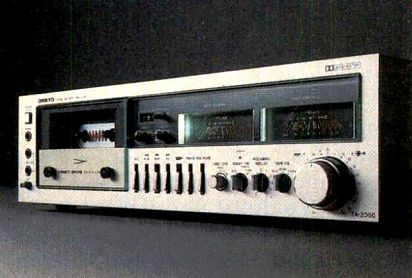
Equally impressive is the elegant new Onkyo TA-2050... an advanced two-motor stereo cassette tape deck featuring "Accu-Bias", a Dolby* noise reduction system with switchable MPX filter, full metal tape capability, and soft touch controls. It too delivers more perfect sound.
The TA-2050 utilizes a full logic direct drive motor transport for extremely high reliability with minimum wow and flutter. A separate motor handles fast forward and rewind functions. A special Hard-Permalloy record/playback head ... and a ferrite erase head ... provide optimum performance with all types of tape, including metal.
Two valuable features of the TA-2050 are its instant muting and automatic fade in/fade out control systems ... which permit far more professional recording effects. Musical passages can be "cut- n" or "cut-out" instantly. Sound passages can be "faded-out" or "faded-in" smoothly. And cassettes can be recorded right to the end ... then rewound a short bit to overlay a professional "fade-out" effect.
The Onkyo TA-2050 also features a memory-stop/memory-play system, a timer mode selector, special "peak-hold" meters for added precision and convenience, and full remote control capability with the optional RC-5 remote control unit.
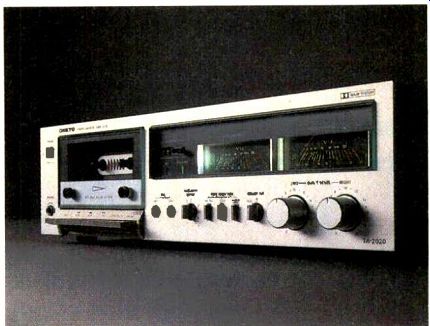
Many of the same innovations are found in the Onkyo TA-2020.
a surprisingly affordable stereo cassette tape deck with "Accu-Bias" and metal tape capability.
The Onkyo TA-2050
The Onkyo TA-2020
The Onkyo TA-1900
The TA-2020 features a servo-controlled DC motor, large VU meters, a Dolby noise reduction system with built-in MPX filter, and a convenient timer/pause button for unattended operation.
Richly engineered to Onkyo's uncompromising standards, no other stereo cassette deck in its price range provides such sound quality.
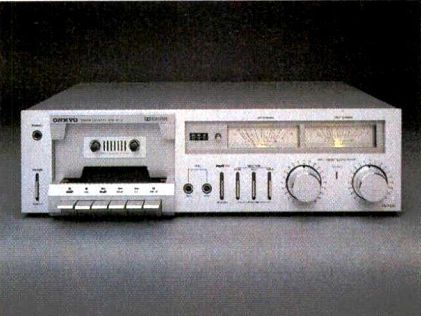
The Onkyo TA-1900 represents an incredible achievement ... in both performance and economy. It puts full high fidelity metal tape stereo within easy reach of even the entry level audiophile.
The TA-1900 features simplified soft-touch controls, three position Bias/EQ switches to maximize tape performance, Dolby" noise reduction circuitry, a Hard-Permalloy record/playback head, a ferrite erase head, and a DC servo motor.
Without exception, the Onkyo TA-1900 is the most affordable quality tape deck in audio today! Styling of all four new stereo cassette tape decks is superb.
Brushed silver metal with elegant appointments. The TA-630DM resembles Onkyo's top-of-the-line TA-2080 ... while the other three models debut Onkyo's dramatic new slim-line design.
Onkyo USA Corporation. 42-07 20th Ave., Long Island City N.Y. 11105, (212) 728-4639
TM of Dolby Laboratories
-------------------
ASTRION
We build them
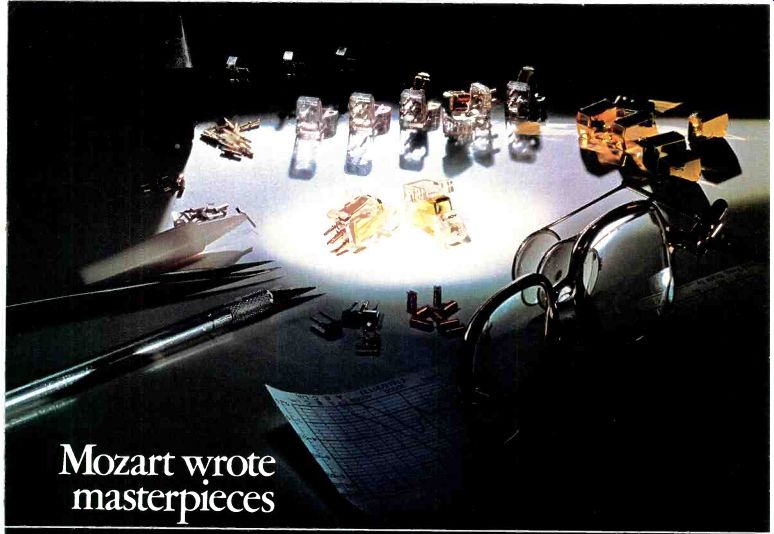
Introducing the new hand crafted Astrion. How do we achieve such unparalleled musical excellence? One by one. Piece by piece. All by hand. Each and every Astrion component is hand inspected, hand selected and finally hand assembled by our mast skilled craftsmen. Like you, they look beyond specifications. That's why they personally audition every Astrion they build.
What qualities do they look for? Performance without restriction.
Realism without compromise.
Music. Pure and simple. We could go on. But why listen to a description when you can listen to our new Astrion. Take your most cherished recording to one of our selected Astrion dealers. What you hear will be incredible. What you don't hear is what you never should.
Like distortion caused by conventional cantilevers. Our engineers did away with it. By eliminating the conventional metal cantilever. In its place is a laser-etched solid sapphire shaft. Its high "stiffness-to-mass" ratio solves any flexing problems.

Its exceptional purity creates a new standard for transient response.
In keeping with that high stand and is Astrion's exclusive hand polished "extended contact" elliptic diamond tip. It's the smallest nude diamond tip we've ever made.
Our engineers also developed a unique pivot suspension system for the Astrion. The Orbital Pivot System Unlike other systems there are no restrictive armature wires, adhesives or governors. Instead each armature is micro-machined to form a perfect fit with the Astrion's S-4 suspension block. It's that simple. It's also that much more compliant in all signal directions.
The hand-crafted Astrion. A masterpiece built to do justice to all the masterpieces written.
For the location of your closest ADC Astrion dealer write Audio Dynamics Corp., Pickett District Road, New Milford, CT. 06776 or call toll-free (800) 243-9544.
ASTRION
--------------------
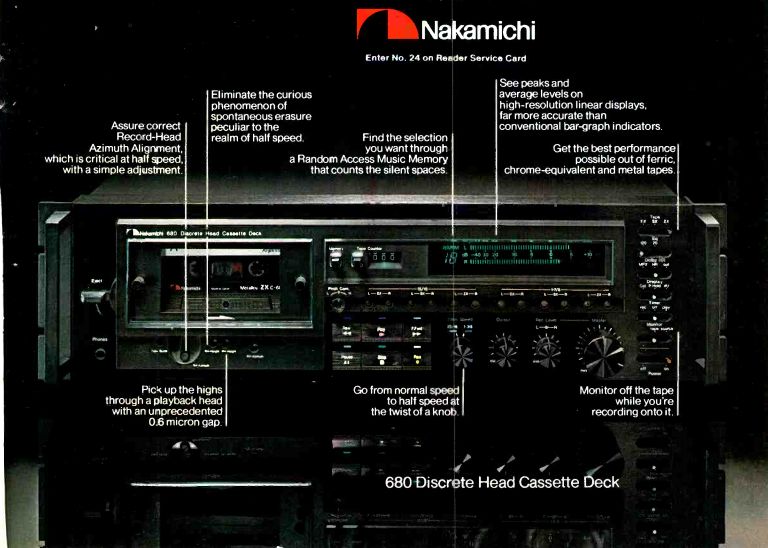
The only half-speed deck anywhere.
And that’s only half the story.
The new Nakamichi 680 2-Speed Discrete Head Cassette Deck is a success story from the moment you turn it on and enjoy the unique convenience of three hours of recording and playback from a C-90 cassette. The sound you'll hear at half speed rivals many decks at normal speed. To deliver superb sound as the tape glides by at 15/16 inches per second meant that Nakamichi had to outdo itself at 1% ips. So when you want the optimum twist the knob back to 1 7/8 ips and you'll hear unheard of fidelity. It's no wonder that Nakamichi is the company to bring you this remarkable cassette deck. The essential component of everything we do-from the smallest detail to the most impressive technological breakthrough-is a constant commitment to excellence in the fine art of recorded sound. For the full story on the new 680 write to Nakamichi U.S.A. Corp., 1101 Colorado Avenue, Santa Monica, California 90401.

=================
(adapted from Audio magazine, 1980)
= = = =