EARS AND ERES
As I listened to concert after concert in Silva Hall, the new electronically assisted large concert space in Eugene, Oregon (described last month), I developed a strong first-hand feeling as to what this remarkable new kind of sonic architecture can do for the listener in his seat and the live performance on a stage--in a sweeping variety of music, speech, opera, ballet, drama, lectures, pop shows and what have you. At a far remove, I'm already thinking, could not this approach also work in our own little concert halls, the' better to fit our living rooms for recorded and broadcast music? Why not, Assisted Resonance, the other AR, has it well in hand, as a beginning.

The music of the 1983 Oregon Bach Festival was, of course, all classical.
Even so, an astonishing variety of shapes and sizes of music were accommodated though the Festival audiences mostly took it all for granted.
Just think: We heard in that space, full-size, everything from the monumental Bach B minor Mass to that feeble instrument, a solo harpsichord. And, along the way, there were violin and cello sonatas, trios, quartets with piano (Brahms), an evening of late-Baroque concerti and another for small chamber groups (C. P. E. Bach). Also, there was a solo lied recital for soprano, very intimate in intent, and a series of Bach cantatas--with spoken comment--ranging from the smallest, a few faint solo instruments (gamba, recorder) and a tiny chorus, to Bach's biggest public music complete with a trio of trumpets.
In terms of sheer volume, then, both in the sound and the required space, this suggests roughly a 200:1 relationship, whether in decibels or cubic feet.
The hall was stretched to its widest capacity even within the strict classical category. Unobtrusively, it was serving the functions of maybe a dozen separate and very different locales, ideally speaking, each suitable for a much narrower range of performance. As my Bach program book said, "From Symphony to Rock, from Broadway to Ballet, they're all at the Hult Center." True.
Even as Bach unfolded in two weeks of glory, Harry Belafonte and troupe came through Eugene and occupied Silva Hall on a free evening.
The all-purpose hall isn't exactly new. Ever since the precedent-setting Jazz at Carnegie Hall series of a generation ago, we have been adapting old halls, building new ones, to solve the all-in-one problem. The whole apparatus of mechanically shifting wall panels, screens, hanging clouds, unfolding drapes and more was developed in the attempt to make these halls sonically variable and good in the listening for many uses. Or we have simply ignored the problem and used the halls anyway. Long ago I heard a solo harpsichord recital in Carnegie, unassisted-Landowska in her last years of public performing. The place was packed, the audience sound-absorbing, and you could not hear a pin drop as the great little lady came on the stage. Alas, you could not hear the harpsichord either. I listened reverently to pages of silence, not even a cough.
Only the loudest segments, all the strings coupled in high gear, came through as a faint shimmering. Great just to see such a famous artist in the flesh, and no regrets! But … . Now we can tactfully, expertly, enhance such instruments and others with close-up mikes and discreet amplification, scarcely noticeable to most listeners. This indeed is a subtle and still-developing art in itself. It is even used in Silva Hall, exactly as it is elsewhere.
But in Silva (and perhaps a scant dozen halls in the world) we are dealing with an utterly different concept. As I have said, this is not sound reinforcement but hall reinforcement. The electronic systems are a part of the hall itself in acoustic terms. Silva Hall is the first to be predesigned from the start for this dual acoustic structure, electronic and architectural elements permanently joined and working as one--with variability. The actual physical hall cannot be used by itself minus electronics, a bold innovation.
A sudden flash occurred to me the other day. Silva's unique look (as described last month) may not be entirely for technical reasons nor for architectural novelty. There's a better thought.
We often find it anachronistically uncomfortable to listen to loud pop music in the traditionally austere spaces of, say, Carnegie Hall or the equally formal setting of many modern halls. Similarly, we are ill at ease hearing loud, non-sacred music in a church concert, though all of these contradictions are commonplace. Ears and eyes, our sense of place (and suitability) are at odds, though we do go along. What we need for a multi-purpose listening place is neutrality. But how? Silva-that extraordinary upside down basket-weave thing-is very positively neutral! There is nothing else like it. Who ever heard of listening inside a giant green fruit basket? It has its formal aspects but also much whimsy and informality-it's okay for anything. Was that the architects' idea? Anyhow, it works.
Last month, I briefly described one of the two interlocking electronic systems that power the Silva acoustics; AR, Assisted. Resonance, with its 90 tuned microphones and 90 loudspeakers, all located on two high catwalks above the hall's floor. Each of these 90 sharply resonant channels, as they were called, cover a band only a few Hertz wide, not far from a pure tone. I should add that the 45 amp systems that link each mike and speaker combination, a pair of channels per amp, adjust the signals so that mike and speaker are exactly in phase, for a very smooth and sophisticated feedback loop, 90 separate loops, controlled with enormous finesse. This allows the ambient sound-slice in each narrow band to be selectively amplified and, more important, selectively adjusted for die-away time or reverb, frequency by frequency, via the controlled feedback. Thus, not only the overall reverb time is adjusted but the coloration too, dynamically changing with time! The reverb you hear in the hall depends on the combined sound of these dynamic feedback loops, and the original natural architectural reverb-you cannot tell them apart, they are one. But you can change the effect, change the hall itself, with no moving parts except a few computer keys and such. Devilishly ingenious! Also devilishly tricky, if you know about feedback instability. Gremlins by the thousands, just waiting to produce howls, squeals, unimaginable chaos.
How would you like to have that much near-instability in your public system? A horrid thought. Sanity is maintained in Silva, I gather, via the central computer that controls everything. Sometimes those little gadgets with the keys and the screens can be quite useful.
The second system in this array, linked and cooperating, is entirely different in purpose and operation. It is known at the moment as ERES (terms for all this gear are still a bit unstable), signifying Electronic Reflected Energy System, basically a complex digital delay. We have similar, if rudimentary, systems in our various home-based synthetic reverb units, AR being the reverb control and ERES hall size or equivalent.
Up to a point AR and ERES share many qualities. Both work at surprisingly low levels, never above the live stage sound to the point of conscious awareness. In the hall, you simply do not hear either one. Both use smallish speakers and low power; in both, the speakers and microphones are entirely hidden and completely unidentifiable.
After two weeks I still could not visually locate a single speaker out of the hundred plus in that hall, and no microphone other than the stage mikes.
The entire sound pickup of both AR and ERES is strictly at a distance, like ambience mikes; there is absolutely no differentiation between sources on the stage-even when that includes conventional sound reinforcement. The mikes are high above in both systems, and so are most of the speakers, on the happy principle that our vertical directionality is vague when we are not aware of the source location and cannot see it. It works-I never could pinpoint any trace of sound coming from above me, even though I stared at those catwalks where I knew some of the speakers lived.
You can appreciate the difference between AR and ERES by their radically different equipment. In contrast to AR's 90 mikes, ERES uses only one, normally hung at the top of the sound transparent proscenium, 50 feet above the stage. (Other, similar locations serve varying needs.) The ERES speakers, used to define space, are strategically located in various parts of the hall, tied to various delays, creating calculated sound reflections that simulate solid architecture-instantly movable, of course. ERES in particular provides that mystical 20-mS delay for first reflections that has been found to provide presence, vibrancy, realism, as well as spaciousness in good halls, especially large ones. Hence those long, narrow rectangular shapes in the best of the old halls, where the close-in sides do this job, also such newer, scientifically designed halls as Boston's (the first, around 1900) and the recent reconstruction of Avery Fisher Hall in New York.
ERES is supposed to bring that 20mS reflection to every part of Silva Hall.
And in addition it further delays the lower bass (still unobservable as a separate echo), for a sense of warmth and ampleness. This and much, much more. Sonic walls can be moved, even the ceiling (maybe), creating many sizes and shapes for differing purposes, both smaller and larger, if I am right, than Silva's actual dimensions.
Both systems, remember, were designed into the hall itself. Accordingly, for AR the architectural acoustics were intentionally deadened (in the basketwork)-AR brings them up again, variably. The very shape of the hall was designed for ERES. The space is daringly wide, the stage deep, the sides and top rounded, depending on ERES to compensate (variably!) for the severe penalties such a shape would otherwise involve-poorly defined, distant music, a lack of immediacy of presence, a generally blurred and ineffective ensemble of musical sound, as though the performers were somewhere else, not right down in front. In Silva, this is heightened by the muffled, dead acoustic of the hall minus AR. The eyes, my experience tells me, are not at all confused by AR's variable reverb and coloration, which does not change during the music unless by emergency. ERES's variable shapings are potentially more of a problem, with eye-walls and ear-walls that do not coincide, but I was never really bothered by any falsity. After all, what we hear in such places is the entertainment on stage; that is quite conscious. All the rest is subliminal, if important, walls and all.
And then there's that third system, the regular or house system! It has power! It's plastered with JBL 15 inchers in the dozens, mids and tweets to match, a huge central cluster, front fill, side-fill, monitor systems, and three operating boards. Wow-it's loud. But AR and ERES between them, so puny in volume, absolutely inaudible as separate sound sources, are what really matter in
(adapted from Audio magazine, EDWARD TATNALL CANBY)
++++++
ADs
IMF Electronics
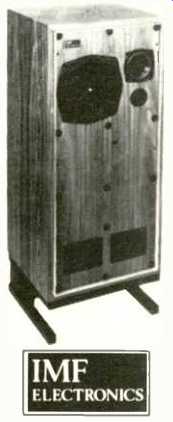
HAVE YOU CHECKED THE PRICE OF A GOOD SUB-WOOFER LATELY?
They certainly are not inexpensive.
To use sub-woofers optimally, a pair of them are necessary. Most loudspeakers on the market require sub-woofers for extended bass response.
This is not the case with IMF Electronics Studio Monitor loudspeakers. Their one-eighth wavelength tapered and heavily damped transmission line bass loading of the 8" polymer cone woofer provides low frequency response down to 23 Hz! With the inherently low distortion of transmission line bass, coupled with ultra-rigid construction, bass sounds are reproduced with exceptional clarity and control, free of overhang and resonant colourations.
The vital mid-range of the Studio Monitor is reproduced by our 4" engineered polymer cone driver, ferro fluid damped to provide higher power-handling and lower distortion. This driver is mounted in its own tapered and damped line whose non-parallel walls ensure freedom from standing waves. Our V." chemical cone tweeter is also ferro fluid damped, and affords extremely linear response from 3 kHz to 40 kHz. The design of the mid-range and tweeter drivers permits "in-line" close mounting for improved acoustical coupling. Exceptionally smooth, high definition sound, with precise stereo imaging and the stunning power and clarity of transmission-line bass characterizes the Studio Monitor loudspeakers.
Even the most severe critics of the CD digital discs concede that their bass response is phenomenally clean and extended.
The Studio Monitor has the "built-in" sub-woofer capability to effortlessly reproduce these low frequency sounds. The Studio Monitor loudspeakers are the least expensive and smallest embodiment of IMF Electronics transmission-line design.
For a dramatic and revealing experience, audition the Studio Monitor at selected dealers.
IMF ELECTRONICS, INC. 5226 State Street Saginaw, Michigan 48603 Tel (517) 790-2121 Telex 227461. IMF ELECTRONICS, LTD. Richardson Street, High Wycombe Buckinghamshire. England HP11 2SB. Tel (0494) 35576. Telex 83545
-------------------
Technics
From lasers that play digital records to computerized tape decks that make digital recordings, nobody delivers the startling realism of digital sound like Technics.
The challenge: to eliminate the audible differences between live music and its recorded counterpart.
The solution: Technics digital audio technology.
Technics digital technology is not a conventional (analog) process of music reproduction as in ordinary turntables and tape decks. Instead, music that is recorded in the digital process is electronically translated into a numerical (digital) code. So sound is not only immune to the scratching and physical damage that can affect conventional records and tapes. But also to distortion that can ruin music.
When you play back a digital disc or tape, the numerical code is translated back into music. And the sound is indistinguishable from the original.
With all of this digital technology Technics has emerged as the only manufacturer to bring you not one, but three digital components. For both tape and disc formats.
First there is the extraordinary Technics SL-P10 Compact Disc Player.
The SL-P10 uses a standard 4.7-inch grooveless, digitally encoded disc. This compact disc (CD) is not played in the conventional sense with a tracking stylus that can damage a record.
Instead it is scanned by a computerized laser system. There is no wear on the disc, and the music is reproduced with a purity that could only be digital.
And the SL-P10 can be programmed to find a specific cut, play a series of cuts in any order or play a cut repeatedly.
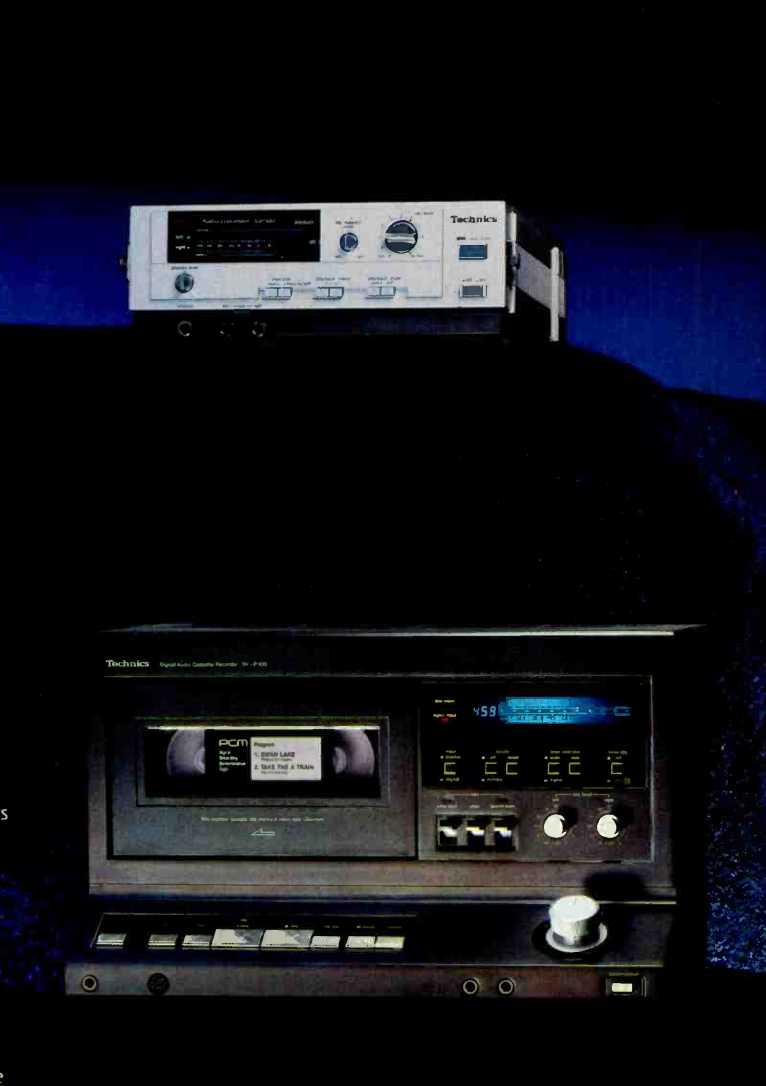
Then there is the Technics SV-P100. The world's first compact, fully self-contained digital cassette recorder. It is a computerized marvel that uses ordinary video cassettes to record, store and play back the astonishing realism of digitally encoded music.
If you already have a video cassette recorder, the ingenious Technics SV-100 Digital Audio Processor connects to your VCR. This endows it with the same kind of computerized digital capability as our digital cassette recorder.
And whatever the future of audio holds, digital and beyond, Technics is committed to leading you to it.
Technics -- The science, of sound
++++++
= = = =