Recently I was visiting a friend who is an avid photography buff, and he was proudly showing me a new telephoto lens for his 35mm SLR. The lens he was showing me was merely the 14th addition to his optical armamentarium, along with countless other photographic gizmos and doohickeys that he feels are a prerequisite for the compleat photographer. The fact that he is a lousy photographer, with virtually no sense of composition and perspective, is purely coincidental.
I was struck by the similarities between this camera buff, and many audiophiles who become so immersed in the "nuts and bolts" of audio technology that they lose sight of the original objectives for all their expenditure of time, energy, and money: To wit, to come as close as they can in creating an illusion of reality, a simulation of the concert hall listening experience which will enhance their appreciation and enjoyment of music. I will be the first to admit to the fascinations of audio equipment, to new ideas and techniques. Quite obviously, audio technology is a major concern in my monthly column. I readily agree there is nothing quite like the thrill of anticipation when you are hooking up a new phono cartridge, amplifier, or loudspeaker, anxious to hear if the device will transport you to some audio nirvana. While one can appreciate the complexities of the device and admire its construction and quality, the important thing is its application and contribution to the improvement of your sound. Technology should, indeed, be the handmaiden of music.
If the pursuit, or "hobby" if you will, of audio is mainly concerned with the reproduction of music, I have had the good fortune of being involved in the recording of music. Over the years, I have had the privilege of knowing and working with many famous music personalities and conductors. This association has led to some interesting situations, and life certainly hasn't been dull!
Composer Conducting
I do not have the presumption to state that I maintained a salon, nonetheless, I have entertained many people who have distinguished themselves in the arts and sciences. One of my recent guests was Morton Gould, the American composer and conductor. I had recorded his well-known American Salute with the Eastman-Rochester Symphonic Wind Ensemble, and he wanted to hear how it sounded. Morton, in his professional life, has heard his own and other's music through studio monitor set-ups many times. However, in my home he was exposed to an ultra high quality audio system for the first time. I played the master tape on the Ampex, and when he heard the pristinely clean woodwinds, the massive brass sonority, and the impact and weight of the percussion in this splendid orchestration, he was mightily impressed.
As is usual in these kinds of sessions, we talked about orchestras and conductors and music, and, of course, exchanged anecdotes and jokes about them. He liked one of my Sir Thomas Beecham jokes, which I'll pass on to you ... Not long after the War, 1949 I believe, Sir Thomas was on an American tour with his Royal Philharmonic Orchestra, and in addition to playing in such obvious cities as New York, Chicago, etc., they had been booked into Joplin, Missouri ... later distinguished as the home of baseball hero Mickey Mantle. This was a major social event, of course, and after the concert there was the usual reception in the Green Room (Don't ask me how it got started, but in every concert hall the world over, even if the reception room should be bright red or purple or whatever, it is always called the "Green Room.") One of the local matrons, "dressed to the nines," came up to Sir Thomas, bubbling with enthusiasm, and said, "Oh, Sir Thomas! How did you like our Joplin audience?" In his inimitable British accent he replied, "I don't know, Madam, my back was turned!" (My apologies to the good people of Joplin for this.) One of the things I was discussing with Morton was our forthcoming recording with the London Philharmonic Orchestra, with him conducting his famous Spirituals for Orchestra (which I had recorded for Everest 20 years ago with the LSO and Walter Susskind) and the first modern recording of his Stephen Foster Gallery.
During our conversation, I mentioned to Morton that one of my impending recording projects was to have Carlos Chavez conduct his audiophile favorite Toccata for Percussion and some other of his smaller scale works. Morton said that it just so happened that he was going to Mexico the following week to conduct some of his works with the Orquesta Nacional de Mexico. Sad to relate, during his engagement there, Carlos Chavez died at the age of 74. Morton told me that he had written an Elegy to conclude his score for the TV special, "The Holocaust," but it was never used.
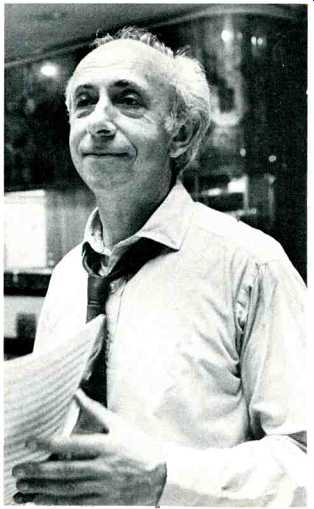
--- Morton Gould
When news of Carlos' death reached Morton in Mexico City, the next day at his concert he announced from the podium that he was dedicating a performance of this Elegy to Carlos Chavez. Carlos was a good friend of Morton Gould and Aaron Copland and a composer much admired and respected in the music world. I had the privilege of knowing him and recording him with the New York Philharmonic, playing his Sinfonia India, Sinfonia Antigona, and the world premiere recording of his Sinfonia Romantica. That recording took place during the summer in Manhattan Center, and with no air-conditioning the place was stifling. Carlos was a rather short, stocky man, and was obviously becoming very uncomfortable. Finally, he stopped the recording, stripped to the waist, and with his rather hirsute bull chest glistening with sweat, we continued! Recording Retiree
I visited London recently to make arrangements for the recording of the London Philharmonic I mentioned earlier, and I had quite a talk with the genial long-time manager of the LPO, Eric Bravington, who quite rightly, has been awarded the Order of the British Empire for his services to music in England. The LPO is a superb orchestra these days, as well they might be with Bernard Haitink as principal conductor and Sir Georg Solti as principal guest conductor. The venerable Sir Adrian Boult is President of the LPO. Now 89, Sir Adrian no longer conducts concerts but, like Stokowski in his later years, is still active in recording. In fact, I had wanted to record Sir Adrian doing Holst's The Planets, a work he virtually "owns," and was quite disappointed to learn that he had recorded it for EMI a few months ago. He has recently recorded the Beethoven "Pastorale'” Symphony, and it has fared very well in the hands of the critics. I vividly remember my last recording session with Sir Adrian and the London Philharmonic in 1959. We were going to do the world premiere recording of Ralph Vaughan Williams, Symphony #9, and the composer was to have attended the recording session. That morning Sir Adrian met me in the Green Room which was (and still is) used as a control room at the Walthamstow Town Hall recording locale. He said, "Oh, Mr. Whyte! As you know, Ralph Vaughan Williams was to have been on the recording session with us today, but he died four hours ago." The orchestra did not yet know about this, and if you should run across my Everest recording of this work, you'll actually hear Sir Adrian announcing this news to the orchestra, and saying . . . "and thanks to our American friends for making it possible to record this great work." While in London, I visited with conductor Walter Susskind in his dressing room at the Royal Albert Hall. He had just finished rehearsing the BBC Symphony Orchestra for one of the annual Sir Henry Woods "Prom" concerts.
Walter is a much underrated conductor who turned the St. Louis Symphony into a first-class ensemble in his seven years as conductor and music director there. He took over as conductor of the Cincinnati Symphony this year, after the tragic death of Thomas Schippers, and will preside over the podium there next year as well. About a year ago, the New York Times carried a most laudatory article about the talents of Walter Susskind and particularly cited him as "an orchestra-builder in the tradition of Stokowski." I am to record Walter with the LPO, just before the Morton Gould sessions. Walter offered me a lift back to my hotel, and as we walked out of the Royal Albert Hotel, the sidewalks around the circumference of the Hall were jammed with several hundred young people, who had been waiting since 8 am that morning (we left the Hall at 2 pm) for tickets to the 8 pm "Prom" concert. They take their classical music in England quite seriously! London Line-up The amount of recording done by the London orchestras is quite astonishing. All the "preferred" recording halls are very heavily booked. Walthamstow, where I have done considerable recording, was totally booked by RCA and Philips, through January, 1979. Watford Town Hall, which is still further out from the heart of London, was secured after considerable negotiation and finagling. Watford was much used by Bob Fine in his many Mercury recordings with the London Symphony. Watford and Walthamstow are, in essence, the equivalent of borough halls in New York City. They were never built for the purpose of recording, being general purpose halls used for various community functions.
Thus, in Watford and Walthamstow, there are dances, weddings, banquets, etc. The acoustical properties of these halls which make them so desirable for recording were discovered quite by accident around 1952. I visited Watford to check on all the various facilities and found the hall being set up for wrestling matches! With the control room up a flight of stairs, there is some back-breaking work ahead, as the Walter Susskind/Morton Gould sessions will be the first direct-to-disc recordings made "on location" in England, and getting those heavy cutting lathes up those stairs will be a Herculean task, to say nothing of the Ampex analog recorders, a digital recorder, input console, etc. Old friend Raymond Cooke, the head of the KEF speaker company, is to supply me with monitor speakers, just as he did 20 years ago when he was with Wharfedale. He'll have to wrestle his new Model 105 speakers up those stairs, as well as the special 400 watt per channel Quad amplifiers he is furnishing.
Well, there you have it ... I thought for a change you might like a little look "behind the scenes" at the world of music and recording.
=========
Video Scenes
You would have to be a hermit in the Himalayas not to know that the VCR ... the video cassette recorder... is an idea ... nay, a product ... whose time has come. VCRs have been proliferating at an astonishing rate, with something on the order of 34 distinct models now on the market.
The VHS format predominates over the Betamax format, but to be fair, it must be pointed out that many of the VHS VCRs are the offspring of a few key manufacturers, and these OEM units are basically the same model with some cosmetic differences to furnish some degree of brand identification for the various units.
Sony's Betamax was the pioneering system that created the market for the VCR. With the arrival of the competing VHS VCRs on the scene, the Betamax has undergone several revisions and updatings. The new Sony SL8600 Betamax is the third generation of their VCR, and I have had the pleasure of using one of them for the past few months.
The Sony SL8600 is a considerable refinement over the early Betamax models. Gone is the clumsy "add-on" program timer, which was an extra cost option. Now there is a standard integral, electronic, digital read-out timer, with a 12-hour clock cycle synchronized with the power frequency.
The SL8600 is mounted on an attractive case, finished in shades of brown, which measures 18 3/8 X 7 3/4 x 16 1/8 inches and weighs in toto a substantial 38 pounds. Operating controls on the SL8600 are of the mechanical "piano key" type, and reading from left to right there is the Eject button, which when depressed causes the entire cassette compartment to rise out of the center of the machine. After a standard Betamax format half-inch videocassette is inserted into the compartment, the assembly is manually pushed back into the recorder, and with a whir and a click, the videocassette is automatically threaded into the tape path. Next button is for Rewind, then Stop, Play, Record, and Pause, whose functions are self-evident. However, it should be noted that unlike many VCR units, wherein the record mode is entered by simultaneously depressing a Play and Record button, on this unit the one Record button does it all. Other controls on the SL8600 include separate VHF and UHF tuner channel selectors, with the VHF tuner covering the usual channels, 2-13 and the UHF channels, 1483. The VHF output signal can be either channel 3 or 4, whichever affords the best quality. There is a tape counter and a Memory switch which functions in the same manner as those on an audio cassette recorder. A program selector switch is provided to activate either the TV set or the VCR. There is a VHF fine-tuning control and an AFT (automatic fine tuning) switch to be used in conjunction with it. On a selected channel, the AFT switch is defeated, and the fine-tuning knob is depressed and rotated either clockwise or counter-clockwise until the sharpest picture is obtained. Then the AFT is engaged to "lock" in the fine tuning. It is easy to use and quite effective. A tracking control on the front panel has a center detent position, which is normal for videocassettes recorded on the machine. If, when playing back tapes from other Betamax units or for prerecorded videocassettes, "snow" appears on the TV screen, adjustment of the tracking control usually corrects this condition.
Of course, the tracking control is returned to the detent position when normal playback is resumed.
A remote control Pause function is provided on the SL8600, and the handheld control that plugs into the unit is very handy for deleting "unwanted program" in the polite language of copywriters, but otherwise known as "commercials." The electronic timer, with its luminous red digital read-out, is on the front panel so that the TV viewer can use it as a normal clock. In fact, the dust cover of the unit has a cut-out for the timer, so that the clock is not obscured. Nice touch! The timer has easy-to-set controls so that unattended recording is a simple matter.
The rear panel of the SL8600 has input jacks to accept VHF and UHF antenna inputs, via 75-ohm coaxial cable or 300-ohm twin-lead with appropriate adaptors supplied. There are VHF outputs to connect with the standard antenna input on TV sets. There are also audio input and output jacks for external audio sources. Input and output jacks are provided for video cameras, [...]
(Source: Audio magazine, Dec. 1978; Bert Whyte)
==========
Vintage magazine ADs:
A new Space Program by Sansui.
Designed to send every audiophile into orbit.
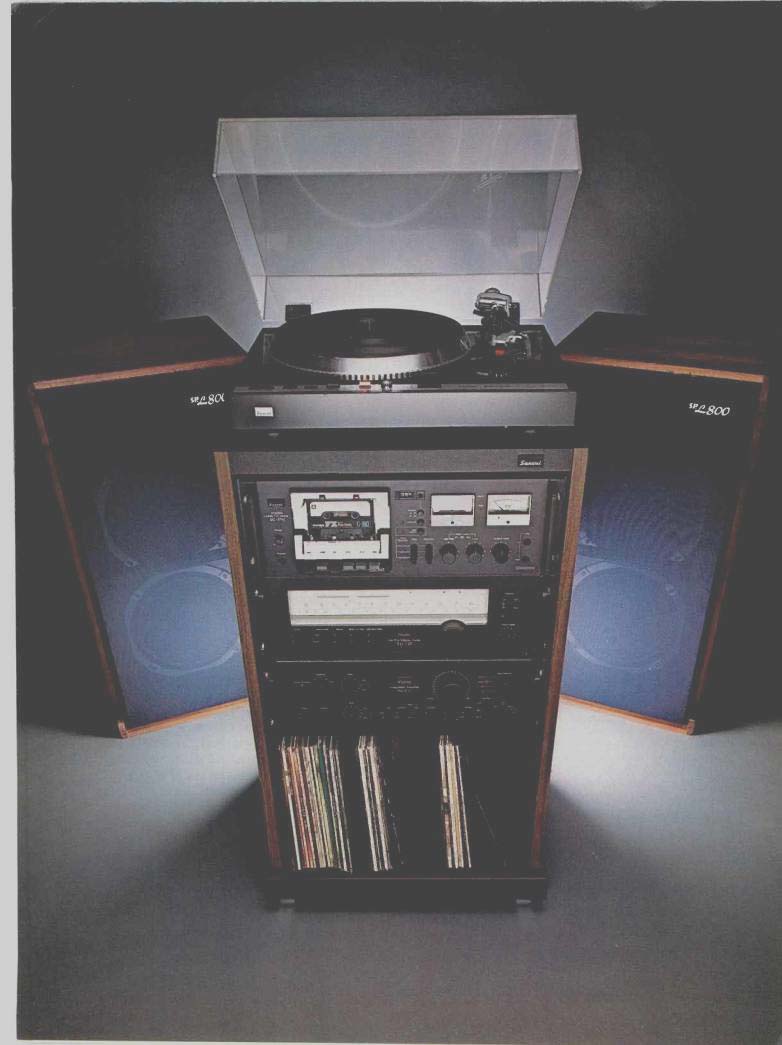
Sansui has conquered space --the space in your listening room. Our engineers have created a rack to hold all your high fidelity components in one place so they're easily accessible and easy to operate. And the Sansui GX-5 rack is so elegant you will be proud to display it in your home.
The Sansui GX-5 rack is about the only EIA 19" standard-width rack available with casters for moving your sound system easily from room to room. It is 37-1/2 inches tall and can hold every rack-mountable component. You can also adjust the height of each unit to meet your needs.
We have filled the rack with our choice of outstanding Sansui components. And there's still plenty of room for your records. Listen to them on the Sansui SR-838 Quartz-Servo direct-drive turntable, about the most elegant and stable precision turntable in the world. Even when set on top of so much power, the SR-838 will perform free from all noise and feedback.
When your mood changes, listen to your favorite FM station on the Sansui TU-717 tuner. Reception, even of the weakest stations, is outstanding, with selectivity so high there is never a problem with adjacent channel programming.
And, of course, if you want to preserve these treasured sounds for years --as clean and pure as they were the very first time you heard them --it's all possible with the SC-3110 cassette deck, our rack-mountable version of the SC-3100, already well-known for its superior performance and ultra-convenience including Sansui exclusive Direct-O-Matic loading.
To match these outstanding components, Sansui offers you the AU-717 amplifier with the widest frequency response (from main-in) of any available DC integrated amplifier at any price. With astonishingly low distortion and noise, and wide overall frequency response, the signal is an ultra-faithful replica of the original. The AU-717 delivers the brilliance and all the nuance that makes music so important in your life.
Listen through a pair of SP-L800 (or SP-L900 or 700) dual-woofer speaker systems? They have been designed to give you the full enjoyment of the clean and pure sound that our advanced technology components provide.
Of course, you can select other components to meet your own listening needs. You may want slightly less power; so we offer you the AU-517 DC integrated amplifier, created with the very same expertise as its bigger brother, the AU-717. If you wish to spend a little less on your cassette, you can choose the SC-1110.
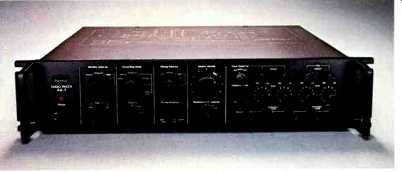
And for you recordists and musicians we have something almost out of this world. The AX-7 mixer/ reverb unit is about the finest home recording console that you can find at such a reasonable price. Versatility is the key, with up to 6 inputs for microphones, line level, electrical instruments, discs, broadcasts or tapes. You get pan-pots and 20dB input level attenuators on the 4 main inputs.
Reverb is included, as well as circuits for 4-channel, equalization and noise reduction. Record the sounds you create on up to 3 tape decks.
We're sure you'll want to visit your local franchised Sansui dealer for a complete demonstration of Sansui's new Space Program. Just think about it.
It will send you into orbit.
Walnut veneer finish
SANSUI ELECTRONICS CORP. Woodside, New York 11377; Gardena, California 90247
SANSUI ELECTRIC CO., LTD., Tokyo, Japan SANSUI AUDIO EUROPE S.A., Antwerp, Belgium
----------
Revox
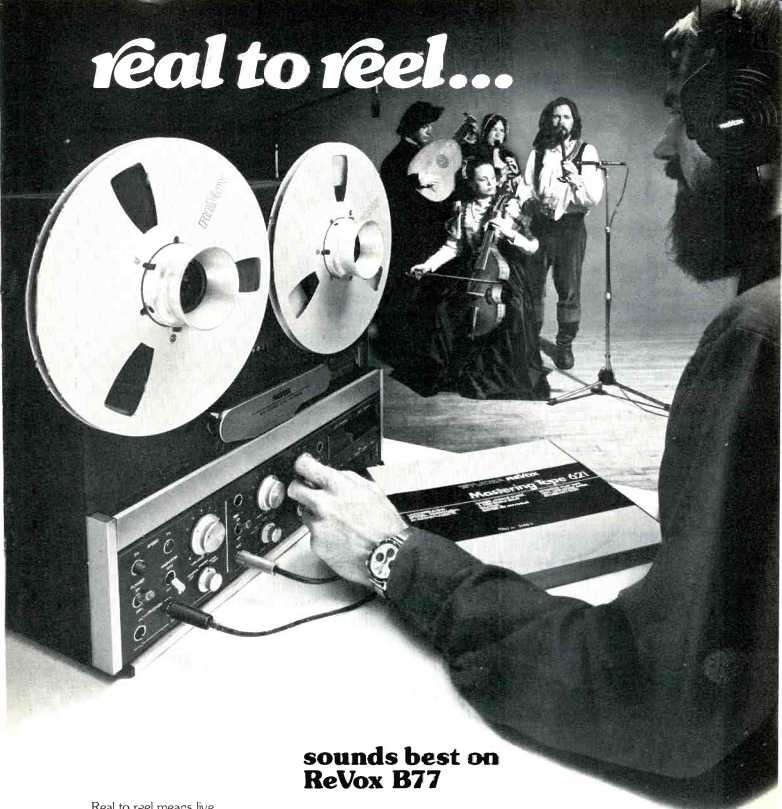
--- sounds best on ReVox B77
Real to reel means live performance recording, and that's where the ReVox 877 dramatically demonstrates its superiority over other tape recorders. Only the B77 has the wide dynamic range and generous record headroom you need to capture without compromise the full detail and dimension of live music.
Only the B77 delivers the "ruler flat" frequency response you get from Willi Studer's legendary head design. Only the B77 combines the convenience of push-button digital logic control of tape motion, professional VU meters with built-in peak level indicators, and a self-contained tape cutter/splicer.
If you're thinking of upgrading your real to reel performance, try the ReVox B77. It's available in half or quarter track, 3 ¾ - 7 1/2 or 7 ½ - 15 IPS. For complete information and list of demonstrating dealers, circle reader service number or contact us at the address shown below.
Studer Revox America. Inc., 1819 Broadway, Nashville. Tennessee 37203 / (615) 329-9576
-------------------
AIWA
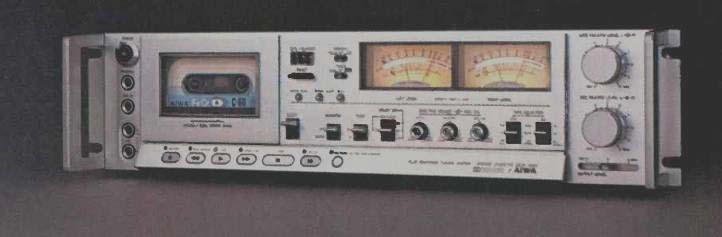
the unreel deck
The AIWA AD-6900U. Super specs and sound quality we defy any reel-to-reel to beat. Plus a lot of extras.
For openers, the AD --6900U delivers a frequency response of 20 to 20,000 Hz and an S/N Ratio of 68 dB using FeCr tape with Dolby* on. And only 0.04% WOW and FLUTTER (WRMS).
Great numbers, but there's more.
The exclusive AIWA Flat Response Tuning System (FRTS) gets sensational sound out of any kind of tape on the market.
With just the push of a button, FRTS will use its own circuitry to measure the precise bias level of any kind of tape and adjust for the flattest possible response. And with the built-in 400 Hz and 8 kHz oscillators, the AD-6900U offers the most precise test recording possible, so you know exactly what to expect before you record. Coupled with AIWA's exclusive combination 3-head V-cut design, you can expect absolute optimum results in recording, playback and test.
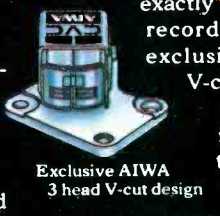
---Exclusive AIWA 3 head V-cut design
The AD-6900U features Full Logic operation and exclusive Double Needle Meters.
Full logic feather-touch push button controls and dual motor operation make the going easy, and the feather-touch operation with Cue and Review can't be found on any other cassette deck. And no other reel-to-reel or cassette deck offers Double Needle Meters that combine both VU and Peak functions on each meter.
AIWA
Plus a full array of extras, including AIWA's exclusive SYNC HRO-RECORD.
When you use the AD-6900U with AIWA's AP-2200 turntable, Synchro-Record activates recording automatically when the record is cued, and stops when the tone arm lifts. Mic/line mixing, oil-damped cassette ejection, Double-Dolby Noise Reduction with fully adjustable calibration, optional RC-10 remote control, low profile design and your choice of rich wood side panels or tough rack-mount handles make this deck an unparalleled value.
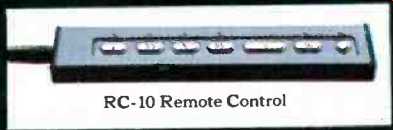
----RC-10 Remote Control
The AD-6900U is the absolute deck. When you hear it, when you use it, you'll agree it's UNREEL.
AIWA Distributed in the U.S. by: AIWA AMERICA INC., 35 Oxford Drive, Moonachie, New Jersey 07074
Dolby is a trademark of Dolby Laboratories, Inc.
--------------------
Kenwood
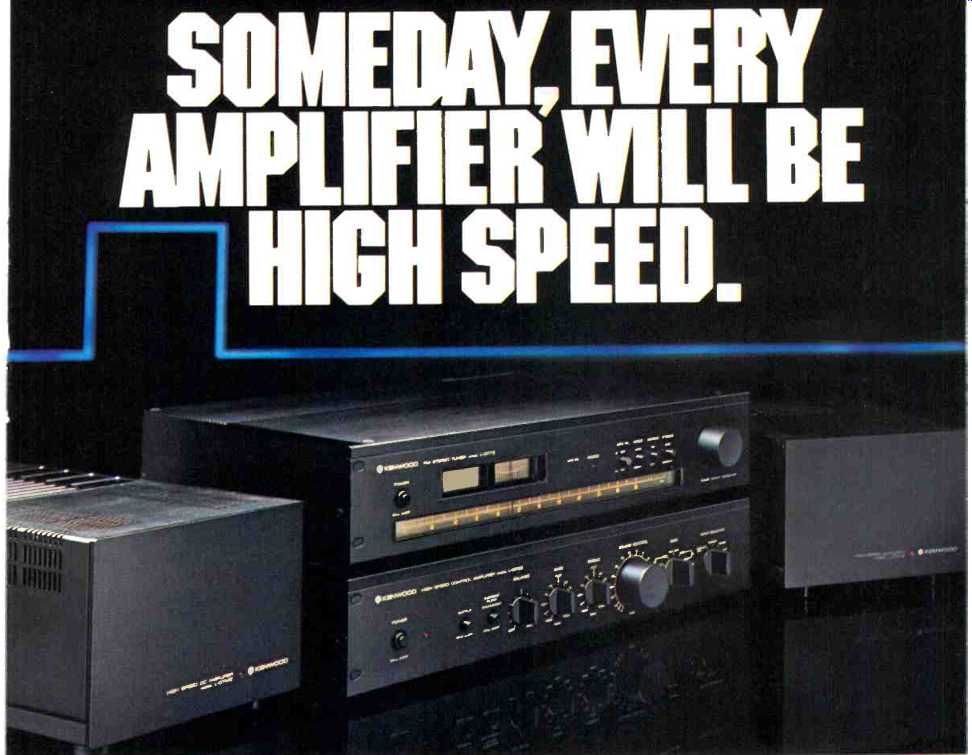
SOMEDAY, EVERY AMPLIFIER WILL BE HIGH SPEED.
From the people who brought you dual power supplies and DC amplification comes high fidelity's most significant breakthrough in years.
The High Speed Transistor from Kenwood. An improvement so important that it will actually change the way you evaluate amplifiers. An improvement that will be part of every amplifier that claims to be state of the art.
Today, only Kenwood has it. Because Kenwood developed it.
Our engineers discovered that even with exceedingly low harmonic distortion, amplifiers typically lack the ability to react quickly enough to an input signal, particularly at the mid and upper frequencies. This is called transient intermodulation distortion (TIM). The result can be seen on an oscilloscope as a square wave that's distorted. And heard as poor spatial imaging and loss of detail. While some manufacturers have dealt with a square wave's rise time, only Kenwood High Speed Transistors produce high frequency square waves that decay as fast as they rise.
That's because Kenwood High Speed Transistors allow a much faster change in voltage (slew rate) than ever before. So no matter what the music demands, the amplifier can match it exactly.
What this means to you is depth and definition that will take your breath away. High frequencies are completely clear and totally non-fatiguing. You'll hear each violin individually in a string section. Each audible harmonic of a single piano note. Even the separate handclaps in recorded applause.
High Speed Transistors are used for the first time in our Audio Purist Group, shown above. Because it takes a very sophisticated and demanding listener to appreciate this new technology.
We're convinced that in a world of compromise, some people still demand the very latest state of the art. Building high fidelity equipment for them will always be our commitment. For more information and complete technical specifications, please write us.
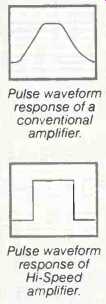
--------Pulse waveform response of a conventional amplifier.
Pulse waveform response of Hi-Speed amplifier.
HI-SPEED
Hear the future of high fidelity.
KENWOOD. Kenwood, P.O. Box 6213, Carson, CA 90749.
----------------
Shure
fact: a stylus tip does not a cartridge make.
... so why all the fuss?
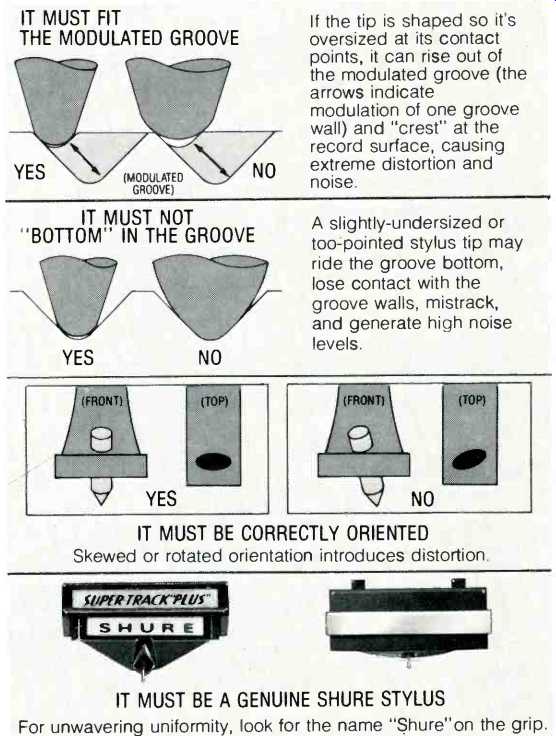
The stylus tip is only part of the complex stylus and cartridge structure, and performs a single function --it positions the entire stylus assembly so that all groove undulations are traced without damaging the record. The production of a top-quality tip calls for exquisite micro-craftsmanship, precision polishing, unwavering uniformity, and exact orientation. (However, important as it is, an exotic diamond stylus tip configuration simply isn't a cure-all for what might ail an otherwise deficient cartridge, regardless of high-flying claims you may have heard or read.)
Here are the basic criteria a top-quality stylus tip must meet:
------If the tip is shaped so it's oversized at its contact points, it can rise out of the modulated groove (the arrows indicate modulation of one groove wall) and "crest" at the record surface, causing extreme distortion and noise.
----A slightly-undersized or too-pointed stylus tip may ride the groove bottom, lose contact with the groove walls, mistrack, and generate high noise levels.
IT MUST BE CORRECTLY ORIENTED Skewed or rotated orientation introduces distortion.
IT MUST BE A GENUINE SHURE STYLUS
For unwavering uniformity, look for the name "Shure" on the grip.
Please send for our "Scientific Study of Competitive Styli" booklet (AL548)
explaining the important specifications all Shure styli are required to meet.
High Fidelity Cartridges & Replacement Styli
Shure Brothers Inc., 222 Hartrey Avenue, Evanston, IL 60204, In Canada: A. C. Simmonds & Sons Limited.
SHURE: Manufacturers of high fidelity components, microphones, sound systems and related circuitry.
----------------
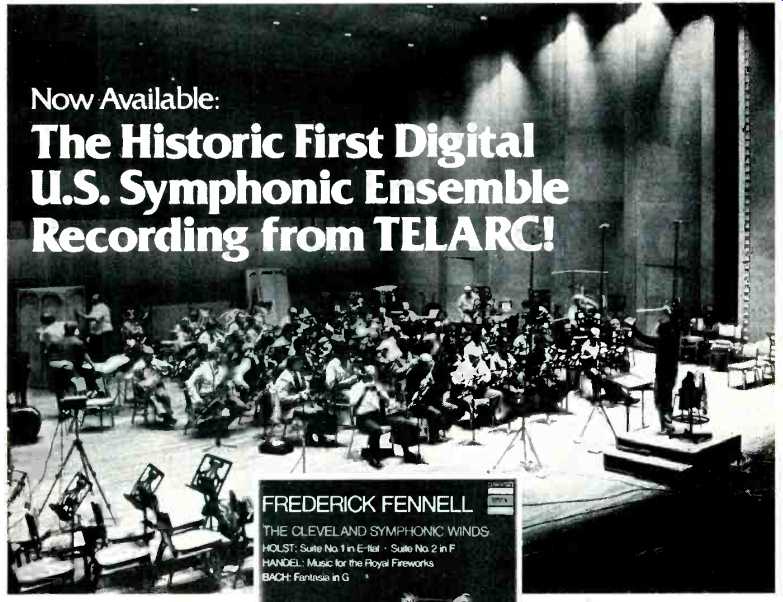
Now Available:
The Historic First Digital U.S. Symphonic Ensemble Recording from TELARC!
The place: Severance Hall in Cleveland, Ohio, highly respected for its superb acoustics. The date: April 4 and 5, 1978. Fifty nine musicians, including the entire reed, brass, and percussion sections of the Cleveland Orchestra, gathered to participate in a unique and significant first symphonic ensemble recording using a sophisticated new method of digital recording.
----Stereo No. 5038 214,95
The music, by Bach, Handel, and Holst, was symphonic band music at its most exciting. The Cleveland Symphonic Winds were conducted by the leading figure in wind music today, Fredrick Fennell. His early recordings on Mercury with the Eastman Symphonic Wind Ensemble helped launch the hi-fi era, and are still treasured by collectors. But the consummate artistry of the Cleveland Symphonic Winds under Fennel's direction must be heard to be believed.
It was the Soundstream digital recorder that gave special importance to this major musical event. Unlike ordinary tape recorders, binary numbers rather than the original electronic waveforms are used for signal storage. This process eliminates problems of noise and tape saturation and maximizes the potential for wide dynamic range, extended frequency response and low distortion.
No matter what type of system you own, this record will sound impressive, both sonically and musically.
The reaction by the musicians themselves, on hearing the playback, was best summed up by Fredrick Fennell (as quoted in High Fidelity): "I'm glad to have lived long enough to have recorded that kind of sound!"
A new and exciting era in digital recording is waiting for you today at your Audio-Technica dealer or wherever the finest records are sold.
StandarDisc
INTERNATIONAL REFERENCE SERIES--Superb technical quality is the hallmark of all StandarDisc recordings. including digital, direct-to-disc, and advanced analog techniques.
If not available locally, write for ordering information and current catalog.
AUDIO-TECHNICA U.S., INC., Dept. 128A, 33 Shlawassee Avenue, Fairlawn, Ohlo 44313
--------------------
Marantz
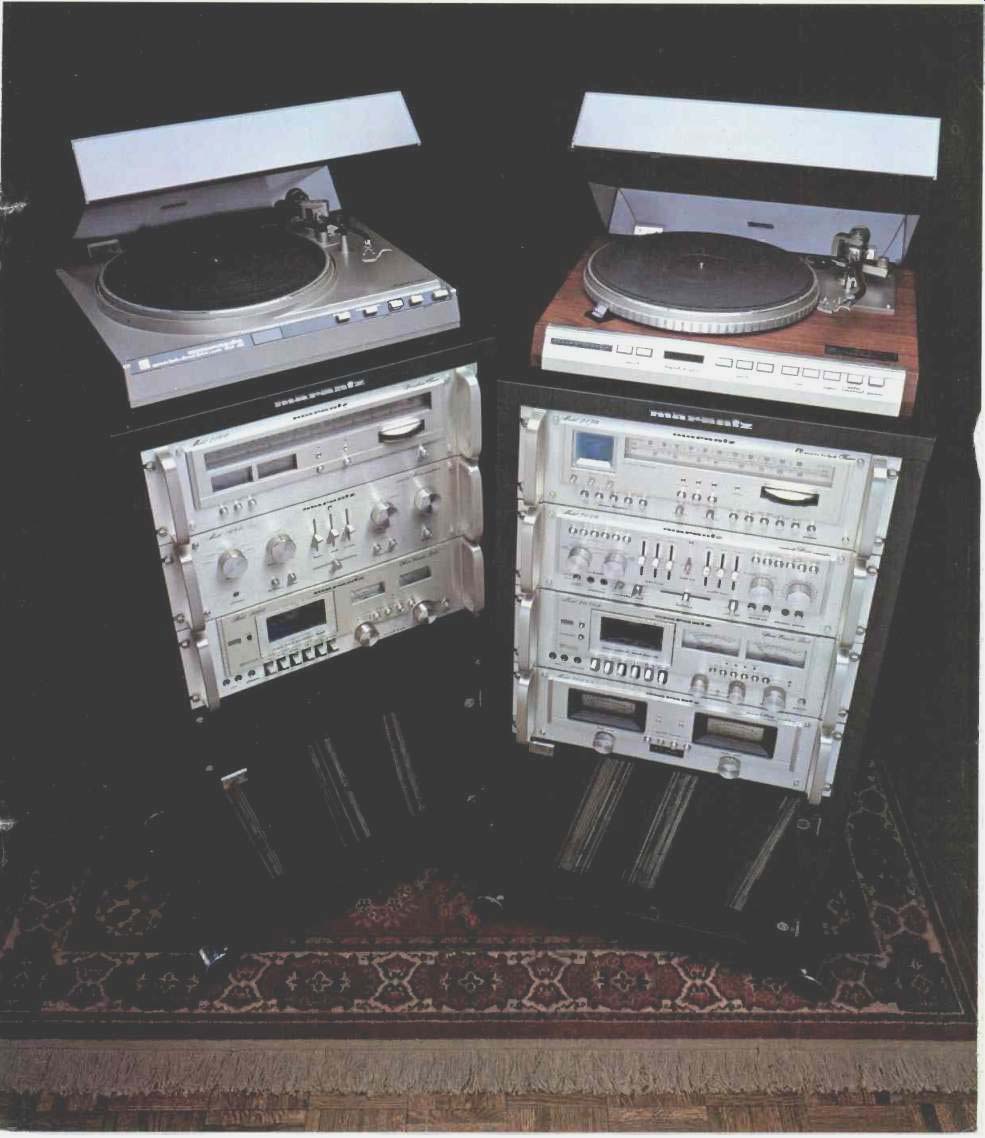
17 MARANTZ COMPONENTS. 225 MARANTZ SYSTEMS. WHATEVER THE MIX IT'S ALWAYS A MATCH--FROM $650 TO $2100.
Now there's a Marantz component system for everyone! From our most affordable to our finest--with 223 systems priced in between --Marantz delivers the same top Marantz quality and the same stunning Marantz look. There's never a compromise! And with so many systems to choose from, you'll be able to find the exact match for your listening requirements and budget.
A MARANTZ EXCLUSIVE: MIXED SYSTEMS THAT REALLY MATCH.
From the least expensive to the most expensive, all Marantz Pre-Amps, Power Amps, Console Amps, Tuners and Front-Load Cassette Decks feature the same front panel size, the same striking cosmetics, the same top quality design philosophy. So whatever component combination you choose, you'll have a perfect match. Only with Marantz.
-------The KM-3700 STACK RACK contains three Marantz components on fixed --positioned shelves, an accessory shelf and divided record compartment behind its full-length smoked-glass door: The Marantz system shown includes the 6170Q Turntable, 2110 Tuner, 1180DC Integrated Amplifier, 5010B Cassette Deck and Design Series 930 Speakers.
BRINGING IT ALL TOGETHER.
Once you have selected a system, only one question remains: Where do you put it? With a Marantz STACK RACK you can bring it all together --with style. The RM-3100 "Professional" STACK RACK (at right) will accommodate up to four Marantz components equipped with optional rack handle adaptors. Or you may prefer the RM-3700 "Decorator" STACK RACK (above) which encloses three Marantz components behind its full-length smoked glass door. A perfect fit in either rack, your entire system will be at your fingertips.
BUILD NOW. ADD LATER.
Once you see and hear what Marantz components have to offer by way of more performance per dollar, striking appearance and unheard of flexibility, you'll be sold. You'll have a perfectly matched system tailored to your specific needs from as little as $650* to $2100'.' And don't hesitate when you want to upgrade any part of your system. Any Marantz component you upgrade to will match what you already have.
MIX AND MATCH BY MARANTZ-IT'S ALL FOR YOU.
17 separate components from Marantz. Designed to mix and match into 225 different systems to give you unprecedented flexibility. Whoever you are, Marantz has the perfect system for you.

--------The three unit Marantz system shown, above left, includes the 2100 Tuner, 1090 Integrated Amplifier and the 5000 Cassette Deck with 6270Q Turntable. The four unit Marantz system shown at above right includes the 2130 Tuner, 3650 Preamplifier, 5030B Cassette Deck and the 300DC Amplifier with a 6370Q Turntable.
= = = =