
by BERT WHYTE
Most people who assemble a stereo component system usually start out with a relatively modest outfit. With extensive listening, their critical faculties generally become more acute, and this usually leads to a continual upgrading of the quality of their systems. Some people, hopelessly smitten with the delights of high-quality sound, throw financial constraints to the wind and acquire a stereo system with a very high level of sophistication. Whatever the quality level of their sound systems, if these people regularly attend classical music concerts, they are familiar with the experience of listening to live music. Thus, it doesn't take them very long to recognize the inadequacies of their systems, no matter how good the system might be in comparison to the concert hall experience. They realize there are some vital elements missing in the sound of the music reproduced in their home listening environment. While we may be a long way off in developing the technology which will completely simulate the concert hall listening experience in the home, modest beginnings have been made in that direction. For some time now, we have known about a method of sound processing which provides us with a fairly significant quotient of that elusive concert-hall sound in the home listening situation. I refer, of course, to time-delay and ambience enhancement technology.
The time-delay devices currently on the market are either of the analog type using BBD (so-called "bucket brigade") chips or the delay line, or digital delay, systems. Both types of units usually feature variable delay times ranging from 10 to 100 milliseconds and a means of multiple recirculation of the delays to create reverberation. Both units also have advantages and disadvantages.
The main problem with most analog delay systems has been their poor signal to-noise ratio and the artificiality and spurious colorations of the synthesized reverberation. With one exception, the digital delay units have also had noise problems in the area of quantization noise, plus unnatural sounding reverberation. Nonetheless, a properly set up delay system can effect a dramatic increase in the perceived naturalness of the recorded sound.
Benchmark Acoustics of New York City has introduced its new Model ARU Ambience Access System. The invention of Francis Daniel, a bright young re cording engineer with a broad knowledge of acoustics, the ARU is particularly well engineered and one of the most effective devices of this type I have en countered. Daniel stresses the fact that his unit is an ambience recovery system that does not employ ambience "synthesizing" in any way. His system is based on the well-known fact that all recordings have "hidden ambience," out-of-phase signals of long and short delays of incredible complexity. How much of this ambience is in a given recording depends on the nature of the recording locale, the kind of microphone techniques employed, and the skill of the recording engineer in capturing the acoustic characteristics which enhance the realism of his recording. The ARU is comprised of two units. The main unit is a slim, attractively styled enclosure that has a mode switch, a rear balance control, a side balance control and a "null" control whose function I will explain shortly.
There is also a 10-segment LED display labeled "cross-correlation" which is a measure of the out-of-phase information.
The higher this display reads, the more ambient information is in the recording.
The remote control module is supplied with 25 feet of interconnecting cable, with longer lengths optionally available. It has a master level control, side and rear level controls, and a control labeled "Lo-Fill" which will also be explained.
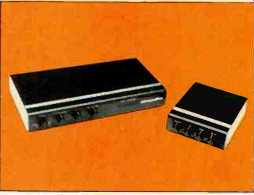
----- The Benchmark Acoustics Model ARU Ambience Access System.
The main unit of the Model ARU is preferably installed between a preamplifier and power amplifier or in a tape monitor loop, although this latter manner of use will degrade signal-to-noise ratio.
While there is no processing whatever of signals to the front speakers, purists will be glad to know that by means of a "Y" connector on the output of their preamplifier, they can avoid interposing the unit between their preamplifier and power amplifier. However, in so doing this, the master level control on the remote module will lose part of its function. As with most time-delay and ambience systems, the ARU delivers its signals to a second stereo amplifier and speakers located to the rear of the listener. For optimum performance, the ARU goes a step further by enabling the use of a third stereo amplifier and a pair of side-mounted speakers. This unit is an analog ambience recovery system, and Daniel uses the latest Matsushita (Panasonic) BBD chip for his delay augmented by a clever compansion and pre- and de-emphasis circuit which affords a signal-to noise ratio, in both the rear and side channels, of almost 80 dB. This is considerably quieter than previous BBD de signs of this type. Operationally, the ARU feeds the ambient information to the rear channels out of phase, and it is delayed by 30 mS; this assures maximum noncoherent signals in the rear channels. The "Lo-Fill" control now comes into play, extracting mono information below 60 Hz, and this is also fed to the rear speakers after the same time delay as the out-of-phase information.
The combined effects of the time and spatial dispersion of the very low frequencies is subjectively perceived as a large increase of bass. The side channels are fed differently. They receive the left and right channels of the stereo signal, then delayed by 30 mS, thus enabling the ear to largely ignore the direct sound and instead detect the original ambience in the source. It goes without saying that the rear and the side power amplifiers and speakers can be very modest in power and size and that quite a number of possible layout configurations can achieve good results in a variety of listening rooms.
The "Null" control is used to obtain a minimum volume of sound in the rear speakers. This adjusts the cross-correlation circuits for maximum extraction of ambience from the source recordings. In use, the rear speakers are adjusted first for L/R balance and level in relation to the sound levels of the front channels, and then the level of the side channels is blended into the sound field. A certain amount of interplay between the speakers takes place, and one rapidly be comes proficient in achieving satisfactory balances; this adjustment is made all the easier with the remote control. The increase in the realism of the music using just the rear channels is very convincing. Given a recording made in a fine concert hall with simple microphone techniques (like a Blumlein coincident pair), the recreation of the large acoustic space of the hall through the six-speaker array and the subsequent increase in realism is quite simply breathtaking.
Benchmark's ARU Ambience Access System is priced at $829, and the company is located at 201 West 89th St., New York, N.Y. 10024.
Monster Cable, well-known for their highly regarded heavy-duty speaker wire, has branched out with a whole line of new cables and interconnect hard ware and other audio accessories.
These interesting and practical new audio connectors are called Powerloks, and essentially they are heavy, machined (rather than stamped) banana plugs of the single-terminal variety.
These gold-plated units have an expandable-collet locking system. When the plug is inserted into the female receptacle, a turn of the knurled grip on the top of the plug expands the spring fingers of the plug and internally locks it in place. A locking device on the top of the plug accepts large gold-plated spade lugs which can handle wire as large in diameter as the firm's Monster cable. No price has been announced as yet. Less elaborate, but nonetheless useful, is the Super Monster Tip. Again, this is a single banana plug, gold-plated, with heavy spring fingers. Large diameter wire can be attached by a special crimping tool, available at Monster Cable dealers, who will also cut Monster cable to any length and install these tips, plus special grips and strain reliefs.
IMF Electronics Inc. of England, a speaker manufacturer heavily involved with "Ambisonic" surround sound re cording, has evidently decided to meet the dynamic challenges of the digital era with the introduction of their Special Applications Control Monitor speaker. This does not replace their well-known Reference Monitor Four speaker, though it is akin to it but has heavier duty drive units.
The midrange and tweeter are separately mounted on top of the main speaker enclosure and are phase aligned. During a demonstration, they certainly had a big sound output while sounding extremely linear. The company is continuing ambisonic experiments, and I have been promised a recording of the Royal Wed ding made with the Calrec Soundfield mike. I actually spotted one in St. Paul's during the video broadcast of the wedding!
-----------
(Adapted from: Audio magazine, 1981; Bert Whyte )
= = = =