Amp Updates
The Double Barreled Amplifier project which I presented in Audio's April and May 1980 issues can be updated by in stalling a 10-ohm 1/2-watt resistor in series with the base lead of each of the eight output transistors Q20-Q27. These resistors should be mounted on the transistor sockets and completely covered with heat-shrink tubing to provide electrical insulation and mechanical strength against lead breakage due to possible flexing of the resistor leads.
These resistors will damp out possible parasitic oscillations caused by the inductance of the connecting wires. In addition, resistors R1, R58, and R59 should have a 0.1-uF polyester capacitor soldered in parallel with each. These improve the chassis grounding at high frequencies.
-W. Marshall Leach, Jr. Atlanta, Georgia
Elcasets Live!
Dear Editor:
You are my last hope in finding out more information about the five-year-old Elcaset format. I still have all of the articles you published on the format.
My persistence in supporting the Elcaset has paid off very well since I have picked up numerous machines for under $100.00 brand-new and tapes for $4.00. And the stereo salesmen have been very happy to unload them.
The problem now is in finding tapes.
I've bought out just about everybody. Do you know of any dealers? You could help about 10 of us--yes, there is an Elcaset Club of America! Sony had promised to keep them available eight more years.
Our other question regards the "control tracks." Is there any way to change the heads and/or the electronics on present machines? We haven't been able to get any information from the companies on this.
Greg McIntyre Box 34082 Atlanta, Ga. 30332
Editor's Note: We asked our contact at Sony about the situation, and he replied:
To begin with, we at Sony appreciate this long-term support of our products, especially in regards to the formation of an Elcaset Club of America. As you well kn6w, there are still many hundreds of Elcaset recorders still in use throughout the country.
Regrettably, there is no factory-authorized procedure that has been re leased to the field covering the installation of "control tracks." Any modification to the head block assembly or electronics of a Sony Elcaset machine would have to come from an outside specialist, perhaps someone working in the computer hardware field.
I am happy to inform you, however, that you and other Elcaset owners can now purchase blank cassettes directly from Sony. Just send a check or money order (sorry, no cash accepted), to: Sony Corp. of America, Tape Div., Consumer Relations, 9 West 57th St., New York, N.Y. 10019.
The prices are as follows: LC-60 SLH, $8.00; LC-90 SLH, $10.60; LC-60 FeCr, $10.60, and LC-90 FeCr, $12.80.
Marc Finer, National Training Manager Sony Corp. of America New York, N.Y.
Taping Tip
Dear Editor:
In the October 1981 issue of Audio, the "Tape Guide" column offers a few tips for recording 78-rpm discs. I think one important one was left out: Make certain that the signal is mixed down to monaural BEFORE the recorder. This cancels out all of the out-of-phase noise, and there certainly is a lot of it on 78s.
(Must be the shellac!) It will most likely require a couple of "Y" connector patch cords to do this because the stereo mono switch is after the tape-out jacks ordinarily.
Once the out-of-phase signal is removed, you will be quite surprised how quiet 78s actually are. I also strongly recommend a stylus specially designed to play 78s.
Mike Miller, Bethel, Conn.
Angles on SLTs
Dear Editor:
I really enjoyed Gary Stock's article on linear tracking turntables in the June 1981 issue of Audio. As a former owner of a Rabco SL-8, I have followed the development of later models of SLTs with extreme interest. It has been gratifying to see the SLT concept evolve into the sophisticated models available today.
Mr. Stock's observations on the angular deviation of SLTs was certainly a pertinent issue. Another SLT design concept, which would be difficult/to implement, is the reduction of the vibration resulting from the movement of the servo driven arm base to keep the arm tangential to the groove. In the old Rabco design, some vibration or rumble was caused by the arm assembly rolling across the "rails." Some of the new de signs use essentially the same type of guides, and they could suffer the same degradation of sound. Lamentably, your review of the Mitsubishi LT-30 did not examine this potential problem area.
Perhaps conventional rumble tests aren't well suited to detecting this phenomenon, which is intermittent.
Vade G. Forrester, Jr., San Antonio, Texas
George Tillett, who reviewed the Mitsubishi, replies:
Mr. Forrester's letter brings up some interesting points on SLT design, but as far as the Mitsubishi arm is concerned, the angular deviation is quite small, with the maximum tracking error being less than one degree. (The 1.76 degrees referred to applies to a 10-inch arm.) The rumble test is usually made over a total period of several minutes, and it would certainly include rumble and other deviations caused by irregular arm movement.
Pole Desires Pen-pals
Dear Editor:
My name is Waldemar Nowacki. I am 25 years old, have finished studying, and live in the city of Lodz, Poland. I would like to get acquainted with your country and somebody who has interests like mine.
I am interested in sports and games and music, especially electronic music.
Of course I am interested in hi-fi, but I am most interested in electro-acoustics and measuring apparatus. I make a low frequency amplifier amateurishly. I wish to exchange observations and experiments in this subject.
I apologize to you for mistakes in my letter because I am learning to write English and I'd like to try my hand at it.
-Waldemar Nowacki, 9 Janiny Street 93-563 Lodz Poland
===========
A Christmas gift of music, long ago.
by HANS FANTEL
[c. 1980 by The New York Times Company. Reprinted by permission.]
I cannot say how much of my life I spent listening to phonographs, but the most unforgettable of these many hours came on Christmas Eve some 41 years ago. I was then in my late teens and, being racially obnoxious to Hitler's government, I had become a fugitive and outlaw and had to be hidden In a re mote village in the Tatra Mountains I found shelter, for a fee, in the house of an elderly grain dealer. He loosely sup ported the local Resistance movement, but firmly hated Hitler. So he could be trusted.
In happier days he had sold his produce at the commodities exchange in Brno, gone to the opera there, and fallen under the spell of music. In consequence, he owned one of the few radios to be found at the time in the uplands of Slovakia, where even plumbing was rare and water had to be fetched from a pump. Since the village had no electricity, the radio ran on batteries and reception was erratic. But when the weather was right, my host told me, he used to be able to hear concerts from Prague, relayed by the transmitter at Kosice.
The radio was silent now. Batteries, along with almost anything else, were unavailable in wartime. Besides, the government frowned on private ownership of radios, preferring to entertain the populace with loudspeaker trucks parked in the village square, which blared out martial music interspersed with triumphant news of German victories from Norway to Greece. In fact as in its songs, the Third Reich proclaimed dominions over the earth.
But beyond earshot of the sound trucks, our village rested in stillness broken only by the occasional lowing of a cow. Yet, we knew the world was turbulent and terrible, that the stillness would end and we, too, would be engulfed in the nightmare.
It didn't matter about the batteries be cause my host was no longer in the mood for music. His business had collapsed when the Germans confiscated the crops and there was no grain to sell.
His wife was dead and his son, with a snug job in the Nazi-sponsored bureaucracy at Bratislava, had nothing to say to him. Much of the day he sat in an elaborately carved high-backed chair--a relic of bygone opulence--and stared at the wall. I kept out of his way and busied myself in the garden, pruning trees or--for some perverse pleasure--beheading snails, or worked my way systematically through an old German encyclopedia I found on his shelves. Europe raced in the maelstrom. History tumbled in its cataclysm. For us, the hours didn't move. Time had stopped.
The two of us lived in the house that way for several months. A peasant woman came to cook and clean. Her son was with the partisans, so she wouldn't be tray me either. She spoke no German, so I couldn't talk with her. And, of course, I could not go out. I had no legal existence and hence no right to live. To be seen was dangerous.
----My host asked me what I would like for Christmas. I said I would like to hear some music.----
In the silence and solitude of my days I developed the habit of trying to hear music inside my head. I tried to recon struct from memory the music I had so often heard at home when my father systematically acquainted me with his record collection. Those were the years when the mainstays of the repertoire were being recorded for the first time, the electric phonograph just having made it possible to capture music sound with tolerable verisimilitude. Each new rebase was an event in our lives. We waited eagerly for another Mozart symphony from Sir Thomas Beecham, for the next album in Weingartner's Beethoven cycle, and for Bruno Walter's Brahms. We discovered the existence of faraway places like Boston and Philadelphia through the recordings of Serge Koussevitsky and Leopold Stokowski and marveled at the magnificent performances of Toscanini in New York.
Those evenings with the phonograph, back home, had been my happiest times, sharing in concentrated attention the experience of music with my father, who soon afterward vanished forever in the Gestapo dragnet during the invasion of Austria.
Now, in the little Slovak village, I was trying to put together pieces of remembered music like a jigsaw puzzle. Often they didn't fit. Bits of Schubert's Trout would get right into the middle of a Rasumovsky quartet. And sometimes the music would simply break off. I couldn't re member the rest.
This frightened me and made me desperate. For, without realizing it at the time, I must have harbored the notion that if I could put all the music I had heard at home back together in my head, in one seam less continuity, my father would come back. I suppose that is why I felt that the whole world was going to come right, after all, when I discovered that I could--in my mind--get through the Meistersinger prelude all the way from be ginning to end.
It was easier in the summer when I could be in the garden. But the cold weather comes early in the mountains, and indoors it was harder to think of the tunes. It was as if the low ceilings and thick walls, the meager windows and prevalent gloom of the house had quenched the music of my imagination, and I knew it could be rekindled only by hearing real music once again. Without the music, I too began to despair--to lose the links between one day and the next. I no longer sensed the connection between where I was and the days with my father.
By November everything had grown dark. The mists rarely lifted. The towering bulk of the High Tatras kept the low sun out of our valley. You couldn't see inside the house by mid-afternoon. We had no petroleum for the lamps and in sufficient candles.
The approaching winter also darkened our lives in other ways. The Germans had taken the cows when they were driven back down from their mountain pastures after the first frost; so, there was even less to eat. More soldiers loitered about after Slovakia opened its roads to the German army, allowing ac cess to the oilfields in nearby Rumania.
Occasionally, we saw a black Mercedes carrying black-clad men with silver skulls on their caps--the SS. In a neighboring town, we were told, the Germans had taken away all members of the Resistance and their families. Their names, the peasant woman said, had been betrayed by someone under torture. The loudspeakers in the square told of Hitler's new friendship with Japan and boasted of the burning of London. The horror now spanned the globe, and our valley was a trap.
Later in the year, my host asked me what I would like for Christmas. I am not sure he liked me much, but he was a kind man. I said I would like to hear some music.
I said it almost without thinking, but my eyes shifted to the radio. Perhaps, without being aware of it, I hoped that my host's well-connected son might use his influence to get a set of batteries in Bratislava. But I certainly never would have suggested this. The old grain dealer just nodded.
We had no Christmas tree. On December 24, the peasant woman brought several boughs of fir and we lit some extra candles. I thought of midnight mass in the village church. The organ would be playing. I trembled at the imagined sound of the big bass pipes, the fullness of the great chords, and the miracle of melody rising from it all. But I could not go to church. It was too risky to be seen, especially now that there were so many more Germans in the district.
Still, I had my Christmas wish.
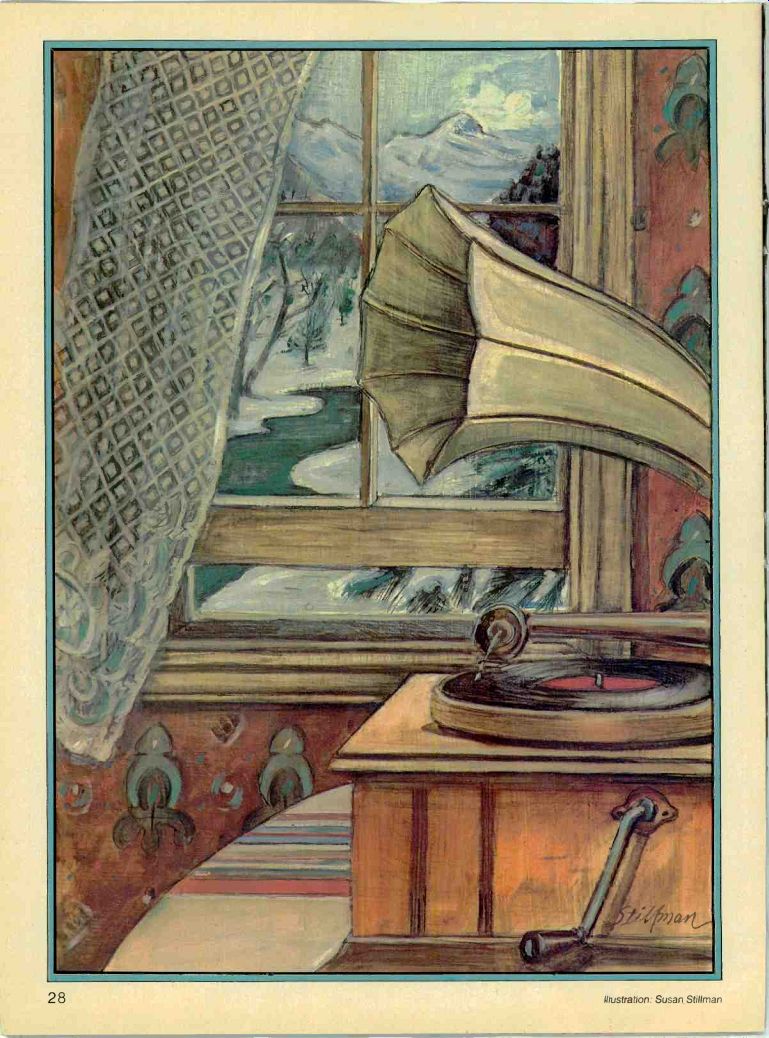
On the table in the dining room, on the thick ochre rug that usually covered it between meals, stood an ancient and rather ramshackle phono graph. But its brass horn was freshly polished and the tattered green felt covering the turntable was more or less sewn together. The old man had remembered the phonograph, fetched it from the rumpus room, and the peasant woman had helped him fix it up. It hadn't been used since they began broadcasting music from Kosice. The radio sounded better, he said. But he still had some re cords and even a box of needles.
So, on Christmas Eve, 1940, I listened to Fritz Kreisler play the Beethoven violin concerto with the orchestra of the Berlin State Opera conducted by Leo Blech. I have no recollection how it sounded. But I remember having to wind up the phonograph after each side--10 times in all. Curiously, this was no real interruption of the music. On the contrary, it was as if the music swelled to boundless force in those intervals. As I turned the crank, it set in motion engines of war all over the world that threw back and cut down the armies of the enemy.
=============
TDK
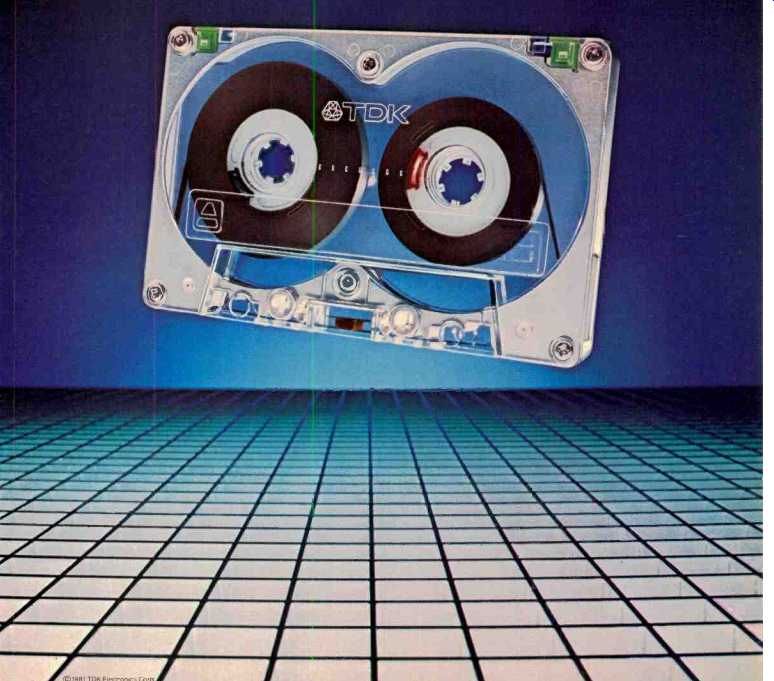

YOU'LL NEVER BUY OUR METAL FOR LOOKS ALONE.
That should come as no surprise. The quality of TDK metal is renowned. The classic MA-R created a new state-of-the-art concept in cassettes. But even as its design elements caught the imagination, its sound quality made a lasting impression. MA-R is meal tape with a higher energy. A dynamic range unheard of in most cassettes. On it, your music comes alive. The unique, die-cast metal frame and Reference Standard Mechanism is designed to eliminate warpage, reduce wow and flatter, and withstand environmental changes.
Maintaining performance at the highest levels possible. Ultimately, sound transcends good looks. The MA offers the same metal tape in a more economical cassette utilizing TDK's Laboratory Standard Mechanism. Thus making another case for quality. We feel that's characteristic of TDK.
And why price is rarely a consideration when you want to hear the best.
TDK--The Machine For Your Machine
=============
THE 80S ARE BRINGING US CLOSER TO THE SOURCE.
CAN YOUR SPEAKERS HANDLE THE POWER?
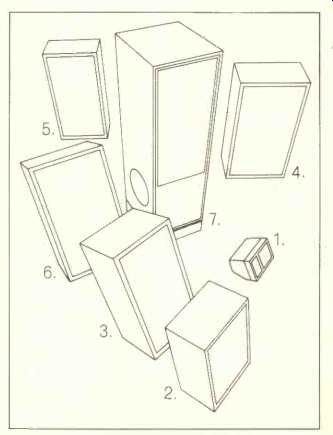
1. 81 MINI: 95Hz-20KHz; 15-70Watts.
2. A70: 58Hz-20KHz; 15-80Watts.
3. 100: 48Hz-20KHz; 15-90Watts.
4. A120: 38Hz-20KHz; 15-90Watts.
5. A140: 38Hz-20KHz; 20-100Watts.
6. A300: 40Hz-20KHz; 20-250Watts.
7. A500: 45Hz-20KHz; 20-250Watts.
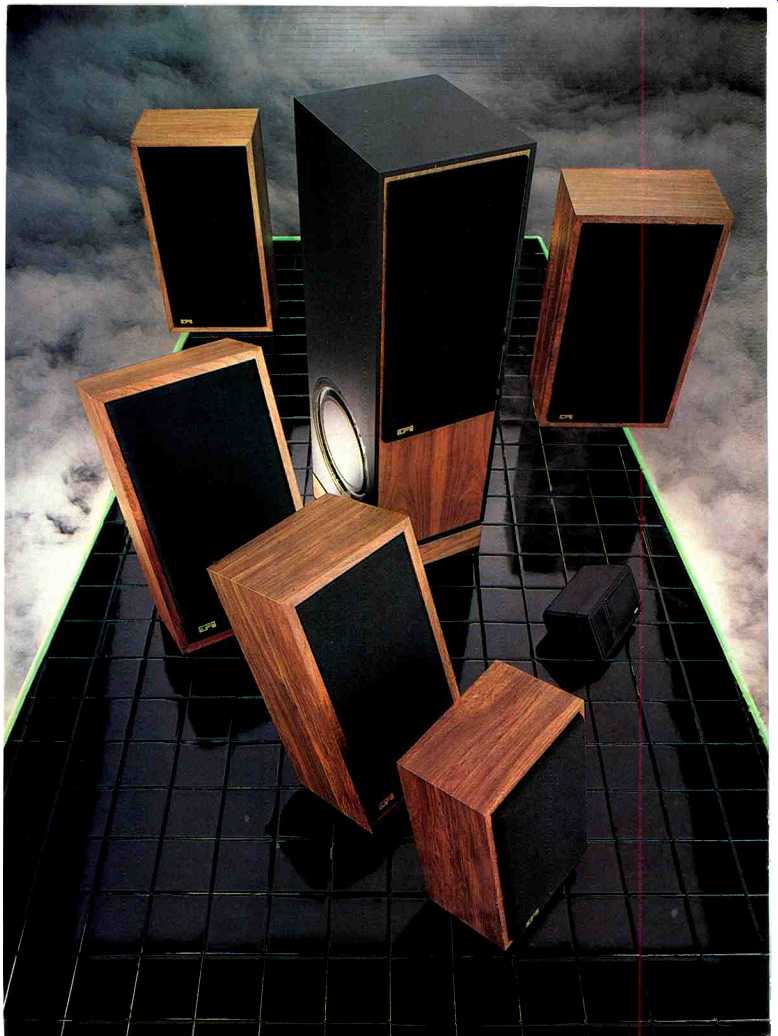
Advancements of different kinds are pushing the noise level down, and bringing us closer and closer to pure sound. This means you can play louder than ever before, if your speakers can take it. At EPI we believe the challenge of the '80s for loudspeaker manufacturers will be to prepare themselves for all that new power. Forgive us for sounding smug, but at EPI we've been busy making those preparations right along.
THE NEW WOOFER.
The new woofer in our advanced speakers can handle more dynamic range than any other woofer made. It uses a new voice coil, a new "Focused Field" magnetic structure, and a special suspension system for better control of the cone motion. It mixes extraordinary power handling capacity with extremely low distortion.
THE NEW F.S.T. "AIR SPRING" TWEETER.
The EPI "Air Spring" tweeter is already famous for its power handling abilities. It was the first tweeter to use Ferrofluid in the voice coil gap to dissipate heat and increase driver power capacity. Our new Full Spectrum Testing (F.S.T.) procedures assure that every EPI tweeter meets performance standards that go way beyond the ordinary industry standard.
THE IMPROVED MIDRANGE DRIVER.
Our 3-way systems have a driver that is fully sealed, or acoustically isolated, so there is no possibility of interaction with the woofer. The suspension system has been improved and it provides smoother response and lower distortion through the critical midrange.
BETTER GET READY, THE TRAIN'S A COMIN’
Yes, noise, and distortion, and artificial coloration are falling away. Purer, cleaner sound is coming down the track, louder and louder. It's coming to blast you away. Just be sure it doesn't blast your speakers away. Get EPI.
THE LINEAR SOUND OF EPICURE PRODUCTS, INCORPORATED NEWBURYPORT, MASS. 01950. A Penril Company
---------------------
Give Record Abrasion the Brush Off
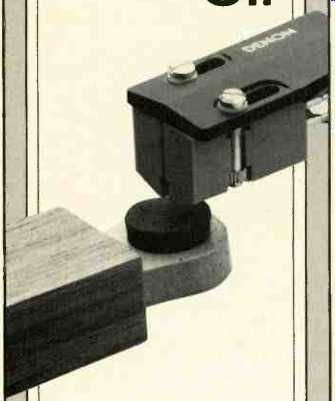
Brush away stylus contamination with the SC-2T. Stylus Care System. Two drops of SC-2 fluid on the special nylon fiber brush effectively loosens and wipes away harmful coatings.
Protect your stereo system and maintain its sound with the SC-2 Stylus Care System.
For a free copy of our "Guide to Record Care" write to Discwasher.
Discwasher

PRODUCTS TO CARE FOR YOUR MUSIC
1407 North Providence Road, Columbia, MO 65201, USA
Discwasher USA--A DIVISION OF JENSEN an ESMARK Company
=================
(adapted from Audio magazine, 1981)
= = = =