The Vanishing Monaural
I have noticed with great regret that the Schwann catalogue has discontinued listing monaural recordings over one year old as of their January issue. I am firmly convinced that this is a very un wise move on their part, and something they should seriously reconsider. As any classical collector knows, the record companies over the past number of years have embarked upon a major program of reissuing many releases-mostly monaural-that are of considerable musical value. As of January, the classical record-buying public will be made increasingly less aware of such records.
As their sales decline, the record organizations will have no alternative but to delete them.
In light of the state of classical music in this country, I wish to propose that Schwann reconsider its decision or at least carry the mono material in their supplementary catalogue.
Allen Mackler Wilmette, Ill.
William Schwann replies:
A revised announcement appeared on pages 189 and 193 of the December Schwan,' record catalog. It explains in greater detail that mono records are being removed from monthly Schwannsstarting with our January 1971 issue, but that most of these will appear in the spring supplementary Schwan,: catalogue (out this month). Any new motto reissues, such as the fine ones Mr. Muckier mentions, will be listed as issued in our monthly new listing section. The following month they will be transferred to a new mono section in the monthly Schwann where they will accumulate until the next supplement when they will be transferred to it.
There are several reasons for this change: 1) beginning with our February issue we rust find space for the important project of listing tapes; 2) very few dealers carry mono records nowadays with the exception of recent reissues even these are for a limited market: 3) there simply are too many records still on the market, both mono and stereo, to be listed. Schwann publications are not subsidized by any foundation nor by the record industry. Unlike the books-in-print publications, Schwann has never charged record manufacturers for their listings.
Printing and publication costs continue to rise along with the size of our monthly catalogue, so it seems necessary to put the less popular mono records into our semiannual supplement to make room for the increasingly popular 8-track cartridge and cassette tape listings.
Les Huguenots: Massacred Again Early in this century the Met gave a performance of Meyerbeer's Les Huguenots with such an auspicious cast that it went down in musical history as The Night of the Seven Stars. Now we have London's recording of the work, and what does it amount to? Answer: one star and six satellites.
Couldn't London, with its glamorous roster, have done better by Meyerbeer than Anastasios Vrenios? Good Lord, the young man ought to be singing Buxtehude at some mid-western university.
Instead he has been cast in one of the most heroic and taxing roles in operatic annals.
I will not go into the merits of the other pale planets that surround Joan Sutherland. None is as wan as Vrenios, to be sure. Tourangeau turns out to be a delightful discovery, and Arroyo is a serviceable though not exciting Valentine. But the opera demands excitement.
It demands temperament, fire, melodrama, and spectacular voices. London could have done infinitely better. Why not Marilyn Horne or Teresa Berganza or Janet Baker as Valentine? Why not Nicolai Gedda or Placido Domingo or Luciano Pavarotti as Raoul? And Nicolai Ghiaurov as Marcel? And Boris Christoff as St. Bris?
I suspect that some of these singers could have been obtained and that it was Richard Bonynge's decision to cast the recording in this wretched fashion.
Mr. Bonynge has made a practice of surrounding his wife with mediocrities, particularly on recordings, where his control is apparently quite powerful.
Why he has done so, I can't say. Sutherland need fear comparison with no singer alive, even if she does mumble her words.
Let me add that I am not totally un grateful to Bonynge. He has given us the score almost complete, something I had hardly dared hope for, especially after his recklessly hacked recording of Semiramide. And he conducts it well, beautifully in spots-though he might linger a little less over Meyerbeer's orchestral felicities.
Well, there it is. The fabled Les Huguenots recorded at last, recorded complete, but fatally flawed in its casting. It pains the heart to think what might have been.
David Johnson, New York, N.Y.
Funny Records Having always been a fan of Paul Wes ton and his wife (alias the Edwards), I was happy to read Gene Lees's column "The Funniest Put-On" in your November issue. I was surprised, though, that he did not mention one of the Edwards' most hilarious albums, "Sing Along with Jonathan and Darlene Edwards" (which is now deleted). It was issued at the height of the "Sing Along with Mitch" mania; and the sounds of a robust men's chorus, which perfectly apes Miller's sound, trying to keep up with the eccentricities of Jonathan's keyboard work and Darlene's lead vocalizing, produces some of the most sidesplitting moments on record.
As for Weston's more serious albums, " Crescent City" is indeed a classic piece of Americana and should be made avail able again. The same goes for his two albums of film music, "Sound Stage" and "Love Music from Hollywood." Though Columbia issued them as mood albums, they are collector's items for film-music buffs. The tracks are actually microcosms of the scores and use many of the film's secondary themes as op posed to simply pounding out the main title ad nauseam.
Ross Care, Lancaster, Pa.
I have just finished listening to a delightful record, which shall be placed next to the Spike Jones, P.D.Q. Bach, and Hoffnung Festival records in my collection. I am speaking, of course, of The Naked Carmen. I'm afraid that Conrad L. Osborne's generation gap was showing when he wrote his review of this recording [September 1970]. He actually thought that it was a serious piece of multimedia contemporary music.
Serious? Any recording that contains a kazoo solo, Mary Bruce and her Star buds, a tap dance, and instructions on how to make your "Naked Carmen Electric Spanish Cigar-Box Guitar, Light Show, and Sound Sculpture" cannot be serious. Mr. Osborne's damning remarks concerning record company executives are quite uncalled for.
Charles P. Repka, Huntsville, Ala.
Our own choice for the funniest record of the year is Carl Czerny's Variations on a Haydn Theme for Piano and Orchestra (Victrola VICS 1501) in which the old Romantic pedagogue goes to even more extravagant lengths than Doluuinyi in his Nursery Variations. Unlike the Hungarian composer, Czerny is serious in his introduction to and variations on Deutschland fiber alles.
The King and I My thanks to Peter G. Davis' informative article "The World's Most Complete Record Store" [September 1970].
First, the people at King Karol are prompt. Although more than 3,000 miles separate my home and King Karol, records are received within two weeks after mailing in the order. (There are two record clubs that require as much as six weeks for delivery.) Second, there are no hidden "small shipping-handling" charges. Third, King Karol's honesty is impressive: when I misestimated the price of a record and overpaid, they issued me a credit memo. And fourth, it is comforting to do business sans IBM computer cards, and a joy to receive their hand-scribbled statements.
But they are human. In three attempts I have been unable to get Andre Previn's reading of the Shostakovich Symphony No. 5.
Barton King, Citrus Heights, Calif.
Stainer and or Verdi The intramural exchange of correspondence between Peter G. Davis and David Hamilton ("Letters." November 1970] probably made an unfortunate impression on those of your readers who take music seriously.
Mr. Hamilton refers to Sir John Stainer's The Crucifixion as "oh-so-staid"-a smug remark and unworthy of a major critic. Not to be outdone in the Upmanship Department. Mr. Davis counters with "a bit obsolete"--a snide remark and unworthy of a major editor.
The Crucifixion, of course, is not and never was intended to be a musical selection. Stainer would be horrified to learn that it is performed in concerts, let alone recorded for critical listening by "name" artists. It is, as its subtitle clearly indicates ("A Meditation on the Sacred Passion of the Holy Redeemer"), a devotional exercise for pious congregations, a liturgical and ecclesiastical act.
It is not a cantata, pated in, not to be listened to; in this regard, it is closer to plainsong than are Messiah or Bach's Passions. The five congregational hymns attest to this.
Stainer made it clear that the music was kept deliberately simple so that the average parish organist could handle its accompaniment. It is diametrically op posed to such an exhibitionist tour de force as the Verdi Requiem. There you have a really "obsolete" piece-showy, insincere, and anti-liturgical.
It might at least be remembered that Stainer was attempting the nearly impossible: to raise the level of taste in England in the 1870s. His work should be compared with the Rossini transcriptions, which were his serious competition, not with the works of Palestrina and Bach (who were out of the question to the public of that day). Stainer's royalties from this work were donated to his publisher in order to keep the B minor Mass and other genuine masterworks in print.
Like all truly popular music, The Crucifixion will outlive all the fads of the times-even the ones perpetuated by supercilious criticism.
Robert M. Strippy, Wheeling, Ill.
Musical Agnewisms The letter from Mark Koldys [August 1970] apropos Vice-President Agnew's statements concerning mass media commentators (which Mr. Koldys has re applied to "music commentators") suffers from the same pomposity as the re marks on which it is modeled. His basic premise bears no argument, but he is led to overstatement in order to justify his defensiveness. I'm sure the very critics whose comments Mr. Koldys finds offensive have their own favorite pot boilers, which they would rush to defend at the drop of an innuendo.
Most critics manage to avoid confusing the words "favorite" and "greatest"; not so Mr. Koldys. He prefaces his re mark about Respighi's Feste romane with the words "No other work . . ." when the most he could well say would be "Few other works. . . ." He uses words like "ideal," "irresistible," "important," and "original" to set up what are at best minor masterpieces on the highest verbal pinnacles. Most music lovers would have no trouble naming a dozen orchestral gems that gleam more brightly than Respighi's Festivals; Jangek has no monopoly on powerful organs; nor has Ibert cornered the market on melodic pastiche.
In other words, if our vocabularies are to become so devaluated that Morton Gould's Spirituals for Orchestra can rightly be called " ... one of this century's most important and original compositions," what can begin to describe the likes of The Rite of Spring; Wozzeck, Le Voile d'Orphoe, Le Marteau sans maitre, Die Dreigroschenoper, or (to name a work that is not "disparaged because of its origins in celluloid") Alexander Nevsky?
Allen Watson, Redwood City, Calif.
TOO HOT to HANDLE
HF answers your more incisive questions
I am thinking of purchasing the new Dolby unit for my home tape deck, but one problem keeps entering my mind. If the Dolby unit does such a fine job of removing tape hiss, will it not also remove some of the sparkle and liveliness, giving most program material a slightly dull sound?
-Charles H. Fedel, Chicago, Ill.
Our tests of both of the Advent and Advocate Dolby units currently offered to consumers and our experience with new cassette recorders that incorporate Dolby circuitry indicate that the Dolby circuitry does indeed lower back ground tape hiss without degrading the high-end response. If anything the highs are improved because they no longer have to compete with noise. For further information, see last month's report.
Does the Crolyn switch that is built into some cassette recorders change the record bias or the equalization or both?
- Alan Bartman, Washington, D.C.
First let's get our terminology straight. Crolyn is Du Pont's trade name for its own chromium dioxide tape. Properly speaking, the word Crolyn can apply only to cassettes containing tape manufactured by Du Pont. Of course, Du Pont licenses four companies (Ampex, Philips, Sony, and Memorex) to make chromium-dioxide tapes, but these companies have developed their own formulations which may or may not be identical to Crolyn. Companies not licensed by Du Pont (BASF and Agfa, for example) obviously have no claim on the Crolyn name. The chromium-dioxide switches on cassette equipment may affect one or more of the following: record bias (and erase current), record equalization, and playback equalization. So far, there is no standardization in the functions altered--let alone the degree to which they are altered by chromium-dioxide switches.
I own a Dynaco 120 basic amplifier. It has no provision for connecting more than one loudspeaker per channel. However I want to add extension speakers, and am considering the Marantz Imperial III which, according to your test report in November 1970, has an impedance curve that dips at one point to 5 ohms. Can I add these speakers to my present system safely?
-Albert E. Schmidtke, Bremerton, Wash.
Yes indeed, assuming that your present speakers are of 8-ohms or higher impedance across most of the range. The Dynaco Stereo 120 amplifier has enough stability and clean power re serves to drive a pair of speaker systems simultaneously on each channel--even if the combined impedance drops to around 4 ohms per channel.
The fact that it has no separate terminals for the hookup shouldn't bother you-simply connect the appropriate wires from each speaker to the same screw. As for other amplifiers or receivers, follow the instruction manual: if a particular set should not drive a very low-impedance load, there will be a statement to that effect.
Do any of the cassette players for auto mobiles offer enough fidelity and quality to be bothered with? I have a number of cassettes that I'd enjoy hearing in my car, but the high fidelity maga zines have published very little on car cassette players. Can you recommend one?
-Adolphe V. Bernotas, Concord, N.H.
Because of road noise and the size of loudspeakers used in a car, the fidelity of any playback medium is not likely to be as high in an automobile as at home. The stereo effect itself will depend on speaker placement, with the most "headphone-like" stereo available when the speakers are installed in the doors. You can play your cassettes on any of a number of players built for car installation or on a few, such as the Ampex and Norelco, for which specific under-the-dash adapters are avail able. Or, you might consider the Sony TC 125 which can run on its own batteries. You can listen to it mono phonically via a built-in speaker, or stereophonically via a pair of outboard speakers that fit conveniently into its carrying case.
Nowhere in the report on the Harman Kardon Citation XII amplifier (September 1970), or in any other of the amplifier reports for that matter, is it made clear that distortion measurements were taken below the 1-watt output level. Yet distortion figures at less than 10-milliwatts output can be important for the user of a very efficient loud speaker. Since you do not state the efficiency of the speakers used in your listening tests, your report does not exclude the possibility that the Citation XII (or any of several other amplifiers covered in your reports) is a poor amplifier to use with efficient loud speakers.
-F. Brock Fuller, Altadena, Calif.
We test all amplifiers the same way, basing the tests largely on the IHF Standard for amplifiers (IHF-A-201, 1966) and modifying the procedures as deemed necessary. One such modification is a measurement of distortion at the 100th power level, or 20 dB down from rated output. We have not shown these figures because they have never proven to be significant; often, in fact, the distortion encountered at a few milliwatts of output power is hard or impossible to separate from the residual distortion of the measuring instruments. So we continue to show distortion at full power and half power. If and when we encounter significant distortion at 1/100th of rated power, we will not hide the fact. As for the Citation XII, or any other high powered amplifier, you can use it to drive any speaker-regardless of its efficiency-that has enough power-handling ability.
I intend to buy a record/playback cassette deck and was wondering if I should wait to see what happens to the Dolby technique. Will it make al the previous decks obsolete?
-Richard Frainier, Placentia, Calif.
We have found that the Dolby technique produces a noticeable improvement in cassette sound. This verdict applies to your own recordings and to prerecorded cassettes. For the latter, the Dolbyized cassettes sound best on a Dolbyized deck, but even when played on a non-Dolby unit the highs are clearer and you tend to hear less background hiss.
To that extent (and assuming that the music you want to hear will be on the Dolbyized cassettes) the Dolby models might be said to make the non-Dolby models obsolete. But any cassette deck can be converted to Dolby operation by the addition of the separate Advent or Advocate Dolby unit-though at a higher total cost.
I recently bought the new Norelco 202 turntable and their Model 412 cartridge. I installed the cartridge in the tonearm, connecting the four leads (for signal and ground on each channel) as per the instructions furnished. Some thing must be wrong because when I move my amplifier switch from stereo to mono, the sound from both speakers becomes much lower than before.
My left and right channels, however, seem to be correctly hooked up since I can change from one speaker to the other with the balance control. Any ideas on this?
-J. Kenilworth, Springfield, Mass.
Either the instructions for two of the lead connections in the arm shell, or the wiring itself, must be wrong. And the result, what you've done actually is wire the pickup out of phase. Simply change the white and red leads to their respective cartridge pins in the arm shell aid all will be correct.
High Fidelity, February 1971, Vol. 21, No. 2. Published monthly by Billboard Publications, Inc., publisher of Stereo, Stereo International, Modern Photography, American Artist, Billboard, Vend. Amusement Business, Merchandising Week. Photo Weekly, Gift & Tableware Reporter. Record Retailer. Record Mirror. Discografia Internazionale. World Radio TV Handbook.
High Fidelity/Musical America Edition published monthly. Member Audit Bureau of Circulations.
Editorial correspondence should be ad dressed to The Editor. High Fidelity, Great Barrington, Mass. 01230. Editorial con tributions will be welcomed. Payment for articles accepted will be arranged prior to publication. Unsolicited manuscripts should be accompanied by return postage.
Subscriptions should be addressed to High Fidelity, 2160 Patterson St., Cincinnati, O. 45214. Subscription rates: High Fidelity, Musical America: In the U.S.A. and its Possessions, 1 year $14; elsewhere. 1 year $15. National and other editions published monthly: In the U.S.A. and its Possessions. 1 year $7; elsewhere, 1 year $8. Change of address notices and undelivered copies (Form 3579) should be addressed to High Fidelity, Subscription Fulfillment Dept., 2160 Patterson St., Cincinnati, Ohio 45214.
-------------
AD:
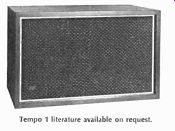
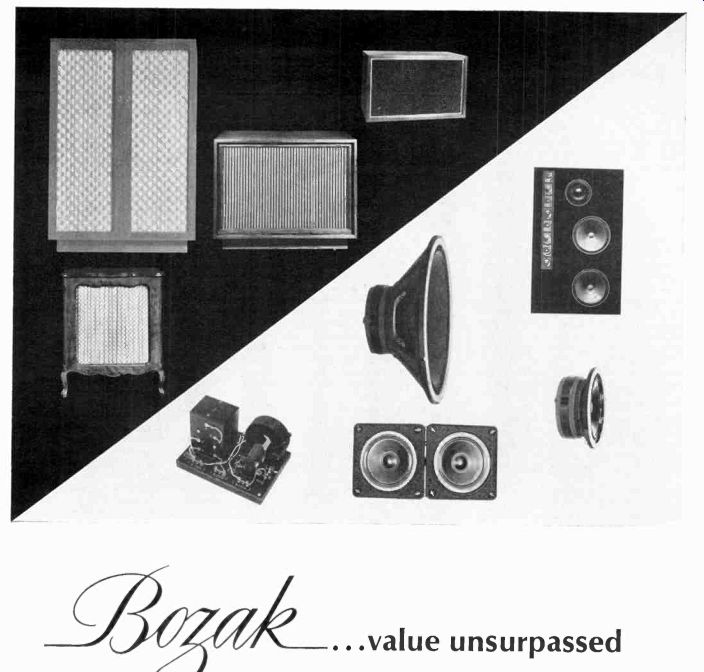
...value unsurpassed for integrity of sound for quality and elegance of cabinetwork and above all, for ability to meet your needs of today and your greater need tomorrow.
Our Catalog tells the story of Bozak's two decades of leadership in loudspeakers, and explains the dynamic concept of Systematic Growth. Ask for your copy.
P.O. Box 1166 Darien, Connecticut, 06820. Elpa Marketing Industries. Inc. New Hyde Park, New York 11040 U.S A.
-------------
(High Fidelity)
Also see: