STEREO REVIEW'S SELECTION OF RECORDINGS OF SPECIAL MERIT -- BEST RECORDINGS OF THE MONTH: Johnny Mathis: "The First 25 Years" Sibelius: Symphony No. 4 Franck: Organ Music; Mussorgsky: Orchestral Showpieces; Steeleye Span: "Sails of Silver"; Kid Creole and the Coconuts: "Fresh Fruit".
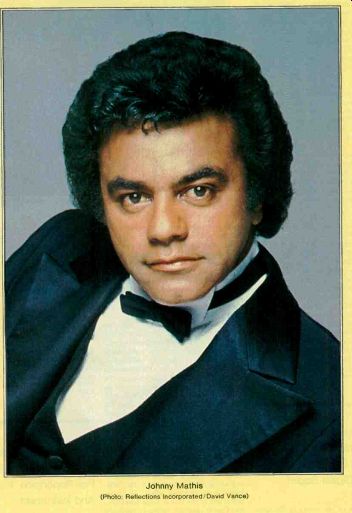
Johnny Mathis: A Quarter-century of Stardom
No amount of freakish good luck, no series of promotional blitzes, and no repertoire of management ploys can by themselves keep a star performer fixed in the pop-music firmament for very long. The average run for the averagely talented singer, even augmented by the Special Measures listed above, is three to five years. A decade would be exceptional. Fill in your own word, then, to describe the career of Johnny Mathis, whose latest Columbia release, "The First 25 Years: The Silver Anniversary Album," celebrates a quarter-century of stardom with twenty tracks on two discs.
The performing longevity is remarkable enough, but the sales statistics of the Mathis career are simply awesome: there have been fifty-count 'em-fifty gold and platinum record awards, one hundred million records sold world wide; his album "Johnny's Greatest Hits" appeared on the Billboard charts for a phenomenal nine and a half years; and twenty-two years after his first big hit (Wonderful, Wonderful, released in 1956, when some of you weren't even born yet) he once again had the number-one pop single in the country (Too Much, Too Little, Too Late, with Deniece Williams as his duet partner). His only peer as a record seller through the Seventies was Sinatra, and he is now strongly embarked into the Eighties with what appears to be a following wind.
Once the staggering statistics have been absorbed, the question naturally arises: Why? Since there is no such thing as a twenty-five-year fad, we have to ask ourselves just what it is in the personality, the voice, or the singing style of Mathis that has made it possible for him to woo, win, and hold not just one audience but, obviously, a succession of them. He has certainly not done it by changing his style to suit the whims of pop-music fashion-there has been no hard-rock Mathis, no funky, punky, country, or disco Johnny. For ...
------- JOHNNY MATHIS: The First 25 Years-The Silver Anniversary Album. Johnny Mathis (vocals); orchestral accompaniment. Misty; Begin the Beguine: Didn't We; It Doesn't Have to Hurt Every time; Wonderful, Wonderful; It's Not for Me to Say; Star dust; Three Times a Lady: The Way You Look Tonight; Deep Purple; Chances Are; All the Things You Are; A Time for Us; Nothing Between Us but Love; There! I've Said It Again; Too Much, Too Little. Too Late; As Time Goes By: When Sunny Gets Blue; Ready or Not; I'm Coming Home. COLUMBIA C2X 37440 two discs, C2T 37440, no list price. ----------
... proof, compare his classic Fifties Misty track in this new album with the 1981 Nothing Between Us but Love; you'll find almost no change either in voice or in style. His amazing durability as a star performer seems rather to be the result of a kind of magical universality, an innate ability to establish, simply through the sound of his voice, an emotional affinity with his audience. That famous, easily parodied vocal sound seems to resonate naturally and effortlessly with the wishful dreams and the real experience of millions of people around the world.
Mathis has never been (to put it mildly) a critic's pet or the subject of media coverage anywhere near equal to his popularity; in the Small but Wonderful World of Hip he simply doesn't exist. What does he stand for, then, in that larger world he has dominated for all these years? Asking around at random, I got some revealing reactions.
"When I think of him, I think of a singer who always knows what he's singing about," said one. "He has real vocal quality," said another, "he doesn't use gimmicks or tricks." A young woman in her twenties remarked, "He makes me feel comfortable; he's warm and sexy in a non-threatening way." There is plenty of supporting evidence, I think, for all these reactions in "The Silver Anniversary Album." From the famous signature songs (Misty, Chances Are, It's Not for Me to Say, Wonderful! Wonderful!, all in their original versions) to the brand new tracks (It Doesn't Have to Hurt Every time, There! I've Said It Again, The Way You Look Tonight, Nothing Between Us but Love) there is a consistent, unchanging emphasis on the bas ics that have sustained Mathis' career:
----------- "Critics may call it emotional Muzak, but legions of long-time fans call it sheer bliss."
Johnny Mathis (Photo: Reflections Incorporated David Vance)
the sweetness of the sound, the high-voltage charge given certain key words within a lyric, and, of course, the trade mark ritards of his phrasing. Probably no performer since Crosby has under stood microphone technique as well as Mathis. And probably no other recording singer ever has been able to count on the one-two punch Mathis delivers so easily: a remarkably flexible vocal instrument catches you off guard, making you easy prey for the insinuating, reverie-inspiring seductiveness of the lyrics. Critics may call it emotional Nfuzak, but legions of long-time fans call it sheer bliss.
There's been a good deal of talk lately about the Good Old Days returning to pop music. Whether they will or not seems irrelevant in the case of Johnny Mathis, for he's never been away. Try as I may, I can think of no stylistic predecessor-any more than I can think of any possible successor. Audiences throughout the world continue to respond to his unique gifts, and I think you'd better lay in a copy of this "Silver Anniversary Album" to go with the "Golden Anniversary Album" that is bound to come.
Most of the music in the album seems to stem from older, slightly com pressed analog master tapes, so this is hardly a representative test of CBS' new "CX" noise-reduction system (see "Audio/Video News," July 1981). Listening with the CX decoder switched in, there was a slight impression of increased dynamic range (probably stemming from the considerable reduction in record-surface noise) and no evidence of decoder mistracking (the so called "breathing" or "pumping" effect). Undecoded, the album sounded like a heavily compressed FM broad cast (although with more high-frequency content than FM can deliver) and certainly quite satisfactory for the uncritical listener.
-Peter Reilly
----------------
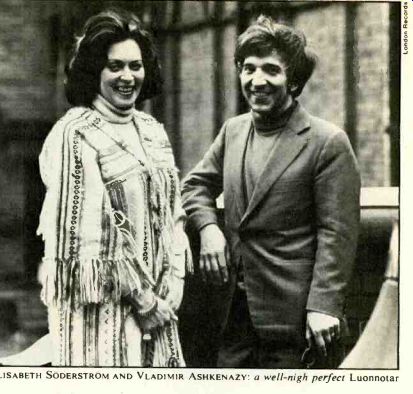
-------------- ELISABETH SODERSTROM AND VLADIMIR ASHKENAZY: a well-nigh perfect
Ashkenazy Leads, SODERSTROM Sings: Mystical Sibelius in Superb Digital Sound
I CAN think of few works in the symphonic repertoire that would profit more from digital mastering and minimalist microphoning techniques than the bleak and profoundly tragic Sibelius Fourth Symphony with its predominantly chamber-music textures. I was disappointed with conductor Vladimir Ashkenazy's rather undisciplined handling recently of the luxuriantly roman tic Second Symphony (London LDR 10014), but I must admit that he has taken the full measure of the wintry vistas of No. 4, especially with regard to pacing, details of balance, and avoidance of congested sonorities in the heavily scored end movements.
Digital mastering helps clear up many murky things in these movements, chiefly in the developmental episodes that other readings have made either vague or sonically overloaded.
Ashkenazy and the Philharmonia players bring off the gear shifts in the enigmatic scherzo, always a nasty trap when it comes to maintaining flow, with admirable aplomb, and the feeling for the big line in the great slow movement is unerring. The finale sizzles with spontaneity, electrifying tension, and a genuine appreciation of its improvisatory aspects. Ashkenazy opts for the use of the glockenspiel (as against the large bells sometimes used), and here especially the digital conics do wonders, capturing the instrument's icy brilliance with stunning effect. In short, this is one of the two or three best Sibelius Fourth readings currently available on discs, the others being those by Colin Davis with the Boston Symphony on Philips and by Gennady Rozhdestvensky and the Moscow Radio Symphony recently issued on Quintessence.
As a striking bonus, Ashkenazy and the Swedish soprano Elisabeth Soderstrom give us a well-nigh perfect realization of Luonnotar, Sibelius' mystical evocation of the Kalevala creation leg end. While I would have preferred The Bard as a second coupling, I have to admire the conductor's courage in choosing instead a spirited treatment of that venerable but still intensely vital patriotic chestnut, Finlandia. This is a marvelously satisfying disc.
-David Hall
SIBELIUS: Symphony No. 4, in A Minor, Op. 63; Luonnotar, Op. 70; Finlandia, Op. 26, No. 7. Elisabeth Soderstrom (soprano, in Luonnotar); Philharmonia Orchestra, Vladimir Ashkenazy cond. LONDON LDR 71019 $10.98.
----------------
Franck's Organ Music: A Three-way Triumph For Repertoire, Performer, And Instrument
THERE are about a hundred other extant short pieces by Cesar Franck for organ or harmonium, but the twelve major works included in a new release by L'Oiseau-Lyre constitute the heart of the French master's monumental contribution to the organ literature over a period of thirty years. To these dozen, organist Graham Steed has added a thirteenth: Marcel Dupre's transcription of the Symphonic Interlude from Redemption. Listening to these works in a single comprehensive edition, one can easily understand why Franck is considered the founder and glory of the modern French organ school. The music is conceived on a vast scale, synthesizes many formal and compositional techniques, combines a fine melodic gift with a daring use of chromatic harmonies, and dramatizes the rich sound palette of the Romantic organ.
The organ in Bath Abbey, England, originally built by Hill in 1868, rebuilt by Norman and Beard in 1895, and re stored after war damage in 1948, is the perfect vehicle for these visionary works. The engineers of L'Oiseau-Lyre have caught its sonorities and ambiance perfectly, and Graham Steed has employed its full resources in his stunning readings of Franck's music.
Steed is a superb musician who understands the art of melodic phrasing on the organ. Listen to the supple melody Franck presents in the opening of the Prelude, Fugue, et Variation for a splendid example of the use of a subtly graduated rubato. Each phrase is marked by a slight terminal ritard, but the melody never sags as the initial tempo is resumed for the succeeding phrase. The same technique is used for the return of the melody in the Variation, but the rubato never hinders the ebb and flow of the rippling sixteenth-note accompaniment. Steed also knows how to apply direction to Franck's chromatic effusions and contributes a fresh rhythmic vitality (so frequently lacking in the performance of this music) through his use of short, detached chords and accompanying figurations.
No matter how thick the textures, how vagrant the harmonies, Steed always maintains the grand line, moves inexorably to the climaxes, and clarifies the structures. This album deserves triple honors for Cesar Franck, Graham Steed, and the organ of Bath Abbey.
-Stoddard Lincoln
FRANCK: Organ Music. Fantaisie No. 1, in C Major. Op. 16; Grande Piece Symphonique, Op. 17; Prelude, Fugue, et Variation. Op. 18; Pastorale. Op. 19; Priere. Op. 20; Final, Op. 21; Fantaisie in A Major; Cantabile; Piece Heroique; Chorales in E Major, B Minor, and A Minor; Symphonic Interlude from "Redemption.' Graham Steed (organ). L'OISEAU-LYRE DI65D3 three discs $29.94.
--------------
Nine Unfamiliar Pieces By Mussorgsky in Stunning Performances Under Claudio Abbado
ALTHOUGH Mussorgsky's Pictures at an Exhibition has become a popular orchestral showpiece thanks to the brilliant transcription by Ravel, we do still hear the original piano version, both live and on records. Mussorgsky's other popular orchestral piece, however, Night on Bald Mountain, has come down to us mainly as the brilliant pastiche created by Rimsky-Korsakov from three different sources. The original version in this case remained un known until 1968; in the meantime, like Pictures, the work was performed and recorded in a number of other arrangements. In 1968, the year the original version was at last published, it was re corded by the London Philharmonic under David Lloyd-Jones as part of a Russian collection which included Balakirev s frequently discussed but seldom heard King Lear Overture. That Philips release never reached our side of the Atlantic and has now disappeared altogether, but a stunning new recording of the original Night on Bald Mountain by Claudio Abbado and the London Symphony Orchestra has just been issued by RCA together with eight other Mussorgsky orchestral any choral pieces, most of them similarly unfamiliar. It is a fascinating collection, and Lloyd-Jones is again involved, this time as the author of the invaluably informative annotation.
This original version of Night on Bald Mountain is utterly different from both Rimsky-Korsakov's and Stokowski's, with a somewhat narrower gap separating it from the Rene Leibowitz version (available on Quintessence PMC-7059). Motifs made prominent by these arrangers are less so in the original, and instead of the quiet concluding section in Rimsky's edition the piece ends with the witches' sabbath going full tilt. What is most surprising is that the orchestration, anything but
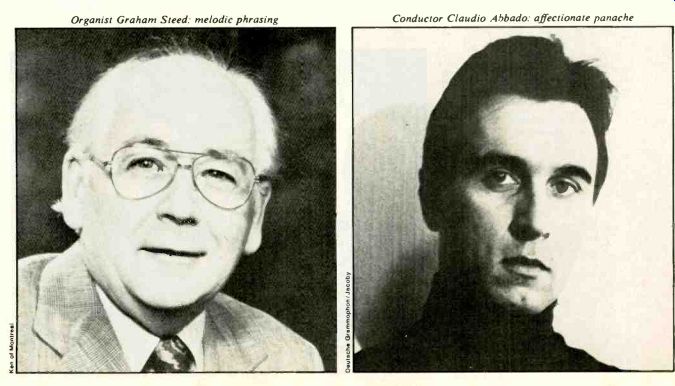
---------------- 77 Organist Graham Steed: melodic phrasing Conductor Claudio Abbado: affectionate panache
crude, is extremely brilliant and imaginative. Rimsky's version will always de serve its place in the repertoire, but Mussorgsky's own is an exciting discovery and a place must be made for it too.
The other discoveries in this superb collection are hardly less intriguing.
The four choral items have been presented by Abbado in his guest appearances with the New York Philharmonic and the Philadelphia Orchestra, but none of them seems to have been re corded before. They are the Chorus of Priestesses from Act IV of the uncompleted opera Salammbo, the independent piece Joshua (or Jesus Navin, actually an adaptation of material from the same Flaubert-derived opera), the Chorus of the People in the Temple from the incidental music for Ozerov's Oedipus in Athens, and a setting of the opening verses of Byron's poem The Destruction of Sennacherib (with Mussorgsky's own prose rendering of the text). Rimsky's hand is apparent in the polished orchestration of all four of these choruses, but here we have no case of reconstruction or pastiche as in his version of Night on Bald Mountain, and the originality and power of all this material make quite an impact.
It is in Rimsky's familiar orchestration too that we hear the Prelude to Khovanshchina and the Entr'acte from that opera's fourth act, but it is in Mussorgsky's own scoring that the two remaining pieces are performed. These are the darting little Scherzo in B-flat Major and the brilliantly colorful Triumphal March (often listed as "Turkish March") called The Capture of Kars. Both of these, as well as the Khovanshchina excerpts, have of course been recorded before, but not with anything like the panache displayed here. Abbado's affection for this material is infectiously apparent, the LSO and its fine chorus are at the top of their form, and the recording itself is vivid and rich. The one lapse in this otherwise splendid production is the failure to provide texts, or even synopses thereof, for the four choral numbers. Even without them, though, this is for me one of the most stimulating re leases in a very rich year.
-Richard Freed
MUSSORGSKY: Night on Bald Mountain (Original Version); Khoranschchina, Prelude and Entr'acte; Scherzo in B-flat Major; Triumphal March ("The Capture of Kars").
London Symphony Orchestra, Claudio Abbado cond. Joshua; Salammbo, Chorus of Priestesses; Oedipus in Athens, Chorus of People in the Temple; The Destruction of Sennacherib. Zehava Gal (contralto, in Joshua); London Symphony Chorus and Orchestra, Claudio Abbado cond. RCA ARLI-3988 $9.98, ARKI-3988 $9.98.
---------------------
Steeleye Span's Return: Words Worth Hearing Mounted on Shockingly Pretty Melodies
OF all the disbanded bands that have managed to return to life lately, Steeleye Span may have done it best-come back to life, that is. "Live at Last," their "farewell" album of three summers ago, was unfocused and dispirited, but their new "Sails of Silver" redeems that failure and stands up well against some of the good early al bums such as "Parcel of Rogues." Steeleye isn't exactly its old self, of course, either in its personnel or in its sound. The lineup on the new disc Maddy Prior, Tim Hart, Peter Knight, Rick Kemp, Nigel Pegrum, and Bob Johnson-mirrors the group that coalesced in 1974. Steeleye was first formed in 1970, and various subsequent incarnations of the band included Tyger Hutchings, Gay and Terry Woods, Martin Carthy, and John Kirkpatrick (the last two replaced Knight and Johnson on the farewell album). As for their new sounds, Steeleye has filed off some of the rough edges, apparently in an attempt to make the music easier for more people to swallow.
I disapprove of that in principle, but I try to keep in mind that everything is a matter of degree. Once you get into this new effort, I think you'll find that a lot of the old inventiveness still remains.
And besides, though the other guys may be toning it down a bit, Rick Kemp's bass is still athletic and surprising, and any vocal complement that includes the clarion pipes of Maddy Prior has to be a cut above 90 percent of the ear candy on the radio. Besides that, the words are worth hearing, the melodies almost shockingly pretty.
The notes credit most of the songs to the whole band. I don't know if that means they have no antique folk-song connections (my research on the old Child ballads has been sadly neglected lately), but most of them sound as traditional as the songs they don't write 'em like any more. The title song and Where Are They Now are particularly lovely. The melodies and the haunting vocal harmonies are worth the price of admission; what's left of the old Steeleye spirit in the arrangements makes it all a bargain.
-Noel Coppage
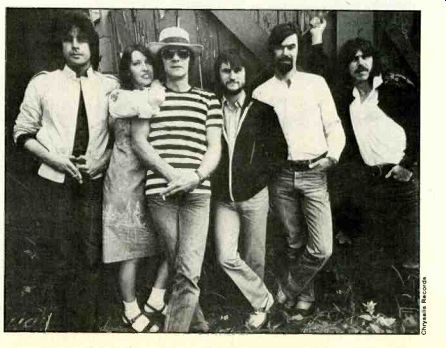
------ Steeleye Span: together again with their old inventiveness
intact.
STEELEYE SPAN: Sails of Silver. Steeleye Span (vocals and instrumentals). Sails of Silver; My Love; Barnet Fair; Senior Service; Gone to America; Where Are They Now; Let Her Go Down; Longbone; Mari gold/Harvest Home; Tell Me Why. TAKO MA TAK 7097 57.98.
-------------------
Kid Creole and Coconuts: Their "Fresh Fruit" Is Devilish Musical Satire Served Up with Style
KID CREOLE AND THE COCONUTS is Dr. Buzzard's Original Savannah Band (1976) in its latest metamorphosis (there have been several). No later edition of the group has managed to re peat the startling commercial success enjoyed by the original band's offbeat blend of Forties movie music and Seventies disco sounds, even though much of what followed often far surpassed that debut disc in artistic quality.
The Original Savannah Band was a cooperative effort spearheaded by Au gust Darnell and Stony Browder Jr., but the latter plays no part in the new Kid Creole group, which seems to be entirely the work of Darnell and Andy Hernandez (whose input has been vital since the Savannah days but who tends to stay out of the publicity spotlight).
Darnell and Hernandez have exhibited a prepossessing creative rapport with each other before, but never as strikingly as they do in "Fresh Fruit in Foreign Places," a new Sire album that is the musical foundation for an extended theatrical presentation that has Darnell (Kid Creole) scouring the Caribbean in search of his lost lover. (A stage presentation, with Joseph Papp directing, is in the works, with some kind of video project rumored to be warming up in the wings.) Perhaps not surprisingly, "Fresh Fruit" abounds in reggae sounds, but Darnell and Hernandez-who either individually or together composed all the tunes-avoid the monotony that so often creeps into that genre, generously flavoring their arrangements with often devilishly subtle dabs of sound picked up from such common denominators of the public ether as late-night movie reruns.
Darnell and Hernandez are a magnificently imaginative team whose witty musical satires (for that is what they are) have a rare ingredient that is al most totally lacking in pop music today:
style. Their music may be hard to categorize, but it is easy to digest, and their performances are a breathtakingly natural extension of their considerable writing talents.
-Chris Albertson
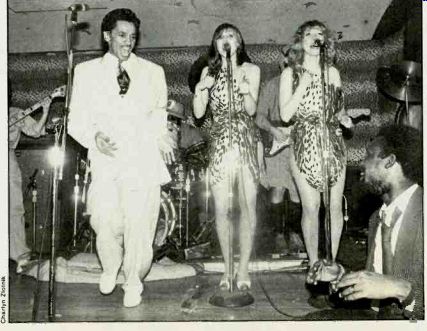
--- August "Kid Creole" Darnell with a couple of lovely coconuts.
------------
KID CREOLE AND THE COCONUTS:
Fresh Fruit in Foreign Places. Kid Creole and the Coconuts (vocals and instrumentals). in the Jungle; I Stand Accused; Musica Americana; Schweinerei; Animal Crackers; Latin Music: I Am: With a Girl like Mimi; Table Manners; Dear Addy: Going Places; Gina, Gina. SIRE. SRK 3534 $8.98, M55 3534 $8.98.
---------
--------
BEST OF THE MONTH RECENT SELECTIONS YOU MAY HAVE MISSED
Classical:
Bach Goldberg variations. ARCHIV 2533 425 "A thoroughly seasoned and mature reading by Trevor Pin mock "(July) O Bartok: Piano Concertos Nos. 2 and 3. LONDON CS 7167 "The partners Ap of ilsdimit Ashkenazy and Se Gem Solt, is complete and electrifying "(July) O Janet*: Glagoak Nast
SUPRAPHON
'Idervonal, ?ratans( indispensable "(August)
Gidon and Elena Kremer: Musk for Viola and Plano.
PHILIPS 9500 904 9500 912 "Exceptional music mek,nc (September) O Rossini: L'Itallana in Algori. RCA ARL3-:855 A oe IOW comic totality springs to triumphant life (July)
Stravinsky: The Firebird. LONDON LDF 10012 'A must tor the Stravinsky tan ' (June)
Sutherland / Nome, Pavarotti: Live from amok, Can
LONDON LDR 72009 "Dazzling coca virtuosity (September)
Wagner: Pandit DEUTSCHE GRAIAMCPHON 274:002 'Outstanding singers end the grand line e: a luminous transparent recording "(August) E Weber: Der Froischdtz. LONDON OSA 17:136 "A lovingly conducted realization of a glorious score ' (June)
POPULAR:
Stanley Clarke and George Duke: The Clef * Duke Prolmt.
EPIC FE 36918 "A wonderful musical splash ix some deep pop waters "(July)
Ellen Foley: Spirit of St LOA EPIC CLEVELAND IN TERNATIONAL JE 36984 "A most ingressive album in the difficult cabaret genre "(July)
Emmytou Hartle: Evangeline. WARNER BROS 3508 "Awesome music making "(June)
Katy and the Haywoods: Excuse W, I've Got a LIN to Catch. CAPITOL ST.12149
"Sweet old-fashioned get down Add singing (September)
Leo Kottke: Gutter Musk.
flYSALIS 041 1328 "Itoldie a at the top of fus form "(August)
Carole Bayer Sager: Sometimes Late at Night BOARDWALK FW 37069 amounts to a summation at the attitudes of the women of her generation "(August)
Phoebe Snow: Rock Away. MIRAGE WIG 19297 "This album is a real charmer "(July)
Leon Ware: Rockin' You Eternally. ELEOTRA 6E-332
'A fee showcase for a foe songwriter ' (June)
Women of the Yew
ARISTA AL 8303 "Bnsk, bnpit and beautifully recorded ' (September)
---------------------
Also see:
POPULAR MUSIC: Arlo Guthrie: "Power of Love" Janis Ian: "Restless Eyes" Stevie Nicks: "Bella Donna" Cabaret: Bobby Troup and Meredith; The Swinging Madison ... Jimmy Witherspoon: " Olympia Concert"; Smithsonian Collection: C-&-W Classics.
Source: Stereo Review (USA magazine)