HEADING the new line of record players from Dual is the Model 741Q, a two-speed, direct-drive, quartz-locked turntable combined with an improved version of Dual's ULM (ultra-low-mass) tonearm.
The straight tubular arm is now made of a magnesium/aluminum alloy that gives greater rigidity while retaining the advantage of very low mass (only 8 grams, including the 2.5 grams of the optional Dual/Ortofon ULM 60E cartridge). The tonearm has Dual's anti-resonator, a secondary weight suspended within the counterweight, whose effective mass and suspension compliance are adjustable to compensate for the low-frequency arm/cartridge resonance with almost any type of cartridge installed in the arm. The Dual/Ortofon cartridges are supplied on special low-mass mounts, but a separate mount is provided for use with other cartridges. Additional counter weight sections are also furnished to balance heavier cartridges.
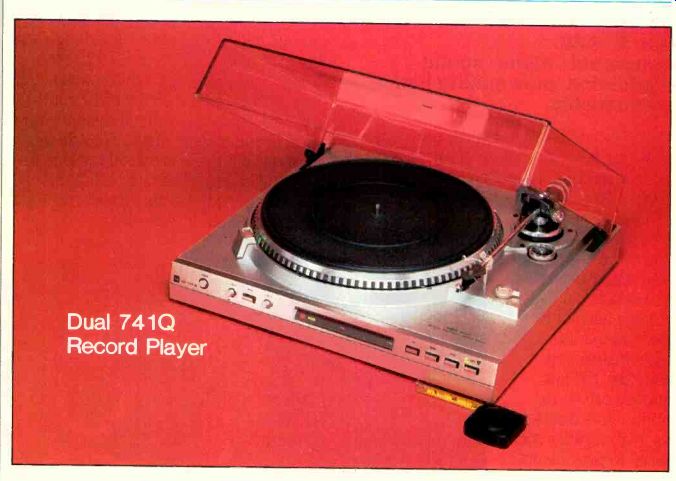
The major improvement in the Dual 741Q is in its suspension system. The motor, platter, and tone arm are suspended as a unit from the base on four accordion-like rubber isolators filled with a viscous damping fluid. The dampers are combined with a coil spring (like an automobile coil-spring and shock-absorber combination) and a transverse rubber suspension element to provide optimum isolation from external vibration. In addition, the entire record player is supported on four adjustable feet, each of which can be set to attenuate the transmission either of low audio frequencies (for feedback reduction) or of infrasonic frequencies (for shock isolation).
All the operating controls of the 741Q are on its front panel and are fully accessible when the dust cover is lowered. Light-touch pushbuttons initiate the play cycle (the arm-indexing position is determined by the selected speed), and the stop cycle can be activated by a touch on its button. An other button (LIFT) raises and lowers the pickup on alternate touches, with the arm position shown by green arrows next to the button. If the REPEAT button is engaged, a record will be replayed indefinitely.
At the left of the panel is a POWER button and a small rectangular button marked PITCH flanked by two small knobs marked 33 and 45. With the PITCH button out, the speeds are controlled by the quartz-crystal reference in the turntable servo system, being selected by a knob on the motorboard near the cartridge end of the arm. A "dial window" near the center of the panel displays the turntable speed in red numerals, and the QUARTZ legend appears in green to show that the speed is fixed.
When the PITCH button is engaged, the green QUARTZ indicator is replaced by PITCH in red, and a dial scale shows the actual deviation of the speed, in percent, from nominal value. The scale is calibrated at I percent intervals over a ±6 percent range; a colored LED pointer makes it very easy to read. The small PITCH knobs provide vernier adjustment of the 33 1/3- and 45-rpm speeds.
The nonferrous-alloy platter (which weighs 3 1/4 pounds including its rubber mat) has stroboscope marks cast into its rim; these are illuminated from below the motorboard only when the speed is quartz-locked.
The counterweight of the gimbal-mounted tone arm carries the anti-resonance-filter adjusting ring, which is calibrated in terms of the resonant frequency to which it is tuned. The manual has a table of recommended settings for most popular cartridges. The tracking force is set by a small knob on the side of the gimbal housing, which operates through a spring so that the arm remains balanced at all times. It is calibrated at 0.1-gram intervals up to 1.5 grams and at 0.25-gram intervals from 1.5 grams to its 2-gram maximum. The anti-skating dial, with separate scales for conical and elliptical styli, is on the motorboard next to the arm base and can be adjusted while a record is playing.
The exterior appearance of this year's Dual turntables is a definite departure from past designs. Instead of a basic-black finish, the 741Q is finished in a metallic satin sil ver. It is 17 1/2 inches wide, 15 1/4 inches deep, and about 5 inches high with its clear-plastic dust cover down. The hinges for the cover move forward slightly as it is raised so that the turntable can be placed close to a wall without restricting the opening of the cover (which can be set at intermediate angles as well as fully raised). The whole unit weighs about 17 pounds. Price: $500; with factory-mounted Dual/Ortofon ULM 60E cartridge, $649.95.
Laboratory Measurements.
The Dual 741Q was tested with its optional ULM 60E cartridge. The low-frequency resonance was at about 10 Hz, with a 4- to 5-dB amplitude. Although more massive cartridges would lower that frequency some what, we would expect it to be above 8 Hz under any conditions.
When the arm had been carefully balanced, the calibrations of the force scale on our sample were slightly off (by 0.1 to 0.2 gram). Since the actual force was always higher than the reading, this error is on the "safe" side. We used the 1-gram setting for which the 60E cartridge is rated. The tracking error over the surface of a 12-inch record was well under 0.5 degree per inch of radius. The tone-arm and signal-cable capacitance was 180 picofarads, with an inter channel capacitance of 4.5 picofarads.
The unweighted rumble was a low -37 dB,-60 dB with ARLL weighting. The maximum rumble energy was around 6 Hz, and it decreased rapidly at higher frequencies. The flutter was about 0.06 percent in a weighted rms or average measurement, ±0.07 percent weighted peak. These figures represent the best that can be measured with standard test records because of their inherent warpage and eccentricity.
The flutter spectrum was uniform below 10 Hz, with little at higher frequencies. The speeds were adjustable over the rated range (we measured extremes of + 5.8 and-5.9 percent), and the calibrations of the speed scale were as accurate as their single-digit resolution allowed. The automatic start cycle required about 11 seconds from touching the button to the set-down of the stylus on the record. The stop or shut-down cycle required 7.5 seconds. The arm can also be cued manually, since the motor starts when the arm is moved from its rest.
The antiskating dial had to be set I gram higher than the force setting for equal distortion in both channels on very high-velocity records. In spite of the higher setting, the tonearm drift during cueing descent was very slight; rarely was more than a couple of seconds of a record repeated in an "up/down" arm-lift operation. The lift was virtually instantaneous, and the smoothly damped descent to the record surface required only about 1.5 seconds.
We did not test the Dual/Ortofon ULM 60E cartridge (it and other Dual/Ortofon cartridges have been covered in reviews of earlier Dual turntables). However, we did mount another, conventional cartridge in the arm to check the completeness and accuracy of the instructions. We discovered that careful attention must be paid when in stalling the cartridge with the supplied gauge and that remounting the cartridge plate in the arm is a bit tricky.
Comment. Although the Dual 741Q differs from its predecessors in styling and in many features, it retains their smoothness and ease of operation. For most home applications, it would be hard to imagine a more effective or attractive record player.
The major innovation of the 741Q is in the lengths to which its designers have gone to isolate it from its environment so as to reduce the feedback that muddies the sound or induces oscillation in many other players.
Our listening room, built on a concrete slab, is virtually free of conducted vibration, and we are forced to use extraordinary measures to induce airborne acoustic feedback (in fact, we have yet to do so in any recognizable form). For that reason, as well as to quantify our data, we measure base isolation of a record player by exciting all four of its feet with small magnetic drivers (essentially miniature loudspeakers) with a sweeping audio frequency from 20 to 1,000 Hz. The output of the cartridge, resting on a stationary record, is RIAA-equalized and fed to a graphic level recorder synchronized to the sweep-signal frequency. After calibration, the readout can be compared with test data from other turntables to evaluate relative base isolation.
Does Dual's rather extensive design effort to isolate the 741Q make it less susceptible to transmitted vibration? Compared to previous Dual players we have tested, the 741Q enjoys a clear superiority of at least 5 to 10 dB by our nonstandard test procedure.
It showed a single transmission response at 33 Hz-unlike most units, which display either a broad response up to 100 or 200 Hz, or else a number of discrete responses in that range. Its acoustic and mechanical isolation surpassed the measurements we have made on almost all the belt-drive turntables we have tested, as well as all but a couple direct-drive models. Our tests of the 741Q were made with its mounting feet set for best isolation in the audio spectrum, where our measurements were made. We did not experiment with different settings of the feet, since their effects would have been be low our 20-Hz lower measurement limit.
Although the effects of the tunable anti-resonance filter in the tone-arm counter weight are difficult to detect either by measurement or by ear, it is clear that the multiple isolation systems of the Dual 741Q combine with its overall excellent performance and ease of operation to make it one of the best record players on today's market.
---------------
Also see:
Dual turntables (ad) (Feb. 1974)
Hitachi HA-4700 integrated amplifier
Source: Stereo Review (USA magazine)