DIGITAL-READY SPEAKERS --- How much power can your speakers handle? Can they stand up to the peaks put out by Compact Discs?
HOW MUCH POWER CAN YOUR SPEAKERS HANDLE? CAN THEY STAND UP TO LOUD VOLUME? BIG AMPS? THE HIGH-LEVEL PEAKS PUT OUT BY COMPACT DISCS?
BY JULIAN HIRSCH
As prices drop, more and more Compact Disc players are being added to home hi-fi installations. New buyers are always concerned about the compatibility of the CD player and their existing equipment, and the CD's ability to produce high-level peaks through powerful amplifiers focuses attention especially on the power-handling ability of speakers.
Let's face it--the speaker power ratings supplied by manufacturers can be confusing. They run the gamut from none at all to de tailed listings of the allowable power in each frequency range as a function of time. Most often, however, this specification is merely a range of power levels, such as the "50 to 500 watts" rating of the Ohm Walsh 4 reviewed in this issue.
This kind of specification is intended only to define loosely the range of rated amplifier power outputs that a manufacturer considers to be suitable for driving his speaker. The lower figure is the approximate minimum amplifier rating that will produce a comfort ably loud listening level in a typical room, while the upper one is the highest rated out put that the manufacturer feels can be used safely with the speaker.
It must be understood that these are extremely rough figures, not to be taken as gospel by the consumer. For example, Ohm's specification for the Walsh 4 states that the speaker requires only 1 watt input to develop an 87-dB sound-pressure level (SPL) at a 1-meter distance. A 10-watt input should produce an SPL of more than 90 dB in the listening area, which is loud enough to preclude comfortable conversation in the room.
Most of the time, then, a good 25- or 30-watt amplifier would probably be perfectly satisfactory with this speaker.
Of course, most people sooner or later wish to play their music a little louder than they usually do. And what about the broad dynamic range of digital Compact Discs? As little as a barely noticeable 3-dB increase in SPL will double the power requirement to 50 or 60 watts per channel. The reason for the 50-watt lower limit in the Ohm specification should now be obvious.
The upper power limit in a speaker specification may be determined by the onset of unacceptable distortion or by the potential for actual physical damage to one or more of the drivers in the speaker system. In most cases, the determining factor is physical damage, either deformation or destruction of the mechanical system (cone or suspensions) or thermal burnout of the voice coil. Which limit applies depends on the size of the driver and the frequency range in which it is operated.
The lower-frequency drivers (the woofer and the lower-midrange driver in a four-way system) usually have to handle the largest part of the total signal power supplied to the system. The maximum sustained power levels in most orchestral music occur at frequencies below 1,000 Hz. To radiate acoustic power in this frequency range requires a considerable cone or diaphragm amplitude range (acoustic-suspension woofers can be capable of a total excursion of an inch or more at 30 Hz). Thus, the most likely source of damage is actual tearing of the cone or its suspension. Sometimes the voice-coil form is pulled away from the cone's apex, or the wire may separate from the form on which it is wound.
Fortunately for our speakers, a low- or middle-frequency driver will usually produce unmistakable sounds of distortion before it is irreversibly damaged. The rasping, buzzing, or clattering sound of a voice-coil suspension hitting bottom will often given sufficient warning to turn down the volume. The heavy-duty voice coil of a low-frequency driver is usually able to dissipate a large amount of power without burnout, which is only likely to occur in sustained high-power operation (as in the amplifying systems used for live rock music).
Sometimes this sort of abuse will actually set the speaker on fire, al though improved adhesives and form materials permit some of to day's speakers to operate at temperatures that would be more appropriate inside an oven.
High-frequency drivers arc a different matter. Their diaphragms--usually small, light domes of paper or plastic--do not move visibly, and in use it is next to impossible to damage them or their suspensions.
Distortion of their acoustic output is usually not audible as such, for the harmonics fall in the upper reaches of human hearing or higher.
Intermodulation distortion components can be generated at lower frequencies, but a typical tweeter diaphragm is too small to radiate such frequencies efficiently.
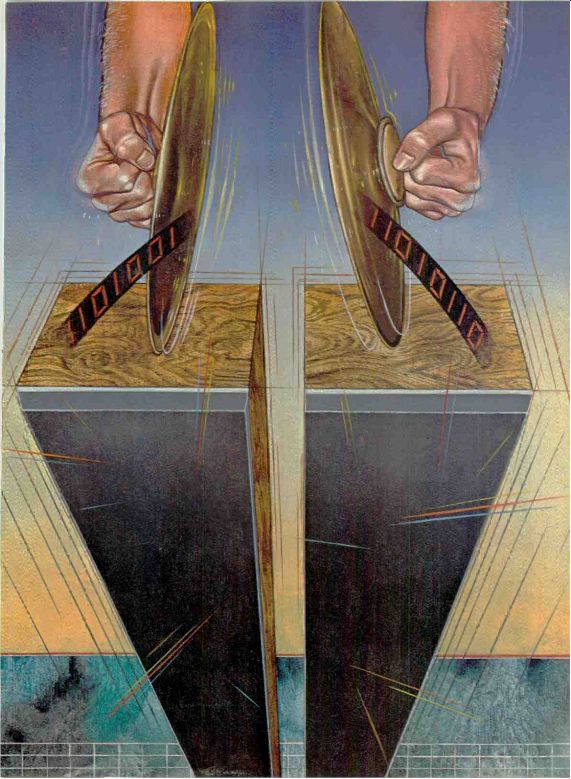
A CYMBAL CLASH CAN DEVELOP ENORMOUS OUTPUT AT THE HIGHEST FREQUENCIES, ESPECIALLY ON CD.
The sonic effect of a tweeter over load is likely to be a compression of the program dynamics, since the sound intensity no longer increases in proportion to the amplitude of the electrical signal waveform. With any well-designed speaker, this is not a serious problem at reasonable listening levels, but that situation may well change with the growing r use of CD's and other digital pro gram sources having a greatly expanded dynamic range.
What high-frequency (and upper-middle-frequency) drivers are very vulnerable to is excessive electrical input. To keep the moving mass low, tweeter voice coils are wound with very fine, light wire. It takes little current to heat up these voice coils to the point where they burn out, and their low mass permits this to happen very rapidly. The speaker designer may elect to provide in creased heat dissipation by using a material such as ferrofluid in the magnetic gap, in contact with the voice-coil winding, so that it can conduct heat to the higher mass of the magnet and its structure. This helps but does not eliminate the possibility of voice-coil burnout.
One might well ask how such drivers can absorb the high peak power levels that are known to occur in the higher frequency ranges of recorded music. A cymbal clash, for example, can develop an enormous acoustic output at the highest frequencies, especially on a Compact Disc. The key word is peak. These high power levels exist for very short times, on the order of milliseconds. Since voice-coil burnout is caused by excessive average power input, it is possible for a driver to absorb incredible power levels (more than 1,000 watts) without harm if the time is brief and the occurrences infrequent.
If, say, a 1,000-watt pulse is applied only one thousandth of the time (such as 1 millisecond on and 1 second off), the average power level is only 1 watt, which is unlikely to damage any speaker. On the other hand, increasing the repetition rate of the pulse or tone burst by a factor of ten, to ten times a second instead of once, increases the average power to 10 watts, which will burn out al most any tweeter in a few seconds.
As you can see, a reasonably complete power-handling specification for a speaker system can be quite complex, involving separate definitions for each of the drivers and usually being stated in the form of "x watts for no more than y seconds at a frequency of z Hz." A graph would be even more desirable-but even more difficult for the average person to interpret! The simplified form in which this information is usually presented is quite sufficient for most users, so long as they realize that the stated power limits, both upper and lower, are very general and not to be taken literally.
Basically, interpreting power-handling specs is pretty much a matter of common sense once you have a slight appreciation of the problems involved. Driving a single 6-inch speaker with a 500-watt amplifier is clearly an invitation to disaster even if you are careful. Accidents can always happen, and this sort of mismatch leaves no margin for error. Dropping the phono pickup or accidentally knocking it across the record could easily wipe out such a speaker with a 500-watt amplifier, but the same mishap would do no damage with a 50-watt amplifier. At the other extreme are those few speakers having heavy-duty voice coils in all their drivers, such as most Ohm Walsh models or the Bose 901 series. It is unlikely that you could burn out a voice coil of one of these speakers with any amplifier, no matter how powerful.
Our peak-power speaker tests use short-duty-cycle tone bursts, which are not likely to burn out the most delicate tweeter voice coil. We look for signs of nonlinearity in the acoustic output of the speaker rather than exploring the safe limits of its operation. Most of the time, the amplifier's power capacity, rather than the speaker's power-handling capability, is the limitation in this test. Only in the bass region can we reach the limits of a speaker cone with only a few hundred watts of power, and there our ears alert us to the onset of distortion.
To sum it up, therefore, most speakers can handle a lot of power for very brief periods, often far more than the speaker's ratings would indicate. It is continuous high-power operation that causes problems. Unless your normal listening level is very loud, you should be able to play Compact Discs at the same volume you are accustomed to without risk to your speakers. But you may consider upgrading them if you want to take advantage of everything else that digital technology has to offer.
----------------
Also see:
SYSTEMS--Audio and video merge in a producer's dining room