THE MARK LEVINSON ML-3 AMPLIFIER--- We discover "gold-plated" sound in a special lab test on a high-end power amplifier. by Julian Hirsch
No-compromised design and construction plus "gold-plated" sound may lure you into the world of audio's high end.
I've tested quite a few power amplifiers in my day, but never anything quite like the Mark Levinson ML-3. Priced at $5,400 and recommended for use with special cables that run several hundred dollars more, the ML-3 is definitely a product from audio's "high end," a region where cost-no-object design and construction are the rule.
Now, in the past I have made no bones about my contempt for the poorly considered, pseudo-scientific claims of some fanatical proponents of expensive, exotic equipment, and about many of these claims I haven't changed my mind. But the measured and audible performance of the ML-3 amplifier has almost made me a convert to the high end! The Mark Levinson name has long been associated with the highest standards of performance and construction quality. The company's no-com promise preamplifiers, power amplifiers, and tape recorders naturally command very high prices, but thousands of dedicated audiophiles have obviously decided that they represent good values. Testing and living with the ML-3 for an all-too-brief period has enabled me to appreciate the unique appeal such a product has to a serious listener.
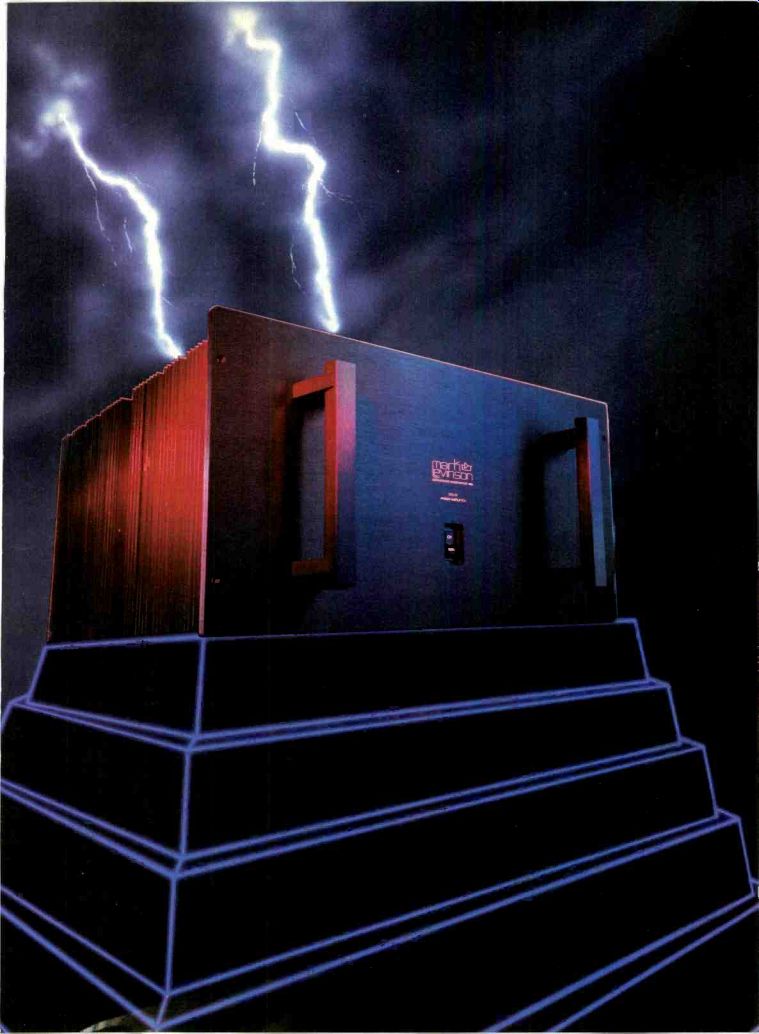
The ML-3 is a huge, heavy amplifier that is completely finished in flat black. The front panel-a 10 7/8 x 19-inch slab of 3/8-inch-thick anodized aluminum fitted with heavy machined handles-contains only a single recessed rocker-type power switch, which has a small red LED in it to show that the amplifier is on. A discreet company logo and the product model number are the only other visible features of the panel.
Even the sizable front dimensions of the ML-3 are dwarfed, however, by its 24 1/2-inch depth! Both sides are completely covered by the heat sinks for the forty (!) high-power output transistors. On the rear of the amplifier are the special Levinson input and output connectors, a pair of 15-ampere "Slo-Blo" power-line fuses, and two small three-position toggle switches that adjust the damping factor (separately for each channel) for high, normal, or low values. A second pair of handles is provided on the rear of the ML-3. Their importance becomes obvious when you try to lift or move the 120-pound unit definitely not a job for one person! The specifications of the Mark Levinson ML-3 include a rated out put of 200 watts per channel from 20 to 20,000 Hz into 8-ohm loads with no more than 0.2 percent total harmonic distortion or 400 watts into 4 ohms with no more than 0.4 percent distortion. The amplifier's input impedance is 20,000 ohms, which, though relatively low, can be driven easily by any good-quality current-model preamplifier.
The ML-3 is thoroughly protected against improper operation or excessive output-current demands by a combination of temperature sensors, fast-acting relays, internal d.c. fuses, the .c. line fuses, and a magnetic circuit breaker that is an integral part of the on-off switch. The output stages themselves can de liver enormous currents to any conceivable speaker load without distortion or damage to the amplifier, but the protection system normally allows these currents (corresponding, for example, to a steady-state output of almost 900 watts into a 2-ohm load) to flow only for the relatively brief duration of a typical musical transient.
UNIQUE CONNECTORS
The input and output connectors of the ML-3 are as unusual as the over all amplifier design. They are Swiss-made precision devices with gold plated contact surfaces and Teflon internal insulation. The speaker connectors can carry 50 amperes continuously (80-ampere peaks), and when used with the recommended Levinson HF 10 C cable (also made in Switzerland), they enable the amplifier to deliver its huge peak currents to the speakers with a minimum of loss in the intervening wiring.
The input connectors are similar in concept, though much smaller. They are designed to make the ground connection before the signal connection when they are inserted and to break the signal connection ...
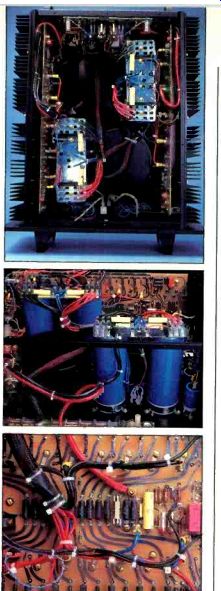
The quality of workmanship
that goes into building a Mark Levinson ML-3 was apparent the moment we
took the covers off. The two large black toroidal transformers and four 36,000-pF
capacitors dominate the interior. The bottom photo shows a close-up of the
output-amplifier circuit board.
... before the ground on removal. Such an arrangement makes it impossible to produce a speaker-killing blast of 60-Hz hum by carelessly or accidentally inserting or removing a connector with the system operating.
This safety feature is augmented by an expanding internal contact that permits removal of a plug only by grasping and pulling its body. Pulling on the input cable merely tightens the grip of the connecting socket on the plug.
The internal construction of the Mark Levinson ML-3 will gladden the heart of anyone who appreciates fine workmanship. Engineers will be especially impressed by the high-quality components and assembly techniques used throughout. There are no signs of compromise in any aspect of this amplifier's design or construction. Indeed, its internal appearance is so striking that the company makes the unit available with a clear Lexan top plate ($97.50) for those who want to show off its construction.
"BULLETPROOF" DESIGN
Testing the ML-3 was a fascinating experience. It is one of the very few high-power amplifiers we have seen that appears to be totally immune to damage in any sort of home service.
After we came to accept this, we felt no compunction about driving it to clipping-or beyond-under any load conditions. When the load cur rent was excessive the amplifier shut off with a soft click, and when the signal level was reduced it re turned to operation in an equally discreet manner. This happened without any extraneous noise from the amplifier. We heard no acoustic (mechanical) hum in its vicinity (the two huge 1.2-kilowatt toroidal power transformers see to that) and, of course, no fan noise. The ML-3 was evidently designed to perform in an ideal manner for an indefinitely long period, and we have no doubt that it will do just that.
We put the novel input connect ors to the test of inserting and re moving them with the system operating. There was not a trace of noise from this action, which would be al most sure to cause speaker damage if conventional connectors were used with an amplifier of this power rating.
The test amplifier was furnished to us with a pair of 30-foot Mark Levinson HF 10 C speaker cables ($367). Their free ends were fitted with heavy-duty lugs that would have made them suitable for use in an automobile's starter-motor circuit. These made it impossible to route the amplifier-to-speaker wiring through our switching comparator, so we connected the ML-3 directly to our reference speakers and proceeded to listen, using records, FM radio, and Compact Discs as program sources.
AN AUDIBLE DIFFERENCE?
I have often said that I have yet to hear a difference in sound between power amplifiers whose measured
( Continued on page 102)
LEVINSON MI-3 (Continued .from page 46) performance was essentially identical. That statement is still valid, since I was unable to make a direct comparison between the sound of the ML-3 and that of any other am plifier. But even before making any measurements, I could not help being impressed by the utterly effort less and transparent sound of my regular system as modified only by the use of the ML-3 and its special cables and connectors.
The ML-3 simply sounded the way one would expect a $5,400 amplifier to sound. It could be de scribed, I suppose, as having a "gold-plated" sound that was immediately apparent to me regardless of the program source. Interestingly, our measurements showed a subtle departure from ruler-flat response, and that may have been responsible for some of these impressions.
My impressions were undoubtedly influenced as well by what I saw inside the ML-3. Twenty-five years in the electronics engineering world has given me some appreciation of the distance between consumer products, no matter how "deluxe," and top-quality laboratory- or mili tary-grade electronic equipment.
The Mark Levinson ML-3 power amplifier is the only consumer product I have seen that bridges that gap. What else can I say? If cost were no object, this is the amplifier I would choose for myself.
For more information on the ML-3, write to Mark Levinson Audio Systems. Ltd., Dept. SR, 2081 South Main Street, Route 17, Middletown, Conn. 06457.
------------------
LAB MEASUREMENTS
SINCE the two channels of the ML-3 are completely independent (they even have separate power supplies), we made our measurements driving only one channel. For the one-hour preconditioning period, however, both channels were driven at 1,000 Hz to the required one-third-power output (67 watts) into 8-ohm loads.
The output transistors of the ML-3 draw a fairly high quiescent current, so the heat sinks became moderately warm during idling, but they did not become significantly hotter (and never uncomfortable to the touch) during subsequent high-power testing.
Driving an 8-ohm load at 1,000 Hz, the output clipped at 312.5 watts for a clipping headroom of 1.94 dB. The output power at clipping was 530 watts into 4 ohms (for a clipping headroom of 1.22 dB). With a 2-ohm load, the protective relit.), operated long before any waveform clipping was observed, at about 162 watts.
The true capabilities of the ML-3 were evident in its 1,000-Hz dynamic output with a 20-millisecond tone-burst signal. The clipping levels in this dynamic-power test were 371, 663, and 1,126 watts, respectively, into loads of 8, 4, and 2 ohms. The dynamic headroom for the rated impedances of 8 and 4 ohms was 2.68 and 2.19 dB.
The ML-3 is not designed to sustain its full output at ultrasonic frequencies, so its slew factor is unspecified and cannot be measured in the usual manner. Its square-wave response was excellent, however, and the amplifier was perfectly stable with a complex simulated speaker load. Instead of the typical ringing that we find in amplifier outputs when driving this load, the ML-3 showed only a single small overshoot. Amplifier sensitivity measured 84 millivolts for a 1-watt output, and the A-weighted noise level was 86 dB below 1 watt.
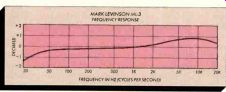
The frequency response was within ± 1 dB from 20 to 20,000 Hz, but our expanded-scale frequency-response plot shows a broad high-frequency rise (+0.8 dB from 6,000 to 10,000) and a slowly sloping low-frequency response (-1.25 dB at 20 Hz). These characteristics should be audible in a direct comparison with an amplifier that has flatter response.
The 1,000-Hz total harmonic distortion into 8 ohms was extremely low at normal home output levels, increasing smoothly from 0.0006 percent at 3 watts to 0.0015 percent at 10 watts and 0.014 percent at 300 watts (just before clipping occurred). The 4-ohm distortion varied from 0.0019 percent at 3 watts to 0.0165 percent at 350 watts. Even a 2-ohm load did not significantly increase distortion, which ranged from 0.0019 percent at 1 watt to 0.037 percent at 100 watts, the highest measurable power.
The amplifier's distortion across the audio frequency range (with an 8-ohm load) was under 0.002 percent from about 50 to 1,000 Hz at any power output, climbing slightly to about 0.005 percent at 20 Hz and with a steeper rise at the high frequencies. At rated power and half power, the distortion was about 0.01 percent at 3,000 Hz and just over 0.1 percent at 10,000 Hz. At one-tenth rated power the readings were 0.01 percent at 5,000 Hz, 0.025 percent at 10,000 Hz, and 0.2 percent at 20,000 Hz, all totally inaudible distortion levels.
--------------
----------------
Also see: