BULLETIN
by Christie Barter and Gordon Sell

AFFCC OKAYS STEREO TV
The FCC has authorized broadcasting of multichannel (stereo plus mono bilingual) tele vision signals. While the decision is a free market one in that it doesn't specify one system, the technical parameters are so tightly specified as to preclude all but the Zenith/dbx system that was chosen by broadcasters and electronics manufacturers.
Stereo/bilingual broadcasting is expected to begin by summer, and some stereo TV's and sound tuners are expected on the market soon after. . . . Sony has announced June availability of a stereo TV decoder to plug into its stereo-ready TV's, which have been on the market for four years. Price:
$200.
PRICE CUTS
The Moss Music Group has dropped the price on all of its MMG and Vox Cum Laude albums, both digital and analog, LP and tape, to $7.98. . . . And Telarc has cut the price of its LP's to $12.98. In the past Telarc's "high tech" digital recordings have sold for a suggested list price of $17.98, mainly through audio outlets. The new price drop is a move on the company's part to increase their availability in record stores.
Air TECH NOTES
Threshold has reached on agreement with Nakamichi to design a series of Nakamichi power amplifiers using Threshold's "Stasis" technology. . . . Universal Studios and Walt Disney recently petitioned the Supreme Court for another hearing on the Betamax case. The Court said no. . . . Harman Kardon is giving away up to twelve Maxell metal cassettes to buyers of new HK decks. . . .
Audio-Technica is now marketing its turntable isolators as devices to prevent CD player mistracking. . . . JVC will sponsor the Newport Jazz Festival to be held in Newport, R.I., this August. The company will also sponsor jazz festivals in France, England, and West Germany. . . . Sparkomatic is sponsoring a 100-city tour of the U.S., Canada, and Europe by the rock group Yes. . . . The West German government has approved a merger of Grundig with N. V. Philips of The Netherlands.
AV GOLD AND PLATINUM AWARDS
A computer at the office of the Recording Industry Association of America has been working overtime to compile a list of the best-selling records that received Gold or Platinum awards from the RIAA from 1958 through 1983. The peak year, according to the 271-page printout, was 1978, when 193 albums were certified Gold and 102 V Platinum. With 49 awards, Elvis Presley re mains the male vocalist with most certifications, and Barbra Streisand leads the females with 36. The top groups are the Beatles (46), the Rolling Stones (36), and the Bee Gees (27). Copies of the *bound, paperback report are available for $5 for postage and handling from Jennifer West, Gold and Platinum Awards, R/AA, 888 Seventh Avenue, New York, N. Y. 10106.
RCA DROPS CED VIDEODISC
RCA has decided to stop manufacturing and marketing its CED videodisc player. Sales never met the company's expectations, and RCA lost an estimated $575 million on the product. The company said, however, that it will continue to supply parts and service on the players and will make discs for them for at least three more years.
SPEAKING MY PIECE
by William Livingstone
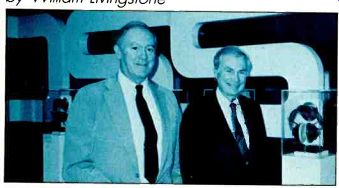
-----With hi-fi manufacturer John Koss at Koss Corp. headquarters in Milwaukee
STYLE
HI-FI pioneer Paul Klipsch is put ting together a collection of historic sound-reproducing equipment to display in a museum that will be an adjunct to the Klipsch speaker plant in Hope, Arkansas.
I've just donated my first cassette deck to the museum.
A Teac Model A-24, the deck is a sturdy little unit, and it's still in working order. I've had it so long I thought it must date back to the mid-Sixties, but the earliest mention of it I can find is in an ad in our December 1970 issue.
That ad boasts of an "outstanding" frequency response of 40 to 12,000 Hz. But you wouldn't have to check the unit's specs or performance to know that it is old-fashioned. Its appearance alone makes clear that in only fourteen years this deck has become an antique.
I've thought a good bit about changing fashions in audio equipment and how style affects sales.
Without reaching any conclusions, I've wondered how much our opinion of a unit's performance is affected by its visual appearance.
There have been studies about the way a man's choice of a car reveals his image of himself. What do you reveal about yourself if you respond to the industrial design of some units from VSP or Carver? Or to the Scandinavian styling of the Bang and Olufsen line? Or to the Darth Vader black equipment from, say, Yamaha or Nakamichi? I don't know, but when I recently hooked up a little B&W LM 1 loud speaker, I realized that besides re acting favorably to its sound, I responded aesthetically to its contemporary high-tech look. It fits perfectly with my new plan to turn my apartment into a cross between a SoHo art gallery and the trendy Minneapolis offices of the Canton speaker company, where all the furniture is white and everything else is black or gray except the plants.
This struck me as an original plan until I learned that half my friends are trying to make their homes look like offices or factories with mini malist high-tech decor. We are, it seems, influenced by Young Urban Professionals. In "Music for Yuppies" on page 54 I've written about some aspects of the life-style of these powerful trendsetters.
In a new column, "The High End," on page 106, Ralph Hodges writes about people in the audio world who resist mainstream trends and pursue their own goals. Style of a different sort is probably important at the High End, and I hope Hodges will address that topic.
Fourteen years from now the B&W LM 1 may look quaint in a glass case in a museum. For the present, though, I am enjoying it for its style as well as its substance.
NEW PRODUCTS
THREE-HEAD TEAC CASSETTE DECKS
The V-900X (shown) is the top of Teac's new line of three-head cassette decks. Its two-motor transport has a direct-drive capstan and microprocessor control for smooth tape handling. Dolby B, Dolby C, and dbx noise reduction are included, and the deck has a decoder for playback of dbx-processed records. An Auto Calibration feature optimizes bias and equalization automatically for the particular tape in the deck, and the same settings can be stored for later use. Standard factory settings for each tape type can also be selected. Convenience features include music search, memory play/repeat, auto fade, and facilities for remote control or timer activation.
Wow-and-flutter is rated at 0.028 percent, frequency response as 30 to 21,000 Hz, and signal-to-noise ratio as 92 dB with dbx. Price: $725.
The V-800X deck has many of the same features, including all three noise-reduction systems, but lacks Auto Calibration. Price: $599. The V-700, for $475, does not include the dbx system. Teac, Dept. SR, 7733 Telegraph Road, Montebello, Calif. 90640.
TWO-WAY AR CAR SPEAKER
An infinite-baffle two-way car speaker, the AR2CS from Acoustic Research has a 4-inch woofer and a 0.75-inch liquid-cooled dome tweeter. Frequency response is given as 65 to 32,000 Hz and nominal impedance as 4 ohms. The power requirements range from a minimum of 5 watts to a maximum of 100 watts on program peaks.
The rectangular frame of the AR2CS is made of black plastic with a black steel grille. It projects 1 1/8 inch above the mounting surface and fits into a 4-inch-diameter hole. External width is 5 15/16 inches, length 8346 inches. Weight is 3 1/3 pounds. Price: $199.98 per pair. Teledyne Acoustic Research, Dept. SR, 10 American Drive, Norwood, Mass. 02062.
HARMAN KARDON T-SERIES TURNTABLES
The three belt-drive, semi-automatic turntables in Harman Kardon's new T series have heavy particle-board bases to reduce vibration. Spring-isolated, foam-damped feet contribute to a fundamental suspension resonance as low as 4.5 Hz.
All three models have low-mass straight tone arms with carbon-fiber headshells.
Recommended tracking force is 0 to 3 grams. The nominal 33 1/3- and 45-rpm speeds can be adjusted up to ±3 percent for pitch correction.
An auto-lift feature on the two top models, the T-35 and T-45 (shown), optically senses the position of the tone arm at the end of play and raises it from the record. It must then be returned manually to its rest. The tone arm and headshell used on the T-35 and T-45 have a combined mass of 8 grams. Rated wow-and-flutter for both models is 0.04 percent, rumble (DIN B-weighted) 68 dB. The T-45 has gold-tipped phono cables, a disc stabilizer, and a trim control to match the impedance of the cartridge to the system's electronics. Prices: T-35, $235; T-45, $295.
Wow-and-flutter for the T-25 is given as 0.05 percent, rumble as 65 dB. Price: $185. Harman Kardon, Inc., Dept. SR, 240 Crossways Drive West, Woodbury, N.Y. 11797.
SPEAKER OPTIONS IN BOSE CAR SYSTEM
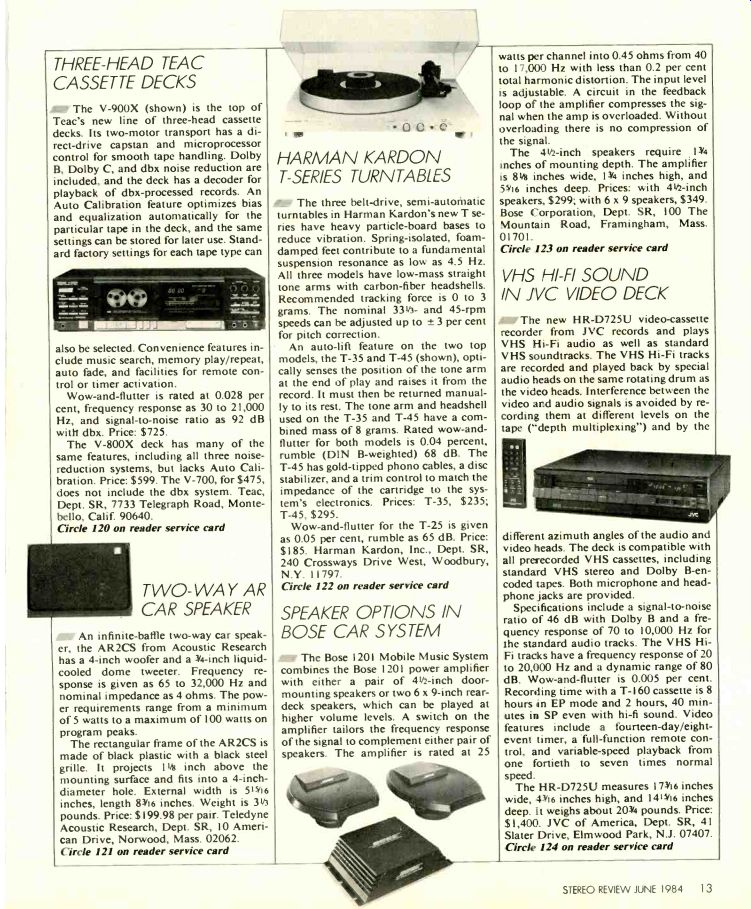
The Bose 1201 Mobile Music System combines the Bose 1201 power amplifier with either a pair of 4 1/2-inch door-mounting speakers or two 6 x 9-inch rear-
deck speakers, which can be played at higher volume levels. A switch on the amplifier tailors the frequency response of the signal to complement either pair of speakers. The amplifier is rated at 25 watts per channel into 0.45 ohms from 40 to 17,000 Hz with less than 0.2 percent total harmonic distortion. The input level is adjustable. A circuit in the feedback loop of the amplifier compresses the signal when the amp is overloaded. Without overloading there is no compression of the signal.
The 4 1/2-inch speakers require inches of mounting depth. The amplifier is _ inches wide, _ inches high, and __ inches deep. Prices: with 4 1/2-inch speakers, $299; with 6 x 9 speakers, $349. Bose Corporation, Dept. SR, 100 The Mountain Road, Framingham, Mass. 01701.
VHS HI-FI SOUND IN JVC VIDEO DECK
The new HR-D725U video-cassette recorder from JVC records and plays VHS Hi-Fi audio as well as standard VHS soundtracks. The VHS Hi-Fi tracks are recorded and played back by special audio heads on the same rotating drum as the video heads. Interference between the video and audio signals is avoided by re cording them at different levels on the tape ("depth multiplexing") and by the different azimuth angles of the audio and video heads. The deck is compatible with all prerecorded VHS cassettes, including standard VHS stereo and Dolby B-encoded tapes. Both microphone and head phone jacks are provided.
Specifications include a signal-to-noise ratio of 46 dB with Dolby B and a frequency response of 70 to 10,000 Hz for the standard audio tracks. The VHS Hi Fi tracks have a frequency response of 20 to 20,000 Hz and a dynamic range of 80 dB. Wow-and-flutter is 0.005 percent.
Recording time with a T-160 cassette is 8 hours in EP mode and 2 hours, 40 minutes in SP even with hi-fi sound. Video features include a fourteen-day/eight event timer, a full-function remote control, and variable-speed playback from one fortieth to seven times normal speed.
The HR-D725U measures 17 3/16 inches wide, Om inches high, and 141416 inches deep. It weighs about 2034 pounds. Price: $1,400. JVC of America, Dept. SR, 41 Slater Drive, Elmwood Park, N.J. 07407.
NEW PRODUCTS LINEAR-TRACKING ADC TURNTABLE
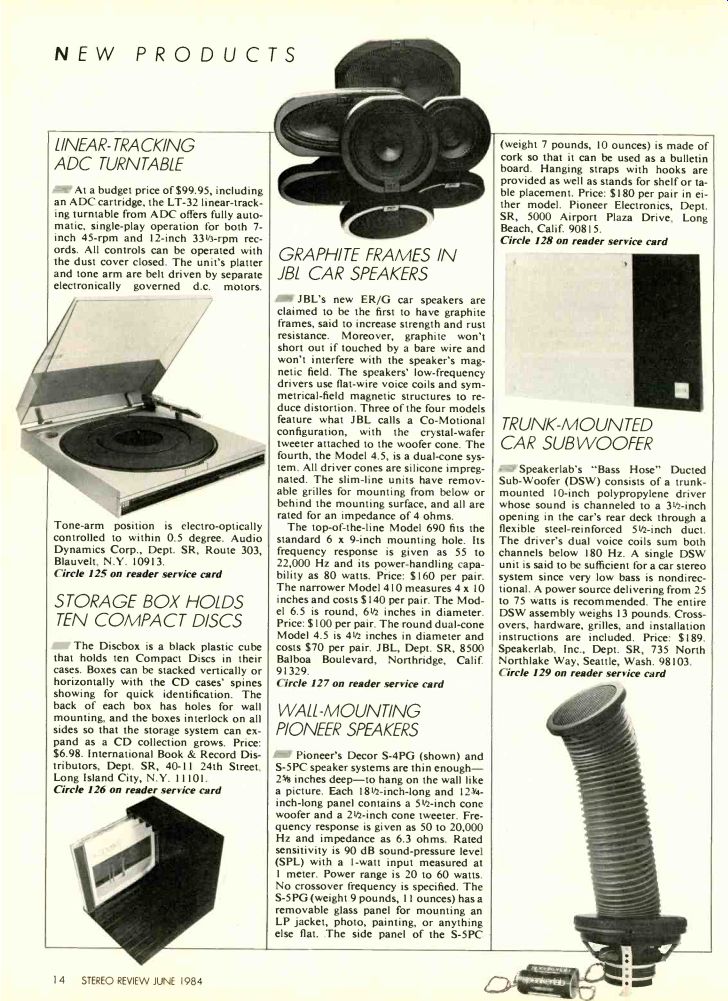
At a budget price of $99.95, including an ADC cartridge, the LT-32 linear-tracking turntable from ADC offers fully automatic, single-play operation for both 7-inch 45-rpm and 12-inch 33 1/3-rpm records. All controls can be operated with the dust cover closed. The unit's platter and tone arm are belt driven by separate electronically governed d.c. motors.
Tone-arm position is electro-optically controlled to within 0.5 degree. Audio Dynamics Corp., Dept. SR, Route 303, Blauvelt, N.Y. 10913.
STORAGE BOX HOLDS TEN COMPACT DISCS
The Discbox is a black plastic cube that holds ten Compact Discs in their cases. Boxes can be stacked vertically or horizontally with the CD cases' spines showing for quick identification. The back of each box has holes for wall mounting, and the boxes interlock on all sides so that the storage system can expand as a CD collection grows. Price: $6.98. International Book & Record Distributors, Dept. SR, 40-11 24th Street, Long Island City, N.Y. 11101.
GRAPHITE FRAMES
CAR SPEAKERS JBL's new ER/G car speakers are claimed to be the first to have graphite frames, said to increase strength and rust resistance. Moreover, graphite won't short out if touched by a bare wire and won't interfere with the speaker's magnetic field. The speakers' low-frequency drivers use flat-wire voice coils and sym metrical-field magnetic structures to re duce distortion. Three of the four models feature what JBL calls a Co-Motional configuration, with the crystal-wafer tweeter attached to the woofer cone. The fourth, the Model 4.5, is a dual-cone sys tem. All driver cones are silicone impregnated. The slim-line units have removable grilles for mounting from below or behind the mounting surface, and all are rated for an impedance of 4 ohms.
The top-of-the-line Model 690 fits the standard 6 x 9-inch mounting hole. Its frequency response is given as 55 to 22,000 Hz and its power-handling capability as 80 watts. Price: $160 per pair.
The narrower Model 410 measures 4 x 10 inches and costs $140 per pair. The Mod el 6.5 is round, 6V2 inches in diameter.
Price: $100 per pair. The round dual-cone Model 4.5 is 4 1/2 inches in diameter and costs $70 per pair. JBL, Dept. SR, 8500 Balboa Boulevard, Northridge, Calif 91329.
WALL-MOUNTING PIONEER SPEAKERS
Pioneer's Decor S-4PG (shown) and S-5PC speaker systems are thin enough--2.5 inches deep-to hang on the wall like a picture. Each 18 1/2-inch-long and 12.25- inch-long panel contains a 51/2-inch cone woofer and a 21/2-inch cone tweeter. Frequency response is given as 50 to 20,000 Hz and impedance as 6.3 ohms. Rated sensitivity is 90 dB sound-pressure level (SPL) with a 1-watt input measured at 1 meter. Power range is 20 to 60 watts.
No crossover frequency is specified. The S-5PG (weight 9 pounds, 11 ounces) has a removable glass panel for mounting an LP jacket, photo, painting, or anything else flat. The side panel of the S-5PC (weight 7 pounds, 10 ounces) is made of cork so that it can be used as a bulletin board. Hanging straps with hooks are provided as well as stands for shelf or table placement. Price: $180 per pair in either model. Pioneer Electronics, Dept. SR, 5000 Airport Plaza Drive, Long Beach, Calif 90815.
TRUNK-MOUNTED CAR SUBWOOFER
Speakerlab's "Bass Hose" Ducted Sub-Woofer (DSW) consists of a trunk-mounted 10-inch polypropylene driver whose sound is channeled to a 3 1/2-inch opening in the car's rear deck through a flexible steel-reinforced 5 1/2-inch duct.
The driver's dual voice coils sum both channels below 180 Hz. A single DSW unit is said to be sufficient for a car stereo system since very low bass is nondirectional. A power source delivering from 25 to 75 watts is recommended. The entire DSW assembly weighs 13 pounds. Cross overs, hardware, grilles, and installation instructions are included. Price: $189.
Speakerlab, Inc., Dept. SR, 735 North Northlake Way, Seattle, Wash. 98103.
TAPE TALK
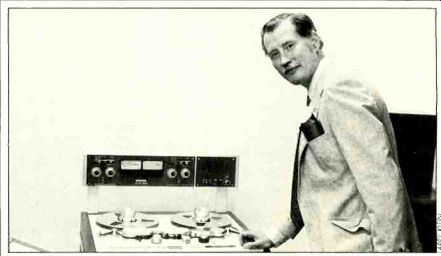
BY CRAIG STARK
EQ AND NR
Q. In columns where you've discussed Dolby noise reduction and tape-deck equalization you've mentioned that both involve boosting the high frequencies before the tape is recorded. But the first is supposed to reduce noise and the second is supposed to improve frequency response.
Does wider frequency response mean less noise, or what?
ROGER PEMBROKE
Los Angeles, Calif.
A. Actually, the wider the frequency response of a system, the more noise it includes, so your confusion is understandable. While both noise reduction and recording equalization use treble boost, they do so in different ways that are related to their different objectives.
In a noise-reduction system such as Dolby, treble boost during recording is matched by a complementary treble cut during playback. Further, the boost or cut is applied only to very low-level ("soft") signals. In contrast, the recording-equalization circuitry in a tape deck applies a treble boost to all the signals that pass through it regardless of their level. And the complementary playback cut is produced by losses incurred in the record/ playback process itself. These losses do indeed reduce noise, but they also reduce the musically important frequencies.
Looked at from another angle, once the record/playback response of the tape sys tem is flattened out using recording equalization, a Dolby-encoded tape is sonically over-bright (has too much treble) for very low-level signal components.
We can therefore afford to reduce noise by cutting the tape's low-level treble response back to normal, which is what Dolby decoding does during playback. If we didn't use sufficient record equalization, the tape would sound better without Dolby decoding.
DOLBY DUBBING
Q. I am thoroughly confused by conflicting advice from hi-fi salesmen on the subject of dubbing tapes with Dolby encoding. I use two cassette decks (both have Dolby B) to make copies from LP's.
FM broadcasts, other Dolby-encoded cassettes, and non-Dolby-encoded cassettes.
When should I use the Dolby system on my copying deck if I am dubbing from these various sources?
JOE GOTTESMAN
Beverly Hills, Calif.
A. If you want your tape copies to be Dolby B-encoded, always turn on the Dolby system of the copying (recording) deck. The tape copies will then require playback with Dolby-B decoding for correct tonal balance. That rule is enough for dubbing from discs or FM since only one deck is involved. When you are dubbing a Dolby-encoded cassette, turn the Dolby system on in both decks. This will result in decoding the playback signal and re-encoding it on the copying deck, which is the procedure recommended by Dolby Labs. For non-encoded cassettes, turn the Dolby system, if any, off in the playback deck and on in the copying (recording) deck.
If you want copies that are not Dolbyized-for instance, to play on a car sys tem or personal portable that lacks Dolby circuits-you should follow the same formulas as above, except that this time leave the Dolby system in the copying deck off.
Cartoons
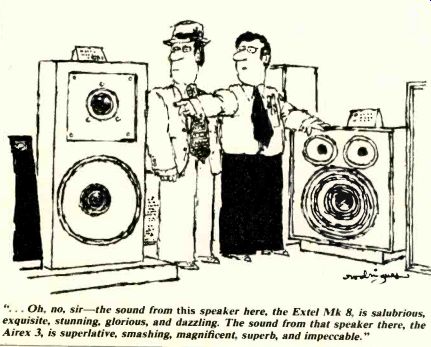
.. Oh, no, sir-the sound from this speaker here, the Extel Mk 8, is salubrious exquisite, stunning, glorious, and dazzling. The sound from that speaker there, the Airex 3, is superlative, smashing, magnificent, superb, and impeccable."
-------------
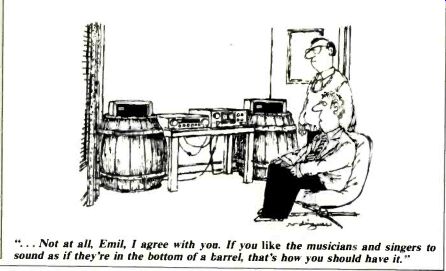
... Not at all, Emil, I agree with you. If you like the musicians and singers to sound as if they're in the bottom of a barrel, that's how you should have it."
THE HIGH END
BY RALPH HODGES
ORIGINS OF THE SPECIES
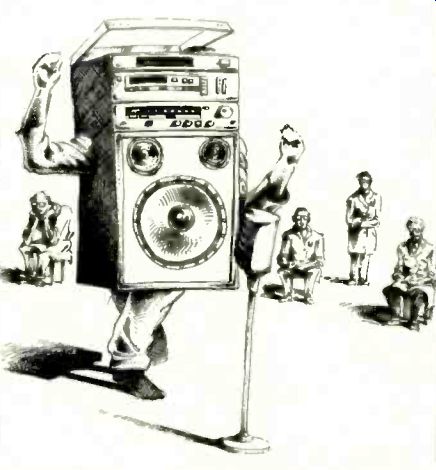
TODAY the vast bulk of home audio equipment is made on the assembly lines of large Far Eastern corporations, for profit. But way back in the beginning, the bulk and there was nothing vast about it-of high-fidelity equipment was made on workbenches in basements and garages, for love, or rather for the easement of frustration.
The Avery Fishers, Herman Scotts, and others who established the concept of high fidelity in this country did not initially have money on their minds. They had deep and urgent musical interests that could not be satisfied by anything then available in the appliance stores. So they built what they wanted themselves, for themselves.
But, of course, they had friends who also had deep and urgent musical interests, and before they really understood what was going on they were sucked into entirely new careers. The hi-fi industry was born, and, after some difficulty in educating the public, it prospered.
The so-called "high end" of the audio industry today is the lineal descendent of high fidelity's first flowering. Most of its manufacturers began as one or two people with a passion for music and a dissatisfaction with what they could buy to reproduce it. Most of them labored to please themselves first and the rest of the world later-maybe. Of course, they knew there was also money to be made. But money was not an adequate motivation for the work involved. Music was.
A few random examples: Jon Dahlquist once decided that the original Quad electrostatic loud speaker was the best midrange speaker he had ever heard, so he tried to build something that had that same midrange and some bass and treble as well. Bob Waterstripe and Steve Eberbach reasoned that a speaker with the cleanest possible response to impulse would sound better and be better, so they created the DCM Time Window. Mark Levinson believed that the finest materials and most imaginative but conservative engineering available had to result in a superior amplifier, so he invested heavily in both.
These engineers all became manufacturers, and they now probably spend more time at desks than at workbenches. But the high-end phenomenon keeps producing new comers to hone its cutting edge. For instance, Richard Marsh is a scientist at Lawrence Livermore Labs who wouldn't dream of being in the audio business full time, but he de signs amplifiers because he sees so many potential design refinements.
His partner, William Westerfield, is a former piano student whose hopes for a concert career were dashed by a bout with polio. Together they produce an amplifier, the Moraga 935, that reportedly will soon be in service at companies that could obtain any amplifier they wished.
Now, how was this amplifier, from a brand-new and extremely obscure supplier, chosen over dozens of much more likely contenders? Does it have more power, lower noise and distortion, more graceful overload characteristics, more sophisticated protective circuitry? Well, any and all of those factors could have been involved, but the bare fact seems to be that the engineers who made the selection did not really test the amp. They listened to it. And that's the way Marsh claims he designs an amplifier. He may get around to doing a few lab tests eventually, for curiosity's sake, but his overriding concern is how the device sounds. To quote him (loosely): "There are very few amplifiers around that won't pro duce good numbers in the laboratory, but at the same time there are very few good amplifiers. We're missing something. If the numbers won't get you where you want, it's pointless to cling to them." Several questions are immediately raised: (1) Why don't the numbers for distortion, noise, frequency response, power output, etc. tell us in advance how an amplifier will sound? (2) If they don't, are there other numbers that will? (3) If so, why don't those numbers appear in equipment reports? The answers, according to proponents of the high end, are: (1) Don't know. (2) Perhaps. (3) Their nature hasn't been identified yet. And the response of the high end to all these unresolved matters has been to for get about them and proceed with the task of making something that's pleasant to listen to.
MOST OF THEM LABORED TO PLEASE THEMSELVES FIRST, THE REST OF THE WORLD LATER MAYBE.
But what is "pleasant"? Another quote from another manufacturer: "If it doesn't sound like music, the genuine experience of music, then it's not perfected. If some people don't know what music really sounds like, let them buy what they wish. But I do know, and I've not been able to buy it in any audio store from here to Tokyo. Everyone claims that recording techniques, listening-room acoustics, you name it, are to blame, and I agree completely. But I'm also aware that the products I've come up with get me closer to what I want. If someone comes up with a reproduction sys tem that gets me all the way, I'll gladly retire. But not until." Amen.
Vintage ADs:
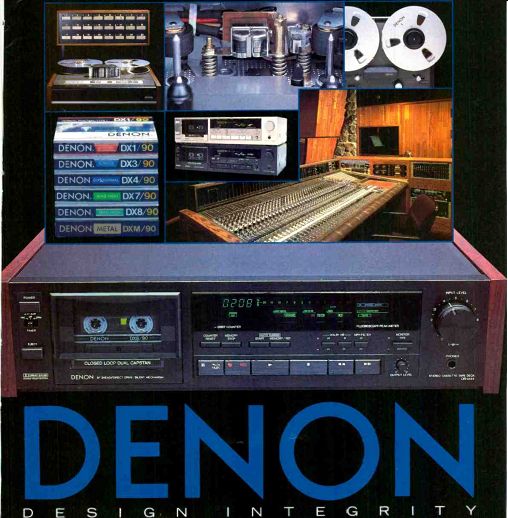
TO MAKE CASSETTE DECKS SOUND MORE LIKE OPEN REEL, YOU HAVE TO KNOW HOW TO BUILD OPEN REEL DECKS.
An audio cassette should be really no more than two miniature open reels in a case. It follows, therefore, that extracting “open reel-like" performance from cassettes will involve miniaturized open reel technology.
Denon has been producing open reel tape and tape recorders for over 25 years. Not simply 1/4" machines, but 24-track 2' studio machines. This open reel technology helped Denon became one of Japan s largest recording companies and a prime supplier of--equipment to Japanese recording studios and radio stations.
It also led to the Non-slip Reel Drive Motor and Closed-bop DENON DX4/90 DENON
DENON METAL DXM/90 DENON DX8 90 CLOSED LOOP DUAL CAPSTAN DENON
Dual Capstan technologies found on Denon's DR-M33 and the DR-M44
Three-head Cassette Decks. Similarly, the outstanding audio performance of these decks car to attributed
Denon's electronics experience
-----------------
The Easiest Way to Perfect Reception.
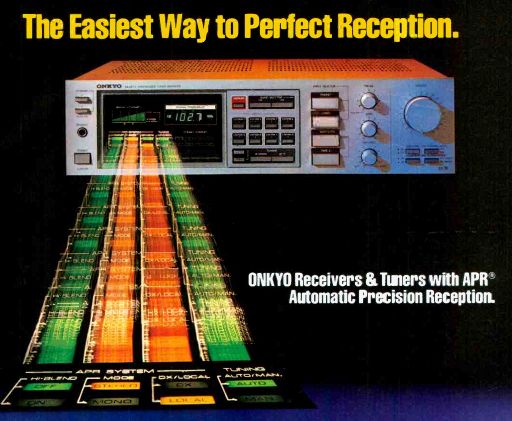
ONKYO Receivers & Timers with APR Automatic Precision Reception.
Onkyo s new receivers and tuners with Automatic Precision Reception guarantee the best FM reception possible.
And. that s a fact you can hear for yourself.
Our test bench photo shows how all tuners re performance verified. Special equipment generates FM test tones and sends them via cable to the test unit.
Unfortunately, this does not take into account actual reception conditions like distance. local terrain. buildings and antenna type.
Conditions that definitely affect a tuners performance.
Onkyo's special APR circuitry prevents these real world problems from interfering with your listening enjoyment. As each station is tuned the microprocessor controlled APR system automatically analyzes the incoming FM signal and controls the most important reception modes: It Cal distant input sensitivity, stereo/mono and Automatic High Blend on off, all in a fraction of a second. Or other tuners and receivers. you may have to make these adjustments yourself as each station is tuned.
Compare the ease of tuning Onkyo's APR system offers with conventional tuner design. … see why APR is really the easiest way to perfect reception
ONKYO---Artistry in Sound 200 Williams Drive. Ramsey. NJ 07446
-------------------
Seek, Scan, Digital, Dolby and more...
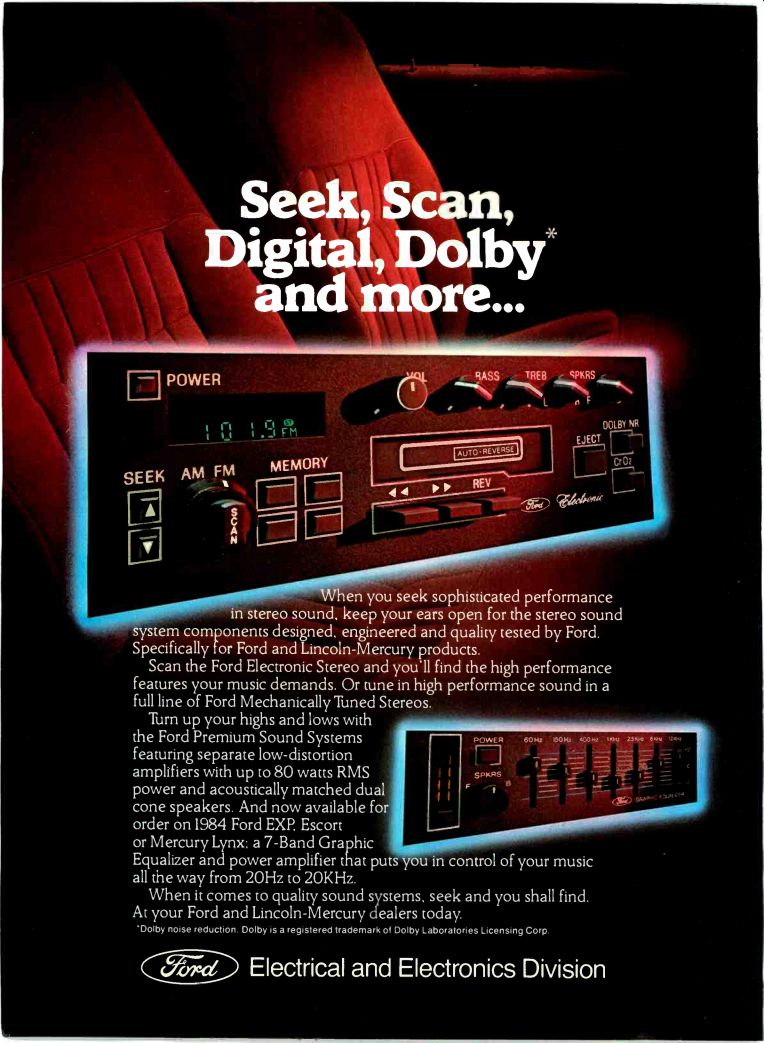
SEEK AM FM MEMORY: When you seek sophisticated performance in stereo sound. keep your ears open for the stereo sound system components designed, engineered and quality tested by Ford.
Specifically for Ford and Lincoln-Mercury products.
Scan the Ford Electronic Stereo and you'll find the high performance features your music demands. Or tune in high performance sound in a full line of Ford Mechanically Tuned Stereos.
Turn up your highs and lows with the Ford Premium Sound Systems featuring separate low-distortion amplifiers with up to 80 watts RMS power and acoustically matched dual cone speakers. And now available for order on 1984 Ford EXP. Escort or Mercury Lynx: a 7-Band Graphic Equalizer and power amplifier that puts you in control of your music all the way from 20Hz to 20KHz.
When it comes to quality sound systems, seek and you shall find.
At your Ford and Lincoln-Mercury dealers today.
Dolby noise reduction. Dolby is a registered trademark of Dolby Laboratories Licensing Corp 604: 150, Electrical and Electronics Division
----------------
---------------
Also see: