CAR STEREO--The first road test of AM stereo: Chris Greenleaf puts the Sansui CX-990 through its paces.
BY CHRISTOPHER GREENLEAF
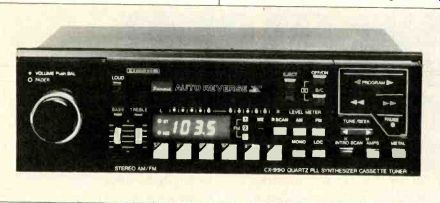
THE FIRST AM STEREO ROAD TEST
FOR years I've been hearing about and writing about the promise and problems of AM stereo broad casting, so you can imagine how ex cited I was when Sansui offered me the chance to be the first audio journalist to test drive a car equipped with its AM stereo receiver. In spite of my excitement, I was not overly optimistic. I suspected that AM stereo would have typical 3-k Hz bandwidth AM sound but with two channels-stereo, but hardly high fidelity. Was I wrong!
WHY AM STEREO?
AM stereo was born of the needs of the AM broadcast stations, which have been losing listeners to FM because music sounds a lot better on FM than on AM. If AM stations could get those music listeners back, they could earn more from advertising, and AM's greater range (typically 150 miles instead of 30 to 50 miles for FM) would mean even bigger markets. And AM doesn't suffer from multipath interference, at least during the daytime, which is a big plus for mobile listening. On the negative side, AM has a narrower bandwidth and more noise. Proponents of AM stereo say these problems can be largely overcome with the use of better broadcasting equipment and higher-quality receivers.
But AM stereo has not gotten off to a very good start. It was first pro posed in the middle Seventies, and various manufacturers developed different schemes for transmitting it. At one point the FCC chose a sys tem developed by Magnavox but later revoked the decision. In March 1982, the FCC announced a "free market" decision, which allows broadcasters to use any type of AM stereo system as long as it is compatible with and does not interfere with the standard mono AM signal.
As a result, we now have four different systems-from Motorola, Magnavox, Harris, and Kahn-competing for dominance in the transmitting-equipment market. There are hundreds of radio stations all over the country using one or another of these systems, but very few radios are capable of receiving AM stereo.
Sansui's CX-990 ($519) can de code all four types of AM stereo broadcasts automatically, so the user doesn't have to be concerned with which system is being used.
And in addition to receiving AM in stereo or mono, the CX-990 has an FM stereo tuner and an autoreverse cassette player.
THE ROAD TEST
Our normal car stereo test route is geared for evaluation of FM and tape-player performance, so we went further to test AM stereo. The route extended from nearby Brooklyn to the hills and hollows of the Berkshire County townships in western Massachusetts. Our main test station was New York City's WNBC, broadcasting from a tall mast on City Island in the Bronx, right on Long Island Sound in a relatively clear area. At our greatest distance we were 125 miles from the transmitter. The route also included areas within a hundred yards of the transmitter, streets with line-of-sight reception, and urban locations completely cluttered with structural steel or reflective surfaces.
The Sansui CX-990 has just about the nicest AM section I've heard.
AM STEREO IS RECEIVABLE AT GREAT DISTANCES, AND THE SIGNAL HAS NONE OF THE RECEPTION QUIRKS OF FM BROADCASTS.
Most AM car radios (or the AM portions of tuner/tape players) have such a constricted tonal character that it is virtually impossible to hear any differences between individual broadcasters. The Sansui, in contrast, sounded open and spacious, showing that AM's limitations are not necessarily as great as we've been told. The inevitable prejudices that long-time FM aficionados bring to AM listening may be partly based on fact, but the qualitative gap separating a good AM broad caster from a lousy one is surprisingly wide. This tuner made that gap audible. WNBC was easily among the best two or three stations on the AM dial, and it sounded substantially better than a large percentage of the FM stations I tried.
Since WNBC broadcasts in AM only, the only available choice for an A/B comparison of AM and FM stereo was classical station WQXR, which simulcasts from the Empire State Building. Both WNBC and WQXR-AM use the Kahn system of AM stereo encoding-at the time of our test no broadcasters in the New York area were using the Harris, Motorola, or Magnavox systems.
Unfortunately, WQXR's AM signal was so noisy and constricted in frequency range that comparisons with the FM broadcasts were virtually meaningless.
At least as broadcast using the Kahn system, AM stereo is receivable at great distances. Unlike FM stereo, an AM stereo signal can be decoded for stereo listening wherever the signal can be received at all.
There is little difference in noise level between mono and stereo, and the signal has none of the reception quirks of FM broadcasts. The familiar narrow frequency response and higher overall noise level of AM are still evident, but a quality-conscious broadcaster can make them much less inhibiting for listening to music than you might expect.
WNBC's broadcasts had satisfying amounts of bass and treble, and the stereo imaging was rock solid.
SANSUI'S CX-990 HAS ABOUT THE NICEST AM SECTION I'VE HEARD. UNLIKE MOST
Local and short-distance listening was invariably clean and unencumbered by interference except in tunnels or near sources of unshielded electrical discharges (such as welding crews doing road work). Distant and very distant listening was clear about 90 percent of the time, and the slightly impaired remaining 10 percent was still listenable. To appreciate this, remember that the typical maximum distance for clear reception of FM in mono is about 60 miles, compared with 125 miles or more for AM stereo. For listenable FM stereo, 20 to 30 miles is usually about the limit in a car.
Overall, the performance of the Sansui CX-990 with AM, FM, and tapes was smooth and always musical. We expect that its AM stereo decoder will work as well with any of the other formats as it did with the Kahn-system broadcasts we were able to audition. We look for ward to repeating our road test of AM stereo when there are more broadcast sources to try out.
++++++++++++++++
ADs:
=============
---------------
Also see: