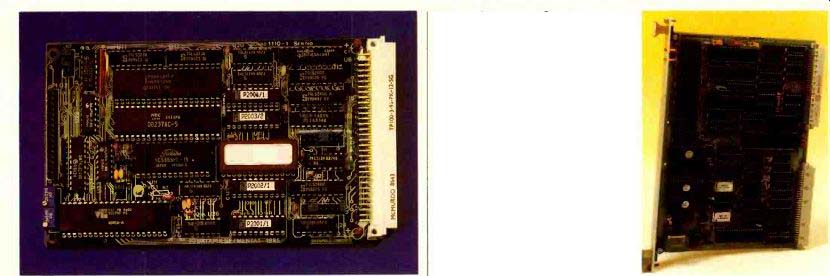
High-performance STEbus disc controller
An intelligent floppy disc controller is able to control up to four drives over an STEbus.
Based on Western Digital's control i/c, the FDC-1110 incorporates an 8085A-2 c.p.u. and an 8237A-5 memory access controller for local processing and high-speed data transfer. The board communicates with bus masters over the STEbus through a simple two-byte slave interface.
In addition to the 2797 controller, there are software-controllable input/outputs to the disc interface.
These make it a simple matter, the makers say, to control the 5.25in drives directly without having to modify the interface cable.
Data rates supported are 125, 250 and 500Kbits/s.
The FCD-1110 has provision for an eprom up to 32Kbyte and static ram up to 32Kbyte forming a 64Kbyte local memory. The STE interface, FDC interface and the d.m.a. controller all lie within the i/o space of the processor, whilst the memory controller configured for memory-to-memory. STE-to-memory and FDC-to-memory transfers.
Provision of these features allows management algorithms to be executed locally, while the STE master processor boards can be executing other code. This reduces bus overhead since only simple command sequences are required between the FDC-1110 and the STE bus masters.
The STE interface consists of a data byte and a status byte within the STE i/o address space. Data transfers over STEbus may be software-polled by monitoring the status register.
With the local d.m.a controller running from a 4MHz clock it can transfer data between local memory and the STE interface at 1.3 Mbytes/s.
Datapulse Ltd, Tel: 0491 571955.
Stepped packaging for STE Latest item in Dean Microsystems STEP system is the STEP-1-SUB, a 3U by 84E self-contained 10-slot sub-rack in which the backplane containing mains input and i/o connectors is an intrinsic part of the assembly. This means that the rack can be removed from the front of an enclosure without the need to disconnect the wiring.
The STEP (STE Packaging) system has been developed to make life easy for STE users. It is a standard packaging system, that calls up all the options essential to the STE user, from power supply to disc drives.
It's unique feature is the stepped front in which the extrusions have been stepped by 60mm to allow board to be set back with room for front access i/o cabling to be routed to the rear, whilst disc drives can be located forward of the boards.
Kemitron adopt STEbus
Kemitron have chosen STE for their data acquisition and control systems because it is the only international standard bus that specifies a double eurocard option. The format has two advantages: the second connector may be used for i/o connections, and the larger area allows more facilities per board.
With single eurocards, the front of the board is generally used for signal termination and the front panel holds the connectors. If i/o is routed o the rear of the system, ribbon cables are laid across the front of other boards in the rack making hem difficult to withdraw.
In the Kemitron design, input or output signals are taken via the second connector. From here ribbon cable runs directly to panels on the rear of the system. This allows the front panel to be used for led indicators and the whole board can be unplugged without affecting any connections.
A secondary advantage of double eurocard is its size. This is greater than that available on two single eurocards since one STE interface is saved and there is a free area in the middle of the board. Kemitron say hat one double eurocard can replace at least three, usually more, single eurocards.
One of Kemitron's first boards which takes advantage of the double eurocard design is a processor card with Hitachi's 6MHz 64180, 768ram, dma, four serial channels, floppy and hard-disc interface, maths processor, counter/timer and r.t.c. with battery.
Two interface cards are also available which are a 64/32 channel analog input with eight analog outputs and a 32-channel opto-isolated input/output board with 10-channel c.t.c.
Two CP/M 3.0 systems are also available. Dubbed STE/RIO, the name reflects the STE bus, Rear I/O and the double eurocard format.
STE-based computer uses 64180
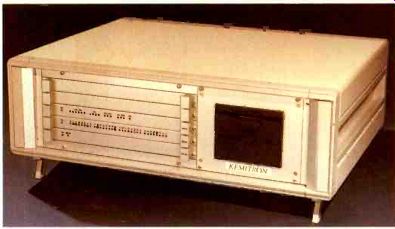
Unlike most STE computers, the STE/RIO system accommodates five horizontally-mounted double eurocards, which approach facilitates the routing of i/o signals to the rear of the case. Board front panels are then free for led indicators and each board may be unplugged from the front of the rack without disturbing plant connections.
The front of the integral 19in by 3U rack holds the five slot backplane and a disc-drive module. Several disc options are available including 3.5, 5.25in floppy and hard discs, all supported by the CP/M 3.0 operating system.
The 64180 processor is used on the processor card. Its double eurocard design allows the card to contain all the essential system-level features such as 768Kb memory with d.m.a. four serial channels, maths processor, counter timer, watchdog, real-time clock, Floppy-disc controller hard-disc interface and the STE bus.
A selection of i/o boards is also available which includes a 32-channel digital input/output/ counter/timer card with feedback sensing and opto-isolation, as well as a 64/32 channel single-ended or differential analog input/output card with sample and hold amplifier.
Kemitron Limited, Tel: 0244 536123
NEW PRODUCTS--Computers
High-speed eprom programmer Newly launched is the G-Stack an addition to the Elan Universe 1000 Universal Programmer range. It incorporates 32-pin zif sockets, enables up to eight devices to be programmed concurrently either in sets or in gang (all identical) arrangements. The set mode for a single G-Stack allows expandable data set sizes of two to eight concurrent devices from 8 bit through 16, 24, 32, 48 to 64 bits wide. For higher production requirements, two C-Stacks may be linked together in a Universe 1000 to program up to 16 devices at a time in either sets or gangs. This would allow one set of say eight eproms to be programmed whilst another set is being loaded/unloaded and labeled.
Label printing output to a printer is included. The control of the Universe 1000 operation is carried out by its Master Control Unit (m.u.c.) which may be connected by the system's parallel bus to any selection of "stacks" including those needed to program pals. IFLs, bipolar proms etc. Only the top stack is fixed; the lower stacks are all motorized with a simple reliable mechanism to move forward or retract under m.c.u. control so that the operator is clearly directed to use the correct stack and socket for the device selection.
G-Stack can handle 28-pin devices up to the latest 1MB Intel 27011 EPROMS as well as the 32 pin 1MB versions from Intel, Fujitsu and Hitachi. New algorithms may be easily added by cartridge replacements.
68020 emulator
An in-circuit emulator for Motorola's 32-bit processor has been produced by Applied Microsystems, the first to do so apart from Motorola themselves. The EP68020 module allows full emulation at up to 12.5MHz, and is used in conjunction with an ES1800 stand-alone emulator. Together they provide real-time analysis of all bus and control signals, with full-width address and data buses, by using trace modes. The trace memory allows the capture of 2046 words of 72-bit processor cycles to reveal what is actually happening. The patented events monitoring systems enables the user to control the emulation by setting the break vector on any combination of address, data, status, pass counter and logic state. An event or combination of events can be defined by logic statements and then used to break emulation, trace software sequences, count events or trigger outputs.
Bubble memory for VME bus
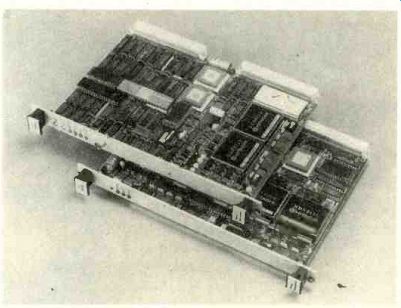
An intelligent bubble memory has been developed by Plessey for the VMEbus. The memory is totally non volatile, without the need for battery back-up. It has no moving parts, is insensitive to adverse environments, and provides a high level of reliability. This results in a longer operating life and completely maintenance-free operation. The system comprises a master card (PME BB-IM) containing 1Mbyte of memory plus control logic, which may be configured with up to 8 Slave cards (PME BB-IS), each providing an additional 2Mbytes. In total, the sub-system offers up to 17Mbyte of storage. BB-1 implements standard SCSI-type commands and supports VME transfers at up to 2.6Mbytes/s on read cycle and 3.6Mbyte/s on write operations. Bubble access takes, on average, 11 ms; 8 and 16-bit transfers are supported and the memory base address is user-selectable within a 4Gbyte address space. Applications include process control and automation, offshore equipment, mobile systems and embedded applications.
Disc drive for IBM compatibility
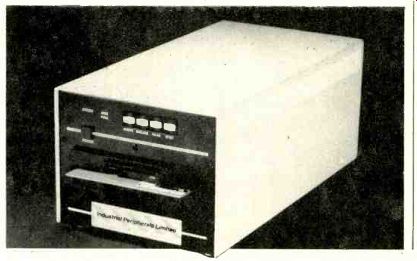
An intelligent disc drive has been developed which will allow data loggers, instruments and any other device with RS232c interface, including other computers, to generate discs compatible with the IBM-PC. The T14, as it is called, receives data on one of its RS232 ports and stores it on a PC-DOS disc.
The disk may then be used to transfer the data to an IBM-PC. Disks written by the PC can be read by the device connected. The internal software enables the 114 to operate in 'remote' mode; commands can be sent from the host device to give a directory, write files, erase files, read files, rename files as well as controlling the unit. In addition to converting data into IBM format, the unit can be used as a complete disc operating system for devices without one and can be used, for example as a printer replacement for data loggers and remote test and instrumentation sites.
Other models in the range include a PC-AT compatible version, twin discs and an intelligent tape drive with 3.8 or 15Mbytes of storage.
Industrial Peripherals Ltd.
8-bit one-chip Microcomputer Expanding its range of 8048 and 8049 single chip microprocessors, Toshiba introduces a 4Kbyte rom c-mos 80050A device in a 40 pin dil or 44 pin flat package.
The 8 bit TMP 80050A is made in Silicon gate c-mos which enables low power consumption during normal operations of 10mA at its fixed supply of +5V and frequency of 6MHz. A stand-by mode reduces current consumption 104 maximum. On the chip is an 8bit c.p.u, 256byte ram data memory, 4Kbyte rom program memory, 27 I/O lines and an 8 bit timer/event counter. Another version, the TMP 90C40A may be supplied without the rom program on chip. By using this chip with an external eprom or ram software debugging is made easy. Instruction cycle time for both devices is 1.3611,s for temperatures between 0 and 70°C Software is upwardly compatible with Toshiba's TMP80C49AP/ TMP80C49AP-6 or Intel's 8049.
Hard drive with s.c.s.i. interface Including an s.c.s.i. controller in the circuit of a hard disc drive simplifies interfacing and reduces space requirements. The Mini Scribe 8425S 3.5in drive includes a standard s.c.s.i. controller but drives with a custom interface are also available.
When formatted, data capacity of the half-height 8425 is 21.3M-byte. A single PCB with surface-mounted components is used so the drive consumes only 12.5W. Average access time is 68ms and data is transferred to the host at up to 1M-byte/s.
68000 emulators
Plug-in pods for the emulation of 68000/68010 and 68008 processors are available for the Position SDT (symbolic debugging tool). The pods offer full emulation at the maximum rated clock speed (16MHz). The STD consists of a 8/16-bit universal control unit built around a Z8OB processor with its associated memory. Additional ram boards fit inside the controller for real-time trace overlay operations. The emulation is performed by a second dedicated processor, housed at the target-board end of the pod cable.
The system can be used with most development systems, many computers and terminals and Position's own Technical Development Computer.
Video workstation

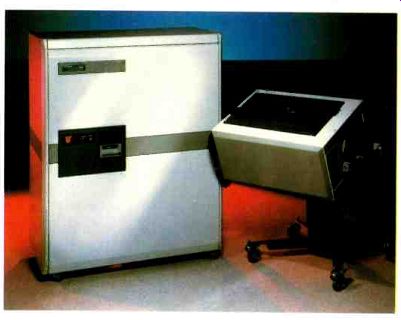
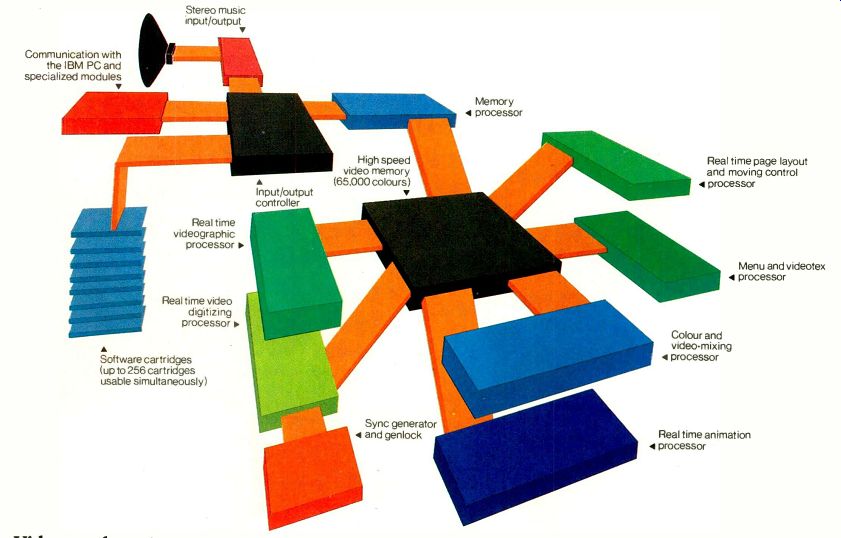
This compact all-in-one video workstation brings to small studios a package of image creation and manipulation tools which until now have been restricted to much more lavishly-equipped production centers.
Once digitized by the system, an image can be retouched using textures and colors selected from within itself; it can be mirrored, deformed, dissolved, multiplied, or turned into a mosaic. Moving pictures can be captioned, colorized artificially, inlaid and manipulated with a wipe effects generator, all in real time. Up to four video sources can be handled; Pal, Secam or NTSC, with automatic genlock on each. The makers plan to offer still more effects later by means of plug-in cartridges.
Besides video effects, the unit also has a facility for page layout and for creating and editing business graphics: with the addition of an extra module, results can be turned into a photographic slide with a resolution of 4,000 by 4,000 pixels.
The system is based on seven dedicated processors, with an open architecture which allows the user to add further applications modules or to control it from existing equipment--for example, an IBM PC.
The De Grafe Silver Workstation is made in France and distributed in the UK by Bell & Howell (telephone 01-902 8812). Prices for a complete system are in the range of £ (x1.34 for $) 10,000- £ (x1.34 for $)15,000, which includes all updates or new versions of the integrated software for five years.
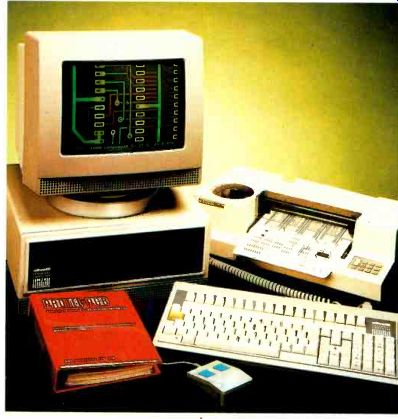
Pcb design on a PC (including Amstrad) The major new features of the Quickpad 1.1 PCB design package from Conguin Software, which runs on an IBM PC, include Block Move, Block Copy and Block Save commands. It has 126 pad and track sizes, ranging from 0.002 to 0.254in, a maximum board size of 32in. square and mass change commands for track and pad sizes. Other improvements over its predecessor are faster screen refresh times and the ability to generate silk screen images directly. Camera-ready artwork can be produced at up to eight times full size on a dot-matrix printer and a wide range of pen plotters. The system can be used on an IBM XT or AT computer and a version is being developed to run on the GEM-based Amstrad 1512 PC.
The company are offering complete low-cost workstations centered around the Amstrad PC. An IBM evaluation disc offers the full facilities but will not plot the result (Conguin will produce one free double-sided plot as a gesture of good will). This comes with the full user manual and costs £ (x1.34 for $)36.50 while the complete package, including a mouse, comes to £ (x1.34 for $)995.
Graphics controllers
A family of high performance graphic display controllers is manufactured by Control Systems Inc. and distributed by KGB of Windsor.
Designed to work with IBM AT and high resolution monitors the 'Artist' board is expected to become a standard graphic enhancement for the operation of computer design software, such as AutoCAD, on the IBM micro.
The Artist series comes in a range of six models depending on the application and supports 42 software products, including all the major graphic and c.a.d. vendors using personal computers, including Autodesk with AutoCAD, Calcomp with Cadvance, and Computervision with Personal Designer.
The Artist range starts with the Monochrome 1024 by 768 Resolution Board at £ (x1.34 for $)695, through to the Artist 101024 by 1024 Resolution in 256 colors at £ (x1.34 for $)2095.
8-bit video-speed a-to-d
A bipolar monolithic, video-speed 8-bit flash a-to-d converter comes from Datel, the ADX-300 It is capable of digitizing an analog signal at conversion rates up to 20MHz, yet the device's maximum power dissipation is 700mW. A serial/ parallel technique is employed to obtain high conversion speeds using a single-5V power supply. The analog input range is 0 to-2V, with-2V ref, and digital inputs and outputs are e.c.l. compatible. The outputs are buffered and provide an open emitter. The ADC-300 is designed for use with an external sample-and-hold amplifier together with external clock and reference source. The device features maximum non-linearity of ±0.5 l.s.b. and maximum differential non-linearity of ±0.5 l.s.b. The ADC-300 is ideally suited to applications requiring a combination of high speed digitization and low power including high-speed data acquisition, radar pulse analysis and optical character recognition.
Datel UK, Tel: 0256 573675.
------------
Also see: Electrometer amplifiers for sub-pico-amp currents
RADIO BROADCAST; TELEVISION BROADCAST; RADIO COMMUNICATIONS
==========
(adapted from: Wireless World , Jan. 1987)