IN EVERY CONSTRUCTION PROJECT that awful moment arrives when you must finally plug the thing in and turn it on: my efforts were wasted if Tigersaurus couldn't perform. To the accompaniment of sweaty palms and weak knees, I plugged in the amps one at a time and gradually brought them up to full power with a variac. No smoke.
Next I tried plugging them directly into the AC line and turning them on to see how they would withstand the power up surge. No problems, good voltages everywhere, I was exhilarated.
Settling down to make adjustments and bench tests, I realized the Tigersauri were practically twins-without some way to tell them apart there would be confusion and mistakes on the bench. The amps were identical except for their output devices. I designated the one with 2N6328/6331 out puts as Unit A; Unit B had the MJ802/ 4502 devices. I adjusted R53 in both amps for a meter indication of 100% using a 1kHz/40V RMS sine wave out put across an 8 ohm resistive load. These adjustments went smoothly.
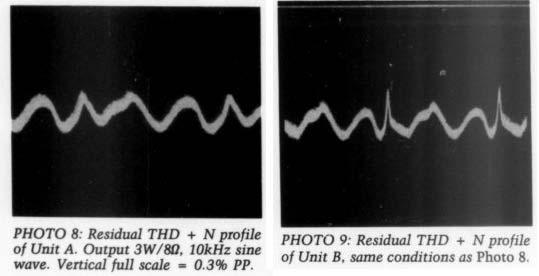
PHOTO 8: Residual THD + N profile of Unit A. Output 3W/82, 10kHz sine wave. Vertical full scale = 0.3% PP. PHOTO 9: Residual THD + N profile of Unit B, same conditions as Photo 8.
Then I adjusted the R22 bias pots for lowest crossover notch while monitoring a 10kHz/5V RMS sine wave output on the Ramsey' oscilloscope. Dan Meyer recommended this procedure in his article.! Later when I performed noise and total harmonic distortion (THD) measurements I found these original settings caused large crossover spikes in the THD residual profile.
Dan's article also suggested another procedure for bias adjustment using an intermodulation distortion (IMD) analyzer. I tried that and consistently over shot the setting, ending up with blazing heatsinks, high output noise and a tendency toward oscillation and instability. Reeling with frustration, I realized that bias setting in these amps was going to be a ticklish affair that required balancing the conflicting requirements of low noise, low heat, and low distortion. I decided THD measurements offered the best “handle” on the problem but wasn't quite sure how to go about it.
Starting Point
I ended up using a modified version of Fred Gloeckler's procedure! in which he first calibrated the scope display with the test signal fed from the THD analyzer. Fred used 2kHz, but I decided to stick with the 10kHz Dan Meyer recommended. I also retained the 3W (5V) output level he suggested for the IM procedure. I reasoned that a good starting point from which to seek the ideal set ting would be the one where the cross over spikes' amplitude matched the overall intensity of the rest of the distortion profile.
From there I reasoned I could back off to allow higher distortion in exchange for lower noise or heat, or I could apply more bias to achieve lower distortion as heat and noise would permit.
Photos 8 and 9 show that my choice of a starting point was fortuitous, as it turned out to be close to the ideal set ting. In Unit A, applying additional bias from the starting point setting gave a rapid increase in output noise and heat without a significant THD improvement; my starting point coincided with the ideal setting and caused the heat sinks to idle moderately warm.
In Unit B my starting point setting produced excessive heat, so I had to back off a little. Reduced bias brought down the heatsink temperature to a moderate level but resulted in slightly higher crossover notch and THD than Unit A. However, lower bias also resulted in slightly better noise performance than Unit A. Final bias current setting in both amplifiers was approximately 600mA/rail; my results are summarized in Table I.
After I had completed bench tests and a listening evaluation I rechecked the bias settings and found they had drifted slightly toward higher distortion. I reset bias controls in both amps
[33]
Twisting the Tyger's Tail
Adjustments completed, I set about conducting some bench tests. I was curious to see just how far I could push The Beasts before they turned on me.
For openers I ran standard FTC preconditioning tests!! using an 8 ohm resistive load. Both units passed without problems, though their heatsinks became uncomfortably hot during the test.
Next I wanted to see what the full power (clipping power) frequency response looked like. (For these and all subsequent tests I fitted the amps with oversize output fuses.) In this performance area the two units were essentially identical, being within a few watts of each other all across the spectrum.
The composite curve of Fig. 3 represents the clipping response of either unit with in the range of my experimental error.
Polished and refined as they now appeared, when it came to delivering clean, raw power these amps were still savage brutes, besting their 200W specification by a wide margin.
Due to my test equipment's limitations I was unable to produce a full power response curve for a 4-ohm load, but I did spot-check the 4 ohm output of both units at 1kHz. Results were impressive:
Unit A clipped at 358W output while B did slightly better--363W. The modest 4-ohm power claim of 250W didn't do justice to this kind of performance.
Some minor mishaps occurred during these full-power tests. In both amps I “smoked” R46 with full power out put at 40kHz. Upgrading this fixed composition 10 ohm 1W resistor to a 2W wirewound type enabled me to safely complete the high frequency tests. A more serious incident occurred when I commenced full-power testing of Unit B. As I increased the input signal level to B the output rose only to about 4V and stayed there despite increasing in put level, and the amp began to physically tremble on the bench.
Short Circuit Posthaste
I reduced the signal level, but it was already too late: fuses were pop ping and smoke was curling up. With great concern I looked over my test setup and discovered the output con nections were reversed, causing a short circuit (did I do that?). Damage to the amp was relatively minor-both supply ...
TABLE 1
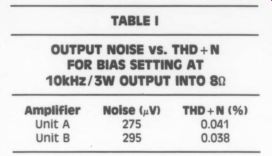
OUTPUT NOISE vs. THD +N FOR BIAS SETTING AT 10kHz/3W OUTPUT INTO 80 Amplifier Unit A Unit B Noise (.V) 275 295 THD +N (%)
... fuses blown, R27 smoked, and output devices Q18 and Q22 shorted.
When I pulled the blown outputs I found they were the "PECOR" MJ4502s. Maybe it was coincidence, but it aroused my suspicion. On my curve tracer these two transistors had passed the same stress test to which I subjected all the output devices prior to mounting. However, my curve-trace tests don't give an indication of the gain-bandwidth response, and I believe the failed outputs must have been deficient in that regard. I had driven the amp into hard clipping which produces high-frequency/high-amplitude harmonics well into the RF spectrum, and these devices apparently couldn't handle the RF overload.
All the other undamaged outputs were Motorola devices. I ordered new outputs (Circuit Specialists), this time specifying Motorola. After installing the new transistors and replacing the other damaged components I observed no change in the bias setting, and my reported data for Unit B is for the all Motorola version. Annoying as this incident was, it actually endeared the amps to me. You can't help admiring an amp that pumps out 4V across a dead short.
From a 6009 source, input sensitivity was 1.77V for Unit A and 1.81V for B, for rated 200W output into 8-ohm. These figures are substantially better than the specified value of 2V and indicate Tigersaurus delivers about 27dB of gain at rated output.
POWER ( WATTS)
Noise
The output noise measurements with shorted input were about the lowest I've ever measured. The output noise pro file of Tigersaurus on the oscilloscope was essentially identical for both amps and consisted mostly of 60Hz line volt age harmonics modulated by low-level high-frequency hash. Noise voltage figures in Table I translate into unweighted S/N ratios of about 103dB below rated output, a figure which would probably improve by 6-8dB with A-weighting.
This is excellent performance, far better than the 90dB claimed.
I take issue with the practice of ex pressing noise figures relative to rated output. Manufacturers love to do this because it is a sneaky way of making big amps sound quieter than little ones.
Just as the industry has been forced to adopt RMS values for output power claims, I believe noise figures should be expressed in standard dBw notation (decibels referred to 1W) to permit direct comparison of amplifiers without regard for power claims. Expressed in this fashion, unweighted S/N ratios for Tigersaurus are 80.2 and 79.6dBw for Units A and B respectively. Tigersaurus appeared before the days when high slew rate (SR) and low slewing-induced distortion became ground rules for amplifier design, so I offer no SR specs.
I made a rough estimate of slew rate by measuring a scope display of a 40Vp-p 10kHz square wave into 8-ohm and came up with an average value of about 18V/ uS. The output waveform was slightly asymmetrical, being about 19V/uS on the positive side and 17V/uS on the negative slope, and was about the same for both amps. By today's standards Tigersaurus would be considered a rather ...
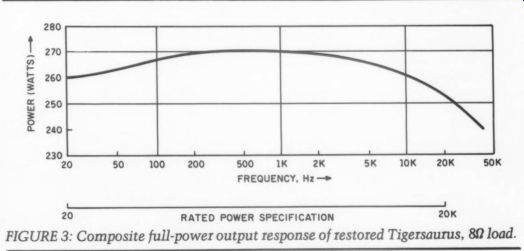
FIGURE 3: Composite full-power output response of restored Tigersaurus, 8 ohm load.
... “slow” amp, but I think these figures should be viewed with some historical perspective. Slew rates of 10-25V/uS characterized the first generation super amps contemporary to Tigersaurus: Ampzilla, Heath's AA-1640, and the Dynaco ST-400/410/416 series. At the very least my SR measurements show Tigersaurus was performing on a level with its contemporaries.
Distortion No bench check would be complete without THD measurements, and here I caught the first glimpse of performance differences between the two amplifiers. Due to my test equipment's limitations I was unable to quantify harmonic distortion behavior below about 0.02%, so at a 1W output level amplifier performance was indistinguishable from my test residual up to about 5kHz (Fig. 4). At that frequency THD in Unit A began a rapid increase to a final 20kHz value of just under 0.1% while B had risen to only about 0.03%.
This general pattern of THD behavior persisted through all the measurements I made at various power levels right up to the rated power output curves in Fig. 5. Response curves of B maintained a fairly flat profile at all power levels, but A's high frequency performance clearly deteriorated as power was increased; with a 20kHz signal at rated output, Unit A didn't quite pass its 0.2% THD specification.
If the THD data gave me cause for concern about Unit A, measurement of the SMPTE-IM distortion (Fig. 6) brought the matter clearly into the open. Unit B was sufficiently well behaved over most of its output range to be considered within specification, but I had to admit that A's IMD performance could only be called a failure.
Since I had not observed anything un usual during the earlier sine- and square-wave tests I began to wonder if my distortion analyzers might be responding to some phenomenon other than distortion.
I repeated high frequency clipping power tests on Unit A, this time adjusting the scope to display just one cycle of the waveform at maximum amplitude. Under these conditions the 20kHz waveform was not visibly distorted, but I did observe the negative half of the waveform appeared slightly thickened; at 40kHz the thickening was more obvious. Further expansion of the scope display clearly revealed that the trace thickening was due to a very high frequency parasitic oscillation.
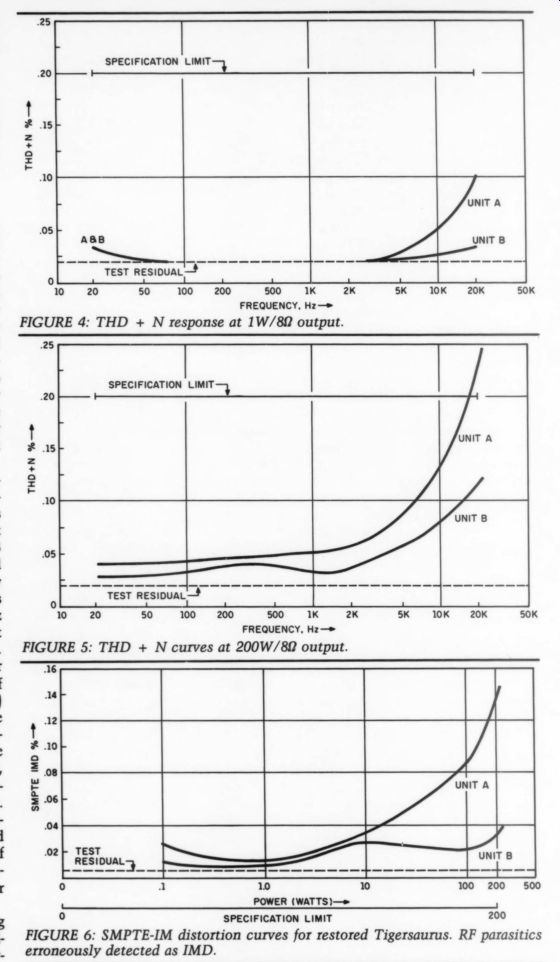
FIGURE 4: THD + N response at 1W/ 8-ohm output.
FIGURE 5: THD + N curves at 200W/8-ohm output.
FIGURE 6: SMPTE-IM distortion curves for restored Tigersaurus. RF parasitics erroneously detected as IMD.
Pesky Parasitics
I didn't measure the oscillation frequency exactly, but from the time-base settings on my scope I estimated it in the range of 2-4MHz. When I reduced either the power or the frequency, the oscillations diminished. With a 50W output at 60kHz the parasitics appeared on both the upper and lower halves of the waveform. Then I ran some ultra sonic test signals through Unit B to see whether it also exhibited parasitics and found that it did, though to a less noxious degree than A. At 50W output Unit B began to exhibit negative parasitics at around 65kHz, with positive-going parasitics appearing around 90kHz. Again, reduction of frequency or power diminished or eliminated the oscillations.
I tested many different points in the amplifier circuitry with a scope probe in hope of finding the source of the pesky parasitics, without success. The oscillations seemed to appear every where in the chassis, even the ground bus. I also tried a “shotgun” approach to the problem by placing bypass capacitors at various places, again without success. The only certain truth I was able to ascertain was that C8 plays a crucial role in the overall high-frequency stability of Tigersaurus, but I was unable to exploit this knowledge to any advantage.
My approach to oscillation problems has always been to locate the source of the oscillation and apply the appropriate cure, and I have successfully resurrected a number of amplifiers that had oscillated themselves to death. But parasitic oscillation is a dynamic phenomenon, more subtle and far more difficult to suppress than simple static instability. I have battled parasitics in both solid-state and tube amplifiers and have been defeated on every occasion.
I welcome informed opinions from readers regarding parasitics in Tigersaurus particularly, or any contributions you might have to offer on the subject of parasitic oscillation in general. It was time to take stock of my observations and obtain some perspective on the parasitic oscillation problem. The only reason I detected the phenomenon was the extreme sensitivity and wide bandwidth response of the voltmeters in my distortion measuring equipment.
Better Than Indicated
In my Heath instruments it is possible for an RF signal to sneak through the distortion analyzer's nulling process un attenuated, appearing to the voltmeter as distortion even if no measurable distortion was present. On this basis I deemed it reasonable to assume Tigersaurus' IMD and THD performance was probably much better than my measurements indicated, especially Unit A.
Walt Jung's Tigersaurus exhibited measurable levels of parasitics at frequencies as low as 1kHz. My careful construction techniques had obviously reduced the severity of the problem, and I considered the possible effects of the oscillations on stability and sound quality.
First, the problem was largely con fined to high power output in the ultrasonic spectrum-a situation unlikely to occur in ordinary operation. Second, the oscillation frequency itself (several megahertz) was so far into the RF spectrum that the probability of low-order resonant harmonics aliasing down in to the audio spectrum at measurable power levels seemed remote. Third, even under worst-case conditions (50W output at 90kHz) the total RF component never exceeded 1% of the audio signal and did not appear to threaten Tigersaurus' overall operating stability. I finally concluded the parasitics problem, while offensive to my audiophile sensibilities, would probably have minimal impact on stability and sound quality.
Before adjourning to the listening room I ran a quick linearity check of the output meters. Both responded identically, and both were equally poor (Table II). The display is labeled “% MAXIMUM POWER" with "100%" being set at 40V RMS output across 8 using R53. Scale markings are almost linear, with five major divisions. Unfortunately these major divisions don't correspond to the expected 0-20-40-60 80-100% but are instead labeled non linearly, 0-5-20-50-100-red. With a linear scale marked off in nonlinear di visions it is almost impossible to make accurate interpolations, which is probably the source of error observed in Table 11.
The meters employ taut-band movements with excellent transient characteristics; I judged their overall dynamic behavior to be an acceptable compromise between average and peak response. I have never liked power amplifier output displays of any kind, and the Tigersaurus output meters did nothing to change my attitude. The best that can be said for them is that they offer a crude indication of output power, and provide cosmetic relief for the otherwise bland front panel.
Tigersaurus Roars
I hooked up the Tygers to my speakers a bit apprehensively. Most superamps have a relay or some type of protection circuit to quickly disconnect the load in the event of excess DC, excessive ...
--------------------
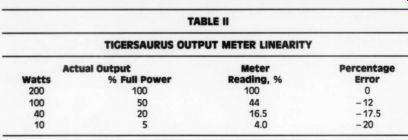
TABLE 2
---------------------
... output, or some other potentially disastrous output condition. I did a quick check of output DC at idle and found +4mV for Unit A and - 12mV for B-, certainly close enough to zero to pose no threat to speakers.
First-line speaker protection in Tigersaurus is provided by transistors Q14 15 (for volt/amp limiting) and by the output fuse F1. These are minimal protection measures; I was uneasy thinking of what might happen if a DC sup ply fuse blew and suddenly shifted 75V of DC to the outputs, even if only for a fraction of a second. Such an event could vaporize an expensive woofer.
Taking the 'damn the torpedoes” approach, I decided to put faith in my test bench observations and ignore the potential threat to my speakers posed by the absence of output relays.
After spending several months listening to Tigersaurus my initial anxieties were completely allayed; in operation The Beasts performed like docile work horses, really belting out the power without harm either to themselves or to the rest of my system components.
I listened to a variety of music: folk, pop, choral, orchestral, small ensemble, instrumental and vocal solo, and movie soundtracks. Being as yet un-smitten by the CD craze, all of my source material consisted of 33.33 LPs.
My turntable is a Philips AF-829 servo belt-drive type with integral arm and an Omega One Sound-Saver antistatic mat. I have modified this table slightly with insulating mats underneath'? and a bead of silicone under the platter rim to suppress metallic resonances. I employed two cartridges for the listening tests: a Shure V-15 Type V-MR and my aging but venerable Micro Acoustics 630mp (doesn't anyone make electrets any more?). For a preamp I used a Soundcraftsmen PE-2217 with power supply and capacitor upgrades, and I occasionally used a power supply/capacitor upgraded MXR 132 Dynamic Range Expander for noisy records.
My speakers were highly modified Speakerlab Super Sixes!? with a handling capacity of about 150W RMS. I favor the smooth low-frequency response of acoustic suspension types (as are my Sixes), but due to the poor efficiency of this design my speakers really soak up the watts. I don't believe in fancy speaker cables; my speaker connections consisted of a good grade of #14 zip cord with soldered banana plug connectors at each end. Just prior to commencing the listening tests I treated all my interconnections with Cramolin Blue.
My usual power amp is a Dynaco ST-400 incorporating the “Double Dyna" (ST-416) modifications and my own scratch-built 150,000uF out board cap bank with soft-start circuit.
Insofar as the stock ST-400 or its vari ant ST-410 is still commercially avail able as of this writing (Sound Values), I thought it valid to make sonic comparisons of Tigersaurus relative to my usual Dynaco amp.
Warming Up
With my system all connected, I first turned on only the power amps. At power-up I was pleased to observe a total absence of transients, and at turn off my speakers emitted only the faintest “pop." With the amps still on I momentarily suspected something was amiss since I was unable to detect the usual background hiss from my speakers; pressing my ear to the grille cloth, I heard a faint hum from the woofers but no sound at all from the other drivers. As regards noise, Tiger saurus is the quietest amp I've ever owned. I allowed The Beasts and the rest of my system to idle for an hour before commencing my listening evaluation.
If one word could best describe the overall sound of Tigersaurus, it would have to be "neutral." Bass response is deep, tight, and controlled to an almost Spartan degree, without the low-end “bloom” I was accustomed to with the Double Dyna. In the critical upper mid range and treble, Tigersaurus exhibits a slightly dry, laid-back quality. While
I find this not quite as satisfying as the sparkling pop-carbonated sound of a Van Alstine MOSFET 120, it is still superior to the slight hardness and grain of my Double Dyna.
This dryness is most noticeable on female vocals and string passages, where I prefer a sweeter, more fluid sound. Otherwise, vocal and instrumental timbres are rendered in highly lifelike fashion. Although the exaggerated bass response of my big Dyna is clearly audible in an A/B comparison, Tigersaurus comes across as the warmer, sweeter amp. This perplexed me, as it contradicts a long-standing association I had made that warm amps are always a little bass-heavy. Tigersaurus possesses the leaner bass response but still delivers more warmth and overall musicality. [ am tempted to explain the discrepancy as being related to slewing performance, but mostly I still regard it as a pleasant mystery.
Stereo separation is equal to the best I've experienced. The vertical and horizontal sound panorama provides a very solid and spacious stereo image free of 'holes' or 'bunching.' Soundstage depth is superb. Group vocals and ensembles in particular project a realistic 3-dimensional image. In evaluating soundstage depth I believe I have made a novel observation: The quieter the amp, the better the projection of sound stage depth. Or at least, background noise will compromise the psycho acoustic perception of depth.
Observations
At my listening position, background noise from the big Dyna (and several other amps I tried) ranges from audible to barely audible. The projection from these amps is less spacious, as the soundfield emerges from a 'noise curtain” located in the plane of the speakers. Dimensional images at the outer edges of the soundfield are rendered adequately, but images originating closer to the speaker plane seem more obscure, and no images at all (or badly smeared ones) appear from behind the plane.
Thus it seems to me that the presence of background noise effects a compression of perceived depth. Background noise levels in Tigersaurus are inaudible even at close proximity to the speakers, and the effect on depth was in some instances almost surrealistic.
Voices and instruments materialize from empty space, disappear, and re-materialize with such clarity I feel physically drawn into the soundfield, as though I can hear into the music. In my listening area the speakers are arranged on a semicircular arc flanking either side of my fireplace. With Tigersaurus I experience dimensional images that clearly originate from behind the speaker plane to create bewildering psychological effects: my mind rebels at the “sight” of tympani and trombones emanating from inside the fireplace.
Only by closing my eyes or turning off the lights am I able to “see” the orchestra.
This sense of clarity carries over to the perceived sense of definition and resolution of inner musical detail. At first I thought Tigersaurus was far superior to the Double Dyna in this respect, but after careful listening and discounting the better soundstage depth of Tigersaurus I find I can't really distinguish between the two.
Definition in the Double Dyna is somewhat obscured by the slightly grainy texture of its treble response (probably due to modulation of treble frequencies by lower-frequency noise components) which at first listening gives it the effect of poorer resolution.
I think the two amps are performing about equally, but a casual listener would probably give the prize to the quieter amp.
Pushing the Limits After some extended listening sessions the Tygers really grew on me. As I came to realize they weren't going to blow up or set my house afire I couldn't resist the urge to crank up the volume and see how loud The Beasts could roar. Beside the big Dynaco amps, the only other amp in this power class with which I've had extensive listening experience is the 300W/channel McIntosh MC2300. In terms of brute power and sheer visceral impact Tigersaurus will stand tall among the best of them, including the MC2300.
I find the better quality source material-half-speed mastered, direct-to disc, and digital recordings-are really well exhibited by Tigersaurus. I monitored the sound levels in my listening area with a Radio Shack SPL meter ("C" weighting, FAST response) while playing a digital recording of Tchaikovsky's Danish Overture and “Poltava” (Chandos DBRD 2003) with the volume set as high as I could stand it.
With the output meters registering in the red zone (more than 200W) I re corded peaks of 105dB SPL with an average level of around 85dB. This was loud.
Yet The Beasts handled it all as part of the day's work. Never have I detected any audible sign of hardness, strain, distortion, or distress from either amp. In a similar experiment to test high-power low-frequency output, I played the opening bars of Strauss's Zarathustra (from the soundtrack to 2001") at high volume. This is a wicked test of power supply stability:
I had an amp succumb to motorboating while playing this piece. That mammoth 16Hz organ pedal note palpated my chest, fluttered my trouser legs and left pictures tilted on the wall, but Tigersaurus took it in stride.
Throughout the listening tests, especially those at high power levels, I strained to detect any audible effects of the oscillation I had observed on the bench. From previous experience with oscillation problems I anticipated hearing swishing noises (“wispies”) or possibly faint chirps ('birdies') from RF trash aliasing down into the treble. At no time was I able to detect wispies, birdies, ringing, squeals, howls, whistles or any audibly recognizable oscillation symptoms. As I had suspected, the parasitics apparently did not interfere with sound quality at any power level or frequency I could hear (my hearing poops out around 14kHz). Reproduc tion at all power levels was always clean and crisp.
Cartridge Trials Since the mid-seventies I have favored electret cartridges for their superior tran sient response. When Micro Acoustics faded from the audio market around 1985, I was left without a source of replacement styli for my two Micro Acoustics cartridges. After reading a favorable review of the Shure V-15 Type V-MR in Stereophile 1 purchased the Shure to replace my well-worn Micro Acoustics 530mp and 630mp units.
Unfortunately, the new Shure is in compatible with the Double Dyna, as both the amp and the cartridge have a slightly exaggerated bass response. The combination of the two produces a bloated bass I find unpleasant. For a couple years I struggled along with the 630 myp, its stylus wearing down while the Shure sat unused. During my listening trials with Tigersaurus I tried the Shure again and was delighted to find The Beasts got on well with either cartridge. After extended listening with both cartridges I decided the Shure was a slightly better overall match for the Tygers; even though it lacks the fine resolution of inner detail of electrets, The Beasts tend to remedy this deficiency with their clarity.
I can summarize my listening evaluation simply: Tigersaurus is the over all best-sounding amp I've ever owned.
I have heard other amps that do sound better, but not by much, and at prices I can't afford. With enough power to jump-start a locomotive and stereo im aging equal to the best I've heard in fancy salons, Tigersaurus richly re warded my restoration efforts. Their sonic attributes far exceeded my expectations from bench tests, and their performance helped me glean some new insights regarding my own perceptions of sound and music.
In use they have proven virtually free of the deadly defects by which they acquired their savage reputation. The Beasts have made good friends with all my cartridges and live in peaceful harmony with my sound system. In gratitude, I have awarded them their own separate filtered AC socket from which they are free to consume as much fresh current as they please. A pair of tame Tigersauri are the most exotic pets an audiophile can own.
Postscript On a recent snowy winter evening, as I sipped wine before the fire while Tigersaurus gently fed me soothing strains of Bach’s Well-Tempered Clavier, | pondered the awful stories I had heard of these amps. Restoring them occupied my spare time for most of a year, and it was hard to believe these were the same amps that had come in to my possession as blasted wrecks.
Taking my experiences into account, I sought some underlying explanation- beyond mere technical defects-why Tigersaurus had acquired such a miserable reputation.
Tigersaurus should never have been sold as a kit. The critical bias control setting is an impossible task for the casual kit builder and would present a challenge even to an experienced technician with proper instruments. Also, the critical heatsink wiring requires a degree of patience and precision few novices would possess. And troubleshooting a malfunctioning Tyger would be beyond the capability of any but the most advanced hobbyist or trained technician.
The casual enthusiast who bought this kit was doomed to almost certain failure.
Given the obvious intellectual capacity that produced the many novel Tigersaurus circuit innovations, the blunders in rendering the design struck me as in comprehensible. How could the same intelligence that designed a cross-coupled differential input have failed the simple task of derating resistors? Or failed to provide safety covers for ex posed output transistors? Or failed to consider the thermal effect of red-hot bias resistors? Or neglected RF bypassing in the power supply? As one who has nursed many projects from paper to finished product it just seemed incredible that any designer could be so indifferent toward design details that threatened the success of the product. The slovenly attitude reflected in the execution of the design ensured that Tigersaurus would never gain the respect of serious audiophiles.
Add to that the horror stories of frustrated kit builders, and Tigersaurus had no future from the day it appeared in Radio-Electronics.
How regrettable. For underneath all the neglect there really was “the nucleus of a more than decent amp." Tigersaurus could have been-should have been-a classic super-amp. With just a little more care the prize for "fearful symmetry” might well have gone to Tigersaurus instead of Ampzilla.
REFERENCES
1. Meyer, Daniel, “Tigersaurus: Build This 250-Watt Hi-Fi Amplifier,” Radio-Electronics, Dec. 1973, pp. 43-47.
2. Sweeney, Daniel and Steve Mantz, 'An Informal History of Solid State Amps,” Audio, June 1988, p. 50.
3. Bongiorno, James, 'Get 400 Watts of Clean Stereo Power With Ampzilla,” Popular Electronics, Sept. 1974.
4. Jung, Walt, 'Test Report: SWTPC 210/A 'Tigersaurus' Power Amp,” TAA 2/80, p. 44.
5. Mcintyre, Bob, “Supercram,'“ TAA 3/81, pp. 18-21.
6. Motorola, Inc., Master Selection Guide, 1979, p. 157.
7. H. W. Sams Co., Transistor Specifications Manual 9th Edition, 1978, pp. 58, 147.
8. Olsher, Dick, 'Cable Bound,” Stereophile, July 1988, p. 105.
9. Poehland, Benjamin L., “Equipment Review: The Ramsey BS-601 Oscilloscope,' TAA 1/85, pp. 40-49.
10. Gloeckler, Fred M., “Measuring Cross over Distortion,” TAA 4/75, p. 34.
11. Electronic Industries Association, EIA Standard RS-490: Standard Test Methods of Measurement for Audio Amplifiers, Nov. 1981, p. 7.
12. Poehland, Benjamin L., 'Turntable Insulator,"" TAA 3/84, pp. 39-40.
13. Poehland, Benjamin L., 'Upgrading Speakerlab's S-6 Crossover,” Speaker Builder 3/86, pp. 22-25.
14. Jung, Walt, 'Kit Report: Dyna 400," TAA 2/77, pp. 48-60.
15. Rollins, Bill, 'Modify Your Dynaco Stereo 400," TAA 3/83, pp. 21-38.
++++++++++++++++
Also see: