Oh, boy, is the disc alive and well! Far from dying as has so often been predicted, it is now likely to become one of the most important of our recording media both as entertainment, on a much wider scale than at present, and strictly business, for information storage. Maybe Edison was right when he launched. his phonograph as the stenographer's dream machine.

Of course, I am not talking about the present standard disc, the venerable LP and its junior sibling the little 45, now respectively a bit over 30 and 29 years on the market. What I mean is the next generation of disc ERA IV a la Shure, counting from the original acoustic shellac a new superdisc family that will at last close the appalling technological gap that has developed over these years between the LP and current disc capability.
That gap is already greater than the one which was closed in 1948 when LP took over from the 78, then a half-century old, acoustic and electric. When the present enormous gulf is at last closed, as between standard and possible, we will have a true revolution in hand, in the classical pattern. That is, much more than the mere parameters and system of the present disc will be replaced. The platter, as we know it in the entertainment area, at least, will no longer exist. An immense rearrangement, an upheaval! I wonder which will come first, this or the next California earthquake? The odds are not very different.
Our forces of technology do, in fact, build up very much as do those of the big quakes, though fortunately they are not let loose as suddenly. New methods, new ideas, new know-how, new processes, new R & D, all these keep right on proliferating, in our field as in others; and yet because there is already an operating standard, very little can be directly applied. Everything funnels through the necessary parameters of the standard or is put aside.
And the more successful and extensive is that standard operating system, the greater is the vested interest in its status quo. Thus the big slowdown and the larger the gap grows, the greater are the forces required to overcome, to establish the new. Earthquake building.
Nothing wrong! Please don't think that "old" or "established" means something nasty like reactionary! The LP record and system is NOT reactionary indeed, in its own way, it is the opposite, still active, mature, still moving forward, an enormously successful system, and a useful one. After all, what would we do without standards, long enduring, even beyond their time? Such as, say, railroad track width, the numbers in a round dozen, the ounces in a pound. You can name a hundred that are rightly under challenge though of honorable descent.
Go metric! Go binary. Throw out the d (British old penny) in favor of the p (new penny). How ingenious and wise of the British to toss away their duodecimal-and-worse coinage in favor of decimals with so very small an upheaval! What we must always do in these overdue catch-up operations is to minimize the human earthquake that is inevitable, do what we can to make useful links, maximize the benefits and reduce the hurt. In England you can still spend a shilling anywhere in the actual metal, or a florin, or sixpence. They even fit the slot machines.
And so right now we are working on a few disc links, ahead of time, to help us over that vast technological gap in disc potential between the present LP/ 45 and the violently different discs that are inevitably coming, to bring us to up-to-date standards. What'll you bet that the first of these you will see will be, by no coincidence, 12-inch platters, pressed in existing plants out of plastic of a normalish sort, and probably stuck into present paper envelopes and cardboard jackets, shipped in existing cartons and stacked up on regular record shelves? That's the idea. But what a very different record this will be.
Compatible Collusion
So, it is save what you can, cushion the quake, be reasonable, lessen the shock, spread the load, salvage the salvageable. Plenty of salvage, even in such a relatively ancient system as LP and with such an incredible distance to jump. There's a word for this. Compatibility! Its purpose is ever the same, to help in a difficult transition. Sometimes better, sometimes worse, like, say, the "all-groove" needle, the stylus that would play (more or less) both 78 and LP grooves, or the much less disastrous turnover-style double cartridge.
And where do you think our present handy semi-plug in cartridges got their form? Same place alternative plug ins for the two grooves. So it's not sauve qui peut, before this revolution, but save sensibly. And in these last few brief years each new prototype disc of the coming generation has shown more awareness of this critical aspect of change that, to me, denotes real progress.
What we are doing today, and must do for a good while, is to live on two planes at once. We watch the new discs develop and approach marketability maybe. And we go right along with the old disc. Curiously, though, this necessary double standard is surprisingly difficult for most of us to understand and evaluate even for those who are highly knowledgeable in a technical way. Maybe worse for them. It is much more than merely living with the old and the new, perforce. We must give them true equality, however different they are.
Now that involves a lot more than you may think. After all, there is that gap, and the comparative performance figures for the old and the new, so incredibly different. It's easy to sound off about the new technological marvels and the utter obsolescence of the silly old LP or, oppositely, mutter away about visionary money-wasting and the importance of the tried and true and a mature, workable, successful existing system. We can't think either of these ways. We must think equality. Different, but equal and, moreover, interdependent.
So even our thoughts, in the engineering and in the home playing, must exist on two planes, both continuing, both showing advancements of importance. Sort of hard, I admit, but there you are. On one level we have the rarified and money-rash area of R & D where the new miracles go into expensive development and then, usually, go back to be developed some more or maybe dropped cold. A dangerous game and prone to massive mistakes.
Sometimes, oddly, the fault is not enough radicality. Or a slant in a wrong direction, out of touch with the future. Who can be sure? Wrong direction can be as fatal as faulty technology. Right direction (as it turns out) and you're in. Everybody tries to be right. That's R & D and is it nerve-wracking, as well as exciting, for all those involved. Nothing too theoretical about our R & D in disc, these days.
The gap has long been bridged and bridged many times. But the gulf itself isn't yet closed. No new standard yet.
Evolutionary Improvement
Down on the other level, the other plane, we have the present LP disc and the 45. One of the astonishing things about the LP is that its basic parameters, as set forth by Dr. Goldmark in 1948, have allowed a steady flow of improvements right through these 30 long years, and even for an unforeseen revolution, the introduction of disc stereo. That was a right direction, and it was essentially within the LP's capability. Some minor compromises, notably in separation but do we now complain that tape stereo separation is audibly better? LP stereo proved extremely practical, if not ideal in all the specs.
So give the LP its due, for the past and even for the present. And don't forget that it is the underpinning, in the disc area, that makes the upper level of advanced R & D possible and reasonable. Also keep in mind that LP technology continues to be important in its own right, and it has not stopped advancing. The LP is still impressive in plenty of ways and I hope that somebody has remembered to celebrate the anniversary with a long list of its achievements over these years.
Not for me to do, but I suggest that, in terms of my two coexisting planes, the upper or R & D, and the lower or continuing standard, the LP system has been a model of excellence. It has been good to us. And the LP is still forward looking. Note how recently it has become the vehicle for the most advanced published recordings yet, the digital and direct-cut types yes, you can hear the difference, even via this ancient record! So the disc situation, the over-all momentary quo is clear and sharp and the latest entries on the upper R & D level, the superdiscs, admirably define its shape and nature. We're getting there! After last year's sensational Mitsubishi/Teac digital disc, laser recorded, laser played (Audio, Feb., 1978), we now have a further entry in the pits (pun intended) out of JVC. These two join a number of earlier prototype systems, such as Teldec (two generations if I am right) and others from Europe and I almost forgot us such U.S.A. developments as the now rather muted RCA venture, pioneer, though not Pioneer. All of these, it is increasingly clear, have been on similar tracks and offer similarly astonishing new parameters of sheer performance. Big diffs, natch, and corporate war as usual. But it begins to look right now as though there actually might be a convergence what a miracle. Those pits, for instance. They are ever more clearly the digital wave of the disc future.
The digital pit replacing the analog groove. Wow they might even come to an agreement on compatibility of the pits! Would that be the earthquake. Let us hope & pray.
Beetlemania
So you begin to get the picture pun intended. The fundamental revolution is ever closer but the LP marches on and it must and should continue to develop, like the VW Beetle, which did the same right up until this last year, because it, too, was obsolescent but world reliable. (I still drive mine in preference to that thing they now call VW.) Note the careful overlap before the Beetle departed to Brazil. And note the mostly unheralded multiplicity of identical parts, between Beetle and its successors. That's the right game. Save what you can, ease the revolution as it happens.
Now, in all this context, a portentous word or two. Beyond all other reasons, including corporate battles, lack of directionality, technical problems partially solved, too late, too little, the real reason that the quadraphonic disc failed (it has failed, at least here) was simply because, for the first time, the LP was pushed overtly beyond its capacity. You can add all the other arguments you want on top (you will) this is the basic one. The LP itself couldn't take it. There had to be either an elaborate overstrain or, equally, an elaborate and admirably ingenious compromise either way, it was too much . .. flogging an elderly race horse, with the young ones almost ready to run.
All you need do is consider what we now have in prospect. Last year's Mitsubishi/Teac disc casually offered, just in case anybody was interested, a potential for 16 discrete audio tracks simultaneously. That would make a nice discrete quadra-quadraphonic, now, wouldn't it? As for JVC, they don't even mention the possibility, but with 14-bit digital PCM they surely could do something of the sort as well. If somebody ordered it.
Well, somebody won't. We need a few more years' worth of long breaths before we tackle all that again. But do not think that multi-channel audio space has just faded away, in favor of stereo forever. We learned unexpected new things during all that four-channel flap and many of them are still with us. New cartridge design, new styli, half-speed cutting, and such active offshoots as the home space synthesizer via digital delay. Please note that you do NOT synthesize space in your living room via two channels.
So we can wait. Via the new systems, when the upper level gets here, multiple-channel sound is going to be easy and very viable, as anybody can see. The whole idea is dormant for the time being, stunned, you might say.
But again, we now have the capability and, sooner or later; we will use it. But it will never again be via the LP. Meanwhile many of us still play all our LP recordings "surround" and we will continue as long as we play LPs at all. A great LP advance for those who have the courage to stick with it.
I have deliberately left unmentioned to the last the real revolution, obvious to all. There will never be another purely audio disc system! The LP is the last of its lineage.
Picture Discs
There will be audio discs, of course. But any future disc system, whatever, will as a matter of course be picture capable. We have this technique too and we will use it. The new audio disc will find its place as a modest alternative type, within the ample parameters of the picture-disc system. Inevitable! There can be no argument. And JVC's new disc entry, the unpronounceable "VHD/AHD" system is an interesting illustration. This system is launched two-way. It has a single disc player that accepts alternative discs, either pictures-with-sound (we shouldn't really call it TV) or audio-by-itself, in super digital fi. Take your choice. The system is still technically prototype (whether or not it is for sale), and it looks to be a bit clumsy and maybe expensive but just wait. And look at the parameters.
A relatively "cheapie" pickup, non laser (capacitative), that just slides. No grooves, instead, pits, millions of them, in close spirals pressed right into the plastic. An electronic feedback pickup drive for tracking. (Maybe eventually compatible with Mitsubishi?) You guessed it 12 inches, on only mildly special plastic (conductive), and it can be pressed via existing LP presses. See what I mean.
Performance is par for the course upper level. Sky high. You get two hours of color and stereo sound per disc through your TV set, an hour on each side. That's more than twice the "long play" of the old LP. You can imagine, at 900 rpm, the sort of spiral this means, and the headroom, bandwidth, etc. Gasp, gasp. That's what we can do now, friends. As for the audio version of this disc, it probably plays forever. They haven't finished timing it yet.
Oh, so you want more details? Sorry, not now. I have to go play an LP.
(Source: Audio magazine, Jan. 1979; Edward Tatnall Canby )
=====
Bookshelf
Honkers and Shouters: The Golden Years of Rhythm & Blues by Arnold Shaw. Macmillan, New York (hardcover), $19.95; Collier Books, New York (softcover), $9.95.
If you like pop, rock, jazz, blues or just about any sort of music save classical, then you'll want to read Honkers and Shouters, since it's an indispensible reference and guide for anyone who is even mildly serious about their music. Aside from being an exhaustive source of information on R&B, the book is as entertaining with its stories, anecdotes, and interviews of fascinating music people as any historically oriented book could be.
To do it by the numbers, there are seven major chapters, entitled The Roots, The Components, The California Cataclysm, The Midwest Mavericks, East Coast R&B, Down-South R&B, and The Disc Jockey Scene, interlaced with some 25 interviews of important figures covered in each chap ter. Among the interviews, or "grooves" as Shaw calls them, are the last ever done with Louis Jordan and T-Bone Walter. The index goes from A&M Records to the Zion Kings of Harmony and, just to give you an idea of the depth of this book, contains well over 1,000 entries. Aside from a very select bibliography, there are two discographies one for collections and the other for individual artists.
Associated with several important record and music companies during the "classic" R&B period, Shaw is also an author with several books to his credit, including two on rock, The Rock Revolution and The Rockin' 50s; two biographies, one on Belafonte and the other on Sinatra; The World of Soul and The Street That Never Slept: N.Y.'s Fabled 52nd St. He's also composed about half a dozen light classic pieces, mostly for piano.
The tone of the book is a little scholarly in places, though this is easily forgiven for the enormous weight of information, and at times Show mildly criticizes music critics "who sometimes think of their music as if it were an “original creation of the Elvis Presley/ Pat Boone generation of the 1950s." Save for these two small criticisms, I can only wish the book were longer.
Shaw tends to plead a special meaning for "rhythm & blues," separating it pretty clearly from most all music produced by whites and even from soul.
Says Shaw on this last point, "they stem from the same roots, but the expression is different enough to involve a detectable difference of style, the difference between the Isley Brothers'
'Twist and Shout' and their 'Fight the Power.' James Brown is not B.B. King, Aretha Franklin is not Dinah Washington, and Ray Charles is not Muddy Waters." 'Nuff said.
The book is full of fascinating information about musicians most will know only in later contexts, as well as intimate details of groups who had only one or two big records. For example, did you know that Ike Turner was a Memphis talent scout for the Modern Records group, beginning at about age 16? And what about Muddy Waters just walking into the Chess Records storefront office and studio at 71st and Phillips in Chicago? And that one of Ahmet Ertegun's first records for Atlantic was of a jazz band formed by Joe Morris, previously a trumpeter for Lionel Hampton, which included Philly Joe Jones, Percy Heath, and (unbelievably) Ray Charles.
One of the best stories is from Elvis Presley: "'You want to make some blues?' Sam Phillips [of Sun Records] asked, knowing that I'd always been a sucker for that kind of jive. He mentioned Big Boy Crudup's name and maybe others, too. All I know is, I hung up and run fifteen blocks to Sun Records' office before Mr. Phillips had gotten off the line. We talked about all the Crudup records I knew 'Rock Me, Mama,' 'Everything's Arl Right,' 'Hey, Mama,'
'Cool Disposition,' and others, and settled for 'That's All Right' ..." If you want any more, you'll have to go read the book yourself. E.P. Walk Away René by Hipgnosis. A&W Visual Library, 1978, $10.95.
Hipgnosis has been at the vanguard of exciting and innovative graphics, mostly on the covers of record albums, for more than a decade now. Their clientele regularly includes Pink Floyd, Led Zeppelin, 10cc, Al Stewart, Wings, and many, many more. Walk Away René is a combination retrospective, overview, critique, history, and scrapbook.
The book's layout could easily have been a simple chronological progression, but given the ambitious nature of The Album Cover Album, a project Hipgnosis and Roger Dean collaborated on brilliantly and released a year plus ago, they would obviously not have been pleased with that simple an out. Instead Hipgnosis, which consists of Aubrey " Po" Powell, Peter Christofferson, and Storm Thorgerson, who wrote the text for René in association with their oft-times collaborator, and illustrator George Hardie, developed categories to illuminate their work and what goes into it. Typical headings for collected work are Animals, Nostalgia, Rays of Light, Projects (a catch-all for non-record jobs), Record Labels, Dust Sleeves, and Stories. Special sections are devoted to the covers for Led Zeppelin's Presence and Pink Floyd's Wish You Were Here and A Nice Pair albums, exceptional packages all. The How a Sleeve is Done section focuses on their job for 10 cc's Deceptive Bends from conceptualization, false starts, shooting, and design all the way through printing and assembly. Some particularly provocative ideas surface in the Unsold Ideas and Tasteless sections.
Storm Thorgerson's text is a bit dry but direct and informative about Hipgnosis' techniques and trickery. He is best when relating anecdotes about memorable assignments. There is an appendix with photographer/designer/illustrator credits for the included pieces as well as data on what camera film, lighting, and lens were used, location of the shot, and what special techniques (montage, hand tinting, etc.) were needed.
From cover to cover, reproduction is in full color with stunning, sumptuous reproduction which is all I could have hoped it would be.
Hipgnosis is clearly the best, most exciting design firm doing record cover work and have deserved this kind of volume for a while. What with Roger Dean's Views and The Album Cover Album, they have had a hand in the three best books examining the graphics that have been so instrumental a part in the music business' explosion in the 70s. The firm may well remain the best for a long while yet.
Michael Tearson
=====
Vintage magazine ADs
DISCWASHER presents
The Clean Truth About Your Naked Stylus
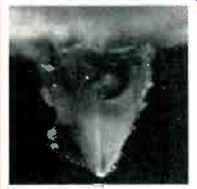
When your stylus plays over one light fingerprint or one tiny "bead" of vinyl stabilizer, the clean naked diamond becomes a glazed, dust-holding abrasive weapon wearing away at your records and masking their true sound.
This unseen build-up may actually hold the tracking tip of the diamond out of the record groove.
Accumulated grit on stylus that looks "clean" to the naked eye.
The SC-1 Stylus Cleaner from Discwasher is designed with a brush that is stiff enough to remove harmful accumulation, but gentle enough to avoid damaging delicate cartridge assemblies. Two drops of Discwasher's D3 Fluid add extra cleaning action to the SC-1 without the side-effects of alcohol, which can harden rubber cantilever mountings.
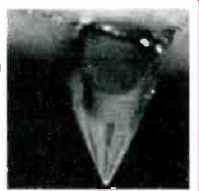
After cleaning with SC-1 and D3 Fluid by Discwasher.
The retractable, walnut-handled SC-1 includes a magnifying mirror for convenient inspection of stylus/cartridge alignment and wiring.
Get the clean truth from your records; get the SC-1.
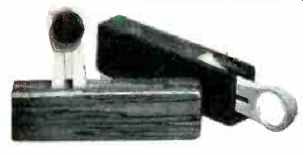
SC-1 STYLUS CLEANER Discwasher inc.
1407 N. Providence Rd. Columbia, MO 65201
-------------------
Reliably Good Sonics
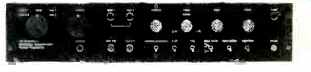
The Apt/Holman Preamplifier was designed to deal most effectively with the wide range of tasks confronted by a preamplifier in a high fidelity music system. As a result, it produces real sonic improvements in virtually every system in which it is installed.
The lack of cartridge impedance interaction, along with flexible cartridge loading, allow optimum performance from moving-magnet cartridges. Internal user-installed cards meet the widely-varying needs of moving-coil cartridges. Sufficient infrasonic filtering eliminates the audible effects of even typically warped records while an anti-TIM filter ameliorates the effects of slew rate limiting in power amplifiers.
Buffered and crosstalk-free, program and tape switching provide real utility that one must use to appreciate. A unique mode control permits variation in the apparent depth of the stereo image with true stereo recordings. And newly researched tone control curves provide truly useful loudness compensation and program equalization.
But good sonics are not very useful in an unreliable product. We've all experienced equipment failure and know how frustrating it can be. At Apt we do triply redundant testing on each and every unit, and we test many performance qualities that others do not even specify. Each unit is delivered with its own test report produced by hand at the final test.
In the unlikely event that you encounter difficulties, we stand behind the unit with a three-year limited parts and labor warranty. If you would like more information about the Apt/Holman Preamplifier, please check the appropriate box(es) below and send to:
Apt Corporation. Box 512 Cambridge, Massachusetts, 02139.
---------------------------
Empire 698 Turntable
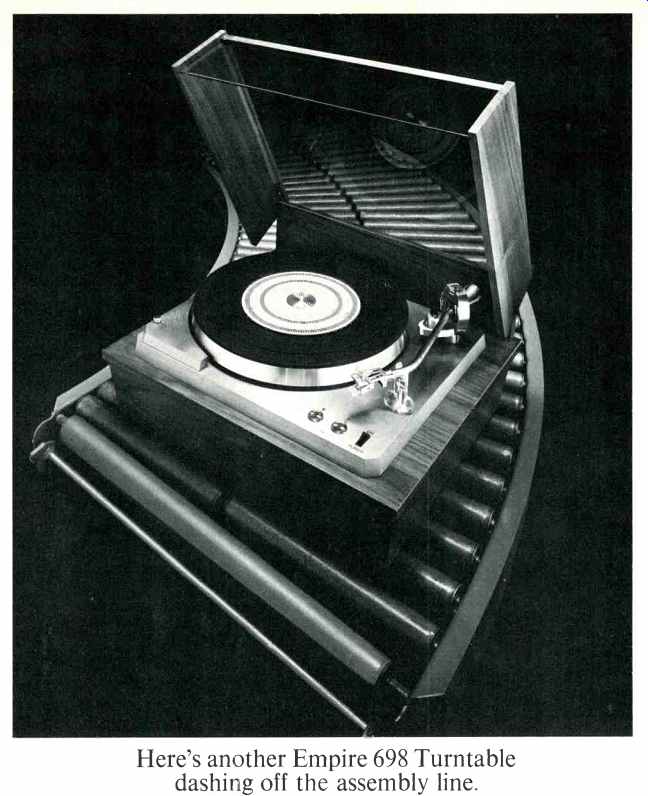
Here's another Empire 698 Turntable dashing off the assembly line.
It takes 15 1/2 hours to make an Empire turntable.
Each one stands over 80 separate inspections before it reaches the end of the line.
And after the assembly is done, we test it some more.
Wow and flutter, rumble, and speed accuracy are electronically confirmed to meet specifications before final approval.
It's not a fast way to finish a turntable, but it's a great way to start one.

Empire Scientific Corp., Garden City, New York 11530
------------
TDK's new one-second, no-headache demagnetizer.
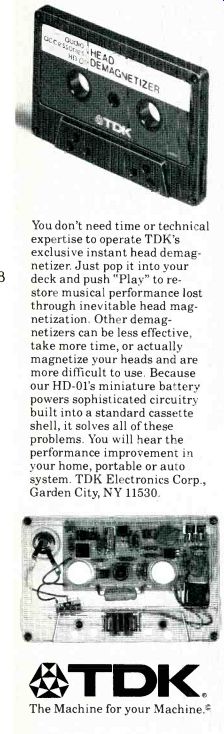
You don't need time or technical expertise to operate TDK's exclusive instant head demagnetizer. Just pop it into your deck and push "Play" to restore musical performance lost through inevitable head magnetization. Other demagnetizers can be less effective, take more time, or actually magnetize your heads and are more difficult to use. Because our HD-01's miniature battery powers sophisticated circuitry built into a standard cassette shell, it solves all of these problems. You will hear the performance improvement in your home, portable or auto system.
TDK Electronics Corp., Garden City, NY 11530.
The Machine for your Machine .
------------------
Signet
Signet dealers are a breed apart.
They don't just sell merchandise. They get involved. In the how and why of sound reproduction. And they don't take anything for granted.
For instance, to hold a Signet franchise, each dealer must have-and know how to use a powerful microscope. Like the $5,500 Wild-Heerbrugg stereo Model AT-M5A we helped to develop. It reveals in intimate 3-dimensional detail the construction and condition of any phono stylus.
We think it's important that your dealer be able to check your stylus for wear, tip geometry, tip polish, damage or dirt. Signet dealers agree.
But they also use their microscope to take a critical look at new cartridge products-ours and others. To see for themselves the quality of this critical component. We wouldn't have it any other way.
If your audio standards are high, your Signet dealer is worth seeking out. Write us and we'll introduce you to him and our current Signet products. We honestly believe you'll appreciate the difference.
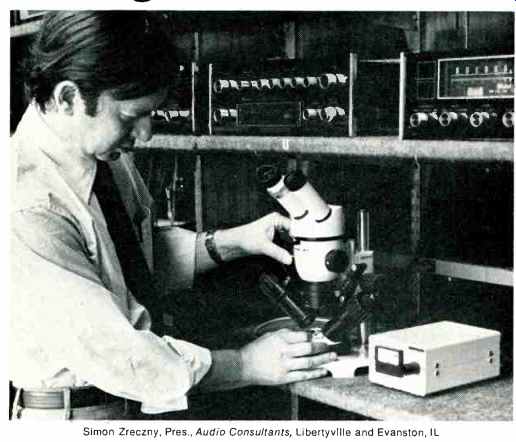
Simon Zreczny, Pres., Audio Consultants, Libertyville and Evanston, IL

SIGNET DIVISION, A.T.U.S., Inc., Dept. 19A-3, 33 Shiawassee Avenue, Fairlawn, Ohio 44313
-------------------
KENWOOD
SOMEDAY, EVERY AMPLIFIER WILL BE HIGH SPEED.
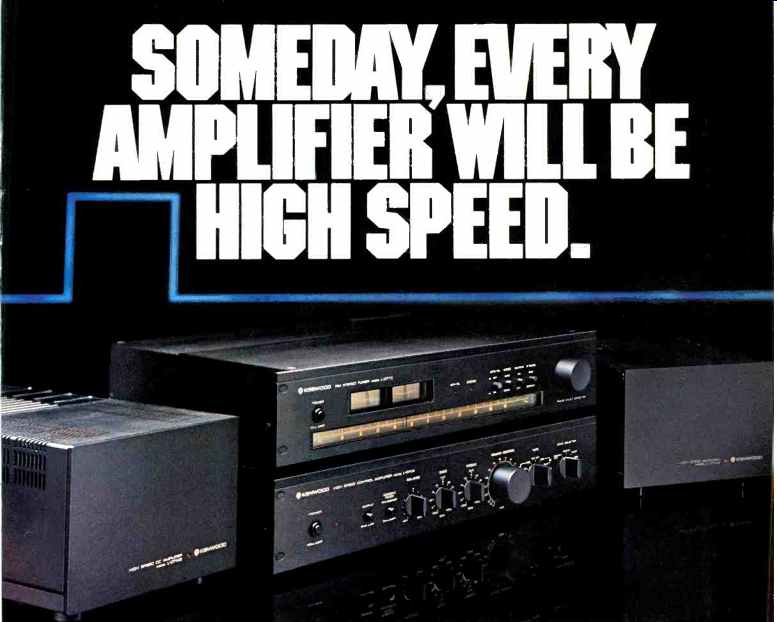
From the people who brought you dual power supplies and DC amplification comes high fidelity's most significant breakthrough in years.
The High Speed Transistor from Kenwood. An improvement so important that it will actually change the way you evaluate amplifiers. An improvement that will be part of every amplifier that claims to be state of the art.
Today, only Kenwood has it. Because Kenwood developed it.
Our engineers discovered that even with exceedingly low harmonic distortion, amplifiers typically lack the ability to react quickly enough to an input signal, particularly at the mid and upper frequencies. This is called transient intermodulation distortion (TIM). The result can be seen on an oscilloscope as a square wave that's distorted. And heard as poor spatial imaging and loss of detail. While some manufacturers have dealt with a square wave's rise time, only Kenwood High Speed Transistors produce high frequency square waves that decay as fast as they rise.
That's because Kenwood High Speed Transistors allow a much faster change in voltage (slew rate) than ever before. So no matter what the music demands, the amplifier can match it exactly.


What this means to you is depth and definition that will take your breath away. High frequencies are completely clear and totally non-fatiguing. You'll hear each violin individually in a string section. Each audible harmonic of a single piano note. Even the separate handclaps in recorded applause.
High Speed Transistors are used for the first time in our Audio Purist Group, shown above. Because it takes a very sophisticated and demanding listener to appreciate this new technology.
We're convinced that in a world of compromise, some people still demand the very latest state of the art. Building high fidelity equipment for them will always be our commitment. For more information and complete technical specifications, please write us.
---Pulse waveform response of a conventional amplifier.
---Pulse waveform response of Hi–Speed amplifier.
HI-SPEED
Hear the future of high fidelity.
Kenwood, P.O. Box 6213, Carson, CA 90749.
-------------------
Altec Lansing
The quickest way to improve your shelf is with the new Series II from Altec Lansing. Each speaker in the Series II line combines the best of everything we've learned during the past 40 years of making professional speakers for studios, concerts and theaters.
As you can see, we've given the Series II a lot of features you'd expect only in Altec's most expensive speakers. Items like long-travel woofers with non-degaussing ceramic magnets; equalizing controls; molded port tubes; and real wood finishes.
What you can't. see (but you can most assuredly hear) is the Series II's high-efficiency design delivering the fullest sound possible, even with a receiver or amp as small as 10 watts. Also, there's the confidence you'll have in knowing that we make every major component and cabinet ourselves. Then we back it all up with a full, 5-year warranty.
For the full course, send for our free, full line catalog and the name of your nearest Altec Lansing dealer. Write: Altec Lansing International, 1515 S. Manchester Ave., Anaheim, CA 92803.
Altec Lansing. The #1 name in professional speakers is coming home.
--------------------
AIWA
the unreel deck
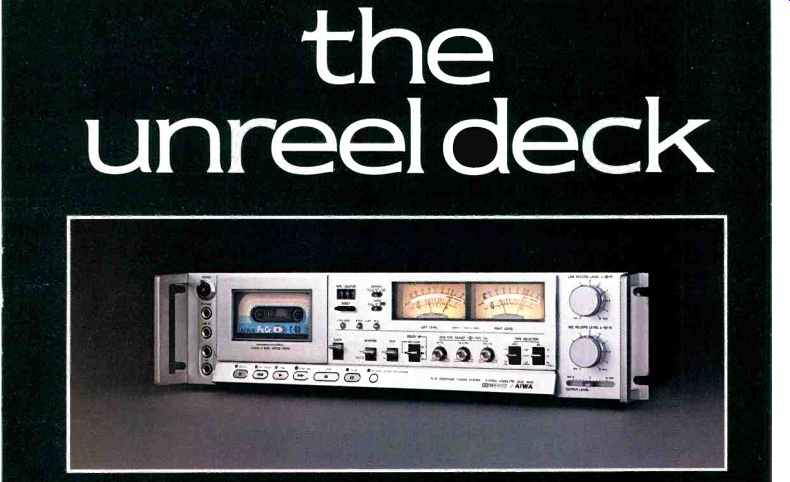
The AIWA AD-6900U. Super specs and sound quality we defy any reel-to-reel to beat. Plus a lot of extras.
For openers, the AD 6900U delivers a frequency response of 20 to 20,000 Hz and an S/N Ratio of 68 dB using FeCr tape with Dolby* on. And only 0.04% WOW and FLUTTER (WRMS). Great numbers, but there's more.
---Exclusive AIWA--3 head V-cut design
The exclusive AIWA Flat Response Tuning System (FRTS) gets sensational sound out of any kind of tape on the market.
With just the push of a button, FRTS will use its own circuitry to measure the precise bias level of any kind of tape and adjust for the flattest possible response. And with the built in 400 Hz and 8 kHz oscillators, the AD-6900U offers the most precise test recording possible, so you know exactly what to expect before you record. Coupled with AIWA's exclusive combination 3-head V-cut design, you can expect absolute optimum results in recording, playback and test.
The AD-6900U features Full Logic operation and exclusive Double Needle Meters.
Full logic feather-touch push button controls and dual motor operation make the going easy, and the feather-touch operation with Cue and Review can't be found on any other cassette deck. And no other reel-toreel or cassette deck offers Double Needle Meters that combine both VU and Peak functions on each meter.
AIWA
Plus a full array of extras, including AIWA's exclusive-SYNCHRO-RECORD.
When you use the AD-6900U with AIWA's AP-2200 turntable, Synchro-Record activates recording automatically when the record is cued, and stops when the tone arm lifts. Mic/line mixing, oil-damped cassette ejection, Double-Dolby Noise Reduction with fully adjustable calibration, optional RC-10 remote con trol, low profile design and your choice of rich wood side panels or tough rack-mount handles make this deck an unparalleled value.
The AD-6900U is the absolute deck. When you hear it, when you use it, you'll agree it's UNREEL.
RC-10 Remote Control
AIWA Distributed in the U.S. by: AIWA AMERICA INC., 35 Oxford Drive, Moonachie, New Jersey 07074
-----------------
AKAI
Quality in Reverse

AKAI introduces automatic reverse record at popular prices.
Now instead of interrupting great moments in music when it's time to flip the cassette, AKAI's two newest decks automatically reverse the tape and continue to record or play back.
In addition, the deluxe GXC-735D is loaded with all the features that make the difference between a good deck and a great one. Things like AKAI's exclusive GX (glass and crystal ferrite) heads, guaranteed for 150,000 hours the equivalent of playing 24 hours a day for 171/2 years. As well as feather-touch controls, Dolby," memory rewind, quick reverse and dramatically recessed red/green illuminated VU meters.
Not to mention the kind of specs serious component buyers all over the world depend on AKAI to deliver.
(For the more economy-minded, there's the CS-732D. Same great auto reverse record/playback feature, with Dolby, quick reverse and tape selector-- a lot of AKAI quality for not a lot of money.)
Hear them both at your AKAI dealer or write AKAI America, Ltd., 2139 E. Del Amo Blvd., P.O. Box 6010, Compton, CA 90224. And see how they can reverse your thinking about automatic recording.
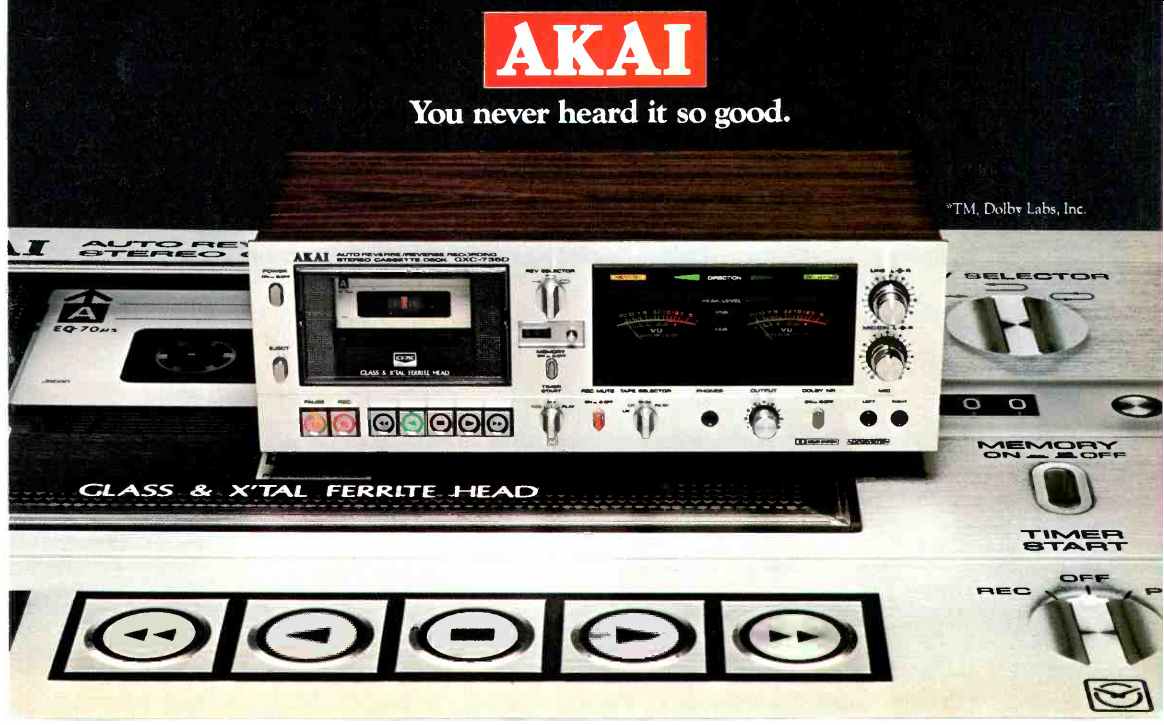
GXC-735D: Wow/Flutter less than 0.08% WRMS; S/N Ratio-better than 58 dB, weighted, at FeCr position, with peak level at 3% THD. Dolby on improves up to 10 dB above 5 kHz. Frequency response 35-17,000 Hz (± 3 dB) using FeCr tape.
CS-732D: Wow/Flutter-less than 0.08% WRMS; S/N Ratio better than 57 dB, weighted, at FeCr position, with peak level at 3% THD. Dolby on improves up to 10 dB above 5 kHz. Frequency response38-16,000 Hz (± 3 dB) using FeCr tape.
AKAI You never heard it so good.
----------------------
ES Translator
ELECTROSTATICS TURNED INSIDE OUT
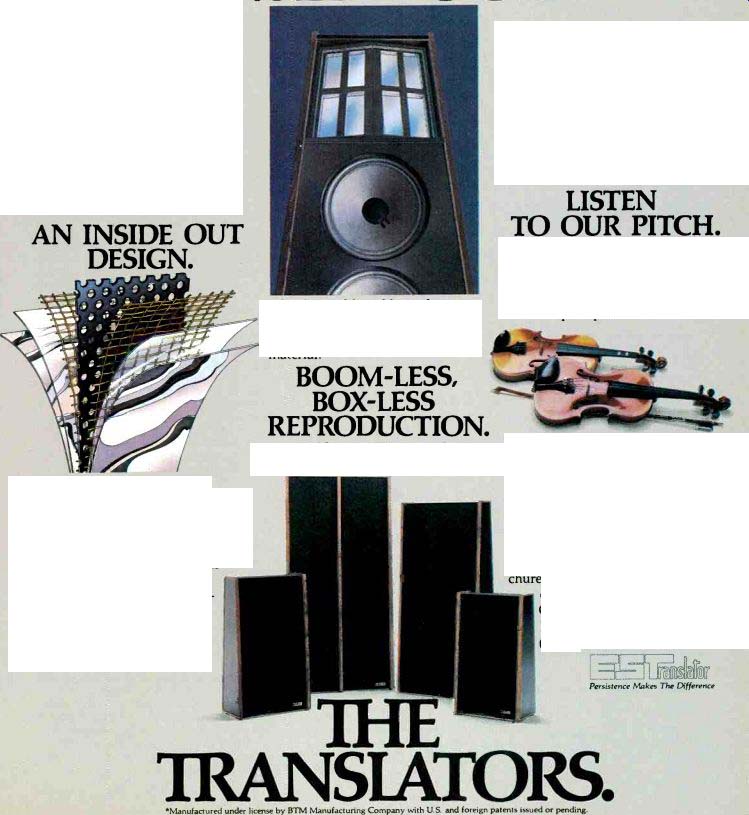
Electrostatics have long been acknowledged as the finest means of audio reproduction.
But traditional designs have been too large, too fragile and too expensive.
Now there's a radical new concept in electrostatic sound reproduction that has turned electrostatics inside out. It's called the ElectroStatic Translator.
AN INSIDE OUT DESIGN.
Unlike old electrostatics, the Translator's elements have one fixed plate surrounded by two diaphragms. Each diaphragm works on half the input signal. So the Translators play as loud as you like. Crystal clear. No breakup. With receivers delivering as low as 35 watts per channel. And there's no need for the traditional external power supplies. We've even solved the old problem of elements burning out by introducing a unique chloride dielectric material.
BOOM-LESS, BOX-LESS REPRODUCTION.
Unlike any other reproducer, the Translators have no acoustic environment of their own. So there's no cabinet resonance, standing wave interference or echo.
The Translator's woofer is the first of its kind, designed to match the ear's real-life sensitivity to low frequency audio signals.
The result is boom-less, box-less bass, midrange and high end.
LISTEN TO OUR PITCH.
The overall Translator design produces near-perfect voicing.
An openness and articulation that offer your ears a new criterion of audio perception.
That's why we invite you to compare the Translators to the finest dynamic or electrostatic speakers you can find. We think you'll agree that the Translators are turning today's speaker technology inside out.
For our informative brochure, see your Translator dealer or write
BTM Manufacturing. Company, 2005 Lincoln Ave. Pasadena, CA 91103. (213) 798-0476.
THE TRANSLATORS.
Persistence Makes The Difference
-----------------------
ONKYO
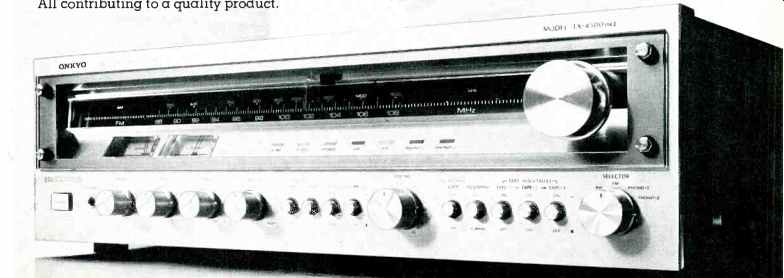
"The Highly Prized Receiver... ONKYO's TX4500 MKII".
In the beginning there was only one Quartz-Locked tuning system. Onkyo's TX-4500. While others started building their own versions, Onkyo's innovative genius was improving on the first to produce the finest.
The result. TX-4500MKII, the world's first IC Quartz-Locked tuning system for totally drift-free reception... and in heavy demand nationally. An improvement on the model Hirsch Houck Labs called, "one of the finest receivers available at any price," with more power (60 watts per channel minimum RMS, both channels driven at 8 ohms with no more than 0.1% THD from 20Hz to 20,000 Hz), new and convenient styling, wide-ranging flexibility and integrated circuitry for longer life and cooler running.
Check the features. The all stage DC OCL Power Amp for delivering clean power. Heavy duty 12,000µF electrolytic capacitors to reduce transient crosstalk distortion. And 200mV RMS phono overload level ensured by linear 3-stage DC equalizer amp. For minimum overload distortion the dual gate MOS FET front end; for superb FM stereo separation the PLL MPX circuit and for maximum selectivity the FM 4-ganged, AM 2-ganged variable tuning capacitors.
All contributing to a quality product.
Redesign has resulted in sloping panels for easy observation, group controls for easy operation, and facilities for 2 turntables, 3 tape decks with dubbing and 3 speaker systems. Complete mode, function and tone controls including high and low filters with 12dB oct /slope and Dolby 25 µs de-emphasis switching.
With so much invested, the TX-4500MKII is equipped with an electronic detector circuit sensitive to the slightest malfunction and a shut-off relay to cut off speaker power in case of a short circuit or drop in load impedance.
Nothing has been spared to give you the most for your money. There's nothing finer on the market.
See everything that Onkyo has to offer at your local dealer or write for information and the name of your Onkyo dealer. Find out how Onkyo stays... a step ahead of state-of-the-art.
*STEREO REVIEW, October 1976.
* *Dolby is a trademark of Dolby Laboratories, Inc.
Artistry in Sound COMMIX) Eastern Office: 42-07 20th Avenue, Long Island City, NY 11105 (212) 728-4639 Midwest Office: 935 Sivert Drive, Wood Dale, IL 60191 (312) 595-2970 West Coast Distribution Center: Damark Industries, Inc., 20600 Nordhoff Street, Chatsworth, CA 91311. (213) 998-6501.
---------------
OSAWA
Pair up for perfect reproduction.
With Osawa's Dynamic Duos.
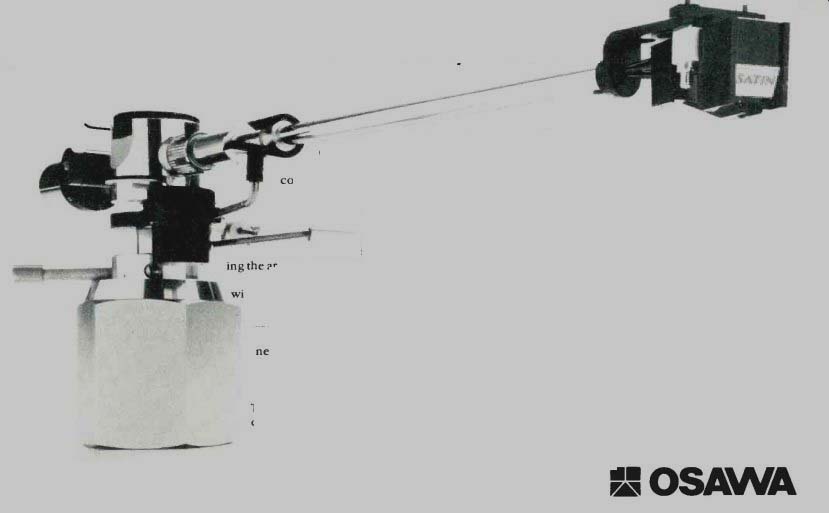
Advanced electronics are just not enough. For the most realistic music reproduction you need a high performance tonearm/cartridge combination to ensure smooth, wide frequency response and highly accurate tracking. The kind of top-quality performance that the Osawa duos deliver.
Start with the Ultracraft AC-300 MK-II tonearm that features adjustable oil damping. This eliminates resonances by fine tuning the arm to your cartridge. Then select the Osawa cartridge that's priced right for you. You can mount it directly on the tonearm without a headshell, thus reducing effective mass to the minimum.
Choose from 4 Satin Moving Coil models, the only MCs available that feature user-replaceable stylus and that don't require a step-up transformer or pre-preamp. Or choose one of the newly introduced high-compliance Moving Permalloy (MP) models by Osawa. Top-of-the-tine 300 MP offers a unique carbon-fiber cantilever that is extremely lightweight yet extraordinarily strong.
To select the combination that's ideal for you, visit your Osawa dealer. Ask him for the Osawa "Consumer Guide to Phono Cartridges," and then get a complete demonstration. Whichever combination you select, the name Osawa assures you the ultimate in clean and faithful music reproduction.
OSAWA & CO. ( USA) Inc./521 Fifth Avenue, New York, N.Y. 10017/Tel. (212) 687-5535-9/TELEX: 23-6593
=====
= = = =