
Distortion! A fascinating subject both for the audio engineer and the avid
listener. It is the very obverse of fi.
At last fall's AES Convention in New York, for instance, there was a memorable give-and-take at one of the morning technical sessions on a new aspect of this old subject, TIM. "TIM" for Timothy, otherwise known as Transient InterModulation. I'm not about to enter the Timothy fray nor any other of the sort, but I do approve. I also love to argue about distortions and I have my own ideas, as derived from the listener's hot seat. TIM has merely reached that point where before we can cope with it, even measure it, we have to codify and standardize and fence it in. It happens all the time and it needs to.
Hence the big arguments.
Of course audio distortions tend to occur simultaneously, all at once, in the natural audio state. But we don't work that way. We have to isolate before we can measure, and we have to discover before we can isolate. So each of the great major types of distortion; the obverse of fi, has had its big moment in the engineering limelight over these years, almost like a series of high-level fads. If they're arguing TIM right now, wasn't it Ph.D. last year? That's phase distortion. And some time before that, quite awhile, we went into a prolonged hassle over plain IM, without the T, measured by nice continuous pairs of clean sine waves. Then there was T by itself, minus IM. Big thing, back then, even if TIM would seem to be a close younger relative. Transients, mixed, all kinds, like mixed nuts.
Back at our beginnings came the granddaddy of all distortions, the old original, now shortened to HD. It was the only kind I ever heard about when I got into this biz, and my earliest power amps were proud of their low, low four or five percent harmonic distortion. Honestly, truly. And don't think it wasn't audible. Most people enjoyed the sound, not having heard anything different other than live, which didn't really count. Good, solid harmonic distortion gave you a bright, metallic sound that could cut through the soggy layers of early audio out of low-pass pickups, cactus needles, and tubby speakers minus tweet. It was good. And it sounded loud, too.
Sometimes I really miss it.
I take pleasure in the audible audio distortions because when they go away I can always hear the difference.
Also, and maybe more important, because I find to my pleasure that each and every type of electronic distortion has its fair analog in live musical sound, not as distortion at all but as part of the signal. That's interesting.
Take IM, for instance. As I see it, IM corresponds to what musicians call beats. Sure, there might be a few li'l technical differences, but have you ever played a recorder (finger holes and no cassette) right next to someone else who is also playing a recorder? What you hear, in addition to the musical notes, is a shattering series of loud buzzes and beepings, seemingly inside your head, bzzz, BZZZZZ, bheeee, Brrrr, wildly different in pitch and totally unrelated to the music.
These are sum and difference tones, which is to say, IM, but they are not distortion; they are "natural." You often hear them, too, in brass ensembles.
(Oddly, a similar effect can be electronically generated pure distortion in faulty audio playback of the same music.)
Call Me Reproducible
Transients have any number of names in music, which is overpoweringly full of them that's what we try so hard to reproduce. The now prized "chiff" of the old or Baroque organ is one transient that the 19th-century organ builders (misguidedly, according to present thought) were able to eliminate via "nicking" of the pipes, bleeding away the transients in favor of steady state. Then there is piano. I will not forget my first piano edits. Turn a piano tape backwards and you have a sort of wheeze box no transients at the beginning and a sort of subdued cough (transients in reverse) at the end. But turn it frontwards, cut off the transient "head" and you still have a piano sound. I was dumbfounded, the first time I heard this. The original transient burst is merely replaced by an electronic burst of distortion caused as the sharp edge of the steady tone goes by your tape head. But is it distortion? A question. Plenty of extant piano notes on a million different records have at least a few of these synthetic tone bursts, masquerading as perfectly good signal.
In singing and speaking there are glottal sounds, a breathy transient from down in the throat. And consonants what else is a consonant but a bundle of transients? In almost every musical instrument there are deliberately induced percussive transients, from the bounce of a violin bow on the string to the takataka tonguing of wind instruments. As for nonpitched percussion, notably the drum, the sound is a mass of transients and not much else. So we musicians are quite familiar with transients, though not as distortion.
All of which I think makes clear what we mean by distortion. We are trying to be faithful to an original, a "given," and that includes the faithful reproduction of all these sound effects. We can only define distortion, then, in terms of a prior model, and the definition of that model can be a tough problem. Oversimplification is our greatest trap, the easy way out.
The trouble with IM is that it doesn't include TIM; we get false readings when it comes to actual listening sound. On the other hand, what do you do about reproducing an "original" that is distributed over 24 separate tape tracks? Or how about the hi-fi reproduction of those electronic fuzz noises in pop music, deliberate electronic distortions (are they, though?) which must be distortionlessly reproduced! It's a slippery world, and no wonder there are arguments. I think, though, that it is reassuring to 20 know that real-life natural sound so neatly parallels the unwanted, falsely generated electronic signals which in fact do constitute our carefully studied types of distortion.
As a listener, I tend to make my own categories of audible distortions, just as I hear them out at the very end of the long audio chain. I fancy that these categories do indeed have some relationship to those of the engineers in our business that is, I am hearing what they are talking about. But as a musician I can never be sure; I only know what I like, as the music hater says.
Categorically Speaking
I have assembled for this month no less than three Canby Categories of audible distortion, and you may make what you will of them. The first, shall I say my "first-order" category, is the kind which, if I am right, is caused by harmonics generated in the system, here, there, everywhere. It is very uncommon now, and usually unmeasurable, but it wasn't so in the past. We used to hear positively enormous quantities of this distortion back in the 78-rpm days, early through late. Vast harmonic content, variably transient, via the old shellac disc and its crude "needle" and cartridge and via many a brave new early loudspeaker. I can hear all those sounds in my head and they weren't always so bad. Various terms come to mind, pro and con we talked about buzz, blast, grind, needle chatter, and about worn grooves and worn needles, sometimes minus their points, or the tips bent into a hook. There were cracked crystals, strained speaker cones, tired tubes, and I don't know what else the resulting sounds had a clear family relationship, from the gentlest to the most raucous. Harmonic? Mainly.
If so, that is important. Because every such distortion is directly related, for the ear, to the "fundamental" sound, the original signal. Harmonics make not only harmony but, more importantly, the whole range of audible tone color. So we were able to "read" this distortion to a remarkable extent as a kind of added coloration, often grotesque and hideous, but often relatively pleasant. Some brand-new speakers in early hi-fi were actually advertised as "golden" in sound note the coloration though this was perhaps to avoid the thought of a less flattering term, "tinny."
Yes, there must have been plenty of the other known distortions in these earlier reproduced sounds, even did not then recognize them. But, really, the biggest factor was harmonic distortion in enormously high percentages. So I would think.
I cannot say exactly how my "second-order" category of audible distortion will look in the figures, but it is certainly a very different kind of unpleasantness, a new sound, cropping up mostly via late-model advanced circuitry thou h I first heard it myself on early FM. I till do. Strong adjacent FM station tries to butt in on your music.
Sput, sputter, splat! Unmistakable and most unattractive. There is no harmonic message n this ugly sound and no coloration. It is just loud, jagged, a shattering, tearing noise that is completely destructive. I hate it. But I hear it more and ore often.
Definitely this is the ugliest of all the gross distortions, far more unpleasant than any ordinary buzzing or blasting.
If there is music in its origin, an occasional bit of musical pitch often gets through with the splat, but it is no more than a hideous gargle, not music.
Purely indigestible, this stuff, and you can give me Caruso on an acoustic portable with a broken needle any day.
A particularly jarring example of this sputtery distortion was to be heard a good while back via those brave earlier four-channel "discrete" record systems. It came at the dramatic peaks of volume and particularly via the innermost record grooves. Few of us would care to listen to any music with that sort of loud sputter coming through every so often! The CD-4 people made heroic efforts to improve, and in their later demodulators the splats were gone. But, alas, it was too late. No more. Curious that here we were also dealing with FM circuitry, via the CD-4 supersonic modulation of the groove walls. Curious, too, that none of the "matrix" decode equipment I ever tried produced this splatty sort of distortion, not even those with logic.
Probably just didn't happen to have the right elements in their circuits to … Whatever 6 my matrix y ... mild exam sat-like, came aQ dbx noiseless … before I … 'mod up as to levels F e y overload, proba S' ,did emit just two istakable, before it , subsequently perfect i criticism but, en[…]nerely indicated that here, too, was a modern circuit which if forced to malfunction would give forth not a harmonic blast but a second-order splat. There must be a lot more of this around, at least in the potential. Can any reader pin it down?
D-Lightful
I won't dwell long on my "third-order" audible distortion because, well, it gets into aesthetics. But I have to bring it up because it just happens to be our greatest concern these days the hi-fi reproduction of unwanted noise, the sounds we never asked for but get anyway. Our equipment can't tell the diff. between noise and signal, and that is the rub. We are frantically going this way and that in our search for the means to get rid of noise without getting rid of signal too. We have gone far. Autocorrelators (excellent), new metal tapes, plus hopefully better disc surfaces, Dolby, dbx, direct-to-disc, digital, maybe even some more uses of the letter "D" for all I know. Yet at home I still hear unwanted noises, just as you do. They are terrifyingly diverse we have to scatter our fire. FM stereo may give out splats but it is also still pretty hissy. Even the natural ambient sound of a concert hall or church can get to be a big problem but there we get into the aesthetics because that ambience is part of the signal, even a part of the musical effect, and therefore we must treat it with deference.
The nearer we come to true silence in our media background, the more careful we must be of all the tiny noises that are still strictly signal.
Where we now have that new silence, in all-digital recording, via dbx encoded discs, even in a few direct-to-disc releases (by no means all of them!), we suddenly find exasperating new problems thanks to the ear's uncanny ability to hear ultra-low-level residual noises once they are unmasked.
Don't, misunderstand me-I have been fascinated by my first batch of dbx noiseless discs and am certain that this is the most important new system we have seen in recent years that uses the still-viable LP record as its base. It has caused me absolutely no trouble since I got the levels of in and out adjusted properly-never a splat again.
But there are a few mighty interesting further items to be noted in connection with dbx.
For example, on a number of dbx discs from various labels, I became aware that some tape editor had repeatedly cut off the die-away reverbs at the end of the musical segments before they had quite disappeared. Now that is an old fault, seldom heard today thanks .to more aware and careful editing. So why here? I suspect that the answer is as you might guess-the noiseless disc has uncovered a new area of audible die-away where formerly the sound merged into general surface noise. Now we have to edit further down, virtually to zero. It's astonishing the way the ear can pick up these tiny faults, down in what used to be (still normally is) the proverbial mud. Caveat editor! I also noticed on the dbx discs that the problem of built-in hall ambience is not always adequately solved. It is quite normal today for a record producer to fade hall noise down to zero between movements, where there is normally a strip of leader tape inserted to fill up the time. OK-we mostly don't notice this because once again the ambient noise blends into the surface sound. Now, alas, we must rethink this problem. On a number of dbx discs I became unpleasantly aware of these between-movement breaks, because not only is the ambient sound nakedly clear-distant buses, cars, faint clunks and bumps, even maybe the ghost of a voice or two-but the sudden fade-out for the leader strip leaves you thinking your system has just died. Total, disconcerting silence.
And a clear disruption of the musical continuity.
We'll have to devise better ways, once it is established for the ear, to keep this ambient signal noise going (or fade it with care when it does have to go). In that way it is subliminal, which is the way it must be.
Well, the direct-to-disc boys and girls should be happy with this. No editing. Just one continuous play, straight through in real time, and ambience all the way. Just don't be tempted to close down your pots between numbers, you people. I'd much rather hear a few discreet coughs and a creaking chair than have to go through more of that unnerving sudden total silence in midstream. Aren't coughs and chair scrapes a part of musical performance? Is not silence, in this case, a clear distortion? You'd better start thinking so.
by Edward Tatnall Canby (adapted from Audio magazine, Feb 1980)
==========
ADs:
Pioneer CT-F1250 cassette deck
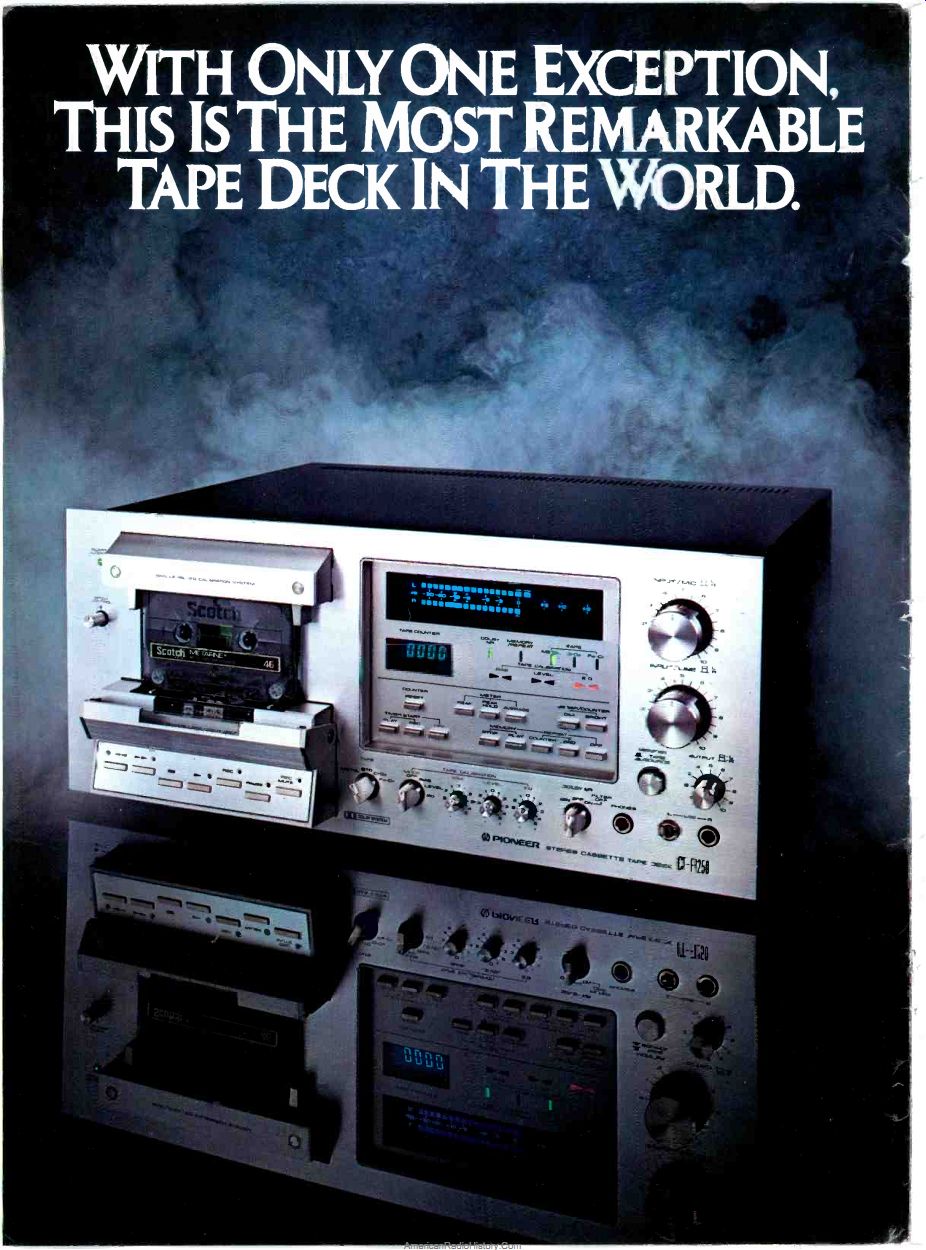
WITH ONLY ONE EXCEPTION. THIS IS THE MOST REMARKABLE TAPE DECK IN THE WORLD.
But without exception it's the most remarkable cassette deck.
Today, a thousand dollars or more is standard fare for a professional quality cassette deck. But when Pioneer designed the new CT-F1250, they not only raised the performance standards of high quality decks, they also lowered the standard price.
Metal tape capability is something most new high quality cassette decks have in common. But while many of them have just been modified for this advancement, the Pioneer CT-F1250 has been specially designed for it.
Instead of the two heads found in most metal capable tape decks, the CT-F1250 has three. And it's these three heads that keep us way ahead of the competition.
Our new "small window" erase head makes a big difference in making sure all metal tapes are wiped completely clean. And our Uni-Crystal Ferrite recording and playback heads give you greater frequency response and better wear-resistance than the ordinary ferrite and Sendust alloy heads you'll find on most other tape decks.
But you don't get distortion-free recordings just by using your heads.
Instead of the single capstan tape transport system you'll find on some tape decks that are nearly twice the price, the CT-F1250 has a closed-loop dual capstan system, similar to that found in our remarkable RT-909 open-reel deck. This system keeps the tape in perfect contact with the heads at all times. So you are assured of getting everything that's on the tape. Nothing more; nothing less. What's more, the CT-F1250 has a Quartz Locked Direct Drive capstan motor that senses the slightest deviation in speed and automatically corrects it to keep wow and flutter down to an unbelieveable 0.03%. It's engineering innovations like these that make the CT-F1250 so remarkable.
But equally remarkable are the features that make the CT-Fl 250 so easy to operate.
Like our specially engineered Tape Calibration System that lets you quickly set bias level, Dolby adjustment, and record equalization for the best possible signal-to-noise ratio, the lowest distortion, and the pest high frequency response.
And our 24 segment Fluroscan meter that works on Pioneer's own microprocessor to give you a more accurate reading of what you're listening to. It even has Peak, Peak Hold, and Average Buttons that let you record without fear of overload.
In addition Pioneer's CT-Fl 250 has a digital brain with a memory that controls four different memory functions. Plus pitch control. Mic/line mixing. Independent left/right input/ output controls. And more.
By now, it must be obvious that the CT-F1250 was designed to push up the limits of cassette deck performance. But only Pioneer would do it, without pushing up cassette deck prices.
----Metal tape capability for far greater dynamic range and far less distortion.
----Pioneer's 24-Segment Fluroscan Meter gives you an instantaneous picture of what you're listening to.
----Pioneer's easy-to-use Tape Calibration System guarantees optimum performance from every tape.
WITH ONLY ONE EXCEPTION, THIS ISTHE MOST REMARKABLE TAPE DECK IN THE WORLD.
But without exception it's the most remarkable reel-to-reel.
Today, many audio manufacturers are putting a lot less into their tape decks and charging a lot more for them. But when Pioneer designed their new R1T-909 open-reel tape deck they made certain it had every conceivable feature an audiophile could expect.
And one feature that was totally unexpected. A reasonable price.
Even if you pay $1500 or more for a so called "professional" quality tape deck, you'll probably still be getting a conventional single capstan tape transport system that is prone to wow and flutter.
Pioneer's RT-909 has a specially designed closed-loop dual capstan system that isolates the tape at the heads from any external interference. So you get constant tape-to-head contact. And constant, clear, accurate sound.
And while many of the expensive new tape decks have old fashioned drive systems that drive up heat and distortion, the RT-909 doesn't. Instead, it has a far more accurate DC motor that generates its own frequency to correct any variations in tape speed. And keeps wow and flutter down to an unheard of 0.04% at 7 1/2 ips.
What's more, the drive system of the RT-909 is unaffected by fluctuations in voltage. So a drop in voltage doesn't mean a drop in performance. The RT-909 also has a logic system that ensures smooth, accurate speed change.
Most professional quality tape decks are designed for use outside the home. So the convenience features most audiophiles enjoy are nowhere to be found. The RT-909, on the other hand, offers automatic reverse, automatic repeat, and a timer controllable mechanism that lets you record a midnight concert even if you can't stay awake for it.
Examine our heads and you'll see Pioneer engineers at their very best. Our playback heads, for example, have a new "contourless" design that makes them more sensitive. They increase frequency response upwards to 28,000 hertz, and extend it all the way down to 20 hertz. So you not only get greater range than any other tape deck, but also any other musical instrument.
Of course, these features alone would make Pioneer's RT-909 quite a remarkable tape deck.
But the RT-909 also has a Fluroscan, metering system that gives you an instantaneous picture of what you re listening to. A pitch control that lets you listen to music in perfect pitch even if it was far from perfectly recorded. Four different bias/equalization selections so you can use many tapes and get maximum performance from them all.
Obviously these advancements are very impressive. But there's still one thing even more remarkable than the technology we feature. It's the price we feature.
independent bias and equalization for maximum performance from any tape.
PIONEER We bring is back alive.
1980 .U. S. Pioneer Electronics Corp., 85 Oxford Drive, Moonachie, N.I.07074
-----Pioneer's closed loop, Dual capstan rape Transport ensures tape nsures constant head contact.
--------------
DISCWASHER presents
The Clean Truth About Your Naked Stylus

When your stylus plays over one light fingerprint or one tiny "bead" of vinyl stabilizer, the clean naked diamond becomes a glazed, dust-holding abrasive weapon wearing away at your records and masking their true sound.
This unseen build-up may actually hold the tracking tip of the diamond out of `. the record groove.
Accumulated grit, on stylus that looks "clean" to the naked eye.
The SC-1 Stylus Cleaner from Discwasher is designed with a brush that is stiff enough to remove harmful accumulation, but gentle enough to avoid damaging delicate cartridge assemblies. Two drops of Discwasher’s D3 Fluid add extra cleaning action to the SC-1 without the side-effects of alcohol, which can harden rubber cantilever mountings.
After cleaning w SC-1 and D3 Fluid by Discwasher, The retractable, walnut-handled SC-1 includes a magnifying mirror for convenient inspection of stylus/cartridge alignment and wiring.
Get the clean truth from your records; get the SC-1. SC-1 STYLUS CLEANER discwasher inc.
1407 N. Providence Rd., Columbia, MO 65201, USA.
-----------------
A. Telarc Digital

Tchaikovsky "1812" Overture; Capriccio Italien; Cossack Dance from Mazeppa Erich Kunzel conducting the Cincinnati Symphony Orchestra
It's stirring, familiar music, superbly played by the Cincinnati Symphony under the sensitive baton of Erich Kunzel.
And captured with all its warmth and emotion in the 100-year-old Cincinnati Music Hall. But what of the huge bells? And what of the fabled cannon? They are there-literally in full force-providing dramatic proof of the superiority of digital mastering of the untapped capabilities of today's disc recording.
========
This 12x enlargement shows the incredible groove modulations during the cannon shots ...probably the most demanding low frequency signals ever cut on disc.
=========
Not For Every System
We'll be perfectly frank: not every system-even some of the finest-will be able to successfully track the remarkable grooves on this record. And even if your cartridge and tone arm can track the record, the full impact of the sound may escape you unless you own an outstanding amplifier and speaker system. In short, this record will challenge every part of your system in every respect.
Most difficult to track and reproduce is the authentic 19th century cannon whose initial "crack" as the powder is ignited is
followed by pressure waves as low as 6 Hz which can easily be seen on the finished disc. Even with maximum recommended tracking force, many tone arm/cartridge combinations may be incapable of following these remarkable groove excursions*. And the "boom" is well below the useful range of all but the most sophisticated speaker systems, coupled to amplifiers with generous reserves of power.
At the other end of the scale, the tumultuous bells provide a challenge to high frequency tracking and a stringent test of the mid-range and tweeter components.
Add the full resources of the Cincinnati Symphony-captured as only the Sound stream digital system and Telarc microphone technique can-and the result is a record which will challenge your ideas about equipment performance and the limits of disc recording capabilities.
This landmark recording is just one of several new digitally-mastered Telarc releases. Available at most Audio-Technica dealers and wherever audiophile recordings are sold. If not available locally, write us today for our current StandarDisc catalog of digital, direct-to-disc, and advanced analog recordings.
AUDIO-TECHNICA U.S., INC., 33 Shiawassee Ave., Fairlawn, Ohio 44313.
Dept. 20A. 51fyour cartridge/tone arm combination is unable to track this spectacular recording, your Audio-Technica dealer can recommend several A-T cartridges and tone arms capable of meeting the rigors of this advanced digital recording technique.
Audio-technica.
ADD THESE EXCITING TELARC DIGITAL RECORDINGS TO YOUR COLLECTION
TCHAIKOVSKY Symphony No. 4, MOUSSORGSKY Pictures at an Lorin Maazel, Cleveland Exhibition/Night on Bald Mountain Symphony TEL-10047 Lorin Maazel, Cleveland Symphony
TEL-10042
AUDIO-TECHNICA PROFESSIONAL AND HOME PRODUCTS FOR BETTER SOUND
PHONO, CARTRIDGES, STEREOPHONES, MICROPHONES
------------------
Fisher Corporation
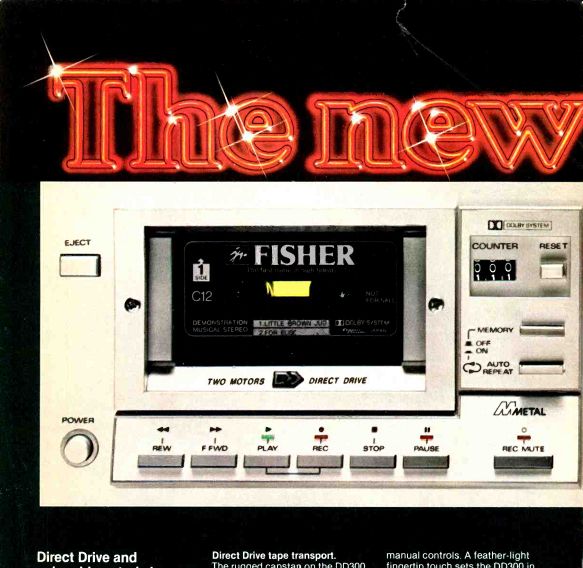
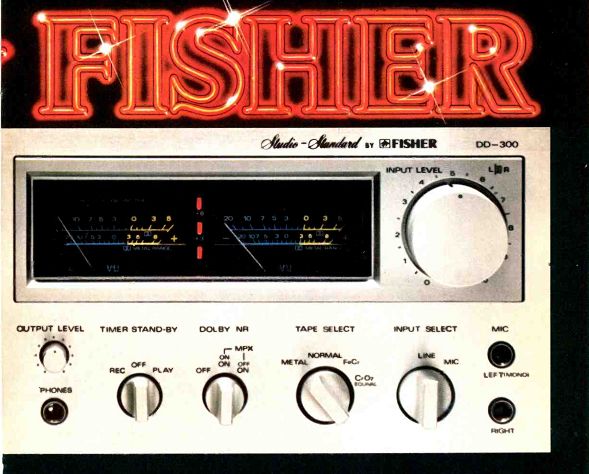

Direct Drive and solenoid controls in a new cassette deck.
Here is the very latest cassette deck technology. The new Fisher DD300 Cassette Deck has direct drive tape transport for lasting, unvarying performance, feather-touch solenoid electronic controls for superior operation and metal tape compatibility for the ultimate in frequency response.
There's an incredible amount of advanced engineering packed into this new Fisher cassette deck.
Direct Drive tape transport.
The rugged capstan on the DD300 is directly driven by a high-torque 18 pole brushless, coreless DC flywheel motor, optimized for the critical record and play transport functions.
It glides silently at a steady 360 RPM. And, it eliminates the problems of conventional high speed DC brush motors and drive belts. Wow and flutter are down to an amazingly low 0.04%. A separate motor is provided for fast forward and rewind.
No compromise.
Feather touch electronic controls.
Goodbye to the old "clunk-clunk" of manual controls. A feather-light fingertip touch sets the DD300 in motion. An IC logic circuit actuates the solenoid transport function for instant, silent, p3sitive action.
LED's light up to continuously display what functions are in operation.
Metal tape compatibility. If you want to try the new metal particle tape you've been hearing so much about, the DD300 is ready. Get set for an astonishing improvement in signal-to-noise, dynamic range and a frequency response of 30Hz-18kHz ± 3dB. Get set, too, to make recordings that rival studio-produced tapes.
It's what you'd expect from the new Fisher. We don't have the space to list all the other features of the new Fisher DD300. Features that are indicative of the high technology of the new Fisher. We invented high fidelity over LO years ago. And we've never sbpp c innovating. If you're ready for the latest cassette deck technology, Eee tre new DD300 at your Fisher sealer.
Fisher Corporation, 21314 Lassen Street, Chatsworth, CA., USA.
FISHER
The first name in high fidelity:
Drive coils provide 18-pole permanent pulsating magnetic ring magnet is field to propel bonded to back of flywheel.
Sensing coil between driving coils and flywheel magnet continuously monitors speed in DC servo circuit.
Dynamically balanced flywheel weighs over lb., helps maintain speed accuracy, low wow and flutter.
Capstan shaft is directly connected to, and is part of the flywheel. There are no belts, no pulleys.
Separate motor operates fast forward and rewind functions.
Instant, silent, positive tape transport functions are operated by solenoids.
---------------------
DON'T BELIEVE EVERY DIGITAL READOUT YOU READ.
When you tune to 102.7, you want to stay tuned to 102.7.
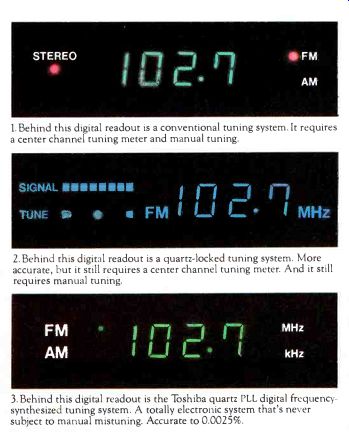
Toshiba has solved the problem of mistuning by eliminating the need for a center channel tuning meter. Instead, digital frequency synthesis uses a carefully selected quartz crystal to produce a stable reference frequency. In plain English, this system constantly corrects tuning errors. The result is the lowest possible distortion and absolutely no drift.
Toshiba was the first to utilize this system in a receiver, and now we're using it again in our SA 850 receiver.
Digital frequency synthesis not only makes us accurate, it also makes us more convenient.
No unnecessary parts.
We've eliminated the center channel tuning meter, FM/AM dial scale and tuning knob. So you can tune automatically or manually with the ease of pushbutton selection. You get LED digital readout and 5 LED signal strength indicators.
You'll thank us for the memory and scan.
Actually, you'll thank digital frequency synthesis. Because only with
1. Behind this digital readout is a conventional tuning system. It requires a center channel tuning meter and manual tuning.
2. Behind this digital readout is a quartz-locked tuning system. More accurate, but it still requires a center channel tuning meter. And it still requires manual tuning.
3. Behind this digital readout is the Toshiba quartz PLL digital frequency synthesized tuning system. A totally electronic system that's never subject to manual mistuning. Accurate to 0.0025%. this process can you store 6 FM and 6 AM stations for instant recall tuning at the touch of a memory button.
And in the automatic FM mode, digital frequency synthesis allows the tuner to scan until it stops at the next listenable station. FM stereo S/N ratio is 68 dB. FM selectivity is a high 80 dB. Frequency response is 20 to 15,000 Hz + 0.2 0.8 dB. But there's more to this receiver than just a superb tuning system.
Power you'll respect.
We're talking about 50 watts rms per channel into 8 ohms from 20-20,000 Hz.
This is provided by full complementary direct coupled power amplifiers.
And couple that with an ultra-low THD of 0.03%. A preamp you'll appreciate.
Along with provisions for attaching two tape decks, we give you full monitoring controls.
Plus duplication switching between the decks.
Our special subsonic filter switch helps eliminate low-frequency warp distortion.
And our receiver looks as good as it sounds.
With a sleek slide-away cover that conceals a full range of controls, including tone/defeat switch and a dual speaker selector.
The Toshiba SA-850 digital frequency-synthesized receiver.
The next time you're looking at receivers, don't believe every digital readout you read.
Except ours.
TOSHIBA Again, the first.
Toshiba America Inc. 280 Park Ave., New York. NY 11710
---------------
Sansui is breaking up a very successful relationship.
The TU-717 has a new mate: The AU-719. Sansui has just introduced an exciting new integrated amplifier, the AU-719. It represents the very latest developments in audio and electronics technology t is so good, in fact, that has replaced its rave-reviewed, best-selling predecessor as the partner of the TU-717 tuner.
The-U-717's performance has been extravagantly praised by professional critics and knowledgeable consumers alike. With advanced features like switchable IF bandwidth and specs like 81dB signal-to-noise ratio and 0.06% THD, it's only natural.
We expect the tuner's new mate to receive a tremendous reception and set industry amplifier standards for a long time to come. Here's why.
INTRODUCING DD/DC
What particularly distinguishes the new AU-719 amp is Sansui's patent-pending DD/DC (Diamond Differential/DC) circuitry that provides the extremely high drive current needed to reduce THD by adding large amounts of negative feedback without compromising slew rate or adding TIM. Slew rate refers to an amplifier's ability to respond to rapidly changing musical signals. The slew rate of the AU-719 is an astounding 170V/µ Sec.
MAGNIFICENT MUSIC
Many modern amplifiers have extremely low total harmonic distortion specs. And hat's important.
But THD is measured with steady test signals and is not really representative of an amp's ability to deal with music. Sansui alone, with it's DD/DC technology, is, able to provide both low THD and lowest TIM simultaneously. Instead of the harsh metallic sound you sometimes get on a conventional amp when the musical signals are complex, with the AU-719 you hear only magnificent music.
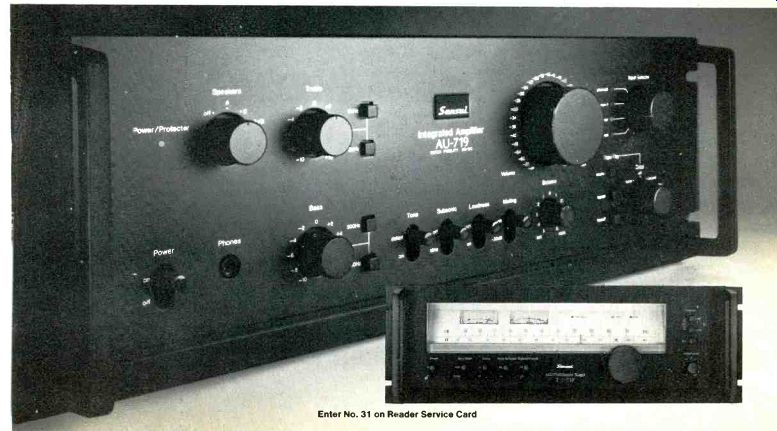
THD is less than 0.015% at full rated power of 90w/channel, min. RMS, both channels into 8 ohms from 10 20,000 Hz. Overall frequency response is awesome: DC 400,000 Hz, +0,-3dB. Hum and noise area super-silent-100dB on aux and-88dB on phono. The phono equalizer, which adheres to the standard RIAA curve within ±0.2áB from 20 20,000 Hz, also uses our unique DD/DC circuit for record reproduction that's second-to-none.
CONTROL YOURSELF
The unit is equipped with a full complement of versatile controls and connections to create the system and sound that's right for you, including two phono and two tape inputs, defeatable tone controls with switchable center frequencies, deck-to-deck tape dubbing and a very convenient 20 dB muting switch.
Audition the new AU-719 and matching TU-717 at your authorized Sansui dealer. We think it will be the start of a very successful relationship.
SANSUI ELECTRONICS CORP. Lyndhurst, New Jersey 07071 Gardena, Ca. 90247, USA.
Sansui Electric Co., Ltd., Tokyo, Japan
Sansui Audio Europe S.A., Antwerp, Belgium
In Canada Electronic Distributors
------------------
FACT: five new Shure Cartridges feature the technological breakthroughs of the V15 Type IV
Shure: the M97 Era IV Series phono cartridges
Shure has written a new chapter in the history of affordable hi-fi by making the space-age technological breakthroughs of the incomparable V15 Type IV available in a complete line of high-performance, moderately-priced cartridges: the M97 Era IV Series Phono Cartridges, available with five different interchangeable stylus configurations to fit every system and every budget.
The critically acclaimed V15 Type 'IV is the cartridge that astonished audiophiles with such vanguard features as the Dynamic Stabilizer-which simultaneously overcomes record-warp caused problems, provides electrostatic neutralization of the record surface, and effectively removes dust and lint from the record-and, the unique telescoped stylus assembly which results in lower effective stylus mass and dramatically improved trackability.
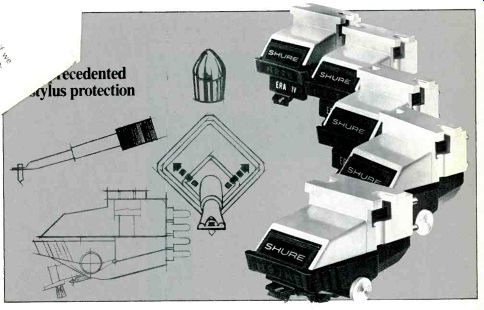
Each of these features ...and more... has been incorporated in the five cartridges in the M97 Series-there is even an M97 cartridge that offers the low distortion Hyper-elliptical stylus! What's more, every M97 cartridge features a unique lateral deflection assembly, called the SIDE-GUARD, which responds to side thrusts on the stylus by withdrawing the entire stylus shank and tip safely into the stylus housing before it can bend.
NEW! M97 Series Era IV Phono Cartridges ... Five new Invitations to the new era in hi-fi.
----------------
Beyer Dynamic

All you feel is the music.
Music should be a sensory delight. But it can't give you the pleasure you deserve if your headphones squeeze your ears and hurt your head.
The Beyer DT 440 is quite probably the world's most comfortable headphone. At 9 ounces, it's not quite the world's lightest (that record belongs to our Beyer DT 302). But with its sponge-padded ear cups and low-pressure air-tilled headband, it's so beautifully balanced it just about disappears.
When you plug in the DT 440 you'll be part of an almost unbelievably realistic musical experience. The strong bass, high efficiency and
fast transient response have all been acclaimed by sophisticated audiophiles, audio critics and musicians worldwide. And the DT 440's open-air, high-velocity design gives you a perfectly natural balance between recorded and environmentally-present sound.
The overall sound is absolutely clear, yet at the same time, warm and rich. With smooth, undistorted reproduction across the entire audible spectrum.
Stereo imaging approaches the ideal, providing accurate and dramatic locating of each and every sound source.
Please visit your Beyer dealer.
He'll make you feel better.
BURNS AUDIOTRONICS, INC. 5-05 Burns Avenue, Hicksville, NY 11801 (516) 935-8000
In Canada, H. Roy Gray, Ltd.
-------------
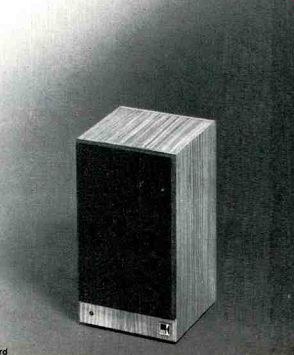
KEF Reference Series Model 101: Accurate, Small, Protected.
An acknowledged world leader in loudspeaker design and engineering, KEF has developed a monitor-standard d.speaker system that is both small only 1/4-cubic foot in size-and truly "high" fidelity. While these objectives are not new, the Reference Series Model 101 speaker system represents the first time that both are available in one product.
The Model 101 is, therefore, ideal for use in locations where an accurate small speaker is required in keeping with the rest of a high quality audio system.
System Design
Despite all the ingenious ideas that have been proposed by various speaker manufacturers over the years, the three basic parameters of Enclosure Volume, Bass Response and Efficiency are still related by unchanged physical laws. What is different is the thorough manner in which KEF engineers have, with the use of advanced technology, optimized the relationships between these parameters.
Starting with the premise that prospective Model 101 users will have substantial amplification available, KEF engineers achieved a response from this small enclosure of 90Hz-30kHz ±2dB (-10dB at 47Hz). KEF's leadership in computer-aided digital analysis techniques enabled them to optimize the design of the drivers, crossover network and enclosure to achieve a Target Acoustic Response without repetitious trial and error experimentation. Much of this technology, which did not previously exist, has been applied to the design and production of a small high fidelity speaker system for the first time in the Model 101.
Once the desired prototype was completed, KEF applied the same unique computer-aided techniques developed for the production of the critically acclaimed Model 105, so that the sound quality originally achieved in the laboratory prototype will be available to every user.
In addition, the high standards of the computer-aided production and assembly procedures enable precision-matched pairs of stereo loudspeakers to now be offered. For example: every Model 101 driver is tested and matched to tolerances of better than 0.5dB, and crossover networks to tolerances of 0.1dB; each pair of drive units is matched not only to each other, but to the other components in the system as well.
Loudspeaker Protection
The major problem with small, relatively less efficient loudspeakers is thermal overloading of the voice coils. KEF engineers have developed a unique self-powered electronic overload protection circuit, S-STOP (Steady State and Transient Overload Protector). Musical peaks are generally of short duration, so tweeters can handle far in excess of their normal program rating. A similar situation exists with low frequencies and their effect on the bass unit.
Consequently any form of fuse protection can reasonably limit the instantaneous peak handling ability of the system, yet fail to protect the system against a very high average power level. KEF's solution is to incorporate a protection circuit which takes into account the instantaneous power applied to each drive unit and also computes the length of time the signal is applied. The law under which it operates resembles very closely the temperature rise within the voice coil. A potentially damaging signal is immediately attenuated by about 30dB, and the full signal is automatically reconnected when it is safe to do so.
As a result, the Model 101, although only 1/4-cubic foot in size, is fully protected against fault conditions when used with amplifiers of up to 100 watts per channel.
The Model 101 is obviously not your average "miniature" speaker system where the quality of sound or power handling capacity is compromised by the small size of the enclosure.
Nor is it inexpensive. If you require a speaker system that INis both small and truly high fidelity, visit your authorized KEF dealer for a thorough demonstration.
For his name, write: KEF Electronics, Ltd., c/o Intratec, P.O. Box 17414, Dulles International Airport, Washington, DC 20041.
-----------
Interface: C Series II
It sounds like music.
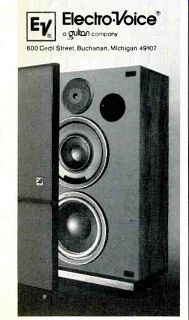
Interface: C Series II is the fulfillment of our six-year association with optimally vented speakers based on the theories of ® A.N. Thiele speaker designs first introduced, by Electro-Voice in 1973: The Interface: C offers you a unique combination of he efficiency and high power capacity-the only way to accurately reproduce the 120+ dB peak sound pressure levels found in some types of live music.
The SuperDome tweeter, an E-V exclusive, and the VMRT" vented midrange driver, the first to apply optimally vented design to mid frequencies, ensure your music is reproduced without the coloration normally found in other high efficiency drivers. An honest 30 Hz low end totally eliminates the need for expensive sub woofer assemblies.
When you spend $1.000 for a speaker system, get your money's worth.
Audition the Interface:C Series II at your nearest Interface dealer. If you want a speaker that sounds like music. the
-Interface: C Series II is the one you'll buy.
MI Electral/oice9 c 2UItorl company 600 Cecil Street, Buchanan, Michigan 49107
---------------
TEAC
TEAC TODAY THE X-SERIES.
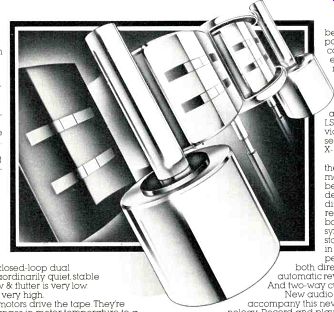
You're looking at four new machines that have more in common with data recorders than audio recorders. Together they are called the X-Series. And they bring a totally new kind of technology to the open reel format.
Each X-Series transport is an instrumentation mechanism.
For 15 years, this TEAC design has stood the grueling test of time in computer installations where dependability is worth millions.
The basic configuration is closed-loop dual capstan. It's extraordinarily quiet, stable and precise. Wow & flutter is very low Speed accuracy very high.
Three DC motors drive the tape. They're used to keep changes in motor temperature to a minimum under different loads so constant torque is maintained.
Our Magnefloat flywheel assembly, a completely new concept, uses magnetics rather than mechanics to eliminate problem-causing springs and pressure plates. Axial variations between the tape and capstans are prevented so proper tracking is assured. The result is highly accurate audio reproduction even after years of hard use.
The X-Series transport maintains ideal tape-to head contact. Audible drop-outs, level and frequency losses are absolutely minimized. Frequency response is wide and flat. And signal articulation is unusually clear.
The brain behind the transport is our LSI control chip. It eliminates the need for mechanical relays so transport control is faster, more positive and reliable. The LSI also lets us provide full motion sensing in the X-10 and X-10R. Within the X-Series, machines have been specifically designed for bidirectional record and playback. Perfectly symmetrical head stacks (6 heads in all) assure top performance in both directions. There's automatic reverse and repeat.
And two-way cue monitoring.
New audio electronics accompany this new transport technology. Record and playback amplifiers are quieter and completely free of audible distortion.
The sound is cleaner, more faithful to the source. The fidelity is unsurpassed.
An option previously available only on our professional recorders can now be added to any X-Series machine. Called dbx I. this noise elimination system adds 30dB to the already high S/N and over 10dB of headroom to give you master quality recordings.
If your audio perception is critical, your listening standards high, audition an X-Series recorder. The performance is flawless. The sound peerless.
TEAC
-----------------
Nakamichi
The dawn of a new recording era Auto Azimuth Alignment
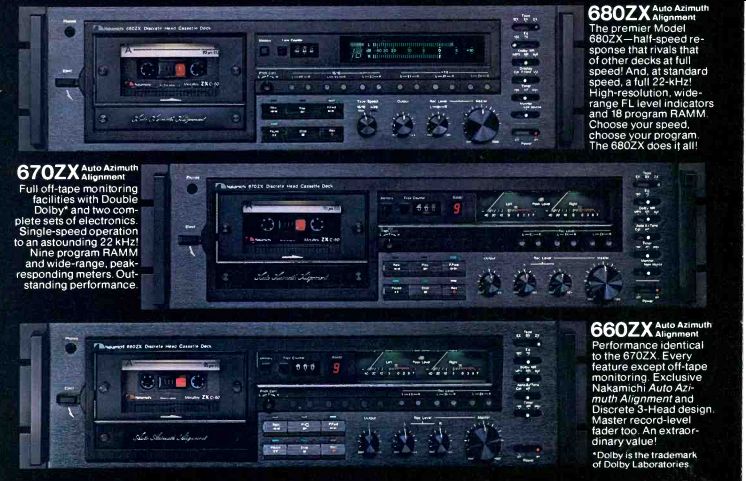
680ZX Auto Azimuth Q / Alignment The premier Model 680ZX-half-speed response that rivals that of other decks at full speed! And, at standard speed. a full 22-kHz! High-resolution, wide range FL level indicators and 18 program RAMM.
Choose your speed.
Choose your program.
The 680ZX does it all!
670ZXAuto Azimuth A Alignment Full off-tape monitoring facilities with Double Dolby* and two complete sets of electronics.
Single-speed operation to an astounding 22 kHz'
Nine program RAMM and wide-range, peak responding meters. Outstanding performance.
660ZXAuto Azimuth Alignment Performance identical to the 670ZX. Every feature except off-tape monitoring. Exclusive Nakamichi Auto Azimuth Alignment and Discrete 3-Head design.
Master record-level fader too. An extraordinary value!
'Dolby is the trademark of Dolby Laboratories.
Undoubtedly the most advanced and sophisticated innovation in cassette-recorder technology, Auto Azimuth Alignment launches a new era in high-fidelity recording. For the first time, you can be assured of perfect record-head azimuth alignment-on any cassette-at the flip of a switch. And, with that perfection comes an unprecedented frequency response-22 kHz at standard speed, 15 kHz at half speed! Auto Azimuth Alignment-designated by the ZX in the model number-is available now on three revolutionary decks-the 680ZX, 670ZX, 660ZX. Each features exclusive Nakamichi Discrete 3-Head technology, 4-Motor, Dual Capstan, Asymmetrical, Diffused-Resonance Transport, Random Access Music Memory and 22-kHz response at standard speed. And, the 680ZX-joining the popular 680 with manual alignment-matches its unique half-speed recording response of 15 kHz! Auto Azimuth Alignment--Nakamichi's commitment to excellence in the fine art of recorded sound.
Nakamichi
For more information, write to Nakamichi U.S.A. Corp.. 1101 Colorado Avenue, Santa Monica. CA 90401
------------