by Edward Tatnall Canby
Inevitably some press events come at the worst possible time for those of us with regular deadlines, but this one just had to be attended. Both Bert Whyte and myself, representing this magazine, were on the spot to hear Bell Labs present an astonishing collection of early test hi-fi discs, gold-sputtered masters, no less, made in 1931 and 1932 in-believe it or not both mono and disc stereo-and housed in the Rodgers and Hammer stein Archives of Recorded Sound in New York, a division of the New York Public Library. The discs were of music played by the Philadelphia Orchestra under Leopold Stokowski, recorded in the Academy of Music in Philadelphia during both rehearsals and actual concerts.
Stokowski--at the very top of his career! And disc stereo in 1932?
This just had to be heard. Those proverbial wild horses could not keep us away. And mind you, this was when Bell Labs was leading everybody in the new electrical recording, every aspect, from disc cutters to sound. movies (Vitaphone discs, 16 inches at 33 1/3 rpm)--and even stereo, it now turns out. I have been fascinated historically by early stereo recordings from around 1952 or so, and the Bell Labs recordings were 20 years before more than 25 years before the earliest commercial stereo discs of 1958.
Alas, it is my duty to report on this epochal sound demonstration. I don't know Bert's reaction, but as for me, I was disappointed. The records were fine, as I found out later. But the demo, as put on by the very outfit that practically determined the course of our history, was more than ineffective--it was downright misleading.
After so much speechmaking, and such a buildup, I suspect many in the small audience went away muttering so that's the best they could do?
Even with a charitable allowance for the "crudity" of such early experiments, the average and uninformed music listener and, especially, the hi-fi man would rightly have gone away unimpressed, at least by the sound itself, gold-sputtered or no. "Well, waddya expect? Not bad, considering. Forty nine years! Back in the Stone Age of electrical recording. Frankly, though, I wouldn't want the stuff around my hi fi system." After two minutes of actual demo, I decided I would reserve all judgment on the recordings until I got to my own objective home listening grounds and could play the derived LP of Stokowski samples that had been pre pared. From Bell Labs, in that extraordinarily progressive era, these recordings simply had to be better than what we heard. So let me tell you, first, what seemed to be wrong with that demo. And let the climax of this article, as at the demo itself, be the recordings.
I suppose we can't expect eminent scientists to be dramatists. There, we surely can be charitable and under standing. The speeches at this presentation went on and on, from the Chairman of the Board on down and, on the part of the Library, the honorable and venerable David Hall, well known to all of us for writing about and producing records. But the best speech, the most unassuming as well as in formative, was that of the man who actually made the recordings, who was called back to supervise the restoration of the collection--Arthur C. Keller. Now that was a bit of drama! And nicely underplayed--he gave us a fine sense of the reality of that occasion, when Bell Labs was lucky enough to get, so to speak, the use of the Philly Orchestra as an experimental sound source to check out all sorts of newly developed audio gear, including the stereo process on disc. Keller did not declaim and boast; he was modest.
Yes, the mikes were special calibration jobs, the Western Electric WE 640 (another arm of Ma Bell), which, he thought, were omnis--but some discussion revealed that perhaps there was indeed a slight directionality to these micro phones, which could account for some of the rather dead and close sound in the re cords. Yes, he thought that might be true. Good little discussion.
David Hall's re marks about his Library were to the point; prior to the Rodgers and Hammerstein Archives, the New York Public Library had nowhere to house its increasing acquisitions of recorded material. So true! When the "Music Division" of the Library was located in the big main building at 42nd Street and Fifth Avenue, all the records were "stored," hopefully for future cataloging. Do I remember! Years ago, Philip Miller of the Library took me down in some sub-basement to see for myself. It wasn't his fault; there were no funds. I was aghast. Hundreds of unopened boxes, just as they had come in from the record companies each month, year after year, for decades. Not a box even sampled, let alone cataloged. All that was changed when the Rodgers and Hammerstein opened up in Lincoln Center, with funds to do the job.
So the Stokowski recordings are in deed going to a splendid home with all the correct "archival" facilities.
You get the idea. Speeches, on and on. I did not hear one mutter of "Let's hear the MUSIC!" from the well-bred audience on hand. So finally, the big anticlimax.
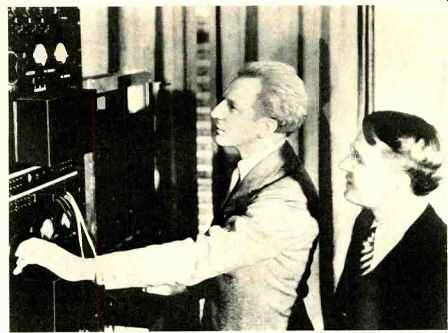
----Stokowski (left) and Harvey Fletcher, Bell's Director of Physical Research, during playback at Constitution Hall.
Demos Are Delicate
I have attended a thousand public playings of recorded music in large spaces, and put on a few of my own. I tend to fear the worst and am often justified. Under the best of circum stances, this is never an easy proposition. And, unfortunately, many otherwise excellent engineers and executives are thoroughly unaware that there are problems involved--and of ten good solutions, given the right planning. Most seem to think that all you do is to get hold of an amplifier, er, some amplifier or other, and a couple of good loudspeakers--i.e. good for the home living room--and just play what you have to play. After all, the sound is already there in the re cording, isn't it? Not true! A very large part of it is in the playback.
One look at this Bell Labs setup and I began to have my doubts. A small modern auditorium, very wide and shallow, with a large stage up front.
And totally dead. Excellent for speech! The Chairman of Bell Labs spoke into his microphone at the rostrum but the mike was dead. No matter. Every word was clear, even at conversational level.
Others didn't bother, and just talked from their chairs. You could hear. But what sort of an auditorium was this for musical reproduction? With so much sound absorbing, you might just as well be out of doors in some wide open space. Some of us would have taken one look and sent out for lots more amplifiers, preferably disco.
On the very wide stage, two tiny speakers were set up, far, far apart.
Squat bookshelf type, big enough in the living room but awfully diminutive in this much larger space. In front of them was the forward rostrum, plus tables, chairs, what-not, extensively laid out between the speakers, and neatly blocking one or the other for many listeners, including myself. I was in the center but could not see the right hand speaker. Nor hear it, thanks to sound absorption. The audio source in this case was a tape, seven-inch reel.
That part of the gear was properly set up against the back wall and out of the way, though it would have been better still down on the floor or out of sight entirely.
So the music at last began. Such a muffled sound! And not nearly loud enough. That is, for an auditorium of this size and a large symphony orchestra playing very powerful music. More over, it seemed to be astonishingly distorted. There was strain and stridency, coming out of the general muffled effect, at every climax. Too much--it just couldn't be. Bell Labs gave us to understand, remember, that these were remarkable examples of early wide-range recording, and Bell Labs surely knows.
Distorted Perspective
If you are going to reproduce the Philadelphia Orchestra on a stage large enough to hold most of that orchestra in person (though things might be a bit crowded), then you must provide some illusion of size and power.
This was NOT a home living room. But you must also understand that in a dead space--as in the great outdoors--and at a high volume, too, any distortion that is present will seem worse than it is. A sad fact of our listening nature. (Conversely, good indoor play back acoustics make distortion seem less, as with a small radio playing in the kitchen or the bathroom.) So, with those relatively small speakers, so very widely spaced apart, we were doomed before we started. Especially in mono.
Most of the more than a hundred Stokowski excerpts in this collection (out of some 6,000 discs stored by Bell Labs all these years) are, of course, in mono.
In that space, the mono recordings became a point source, or rather, two point sources, whichever one was nearest you. We older souls can, on occasion, readjust our ears to the mono situation we used to know so well. But younger people of the stereo age would find this sort of point projection of a mono original particularly difficult. Reflection, diffusion of the sound is one helpful answer. There was none. Result? Artificiality and a seeming heightening of distortion. Not a good listening experience.
Was the distortion actually in the recording? The more I listened, the more I felt that it could not be. An excerpt from Wagner's Tristan began; as the strings soared up, ever louder, the stridency was dreadful. Strings, of course, always show up distortion of the common harmonic sort, as who doesn't re member. (In older times we were mercifully spared, thanks to the prevailing cut-off somewhere around 4 kHz.) Of the audio elements involved here, began to suspect the speakers, which would be overdriven, most likely, be fore the amps reached their own stage of acute distress. Look! This was a "small" auditorium, granted, but even so its cubic volume (clumsy term for rounded internal spaces) was enormously greater than any imaginable living room. And well padded, too.
SOMEBODY should have realized, ahead of time, I say. But is Bell Labs (and Rodgers and Hammerstein Archives) really aware of all that goes on in the outside world--say, the sort of sound we now get in the disco biz? I suspect not.
Could be wrong--I'd like to see the Chairman of the B. in a disco and, in fact, wouldn't put it past him. Amiable soul. So it was a matter of not putting two and two together? I do not know where the "blame" could be placed, if anywhere. And after I had heard the records at home (the LP of excerpts) I felt extremely charitable. So the demo fizzled! Not so the recordings. Which is what matters.
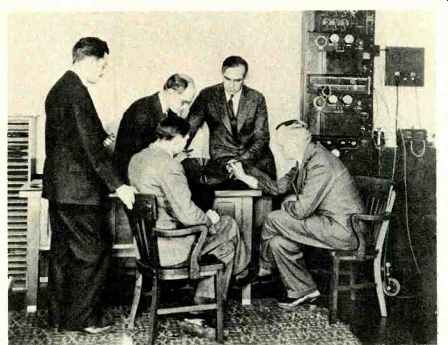
----- Bell Labs' Development Group c. 1930 included (clockwise from left) P.B. Flanders, J.P. Maxfield, A.C. Keller, H.C. Harrison, and D.G. Blattner.
Why were these extraordinary musical examples of Stokowski at work in his prime ignored for a half century, almost? Simple enough. They were not made as musical projects but simply as informal behind-the-scenes tests of equipment, thanks to Stokowski's well-known great interest in anything to do with recording. It was a superb chance to produce a real sonic work out for developmental material--no more. It was luck, indeed, that the fragmentary sonic results were saved at all, once they had done their work.
The gold sputtering technique was a recent Bell Labs improvement at the time, replacing noisy graphite as a base for plating; also the use of vinyl plastic. The discs are preserved in the form of golden platters, 12-inch, with the characteristic wide center holes of an intermediate "generation" in the pressing process. Apparently they are not suitable for use in the present day pressing cycle, but a way to transfer them to tape was quickly found and clearly must have given impetus to the whole restoration project--if I am right, the ingenious new Stanton/Pickering forked stylus that will play a "negative" groove, i.e. a ridge. Marvelous idea!
Right here, our demonstration left a lot of questions hanging. Does this imply that the old gold sputtered masters are negatives, with raised ridges? No body said. I didn't get close enough to see.
WE 640 mikes, slightly directional--but what cutters (and how many)? Again, nobody said and I'd like to know. Surely they were advanced magnetic. What cutting medium? Was it still wax? Nobody said in so many words. If wax, then these remaining masters were definitely not wax, as could easily be seen--are they sputtered vinyl or metal with some coating? Nobody said. Anyhow it seems apparent that these golden masters are not the original cuts. Or so I began to think. Well, it wasn't exactly a technically minded audience.
Why sputter them--for non-distribution? If I had more time I could find out.
Answers At Home
Well, I went home and in due time found that the sound was indeed a lot better than it had seemed at the demo.
Home sound for a reviewer represents neutrality out of long familiarization; one hears "through" it into the recorded sound itself.
For mono, after a bit of listening via one speaker, I set up an enhancement:
QS decode (throws a lot into the back speakers of a surround system) and maximum Advent SoundSpace delay, which if I am right does synthesize useful sidewise random cross-relations between two channels, in this case identical mono. What I heard was a good and realistic space, a sonic "box" which was long but narrow (it did have some width, at least), like a squashed concert hall. Not bad for the music and it brought out its best sonic qualities, which was my intent. Some distortion, yes. Characteristic strained sounds at higher levels, typical of much earlier electrical recording. But not bad--not nearly as unpleasant as at the demo. The quiet passages were lovely, clear and wide range. Some thing, for December of 1931! There is a complete Roman Carnival Overture and an Invitation to the Waltz which, judging by the lengths, were taped together from two 78-rpm sides each.
(They didn't say.) Wonderful fiery performances, especially the extraordinary Berlioz Carnival, if with some distracting vagaries in the levels here and there. Gain riding? The rest is in hap hazard, incomplete fragments though most of Moussorgsky's Pictures (Ravel) is there, a mix of mono and stereo.
Ah stereo! Bell Labs says its disc stereo grew out of a curious double-band experiment whereby filters sent lows into one disc cutter and highs into an other on the same record, the two played back (in sync!) for a wide tonal range otherwise impossible with avail able amps. So they say. It was this system, later consolidated into a single groove via a lateral-vertical cutter (Keller again) that was adapted to stereo. But how? Didn't say. Was this a fake stereo of sorts, highs to the right, lows to the left? Or did they somehow shift over to two full-range bands, after all? There were some two-band stereo cuts, two pickups, among the Stokowski segments. Also, clearly, single-groove cuts, lateral/vertical: The excerpts on our LP all run typically around 3:30 to 3:50, one 78-rpm side ONE groove.
Well, my ears say it was the real thing, however they did it. Lovely spatial presence, even startling. Excellent sonic quality, too, comparable to the mono. Some fluttery instability of image, a bit of "hole-in-the-middle," characteristic of early stereo--and lots of separation. Especially in Gnomes (Pictures) when suddenly the violins take off and fly across stage, left to right, then straight back. Some body fiddling with the 1932 controls.
Final note: Those violins did not change in sound as they flew from one side to the other. This could only be real, honest stereo. Stereo as of 1932 and fi as of 1931--I heard it myself.
That's what I wanted to know.
by Edward Tatnall Canby
(adapted from Audio magazine, 1980)
= = = =