PARENTS OF THE LOST ARK
After only three months, I must hastily return to my whiskered friend who bought a camcorder to make home videos and invited me to his party the day after he acquired it (see "Audio ETC," March '86).
This man is not young, but he has the energy of a man of 20. Since I last wrote, that big camcorder has already been hauled all over New York City and, believe it or no, to Mexico. I have seen--and heard--some of the results. I am glad to report that the video aspect of these new home movies continues to blossom and my friend to exploit it with ever more ingenuity. He is canny. I think he has a sense, at least in the video area, as to what is good, just as some of us do with our still cameras. He is learning, as predicted. But it is sad to note that, with one big exception, the audio as I hear it (or do not hear it) is getting nowhere fast. I saw lots of pretty Mexico; I heard nothing but faint, distant, unintelligible voices off somewhere. And so it goes-with that one exception. So much superb audio equipment at hand here, in the newer cameras, in the new VCRs, and what are we doing with it? Not much. We just let the sound roll, as it will, and take pretty pictures.
The one enormous exception to an audio that mostly does nothing at all came in a classic, ever-expanding area that is as inexhaustible as the human species-babies! And parents.
Millions and millions of baby pictures in full color, fuzzy in print form, better (but less popular) in slides, are taken every day. Minus sound. And quite a few home audio tapes are made too, on every sort and size of cassette recorder. Minus picture. The combination of these two in video format is, shall I say, potentially explosive. That's what I think, after having seen it, again via my busy friend, who did all the work.
He is not, really, an amateur-at-large, though he was surely a beginner in the use of a camcorder as de scribed in March. How could he be otherwise? But he knows what he wants. Days after he bought that equipment, he put out an ad offering his studio (that is, his apartment) for video pictures at $50 an hour, video cassette included. It's my guess that what he really wanted was something to take pictures of, to experiment on some subject matter. And I think he had a good idea of what might show up. Presto, a young couple with baby, plus a couple of ancillary hangers-on, came right downstairs from higher up in his building and signed for a video hour, sound and sight. Young, and photogenic too. How could he do better? I have to admire the guy.
Gently mix a bland liquid, glycerine, with nitric acid and sulphuric acid, and you have another liquid, looking just as innocent, which will blow up if you so much as tickle it. Nitroglycerine, the basis of dynamite. That's what we have here in audio/video terms. Just combine the ingredients.
On the one hand, you have baby's first visibly toothless grin and drool, or maybe those epochal first steps, with visibly delighted adults beaming all around. Just lovely for those who are near and dear, but sometimes too much of a muchness if you are not quite that close. I speak, of course, firsthand. I am subject not merely to vast quantities of family photos but those of most of my older friends, whose grandchildren populate the world. I've seen 'em all. (I am not totally hard-boiled: Two lovely pictures of my Irish niece with baby, and her English husband with their second baby, are thumb-tacked to my wall. Very nice.) On the other hand, babies (and parents) in audio, minus pictures, are of very limited value, hi-fi or not. I should know. In palmier days I once made a long, super hi-fi audio tape of my first nephew. It went on and on-the great new feature at the time-via an Ampex or such, in impeccably first-class sound. Pioneer baby recording! I was proud of it. Babies are cute to look at, but, really, their audio is not of the best.
Years later I played that tape to the same nephew, now grown up. What an anticlimax. He was merely embarrassed and disgusted. One does not play baby tapes to the same baby until he or she is at least 65 years of age.
Baby's first argh-gargle-gargle is the way I put it. That's what you hear. Plus the ecstatic cooings and coochy coochy sounds of the fond parents.
Good sound only makes things worse.
When my brother walked into the room, on the above playing, he merely said, "What's that?" and walked out again.
He didn't notice that the grown-up voice doing all the cooing was his own.
(He can't recognize his own mother in a recording I made, either, nor his father.) Isn't audio wonderful? So there's the fate of baby's first audio, minus the picture. Throw it out, and the sooner the better.
When I saw my friend's baby video tape, or, say, around half of it (I think they went on into a second hour), things went bang. Nitroglycerine. I was astonished, entertained, pleased even though these were total strangers. It was quite charming, even if it went on and on, and definitely some thing I had never imagined before in recording and reproduction of sound or sight.
Unrehearsed? Of course. Amateurs? Of course, though the mother might have been a model and all the other young folks were good looking too. As the minutes wore on-and on-I found that for the first time the endless expanse of recording was a positive thing and wholly new. These people just sat, or stood. No special arrangement, no script, no nothing. For a few moments, things were self-conscious and a bit uncomfortable, and the baby tended to hide behind Mama with a finger in her mouth. But time does march on, and after a while everybody began to relax; how long can you be uncomfortable? Not that long. Desultory conversation sprang up, not of any importance, not always intelligible, but natural enough. There were long silences, not at all uncomfortable. Baby began to come forward. The mother was on one side, father on the other; that calls for action among babies.
Papa played games with baby on his shoulder, swinging her around casually, the familiar way of good papas.
Then baby reached toward Mama, and crawled across. Delighted chirps and gurgles, much better than on any old "blind" tape. And finally, after about a dozen crossings back and forth (do babies ever get tired of such things?), the miracle happened. Right on cam era, that baby took its first unaided steps. Wow! You don't get that in old time short movies. Not only the first, of course, but about 15 minutes worth of further first steps. Baby caught on, fast. By that time, honestly, I was one of that family, whose names I did not even know.
If the recording parameters are right-right for the picture, right for the audio-this kind of a long, long scene is practically self-generating. Just let it go. And go some more. Not that a large audience would want to view at such length! This is still the old, traditional baby scene, for parents and others they can bulldoze into paying attention, not to mention aunts and uncles and neighbors. But for a while, maybe 10 or 15 minutes, almost any body could find it pleasing. And if the audience starts its own desultory conversations while the video plays (they will, they will), then-again, if the thing is rightly done-the two groups, "live" and on videotape, will shortly seem to merge, the two conversations become one, and the celebrated baby is not in the least disturbed. Quite a fine thought; my imagination soars. How to combine two family gatherings at a distance, like the remotes that allow conversation between TV newscasters far apart? No, you can't do a give-and take of that sort. But two groups, one a live audience, the other recorded but very real, can indeed happily merge in a useful if limited way.
So you see why I think the baby boom, plus all other and similar family affairs, babies or no, is about to come upon us in home-video terms. I do regret the (temporary) disappearance of the outdoor scenic picture, in favor of all this indoor stuff, but I bow to the inevitable. Me, I'll be out there taking stereo color slides again, of landscapes, mind you, and cats and dogs and horses as often as babies. (I got one marvelous, accidental 3-D shot of a baleful, yellow-eyed cat glaring at me from underneath a parked car in France. I never even noticed it as I took the picture.) The rest of you will be safely indoors wielding your video, and more audio/video power to you. Especially audio.
But how did this videotape get taken, in that same big apartment as de scribed in March? The differences between this and my friend's first efforts are instructive. First, instead of a large, noisy crowd of party people, shouting over their eats and drinks, plus loud background music from the hi-fi speakers, there was this time only a handful of people, including baby, and no background noise in the apartment nor from outside (maybe it was Sunday morning). And the camera was now moved way forward, there being no impeding bodies, carrying its built-in mike (which I have found is not removable, a terrible mistake) right up front, relatively close. The sound was still a bit off-mike, but the pictures made up for it as in professional TV (where the voices, minus picture, often sound surprisingly tinny). Thus the sound was good and natural as one watched including the baby. Indeed, it was a fine 50/50 proposition, a balance between audio and video such as we must have for good results.
If you want good sound, any sound at all, do not use the camera zoom to bring things up close! Not, at least, until someone takes up my idea of a built-in and synchronized sound-zoom microphone which can change the sound pickup as the zoom changes the picture, automatically. Then you can zoom close and your sound will also be close. (Not only the mike pick up pattern but the volume level would have to be synchronized, come to think of it, before feeding the overall automatic gain ride. Unless, of course, the gain ride could cope with the differences on its own. More R&D-we would have to find out.) A few words, in contrast, about my friend's videos of Mexico. On a raw winter evening in New York, the big monitor suddenly spread out the blue, blue Mexican sea, all gentle wavelets (with, alas, color fringes) and piled-up white clouds above (the same). Such an idyllic scene! We gasped with plea sure-for about four minutes. We heard extremely faint occasional sounds of distant voices in the back ground, otherwise no audio. Just wavelets and a moderately distant shoreline, with white buildings discernible. We were anchored in a hired mo tor launch, a ways off shore. Ten minutes later, the same. Fifteen minutes, still the same. Ugh. Blue waves ad infinitum? Not very good video.
Then suddenly the cameraman (same old Mr. Whiskers) bethought himself and jumped into action. We had been sitting, motionless, in a hired boat, the bored local launchman ensconced in the rear at the tiller. Now we were seen to move in towards shore, at speed. The buildings loomed up closer, and the camera roved back and forth for some interesting views houses, hotels, beach establishments, tropical foliage in green. We dashed sidewise along the shore at full speed, then turned and dashed back again. A fine picture! Lots to look at, even people along the beach and docks. But the sound? Nothing changed. What about the launch motor, which must have been pretty loud? It was silent.
Yet the traces of audio were still there, distant voices and such.
You see, audibly we had never moved an inch. The motor did not stir.
All that traveling was done with the zoom lens from a motionless deck.
Clever, but the whole thing might as well have been a silent film. Give me babies, audible babies, any day.

(by: EDWARD TATNALL CANBY; adapted from Audio magazine, 1986)
=========
ADs:
Sony
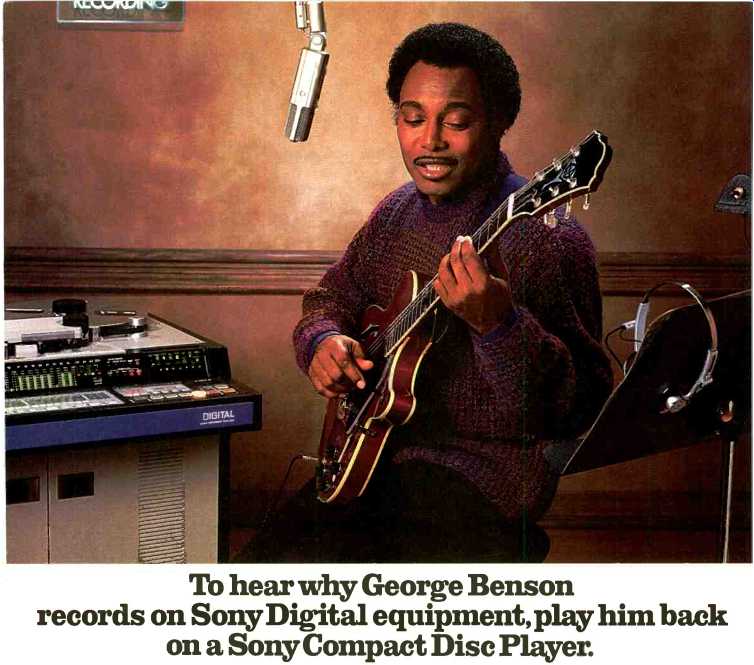
To hear why George Benson records on Sony Digital equipment, play him back on a Sony Compact Disc Player.
When it comes to capturing the experience of live music, no audio equipment delivers the performance of digital audio.
That's why George Benson, creator of Breezin; the best-selling jazz recording in history, has decided to invest in digital equipment.
And the name this leader in jazz/pop fusion chooses, interesting y enough, is the leader in digital audio: Sony Not only has Sony led the way in professional digital recording equipment, we also invented the digital system for playback-the compact disc player. Sony introduced the first home, car and portable CD players. And Sony sells more types of compact disc players than anyone else in the world.
But whichever Sony Compact Disc Player you choose, each allows you to hear the music the way the artist originally intended.
So why not do what George Benson does? Play back the top-selling compact discs the same way they were mastered. On Sony Digital equipment. You'll find that when it comes to bringing you close to the music, nothing else even comes close.
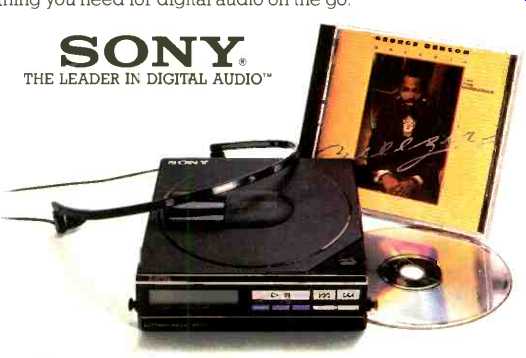
Presenting the Sony Discman;' the world's smallest portable compact disc player.
Hardly larger than the disc itself, the fully programmable Discman D-7DX comes complete with carrying case, headphones and a rechargeable battery. Every thing you need for digital audio on the go.
SONY---THE LEADER IN DIGITAL AUDIO
----------------
AKAI-- FOR LIFE'S GREAT PERFORMANCES
The most beautiful music in the world begins with three simple words: To. Without. And.
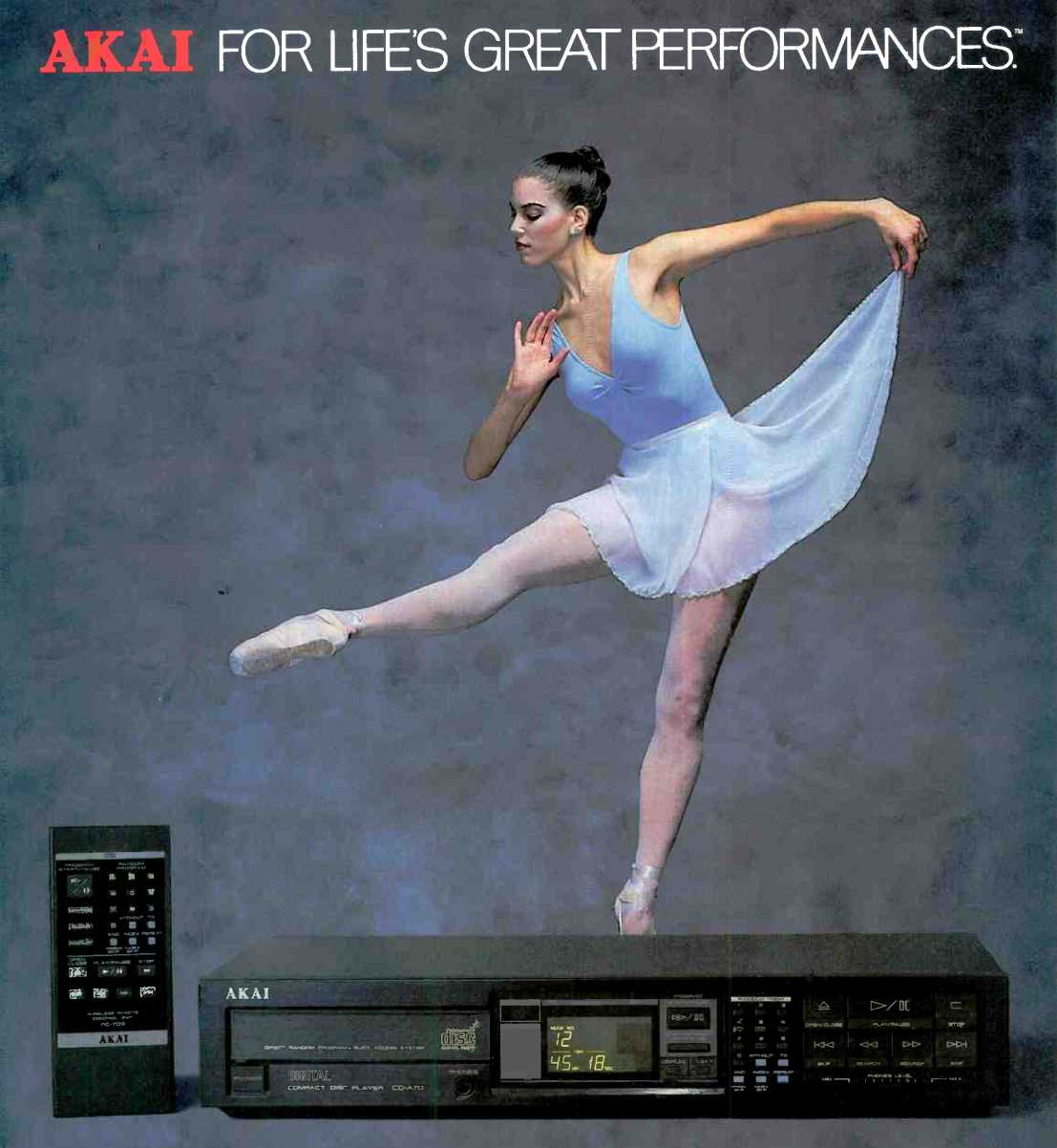
These three simple commands make the new AKAI CD-A70 the most easily programmed CD player you can buy. At any price.
AKAI calls it Natural Logic Operation. And here's how it works.
To hear, for example, tracks 1 thru 9, while skipping 3 and 5, you simply enter the following:
1 To 9 Without 3 And 5.
It's fast, simple and foolproof.
And the full-function wireless remote control lets you manage the CD-A70's talents from a more comfy command center. Like your couch.
Best of all, the performance is flawless. Thanks to an advanced 3-beam laser pick-up. 16-track memory. A Random Play System.
Digital filter. Subcode terminal.
Plus an insulated floating mechanism and special cabinet to eliminate resonance.
The AKAI CD-A70.
Nobody makes great performances easier to enjoy.
Visit your AKAI dealer soon for an audition.
Or write to: AKAI America, P.O. Box 6010, Compton, CA 90224-6010.
---------------
Denon


With new companies entering the Compact Disc market every month, it's not surprising that many people haven't the faintest idea how digital audio was developed. Or by whom.
The theory of digital recording was worked out in the 1920's.
But it took almost 50 years for someone to build the first digital audio recorder good enough for commercial record production. That someone was Denon.
How did it happen to be Denon? Perhaps because Denon is Japan's oldest record company, with a single-minded commitment to recorded music. Or possibly because Denon is Japan's oldest audio company, with a 75-year tradition of advancing the state of the audio art.
In any case, Denon engineers quickly put their digital invention to use releasing the world's first digitally-recorded LP and compiling the world's largest library of digital master tapes.
Soon we were making digital-grade amplifiers, digital-grade recording tape, digital Compact Discs, and CD players regarded by many reviewers as the world's finest.
Consider the DCD 1500 Compact Disc Player. Digital Audio gave it the highest rating of any CD player under $1,000. Not bad, considering it retails for $629.95.
And then there's Denon HD8 cassette tape. Our exclusive "High Technoroum" magnetic coating makes it simply the best Type II tape for recording digital sources. And don't miss Denon's PMA-900V Integrated Preamplifier, with the new Pure Current ewer Supply for prodigious dynamic range.
when it comes to getting the latest and best in high performance digital audio, you have two choices. You can wait for other companies to catch up. Or you can be there first. With Denon.
DENON The first name in digital audio.
-------The first PCM digital audio recorder used in commercial record production, the Denon DN-023R.
Denon's Broadcast Compact Disc Player, the DN-3000F, cues to an accuracy of 13.3 milliseconds.
Denon introduces the finest high-bias cassette far recording digital sources: HD8.
With the highest ranking of any CD player under $1,000, the Denon DCD 1500 lists for only $629.95.
---------------
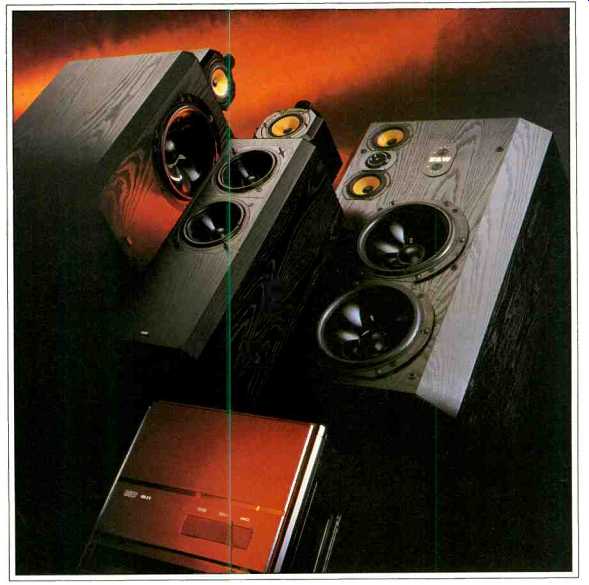
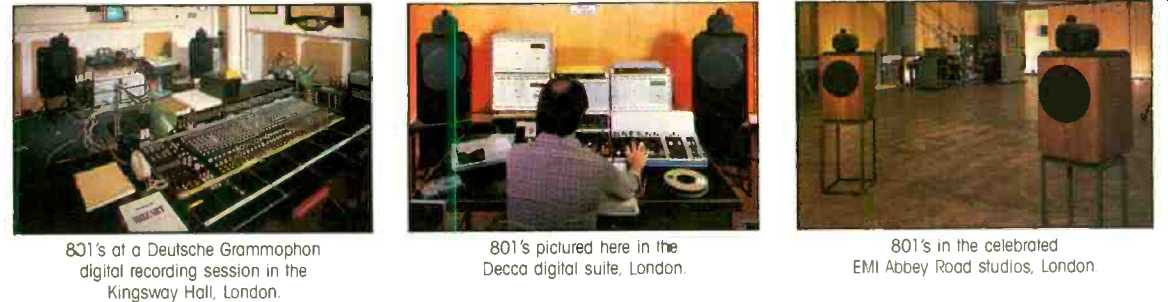
THE 800 SERIES MASTER MONITORS LISTEN AND YOU'LL SEE 831s at a Deutsche Grammophon digital recording session in the Kingsway Hall, London 801's pictured here in the Decca digital suite, London 801's in the celebrated EMI Abbey Rood studios, London Top-of-the-line models 801 F 802F, 808 and the new MPA810 power amplifier: at the fore-front of sound reproduction technology. Used by digital recording studios worldwide and soon, we hope, by you.
B&W CELEBRATES 20 YEARS OF THE QUEST FOR PERFECTION
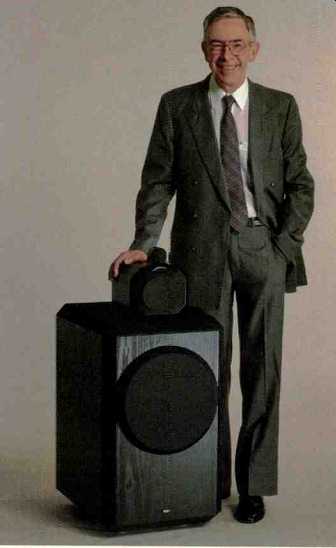
The inspiration behind B&W was, and still is, that of John Bowers--creator, engineer, music--lover and perfectionist. B&W is a personal dream that became an internationally respected company.
Twice the winner of the Queen's Award to industry and designer of numerous award-winning and trend-setting loudspeaker models, B&W still re mains committed to the goal which was the impetus for its founding: the most faithful re-creation of music possible. For while John Bowers and his B&W team enjoy the great respect of the audio industry, they have as many admirers and friends among the world's top professional musicians, conductors and recording engineers. That, perhaps better than any other accolade, attests to the quality of every B&W design.
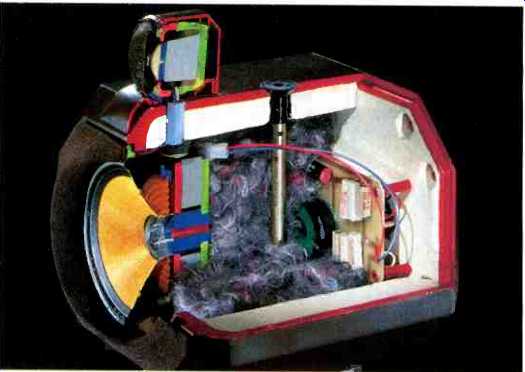
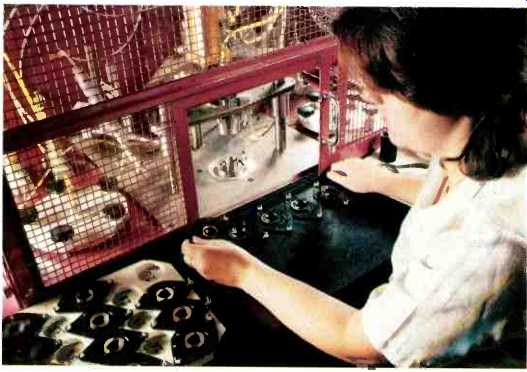
Today the B&W sound quality is legendary, and extends from the professional monitor models 801F and 808 to a range of products to suit virtually every application. The affordable 100-series of Digital Monitors, the Video Acoustical Monitors, Professional Amplifiers, Active loudspeakers and a complete range of Automobile loudspeakers, all reflecting the "Quest for Perfection" which motivated B&W's beginnings 20 years ago.
----"My own critical standards when listening to music have always been exacting, have never expected those of B&W customers to be less so." John Bowers Founder and Managing Director, B&W Loudspeakers
The world's audio press tells the story:
Model P2 (1966) "... for this loudspeaker with its broad and balanced polar response, its linear and extended frequency response is approaching the ideal everyone is seeking--perfection."
John Gilbert, Gramophone (U.K.) Model 801 (1979) "In simplest possible terms, the 801 is among the handful of great loudspeakers available."
High Fidelity (U.S A.) Model DM6 (1975)
"... the overall impression left after many weeks of listening is predominantly one of satisfying, untiring natural sound, without any distracting feature which could be termed a flaw."
Trevor Atwell, Hi-Fi News ( U.K.)
Model 808 (1984) "It is difficult to describe how one gets caught up in the music, how the climaxes of a Mahler symphony, for instance, afford an emotional impact that can truly be described as uplifting... There is no doubt that the B&W 808 is a major achievement in advanced speaker design." Active 1 (1985) Bert Whyte, Audio (U.S.A.) "The John Bowers Active I certainly measured like a fine speaker, and we are happy ;o report that it sounds as good as its measurements imply--beautifully b lanced and uncolored... The bass output from the two 6-inch drivers... compares very well with the output from good 12-inch woofers in cabinets at least twice the size of the Active I."
Julian Hirsch, Stereo Review ( USA)
B&W Hi-Fi Leaves Home... And Takes to the Road
The beginning of this decade saw the logical extension of home hi-fi into the automobile, with sophisticated audiophiles seeking performance standards on a par with those of their high-end domestic systems.
B&W responded to the challenge in 1982 by introducing their LM1 series of Leisure Monitors. =or many LM1 provided for the first time an opportunity to have quality hi-fi in the automobile.
The enthusiasm with which LM1 was received led to the introduction of MASS--B&W's Modular Automobile Sound System--in 1985.
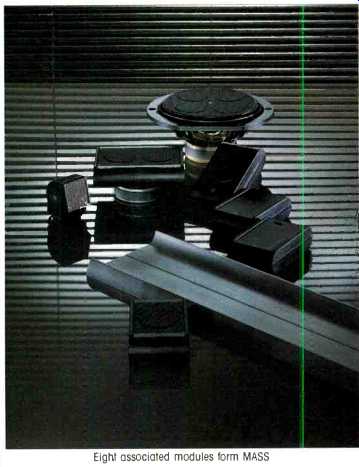
Comprising 8 interlinking modules, MASS combines B&W's world-famous sound quality with system flexibility, high sensitivity and a wide range of installation options.
MASS provides a refined solution to the problems of critical in-car listening, maintaining
The highest performance standards while overcoming installation limitations, off-axis listening positions and adverse climatic conditions. Such refinements as B&W's APOC (Audio Powered Over load Circuit) to protect the drive units and the unique dual-action swivel mount of the LT40 tweeter (based on the famous TXS26 high-frequency driver used in studio monitor 801 F) are just some of the technological advances made with MASS.
- - - - -
The Kevlar Cone
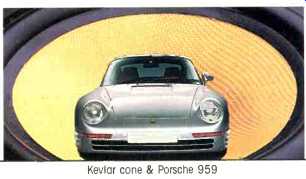
Kevlar--DuPont's aromatic polyamide fibre--is vastly r to conventional loudspeaker materials and particularly o automobile loudspeaker applications. Kevlar's combination of high stiffness and low mass had proved its sonic superiority in use in the all-important midrange driver of the 801 F. Its extremely low mass is particularly critical for automobile application--where high sensitivity is an important criterion given the lower output of most car audio amplifiers.
Easily capable of withstanding temperature extremes arid highly, Kevlar will not be affected by the adverse conditions t in the automobile environment. Initially developed for bullet-proof vests Kevlar is used today for racing cars, yachts, my other high-performance products where the weight-to-strength ratio is critical, such as the Porsche 959 which must be ) example of today's technology ahead of its time.
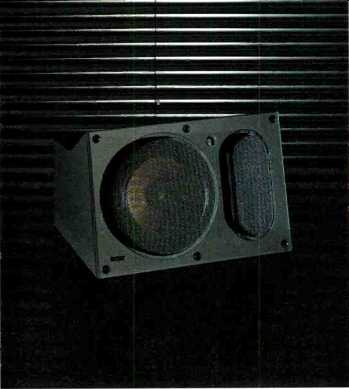
---Eight associated modules form MASS
---Kevlar cone & Porsche 959
Two Decades of Creative Innovation
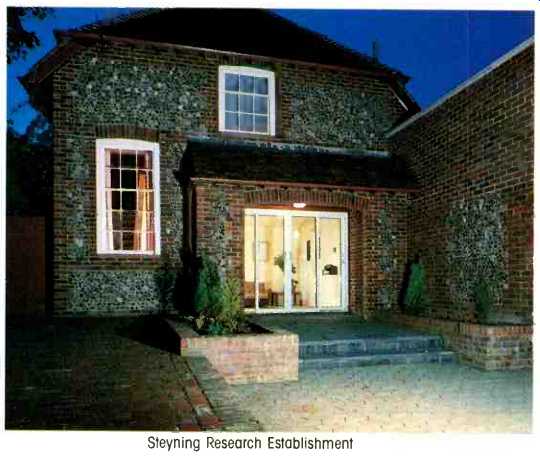
In his heart John Bowers is an engineer and designer, and his engineering creativity has directed B&W's policy from the very beginnings of the Company. This dedication has made B&W one of the most research-oriented companies in the audio industry, and their Steyning Research Establishment is among the most advanced acoustical laboratories in Europe.
Steyning Research Establishment
Although equipped with some of the most modern and sophisticated tools available, it is the Steyning Research Establishments engineering team which is B&W's greatest asset. Their creativity over the last twenty years has pioneered a number of industry milestones:
a calibration certificate included with every production loudspeaker
digital testing for quality control in production
incorporation of electronic overload protection circuits
first to use Kevlar for loudspeaker cone construction
first in Europe with a linear-phase loudspeaker--DM6
first with computer optimisation for crossover design
first to use composite enclosure techniques employing Fibrecrete bonded to structural foam
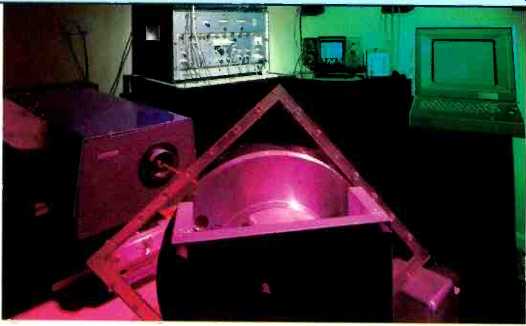
first to employ laser interferometry to study the vibrational behavior of loudspeaker drivers.
... and in 1986...
MATRIX--a significant advance in loudspeaker enclosure technology.
It is a source of considerable pride to everyone at B&W that every model in the range employs only components of B&W's own design and manufacture. All drivers and crossover networks are manufactured at B&W's facilities in Worthing, Sussex, under the most stringent quality control systems Styling has always been recognised as an important feature of B&W loudspeakers and Kenneth Grange of Pentagram Design has consistently created enclosure designs which complement the technical excellence of the loudspeakers.
Dr. Glyn Adams, head of B&W's research department, pioneered a technique for monitoring the vibrational behaviour of loudspeakers using lasers.
The Fibrecrete lining of its midrange head assembly is one of the important reasons for B&W 801F's superior performance.
B&W's automated tweeter assembly.
Technology in the service of music.
MATRIX The Modern Art of Sound
In loudspeaker design, as in other technologies, the frontiers of what can be accomplished are pushed back gradually in an evolutionary process of development. Occasion ally, however, a breakthrough of major proportions is made. B&W MATRIX* is just such a break through.
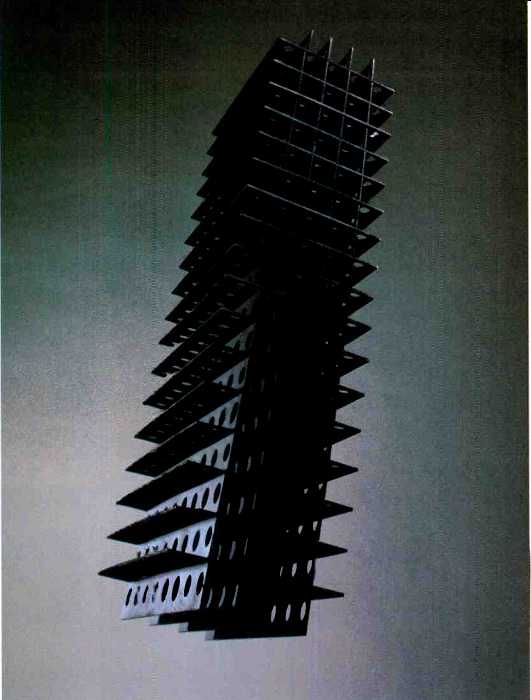
Whilst steady progress has been made in the development of new and better drive units, until recent years little attention has been paid to the actual enclosure housing these drive units. Because of its importance to loudspeaker performance, B&W instigated a research programme on enclosure design three wars ago, embracing a wide range of materials including the so called Aerospace materials, " Sandwich" construction and even concrete. Despite the extravagant claims made for these materials, B&W's research showed that in some respects they were inferior to a conventional enclosure. B&W therefore invented MATRIX.
The MATRIX enclosure comprises an inner honeycomb structure bonded to the outer skin of the cabinet and filled with sound absorbing foam. The enormous stiffening provided by this structure virtually eliminates enclosure radiation at low and mid frequencies, with the additional damping providing a similar effect at high frequencies.
The cellular foam configuration al most completely absorbs rear radiation by the driver.
Of equal importance is the "Time History”--the time required for the sound to decay. MATRIX scores equally well on this count, minimizing "hang-over" inherent in less sophisticated loudspeaker enclosures The B&W MATRIX series of Digital Monitors has been designed 'or the age of the compact disc, with all the additional requirements this source material places on the loudspeaker system: increased dynamic range:
increased transient information and a lower noise floor.
Having designed a near-perfect enclosure B&W developed totally new and improved components to complement their invention. Homo-polymer Polypropylene cones (almost twice as stiff as Copolymer Polypropylene used by other manufacturers), a totally new Ferrofluid cooled tweeter giving 8dB increased dynamic headroom at high frequencies and a crossover network providing a new standard for low distortion and resistive amplifier loading.
B&W have published a complete "Design Story" on the MATRIX series of Digital Monitors, including research results from the three-year design programme. Write to us for your copy, or visit your local author zed B&W dealer.
*B&W MATRIX is a trademark of B&W Loudspeakers Ltd
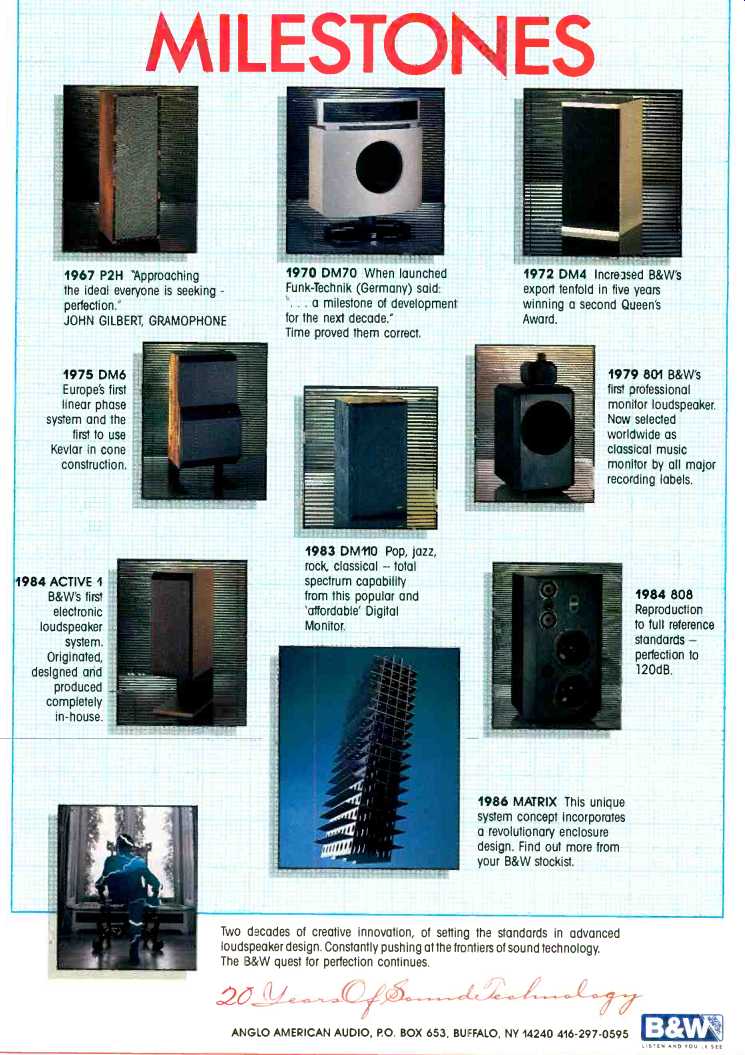
MILESTONES
1967 P2H 'Approaching the ideal everyone is seeking-perfection." JOHN GILBERT, GRAMOPHONE
1975 DM6 Europe's first linear phase system and the first to use Kevlar in cone construction.
1984 ACTIVE 1 B&W's first electronic loudspeaker system.
Originated, designed and produced completely in-house.
1970 DM70 When launched Funk-Technik ( Germany) said:
.. a milestone of development for the next decade." Time proved them correct.
1983 DM110 Pop, jazz, rock, classical-- total spectrum capability from this popular and 'affordable' Digital Monitor.
1972 DM4 Increased B&W's export tenfold in five years winning a second Queen's Award.
1979 801 B&W's first professional monitor loudspeaker.
Now selected worldwide as classical music monitor by all major recording labels.
1986 MATRIX This unique system concept Incorporates a revolutionary enclosure design. Find out more from your B&W stockist.
Two decades of creative innovation, of setting the standards in advanced loudspeaker design. Constantly pushing at the frontiers of sound technology.
The B&W quest for perfection continues.
1984
Reproduction to full reference standards--perfection to 120dB.
ANGLO AMERICAN AUDIO, P.O. BOX 653, BUFFALO, NY 14240 416-297-0595
-------------------
SIGNET
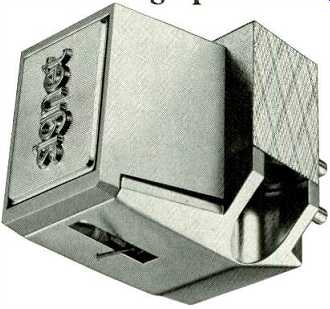

There's simply no other moving coil cartridge quite like it.
MK440m1 Dual Moving Micro-Coil Stereo Phono Cartridge with MicroLine' Stylus Start with the precision Dual Moving Micro-Coils at the heart of the MK440m1. They are wound from Linear Crystal Oxygen-Free Copper (LC-OFC) wire. The result is phase coherency and low distortion impossible with ordinary wire. And an unmatched ability to reproduce transients and the highest frequencies with superb clarity.
The MK440m1 MicroLine stylus is equally outstanding.
Mounted on a tiny beryllium rod, gold plated to reduce resonances. It has the minimum possible scanning radius for perfect tracing, yet an uncommonly long support radius for best tracking. This "contact ridge" maintains its unique shape throughout its useful life. Unlike all other stylus shapes, it exhibits no gradual increase in distortion, record wear, or erosion of frequency response. The Signet MicroLine stylus is indeed the most advanced stylus shape ever created.
The MK440m1 is bench-crafted to remarkable standards of precision and uniformity in the finest Signet tradition. Until you've seen and heard this outstanding component, you can only guess how good your records can sound. At your helpful Signet dealer.
Write or call today for the one nearest you.
4701 Hudson Dr., Stow, OH 44224. (216) 688-9400 9
=========
= = = =